

 |
市場調查報告書
商品編碼
2119342
本地電信合作夥伴和系統整合商分佈圖:市場佔有率分析、產業趨勢和統計數據以及成長預測(2026-2031 年)Local Telecom Partner and System Integrator Mapping - Market Share Analysis, Industry Trends & Statistics, Growth Forecasts (2026 - 2031) |
||||||

※ 本網頁內容可能與最新版本有所差異。詳細情況請與我們聯繫。
據 Mordor Intelligence 稱,本地電信合作夥伴和系統整合商地圖市場預計將從 2025 年的 245.1 億美元成長到 2026 年的 267.5 億美元,到 2031 年達到 413.7 億美元,2026 年至 2031 年的複合年成長率為 9.11%。
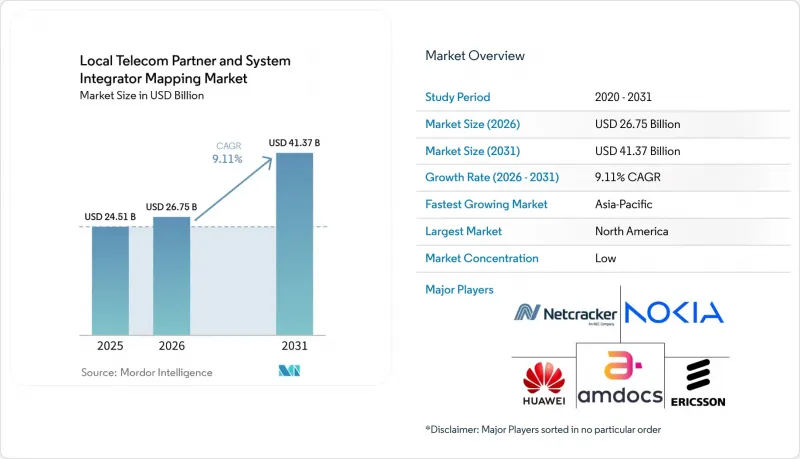
本報告按合作夥伴類型(例如,獨立系統整合商)、服務類型(例如,諮詢和顧問服務)、整合領域(例如,網路整合)、部署模式(例如,雲端、混合)、客戶類型(例如,一級行動網路營運商)和地區進行細分。市場預測以美元計價。
全球本地電信合作夥伴與系統整合商分佈圖:市場趨勢與洞察
5G、開放式無線接取網路和網路現代化計劃
在開放式無線接取網路(Open RAN)中,營運商需要連接來自不同供應商的無線單元、分散式單元、集中式單元和服務管理階層。這種架構使得對了解介面、測試流程和現場部署要求的本地系統整合商的需求日益成長。 2026年2月,Capgemini SA)和德國電信(Deutsche Telekom)共同開發了一個智慧無線接取網路自動化平台,可在開放式無線接取網路和傳統無線接取網路環境中運作。德國電信宣布,正準備在歐洲範圍內推廣該平台,並向全球營運商提供軟體服務。對於本地電信合作夥伴和系統整合商而言,這些平台仍需要在各個營運商環境中進行部署、檢驗和生命週期支持,這創造了市場機會。 2025年10月,沃達豐(Vodafone)選擇三星作為其在德國和其他歐洲國家的虛擬化無線接入網和開放式無線接入網解決方案提供商,其中也包含了系統整合服務,這表明設備供應商正在尋求在部署項目中扮演更重要的角色。
轉型雲端原生開源軟體和業務系統
雲端原生OSS和BSS專案正在將整合工作從一次性實施轉變為持續性活動。電信業者必須在部署模組化應用程式和雲端服務的同時,保持傳統介面的運作。這對能夠連接營運、收費、庫存管理和編配系統而不中斷服務交付的專家產生了持續的需求。由於許多業者無法採用通用於所有系統的單一遷移路徑,因此這項要求有利於本地電信合作夥伴和系統整合商的映射市場。 TM Forum的開放數位架構(ODA)計畫包含Catalyst項目,該項目將於2025年至2026年實施,將利用人工智慧從傳統程式碼中提取邏輯,並將應用程式重新設計為符合ODA標準的元件。這項計劃表明,即使開放介面提供了通用的目標架構,舊有系統的現代化仍然是一項真正的部署挑戰。
舊有系統互通性的局限性
傳統的OSS和BSS系統仍然是重要的限制因素,因為它們的流程和資料結構並非基於模組化、基於API的架構建構。每個連接可能需要單獨的抽象層,以使舊的庫存管理、收費和編配邏輯與新的應用程式保持一致。雖然開放標準可以緩解這種差異,但它們並不能消除資料格式、存取控制或過去自訂方面的差異。 TM Forum的傳統系統現代化舉措表明,業界正在積極探索如何提取和重建符合ODA標準的傳統業務邏輯。在本地通訊合作夥伴和系統整合商的映射市場中,引進週期往往更長,因為團隊必須在引入新功能之前解決這些限制。此外,用於橋接傳統系統的資源可能會延遲雲端原生功能和自動化程序的開發。
細分市場分析
截至2025年,成熟的電信設備供應商在本地電信合作夥伴和系統整合商的網路映射市場中佔據41.23%的佔有率。這一地位反映了其長期穩定的採購關係以及將整合工作融入設備和軟體交付的能力。當電信業者需要成熟的網路支援和可靠的交付資源時,成熟的供應商保持著其主導地位。預計到2031年,新興電信技術供應商的複合年成長率將達到10.34%。這些供應商提供的雲端原生和人工智慧解決方案非常適合新型開放式無線存取網(Open RAN)和專用網路項目,因為這些項目的買家不希望依賴專有技術堆疊。
電信營運商正日益將設備供應競標與軟體和整合服務競標分開,這為擁有靈活工具和快速部署方法的新興供應商創造了更清晰的市場准入機會。當營運商希望在多供應商專案中減少對單一供應商的依賴時,獨立系統整合商將從中受益。同時,隨著雲端基礎設施與網路、OSS 和 BSS 工作負載的整合日益緊密,雲端服務供應商也開始進入同一市場。 Amdocs 公佈的 2025 會計年度營收為 45.3 億美元,反映了大規模OSS 和 BSS 合約通常所需的資源深度。本地電信合作夥伴和系統整合商市場由成熟供應商、獨立整合商和專注於雲端服務的供應商所構成,他們服務於同一轉型專案的不同環節。這些群體之間的平衡是…
到2025年,系統整合和部署將佔本地電信合作夥伴和系統整合商市場規模的36.14%。系統協調在網路升級、雲端部署和新業務推出中仍然至關重要。許多開放式無線接取網路(Open RAN)專案中的多廠商結構增加了每個專案所需的協調工作量。預計到2031年,遷移和現代化服務將以10.46%的複合年成長率成長。這反映出越來越多的電信業者正在將營運支撐系統(OSS)和業務支撐系統(BSS)專案從規劃階段推進到執行階段。
即使大規模轉型專案進入生產階段,託管網路和IT服務的重要性依然凸顯,因為電信營運商在應對持續營運的複雜性和系統維護方面仍需要支援。多廠商開放式無線存取網路(Open RAN)環境需要滿足不斷變化的合規性要求,因此對測試、保障和認證的關注度日益提高。同時,儘管自動化故障解決日益普及,技術支援和生命週期服務仍然至關重要。本地電信合作夥伴和系統整合商的市場定位仍然基於多種服務類型,因為單一活動無法涵蓋整個轉型過程。提供遷移、測試和託管交付服務的供應商即使在初始部署完成後也能繼續參與。這種連續性使客戶能夠在網路和業務系統不斷發展的同時,保持交付方面的專業知識。
區域分析
2025年,北美地區在本地電信合作夥伴和系統整合商的地圖繪製收入佔有率中佔36.49%。該地區受益於一級電信業者的轉型計畫和政策措施,這些措施提升了與國內合作夥伴協作的重要性。 2026年2月,Amdocs和AWS宣佈建立多年合作夥伴關係,以支援利用人工智慧(AI)實現通訊現代化,同時,一項針對北美一級電信服務供應商的大規模計畫正在實施中。此外,美國聯邦通訊委員會(FCC)於2026年4月通過的規則改變了政府和關鍵基礎設施合約的資格審查流程。歐洲地區佔據第二大佔有率,並正朝著與開放式無線接入網(Open RAN)相關的多廠商合作項目邁進,例如諾基亞和愛立信的市場合作以及由五家電信運營商開展的“歐洲邊緣連續體”(European Edge Continuum)試點項目。
預計到2031年,亞太地區將以10.92%的複合年成長率實現最高成長。待開發區5G網路、公共數位基礎設施項目以及雲端原生網路架構正在推動日本、韓國、印度和東南亞地區的需求成長。樂天移動與樂天Symphony於2026年2月在日本完成了符合O-RAN標準的RAN智慧控制器的商用部署,顯示開放式RAN整合已在日本全國進入商用階段。印度的《2024年通訊網路安全法規》強制要求網路保護措施和事件報告,這增加了對具備認證安全能力的合作夥伴的需求。該地區本地電信合作夥伴和系統整合商的市場需求,主要源於在滿足國內安全和營運要求的同時整合新網路的需求。
南美洲、中東和非洲正在形成一個新興的成長層級,其核心是第一代5G部署、光纖網路擴建和政府主導的網路投資。巴西在南美洲引領5G整合進程,電信業者正積極推動5G獨立組網部署,並對營運支撐系統(OSS)和業務支撐系統(BSS)進行現代化改造。阿拉伯聯合大公國和沙烏地阿拉伯正與全球系統整合商合作,進行5G核心網路建置、OSS轉型以及合作夥伴生態系統專案。同時,南非、奈及利亞和埃及正透過4G到5G的過渡和光纖網路擴建來滿足非洲的需求。隨著專案從網路建設轉向持續營運、維護和現代化改造,本地電信合作夥伴和系統整合商的市場需求也將隨之成長。
其他好處:
- Excel格式的市場預測(ME)表
- 3個月的分析師支持
目錄
第1章:引言
- 研究假設和市場定義
- 調查範圍
第2章:調查方法
第3章執行摘要
第4章 市場狀況
- 市場概覽
- 市場促進因素
- 5G、開放式無線接取網路和網路現代化計劃
- 雲端原生OSS與BSS轉型
- 拓展B2B2X和合作夥伴獲利模式
- 對區域交付和監管方面的專業知識的需求日益成長
- 人工智慧驅動的網路自動化與保障
- 電信技術供應商生態系統的分散化
- 市場限制因素
- 舊有系統互通性的限制因素
- 整合計畫工期延長,預算超支。
- 電信業資料安全和主權的要求
- 持證電信整合專家短缺
- 宏觀經濟因素對市場的影響
- 產業價值鏈分析
- 科技趨勢
- 監理情勢
- 波特五力分析
第5章 市場規模與成長預測
- 依合作夥伴類型
- 獨立系統整合商
- 現有通訊設備供應商
- 挑戰者電信技術供應商
- 雲端服務供應商
- 其他合作夥伴類型
- 按服務類型
- 諮詢和顧問服務
- 網路設計與規劃
- 系統整合與部署
- 轉型與現代化服務
- 測試、保證、認證
- 託管網路和IT服務
- 技術支援和生命週期服務
- 按領域整合
- 網路整合
- 營運支援系統的整合
- 業務支援系統的整合
- 雲端和資料中心整合
- 應用程式和 API 整合
- 安全和身份整合
- 合作夥伴生態系統和支付整合
- 按部署模式
- 雲
- 混合
- 現場
- 依客戶類型
- 一級行動網路營運商
- 二線和三線行動網路營運商
- 固定寬頻服務供應商
- 有線電視營運商和融合營運商
- 行動虛擬網路營運商 (MVNO) 和行動虛擬網路工程師 (MVNE)
- 網際服務供應商
- 企業和政府機構
- 按地區
- 北美洲
- 美國
- 加拿大
- 墨西哥
- 南美洲
- 巴西
- 阿根廷
- 智利
- 其他南美國家
- 歐洲
- 德國
- 英國
- 法國
- 義大利
- 西班牙
- 其他歐洲國家
- 亞太地區
- 中國
- 日本
- 印度
- 韓國
- 澳洲
- 其他亞太國家
- 中東
- 阿拉伯聯合大公國
- 沙烏地阿拉伯
- 卡達
- 其他中東國家
- 非洲
- 南非
- 埃及
- 奈及利亞
- 其他非洲國家
- 北美洲
第6章 競爭情勢
- 市場集中度
- 策略趨勢
- 市佔率分析
- 公司簡介
- Amdocs Limited
- Netcracker Technology Corporation
- Telefonaktiebolaget LM Ericsson
- Nokia Corporation
- Huawei Technologies Co., Ltd.
- ZTE Corporation
- Ciena Corporation
- Mavenir Systems, Inc.
- Cerillion plc
- Tecnotree Oyj
- Subex Limited
- Optiva Inc.
- Ribbon Communications Inc.
- Aviat Networks, Inc.
- Comtech Telecommunications Corp.
- Radisys Corporation
- Harmonic Inc.
- Parallel Wireless, Inc.
- JSC Ingenium
- Hansen Technologies Limited
- MATRIXX Software, Inc.
- Qvantel Oy
第7章 市場機會與未來展望
According to Mordor Intelligence, the local telecom partner and system integrator mapping market size is expected to increase from USD 24.51 billion in 2025 to USD 26.75 billion in 2026 and reach USD 41.37 billion by 2031, growing at a CAGR of 9.11% over 2026-2031.
This report is Segmented by Partner Type (Independent System Integrators, and More), Service Type (Consulting and Advisory Services, and More), Integration Domain (Network Integration, and More), Deployment Model (Cloud, Hybrid, and More), Customer Type (Tier-1 Mobile Network Operators, and More), and Geography. The Market Forecasts are Provided in Terms of Value (USD).
Global Local Telecom Partner and System Integrator Mapping Market Trends and Insights
5G, Open RAN, and Network Modernization Programs
Open RAN requires operators to connect radio units, distributed units, centralized units, and service management layers from different suppliers. This structure increases the need for local system integrators who understand interfaces, testing procedures, and field deployment requirements. In February 2026, Capgemini and Deutsche Telekom developed an intelligent RAN automation platform that operates across O-RAN and legacy RAN environments. Deutsche Telekom said it was preparing the platform for use across its European footprint and as a software service for operators worldwide. The Local telecom partner and system integrator mapping market benefits because these platforms still require deployment, validation, and lifecycle support in individual operator environments. Samsung's selection by Vodafone in October 2025 to provide virtualized RAN and Open RAN solutions in Germany and other European countries also included system integration services, showing that equipment suppliers are pursuing a larger role in delivery programs.
Cloud-Native OSS and BSS Transformation
Cloud-native OSS and BSS programs change integration work from a one-time implementation into an ongoing activity. Operators must keep legacy interfaces running while introducing modular applications and cloud-based services. This creates a continuing need for specialists who can connect operational, billing, inventory, and orchestration systems without disrupting service delivery. The Local telecom partner and system integrator mapping market gains from this requirement because many operators cannot use a single migration path across all systems. TM Forum's Open Digital Architecture work includes a 2025 to 2026 catalyst project that applies artificial intelligence to extract logic from legacy code and redesign applications into ODA-compliant components. This work indicates that legacy modernization remains a practical delivery issue, even where open interfaces provide a common target architecture.
Legacy-System Interoperability Constraints
Legacy OSS and BSS systems remain a major constraint because their processes and data structures were not built for modular, API-based architectures. Each connection may require a separate abstraction layer to align old inventory, billing, and orchestration logic with newer applications. Open standards can reduce variation, but they do not remove differences in data formats, access controls, or historic customizations. TM Forum's legacy modernization catalyst shows that the sector is actively seeking ways to extract and restructure legacy business logic for ODA-compliant environments. The Local telecom partner and system integrator mapping market faces longer delivery cycles when teams must resolve these constraints before new capabilities can be introduced. Capacity used for bridging old systems may also delay work on cloud-native functions and automation programs.
Other drivers and restraints analyzed in the detailed report include:
- Expansion of B2B2X and Partner Monetization Models
- Rising Demand for Local Delivery and Regulatory Expertise
- Prolonged Integration Timelines and Budget Overruns
For complete list of drivers and restraints, kindly check the Table Of Contents.
Segment Analysis
Incumbent telecom equipment vendors held 41.23% of the Local telecom partner and system integrator mapping market share in 2025. Their position reflects long procurement relationships and their ability to package integration work with equipment and software deliveries. Incumbents retain an advantage where operators require established network support and proven delivery resources. Challenger telecom technology vendors are projected to grow at a 10.34% CAGR through 2031. Their cloud-native and artificial intelligence-focused offerings suit new Open RAN and private network programs where buyers do not want to rely on a proprietary stack.
Operators are increasingly separating tenders for equipment supply from tenders for software and integration delivery, creating a clearer opening for challengers with flexible tools and faster implementation methods. Independent system integrators benefit when operators want to limit dependence on a single supplier across multi-vendor programs, while cloud service providers enter the same space as cloud infrastructure becomes more closely integrated with network, OSS, and BSS workloads. Amdocs reported fiscal 2025 revenue of USD 4.53 billion, reflecting the resource depth typically required in large OSS and BSS contracts. The Local telecom partner and system integrator mapping market is shaped by established vendors, independent integrators, and cloud-focused providers that address different parts of the same transformation program. The balance between these groups depends on whether
Systems integration and implementation accounted for 36.14% of the Local telecom partner and system integrator mapping market size in 2025. Connecting systems remains necessary across network upgrades, cloud adoption, and new service launches. The multi-vendor structure of many Open RAN programs increases the coordination required for each project. Migration and modernization services are forecast to grow at a CAGR of 10.46% through 2031. This reflects the number of operators moving OSS and BSS programs from planning to execution.
Managed network and IT services become more relevant after major transformation projects reach production, as operators still need help managing ongoing operational complexity and system maintenance. Testing, assurance, and certification receive greater attention because multi-vendor Open RAN environments must meet evolving conformance requirements, while technical support and lifecycle services remain necessary despite the wider adoption of automated fault resolution. The Local telecom partner and system integrator mapping market continues to rely on a broad range of service types because no single activity can cover the full transformation process. Providers that combine migration, testing, and managed delivery can stay involved after the initial implementation is complete. This continuity gives customers a way to retain delivery knowledge as network and business systems continue to change.
Complete Report Scope:
- By Partner Type
- Independent System Integrators
- Incumbent Telecom Equipment Vendors
- Challenger Telecom Technology Vendors
- Cloud Service Providers
- Other Partner Types
- By Service Type
- Consulting and Advisory Services
- Network Design and Planning
- Systems Integration and Implementation
- Migration and Modernization Services
- Testing, Assurance, and Certification
- Managed Network and IT Services
- Technical Support and Lifecycle Services
- By Integration Domain
- Network Integration
- Operations Support Systems Integration
- Business Support Systems Integration
- Cloud and Data Center Integration
- Application and API Integration
- Security and Identity Integration
- Partner Ecosystem and Settlement Integration
- By Deployment Model
- Cloud
- Hybrid
- On-Premises
- By Customer Type
- Tier-1 Mobile Network Operators
- Tier-2 and Tier-3 Mobile Network Operators
- Fixed Broadband Operators
- Cable and Converged Operators
- MVNOs and MVNEs
- Internet Service Providers
- Enterprises and Government Agencies
- By Geography
- North America
- United States
- Canada
- Mexico
- South America
- Brazil
- Argentina
- Chile
- Rest of South America
- Europe
- Germany
- United Kingdom
- France
- Italy
- Spain
- Rest of Europe
- Asia-Pacific
- China
- Japan
- India
- South Korea
- Australia
- Rest of Asia-Pacific
- Middle East
- United Arab Emirates
- Saudi Arabia
- Qatar
- Rest of Middle East
- Africa
- South Africa
- Egypt
- Nigeria
- Rest of Africa
- North America
Geography Analysis
North America held 36.49% of the Local telecom partner and system integrator mapping revenue share in 2025. The region benefits from Tier-1 transformation programs and policy measures that increase the importance of domestic partner engagement. Amdocs and AWS announced a multi-year collaboration in February 2026 to support artificial intelligence-driven telecom modernization, with a large-scale program underway at a North American Tier-1 communications service provider. The FCC rules adopted in April 2026 also change qualification processes for government and critical infrastructure contracts. Europe holds the second-largest regional position and is shifting toward multi-vendor programs linked to Open RAN, including Nokia and Ericsson marketplace cooperation and the European Edge Continuum demonstration by 5 operators.
Asia-Pacific is projected to record the fastest CAGR of 10.92% through 2031. Greenfield 5G investment, public digital infrastructure programs, and cloud-native network architecture support demand across Japan, South Korea, India, and Southeast Asia. Rakuten Mobile and Rakuten Symphony completed a national commercial rollout of O-RAN-compliant RAN Intelligent Controllers in Japan in February 2026, demonstrating that Open RAN integration has entered commercial production at a national scale. India's Telecom Cyber Security Rules, 2024, require network protection measures and incident reporting, increasing the need for partners with certified security capabilities. The Local telecom partner and system integrator mapping market in the region is supported by the need to integrate new networks while meeting domestic security and operating requirements.
South America, the Middle East, and Africa form an emerging growth tier centered on first-generation 5G deployment, fiber expansion, and sovereign network investment. Brazil leads South American integration efforts as operators advance 5G standalone deployments and modernize OSS and BSS. The United Arab Emirates and Saudi Arabia are working with global system integrators for 5G core, OSS transformation, and partner ecosystem programs, while South Africa, Nigeria, and Egypt are supporting African demand through 4G-to-5G migration and fiber expansion. The Local telecom partner and system integrator mapping market can benefit as projects move from network construction into recurring operation, assurance, and modernization work.
- Amdocs Limited
- Netcracker Technology Corporation
- Telefonaktiebolaget LM Ericsson
- Nokia Corporation
- Huawei Technologies Co., Ltd.
- ZTE Corporation
- Ciena Corporation
- Mavenir Systems, Inc.
- Cerillion plc
- Tecnotree Oyj
- Subex Limited
- Optiva Inc.
- Ribbon Communications Inc.
- Aviat Networks, Inc.
- Comtech Telecommunications Corp.
- Radisys Corporation
- Harmonic Inc.
- Parallel Wireless, Inc.
- JSC Ingenium
- Hansen Technologies Limited
- MATRIXX Software, Inc.
- Qvantel Oy
Additional Benefits:
- The market estimate (ME) sheet in Excel format
- 3 months of analyst support
TABLE OF CONTENTS
1 INTRODUCTION
- 1.1 Study Assumptions and Market Definition
- 1.2 Scope of the Study
2 RESEARCH METHODOLOGY
3 EXECUTIVE SUMMARY
4 MARKET LANDSCAPE
- 4.1 Market Overview
- 4.2 Market Drivers
- 4.2.1 5G, Open RAN, and Network Modernization Programs
- 4.2.2 Cloud-Native OSS and BSS Transformation
- 4.2.3 Expansion of B2B2X and Partner Monetization Models
- 4.2.4 Rising Demand for Local Delivery and Regulatory Expertise
- 4.2.5 AI-Based Network Automation and Assurance
- 4.2.6 Fragmentation of Telecom Technology Vendor Ecosystems
- 4.3 Market Restraints
- 4.3.1 Legacy-System Interoperability Constraints
- 4.3.2 Prolonged Integration Timelines and Budget Overruns
- 4.3.3 Telecom Data-Security and Sovereignty Requirements
- 4.3.4 Shortage of Certified Telecom Integration Specialists
- 4.4 Impact of Macroeconomic Factors on the Market
- 4.5 Industry Value-Chain Analysis
- 4.6 Technology Outlook
- 4.7 Regulatory Landscape
- 4.8 Porter's Five Forces Analysis
- 4.8.1 Threat of New Entrants
- 4.8.2 Bargaining Power of Suppliers
- 4.8.3 Bargaining Power of Buyers
- 4.8.4 Threat of Substitutes
- 4.8.5 Intensity of Competitive Rivalry
5 MARKET SIZE AND GROWTH FORECASTS (VALUE)
- 5.1 By Partner Type
- 5.1.1 Independent System Integrators
- 5.1.2 Incumbent Telecom Equipment Vendors
- 5.1.3 Challenger Telecom Technology Vendors
- 5.1.4 Cloud Service Providers
- 5.1.5 Other Partner Types
- 5.2 By Service Type
- 5.2.1 Consulting and Advisory Services
- 5.2.2 Network Design and Planning
- 5.2.3 Systems Integration and Implementation
- 5.2.4 Migration and Modernization Services
- 5.2.5 Testing, Assurance, and Certification
- 5.2.6 Managed Network and IT Services
- 5.2.7 Technical Support and Lifecycle Services
- 5.3 By Integration Domain
- 5.3.1 Network Integration
- 5.3.2 Operations Support Systems Integration
- 5.3.3 Business Support Systems Integration
- 5.3.4 Cloud and Data Center Integration
- 5.3.5 Application and API Integration
- 5.3.6 Security and Identity Integration
- 5.3.7 Partner Ecosystem and Settlement Integration
- 5.4 By Deployment Model
- 5.4.1 Cloud
- 5.4.2 Hybrid
- 5.4.3 On-Premises
- 5.5 By Customer Type
- 5.5.1 Tier-1 Mobile Network Operators
- 5.5.2 Tier-2 and Tier-3 Mobile Network Operators
- 5.5.3 Fixed Broadband Operators
- 5.5.4 Cable and Converged Operators
- 5.5.5 MVNOs and MVNEs
- 5.5.6 Internet Service Providers
- 5.5.7 Enterprises and Government Agencies
- 5.6 By Geography
- 5.6.1 North America
- 5.6.1.1 United States
- 5.6.1.2 Canada
- 5.6.1.3 Mexico
- 5.6.2 South America
- 5.6.2.1 Brazil
- 5.6.2.2 Argentina
- 5.6.2.3 Chile
- 5.6.2.4 Rest of South America
- 5.6.3 Europe
- 5.6.3.1 Germany
- 5.6.3.2 United Kingdom
- 5.6.3.3 France
- 5.6.3.4 Italy
- 5.6.3.5 Spain
- 5.6.3.6 Rest of Europe
- 5.6.4 Asia-Pacific
- 5.6.4.1 China
- 5.6.4.2 Japan
- 5.6.4.3 India
- 5.6.4.4 South Korea
- 5.6.4.5 Australia
- 5.6.4.6 Rest of Asia-Pacific
- 5.6.5 Middle East
- 5.6.5.1 United Arab Emirates
- 5.6.5.2 Saudi Arabia
- 5.6.5.3 Qatar
- 5.6.5.4 Rest of Middle East
- 5.6.6 Africa
- 5.6.6.1 South Africa
- 5.6.6.2 Egypt
- 5.6.6.3 Nigeria
- 5.6.6.4 Rest of Africa
- 5.6.1 North America
6 COMPETITIVE LANDSCAPE
- 6.1 Market Concentration
- 6.2 Strategic Moves
- 6.3 Market Share Analysis
- 6.4 Company Profiles (includes Global Level Overview, Market Level Overview, Core Segments, Financials as available, Strategic Information, Market Rank/Share, Products and Services, Recent Developments)
- 6.4.1 Amdocs Limited
- 6.4.2 Netcracker Technology Corporation
- 6.4.3 Telefonaktiebolaget LM Ericsson
- 6.4.4 Nokia Corporation
- 6.4.5 Huawei Technologies Co., Ltd.
- 6.4.6 ZTE Corporation
- 6.4.7 Ciena Corporation
- 6.4.8 Mavenir Systems, Inc.
- 6.4.9 Cerillion plc
- 6.4.10 Tecnotree Oyj
- 6.4.11 Subex Limited
- 6.4.12 Optiva Inc.
- 6.4.13 Ribbon Communications Inc.
- 6.4.14 Aviat Networks, Inc.
- 6.4.15 Comtech Telecommunications Corp.
- 6.4.16 Radisys Corporation
- 6.4.17 Harmonic Inc.
- 6.4.18 Parallel Wireless, Inc.
- 6.4.19 JSC Ingenium
- 6.4.20 Hansen Technologies Limited
- 6.4.21 MATRIXX Software, Inc.
- 6.4.22 Qvantel Oy
7 MARKET OPPORTUNITIES AND FUTURE OUTLOOK
- 7.1 White-Space and Unmet-Need Assessment

 系統整合服務市場-2026-2032年全球市場預測
 2026年全球工業自動化系統整合商市場報告SAP S4 系統整合商服務全球市場報告(2026 年)2026年全球系統整合商市場報告
 工業自動化系統整合商市場規模、佔有率和成長分析(按系統整合商類型、服務、專業領域、公司規模、產業和地區分類)-2026年至2033年產業預測
 系統整合商市場分析及預測(至2035年):按類型、產品、服務、技術、組件、應用、流程、部署、最終用戶及解決方案分類
 系統整合商市場規模、佔有率和成長分析(按產品、技術、最終用戶產業和地區分類)-2026-2033年產業預測
 2032 年工業自動化系統整合商市場預測:按服務類型、組件、技術、應用、最終用戶和地區進行的全球分析
 全球工業自動化系統整合商市場規模(按服務、產業、地區和預測):
 系統整合商市場規模、佔有率、趨勢分析報告:按類型、公司規模、產業、地區和細分市場預測,2024-2030 年