


 |
市場調查報告書
商品編碼
2124319
系統整合商:市場佔有率分析、產業趨勢與統計資料、成長預測(2026-2031 年)System Integrators - Market Share Analysis, Industry Trends & Statistics, Growth Forecasts (2026 - 2031) |
||||||

※ 本網頁內容可能與最新版本有所差異。詳細情況請與我們聯繫。
據 Mordor Intelligence 稱,2025 年系統整合商市值為 468.8 億美元,預計到 2031 年將達到 637.3 億美元,而 2026 年為 494.1 億美元,預測期內(2026-2031 年)的複合年成長率預計為 5.22%。
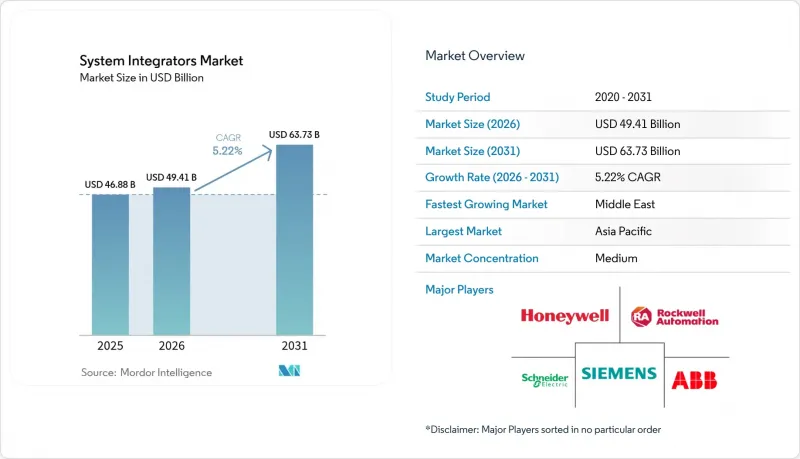
本報告按服務類型(硬體整合、其他)、技術(整合製程控制、製造執行系統、其他)、公司規模(大型企業、中小企業)、最終用戶產業(石油天然氣、汽車和電動車製造、航太和國防、其他)以及地區進行細分。市場預測以美元計價。
全球系統整合商市場趨勢與洞察
承包OT-IT整合專案的需求
企業正在尋找能夠將可程式邏輯控制器 (PLC)、歷史資料庫、製造執行系統 (MES) 和企業資源計劃 (ERP) 軟體整合到統一架構中的單一、負責的合作夥伴。到 2025 年,西門子交付超過 1200 個此類項目,其中 68% 將採用基於雲端的數位孿生技術,使營運商能夠在正式上線前模擬流程變更。歐姆龍和埃森哲已達成戰略合作夥伴關係,目標是到 2027 年實現 3 億美元的年收入,這凸顯了硬體供應商與 IT 整合商合作以共享專業知識的趨勢。隨著符合 ISA-95 資料模型和 IEC 62443 安全控制等標準化介面的普及,供應商鎖定效應降低,這種趨勢正在加速發展。隨著系統整合商市場的演變,承包解決方案正成為標準合約模式,使資產所有者能夠將專案完成風險轉移給專業公司。對參考架構和認證要求有深入了解的整合商將獲得更大的定價權,並能夠建立牢固的長期合作關係。
加速可再生能源資產數位化
風力發電廠、太陽能發電廠和電池儲能設施正在部署多層監控、控制和數據採集 (SCADA) 系統以及狀態監控技術,以最大限度地提高能源產量並延長組件壽命。 Naturgy 公司在 2025 年為其整個歐洲可再生能源專案組合部署了整合監控平台後,營運和維護成本降低了 18%。國際能源總署 (IEA) 預測,到 2030 年,全球可再生能源裝置容量將每年增加 500 吉瓦以上,這將迫使系統整合商整合來自渦輪機、逆變器和電網平衡演算法的數據。邊緣閘道器現在運作機器學習模型,在電網擁塞期間自主調節輸出,從而在穩定頻率的同時確保效益。因此,系統整合商市場的商業機會取決於其能否提供網路安全可靠、符合標準的解決方案,以滿足公用事業公司和原始設備製造商 (OEM) 的保障要求以及監管報告要求。鼓勵高可用性和參與電網服務的區域性措施將進一步擴大計畫儲備。
該項目存在較高的範圍蔓延風險。
未記錄的遺留資產、專案後期才提出的網路安全要求以及不斷變化的監管清單,常常導致整合範圍擴大。麥肯錫2025年的一項調查發現,由於這些擴展,47%的自動化專案預算超支超過20%。對於利潤微薄的整合商而言,預算超支不僅會危及盈利,還會因交付延遲而損害客戶信任。為了減輕對系統整合商市場的負面影響,企業現在會進行付費研究階段,包括雷射掃描、網路拓撲映射和數位孿生檢驗,以便在最終確定成本之前明確需求。對變更指令進行嚴格控制的固定價格合約也變得越來越普遍,將部分波動風險轉移給了資產所有者。雖然這些措施可以緩解財務波動,但由於雙方需要協商詳細的責任分類,因此可能會延長銷售週期。
細分市場分析
預計2026年至2031年間,硬體整合將以5.27%的複合年成長率成長,並在2025年佔據系統整合商市場收入的40.83%,從而取代先前佔據主導地位的軟體和數位整合。這一轉變反映了待開發區可再生能源發電電廠的激增、中東地區石化工廠的擴張以及電池超級工廠的建設。所有這些都需要實體控制面板、現場儀器、配電盤和強大的工業網路骨幹網,才能使軟體疊加層正常運作。整合商透過交付工廠認可的預接線面板來確保客戶信任,從而縮短試運行時間並最大限度地減少返工。由於工廠現場人員短缺,諮詢和培訓仍然是穩定的收入來源。因此,整合商正在將技能發展模組和持續的網路安全修補程式納入託管服務合約中,以確保運作。根據基於績效的服務等級協定 (SLA),售後服務和維護可提供高利潤率,因為補償與避免停機時間掛鉤,從而在整合商的獎勵和客戶的生產目標之間建立一致性。
模組化自動化的轉型也正在重塑這一領域。艾默生的網路可配置撬裝系統可在 12 週內交付,充分展現了標準化如何提升速度。生命科學領域的客戶重視一次性反應器的快速切換,而食品飲料公司則青睞高度可擴展的撬裝系統,這些系統在淡季運作時不會佔用大量資金。隨著這些趨勢的蔓延,系統整合商市場將看到硬體整合團隊與軟體工程師更緊密地合作,以交付整合軟體包。這確保了從實體安裝到虛擬試運行的線性工作流程被簡化為更短的關鍵路徑。能夠根據製程儀器圖自動產生電路圖的工具進一步減少了工程工作量,使資源能夠分配到高利潤的最佳化服務中。
2025年,整合製程控制(可程式邏輯控制器、分散式控制系統、監控和控制資料擷取)將佔系統整合商市場的36.71%,但隨著棕地工廠尋求最大限度地延長其硬體的使用壽命,該領域正趨於成熟。相較之下,工業IoT(IIoT)和邊緣平台預計將以5.31%的複合年成長率成長至2031年,這主要得益於相關人員對亞秒級即時異常檢測和品質預測的需求。邊緣節點可以降低延遲,減少向雲端發送資料的成本,並滿足禁止跨境傳輸敏感遙測資料的資料主權法規要求。製造執行系統(MES)正在離散製造業,尤其是在汽車和航太產業,正得到越來越廣泛的應用。這些行業需要對所有工單進行精細化的協調,因為需要序列化的歷史管理並符合ISO標準。機器人和機器視覺的融合正在從汽車噴漆車間擴展到電子商務倉庫,自主機器人和視覺引導揀選系統正在推動全天候的履約。
隨著IEC 62443標準的強制實施,網路安全解決方案已成為一項必備條件。橫河電機透露,其2025年89%的合約將包含專門的安全評估。這一比例較兩年前的34%顯著成長,表明安全不再是附加選項,而是標準業務範圍的一部分。隨著技術範圍的不斷擴大,系統整合商市場需要能夠理解即時確定性控制、基於Kubernetes的微服務和零信任網路架構的多領域團隊。那些能夠創建包含預先檢驗加密和身分管理的參考設計(涵蓋從感測器到雲端的資料路徑)的供應商,透過加速部署和降低身分驗證門檻,正在獲得更大的市場佔有率。
區域分析
到2025年,亞太地區將佔系統整合商市場收入的33.53%。這反映了中國龐大的部署基礎、印度與生產連結獎勵計畫計劃,以及東南亞作為多元化供應鏈樞紐對韌性的需求。電子、製藥和汽車組裝的持續工廠升級推動了硬體維修和邊緣分析實施相結合的項目,而各國數據主權法規也對國內工程資源產生了穩定的需求。系統整合商透過建立本地夥伴關係並聘用精通普通話和印地語的專案經理,不斷縮短試運行週期,並與要求技術轉移文件齊全的當地監管機構建立信任。隨著5G專網在韓國、日本和新加坡的部署加速,對超低延遲控制迴路的需求不斷成長,從而擴大了離散製造和物流領域的系統整合商市場規模。
北美仍然是一個重要的市場。這是因為製造業回流推動了電動車電池和半導體製造廠等超級工廠的建設,這些工廠需要符合IEC 62443和NIST框架下的端到端網路安全合規性要求。石油、天然氣和化學工業的棕地現代化改造也創造了更多商機,因為老化的控制網路正在向軟體定義架構轉型。聯邦政府鼓勵節能生產的稅收優惠政策為預測性維護維修提供了資金籌措,鼓勵系統整合商將邊緣閘道器、歷史資料庫升級和數位孿生技術整合到單一專案中。儘管2026年的資本預算仍然較為謹慎,但多年期主服務合約為系統整合商提供了收入前景,並使他們即使在大型企劃啟動間隙也能保持專業技術水準。這些趨勢使系統整合商市場前景保持穩定,即使大宗商品價格大幅波動。
中東是成長最快的地區,預計到2031年複合年成長率將達到5.24%。這主要得益於沙烏地阿拉伯公共投資基金(PIF)對NEOM智慧城市基礎設施的撥款,以及阿拉伯聯合大公國的「3000億行動」製造業計畫。政府對在地採購比例的強制性規定要求系統整合商在利雅德、阿布達比和Muscat設立工程中心,通常是透過與當地領先企業成立合資企業來實現。除了朱拜勒和魯瓦伊斯的待開發區石化聯合企業外,商業規模的太陽能發電廠和氫氣生產廠也需要整合控制室、安全儀器系統和即時資產性能儀表板,這使得系統整合商市場的範圍擴展到了流程和電力領域。在歐洲,成長穩定但成長放緩,尤其是在德國、法國和北歐國家,因為碳排放邊境調節機制促使製造商實現能源透明度的數位轉型。南美洲和非洲是規模較小但具有重要戰略意義的市場,在巴西、奈及利亞和南非,採礦和食品加工專案紛紛湧向系統整合商,這些整合商能夠透過模組化自動化撬裝設備和遠端監控軟體包來彌補基礎設施的不足。
其他好處
- Excel格式的市場預測(ME)表
- 3個月的分析師支持
目錄
第1章:引言
- 研究假設和市場定義
- 調查範圍
第2章:調查方法
第3章執行摘要
第4章 市場狀況
- 市場概覽
- 市場促進因素
- 承包OT-IT整合專案的需求
- 加速可再生能源資產數位化
- 利用5G進行邊緣運算的應用案例
- 監管機構正努力透過網路安全措施來維修SCADA系統。
- 模組化自動化的廣泛應用
- 製造工廠自動化人員短缺
- 市場限制因素
- 該項目存在較高的範圍蔓延風險。
- 資本財採購延誤
- 去中心化的供應商生態系統
- 安全關鍵型工廠面臨重大責任風險
- 價值鏈分析
- 監理情勢
- 宏觀經濟因素對市場的影響
- 波特五力分析
第5章 市場規模與成長預測
- 按服務類型
- 硬體整合
- 軟體和每月整合
- 諮詢和培訓
- 售後服務及維護
- 透過技術
- 整合製程控制(PLC、DCS、SCADA)
- 製造執行系統(MES)
- 機器人與機器視覺
- 工業物聯網邊緣平台
- 網路安全解決方案
- 按公司規模
- 大公司
- 中小企業
- 按最終用戶行業分類
- 石油和天然氣
- 汽車/電動車製造
- 航太/國防
- 醫療保健和生命科學
- 能源和發電
- 化工/石油化工
- 飲食
- 其他
- 按地區
- 北美洲
- 美國
- 加拿大
- 墨西哥
- 南美洲
- 巴西
- 阿根廷
- 其他南美國家
- 歐洲
- 德國
- 英國
- 法國
- 義大利
- 西班牙
- 其他歐洲國家
- 亞太地區
- 中國
- 日本
- 印度
- 韓國
- ASEAN
- 其他亞太國家
- 中東
- 沙烏地阿拉伯
- 阿拉伯聯合大公國
- 其他中東國家
- 非洲
- 南非
- 奈及利亞
- 埃及
- 其他非洲地區
- 北美洲
第6章 競爭情勢
- 市場集中度
- 策略趨勢
- 市佔率分析
- 公司簡介
- ABB Ltd.
- Siemens AG
- Rockwell Automation, Inc.
- Schneider Electric SE
- Honeywell International Inc.
- Emerson Electric Co.
- Yokogawa Electric Corporation
- John Wood Group PLC
- TESCO CONTROLS, Inc.
- STADLER+SCHAAF Mess-und Regeltechnik GmbH
- Prime Controls, LP
- MAVERICK Technologies, LLC
- Adsyst Automation Ltd.
- George T. Hall Company
- Avanceon Ltd.
- Wunderlich-Malec Engineering, Inc.
- Burrow Global, LLC
- ATS Corporation
- HCLTech(Industrial and Digital SI Practice)
- Accenture plc(Industry X)
- Fetch Robotics Inc.(Zebra Technologies)
- Korber Supply Chain GmbH
- Cimcorp Oy
- Manhattan Associates Inc.
- Swisslog Holding AG
- Siemens Logistics GmbH
- Bastian Solutions LLC
- Fives Group
- Hai Robotics Co., Ltd.
第7章 市場機會與未來展望
According to Mordor Intelligence, the system integrators market size was valued at USD 46.88 billion in 2025 and estimated to grow from USD 49.41 billion in 2026 to reach USD 63.73 billion by 2031, at a CAGR of 5.22% during the forecast period (2026-2031).
This report is Segmented by Service Type (Hardware Integration, and More), Technology (Integrated Process Control, Manufacturing Execution Systems, and More), Enterprise Size (Large Enterprises and Small and Medium Enterprises), End-User Industry (Oil and Gas, Automotive and EV Manufacturing, Aerospace and Defense, and More), and Geography. The Market Forecasts are Provided in Terms of Value (USD).
Global System Integrators Market Trends and Insights
Demand for Turn-Key OT-IT Convergence Projects
Enterprises want one accountable partner who can stitch programmable logic controllers, historians, manufacturing execution systems, and enterprise resource planning software into a unified architecture. In 2025, Siemens delivered more than 1,200 such projects, and 68% featured cloud-based digital twins that let operators simulate process changes before go-live. OMRON and Accenture formed a strategic alliance targeting USD 300 million in annual revenue by 2027, underscoring how hardware vendors are teaming up with IT integrators to pool expertise. Conformance with ISA-95 data models and IEC 62443 security controls is accelerating uptake because standardized interfaces reduce vendor lock-in. As the system integrators market evolves, turn-key scope is becoming the default contracting model, allowing asset owners to shift project-completion risk to specialists. Those integrators that master reference architectures and certification requirements gain pricing power and stickier multiyear relationships.
Acceleration of Renewable-Energy Asset Digitalization
Wind-turbine farms, solar parks, and battery-storage facilities are installing supervisory control and data acquisition and condition-monitoring layers to maximize energy yield and extend component life. Naturgy cut operations and maintenance costs by 18% after rolling out a unified supervisory control platform across its European renewable portfolio in 2025. The International Energy Agency expects annual global renewable-capacity additions to exceed 500 gigawatts through 2030, forcing integrators to harmonize data from turbines, inverters, and grid-balancing algorithms. Edge gateways now host machine-learning models that autonomously curtail output during grid-congestion events, preserving revenue while stabilizing frequency. The opportunity for the system integrators market therefore hinges on offering cyber-secure, standards-based solutions that satisfy utilities, OEM warranties, and regulatory reporting. Regional policies that reward high availability and grid services participation further amplify project pipelines.
High Project Scope-Creep Risk
Undocumented legacy assets, late-stage cybersecurity demands, and evolving regulatory checklists frequently inflate integration scope. A 2025 McKinsey survey found 47% of automation projects blew budgets by more than 20% because of such creep. Overshoot hits profitability for integrators who operate on thin service margins and strains client trust when deadlines slip. To blunt the drag on the system integrators market, firms now run paid discovery phases that include laser scanning, network-topology mapping, and digital-twin validation to lock requirements before cost commitments. Fixed-price contracts with strict change-order governance are also commonplace, shifting some variance risk back to asset owners. While these measures temper financial volatility, they can prolong sales cycles as both sides negotiate granular responsibilities.
Other drivers and restraints analyzed in the detailed report include:
- 5G-Enabled Edge Computing Use-Cases
- Regulatory Push for Cyber-Secure SCADA Retrofits
- Procurement Delays in Capital Goods
For complete list of drivers and restraints, kindly check the Table Of Contents.
Segment Analysis
Hardware Integration is projected to post a 5.27% CAGR between 2026 and 2031, reversing the 2025 leadership of Software and Digital Integration that held a 40.83% revenue slice of the system integrators market. The swing reflects a surge of greenfield renewable-energy plants, petrochemical expansions in the Middle East, and battery-cell gigafactories, all of which demand physical control cabinets, field instrumentation, power-distribution boards, and hardened industrial-networking backbones before any software overlay can function. Integrators secure loyalty by shipping factory-acceptance-tested panels that arrive on-site pre-wired, cutting commissioning time and minimizing rework. Consulting and Training remains a steady earner because plant-floor talent is scarce; integrators therefore bundle skills-development modules and ongoing cybersecurity patching into managed-service contracts that guarantee uptime. After-Sales Support and Maintenance is margin rich because performance-based service-level agreements tie compensation to avoided downtime, creating alignment between integrator incentives and customer production goals.
A shift toward modular automation also shapes this segment. Emerson's web-configurable skid systems, able to ship within 12 weeks, illustrate how standardization boosts velocity. Life-sciences clients value rapid changeovers for single-use bioreactors, while food-and-beverage firms appreciate scalable skids that can idle during off-seasons without stranding capital. As these patterns propagate, the system integrators market will see Hardware Integration teams collaborate more with software engineers to deliver converged packages, ensuring the linear workflow from physical installation to virtual commissioning collapses into a shorter critical path. Tools that auto-generate electrical schematics from process-and-instrumentation diagrams further compress engineering hours, freeing resources for higher-margin optimization services.
Integrated Process Control-programmable logic controllers, distributed control systems, and supervisory control and data acquisition-accounted for 36.71% of the system integrators market share in 2025 but is approaching maturity as brownfield factories squeeze extra life from existing hardware. In contrast, Industrial Internet of Things and Edge Platforms will expand at a 5.31% CAGR through 2031, driven by stakeholders' demand for sub-second, real-time inference for anomaly detection and quality prediction. Edge nodes reduce latency, lower cloud egress costs, and address data-sovereignty rules that forbid sensitive telemetry from crossing borders. Manufacturing Execution Systems adoption is building momentum in discrete industries, especially automotive and aerospace, where serialized genealogy and compliance with ISO standards require granular orchestration of every work order. Robotics and Machine Vision integration is spilling out of automotive paint shops into ecommerce warehouses, where autonomous mobile robots and vision-guided picking systems drive 24/7 fulfillment.
Cyber-Security Solutions are now table stakes thanks to IEC 62443 mandates. Yokogawa revealed that 89% of its 2025 contracts bundled dedicated security assessments, up from 34% two years earlier, confirming that security is no longer an add-on but a default work-scope element. As technology breadth widens, the system integrators market needs multidisciplinary teams that understand real-time deterministic control, Kubernetes-based microservices, and zero-trust network architectures. Providers that create reference designs for sensor-to-cloud data paths, complete with pre-validated encryption and identity management, accelerate deployment and reduce certification friction, thereby snagging larger wallet share.
Complete Report Scope:
- By Service Type
- Hardware Integration
- Software and Digital Integration
- Consulting and Training
- After-Sales Support and Maintenance
- By Technology
- Integrated Process Control (PLC, DCS, SCADA)
- Manufacturing Execution Systems (MES)
- Robotics and Machine Vision
- IIoT and Edge Platforms
- Cyber-Security Solutions
- By Enterprise Size
- Large Enterprises
- Small and Medium Enterprises (SMEs)
- By End-User Industry
- Oil and Gas
- Automotive and EV Manufacturing
- Aerospace and Defense
- Healthcare and Life Sciences
- Energy and Power
- Chemicals and Petrochemicals
- Food and Beverage
- Other End-User Industries
- By Geography
- North America
- United States
- Canada
- Mexico
- South America
- Brazil
- Argentina
- Rest of South America
- Europe
- Germany
- United Kingdom
- France
- Italy
- Spain
- Rest of Europe
- Asia-Pacific
- China
- Japan
- India
- South Korea
- ASEAN
- Rest of Asia-Pacific
- Middle East
- Saudi Arabia
- United Arab Emirates
- Rest of Middle East
- Africa
- South Africa
- Nigeria
- Egypt
- Rest of Africa
- North America
Geography Analysis
Asia-Pacific accounted for 33.53% of the system integrators market's revenue in 2025, reflecting China's vast installed base, India's production-linked incentive programs, and Southeast Asia's role as a diversification hub for supply chains seeking resilience. Ongoing factory upgrades across electronics, pharmaceuticals, and automotive assembly lines continue to drive projects that blend hardware retrofits with edge analytics deployments, and national data-sovereignty rules create steady demand for in-country engineering resources. Integrators that cultivate local partnerships and Mandarin- or Hindi-speaking project managers consistently shorten commissioning cycles, building credibility with provincial regulators who require documented technology transfer. As 5G private-network rollouts accelerate in South Korea, Japan, and Singapore, demand for ultra-low-latency control loops is widening the addressable system integrators market across discrete manufacturing and logistics.
North America remains a heavyweight because reshoring initiatives are driving the construction of electric-vehicle battery gigafactories and semiconductor fabs that require end-to-end cybersecurity compliance under IEC 62443 and NIST frameworks. Brownfield modernizations in oil, gas, and chemicals add another tranche of work as aging control networks migrate toward software-defined architectures. Federal tax incentives that reward energy-efficient production have also unlocked funding for predictive-maintenance retrofits, prompting integrators to bundle edge gateways, historian upgrades, and digital twins in a single scope. Although capital budgets in 2026 stay cautious, multiyear master-service agreements give integrators revenue visibility, helping them keep specialized talent on the bench between megaproject releases. This dynamic underpins a stable outlook for the system integrators market even if commodity prices swing widely.
The Middle East is the fastest-growing region, with a projected 5.24% CAGR through 2031, fueled by Saudi Arabia's Public Investment Fund allocations to NEOM's smart-city infrastructure and the United Arab Emirates' Operation 300bn manufacturing program. Sovereign mandates for local-content ratios oblige integrators to establish engineering centers in Riyadh, Abu Dhabi, and Muscat, often through joint ventures with national champions. Greenfield petrochemical complexes in Jubail and Ruwais, plus utility-scale solar and hydrogen plants, require integrated control rooms, safety-instrumented systems, and real-time asset-performance dashboards, expanding the system integrators market footprint across both process and power verticals. Europe shows steady but lower-trajectory growth as carbon-border adjustment rules push manufacturers to digitize for energy visibility, especially in Germany, France, and the Nordics. South America and Africa stay smaller but strategic, as Brazil, Nigeria, and South Africa channel mining and food-processing projects toward integrators who can offset infrastructure gaps with modular automation skids and remote-monitoring packages.
- ABB Ltd.
- Siemens AG
- Rockwell Automation, Inc.
- Schneider Electric SE
- Honeywell International Inc.
- Emerson Electric Co.
- Yokogawa Electric Corporation
- John Wood Group PLC
- TESCO CONTROLS, Inc.
- STADLER + SCHAAF Mess- und Regeltechnik GmbH
- Prime Controls, LP
- MAVERICK Technologies, LLC
- Adsyst Automation Ltd.
- George T. Hall Company
- Avanceon Ltd.
- Wunderlich-Malec Engineering, Inc.
- Burrow Global, LLC
- ATS Corporation
- HCLTech (Industrial and Digital SI Practice)
- Accenture plc (Industry X)
- Fetch Robotics Inc. (Zebra Technologies)
- Korber Supply Chain GmbH
- Cimcorp Oy
- Manhattan Associates Inc.
- Swisslog Holding AG
- Siemens Logistics GmbH
- Bastian Solutions LLC
- Fives Group
- Hai Robotics Co., Ltd.
Additional Benefits:
- The market estimate (ME) sheet in Excel format
- 3 months of analyst support
TABLE OF CONTENTS
1 INTRODUCTION
- 1.1 Study Assumptions and Market Definition
- 1.2 Scope of the Study
2 RESEARCH METHODOLOGY
3 EXECUTIVE SUMMARY
4 MARKET LANDSCAPE
- 4.1 Market Overview
- 4.2 Market Drivers
- 4.2.1 Demand for Turn-Key OT-IT Convergence Projects
- 4.2.2 Acceleration of Renewable-Energy Asset Digitalization
- 4.2.3 5G-Enabled Edge Computing Use-Cases
- 4.2.4 Regulatory Push for Cyber-Secure SCADA Retrofits
- 4.2.5 Rising Adoption of Modular Automation
- 4.2.6 Shortage of Plant-Floor Automation Talent
- 4.3 Market Restraints
- 4.3.1 High Project Scope-Creep Risk
- 4.3.2 Procurement Delays in Capital Goods
- 4.3.3 Fragmented Vendor Ecosystem
- 4.3.4 Critical Liability Exposure in Safety-Critical Plants
- 4.4 Value Chain Analysis
- 4.5 Regulatory Landscape
- 4.6 Impact of Macroeconomic Factors on the Market
- 4.7 Porter's Five Forces Analysis
- 4.7.1 Bargaining Power of Suppliers
- 4.7.2 Bargaining Power of Buyers
- 4.7.3 Threat of New Entrants
- 4.7.4 Threat of Substitutes
- 4.7.5 Competitive Rivalry
5 MARKET SIZE AND GROWTH FORECASTS (VALUE)
- 5.1 By Service Type
- 5.1.1 Hardware Integration
- 5.1.2 Software and Digital Integration
- 5.1.3 Consulting and Training
- 5.1.4 After-Sales Support and Maintenance
- 5.2 By Technology
- 5.2.1 Integrated Process Control (PLC, DCS, SCADA)
- 5.2.2 Manufacturing Execution Systems (MES)
- 5.2.3 Robotics and Machine Vision
- 5.2.4 IIoT and Edge Platforms
- 5.2.5 Cyber-Security Solutions
- 5.3 By Enterprise Size
- 5.3.1 Large Enterprises
- 5.3.2 Small and Medium Enterprises (SMEs)
- 5.4 By End-User Industry
- 5.4.1 Oil and Gas
- 5.4.2 Automotive and EV Manufacturing
- 5.4.3 Aerospace and Defense
- 5.4.4 Healthcare and Life Sciences
- 5.4.5 Energy and Power
- 5.4.6 Chemicals and Petrochemicals
- 5.4.7 Food and Beverage
- 5.4.8 Other End-User Industries
- 5.5 By Geography
- 5.5.1 North America
- 5.5.1.1 United States
- 5.5.1.2 Canada
- 5.5.1.3 Mexico
- 5.5.2 South America
- 5.5.2.1 Brazil
- 5.5.2.2 Argentina
- 5.5.2.3 Rest of South America
- 5.5.3 Europe
- 5.5.3.1 Germany
- 5.5.3.2 United Kingdom
- 5.5.3.3 France
- 5.5.3.4 Italy
- 5.5.3.5 Spain
- 5.5.3.6 Rest of Europe
- 5.5.4 Asia-Pacific
- 5.5.4.1 China
- 5.5.4.2 Japan
- 5.5.4.3 India
- 5.5.4.4 South Korea
- 5.5.4.5 ASEAN
- 5.5.4.6 Rest of Asia-Pacific
- 5.5.5 Middle East
- 5.5.5.1 Saudi Arabia
- 5.5.5.2 United Arab Emirates
- 5.5.5.3 Rest of Middle East
- 5.5.6 Africa
- 5.5.6.1 South Africa
- 5.5.6.2 Nigeria
- 5.5.6.3 Egypt
- 5.5.6.4 Rest of Africa
- 5.5.1 North America
6 COMPETITIVE LANDSCAPE
- 6.1 Market Concentration
- 6.2 Strategic Moves
- 6.3 Market Share Analysis
- 6.4 Company Profiles (includes Global Level Overview, Market Level Overview, Core Segments, Financials as available, Strategic Information, Market Rank/Share, Products and Services, Recent Developments)
- 6.4.1 ABB Ltd.
- 6.4.2 Siemens AG
- 6.4.3 Rockwell Automation, Inc.
- 6.4.4 Schneider Electric SE
- 6.4.5 Honeywell International Inc.
- 6.4.6 Emerson Electric Co.
- 6.4.7 Yokogawa Electric Corporation
- 6.4.8 John Wood Group PLC
- 6.4.9 TESCO CONTROLS, Inc.
- 6.4.10 STADLER + SCHAAF Mess- und Regeltechnik GmbH
- 6.4.11 Prime Controls, LP
- 6.4.12 MAVERICK Technologies, LLC
- 6.4.13 Adsyst Automation Ltd.
- 6.4.14 George T. Hall Company
- 6.4.15 Avanceon Ltd.
- 6.4.16 Wunderlich-Malec Engineering, Inc.
- 6.4.17 Burrow Global, LLC
- 6.4.18 ATS Corporation
- 6.4.19 HCLTech (Industrial and Digital SI Practice)
- 6.4.20 Accenture plc (Industry X)
- 6.4.21 Fetch Robotics Inc. (Zebra Technologies)
- 6.4.22 Korber Supply Chain GmbH
- 6.4.23 Cimcorp Oy
- 6.4.24 Manhattan Associates Inc.
- 6.4.25 Swisslog Holding AG
- 6.4.26 Siemens Logistics GmbH
- 6.4.27 Bastian Solutions LLC
- 6.4.28 Fives Group
- 6.4.29 Hai Robotics Co., Ltd.
7 MARKET OPPORTUNITIES and FUTURE OUTLOOK
- 7.1 White-Space and Unmet-Need Assessment

 私人 5G 系統整合商:市場佔有率分析、產業趨勢與統計數據、成長預測(2026-2031 年)本地電信合作夥伴和系統整合商分佈圖:市場佔有率分析、產業趨勢和統計數據以及成長預測(2026-2031 年)
 系統整合服務市場-2026-2032年全球市場預測
 2026年全球工業自動化系統整合商市場報告SAP S4 系統整合商服務全球市場報告(2026 年)2026年全球系統整合商市場報告
 工業自動化系統整合商市場規模、佔有率和成長分析(按系統整合商類型、服務、專業領域、公司規模、產業和地區分類)-2026年至2033年產業預測
 系統整合商市場分析及預測(至2035年):按類型、產品、服務、技術、組件、應用、流程、部署、最終用戶及解決方案分類
 系統整合商市場規模、佔有率和成長分析(按產品、技術、最終用戶產業和地區分類)-2026-2033年產業預測
 2032 年工業自動化系統整合商市場預測:按服務類型、組件、技術、應用、最終用戶和地區進行的全球分析