


 |
市場調查報告書
商品編碼
2154252
生物辨識車輛門禁系統:市場佔有率分析、產業趨勢與統計、成長預測(2026-2031)Biometric Vehicle Access System - Market Share Analysis, Industry Trends & Statistics, Growth Forecasts (2026 - 2031) |
||||||

※ 本網頁內容可能與最新版本有所差異。詳細情況請與我們聯繫。
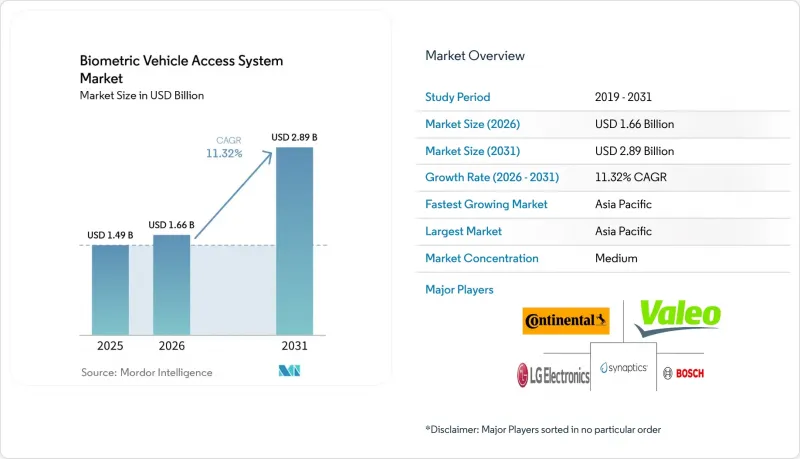
據 Mordor Intelligence 稱,2025 年生物識別車輛存取系統市值為 14.9 億美元,預計到 2031 年將從 2026 年的 16.6 億美元成長至 28.9 億美元,預測期(2026-2031 年)複合年成長率為 11.32%。
全球生物識別車輛門禁系統市場趨勢及洞察
智慧型手機等級的指紋感應器在中階汽車的廣泛應用。
從高階智慧型手機到中階汽車,電容式指紋感應器的廣泛應用正在加速生物識別技術的普及,即使在傳統鑰匙系統佔據主導地位的價格區間也是如此。英飛凌將於2024年10月推出車規級認證指紋感知器IC(CYFP10020A00和CYFP10020S00),其工作溫度範圍為-40 度C至+105 度C,展現了量產所需的成熟技術。這些感測器可與現有微控制器架構整合,同時還提供觸控板功能,從而降低了面向成本敏感型細分市場的OEM廠商的實現複雜度。中階乘用車正擴大採用最初為智慧型手機開發的電容式指紋感應器,將單價降至5美元以下,使OEM廠商即使在售價低於3萬美元的車輛中也能提供生物識別存取功能。
車載設備製造商正在推廣無需密碼的車載支付系統。
汽車製造商正在整合生物識別功能,以實現車內燃油、通行費、停車費和數位服務的無縫支付。這使得用戶在駕駛過程中無需輸入密碼或取出支付卡。梅賽德斯-奔馳與Visa合作推出了「Mercedes me Fuel & Pay」系統,該系統允許駕駛員透過整合在車輛資訊娛樂系統中的指紋認證來授權燃油支付。 FORVIA與Smart Eye共同開發的生物識別方案於2025年4月進行了試驗測試。該解決方案支援在13家原始設備製造商(OEM)旗下32個汽車品牌的200多個應用程式中進行安全支付和訪問,並將生物識別訪問定位為持續軟體收入的途徑。
低溫環境下低成本指紋辨識器可靠性面臨的挑戰。
電容式指紋感應器常用於車輛門把和啟動按鈕,但在寒冷氣候下表現不佳。這是因為低溫會導致皮膚電導率下降30%至50%,材料熱膨脹和電池電壓降低也會增加感測器漂移。卡爾頓大學的一項研究發現,在受控的實驗室條件下,環境溫度與指紋辨識準確率之間的相關性很弱。然而,在賓士EQE車主論壇上一些用戶的申訴表明,當溫度低於-10 度C時,指紋辨識會反覆失敗,迫使車主使用備用鑰匙。
細分市場分析
到2025年,指紋認證將佔據45.23%的市場佔有率,這反映了產業在高階應用領域安全措施升級的進展。虹膜辨識是成長最快的認證方式,預計到2031年將以27.58%的複合年成長率成長。這種成長差異凸顯了市場區隔:通用車輛普遍採用經濟高效的指紋認證解決方案,而豪華車和商用車由於安全實施成本較高,更傾向於使用先進的多模態系統。臉部認證辨識和語音辨識雖然市場佔有率較小,但仍具有重要的戰略意義,尤其是在免持操作和與資訊娛樂系統的整合方面。在高階市場,結合生物識別技術的多模態和多因素認證(MFA)系統的應用日益普及,以確保高價值交易的安全性並滿足監管合規要求。
大陸集團在2025年國際消費電子展(CES 2025)上發布的「隱形生物識別感測顯示器」代表了產業向整合多模態系統發展的趨勢。這些系統結合了臉部辨識和生命徵象監測,提供了一套全面的身份驗證和安全解決方案。這種整合克服了單模態系統的局限性,同時也提供了額外的功能以支撐其高階定價。這種市場細分與汽車行業向軟體定義車輛(SDV)的轉型相契合,在SDV中,生物識別功能可以透過空中下載(OTA)更新進行升級,使原始設備製造商(OEM)無需更改硬體即可實現新的身份驗證方法。
預計到2025年,乘用車將佔市場佔有率的63.14%,凸顯了車隊營運商優先考慮安全性、合規性和營運效率而非成本。商用車預計將成為成長最快的細分市場,複合年成長率(CAGR)將達到21.43%。美國聯邦機動車輛運輸安全管理局(FMCSA)計劃於2025年在卡車註冊中引入生物識別驗證,預計這將加速生物生物識別在商用車領域的應用,並領先於乘用車應用。對於車隊而言,集中採購和提高車輛利用率的優勢使得生物識別系統比個人車更具成本效益。商用車生物識別系統通常與車隊管理平台整合,除了基本的車輛存取功能外,還為營運商提供存取控制、駕駛員監控和合規性報告等功能。
商用車領域的成長表明,隨著生物識別系統的成熟和生產規模擴大導致成本降低,其技術轉移到乘用車具有潛在價值。博斯的「車隊管理擴展訪問」系統展示了商用車應用如何推動遠端存取管理和多車輛認證等領域的創新,進而影響乘用車的發展。這種技術轉移模式表明,商用車正在成為生物識別技術進步的試驗場,這些進步最終將推廣到乘用車應用領域。
區域分析
亞太地區預計將在市場佔有率(到2025年將達到30.47%)和複合年成長率(到2031年將達到18.61%)方面均領先,這主要得益於中國汽車製造商積極採用生物識別技術以及政府支持智慧汽車發展的政策。政府的智慧連網汽車發展藍圖強調多模態駕駛員識別是其基礎要素。隨著地方政府將此功能納入L3級自動駕駛評估標準,供應商的訂單量將會增加。台灣利科達公司已開始大量生產符合AEC Q102標準的VCSEL(垂直腔面發射雷射),確保國內外市場的穩定供應。這將降低成本並加快普及速度。
北美是全球第二大汽車銷售市場,這主要得益於當地法規要求商用車輛牌照續期時必須進行生物識別身分驗證。這也推動了車輛改裝工程的發展。底特律的汽車製造商正在探索以數位錢包為中心的訂閱式收入模式,而習慣了智慧型手機支付的美國消費者也擴大接受在加油站使用臉部認證支付(自助加油)。由於寒冷氣候下的可靠性挑戰,在感測器能夠在-30 度C下可靠運作之前,中西部和加拿大等地區的普及程度有限。
在歐洲,ISO/SAE 21434 標準的合規性以及德國豪華汽車製造商之間的競爭正在推動穩定發展。 GDPR(一般資料保護規則)強制要求使用加密技術進行本地資料存儲,這促使駕駛員監視錄影機的架構轉變為邊緣人工智慧晶片。博世和法雷奧等一級供應商強調“隱私設計”,將合規成本轉化為品牌優勢。雖然歐洲的銷量落後於亞洲,但該地區每輛車的平均售價卻位居世界最高之列,因為消費者需要與數位金鑰共用相結合的無縫多因素身份驗證。
其他好處:
- Excel格式的市場預測(ME)表
- 3個月的分析師支持
目錄
第1章:引言
- 研究假設和市場定義
- 調查範圍
第2章:調查方法
第3章執行摘要
第4章 市場狀況
- 市場概覽
- 市場促進因素
- 智慧型手機等級的指紋感應器在中階汽車的廣泛應用。
- OEM廠商正在推廣無需密碼的車載支付系統。
- ISO/SAE 21434 網路安全強制性要求(2025)
- 一級供應商的「生物辨識即服務」收入模式
- 機器人計程車多元素、多模式接入示範實驗
- 多因素身份驗證系統保險折扣
- 市場限制因素
- 低溫環境下低成本指紋辨識器可靠性面臨的挑戰。
- GDPR 和 CCPA 下的資料隱私訴訟風險
- 缺乏全球欺騙測驗標準
- VCSEL供不應求對供應鏈的影響
- 價值供應鏈分析
- 監理情勢
- 技術展望
- 波特五力模型
- 比較分析(產品、財務、專利、定價)
- 創業生態系分析
- 市場准入情境(營商環境便利程度、個案研究)
- 市場熵(新產品發布、併購、合資企業)
第5章 市場規模與成長預測
- 身份驗證方法
- 指紋認證
- 臉部辨識
- 虹膜辨識
- 語音辨識
- 多模態/MFA
- 車輛類型
- 搭乘用車
- 商用車輛
- 按組件
- 硬體
- 軟體/人工智慧堆疊
- 按銷售管道
- 原廠安裝設備
- 售後/改裝
- 按地區
- 北美洲
- 美國
- 加拿大
- 其他北美國家
- 南美洲
- 巴西
- 阿根廷
- 其他南美國家
- 歐洲
- 德國
- 英國
- 法國
- 義大利
- 西班牙
- 荷蘭
- 其他歐洲國家
- 亞太地區
- 中國
- 日本
- 韓國
- 印度
- 澳洲
- 其他亞太國家
- 中東和非洲
- 沙烏地阿拉伯
- 阿拉伯聯合大公國
- 南非
- 其他中東和非洲國家
- 北美洲
第6章 競爭情勢
- 市場集中度
- 策略趨勢
- 市佔率分析
- 公司簡介
- Continental AG
- Robert Bosch GmbH
- Denso Corporation
- Safran SA
- Valeo SA
- Fingerprint Cards AB
- Synaptics Inc.
- Fujitsu Ltd
- Hitachi Ltd
- Methode Electronics
- Nuance Communications
- Cerence Inc.
- Thales Group
- Gentex Corporation
- LG Electronics
第7章 市場機會與未來展望
According to Mordor Intelligence, the biometric vehicle access system market size was valued at USD 1.49 billion in 2025 and is estimated to grow from USD 1.66 billion in 2026 to reach USD 2.89 billion by 2031, at a CAGR of 11.32% during the forecast period (2026-2031).
Global Biometric Vehicle Access System Market Trends and Insights
Ubiquity of Smartphone-Class Fingerprint Sensors in Mid-Price Cars
The democratization of capacitive fingerprint sensors from premium smartphones to mid-market vehicles accelerates biometric adoption across price segments previously dominated by traditional key systems. Infineon's October 2024 launch of automotive-qualified fingerprint sensor ICs (CYFP10020A00 and CYFP10020S00) operating over -40°C to +105°C demonstrates the technical maturation required for mass-market deployment . These sensors integrate with existing microcontroller architectures while providing trackpad functionality, reducing implementation complexity for OEMs targeting cost-sensitive segments. Mid-price passenger cars are integrating capacitive fingerprint sensors originally developed for smartphones, lowering per-unit costs to below USD 5 and enabling OEMs to offer biometric access in vehicles priced under USD 30,000.
OEM Push for Password-Free In-Car Payments
Automakers are embedding biometric authentication to enable frictionless in-car payments for fuel, tolls, parking, and digital services, eliminating the need for users to enter passwords or retrieve payment cards while driving. Mercedes-Benz launched the Mercedes me Fuel & Pay system in partnership with Visa, allowing drivers to authorize fuel purchases via fingerprint authentication integrated into the vehicle's infotainment system. FORVIA's biometric authentication solution, developed with Smart Eye and demonstrated in April 2025, enables secure payments and app access across a catalog of more than 200 applications integrated into 32 car brands from 13 OEMs, positioning biometric access as the gateway to recurring software revenue.
Cold-Weather Reliability Issues for Low-Cost Fingerprint Readers
Capacitive fingerprint sensors deployed in vehicle door handles and start buttons experience degraded performance in cold climates, where skin conductance drops 30% to 50% and sensor drift increases due to thermal contraction of materials and battery voltage sag. A Carleton University study found a weak correlation between ambient temperature and fingerprint recognition accuracy in controlled laboratory conditions. Yet, real-world user complaints on Mercedes EQE owner forums documented repeated authentication failures when temperatures fell below -10°C, forcing drivers to revert to backup key fobs.
Other drivers and restraints analyzed in the detailed report include:
- ISO/SAE 21434 Cybersecurity Mandates (2025)
- Tier-1 Suppliers' "Biometrics-as-a-Service" Revenue Models
- Data-Privacy Litigation Risk Under GDPR and CCPA
For complete list of drivers and restraints, kindly check the Table Of Contents.
Segment Analysis
In 2025, fingerprint recognition holds a 45.23% market share, reflecting the industry's progression toward enhanced security measures for premium applications. Iris recognition is the fastest-growing authentication segment, with a 27.58% CAGR projected through 2031. This growth disparity highlights a market division: mainstream vehicles adopt cost-efficient fingerprint solutions, while luxury and commercial applications prefer advanced multimodal systems, justified by higher security implementation costs. Face and voice recognition segments, though smaller, remain strategically significant, particularly in hands-free operations and integration with infotainment systems. The premium segment increasingly features multimodal and multi-factor authentication (MFA) systems, combining biometric modalities to ensure security for high-value transactions and to meet regulatory compliance requirements.
Continental's CES 2025 presentation of invisible biometric sensing displays demonstrates the industry's movement toward integrated multimodal systems. By combining facial recognition with vital sign monitoring, these systems provide comprehensive authentication and safety solutions. Such integrations address the limitations of single-modality systems while offering additional functionalities that support premium pricing. This segmentation aligns with the automotive industry's transition to software-defined vehicles, where biometric capabilities can be updated through over-the-air updates, enabling OEMs to introduce new authentication methods without hardware modifications.
In 2025, passenger cars accounted for 63.14% of the market, highlighting fleet operators' focus on security, regulatory compliance, and operational efficiency over cost concerns. Commercial vehicles represented the fastest-growing segment, with a 21.43% CAGR. The FMCSA's planned implementation of biometric identity verification for trucking registrations in 2025 is expected to drive mandatory adoption, accelerating biometric deployment in commercial vehicles ahead of consumer applications. Fleet applications benefit from centralized procurement and higher vehicle utilization, resulting in better returns on biometric system investments compared to personal vehicles. Commercial vehicle biometric systems are often integrated with fleet management platforms, providing operators with access control, driver monitoring, and compliance reporting capabilities beyond basic vehicle access.
The growth of the commercial vehicle segment suggests potential technology transfer to passenger vehicles as biometric systems mature and production volumes reduce costs. Bosch's Fleet Management Xtended Access system illustrates how commercial applications foster innovation in areas such as remote access management and multi-vehicle authentication, which subsequently influence consumer vehicle development. This transfer pattern indicates that commercial vehicles serve as testing grounds for biometric advancements that eventually reach passenger car applications.
Complete Report Scope:
- By Authentication Type
- Fingerprint Recognition
- Face Recognition
- Iris Recognition
- Voice Recognition
- Multimodal/MFA
- By Vehicle Type
- Passenger Cars
- Commercial Vehicles
- By Component
- Hardware
- Software/AI Stack
- By Sales Channel
- OEM Factory-Fit
- Aftermarket/Retrofit
- By Geography
- North America
- United States
- Canada
- Rest of North America
- South America
- Brazil
- Argentina
- Rest of South America
- Europe
- Germany
- United Kingdom
- France
- Italy
- Spain
- Netherlands
- Rest of Europe
- Asia-Pacific
- China
- Japan
- South Korea
- India
- Australia
- Rest of Asia-Pacific
- Middle East and Africa
- Saudi Arabia
- United Arab Emirates
- South Africa
- Rest of Middle East and Africa
- North America
Geography Analysis
Asia-Pacific leads both market share at 30.47% in 2025 and growth rate at 18.61% CAGR through 2031, driven by Chinese automakers' aggressive biometric integration and supportive government policies for intelligent vehicle development. Government roadmaps for intelligent connected vehicles emphasize multimodal driver identification as a foundational component. Supplier orders increase when local authorities include this feature in Level 3 autonomy scoring. Taiwan's Lextar has commenced volume production of VCSELs in accordance with AEC Q102 standards, ensuring a stable supply for domestic and export markets. This reduces costs and promotes higher adoption rates.
North America ranks second in revenue, supported by regulations that require biometric validation for commercial motor carrier license renewals. This has spurred fleet retrofit programs. Detroit OEMs are pursuing subscription-based revenue models centered on digital wallets, while US consumers increasingly adopt pay-at-pump facial recognition, driven by familiarity with smartphone experiences. Cold-weather reliability challenges limit adoption in regions like the Midwest and Canada until sensors can operate reliably at -30 °C.
Europe is advancing steadily, driven by ISO/SAE 21434 compliance and competition among premium German automakers. GDPR mandates local data storage with encryption, pushing architectures toward edge AI chips in driver-monitoring cameras. Tier-1 suppliers such as Bosch and Valeo emphasize privacy-by-design, transforming compliance costs into brand advantages. While volumes in Europe lag behind those in Asia, the region's average unit selling prices are the highest globally, as consumers demand seamless multi-factor authentication linked to digital key sharing.
- Continental AG
- Robert Bosch GmbH
- Denso Corporation
- Safran SA
- Valeo SA
- Fingerprint Cards AB
- Synaptics Inc.
- Fujitsu Ltd
- Hitachi Ltd
- Methode Electronics
- Nuance Communications
- Cerence Inc.
- Thales Group
- Gentex Corporation
- LG Electronics
Additional Benefits:
- The market estimate (ME) sheet in Excel format
- 3 months of analyst support
TABLE OF CONTENTS
1 Introduction
- 1.1 Study Assumptions and Market Definition
- 1.2 Scope of the Study
2 Research Methodology
3 Executive Summary
4 Market Landscape
- 4.1 Market Overview
- 4.2 Market Drivers
- 4.2.1 Ubiquity of Smartphone-Class Fingerprint Sensors in Mid-Price Cars
- 4.2.2 OEM Push for Password-Free In-Car Payments
- 4.2.3 ISO/SAE 21434 Cybersecurity Mandates (2025)
- 4.2.4 Tier-1 Suppliers' "Biometrics-as-a-Service" Revenue Models
- 4.2.5 Multi-Factor, Multi-Modal Access Pilots in Robotaxis
- 4.2.6 Insurance Discounts for MFA Systems
- 4.3 Market Restraints
- 4.3.1 Cold-Weather Reliability Issues for Low-Cost Fingerprint Readers
- 4.3.2 Data-Privacy Litigation Risk Under GDPR and CCPA
- 4.3.3 Lack of Global Spoof-Testing Standards
- 4.3.4 Supply-Chain Exposure to VCSEL Shortages
- 4.4 Value/Supply-Chain Analysis
- 4.5 Regulatory Landscape
- 4.6 Technological Outlook
- 4.7 Porter's Five Forces
- 4.7.1 Bargaining Power of Suppliers
- 4.7.2 Bargaining Power of Customers
- 4.7.3 Threat of New Entrants
- 4.7.4 Rivalry among Existing Players
- 4.7.5 Threat of Substitutes
- 4.8 Comparative Analysis (Product, Financials, Patents, Pricing)
- 4.9 Startup Ecosystem Analysis
- 4.10 Market Entry Scenario (Ease-of-Doing-Business, Case Studies)
- 4.11 Market Entropy (New Product Launches, MandA, JV)
5 Market Size and Growth Forecasts (Value (USD))
- 5.1 By Authentication Type
- 5.1.1 Fingerprint Recognition
- 5.1.2 Face Recognition
- 5.1.3 Iris Recognition
- 5.1.4 Voice Recognition
- 5.1.5 Multimodal/MFA
- 5.2 By Vehicle Type
- 5.2.1 Passenger Cars
- 5.2.2 Commercial Vehicles
- 5.3 By Component
- 5.3.1 Hardware
- 5.3.2 Software/AI Stack
- 5.4 By Sales Channel
- 5.4.1 OEM Factory-Fit
- 5.4.2 Aftermarket/Retrofit
- 5.5 By Geography
- 5.5.1 North America
- 5.5.1.1 United States
- 5.5.1.2 Canada
- 5.5.1.3 Rest of North America
- 5.5.2 South America
- 5.5.2.1 Brazil
- 5.5.2.2 Argentina
- 5.5.2.3 Rest of South America
- 5.5.3 Europe
- 5.5.3.1 Germany
- 5.5.3.2 United Kingdom
- 5.5.3.3 France
- 5.5.3.4 Italy
- 5.5.3.5 Spain
- 5.5.3.6 Netherlands
- 5.5.3.7 Rest of Europe
- 5.5.4 Asia-Pacific
- 5.5.4.1 China
- 5.5.4.2 Japan
- 5.5.4.3 South Korea
- 5.5.4.4 India
- 5.5.4.5 Australia
- 5.5.4.6 Rest of Asia-Pacific
- 5.5.5 Middle East and Africa
- 5.5.5.1 Saudi Arabia
- 5.5.5.2 United Arab Emirates
- 5.5.5.3 South Africa
- 5.5.5.4 Rest of Middle East and Africa
- 5.5.1 North America
6 Competitive Landscape
- 6.1 Market Concentration
- 6.2 Strategic Moves
- 6.3 Market Share Analysis
- 6.4 Company Profiles (Includes Global Level Overview, Market Level Overview, Core Segments, Financials as Available, Strategic Information, Market Rank/Share for Key Companies, Products and Services, SWOT Analysis, and Recent Developments)
- 6.4.1 Continental AG
- 6.4.2 Robert Bosch GmbH
- 6.4.3 Denso Corporation
- 6.4.4 Safran SA
- 6.4.5 Valeo SA
- 6.4.6 Fingerprint Cards AB
- 6.4.7 Synaptics Inc.
- 6.4.8 Fujitsu Ltd
- 6.4.9 Hitachi Ltd
- 6.4.10 Methode Electronics
- 6.4.11 Nuance Communications
- 6.4.12 Cerence Inc.
- 6.4.13 Thales Group
- 6.4.14 Gentex Corporation
- 6.4.15 LG Electronics
7 Market Opportunities and Future Outlook
- 7.1 White-space and Unmet-Need Assessment

 汽車生物識別:市場佔有率分析、產業趨勢與統計及成長預測(2026-2031)
 生物識別車輛門禁系統市場:按組件、生物識別方法、認證方法、應用、車輛類型和銷售管道分類-2026-2032年全球市場預測
 生物識別車輛門禁系統市場預測至2034年-按系統類型、車輛類型、技術、通路和地區分類的全球分析
 2026年全球生物辨識車輛門禁市場報告汽車生物識別市場:2026-2032年全球市場預測(按模式、交付方式、整合、車輛類型和應用分類)2026年全球指紋車輛門禁市場報告
 全球汽車生物識別感測器市場規模、佔有率、趨勢和成長分析報告(2026-2034年)全球生物識別車輛門禁系統市場規模、佔有率、趨勢及成長分析報告(2026-2034年)
 汽車生物識別市場-全球產業規模、佔有率、趨勢、機會及預測(依技術、車輛類型、地區及競爭格局分類,2021-2031年)
 整合生物識別座椅感測器市場 - 全球及區域分析:按車輛類型、按推進類型、按感測器類型、按銷售管道、按國家/地區 - 分析與預測(2025 年至 2035 年)