


 |
市場調查報告書
商品編碼
2123094
汽車生物識別:市場佔有率分析、產業趨勢與統計及成長預測(2026-2031)Biometric In The Automotive - Market Share Analysis, Industry Trends & Statistics, Growth Forecasts (2026 - 2031) |
||||||

※ 本網頁內容可能與最新版本有所差異。詳細情況請與我們聯繫。
據 Mordor Intelligence 稱,汽車生物識別市場預計到 2026 年價值 45.8 億美元,高於 2025 年的 38.9 億美元,預計到 2031 年將達到 103.9 億美元。
預計2026年至2031年複合年成長率將達17.80%。
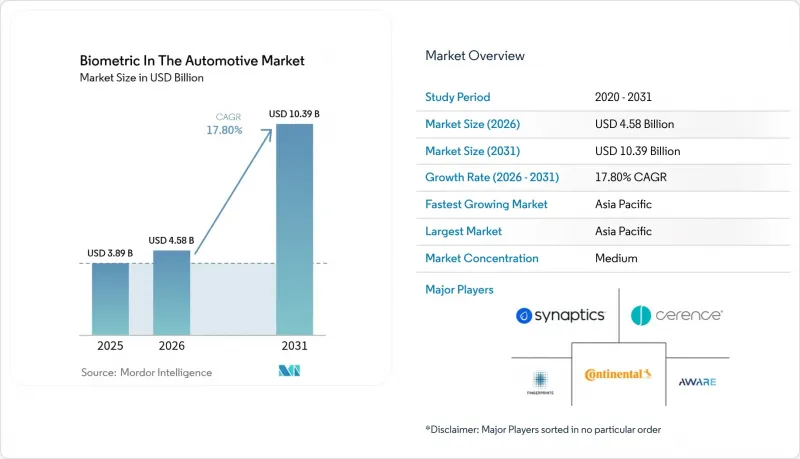
本報告按組件(硬體和軟體)、生物識別方法(指紋辨識、虹膜辨識等)、車輛類型(乘用車、輕型商用車等)、應用(駕駛員認證和存取管理等)、銷售管道(原廠配套和售後市場)以及地區進行細分。市場預測以美元計價。
全球汽車生物識別市場趨勢及洞察
對非接觸式車輛存取和個人化的需求日益成長。
如今,消費者期望車載環境能夠像智慧型手機一樣快速識別他們的身份。 Smart Eye 和 FORVIA 於 2025 年展示的非接觸式虹膜和臉部認證系統,可在車門開啟前驗證駕駛和乘客的身份,並在不到一秒的時間內載入座椅、後視鏡和資訊娛樂系統的設定檔。這省去了每次更換駕駛員後手動重置配置文件的麻煩,為共享出行運營商帶來了更多價值。自 2016 年以來,Synaptics 一直向一級供應商供應其「Natural ID」指紋認證套件,該套件利用滑動和點擊手勢實現身份驗證和選單導航。這簡化了車載按鈕,提高了人體工學舒適度,而亞秒級的配置檔案載入速度則提升了客戶滿意度,並為汽車製造商提供了競爭對手難以快速複製的差異化優勢。隨著使用者體驗標準的不斷提高,這些優勢正在加速生物識別技術在汽車領域的應用。
嚴格的汽車安全法規
隨著歐洲經濟委員會(UNECE)《駕駛員監控法規》於2026年實施,以及歐洲新車安全評估協會(Euro NCAP)駕駛員監控性能與星級評定掛鉤,生物識別已從一項小眾的高階功能轉變為一項合規要求。 ISO/IEC TS 22604:2024正式規定了駕駛人接近行駛車輛時的非接觸式生物識別標準,而車載安全介面的ISO標準則統一了硬體需求。在中國,2025年6月發布的《臉部辨識指南》要求對超過10萬個主體進行資料本地化,迫使汽車製造商(OEM)在其設備中整合匹配功能。這些法規的共同作用將加快設計週期,並確保生物識別技術在汽車領域的應用保持結構性成長。
缺乏全球標準和互通性
自願性ISO和FIDO規範缺乏可強制執行的跨國互認機制,迫使OEM廠商必須分別獲得歐洲、中國和美國的硬體認證。中國的資料本地化法規禁止歐洲汽車租賃公司在中國境內重複使用其駕駛員資料庫,迫使車隊營運商維護各自獨立的系統。小規模的售後市場供應商難以承擔重新測試的成本,這限制了產品在價格敏感地區的供應,並減緩了生物識別技術在汽車領域的應用。
細分市場分析
到2025年,硬體銷售額將佔總銷售額的64.55%,這反映了汽車產業對感測器生物識別技術的長期應用。同時,軟體正以18.62%的複合年成長率快速成長,這主要得益於原始設備製造商(OEM)對包含持續身份驗證、授權管理和空中下載配置文件更新等功能的訂閱式授權模式的偏好。 Synaptics的「感測器內匹配」架構可在感測器晶片內完成捕獲、匹配和加密,從而將價值從中央ECU轉移到邊緣,同時保護模板免受主機級惡意軟體的攻擊。
邊緣智慧化模糊了硬體和軟體之間的界限,生物辨識檢測的韌體權重被直接整合到模組中,使被動設備轉變為智慧節點。因此,授權收入的成長速度超過了實體出貨量的成長速度,即使通用攝影機的價格下降,毛利率也能提高。一級供應商將感測器與安全的雲端API整合,從而獲得額外的平台使用費,加速汽車生物識別市場的商業化進程。
到2025年,指紋認證技術將主導生物識別市場,佔40.15%的市場佔有率,這得益於低成本電容式組件的普及,其功能堪比智慧型手機。然而,臉部認證預計將以每年20.12%的速度成長。這是因為現在只需一個RGB-IR攝影機即可監控駕駛員、識別車內人員並驗證其身份,從而無需在車門或儀表板上安裝單獨的指紋讀取器。 Smart Eye的虹膜辨識SDK(已獲得Fingerprint Cards的授權)面向高階市場,該市場對支付和車隊合規性的誤識率要求低於0.01%。
結合臉部和虹膜辨識的混合配置降低了身分冒用風險,並符合新的FIDO測試協議,而手掌辨識和語音辨識由於環境噪音和文化偏好因素,仍屬於小眾領域。 ISO/IEC TR 24722:2024正式規定了感測器融合的權重,鼓勵OEM廠商採用多模態技術堆疊。隨著攝影機功能的不斷整合,每個生物識別特徵的硬體邊際成本降低,而每輛車的軟體使用費則增加,這進一步加速了汽車生物識別市場向平台經濟的轉型。
區域分析
預計到2025年,亞太地區將佔全球銷售額的37.95%,並有望以19.98%的複合年成長率成長,這主要得益於中國對「智慧網聯汽車(ICV)」的雙重推動以及嚴格的數據本地化法規(要求在設備端進行處理)。目前,中國汽車製造商正與國內的攝影機和指紋識別供應商合作,以滿足配額要求,同時避免跨境資料傳輸。在日本,羽田機場正在試行配備臉部認證的自動駕駛接駁車,以緩解駕駛人。同時,韓國和澳洲正利用智慧型手機的高親和性來加速消費者對這項技術的接受度。在印度,儘管價格仍然是一個敏感因素,但針對都市區防盜生物識別生物識別的保險激勵措施正在推動試點計畫的發展,並有望擴大這項技術的普及範圍。
在北美和歐洲,ISO和FIDO標準的整合正在穩步推進,這將實現跨境租賃車輛的身份驗證。歐洲的《聯合國歐洲經濟委員會駕駛員監控法案》(UNECE Driver Monitoring Act)將於2026年生效,該法案正在加速推進生物識別技術的普及,並將其整合到主流車型中。雖然美國目前尚無聯邦法規,但伊利諾伊州的《同意法案》(Consent Act)和加州的《隱私法案》(Privacy Act)要求技術提供者實施區域性隱私控制措施,例如Lytx的「動態調整」(Dynamic Adjust)地理圍欄技術。在加拿大和墨西哥,生物識別正應用於主要商業貨運路線,以簡化海關程序和承運商審計,從而推動汽車生物識別市場的區域性發展。
在中東,車輛生物識別被視為國家數位身分計畫的延伸。阿拉伯聯合大公國引入臉部認證,沙烏地阿拉伯IDEMIA和SAMI的合作,將車輛存取權限與公民身分資訊關聯起來,加速了適應高溫環境的掌紋和虹膜辨識方法的早期測試。在非洲,高昂的硬體成本和基礎設施差異仍然是障礙,但南非和奈及利亞正在推動車隊中引入生物識別,以遏制物流樞紐的竊盜行為。高溫環境下的耐久性問題依然存在,但耐高溫光學模組目前已通過長期熱浸測試,正逐步為廣泛應用鋪路。
其他好處:
- Excel格式的市場預測(ME)表
- 3個月的分析師支持
目錄
第1章:引言
- 研究假設和市場定義
- 調查範圍
第2章:調查方法
第3章執行摘要
第4章 市場狀況
- 市場概覽
- 市場促進因素
- 對非接觸式車輛存取和個人化服務的需求日益成長。
- 關於汽車安全保障的嚴格規定
- 降低感測器成本並整合到車輛電子架構中。
- 與防盜生物識別技術掛鉤的保險費折扣
- 車載支付生態系統的擴展需要安全認證
- 原始設備製造商 (OEM) 越來越注重使用生物識別來監測駕駛員的健康狀況。
- 市場限制因素
- 缺乏全球標準和互通性
- 大眾市場汽車領域初始系統成本高
- 隱私和資料安全問題
- 機艙安裝式光學感測器的環境耐久性限制
- 產業價值鏈分析
- 宏觀經濟因素的影響
- 監理情勢
- 技術展望
- 波特五力分析
第5章 市場規模與成長預測
- 按組件
- 硬體
- 軟體
- 通過生物識別方法
- 指紋認證
- 虹膜辨識
- 手掌認證
- 臉部認證
- 語音辨識
- 其他測量方法
- 車輛類型
- 搭乘用車
- 輕型商用車
- 大型卡車
- 巴士和長途汽車
- 特種車輛
- 透過使用
- 駕駛員識別和訪問
- 引擎啟動/防盜裝置
- 車內支付
- 監測駕駛員的健康狀況和困倦程度
- 資訊娛樂個人化
- 車隊管理和遠端資訊處理
- 按銷售管道
- 原廠正品零件
- 售後市場
- 按地區
- 北美洲
- 美國
- 加拿大
- 墨西哥
- 南美洲
- 巴西
- 阿根廷
- 其他南美國家
- 歐洲
- 德國
- 英國
- 法國
- 義大利
- 西班牙
- 其他歐洲國家
- 亞太地區
- 中國
- 日本
- 印度
- 韓國
- 澳洲
- 其他亞太國家
- 中東和非洲
- 中東
- 沙烏地阿拉伯
- 阿拉伯聯合大公國
- 土耳其
- 其他中東國家
- 非洲
- 南非
- 奈及利亞
- 埃及
- 其他非洲國家
- 中東
- 北美洲
第6章 競爭情勢
- 市場集中度
- 策略趨勢
- 市佔率分析
- 公司簡介
- Synaptics Incorporated
- Fingerprint Cards AB
- Aware, Inc.
- Cerence Inc.
- Continental Aktiengesellschaft
- Sensory, Inc.
- Shenzhen Goodix Technology Co., Ltd.
- B-Secur Ltd.
- EyeLock LLC
- Precise Biometrics AB
- Robert Bosch GmbH
- Valeo SA
- Gentex Corporation
- NEC Corporation
- IDEMIA Identity and Security France SAS
- IriTech, Inc.
- BioID GmbH
- Nexteer Automotive Group Limited
- Hella GmbH and Co. KGaA
- Stanley Black and Decker, Inc.
第7章 市場機會與未來展望
According to Mordor Intelligence, biometric in the automotive market size in 2026 is estimated at USD 4.58 billion, growing from 2025 value of USD 3.89 billion with 2031 projections showing USD 10.39 billion, growing at 17.80% CAGR over 2026-2031.
This report is Segmented by Component (Hardware and Software), Biometric Modality (Fingerprint Recognition, Iris Recognition, and More), Vehicle Type (Passenger Cars, Light Commercial Vehicles, and More), Application (Driver Identification and Access, and More), Sales Channel (OEM-Fitted and Aftermarket), and Geography. The Market Forecasts are Provided in Terms of Value (USD).
Global Biometric In The Automotive Market Trends and Insights
Rising Demand for Contactless Vehicle Access and Personalization
Consumers now expect a cabin to recognize them as quickly as a smartphone. Touch-free iris and face systems demonstrated by Smart Eye and FORVIA in 2025 verify driver and passenger identities before a door opens, loading seats, mirrors, and infotainment profiles within one second. Shared-mobility operators gain extra value because each hand-off between drivers no longer requires a manual profile reset. Synaptics has shipped Natural ID fingerprint kits to Tier 1 suppliers since 2016, allowing swipe and tap gestures to double as both authentication and menu navigation. The resulting reduction in cabin-button clutter enhances ergonomics, while sub-second profile loading boosts customer satisfaction scores and provides OEMs with a differentiator that is challenging for rivals to replicate quickly. These gains accelerate the biometric in the automotive market as user-experience benchmarks rise.
Stringent Automotive Safety and Security Regulations
Europe's UNECE driver-monitoring rule, effective from 2026, and Euro NCAP's linkage of driver-monitoring performance to star ratings have converted biometrics from a niche luxury to a compliance requirement. ISO/IEC TS 22604:2024 formalizes contactless biometrics for drivers approaching a vehicle while it is in motion, and ISO standards for in-vehicle secure interfaces harmonize hardware expectations. In China, facial-recognition guidelines issued in June 2025 require data localization for over 100,000 subjects, compelling OEMs to embed on-device matching. Together, these mandates accelerate design cycles and ensure that biometric in the automotive market adoption remains on a structural growth trajectory.
Lack of Global Standards and Interoperability
OEMs must certify hardware separately for Europe, China, and the United States because voluntary ISO and FIDO specifications lack enforceable cross-border reciprocity. China's data-localization rule prevents a European rental car company from reusing its driver database within Chinese territory, forcing fleet operators to maintain siloed systems. Smaller aftermarket vendors struggle with the cost of re-testing, which limits product availability in price-sensitive regions and slows the adoption of biometrics in the automotive market.
Other drivers and restraints analyzed in the detailed report include:
- Lower Sensor Costs and Integration into Electronics Architectures
- Insurance Premium Discounts Linked to Anti-Theft Biometrics
- High Initial System Cost in Mass-Market Vehicle Segments
For complete list of drivers and restraints, kindly check the Table Of Contents.
Segment Analysis
Hardware accounted for 64.55% of revenue in 2025, reflecting the sensor-heavy heritage of biometrics in the automotive market. Software, however, is scaling at 18.62% CAGR because OEMs prefer subscription license models that include continuous authentication, consent management, and over-the-air profile updates. Synaptics' Match-in-Sensor architecture performs capture, matching, and encryption within the sensor die, moving value from the central ECU to the edge and shielding templates from host-level malware.
Edge smartness blurs the hardware-software divide by embedding firmware weights for liveness detection directly onto the module, turning a passive device into an intelligent node. Licensing-focused revenue, therefore, rises faster than physical shipments, enabling gross-margin expansion even as commodity camera prices fall. Tier 1 suppliers that integrate sensors with secure cloud APIs will capture incremental platform fees, accelerating the monetization curve of biometrics in the automotive market.
Fingerprint technology dominated the biometric market share with 40.15% in 2025, due to low-cost capacitive parts that leverage smartphone-scale capabilities. Yet, facial recognition is forecast to rise 20.12% annually, as a single RGB-IR camera now supports driver monitoring, occupant classification, and authentication, eliminating the need for separate fingerprint readers on doors or dashboards. Smart Eye's license of Fingerprint Cards' iris SDK targets premium segments requiring a false-acceptance rate of less than 0.01% for payments and fleet compliance.
Hybrid face-iris configurations reduce spoof risk and satisfy emerging FIDO test protocols, while palm-vein and voice remain niche due to environmental noise and cultural preferences. ISO/IEC TR 24722:2024 formalizes sensor-fusion weighting, encouraging OEMs to adopt multimodal stacks. As cameras consolidate functions, the marginal hardware cost per additional biometric decreases, while software royalties per vehicle increase, reinforcing the shift toward platform economics in the biometric automotive market.
Complete Report Scope:
- By Component
- Hardware
- Software
- By Biometric Modality
- Fingerprint Recognition
- Iris Recognition
- Palm Recognition
- Facial Recognition
- Voice Recognition
- Other Modalities
- By Vehicle Type
- Passenger Cars
- Light Commercial Vehicles
- Heavy Trucks
- Buses and Coaches
- Specialty Vehicles
- By Application
- Driver Identification and Access
- Engine Start / Immobilizer
- In-Car Payments
- Driver Health and Drowsiness Monitoring
- Infotainment Personalization
- Fleet Management and Telematics
- By Sales Channel
- OEM-Fitted
- Aftermarket
- By Geography
- North America
- United States
- Canada
- Mexico
- South America
- Brazil
- Argentina
- Rest of South America
- Europe
- Germany
- United Kingdom
- France
- Italy
- Spain
- Rest of Europe
- Asia-Pacific
- China
- Japan
- India
- South Korea
- Australia
- Rest of Asia-Pacific
- Middle East and Africa
- Middle East
- Saudi Arabia
- United Arab Emirates
- Turkey
- Rest of Middle East
- Africa
- South Africa
- Nigeria
- Egypt
- Rest of Africa
- Middle East
- North America
Geography Analysis
Asia-Pacific held 37.95% of revenue in 2025 and is set to expand 19.98% CAGR thanks to China's dual mandate for intelligent connected vehicles and strict data-localization rules that require on-device processing. Chinese OEMs now integrate domestic camera and fingerprint suppliers to meet quota requirements while avoiding cross-border data transfers. Japan pilots facial-verified autonomous shuttles to address driver shortages at Haneda Airport, while South Korea and Australia leverage high smartphone familiarity to accelerate consumer acceptance. India remains price-sensitive, but insurance incentives for anti-theft biometrics in urban centers spark pilot programs that could widen adoption.
North America and Europe converge on ISO and FIDO standards that enable cross-border rental fleet authentication. Europe's UNECE driver-monitoring law, effective from 2026, compresses program timelines and integrates biometric features into mainstream models. The United States lacks a federal rule; however, Illinois' consent law and California's privacy statute require technology providers to ship region-specific privacy controls, such as Lytx's Dynamic Adjust geofences. Canada and Mexico deploy biometrics in commercial trucking corridors to streamline customs and carrier audits, creating regional momentum for biometric in the automotive market.
The Middle East positions automotive biometrics as an extension of national digital-identity programs. The UAE's facial-ID rollout and Saudi Arabia's IDEMIA-SAMI partnership align vehicle access with civil-ID credentials, fostering early trials of palm-vein and iris modalities adapted to high-temperature environments. Africa remains constrained by high hardware costs and infrastructure gaps, yet South Africa and Nigeria are pursuing fleet biometrics to curb theft in logistics hubs. Hot-climate durability challenges persist, but ruggedized optical modules now pass extended heat-soak tests, slowly opening the door for broader uptake.
- Synaptics Incorporated
- Fingerprint Cards AB
- Aware, Inc.
- Cerence Inc.
- Continental Aktiengesellschaft
- Sensory, Inc.
- Shenzhen Goodix Technology Co., Ltd.
- B-Secur Ltd.
- EyeLock LLC
- Precise Biometrics AB
- Robert Bosch GmbH
- Valeo SA
- Gentex Corporation
- NEC Corporation
- IDEMIA Identity and Security France SAS
- IriTech, Inc.
- BioID GmbH
- Nexteer Automotive Group Limited
- Hella GmbH and Co. KGaA
- Stanley Black and Decker, Inc.
Additional Benefits:
- The market estimate (ME) sheet in Excel format
- 3 months of analyst support
TABLE OF CONTENTS
1 INTRODUCTION
- 1.1 Study Assumptions and Market Definition
- 1.2 Scope of the Study
2 RESEARCH METHODOLOGY
3 EXECUTIVE SUMMARY
4 MARKET LANDSCAPE
- 4.1 Market Overview
- 4.2 Market Drivers
- 4.2.1 Rising demand for contactless vehicle access and personalization
- 4.2.2 Stringent automotive safety and security regulations
- 4.2.3 Lower sensor costs and integration into vehicle electronics architectures
- 4.2.4 Insurance premium discounts linked to anti-theft biometrics
- 4.2.5 Expansion of in-car payment ecosystems requiring secure authentication
- 4.2.6 Escalating OEM focus on driver wellness monitoring via biometrics
- 4.3 Market Restraints
- 4.3.1 Lack of global standards and interoperability
- 4.3.2 High initial system cost in mass-market vehicle segments
- 4.3.3 Privacy and data security concerns
- 4.3.4 Environmental durability limitations of cabin-mounted optical sensors
- 4.4 Industry Value Chain Analysis
- 4.5 Impact of Macroeconomic Factors
- 4.6 Regulatory Landscape
- 4.7 Technological Outlook
- 4.8 Porter's Five Forces Analysis
- 4.8.1 Bargaining Power of Buyers
- 4.8.2 Bargaining Power of Suppliers
- 4.8.3 Threat of New Entrants
- 4.8.4 Threat of Substitute Products
- 4.8.5 Intensity of Competitive Rivalry
5 MARKET SIZE AND GROWTH FORECASTS (VALUE)
- 5.1 By Component
- 5.1.1 Hardware
- 5.1.2 Software
- 5.2 By Biometric Modality
- 5.2.1 Fingerprint Recognition
- 5.2.2 Iris Recognition
- 5.2.3 Palm Recognition
- 5.2.4 Facial Recognition
- 5.2.5 Voice Recognition
- 5.2.6 Other Modalities
- 5.3 By Vehicle Type
- 5.3.1 Passenger Cars
- 5.3.2 Light Commercial Vehicles
- 5.3.3 Heavy Trucks
- 5.3.4 Buses and Coaches
- 5.3.5 Specialty Vehicles
- 5.4 By Application
- 5.4.1 Driver Identification and Access
- 5.4.2 Engine Start / Immobilizer
- 5.4.3 In-Car Payments
- 5.4.4 Driver Health and Drowsiness Monitoring
- 5.4.5 Infotainment Personalization
- 5.4.6 Fleet Management and Telematics
- 5.5 By Sales Channel
- 5.5.1 OEM-Fitted
- 5.5.2 Aftermarket
- 5.6 By Geography
- 5.6.1 North America
- 5.6.1.1 United States
- 5.6.1.2 Canada
- 5.6.1.3 Mexico
- 5.6.2 South America
- 5.6.2.1 Brazil
- 5.6.2.2 Argentina
- 5.6.2.3 Rest of South America
- 5.6.3 Europe
- 5.6.3.1 Germany
- 5.6.3.2 United Kingdom
- 5.6.3.3 France
- 5.6.3.4 Italy
- 5.6.3.5 Spain
- 5.6.3.6 Rest of Europe
- 5.6.4 Asia-Pacific
- 5.6.4.1 China
- 5.6.4.2 Japan
- 5.6.4.3 India
- 5.6.4.4 South Korea
- 5.6.4.5 Australia
- 5.6.4.6 Rest of Asia-Pacific
- 5.6.5 Middle East and Africa
- 5.6.5.1 Middle East
- 5.6.5.1.1 Saudi Arabia
- 5.6.5.1.2 United Arab Emirates
- 5.6.5.1.3 Turkey
- 5.6.5.1.4 Rest of Middle East
- 5.6.5.2 Africa
- 5.6.5.2.1 South Africa
- 5.6.5.2.2 Nigeria
- 5.6.5.2.3 Egypt
- 5.6.5.2.4 Rest of Africa
- 5.6.5.1 Middle East
- 5.6.1 North America
6 COMPETITIVE LANDSCAPE
- 6.1 Market Concentration
- 6.2 Strategic Moves
- 6.3 Market Share Analysis
- 6.4 Company Profiles (includes Global level Overview, Market level overview, Core Segments, Financials as available, Strategic Information, Market Rank/Share for key companies, Products and Services, and Recent Developments)
- 6.4.1 Synaptics Incorporated
- 6.4.2 Fingerprint Cards AB
- 6.4.3 Aware, Inc.
- 6.4.4 Cerence Inc.
- 6.4.5 Continental Aktiengesellschaft
- 6.4.6 Sensory, Inc.
- 6.4.7 Shenzhen Goodix Technology Co., Ltd.
- 6.4.8 B-Secur Ltd.
- 6.4.9 EyeLock LLC
- 6.4.10 Precise Biometrics AB
- 6.4.11 Robert Bosch GmbH
- 6.4.12 Valeo SA
- 6.4.13 Gentex Corporation
- 6.4.14 NEC Corporation
- 6.4.15 IDEMIA Identity and Security France SAS
- 6.4.16 IriTech, Inc.
- 6.4.17 BioID GmbH
- 6.4.18 Nexteer Automotive Group Limited
- 6.4.19 Hella GmbH and Co. KGaA
- 6.4.20 Stanley Black and Decker, Inc.
7 MARKET OPPORTUNITIES AND FUTURE OUTLOOK
- 7.1 White-space and Unmet-Need Assessment

 生物識別車輛門禁系統市場:按組件、生物識別方法、認證方法、應用、車輛類型和銷售管道分類-2026-2032年全球市場預測
 生物識別車輛門禁系統市場:分析與預測至 2035 年(類型、產品類型、技術、組件、應用、設備、流程、最終使用者、功能、安裝模式)
 生物識別車輛門禁系統市場預測至2034年-按系統類型、車輛類型、技術、通路和地區分類的全球分析
 生物識別車輛門禁市場:依技術、車輛類型、組件和地區分類
 汽車生物識別市場規模、佔有率、趨勢和預測:按技術、車輛類型、銷售管道、應用和地區分類(2026-2034 年)
 2026年全球生物辨識車輛門禁市場報告汽車生物識別市場:2026-2032年全球市場預測(按模式、交付方式、整合、車輛類型和應用分類)2026年全球指紋車輛門禁市場報告
 全球汽車生物識別感測器市場規模、佔有率、趨勢和成長分析報告(2026-2034年)全球生物識別車輛門禁系統市場規模、佔有率、趨勢及成長分析報告(2026-2034年)