


 |
市場調查報告書
商品編碼
2154243
歐洲、中東和非洲(EMEA)彈性體市場:市場佔有率分析、行業趨勢和統計數據以及成長預測(2026-2031 年)Europe, Middle East and Africa (EMEA) Elastomers - Market Share Analysis, Industry Trends & Statistics, Growth Forecasts (2026 - 2031) |
||||||

※ 本網頁內容可能與最新版本有所差異。詳細情況請與我們聯繫。
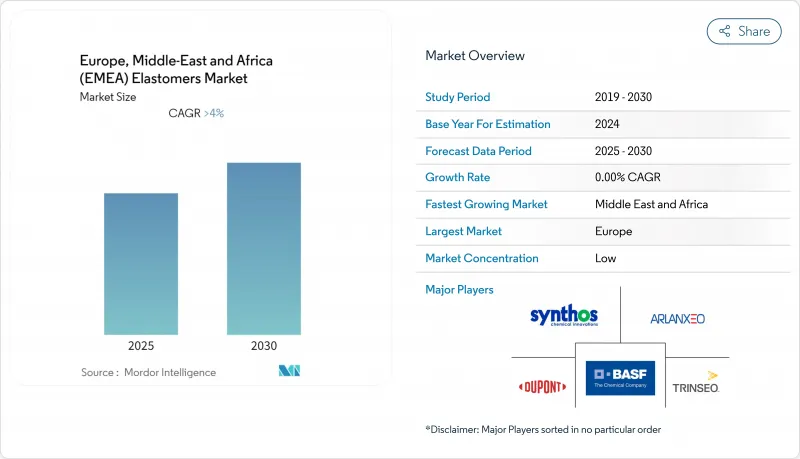
據 Mordor Intelligence 稱,2025 年歐洲、中東和非洲 (EMEA) 地區的彈性體市場價值為 386.6 億美元,預計到 2031 年將從 2026 年的 406.4 億美元成長至 521.6 億美元,預測期(2026-2031 年)的複合年成長率為 5.12%。
歐洲、中東和非洲 (EMEA) 彈性體市場的趨勢和見解。
電動車輕量化和高壓部件的應用
車輛電氣化正在推動歐洲、中東和非洲(EMEA)地區彈性體市場的材料升級。這是因為與傳統車輛系統相比,新型動力傳動系統系統對密封、絕緣、熱控制和阻燃性提出了不同的要求。 800伏特電池組對介電強度和阻燃性的要求高於傳統的密封條應用,因此材料的選擇不再局限於主要用於外部密封的等級。因此,矽橡膠、氟橡膠和熱塑性聚氨酯在連接器密封件、電池熱界面墊片以及其他需要滿足電氣和溫度控管要求的零件中變得越來越重要。在德國,2025年註冊的電池式電動車數量為54.5萬輛,市佔率為19.1%。預計到2026年,註冊量將達到74萬輛,市佔率將達到25%。這種轉變正在提升某些彈性體的價值,即使在傳統引擎支架需求下降的地區也是如此。這也使得能夠獲得高要求汽車專案所需的材料認證、支援零件設計師並滿足與汽車生產相關的文件要求的供應商變得越來越重要。
對醫用級無PVC管材和醫療設備的需求
醫療產業的採購需求正在推動歐洲、中東和非洲(EMEA)地區彈性體市場對專用應用的需求。特別是,流體處理系統需要性能穩定、通過認證以確保病患安全且生產管理可追溯的材料。醫院和醫療設備製造商正在用熱可塑性橡膠和矽膠取代流體處理組件中使用的增塑聚氯乙烯(PVC),這些材料可根據特定的加工和應用要求進行選擇。這種轉變適用於輸液管、導管系統和診斷設備等組件,而不僅限於單一產品類型。材料選擇過程受到化學安全性預期、可靠加工需求以及受法規環境下嚴格文件要求的影響。簡而言之,供應商必須透過合格而非價格來證明其性能。英國國家醫療服務體系(NHS)針對無鄰苯二甲酸酯管材的採購標準正在推動歐洲競標中更廣泛地考慮類似要求,從而提升認證能力的商業性意義。國際標準化組織 (ISO) 10993 和 ISO 13485 的要求繼續對醫療供應商施加高合格標準,有利於擁有完善的驗證和品管系統的公司。
原油、單體和石化原料的價格波動
由於合成材料依賴石油化學原料,而價格在銷售合約最終簽訂前可能會出現波動,因此原料價格波動風險仍是歐洲、中東和非洲(EMEA)地區彈性體市場面臨的一大限制因素。合成彈性體製造商依賴丁二烯、苯乙烯和乙烯-丙烯單體,這些單體的成本反映了整個化學價值鏈中原油和石腦油價格的波動。對於沒有整合原料採購系統的公司而言,這個問題尤其嚴重,因為它們在情況快速變化時,管理成本風險和確保內部供應的能力較弱。能夠內部取得關鍵中間體的製造商則能更好地抵禦投入成本的突然變化,並能更好地保障對戰略重要客戶的持續供應。特種單體和高純度等級產品的供應集中,為從亞洲採購的EMEA地區混煉企業帶來了長期採購風險。這種風險在歐洲、中東和非洲(EMEA)彈性體市場尤為突出,因為材料認證要求限制了企業快速更換供應商的能力。
細分市場分析
預計到2025年,熱可塑性橡膠將佔據歐洲、中東和非洲(EMEA)彈性體市場81.12%的佔有率,並將以5.67%的複合年成長率持續成長至2031年。這一市場地位反映了熱塑性彈性體在加工方面的優勢、廣泛的應用基礎以及人們對可回收材料的日益成長的需求。每種等級的熱可塑性橡膠都能滿足短週期射出成型、在線去毛邊、材料回收以及需要兼具彈性和高效生產的應用需求。這些特性正在推動熱塑性彈性體在製造商既追求功能性能又注重高效製造的領域中得到應用,例如密封條密封件、引擎室內的軟管組件以及內飾的軟觸表面。 EMEA彈性體市場(以熱塑性彈性體為代表)的規模成長得益於循環材料需求以及對可在現有大規模生產線上加工的材料的需求。
熱固性彈性體仍廣泛應用於輪胎、重型輸送帶和工業密封系統等領域。在這些應用中,直接替代品往往難以滿足產品要求。這些應用通常需要透過交聯來獲得動態力學性能,在長期回彈性能至關重要的運作條件下,熱固性彈性體的作用仍舉足輕重。然而,交聯EPDM的回收選項不如許多熱塑性材料豐富,這對於客戶在產品生命週期結束後考慮材料處置方式至關重要。正因如此,人們對熱塑性樹脂在相關應用領域的替代品越來越感興趣,但同時也並未排除熱固性樹脂在一些高要求應用場景中的作用。KURARAY CO. LTD.的「Septon Bio」系列採用甘蔗衍生的BETA-法呢烯,生物基含量高達80%,同時維持了石油衍生氫化苯乙烯嵌段共聚物的獨特特性。
其他好處:
- Excel格式的市場預測(ME)表
- 3個月的分析師支持
目錄
第1章:引言
- 研究假設和市場定義
- 調查範圍
第2章:調查方法
第3章執行摘要
第4章 市場狀況
- 市場概覽
- 市場促進因素
- 電動車輕量化和高壓部件的應用
- 對醫用級無PVC管材和醫療設備的需求
- 亞太地區的建設與基礎建設
- 對可回收和符合循環經濟原則的彈性體等級的需求
- 氫電解槽和燃料電池的密封要求
- 市場限制因素
- 原油、單體和石化原料的價格波動
- 關於微塑膠、輪胎磨損和合成橡膠的法規
- 特種單體和高純度等級產品的供應集中在這一地區。
- 價值鏈分析
- 波特五力分析
第5章 市場規模與成長預測
- 依產品類型
- 熱可塑性橡膠
- 熱固性彈性體
- 按最終用戶行業分類
- 汽車和運輸業
- 電氣和電子設備
- 醫療保健
- 工業機械和設備
- 消費品和鞋類
- 黏合劑、密封劑、塗料
- 其他終端用戶產業
- 按地區
- 歐洲
- 德國
- 英國
- 法國
- 義大利
- 西班牙
- 北歐國家
- 俄羅斯
- 其他歐洲國家
- 中東和非洲
- 沙烏地阿拉伯
- 阿拉伯聯合大公國
- 南非
- 埃及
- 奈及利亞
- 其他中東和非洲國家
- 歐洲
第6章 競爭情勢
- 市場集中度
- 策略趨勢
- 市佔率和排名分析
- 公司簡介
- Arkema
- ARLANXEO
- BASF
- Covestro AG
- Dow
- Exxon Mobil Corporation
- Huntsman International LLC
- KCC Corporation
- KURARAY CO., LTD.
- LANXESS
- LG Chem
- Mitsui Chemicals, Inc.
- Momentive
- Shin-Etsu Chemical Co., Ltd.
- Wacker Chemie AG
第7章 市場機會與未來展望
According to Mordor Intelligence, the Europe, Middle East and Africa (EMEA) elastomers market size was valued at USD 38.66 billion in 2025 and is estimated to grow from USD 40.64 billion in 2026 to reach USD 52.16 billion by 2031, at a CAGR of 5.12% during the forecast period (2026-2031).
Europe, Middle East and Africa (EMEA) Elastomers Market Trends and Insights
EV Lightweighting and High-Voltage Component Adoption
Vehicle electrification is creating a material upgrade cycle across the Europe, Middle East and Africa (EMEA) elastomers market, because new powertrain systems place different demands on sealing, insulation, thermal control, and flame resistance than conventional vehicle systems. An 800-volt battery pack requires higher dielectric strength and flame resistance than conventional weatherstrip applications, so material selection is moving beyond grades designed mainly for exterior sealing. Silicone, fluoroelastomer, and thermoplastic polyurethane are therefore gaining relevance in connector seals, battery thermal-interface gaskets, and other components exposed to electrical and heat-management demands. Germany recorded 545,000 battery electric vehicle registrations in 2025, equal to a 19.1% share, and registrations are projected to reach 740,000 units in 2026, or 25% of the total. The change raises the value of specified elastomers even where conventional engine-mount demand declines, and it increases the importance of suppliers that can qualify materials for demanding vehicle programs, support component designers, and meet the documentation requirements associated with automotive production.
Medical-Grade PVC-Free Tubing and Device Demand
Medical procurement is supporting specialty demand in the Europe, Middle East and Africa (EMEA) elastomers market, particularly where fluid-handling systems need materials with consistent performance, patient-safety credentials, and traceable production controls. Hospitals and device manufacturers are replacing plasticized polyvinyl chloride (PVC) in fluid-handling assemblies with thermoplastic elastomers and silicone, which can be selected for specific processing and application requirements. This transition applies to infusion tubing, catheterization systems, and diagnostic-device components, rather than to a single product category. The material selection process is shaped by chemical safety expectations, the need for reliable processing, and the strict documentation expected in regulated settings, which means that suppliers must demonstrate performance through qualification rather than through price alone. British National Health Service procurement benchmarks for phthalate-free tubing support wider consideration of similar requirements in European tenders and make certification capability more commercially relevant. International Organization for Standardization (ISO) 10993 and International Organization for Standardization 13485 requirements continue to create a high qualification threshold for healthcare suppliers, which favors companies with established validation and quality systems.
Crude Oil, Monomer and Petrochemical Feedstock Volatility
Feedstock exposure remains a material constraint for the Europe, Middle East and Africa (EMEA) elastomers market, because synthetic materials depend on petrochemical inputs that can change in price before selling contracts are adjusted. Synthetic elastomer producers depend on butadiene, styrene, and ethylene-propylene monomers whose costs reflect crude oil and naphtha movements across the wider chemical value chain. This issue is most acute for companies without integrated feedstock positions, since they have less ability to manage cost exposure internally or secure supply when conditions change quickly. Producers with captive access to key intermediates have more protection during abrupt changes in input costs and can better manage continuity of supply for strategically important customers. The supply concentration for specialty monomers and high-purity grades adds a longer-term procurement risk for EMEA compounders that source from Asia, especially where material qualifications limit the ability to switch suppliers quickly in the Europe, Middle East and Africa (EMEA) elastomers market.
Other drivers and restraints analyzed in the detailed report include:
- Asia-Pacific Construction and Infrastructure Expansion
- Demand for Recyclable and Circular-Ready Elastomer Grades
- Microplastic, Tire-Wear and Synthetic-Rubber Regulations
For complete list of drivers and restraints, kindly check the Table Of Contents.
Segment Analysis
Thermoplastic elastomers held 81.12% of the Europe, Middle East and Africa (EMEA) elastomers market share in 2025 and are projected to advance at a 5.67% CAGR through 2031. The position reflects processing advantages, a broad application base, and growing interest in materials that can be recovered after use. Thermoplastic elastomer grades can support short-cycle injection molding, in-line deburring, material recovery, and applications requiring both elastic performance and efficient production. These characteristics have helped them gain use in automotive weather seals, under-hood hose assemblies, and interior soft-touch surfaces, where manufacturers seek both functional performance and efficient fabrication. The Europe, Middle East and Africa (EMEA) elastomers market size represented by this category benefits from its fit with circular-material requirements and from demand for materials that can be processed in established high-volume manufacturing operations.
Thermoset elastomers continue to serve tires, heavy-duty conveyor belts, and industrial sealing systems, where product requirements often remain difficult to meet through direct substitution. These uses often require the dynamic mechanical properties provided through crosslinking, and their role remains relevant in applications where operating conditions place a premium on long-term resilience. However, crosslinked EPDM does not offer the same recovery options as many thermoplastic materials, which is relevant where customers are considering end-of-life material pathways. The gap supports continuing interest in thermoplastic alternatives in adjacent applications without eliminating the role of thermosets in demanding use cases. KURARAY CO., LTD.'s SEPTON BIO series uses sugarcane-sourced beta-farnesene and can contain up to 80% bio-based content while retaining properties associated with petroleum-derived hydrogenated styrene block copolymers.
Complete Report Scope:
- By Product Type
- Thermoplastic Elastomers
- Thermoset Elastomers
- By End-User Industry
- Automotive and Transportation
- Electrical and Electronics
- Medical and Healthcare
- Industrial Machinery and Equipment
- Consumer Goods and Footwear
- Adhesives, Sealants and Coatings
- Other End-User Industries
- By Geography
- Europe
- Germany
- United Kingdom
- France
- Italy
- Spain
- NORDIC Countries
- Russia
- Rest of Europe
- Middle East and Africa
- Saudi Arabia
- United Arab Emirates
- South Africa
- Egypt
- Nigeria
- Rest of Middle East and Africa
- Europe
List of Companies Covered in this Report:
- Arkema
- ARLANXEO
- BASF
- Covestro AG
- Dow
- Exxon Mobil Corporation
- Huntsman International LLC
- KCC Corporation
- KURARAY CO., LTD.
- LANXESS
- LG Chem
- Mitsui Chemicals, Inc.
- Momentive
- Shin-Etsu Chemical Co., Ltd.
- Wacker Chemie AG
Additional Benefits:
- The market estimate (ME) sheet in Excel format
- 3 months of analyst support
TABLE OF CONTENTS
1 Introduction
- 1.1 Study Assumptions and Market Definition
- 1.2 Scope of the Study
2 Research Methodology
3 Executive Summary
4 Market Landscape
- 4.1 Market Overview
- 4.2 Market Drivers
- 4.2.1 EV Lightweighting and High-Voltage Component Adoption
- 4.2.2 Medical-Grade PVC-Free Tubing and Device Demand
- 4.2.3 Asia-Pacific Construction and Infrastructure Expansion
- 4.2.4 Demand for Recyclable and Circular-Ready Elastomer Grades
- 4.2.5 Hydrogen Electrolyzer and Fuel-Cell Sealing Requirements
- 4.3 Market Restraints
- 4.3.1 Crude Oil, Monomer and Petrochemical Feedstock Volatility
- 4.3.2 Microplastic, Tire-Wear and Synthetic-Rubber Regulations
- 4.3.3 Concentrated Supply of Specialty Monomers and High-Purity Grades
- 4.4 Value Chain Analysis
- 4.5 Porter's Five Forces Analysis
- 4.5.1 Bargaining Power of Suppliers
- 4.5.2 Bargaining Power of Buyers
- 4.5.3 Threat of New Entrants
- 4.5.4 Threat of Substitutes
- 4.5.5 Degree of Competition
5 Market Size and Growth Forecasts (Value)
- 5.1 By Product Type
- 5.1.1 Thermoplastic Elastomers
- 5.1.2 Thermoset Elastomers
- 5.2 By End-User Industry
- 5.2.1 Automotive and Transportation
- 5.2.2 Electrical and Electronics
- 5.2.3 Medical and Healthcare
- 5.2.4 Industrial Machinery and Equipment
- 5.2.5 Consumer Goods and Footwear
- 5.2.6 Adhesives, Sealants and Coatings
- 5.2.7 Other End-User Industries
- 5.3 By Geography
- 5.3.1 Europe
- 5.3.1.1 Germany
- 5.3.1.2 United Kingdom
- 5.3.1.3 France
- 5.3.1.4 Italy
- 5.3.1.5 Spain
- 5.3.1.6 NORDIC Countries
- 5.3.1.7 Russia
- 5.3.1.8 Rest of Europe
- 5.3.2 Middle East and Africa
- 5.3.2.1 Saudi Arabia
- 5.3.2.2 United Arab Emirates
- 5.3.2.3 South Africa
- 5.3.2.4 Egypt
- 5.3.2.5 Nigeria
- 5.3.2.6 Rest of Middle East and Africa
- 5.3.1 Europe
6 Competitive Landscape
- 6.1 Market Concentration
- 6.2 Strategic Moves
- 6.3 Market Share (%)/Ranking Analysis
- 6.4 Company Profiles (includes Global Overview, Market Overview, Core Segments, Financials as available, Strategic Information, Products and Services, and Recent Developments)
- 6.4.1 Arkema
- 6.4.2 ARLANXEO
- 6.4.3 BASF
- 6.4.4 Covestro AG
- 6.4.5 Dow
- 6.4.6 Exxon Mobil Corporation
- 6.4.7 Huntsman International LLC
- 6.4.8 KCC Corporation
- 6.4.9 KURARAY CO., LTD.
- 6.4.10 LANXESS
- 6.4.11 LG Chem
- 6.4.12 Mitsui Chemicals, Inc.
- 6.4.13 Momentive
- 6.4.14 Shin-Etsu Chemical Co., Ltd.
- 6.4.15 Wacker Chemie AG
7 Market Opportunities and Future Outlook
- 7.1 White-Space and Unmet-Need Assessment

 動態硫化合金市場:全球市場預測,2026-2032年汽車內裝TPV材料市場:全球市場預測,2026-2032年
 高性能彈性體:市場佔有率分析、產業趨勢與統計、成長預測(2026-2031)
 2026-2034年全球3D列印彈性體市場規模、佔有率、趨勢與成長分析報告
 航太彈性體市場報告:趨勢、預測與競爭分析(至2035年)工業用聚氨酯彈性體市場-2026-2032年全球市場預測3D列印彈性體市場-2026-2032年全球市場預測彈性體:市場佔有率分析、產業趨勢與統計、成長預測(2026-2031)
 聚烯彈性體市場:依應用和地區分類彈性體市場:2026-2032年全球市場預測(依彈性體類型、聚合製程、產品形式及應用分類)