


 |
市場調查報告書
商品編碼
2100547
彈性體:市場佔有率分析、產業趨勢與統計、成長預測(2026-2031)Elastomers - Market Share Analysis, Industry Trends & Statistics, Growth Forecasts (2026 - 2031) |
||||||

※ 本網頁內容可能與最新版本有所差異。詳細情況請與我們聯繫。
根據 Mordor Intelligence 預測,彈性體市場規模將從 2025 年的 1,034.5 億美元成長到 2026 年的 1,084.8 億美元,到 2031 年將達到 1,375.3 億美元,2026 年至 2031 年的複合年成長率為 4.86%。
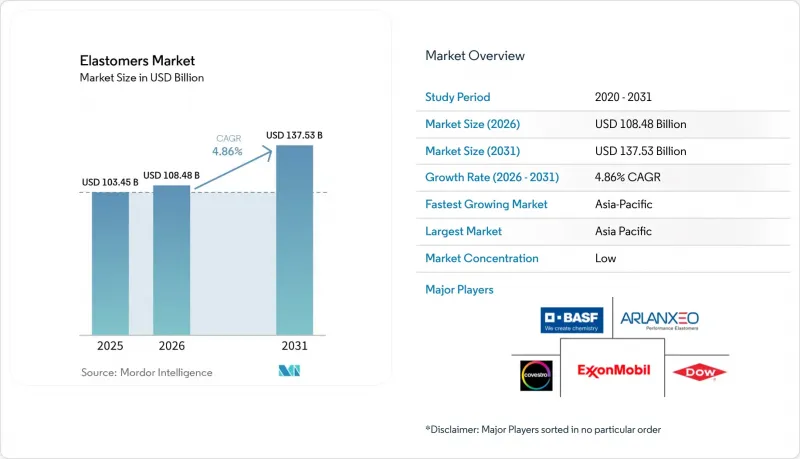
本報告按產品類型(熱可塑性橡膠和熱固性彈性體)、終端用戶產業(汽車和交通運輸、電氣和電子、醫療保健、工業機械和設備等)以及地區(亞太地區、北美地區、歐洲地區、南美地區、中東和非洲)進行細分。市場預測以美元計價。
全球彈性體市場趨勢與洞察
汽車產業對輕量化零件和電動車零件的需求不斷成長
電動車製造商正利用先進的彈性體材料,將電池外殼、懸吊防塵罩和流體管路的重量減輕數公斤,從而直接提升續航里程。例如,Hytrel TPC LCF 等材料在低溫衝擊下仍能保持柔軟性,同時與傳統聚合物相比,碳排放量降低 50%。商用車車隊的擁有者在大型電池組方面也有類似的需求,這推動了高溫密封墊和減振器的多年研發項目。即使在全球乘用車銷量下滑的年份,原始設備製造商 (OEM) 也持續投入研發預算,致力於輕量化密封解決方案,這為彈性體市場帶來了抵禦經濟週期波動的強勁動力。 Cooper Standard 的 Fortrex 平台凸顯了這一趨勢,與 EPDM 相比,其重量減輕了 53%,同時延長了使用壽命。充電站製造商也在推動這項需求,因為彈性體包覆成型的組件必須能夠承受快速充電過程中的熱循環。
亞太地區建築和基礎設施的擴張
在中國、印度和東南亞正在建造的高層建築項目和大型交通走廊中,彈性體密封膠被廣泛應用於伸縮縫、玻璃系統和防水膜中,以確保建築圍護結構的完整性,即使在地震荷載作用下也能保持其性能。政府的綠建築標準鼓勵使用低揮發性有機化合物(VOC)和節能材料,高性能的熱塑性彈性體(TPE)和聚氨酯(PU)密封膠正逐漸成為標準配置。科思創近期在台灣擴大了澆注聚氨酯彈性體的產能,旨在為自動化工廠和風力發電機零件提供原料,從而增強區域自主性。智慧城市的投資正逐步提升對感測器外殼和空氣品質監測器的需求,這些設備需要耐紫外線的彈性體外殼。建築公司傾向於選擇本地生產的彈性體,以避免運輸延誤,這也促使全球彈性體供應商將生產基地設在更靠近終端市場的地方。
原油和原料價格波動
為了維持利潤率,BASF等生產商對關鍵二醇類原料加收了每磅8至10美分的附加費。由於供應緊張,加工商必須謹慎管理庫存,儘管一些加工商正在轉向生物基原料,但數量仍然有限。這些價格波動使得預算編制變得困難,並可能延遲資本投資,可能減緩彈性體市場的短期擴張。
細分市場分析
熱可塑性橡膠(TPE)不僅佔據了彈性體市場81.18%的佔有率,而且預計到2031年將以5.18%的複合年成長率(CAGR)保持最高成長,這得益於其閉合迴路加工潛力,有助於原始設備製造商(OEM)實現其回收目標。這種壓倒性的市場主導地位導致TPE在汽車車窗密封條、線束護套和穿戴式裝置錶帶等關鍵應用領域的重要性日益凸顯,因為它們可以取代交聯橡膠,從而縮短成型週期。
熱固性彈性體在溫度超過 150 度C的應用領域,例如渦輪增壓器軟管和油田封隔器,仍佔有重要地位。然而,即使在這些細分市場,為了兼顧耐化學性和可回收性,採用 TPE 外層與硫化芯材相結合的混合結構也正在被廣泛應用。因此,研究投資的重點在於成核劑、嵌段共聚物設計以及催化劑體系,這些技術能夠將 TPE 的工作溫度提高到 180 度C以上,同時又不影響其疲勞壽命。這些進展可望為彈性體市場帶來更多收益,同時也有助於加工商履行其回收義務。
區域分析
亞太地區佔彈性體市場佔有率的42.15%,以6.27%的複合年成長率 (CAGR) 領先其他所有地區。中國仍然是市場核心參與者,為長三角Delta的高鐵密封件、家用電器密封件和輪胎工廠供應彈性體。在印度,政府主導的產業走廊同樣推動了對資本財的減震墊的需求,而東南亞的電子產業叢集則對用於智慧型手機和平板電腦的耐熱包覆成型材料需求旺盛。
在北美,輕型汽車、醫療設備和頁岩氣基礎設施的整合供應鏈支撐著彈性體市場。針對國內電動車電池工廠的政策激勵措施正在推動阻燃型TPE密封墊片的採購,這些墊片用於密封電池機殼。歐洲正大力推動永續性的轉型,促進採用經ISCC PLUS物料平衡體系檢驗的生物基EPDM和TPE共混物。
南美、中東和非洲的基礎設施投資正在穩步成長。巴西是世界第四大聚氨酯生產國,而沿岸地區的能源計畫則需要耐酸性氣體的彈性體密封。儘管這些地區的絕對規模較小,但隨著供應鏈日益本地化,它們具有長期成長潛力。
其他好處:
- Excel格式的市場預測(ME)表
- 3個月的分析師支持
目錄
第1章:引言
- 研究假設和市場定義
- 調查範圍
第2章:調查方法
第3章執行摘要
第4章 市場狀況
- 市場概覽
- 市場促進因素
- 汽車產業對輕量化零件和電動車零件的需求日益成長。
- 亞太地區的建設與基礎建設
- 熱可塑性橡膠(TPE)在柔軟性家用電子電器。
- 醫用級無PVC管材的使用正在迅速增加。
- 可回收、循環熱可塑性橡膠(TPE)等級的出現。
- 對採用彈性體絲材進行積層製造的需求
- 市場限制因素
- 原油和原料價格波動
- 加強對微塑膠和輪胎磨損的監管
- 生物基彈性體在高溫下的表現差異
- 特種單體供應鏈的集中化
- 價值鏈分析
- 波特五力分析
第5章 市場規模與成長預測
- 依產品類型
- 熱可塑性橡膠
- 熱固性彈性體
- 按最終用戶行業分類
- 汽車和運輸業
- 電氣和電子設備
- 醫療保健
- 工業機械和設備
- 消費品和鞋類
- 黏合劑、密封劑、塗料
- 其他(建築和施工、航太和國防等)
- 按地區
- 亞太地區
- 中國
- 印度
- 日本
- 韓國
- 其他亞太國家
- 北美洲
- 美國
- 加拿大
- 墨西哥
- 歐洲
- 德國
- 英國
- 法國
- 義大利
- 其他歐洲國家
- 南美洲
- 巴西
- 阿根廷
- 其他南美國家
- 中東和非洲
- 沙烏地阿拉伯
- 南非
- 其他中東和非洲國家
- 亞太地區
第6章 競爭情勢
- 市場集中度
- 策略趨勢
- 市佔率分析
- 公司簡介
- Ace Elastomer Co., Ltd.
- Arkema
- ARLANXEO
- Avient Corporation
- BASF
- Covestro AG
- DingZing Advanced Materials Co., Ltd.
- Dow
- Exxon Mobil Corporation
- Firestone Building Products Company
- HEXPOL AB
- Huntsman Corporation
- KRAIBURG TPE GmbH
- Kuraray Co., Ltd.
- Lion Elastomers Co., Ltd
- Mitsui Chemicals, Inc.
- Sirmax SpA
- Suzhou Austin Novel Materials Co., Ltd.
- Teknor Apex, Inc.
- Trinseo LLC
- UBE Corporation
- Wanhua Chemical Group Co., Ltd.
第7章 市場機會與未來展望
According to Mordor Intelligence, the elastomers market size is expected to grow from USD 103.45 billion in 2025 to USD 108.48 billion in 2026 and is forecast to reach USD 137.53 billion by 2031 at 4.86% CAGR over 2026-2031.
This report is Segmented by Product Type (Thermoplastic Elastomers and Thermoset Elastomers), End-User Industry (Automotive and Transportation, Electrical and Electronics, Medical and Healthcare, Industrial Machinery and Equipment, and More), and Geography (Asia-Pacific, North America, Europe, South America, and Middle-East and Africa). The Market Forecasts are Provided in Terms of Value (USD).
Global Elastomers Market Trends and Insights
Growing Demand for Lightweighting and EV Parts in Automotive
Electric-vehicle makers rely on advanced elastomers to shave kilograms from battery housings, suspension boots, and fluid-handling lines, which directly boosts driving range. Materials such as Hytrel TPC LCF cut carbon footprints by 50% compared with incumbent polymers, yet keep flexibility under low-temperature shock. Commercial fleet owners echo the same need in heavy-duty packs, fueling multi-year programs for high-temperature gaskets and vibration isolators. Even in a year when global light-vehicle sales slipped, OEMs funneled research and development budgets toward lightweight sealing solutions, creating a counter-cyclical lift for the Elastomers market. Cooper Standard's Fortrex platform highlights the trend with a 53% mass reduction versus EPDM while extending service life. Charging-station manufacturers add to demand because elastomeric over-mold parts must tolerate thermal cycling during fast charging.
Expansion of Construction and Infrastructure in Asia-Pacific
High-rise projects and mega-transport corridors across China, India, and Southeast Asia use elastomeric sealants to enable movement joints, glazing systems, and waterproof membranes that maintain building envelope integrity under seismic loads. Government green-building codes reward the use of low-VOC, energy-saving materials, turning high-performance TPE and PU sealants into default specifications. Covestro's recent capacity ramp-up in Taiwan for cast polyurethane elastomers is aimed at equipment used in automated factories and wind-turbine components, reinforcing regional self-sufficiency. Smart-city investments generate incremental pulls from sensor housings and air-quality monitors that require UV-stable elastomer skins. Contractors favor locally compounded grades to avoid shipping delays, giving global suppliers a reason to co-locate with end-markets in the Elastomers market.
Volatile Crude Oil and Feedstock Prices
Producers such as BASF implemented 8-10 cents per pound surcharges on key diols to maintain margins. Tight supply obliges converters to balance inventories carefully, and some shift sourcing to bio-based feedstocks, although volumes remain limited. The volatility clouds budgeting and can postpone capital expenditure, dampening near-term expansion of the Elastomers market.
Other drivers and restraints analyzed in the detailed report include:
- Rapid Penetration of Thermoplastic Elastomers in Flexible Consumer Electronics
- Surge in Medical-Grade PVC-Free Tubing Applications
- Stricter Micro-Plastic and Tire-Wear Regulations
For complete list of drivers and restraints, kindly check the Table Of Contents.
Segment Analysis
Thermoplastic elastomers not only own 81.18% share of the Elastomers market but also log the fastest 5.18% CAGR to 2031, thanks to closed-loop reprocessability that helps OEMs hit recycling targets. This dominance means every major automotive window seal, wire harness grommet, and wearable band increasingly relies on TPE, often replacing cross-linked rubber to shorten molding cycles.
Thermoset elastomers maintain footholds where temperatures exceed 150 °C, for instance, in turbocharger hoses and oil-field packers. Yet even in these niches, hybrid concepts mix TPE outer layers with vulcanized cores to marry chemical resistance with recyclability. Research investment, therefore, centers on nucleating agents, block-copolymer design, and catalyst systems that lift the service temperature of TPE beyond 180 °C without eroding fatigue life. Such advances are expected to channel additional revenue into the Elastomers market while helping processors meet take-back mandates.
Complete Report Scope:
- By Product Type
- Thermoplastic Elastomers
- Thermoset Elastomers
- By End-user Industry
- Automotive and Transportation
- Electrical and Electronics
- Medical and Healthcare
- Industrial Machinery and Equipment
- Consumer Goods and Footwear
- Adhesives, Sealants and Coatings
- Others (Building and Construction, Aerospace and Defense, etc)
- By Geography
- Asia-Pacific
- China
- India
- Japan
- South Korea
- Rest of Asia-Pacific
- North America
- United States
- Canada
- Mexico
- Europe
- Germany
- United Kingdom
- France
- Italy
- Rest of Europe
- South America
- Brazil
- Argentina
- Rest of South America
- Middle-East and Africa
- Saudi Arabia
- South Africa
- Rest of Middle-East and Africa
- Asia-Pacific
Geography Analysis
Asia Pacific captures 42.15% of the Elastomers market and outpaces all other regions with a 6.27% CAGR. China remains the centerpiece, channeling elastomers into high-speed rail gaskets, appliance seals, and tire plants clustered along the Yangtze River Delta. India's state-sponsored industrial corridors likewise lift demand for vibration-dampening mounts used in capital equipment, while Southeast Asia's electronics clusters consume heat-resistant over-mold compounds for smartphones and tablets.
North America sustains the Elastomers market through its integrated supply chain for light vehicles, medical devices, and shale-gas infrastructure. Policy incentives for domestic EV battery plants intensify the procurement of flame-retardant TPE gaskets that seal cell enclosures. Europe pivots heavily toward sustainability, driving the adoption of bio-attributed EPDM and TPE blends verified under ISCC PLUS mass-balance systems.
South America, the Middle-East, and Africa post steady gains in infrastructure spending. Brazil's polyurethane output ranks fourth globally, while Gulf energy projects need sour-gas-resistant elastomer seals. Although smaller in absolute terms, these regions provide long-run upside as supply-chain localization continues.
- Ace Elastomer Co., Ltd.
- Arkema
- ARLANXEO
- Avient Corporation
- BASF
- Covestro AG
- DingZing Advanced Materials Co., Ltd.
- Dow
- Exxon Mobil Corporation
- Firestone Building Products Company
- HEXPOL AB
- Huntsman Corporation
- KRAIBURG TPE GmbH
- Kuraray Co., Ltd.
- Lion Elastomers Co., Ltd
- Mitsui Chemicals, Inc.
- Sirmax S.p.A
- Suzhou Austin Novel Materials Co., Ltd.
- Teknor Apex, Inc.
- Trinseo LLC
- UBE Corporation
- Wanhua Chemical Group Co., Ltd.
Additional Benefits:
- The market estimate (ME) sheet in Excel format
- 3 months of analyst support
TABLE OF CONTENTS
1 Introduction
- 1.1 Study Assumptions and Market Definition
- 1.2 Scope of the Study
2 Research Methodology
3 Executive Summary
4 Market Landscape
- 4.1 Market Overview
- 4.2 Market Drivers
- 4.2.1 Growing demand for lightweighting and EV parts in automotive
- 4.2.2 Expansion of construction and infrastructure in Asia Pacific
- 4.2.3 Rapid penetration of Thermoplastic Elastomers (TPEs) in flexible consumer electronics
- 4.2.4 Surge in medical?grade PVC-free tubing applications
- 4.2.5 Emergence of recycling-compatible circular Thermoplastic Elastomers (TPE )grades
- 4.2.6 Additive manufacturing demand for elastomeric filaments
- 4.3 Market Restraints
- 4.3.1 Volatile crude oil and feedstock prices
- 4.3.2 Stricter micro-plastic and tire-wear regulations
- 4.3.3 Performance gap of bio-based elastomers at high-temperature
- 4.3.4 Supply-chain concentration of specialty monomers
- 4.4 Value Chain Analysis
- 4.5 Porter's Five Forces Analysis
- 4.5.1 Bargaining Power of Suppliers
- 4.5.2 Bargaining Power of Buyers
- 4.5.3 Threat of New Entrants
- 4.5.4 Threat of Substitutes
- 4.5.5 Degree of Competition
5 Market Size and Growth Forecasts
- 5.1 By Product Type
- 5.1.1 Thermoplastic Elastomers
- 5.1.2 Thermoset Elastomers
- 5.2 By End-user Industry
- 5.2.1 Automotive and Transportation
- 5.2.2 Electrical and Electronics
- 5.2.3 Medical and Healthcare
- 5.2.4 Industrial Machinery and Equipment
- 5.2.5 Consumer Goods and Footwear
- 5.2.6 Adhesives, Sealants and Coatings
- 5.2.7 Others (Building and Construction, Aerospace and Defense, etc)
- 5.3 By Geography
- 5.3.1 Asia-Pacific
- 5.3.1.1 China
- 5.3.1.2 India
- 5.3.1.3 Japan
- 5.3.1.4 South Korea
- 5.3.1.5 Rest of Asia-Pacific
- 5.3.2 North America
- 5.3.2.1 United States
- 5.3.2.2 Canada
- 5.3.2.3 Mexico
- 5.3.3 Europe
- 5.3.3.1 Germany
- 5.3.3.2 United Kingdom
- 5.3.3.3 France
- 5.3.3.4 Italy
- 5.3.3.5 Rest of Europe
- 5.3.4 South America
- 5.3.4.1 Brazil
- 5.3.4.2 Argentina
- 5.3.4.3 Rest of South America
- 5.3.5 Middle-East and Africa
- 5.3.5.1 Saudi Arabia
- 5.3.5.2 South Africa
- 5.3.5.3 Rest of Middle-East and Africa
- 5.3.1 Asia-Pacific
6 Competitive Landscape
- 6.1 Market Concentration
- 6.2 Strategic Moves
- 6.3 Market Share Analysis
- 6.4 Company Profiles (includes Global level Overview, Market level overview, Core Segments, Financials as available, Strategic Information, Market Rank/Share for key companies, Products and Services, and Recent Developments)
- 6.4.1 Ace Elastomer Co., Ltd.
- 6.4.2 Arkema
- 6.4.3 ARLANXEO
- 6.4.4 Avient Corporation
- 6.4.5 BASF
- 6.4.6 Covestro AG
- 6.4.7 DingZing Advanced Materials Co., Ltd.
- 6.4.8 Dow
- 6.4.9 Exxon Mobil Corporation
- 6.4.10 Firestone Building Products Company
- 6.4.11 HEXPOL AB
- 6.4.12 Huntsman Corporation
- 6.4.13 KRAIBURG TPE GmbH
- 6.4.14 Kuraray Co., Ltd.
- 6.4.15 Lion Elastomers Co., Ltd
- 6.4.16 Mitsui Chemicals, Inc.
- 6.4.17 Sirmax S.p.A
- 6.4.18 Suzhou Austin Novel Materials Co., Ltd.
- 6.4.19 Teknor Apex, Inc.
- 6.4.20 Trinseo LLC
- 6.4.21 UBE Corporation
- 6.4.22 Wanhua Chemical Group Co., Ltd.
7 Market Opportunities and Future Outlook
- 7.1 White-space and Unmet-need Assessment
- 7.2 Shifting Focus toward the Development of Bio-based Products

 2026-2034年全球3D列印彈性體市場規模、佔有率、趨勢與成長分析報告
 航太彈性體市場報告:趨勢、預測與競爭分析(至2035年)
 工業用聚氨酯彈性體市場-2026-2032年全球市場預測3D列印彈性體市場-2026-2032年全球市場預測
 工業聚氨酯彈性體:市場佔有率分析、產業趨勢與統計、成長預測(2026-2031)
 聚烯彈性體市場:依應用和地區分類彈性體市場:2026-2032年全球市場預測(依彈性體類型、聚合製程、產品形式及應用分類)高溫彈性體市場:2026-2032年全球市場預測(依彈性體類型、產品形式、加工技術、應用與最終用途產業分類)全球聚烯彈性體市場規模、佔有率、趨勢和成長分析報告(2026-2034年)
 彈性體市場分析及預測(至2035年):類型、產品、應用、技術、最終用戶、形態、材料類型、組件、製程、安裝類型