


 |
市場調查報告書
商品編碼
2154234
歐洲淨化催化劑:市場佔有率分析、產業趨勢與統計及成長預測(2026-2031)Europe Refining Catalysts - Market Share Analysis, Industry Trends & Statistics, Growth Forecasts (2026 - 2031) |
||||||

※ 本網頁內容可能與最新版本有所差異。詳細情況請與我們聯繫。
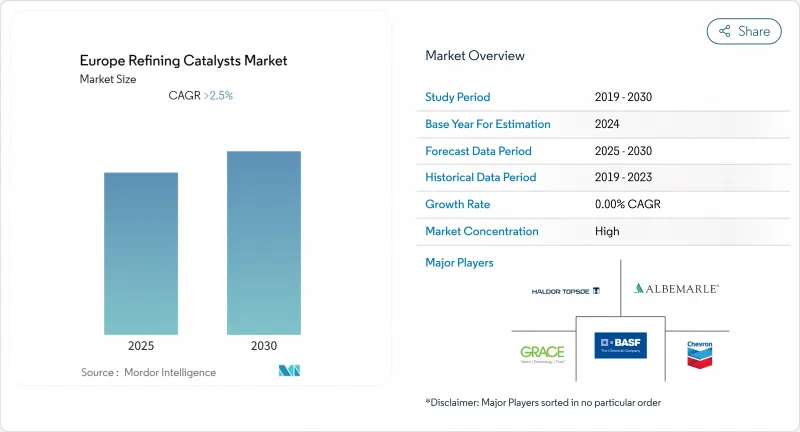
據 Mordor Intelligence 稱,2025 年歐洲純化催化劑市值為 12.6 億美元,預計從 2026 年的 13.1 億美元成長到 2031 年的 16 億美元,預測期(2026-2031 年)的複合年成長率為 4.09%。
歐洲淨化催化劑市場趨勢與洞察
歐洲對燃料中的硫含量和排放氣體製定了更嚴格的規定。
根據歐盟燃料品質指令,在歐盟範圍內銷售的柴油和汽油的硫含量必須低於10ppm。這項要求凸顯了歐洲煉油廠對加氫催化劑處理能力和性能的需求。這也導致歐洲煉油催化劑市場的需求多樣化。生產傳統超低硫柴油的煉油廠使用成熟的鈷鉬和鎳鉬混合催化劑。而加工生物來源基混合原料的煉油廠則需要對高氧濃度和微量金屬污染具有更強耐受性的混合催化劑。為了滿足合規標準帶來的各種產品需求,HoneywellUOP擴展了其用於流體化媒裂(FCC)預處理、柴油、煤油和真空瓦斯油的加氫催化劑產品線。
更換老舊煉油廠的催化劑並解決瓶頸問題
歐洲許多煉油廠的資產都包含老化的設備,其催化劑更換週期與瓶頸消除活動重疊。雖然FCC裝置通常每2-5年需要更換一次催化劑,但固定台加氫反應器的運作週期更長。從2024年起,產能削減將使加工轉移到仍在運作的煉油廠。加工量的增加可能會加速催化劑的失活並縮短更換週期。此外,原油成分的多樣化增加了對FCC催化劑以及耐金屬加氫催化劑的需求。因此,歐洲煉油廠催化劑市場為複雜裝置的升級改造提供了機遇,這些裝置需要應用工程和高活性產品,這與標準催化劑供應不同。
歐洲煉油廠合理化改造和石化燃料需求下降
歐洲煉油廠的關閉減少了催化劑消耗裝置的數量。國際能源總署(IEA)預測,到2030年,歐洲至少有100萬桶/日的煉油產能面臨關閉風險。自2024年初以來,煉油廠的關閉已使運作中的煉油廠網路減少了40萬至50萬桶/日。這些關閉的煉油廠包括蘇格蘭格蘭傑茅斯煉油廠、殼牌公司韋瑟林工廠和英國石油公司蓋爾森基興工廠的蒸餾產能削減。然而,催化劑需求受到的影響與煉油量的減少並非成正比。仍在運作的煉油廠擴大採用流體化媒裂(FCC)、加氫裂解和深度加氫處理設備,這些設備每桶原油的催化劑消耗量高於傳統的、較為簡單的煉油廠。因此,在歐洲煉油催化劑市場,對基礎加氫裂解催化劑的需求可能會下降,而對高性能 FCC 和加氫裂解催化劑的需求預計將保持相對穩定。
細分市場分析
預計到2025年,沸石將佔區域需求的32.86%,並將以4.46%的複合年成長率成長至2031年。這一地位反映了沸石在流體化媒裂(FCC)和加氫裂解中作為活性分解組分的重要作用。超穩定Y型沸石(USY)為FCC設備提供活性分解能力。其大型超籠結構有利於重油中高分子量烴的分解。 ZSM-5可提高低碳烯烴和芳烴化合物的選擇性,並且與USY配合使用時,可使產品組成向汽油和丙烯方向轉變。BASF擁有用於FCC應用的磷穩定MSE(美孚7-11)骨架沸石的專利,該沸石在高分解強度下表現出更優異的水熱穩定性。
Zeolist International公司推出了Opal Renew沸石產品線,拓展了沸石在生物來源原料領域的應用,該產品線專為可再生燃料的加工而設計。 CoMo和NiMo配方在汽油、煤油、柴油、減壓瓦斯油、FCC汽油和殘渣原料的加氫處理中繼續發揮至關重要的作用。由於其成熟的供應鏈、再處理方法和廣泛的供應商基礎,這些產品構成了加氫處理催化劑消費的核心。氧化鋁基貴金屬催化劑在催化重整領域雖然市佔率較小,但利潤豐厚。 NiW級催化劑用於高壓加氫裂解應用,該領域對氮耐受性要求較高。隨著煉油廠混合含氧量和金屬含量更高的原料,歐洲煉油催化劑產業越來越重視改良沸石和雙金屬配方,以延長運作。
其他好處:
- Excel格式的市場預測(ME)表
- 3個月的分析師支持
目錄
第1章:引言
- 研究假設和市場定義
- 調查範圍
第2章:調查方法
第3章執行摘要
第4章 市場狀況
- 市場概覽
- 市場促進因素
- 歐洲加強對燃料中硫含量和排放氣體的監管
- 更換老舊煉油廠的催化劑並消除瓶頸
- 加氫裂解和加氫處理可提高原油和板岩加工的柔軟性。
- 廢棄物與生質能原料的聯合處理
- 數位催化劑的監測與性能最佳化
- 市場限制因素
- 歐洲煉油廠的合理化以及石化燃料需求的下降
- 高昂的製造成本和煉油利潤壓力
- 貴金屬和戰略金屬的價格波動
- 價值鏈分析
- 波特五力分析
- 監理情勢
- 技術展望
第5章 市場規模與成長預測
- 依產品類型
- CoMo
- NiMo
- 氧化鋁基貴金屬
- NiW
- 沸石
- 其他產品
- 透過流程
- 氫處理
- 汽油
- 煤油
- 柴油引擎
- 真空瓦斯油
- 催化裂解汽油
- 剩餘原料
- 流體化媒裂
- 殘渣流化催化裂解
- 加氫裂解
- 氫處理
- 按地區
- 德國
- 英國
- 義大利
- 法國
- 西班牙
- 俄羅斯
- 其他歐洲國家
第6章 競爭情勢
- 市場集中度
- 策略趨勢
- 市佔率和排名分析
- 公司簡介
- Albemarle Corporation
- Axens
- BASF
- Chevron Corporation
- CLARIANT
- DuPont
- Evonik Industries AG
- Exxon Mobil Corporation
- Heraeus Group
- Honeywell International Inc.
- JGC C&C
- Johnson Matthey
- Topsoe
- WR Grace & Co.
- Zeolyst International
第7章 市場機會與未來展望
According to Mordor Intelligence, the Europe refining catalysts market size was valued at USD 1.26 billion in 2025 and is estimated to grow from USD 1.31 billion in 2026 to USD 1.60 billion by 2031, at a CAGR of 4.09% during the forecast period (2026-2031).
Europe Refining Catalysts Market Trends and Insights
Stricter European Fuel-Sulfur and Emissions Requirements
Diesel and gasoline sold across the European Union must comply with a maximum sulfur content of 10 parts per million under the Fuel Quality Directive. This requirement supports demand for hydrotreating catalyst capacity and performance at European refineries. It also creates varying requirements across the European refining catalysts market. Refineries producing conventional ultra-low-sulfur diesel use established cobalt-molybdenum and nickel-molybdenum formulations. Refineries processing biogenic co-feeds require formulations that tolerate higher oxygen levels and trace-metal contamination. Honeywell UOP has expanded its hydrotreating portfolio for fluid catalytic cracking (FCC) pretreatment, diesel, kerosene, and vacuum gas oil applications, reflecting the broader product requirements created by compliance standards.
Catalyst Replacement and Debottlenecking in Aging Refineries
European refining assets include many aging facilities, where catalyst replacement cycles coincide with debottlenecking activities. FCC units generally require catalyst replacement every two to five years, while fixed-bed hydroprocessing reactors operate on longer cycles. Capacity reductions since 2024 have shifted more throughput to refineries that remain operational. Higher throughput can accelerate catalyst deactivation and shorten replacement schedules. A broader crude slate can also increase FCC catalyst top-up requirements and support demand for metals-tolerant hydroprocessing grades. The European refining catalysts market therefore presents upgrade opportunities at complex sites, where application engineering and high-activity products differ from standard catalyst supply.
European Refinery Rationalization and Declining Fossil-Fuel Demand
European refinery closures have reduced the installed base of catalyst-consuming units. The International Energy Agency (IEA) expects at least 1 million barrels per day of European refining capacity to be at risk of closure by 2030. Since early 2024, closures have removed 400,000-500,000 barrels per day from the operating network. These closures include the Grangemouth refinery in Scotland, Shell's Wesseling plant, and a reduction in distillation capacity at BP's Gelsenkirchen site. However, the impact on catalyst demand may not directly correspond to the decline in refining throughput. Surviving refineries are increasingly adopting fluid catalytic cracking (FCC), hydrocracking, and deep hydrotreatment configurations, which consume more catalyst per barrel than simpler refinery operations. Consequently, the Europe refining catalysts market may experience lower demand for basic hydrotreating catalysts, while demand for high-performance FCC and hydrocracking catalyst grades remains comparatively stable.
Other drivers and restraints analyzed in the detailed report include:
- Hydrocracking and Hydrotreating for Crude-Slate Flexibility
- Co-Processing of Waste and Bio-Based Feedstocks
- High Manufacturing Costs and Pressure on Refinery Margins
For complete list of drivers and restraints, kindly check the Table Of Contents.
Segment Analysis
Zeolites held 32.86% of regional demand in 2025 and are projected to grow at a CAGR of 4.46% through 2031. Their position reflects their role as active cracking components in fluid catalytic cracking (FCC) and hydrocracking. Ultra-stable Y zeolite (USY) provides the active cracking function in FCC units. Its large supercage structure supports the cracking of macromolecular hydrocarbons in heavy oil. ZSM-5 improves light-olefin and aromatic selectivity and can be co-loaded with USY to shift the product mix toward gasoline or propylene. BASF has received a patent for phosphorus-stabilized MSE (Mobile Seven Eleven)-framework zeolites for FCC applications, indicating improved hydrothermal stability at higher cracking severity.
Zeolyst International has introduced its Opal Renew zeolite line for processing renewable fuels, extending zeolite applications to biogenic feedstocks. CoMo and NiMo formulations remain important for hydrotreating gasoline, kerosene, diesel, vacuum gas oil, FCC gasoline, and residual feeds. Their established supply chains, regeneration practices, and broad supplier base make them a core component of hydrotreating catalyst consumption. Alumina-based noble-metal catalysts represent a smaller, higher-margin segment in catalytic reforming. NiW grades are used in high-pressure hydrocracking applications that require stronger nitrogen resistance. As refineries blend feedstocks with higher oxygen and metals content, the Europe refining catalysts industry places greater emphasis on modified zeolitic and bimetallic formulations that offer longer campaign stability.
Complete Report Scope:
- By Product Type
- CoMo
- NiMo
- Alumina-Based Noble Metal
- NiW
- Zeolites
- Other Products
- By Process
- Hydrotreating
- Gasoline
- Kerosene
- Diesel
- Vacuum Gas Oil
- Catalytic-Cracking Gasoline
- Residual Feed
- Fluid Catalytic Cracking
- Residue Fluid Catalytic Cracking
- Hydrocracking
- Hydrotreating
- By Geography
- Germany
- United Kingdom
- Italy
- France
- Spain
- Russia
- Rest of Europe
List of Companies Covered in this Report:
- Albemarle Corporation
- Axens
- BASF
- Chevron Corporation
- CLARIANT
- DuPont
- Evonik Industries AG
- Exxon Mobil Corporation
- Heraeus Group
- Honeywell International Inc.
- JGC C&C
- Johnson Matthey
- Topsoe
- W. R. Grace & Co.
- Zeolyst International
Additional Benefits:
- The market estimate (ME) sheet in Excel format
- 3 months of analyst support
TABLE OF CONTENTS
1 Introduction
- 1.1 Study Assumptions and Market Definition
- 1.2 Scope of the Study
2 Research Methodology
3 Executive Summary
4 Market Landscape
- 4.1 Market Overview
- 4.2 Market Drivers
- 4.2.1 Stricter European Fuel-Sulfur and Emissions Requirements
- 4.2.2 Catalyst Replacement and Debottlenecking in Aging Refineries
- 4.2.3 Hydrocracking and Hydrotreating for Crude-Slate Flexibility
- 4.2.4 Co-Processing of Waste and Bio-Based Feedstocks
- 4.2.5 Digital Catalyst Monitoring and Performance Optimization
- 4.3 Market Restraints
- 4.3.1 European Refinery Rationalization and Declining Fossil-Fuel Demand
- 4.3.2 High Manufacturing Costs and Pressure on Refinery Margins
- 4.3.3 Precious-Metal and Strategic-Metal Price Volatility
- 4.4 Value Chain Analysis
- 4.5 Porter's Five Forces Analysis
- 4.5.1 Bargaining Power of Suppliers
- 4.5.2 Bargaining Power of Buyers
- 4.5.3 Threat of New Entrants
- 4.5.4 Threat of Substitutes
- 4.5.5 Competitive Rivalry
- 4.6 Regulatory Landscape
- 4.7 Technological Outlook
5 Market Size and Growth Forecasts (Value)
- 5.1 By Product Type
- 5.1.1 CoMo
- 5.1.2 NiMo
- 5.1.3 Alumina-Based Noble Metal
- 5.1.4 NiW
- 5.1.5 Zeolites
- 5.1.6 Other Products
- 5.2 By Process
- 5.2.1 Hydrotreating
- 5.2.1.1 Gasoline
- 5.2.1.2 Kerosene
- 5.2.1.3 Diesel
- 5.2.1.4 Vacuum Gas Oil
- 5.2.1.5 Catalytic-Cracking Gasoline
- 5.2.1.6 Residual Feed
- 5.2.2 Fluid Catalytic Cracking
- 5.2.3 Residue Fluid Catalytic Cracking
- 5.2.4 Hydrocracking
- 5.2.1 Hydrotreating
- 5.3 By Geography
- 5.3.1 Germany
- 5.3.2 United Kingdom
- 5.3.3 Italy
- 5.3.4 France
- 5.3.5 Spain
- 5.3.6 Russia
- 5.3.7 Rest of Europe
6 Competitive Landscape
- 6.1 Market Concentration
- 6.2 Strategic Moves
- 6.3 Market Share (%)/Ranking Analysis
- 6.4 Company Profiles (includes Global Overview, Market Overview, Core Segments, Financials as available, Strategic Information, Products and Services, and Recent Developments)
- 6.4.1 Albemarle Corporation
- 6.4.2 Axens
- 6.4.3 BASF
- 6.4.4 Chevron Corporation
- 6.4.5 CLARIANT
- 6.4.6 DuPont
- 6.4.7 Evonik Industries AG
- 6.4.8 Exxon Mobil Corporation
- 6.4.9 Heraeus Group
- 6.4.10 Honeywell International Inc.
- 6.4.11 JGC C&C
- 6.4.12 Johnson Matthey
- 6.4.13 Topsoe
- 6.4.14 W. R. Grace & Co.
- 6.4.15 Zeolyst International
7 Market Opportunities and Future Outlook
- 7.1 White-Space and Unmet-Need Assessment

 以茂金屬為基礎的聚乙烯催化劑市場:全球市場預測(2026-2032年)活性基底金屬催化劑市場:全球市場預測(2026-2032年)PEM燃料電池用Pt/C催化劑市場:全球市場預測,2026-2032年催化劑內部電子供體市場:全球市場預測,2026-2032年
 流體化床催化裂解催化劑市場報告:趨勢、預測與競爭分析(至2035年)碳載貴金屬催化劑市場:全球市場預測(2026-2032年)
 北美淨化催化劑:市佔率分析、產業趨勢與統計及成長預測(2026-2031 年)
 鋨市場:依等級、形態、應用和地區分類
 客製化催化劑市場規模、佔有率和成長分析:按催化劑類型、服務類型、應用、最終用戶和地區分類 - 產業預測,2026-2033 年氨分解催化劑:市場佔有率分析、產業趨勢與統計、成長預測(2026-2031)