


 |
市場調查報告書
商品編碼
2154231
北美淨化催化劑:市佔率分析、產業趨勢與統計及成長預測(2026-2031 年)North America Refining Catalysts - Market Share Analysis, Industry Trends & Statistics, Growth Forecasts (2026 - 2031) |
||||||

※ 本網頁內容可能與最新版本有所差異。詳細情況請與我們聯繫。
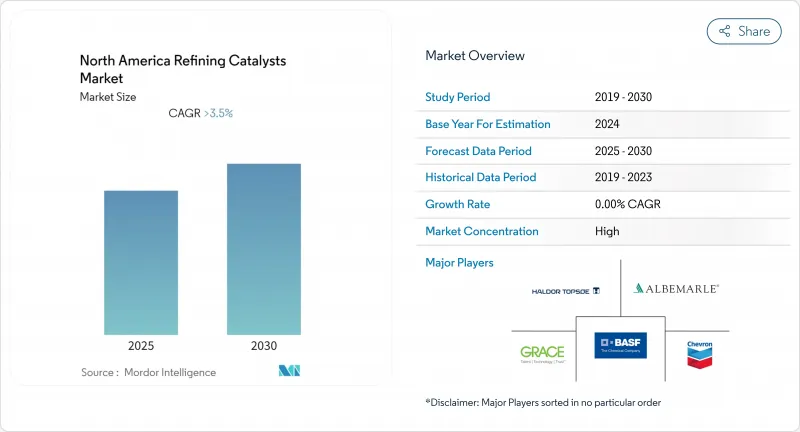
據 Mordor Intelligence 稱,2025 年北美純化催化劑市值為 16.7 億美元,預計到 2031 年將從 2026 年的 17.4 億美元成長至 21.3 億美元,預測期(2026-2031 年)複合年成長率為 4.17%。
北美煉油催化劑市場趨勢與洞察
更嚴格的硫磺和燃油品質標準
美國環保署 (EPA) 的 Tier 3 汽油標準規定,美國供應汽油的年平均含硫量上限為 10 ppm(重量比)。流體化媒裂流體化媒裂(FCC) 石腦油在汽油供應中佔很大比例,也是汽油含硫量的很大一部分,因此 FCC 生產線中的氫氣處理是確保符合監管要求的關鍵環節。提高氫氣處理設備的處理強度可以降低烯烴含量,但會降低辛烷值,這可能需要更高成本的調合成分。這種運作上的平衡導致了對既能提高活性又能保持選擇性的催化劑的需求增加。許多美國煉油廠依賴流體化媒裂汽油後處理設備,而沒有對原料進行預處理,這使得它們容易受到日益嚴格的燃油標準的影響。監管合規成本也促使人們嚴格控制硫性能,從而支撐了北美煉油催化劑市場對催化劑的持續需求。
煉油廠現代化改造與消除二次設備瓶頸
美國墨西哥灣沿岸對二次加工能力的投資持續推動催化劑的需求。瓦萊羅能源公司計劃對其位於德克薩斯州州亞瑟港的AVU-146原油蒸餾裝置進行升級改造,將每日處理能力從23.5萬桶提升至26萬桶,預計2026年初動工。埃克森美孚也宣布對其位於德克薩斯州貝敦的煉油廠進行改造,預計2028年投入運作。現有催化劑層的處理量增加可望縮短循環週期,並提前更換催化劑。即使這些項目沒有新增催化劑裝置,這種影響也將支撐北美煉油催化劑市場。此外,維護活動可能會導致複雜裝置停機並補充催化劑時,催化劑採購量集中出現。
鎳、鉬和貴金屬價格波動
鎳和鉬是用於氫氣處理的鎳鉬催化劑和鈷鉬催化劑的重要成本因素。這些金屬的價格波動會直接影響催化劑的定價和採購預算。當原料成本劇烈波動時,供應商可能會採用與原料指數掛鉤的契約,而不是固定的年度價格。這種做法將部分商品價格波動風險轉移給了煉油廠買家。同樣,用於氧化鋁基貴金屬催化劑的鉑和鈀的供應商也面臨著地域集中的金屬供應問題。這些成本波動會擠壓利潤空間,並使整個北美煉油廠催化劑市場的採購決策變得複雜。
細分市場分析
到2025年,沸石將佔北美煉油催化劑市場32.67%的佔有率,這反映了它們在流體化媒裂催化劑中作為活性裂解成分以及在加氫裂解配方中作為形狀選擇性材料的作用。北美煉油廠催化劑市場中沸石的市佔率成長也得益於煉油廠對提高裂解和轉化設備性能的需求。鎳鉬催化劑用於深度脫硫和分餾氫處理。鈷鉬催化劑用於流體化媒裂石腦油的選擇性脫硫,煉油廠的目標是抑制烯烴飽和度並維持辛烷值。氧化鋁基貴金屬催化劑用於選擇性加氫和重整應用。由於其貴金屬含量高,這些觸媒僅限於小規模、高成本的應用。
預計到2031年,沸石市場將以4.36%的複合年成長率成長。流體化媒裂和石油化工製程的日益融合推動了對ZSM-5添加劑的需求,旨在提高丙烯產量。此外,在加氫裂解裝置中,生質能原料的共處理需要具有適當孔結構和水熱穩定性的沸石。在常規操作條件下,原料中含氧化合物產生的水蒸氣會導致鋁從沸石骨架中脫附。 Zeolyst International公司推出「Opal Renew」產品組合,以滿足可再生燃料催化劑的需求。 Ketjen公司報告稱,其「SaFeGuard」催化劑在為期30天的試驗中將流體化媒裂催化劑的可及性提高了77%,證明了其配方對高負荷原料的有效性。
其他好處:
- Excel格式的市場預測(ME)表
- 3個月的分析師支持
目錄
第1章:引言
- 研究假設和市場定義
- 調查範圍
第2章:調查方法
第3章執行摘要
第4章 市場狀況
- 市場概覽
- 市場促進因素
- 更嚴格的硫磺和燃油品質標準
- 煉油廠現代化改造與消除二次設備瓶頸
- 加工較重且污染較嚴重的原油
- 聯合生產可再生柴油和永續航空燃料
- FCC收率最佳化與石化一體化
- 市場限制因素
- 鎳、鉬和貴金屬價格波動
- 純化裕度的波動與週轉延遲
- 磷和鹼污染導致催化劑循環時間縮短。
- 價值鏈分析
- 波特五力分析
第5章 市場規模與成長預測
- 依產品類型
- 沸石
- CoMo
- NiMo
- 氧化鋁基貴金屬
- NiW
- 其他產品
- 透過流程
- 流體化媒裂
- 氫處理
- 汽油
- 煤油
- 柴油引擎
- 真空瓦斯油
- 催化裂解汽油
- 剩餘原料
- 殘渣流化催化裂解
- 加氫裂解
- 按地區
- 美國
- 加拿大
- 墨西哥
第6章 競爭情勢
- 市場集中度
- 策略趨勢
- 市佔率和排名分析
- 公司簡介
- Albemarle Corporation
- Axens
- BASF
- CLARIANT
- DuPont
- Evonik Industries AG
- Honeywell International Inc.
- JGC C&C
- Johnson Matthey
- Topsoe
- WR Grace & Co.-Conn
- Zeolyst International
第7章 市場機會與未來展望
According to Mordor Intelligence, the North America refining catalysts market size was valued at USD 1.67 billion in 2025 and is estimated to grow from USD 1.74 billion in 2026 to reach USD 2.13 billion by 2031, at a CAGR of 4.17% during the forecast period (2026-2031).
North America Refining Catalysts Market Trends and Insights
Tightening Sulfur and Fuel Quality Standards
The Environmental Protection Agency Tier 3 gasoline program requires a 10 wt ppm annual average sulfur limit for gasoline supplied to the United States. Fluid catalytic cracking naphtha formed a large part of the gasoline pool and contributed a substantial share of gasoline sulfur, which made fluid catalytic cracking-train hydroprocessing an important compliance point. Increasing hydrotreater severity can reduce olefins and lower octane, which can require higher-cost blending components. This operating balance supports demand for catalysts that improve activity while preserving selectivity. Many United States refineries relied on fluid catalytic cracking gasoline post-treaters without a feed pre-treater, leaving them more exposed when fuel specifications became tighter. Compliance costs also create an incentive to manage sulfur performance closely, supporting recurring catalyst demand in the North America refining catalysts market.
Refinery Modernization and Secondary-Unit Debottlenecking
Investment in secondary-unit capacity remains a catalyst-demand driver across the United States Gulf Coast. Valero Energy Corp. planned targeted upgrades to increase the AVU-146 crude distillation unit at Port Arthur, Texas, from 235,000 barrels per day (bpd) to 260,000 bpd, with work beginning in early 2026. Exxon Mobil Corporation also announced a Baytown, Texas, complex reconfiguration that is planned to start up in 2028. Higher throughput through existing catalyst beds can shorten cycle lengths and bring forward replacement needs. That effect supports the North America refining catalysts market, even where projects do not add a new catalyst unit. Maintenance activity can also create concentrated catalyst purchases when complex units are taken offline and reloaded.
Volatility in Nickel, Molybdenum and Precious-Metal Costs
Nickel and molybdenum are important cost inputs for nickel-molybdenum and cobalt-molybdenum hydroprocessing catalysts. Price changes in those metals can directly affect catalyst pricing and procurement budgets. Suppliers may use raw-material index-linked agreements rather than fixed annual prices when input costs move sharply. That approach transfers part of the commodity-price exposure to refinery buyers. Platinum and palladium used in alumina-based noble-metal catalysts also expose suppliers to a geographically concentrated metal supply. These cost movements can constrain margins and complicate purchasing decisions across the North America refining catalysts market.
Other drivers and restraints analyzed in the detailed report include:
- Heavier and More Contaminated Crude Processing
- Renewable Diesel and Sustainable Aviation Fuel Co-Processing
- Refining Margin Volatility and Deferred Turnarounds
For complete list of drivers and restraints, kindly check the Table Of Contents.
Segment Analysis
Zeolites held 32.67% of the North America refining catalysts market in 2025, reflecting their role as active cracking components in fluid catalytic cracking catalysts and as shape-selective materials in hydrocracking formulations. The North America refining catalysts market size for zeolites also benefits from refinery demand for upgraded performance in cracking and conversion units. Nickel-molybdenum formulations are used for deep hydrodesulfurization and distillate hydrotreating. Cobalt-molybdenum grades are used in the selective hydrodesulfurization of fluid catalytic cracking naphtha, where refiners seek to limit olefin saturation and protect octane. Alumina-based noble-metal catalysts serve selective hydrogenation and reforming applications. Their high precious-metal content limits their use to a smaller, premium-priced application base.
Zeolites are projected to advance at a 4.36% CAGR through 2031. Growing fluid catalytic cracking integration with petrochemical operations supports demand for ZSM-5 additives designed for higher propylene production. Bio-feed co-processing in hydrocrackers also requires zeolites with suitable pore structures and hydrothermal stability. Steam formed from feed oxygenates can cause framework dealumination under conventional operating conditions. Zeolyst International offers the Opal Renew portfolio for renewable-fuel catalyst demand. Ketjen reported that its SaFeGuard catalyst improved fluid catalytic cracking catalyst accessibility by 77% in a 30-day trial, demonstrating the relevance of heavy-feed-tolerant formulations.
Complete Report Scope:
- By Product Type
- Zeolites
- CoMo
- NiMo
- Alumina-Based Noble Metal
- NiW
- Other Products
- By Process
- Fluid Catalytic Cracking
- Hydrotreating
- Gasoline
- Kerosene
- Diesel
- Vacuum Gas Oil
- Catalytic-Cracking Gasoline
- Residual Feed
- Residue Fluid Catalytic Cracking
- Hydrocracking
- By Geography
- United States
- Canada
- Mexico
List of Companies Covered in this Report:
- Albemarle Corporation
- Axens
- BASF
- CLARIANT
- DuPont
- Evonik Industries AG
- Honeywell International Inc.
- JGC C&C
- Johnson Matthey
- Topsoe
- W. R. Grace & Co.-Conn
- Zeolyst International
Additional Benefits:
- The market estimate (ME) sheet in Excel format
- 3 months of analyst support
TABLE OF CONTENTS
1 Introduction
- 1.1 Study Assumptions and Market Definition
- 1.2 Scope of the Study
2 Research Methodology
3 Executive Summary
4 Market Landscape
- 4.1 Market Overview
- 4.2 Market Drivers
- 4.2.1 Tightening Sulfur and Fuel Quality Standards
- 4.2.2 Refinery Modernization and Secondary-Unit Debottlenecking
- 4.2.3 Heavier and More Contaminated Crude Processing
- 4.2.4 Renewable Diesel and Sustainable Aviation Fuel Co-Processing
- 4.2.5 FCC Yield Optimization and Petrochemical Integration
- 4.3 Market Restraints
- 4.3.1 Volatility in Nickel, Molybdenum and Precious-Metal Costs
- 4.3.2 Refining Margin Volatility and Deferred Turnarounds
- 4.3.3 Shorter Catalyst Cycles from Phosphorus and Alkali Contamination
- 4.4 Value Chain Analysis
- 4.5 Porter's Five Forces Analysis
- 4.5.1 Threat of New Entrants
- 4.5.2 Bargaining Power of Suppliers
- 4.5.3 Bargaining Power of Buyers
- 4.5.4 Threat of Substitutes
- 4.5.5 Competitive Rivalry
5 Market Size and Growth Forecasts (Value)
- 5.1 By Product Type
- 5.1.1 Zeolites
- 5.1.2 CoMo
- 5.1.3 NiMo
- 5.1.4 Alumina-Based Noble Metal
- 5.1.5 NiW
- 5.1.6 Other Products
- 5.2 By Process
- 5.2.1 Fluid Catalytic Cracking
- 5.2.2 Hydrotreating
- 5.2.2.1 Gasoline
- 5.2.2.2 Kerosene
- 5.2.2.3 Diesel
- 5.2.2.4 Vacuum Gas Oil
- 5.2.2.5 Catalytic-Cracking Gasoline
- 5.2.2.6 Residual Feed
- 5.2.3 Residue Fluid Catalytic Cracking
- 5.2.4 Hydrocracking
- 5.3 By Geography
- 5.3.1 United States
- 5.3.2 Canada
- 5.3.3 Mexico
6 Competitive Landscape
- 6.1 Market Concentration
- 6.2 Strategic Moves
- 6.3 Market Share (%)/Ranking Analysis
- 6.4 Company Profiles (includes Global Overview, Market Overview, Core Segments, Financials as available, Strategic Information, Products and Services, and Recent Developments)
- 6.4.1 Albemarle Corporation
- 6.4.2 Axens
- 6.4.3 BASF
- 6.4.4 CLARIANT
- 6.4.5 DuPont
- 6.4.6 Evonik Industries AG
- 6.4.7 Honeywell International Inc.
- 6.4.8 JGC C&C
- 6.4.9 Johnson Matthey
- 6.4.10 Topsoe
- 6.4.11 W. R. Grace & Co.-Conn
- 6.4.12 Zeolyst International
7 Market Opportunities and Future Outlook
- 7.1 White-Space and Unmet-Need Assessment

 以茂金屬為基礎的聚乙烯催化劑市場:全球市場預測(2026-2032年)活性基底金屬催化劑市場:全球市場預測(2026-2032年)PEM燃料電池用Pt/C催化劑市場:全球市場預測,2026-2032年催化劑內部電子供體市場:全球市場預測,2026-2032年
 流體化床催化裂解催化劑市場報告:趨勢、預測與競爭分析(至2035年)碳載貴金屬催化劑市場:全球市場預測(2026-2032年)
 歐洲淨化催化劑:市場佔有率分析、產業趨勢與統計及成長預測(2026-2031)
 鋨市場:依等級、形態、應用和地區分類
 客製化催化劑市場規模、佔有率和成長分析:按催化劑類型、服務類型、應用、最終用戶和地區分類 - 產業預測,2026-2033 年氨分解催化劑:市場佔有率分析、產業趨勢與統計、成長預測(2026-2031)