


 |
市場調查報告書
商品編碼
2119282
氨分解催化劑:市場佔有率分析、產業趨勢與統計、成長預測(2026-2031)Ammonia Cracking Catalysts - Market Share Analysis, Industry Trends & Statistics, Growth Forecasts (2026 - 2031) |
||||||

※ 本網頁內容可能與最新版本有所差異。詳細情況請與我們聯繫。
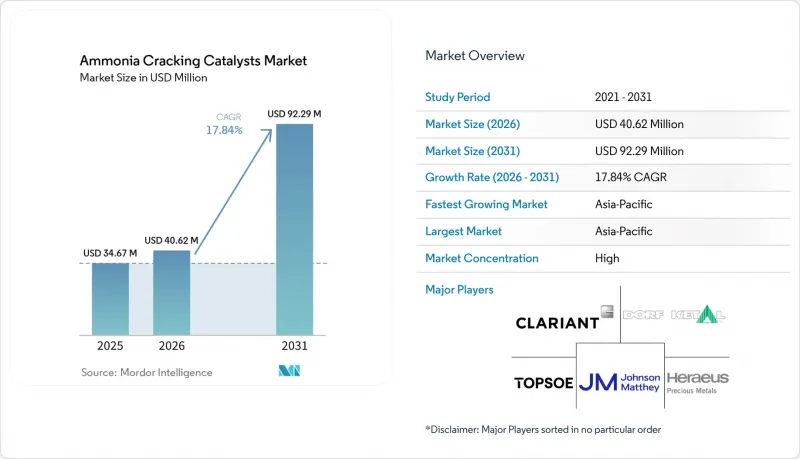
據 Mordor Intelligence 稱,氨分解催化劑市場預計在 2025 年價值 3,467 萬美元,預計到 2031 年將從 2026 年的 4,062 萬美元成長到 9,229 萬美元,在預測期(2026-2031 年)內的複合年成長率為 17.84%。
本報告按催化劑類型(鎳基催化劑、釕及其他貴金屬(PGM)催化劑、鐵基催化劑等)、應用領域(工業製氫、燃料電池及交通運輸、發電、化學原料及其他應用)和地區(亞太地區、北美地區、歐洲地區、南美地區以及中東和非洲地區)進行細分。市場預測以美元計價。
全球氨分解催化劑市場趨勢及洞察
需要氨氫化轉化的氫氣進口中心
在歐洲和東北亞,正在建設相關設施,以推動氨裂解製程從專業化製程向大規模的商業化營運轉型。每個終端都具備維持長期催化劑供應關係的能力。液化空氣集團於2025年11月在安特衛普布魯日啟動了一座每日處理量30噸的氨裂解先導工廠。運作項目為營運商規劃未來進口設施的規模提供了標竿。日本和韓國的集中式專案旨在向工業管道輸送氫氣,從而為多個客戶提供服務。由於催化劑填料需要每3至7年更換一次,因此即使在終端投入運作後,氨裂解催化劑市場仍受益於持續的需求。
工業脫碳及對高純度氫的需求
2024年全球氫氣需求量接近1億噸,但低排放氫氣的使用量不足總使用量的1%。鋼鐵、玻璃、化學和煉製產業的用戶日益需要純度超過99.9%的氫氣以確保運作相容性。催化裂解和變壓式吸附相結合可以滿足工業設施的這一需求。據Topsaw公司稱,其H2Retake製程可在30巴(表壓)下達到高達99.999%的氫氣純度。隨著碳成本的上升,港口地區的使用者無需更換核心製程設備,即可將天然氣重整製氫的氫氣替換為進口氨裂解氫氣的氫氣。 2026年的科學研究表明,將氨裂解、自熱重整和固體氧化物電解結合可以降低石化產業叢集的氫氣成本。
釕和貴金屬的成本風險
對於採用傳統金屬負載量的催化劑而言,釕的成本是重要的阻礙因素。生產到2025年,全球原生釕產量將達3,100萬噸,其中超過90%來自南非的布希維爾德火成岩雜岩體。這種供應集中度限制了礦山快速響應不斷成長的需求的能力。 Amogy公司的低釕催化劑和三菱重工的非貴金屬HyMACS催化劑展示了供應商如何降低此風險。因此,預計氨分解催化劑市場將同時青睞高品質的低溫配方和低金屬含量的替代產品。
細分市場分析
預計到2025年,鎳基催化劑將佔據氨分解催化劑市場42.67%的佔有率。這一地位反映了鎳基催化劑在大規模工業裂解裝置中長期穩定的運作記錄,以及其在管式燃燒系統中耐受高溫環境的能力。 Topsaw公司的「DNK-30 Retake」和「DNK-40 Retake」催化劑已在工業標準裝置中累積了超過30萬小時的運作經驗。這兩款產品分別針對管式燃燒裂解裝置的不同工況而設計。鐵基材料在重水裝置中佔據著一定的市場佔有率,因為鈷鐵催化劑的化學性質與該裝置的運作條件相適應。鈷基和鉬基催化劑作為低成本的雙金屬催化劑,也日益受到重視。
預計2026年至2031年間,釕和其他鉑族金屬催化劑的年複合成長率將達到19.55%。這些催化劑在低溫性能方面表現優異,可用於燃料電池和移動出行等應用領域的小型裂解裝置,而高溫鎳反應器在這些應用中並不實用。 2025年5月,賀利氏貴金屬公司完成了一項研發項目,旨在開發能夠在工業實際條件下耐受氨分解的穩定釕催化劑。根據2025年的研究,一種氧化鋁負載的CoNi催化劑在500 度C下,在分散系統的條件下實現了95%的氨分解率。 2025年2月,韓國化學研究院報告稱,一種鈷鐵基層狀雙氧化物催化劑在450 度C下實現了81.9%的氨製氫轉化率。 2025 年 7 月,韓國能源研究院報告稱,釕合成使氫氣產量提高了 1.7 倍,活化能降低了 20%。
區域分析
亞太地區預計在2025年佔全球銷售額的36.34%,並預計到2031年將以20.80%的複合年成長率成長。由於該地區氫氣進口計畫和催化劑研發的雙重推動,預計將在2026年成為氫氣的主要需求區域。韓國的目標是到2030年每年進口400萬噸氨。其氨基礎設施為氫氣進口提供了實質的基礎。日本正透過新能源產業技術綜合開發機構(NEDO)支持的項目推動國內技術發展。 Amogy和JGC控股公司於2025年4月投產了先導工廠。三菱重工和日本觸媒於2025年10月運作NEDO的供應鏈開發案。
在歐洲,德國正大力推動多個進口碼頭項目,而比利時和荷蘭則受益於萊茵-斯海爾德河港口叢集。液化空氣集團位於安特衛普-布魯日的先導工廠計畫於2025年11月投產,每日處理氨30噸。德國也為反應器溫度控管和不含貴金屬的催化劑的研究提供公共支援。這些努力正在增強歐洲在觸媒技術領域的能力。
在北美,需求趨勢預計將較為溫和,主要集中在工業氫氣和早期氨共燒項目。美國墨西哥灣沿岸地區正在發展藍氨出口供應鏈,這可能會在進口地區催生回流裂解需求。南美洲,特別是巴西和阿根廷,仍然是極具潛力的氨生產地區。中東和非洲也扮演越來越重要的生產和供應區域的角色,而非主要的裂解市場。沙烏地阿拉伯正在發展氨出口產能。南非在催化劑供應方面發揮上游作用,因為它是該地區主要的初級釕生產國。
其他好處:
- Excel格式的市場預測(ME)表
- 3個月的分析師支持
目錄
第1章:引言
- 研究假設和市場定義
- 調查範圍
第2章:調查方法
第3章執行摘要
第4章 市場狀況
- 市場概覽
- 市場促進因素
- 需要氨氫化轉化的氫氣進口中心
- 工業脫碳及對高純度氫的需求
- 現有的氨儲存、運輸和處理基礎設施
- 分散式發電和燃料電池的應用領域不斷拓展
- 低溫催化劑和熱整合技術的創新
- 港口對氫氣的需求推動了裂解裝置的錨泊作業的發展。
- 市場限制因素
- 釕和貴金屬的成本風險
- 高吸熱負荷和複雜的能源整合
- 氨中毒、防滑措施和授權要求
- 催化劑暴露於水、氫氣和雜質中會失去活性。
- 價值鏈分析
- 波特五力模型
第5章 市場規模與成長預測
- 按催化劑類型
- 鎳基催化劑
- 釕和其他鉑族金屬催化劑
- 鐵基催化劑
- 鈷基和鉬基催化劑
- 其他催化劑
- 透過使用
- 工業氫氣
- 燃料電池與移動性
- 發電
- 化工原料
- 其他用途
- 按地區
- 亞太地區
- 中國
- 印度
- 日本
- 韓國
- 東南亞國協
- 其他亞太國家
- 北美洲
- 美國
- 加拿大
- 墨西哥
- 歐洲
- 德國
- 英國
- 法國
- 義大利
- 北歐國家
- 俄羅斯
- 其他歐洲國家
- 南美洲
- 巴西
- 阿根廷
- 其他南美國家
- 中東和非洲
- 沙烏地阿拉伯
- 南非
- 其他中東和非洲國家
- 亞太地區
第6章 競爭情勢
- 市場集中度
- 策略趨勢
- 市佔率和排名分析
- 公司簡介
- AMOGY Inc.
- Casale SA
- Catator AB
- CLARIANT
- Dorf Ketal
- Evonik Industrues AG
- HEESUNG CATALYSTS CORP
- Heraeus Precious Metals
- Honeywell International Inc.
- Johnson Matthey
- Nikki-Universal Co., Ltd.
- TANAKA PRECIOUS METAL GROUP Co., Ltd.
- thyssenkrupp Uhde GmbH
- Topsoe
- UNICAT Catalyst Technologies, LLC
第7章 市場機會與未來展望
According to Mordor Intelligence, the ammonia cracking catalysts market was valued at USD 34.67 million in 2025 and is estimated to grow from USD 40.62 million in 2026 to reach USD 92.29 million by 2031, at a CAGR of 17.84% during the forecast period (2026-2031).
This report is Segmented by Catalyst (Nickel-Based Catalysts, Ruthenium and Other PGM Catalysts, Iron-Based Catalysts, and More), End-Use (Industrial Hydrogen, Fuel Cell and Mobility, Power Generation, Chemical Feedstock, and Other End-Uses), and Geography (Asia-Pacific, North America, Europe, South America, and Middle-East and Africa). The Market Forecasts are Provided in Terms of Value (USD).
Global Ammonia Cracking Catalysts Market Trends and Insights
Hydrogen Import Hubs Requiring Ammonia-to-Hydrogen Conversion
Europe and Northeast Asia are building facilities that can move ammonia cracking from a specialized process to larger commercial operations. Each terminal can support a long-term catalyst supply relationship. Air Liquide commissioned its 30-metric ton-per-day cracking pilot at Antwerp-Bruges in November 2025. The project gives operators a plant-scale reference point while they plan future import facilities. Centralized projects in Japan and South Korea are designed to send hydrogen into industrial pipelines serving several customers. The ammonia cracking catalysts market benefits because catalyst fills need replacement every 3 to 7 years, creating recurring demand after a terminal enters service.
Industrial Decarbonization and High-Purity Hydrogen Demand
Global hydrogen demand reached nearly 100 million metric tons in 2024, while low-emissions hydrogen represented less than 1% of total use. Steel, glass, chemicals, and refining users increasingly require hydrogen purity above 99.9% for compatible operations. Catalytic cracking paired with pressure swing adsorption can meet this need at industrial facilities. Topsoe states that its H2Retake process can deliver hydrogen purity of up to 99.999% at 30 bar gauge. Port-based users can switch from natural-gas-reforming hydrogen to imported cracked-ammonia hydrogen without changing their core process equipment as carbon costs rise. A 2026 scientific study found that integrated ammonia cracking, autothermal reforming, and solid oxide electrolysis can reduce hydrogen costs in petrochemical clusters.
Ruthenium and Precious-Metal Cost Exposure
Ruthenium costs are a material constraint for catalysts using conventional metal loading levels. Global primary ruthenium production was 31 metric tons in 2025, with more than 90% of output coming from South Africa's Bushveld Igneous Complex. This supply concentration gives mines a limited ability to respond quickly to a demand increase. Amogy's low-ruthenium catalyst and Mitsubishi Heavy Industries' non-precious-metal HyMACS catalyst show how suppliers are reducing this exposure. The ammonia cracking catalysts market is therefore likely to support both premium low-temperature formulations and lower-metal alternatives.
Other drivers and restraints analyzed in the detailed report include:
- Existing Ammonia Storage, Shipping and Handling Infrastructure
- Growth of Distributed Power and Fuel-Cell Applications
- High Endothermic Heat Duty and Energy-Integration Complexity
For complete list of drivers and restraints, kindly check the Table Of Contents.
Segment Analysis
Nickel-based catalysts held 42.67% of the ammonia cracking catalysts market share in 2025. Their position reflects long operating experience in large industrial crackers and their resilience at the temperatures used in tubular-fired equipment. Topsoe's DNK-30 Retake and DNK-40 Retake catalysts have accumulated more than 300,000 operating hours in industrial reference plants. The two products are designed for different sections of a tubular-fired cracker. Iron-based materials retain a niche in heavy-water plants where cobalt-iron chemistry suits operating conditions. Cobalt- and molybdenum-based systems are also receiving attention as lower-cost bimetallic alternatives.
Ruthenium and other PGM catalysts are forecast to grow at a 19.55% CAGR from 2026 to 2031. Their lower-temperature performance supports compact crackers for fuel cell and mobility uses where high-temperature nickel reactors are less practical. Heraeus Precious Metals completed an R&D program in May 2025 that produced a stable ruthenium catalyst for ammonia cracking under industrially relevant conditions. A 2025 study found that CoNi catalysts on alumina achieved 95% ammonia decomposition at 500 °C in conditions relevant to decentralized systems. The Korea Chemical Research Institute reported 81.9% ammonia-to-hydrogen conversion at 450 °C for a cobalt-iron layered double oxide catalyst in February 2025. The Korea Institute of Energy Research also reported 1.7 times higher hydrogen yield and 20% lower activation energy from a ruthenium synthesis method in July 2025.
Complete Report Scope:
- By Catalyst
- Nickel-Based Catalysts
- Ruthenium and Other PGM Catalysts
- Iron-Based Catalysts
- Cobalt- and Molybdenum-Based Catalysts
- Other Catalysts
- By End-Use
- Industrial Hydrogen
- Fuel Cell and Mobility
- Power Generation
- Chemical Feedstock
- Other End-Uses
- By Geography
- Asia-Pacific
- China
- India
- Japan
- South Korea
- ASEAN Countries
- Rest of Asia-Pacific
- North America
- United States
- Canada
- Mexico
- Europe
- Germany
- United Kingdom
- France
- Italy
- NORDIC Countries
- Russia
- Rest of Europe
- South America
- Brazil
- Argentina
- Rest of South America
- Middle-East and Africa
- Saudi Arabia
- South Africa
- Rest of Middle-East and Africa
- Asia-Pacific
Geography Analysis
Asia-Pacific held 36.34% of global revenue in 2025 and is expected to grow at a 20.80% CAGR through 2031. The region is the central demand area in 2026 because it combines hydrogen-import planning with catalyst development. South Korea targets ammonia imports of 4 million metric tons per year by 2030. Its ammonia infrastructure offers a practical basis for hydrogen imports. Japan is supporting domestic technology development through New Energy and Industrial Technology Development Organization (NEDO)-backed programs. Amogy and JGC Holdings deployed a low-ruthenium catalyst pilot in April 2025. Mitsubishi Heavy Industries and Nippon Shokubai were selected for a NEDO supply-chain development project in October 2025.
In Europe, Germany is advancing multiple import-terminal plans, while Belgium and the Netherlands benefit from the Rhine-Scheldt port cluster. Air Liquide's November 2025 Antwerp-Bruges pilot processed 30 metric tons of ammonia per day. Germany also has publicly supported research activity in reactor heat management and precious-metal-free catalysts. These efforts strengthen Europe's capability in the catalyst technology tier.
North America has a more gradual demand profile centered on industrial hydrogen and early ammonia co-firing activity. The U.S. Gulf Coast is developing blue-ammonia export supply chains that can create return-flow cracking demand in importing regions. South America remains a prospective ammonia production area, particularly in Brazil and Argentina. The Middle-East and Africa are also more important as production and supply regions than as major cracking markets. Saudi Arabia is developing ammonia production capacity for export. South Africa's majority share of primary ruthenium output gives the region an upstream role in catalyst supply.
- AMOGY Inc.
- Casale SA
- Catator AB
- CLARIANT
- Dorf Ketal
- Evonik Industrues AG
- HEESUNG CATALYSTS CORP
- Heraeus Precious Metals
- Honeywell International Inc.
- Johnson Matthey
- Nikki-Universal Co., Ltd.
- TANAKA PRECIOUS METAL GROUP Co., Ltd.
- thyssenkrupp Uhde GmbH
- Topsoe
- UNICAT Catalyst Technologies, LLC
Additional Benefits:
- The market estimate (ME) sheet in Excel format
- 3 months of analyst support
TABLE OF CONTENTS
1 Introduction
- 1.1 Study Assumptions and Market Definition
- 1.2 Scope of the Study
2 Research Methodology
3 Executive Summary
4 Market Landscape
- 4.1 Market Overview
- 4.2 Market Drivers
- 4.2.1 Hydrogen Import Hubs Requiring Ammonia-to-Hydrogen Conversion
- 4.2.2 Industrial Decarbonization and High-Purity Hydrogen Demand
- 4.2.3 Existing Ammonia Storage, Shipping and Handling Infrastructure
- 4.2.4 Growth of Distributed Power and Fuel-Cell Applications
- 4.2.5 Low-Temperature Catalyst and Heat-Integration Innovation
- 4.2.6 Port-Based Hydrogen Demand Creating Cracker Anchor Loads
- 4.3 Market Restraints
- 4.3.1 Ruthenium and Precious-Metal Cost Exposure
- 4.3.2 High Endothermic Heat Duty and Energy-Integration Complexity
- 4.3.3 Ammonia Toxicity, Slip Control and Permitting Requirements
- 4.3.4 Catalyst Deactivation Under Water, Hydrogen and Impurity Exposure
- 4.4 Value Chain Analysis
- 4.5 Porter's Five Forces
- 4.5.1 Threat of New Entrants
- 4.5.2 Bargaining Power of Suppliers
- 4.5.3 Bargaining Power of Buyers
- 4.5.4 Threat of Substitutes
- 4.5.5 Competitive Rivalry
5 Market Size and Growth Forecasts (Value)
- 5.1 By Catalyst
- 5.1.1 Nickel-Based Catalysts
- 5.1.2 Ruthenium and Other PGM Catalysts
- 5.1.3 Iron-Based Catalysts
- 5.1.4 Cobalt- and Molybdenum-Based Catalysts
- 5.1.5 Other Catalysts
- 5.2 By End-Use
- 5.2.1 Industrial Hydrogen
- 5.2.2 Fuel Cell and Mobility
- 5.2.3 Power Generation
- 5.2.4 Chemical Feedstock
- 5.2.5 Other End-Uses
- 5.3 By Geography
- 5.3.1 Asia-Pacific
- 5.3.1.1 China
- 5.3.1.2 India
- 5.3.1.3 Japan
- 5.3.1.4 South Korea
- 5.3.1.5 ASEAN Countries
- 5.3.1.6 Rest of Asia-Pacific
- 5.3.2 North America
- 5.3.2.1 United States
- 5.3.2.2 Canada
- 5.3.2.3 Mexico
- 5.3.3 Europe
- 5.3.3.1 Germany
- 5.3.3.2 United Kingdom
- 5.3.3.3 France
- 5.3.3.4 Italy
- 5.3.3.5 NORDIC Countries
- 5.3.3.6 Russia
- 5.3.3.7 Rest of Europe
- 5.3.4 South America
- 5.3.4.1 Brazil
- 5.3.4.2 Argentina
- 5.3.4.3 Rest of South America
- 5.3.5 Middle-East and Africa
- 5.3.5.1 Saudi Arabia
- 5.3.5.2 South Africa
- 5.3.5.3 Rest of Middle-East and Africa
- 5.3.1 Asia-Pacific
6 Competitive Landscape
- 6.1 Market Concentration
- 6.2 Strategic Moves
- 6.3 Market Share (%)/Ranking Analysis
- 6.4 Company Profiles (includes Global Overview, Market Overview, Core Segments, Financials as available, Strategic Information, Products and Services, and Recent Developments)
- 6.4.1 AMOGY Inc.
- 6.4.2 Casale SA
- 6.4.3 Catator AB
- 6.4.4 CLARIANT
- 6.4.5 Dorf Ketal
- 6.4.6 Evonik Industrues AG
- 6.4.7 HEESUNG CATALYSTS CORP
- 6.4.8 Heraeus Precious Metals
- 6.4.9 Honeywell International Inc.
- 6.4.10 Johnson Matthey
- 6.4.11 Nikki-Universal Co., Ltd.
- 6.4.12 TANAKA PRECIOUS METAL GROUP Co., Ltd.
- 6.4.13 thyssenkrupp Uhde GmbH
- 6.4.14 Topsoe
- 6.4.15 UNICAT Catalyst Technologies, LLC
7 Market Opportunities and Future Outlook
- 7.1 White-Space and Unmet-Need Assessment

 2026-2030年全球氫燃料電池催化劑市場
 2026-2030年全球燃料電池催化劑市場
 貴金屬催化劑市場規模、佔有率和成長分析:按金屬類型、應用、形態、最終用戶、催化劑相和地區分類-2026-2033年產業預測
 催化劑市場規模、佔有率、成長、全球產業分析、區域趨勢及2026-2034年預測。
 永續觸媒技術市場預測至2034年-按催化劑類型、永續性承諾、製程、應用、最終用戶和地區分類的全球分析
 貴金屬催化劑:市場佔有率分析、產業趨勢與統計、成長預測(2026-2031)石油煉製催化劑:市場佔有率分析、產業趨勢與統計、成長預測(2026-2031)
 貴金屬催化劑市場-2026-2032年全球市場預測催化劑市場:2026-2032年全球市場預測(依產品類型、材料類型、反應類型、形態、最終用途及分銷通路分類)
 全球費托催化劑市場報告:2021-2032年歷史績效及預測