


 |
市場調查報告書
商品編碼
2154228
北美油漆和塗料添加劑:市場佔有率分析、行業趨勢和統計數據以及成長預測(2026-2031 年)North America Paints and Coatings Additives - Market Share Analysis, Industry Trends & Statistics, Growth Forecasts (2026 - 2031) |
||||||

※ 本網頁內容可能與最新版本有所差異。詳細情況請與我們聯繫。
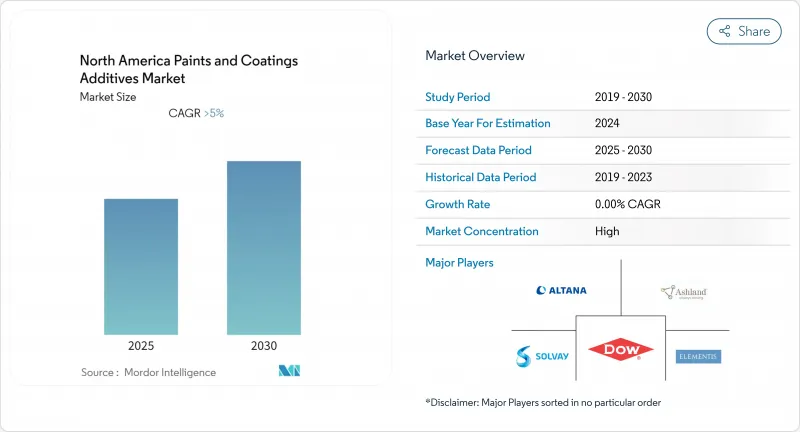
據 Mordor Intelligence 稱,2025 年北美油漆和塗料添加劑市值為 28.5 億美元,預計到 2031 年將達到 38.5 億美元,而 2026 年為 30 億美元,預測期(2026-2031 年)的複合年成長率為 5.12%。
北美油漆和塗料添加劑市場趨勢及洞察。
向水性及低VOC塗料過渡
根據《聯邦法規彙編》(CFR)第40篇第59節,國家揮發性有機化合物(VOC)排放標準於2025年1月進行了修訂,引入了基於產品重量的反應性限值,適用於相關的消費品和商用產品。這項變更進一步強調了單位重量VOC含量的重要性,同時也強調了無芯香料和消泡劑的重要性,因為它們可以降低臭氧生成的可能性。在水性系統中,分散劑和穩定劑必不可少,因為水不像溶劑那樣能夠溶解樹脂。隨著製造商轉向水性配方,這項要求導致每單位成品塗料所需的添加劑用量增加。專業承包商也傾向於選擇低氣味、不含烷基酚聚氧乙烯醚且VOC含量接近零的產品,這進一步提高了配方要求。在加拿大,《某些產品的VOC濃度限制條例》提供了類似的指南,進一步加強了北美塗料添加劑市場對區域合規性的關注。
基礎設施維修與非住宅建築
聯邦橋樑數據顯示,美國許多橋樑仍需維護,凸顯了對維護和重新塗裝工程的需求。橋樑、公路和水利設施所使用的防護系統需要滿足性能規範,並享有10-15年的保固期。這些要求提升了流變改性劑、沉降抑制劑和腐蝕抑制劑在塗料產品中的作用。因此,北美油漆和塗料添加劑市場受益於公共基礎設施項目根據預算分配計劃而非家庭消費趨勢實施的情況。高品質的添加劑組合對於在指定的使用壽命內保持塗層一致性、耐腐蝕性和漆膜品質至關重要。本研究使供應商能夠了解塗層專案在規劃、採購和維護週期中未來幾年的需求。
原物料價格波動
由於大多數合成塗料添加劑都使用石油化學中間體,生產商極易受到原料供應和成本波動的影響。美國對部分特種化學品進口關稅的調整,加上原物料價格上漲,進一步加劇了供應鏈的壓力。二氧化鈦仍然是顏料配方中的關鍵成本指標,而鈦鐵礦供應緊張和硫酸成本上漲正在影響塗料價值鏈。製造商可能需要3-6個月的時間才能讓客戶接受價格上漲,這意味著利潤率受到的影響將先於業務復甦。根據《有毒物質管制法》(TSCA) 的規定,當製造商嘗試在新特種化學品中取代原料時,生產前通知程序可能會耗費大量時間。北美油漆和塗料添加劑市場最為脆弱,缺乏製造商快速轉換供應商所需的規模和已通過核准的替代品。
細分市場分析
到2025年,消泡劑和脫氣劑的需求將佔26.56%。在建築和工業水性塗料中,泡沫控制難以替代,因為它會影響混合、施工和塗膜品質。水性系統在高剪切加工和施工過程中比溶劑型系統產生更多泡沫。因此,每增加一單位水性塗料,都需要可靠的消泡措施。贏創工業集團的矽氧烷基消泡劑濃縮液TEGO Foamex 8051因其在永續水性塗料中的應用而備受認可,並榮獲2026年凌希耶塗料產業創新獎。
低VOC塗料需要高顏料密度和穩定的分散性,因此分散劑和潤濕劑仍然至關重要。 2026年7月,路博潤推出了二氧化鈦和無機顏料系統的Solsperse 82510和Solsperse 84510。殺菌劑有助於建築塗料中罐裝和乾燥漆膜的保存,特別是在潮濕環境中。流變改性劑、穩定劑、表面改質劑和流平劑可滿足配方變化帶來的黏度、穩定性和外觀要求。隨著配方設計人員以不含PFAS的流平劑取代含氟界面活性劑體系,這些產品正日益受到關注。
其他好處:
- Excel格式的市場預測(ME)表
- 3個月的分析師支持
目錄
第1章:引言
- 研究假設和市場定義
- 調查範圍
第2章:調查方法
第3章執行摘要
第4章 市場狀況
- 市場概覽
- 市場促進因素
- 過渡到水性低揮發性有機化合物塗料
- 基礎設施更新和非住宅建築
- 汽車和電動汽車塗料市場的成長
- 對高性能、多功能添加劑的需求
- 生物基和不含 PFAS 的添加劑在配方中的合格
- 市場限制因素
- 原物料價格波動
- 與監管測試和產品註冊相關的成本
- 藥品核准的漫長過程。
- 價值和供應鏈分析
- 波特五力分析
第5章 市場規模與成長預測
- 按類型
- 消泡劑和脫氣劑
- 除生物劑
- 分散劑和潤濕劑
- 流變改性劑
- 表面改質劑
- 穩定器
- 流動性和流平性添加劑
- 其他類型
- 透過使用
- 大樓
- 樹
- 運輸
- 為了保護
- 其他用途
- 按地區
- 美國
- 加拿大
- 墨西哥
第6章 競爭情勢
- 市場集中度
- 策略趨勢
- 市佔率和排名分析
- 公司簡介
- Allnex GMBH
- ALTANA AG
- Arkema
- Ashland
- BASF
- Cabot Corporation
- CLARIANT
- Dow
- Eastman Chemical Company
- Elementis PLC
- Evonik Industries AG
- Lubrizol
- Momentive
- Nouryon
- Solvay
第7章 市場機會與未來展望
According to Mordor Intelligence, the North America paints and coatings additives market size was valued at USD 2.85 billion in 2025 and is estimated to grow from USD 3.00 billion in 2026 to reach USD 3.85 billion by 2031, at a CAGR of 5.12% during the forecast period (2026-2031).
North America Paints and Coatings Additives Market Trends and Insights
Shift Toward Waterborne and Low-VOC Coatings
The January 2025 update to National Volatile Organic Compound Emission Standards under 40 Code of Federal Regulations (CFR) Part 59 introduced product-weighted reactivity limits for relevant consumer and commercial products. The change moved attention beyond VOC content by weight and increased the value of coalescents and defoamers that can support lower ozone-formation potential. Waterborne systems need dispersants and stabilizers because water does not dissolve resin systems in the same way as solvents. That requirement increases additive use per unit of finished paint as manufacturers move toward waterborne formulations. Professional contractors also favor low-odor, alkylphenol ethoxylate-free, and near-zero-VOC products, which adds to formulation requirements. In Canada, VOC Concentration Limits for Certain Products Regulations point in the same direction and reinforce a regional compliance focus for the North America paints and coatings additives market.
Infrastructure Renewal and Non-Residential Construction
Federal bridge data showed that many U.S. bridges still required attention, supporting demand for maintenance and recoating programs. Protective systems used on bridges, highways, and water assets require performance specifications and warranty periods of 10-15 years. Those requirements increase the role of rheology modifiers, anti-settling agents, and corrosion inhibitors in coating packages. The North America paints and coatings additives market, therefore, benefits from public capital programs that follow appropriation schedules rather than household spending patterns. Premium additive packages are relevant where protective coatings must retain application consistency, corrosion resistance, and film quality over the required service period. This work offers suppliers demand visibility across several years where coating projects progress through planning, procurement, and maintenance cycles.
Raw Material Price Volatility
Most synthetic coating additives use petrochemical-derived intermediates, leaving producers exposed to changes in raw-material availability and cost. U.S. tariff changes on some specialty chemical imports add supply-chain pressure to underlying input inflation. Titanium dioxide remains a key cost reference for pigment-related formulations, and tight ilmenite supply and higher sulfuric acid costs have affected the coatings value chain. Producers can face a 3-6-month delay before customers accept price increases, so the margin effect occurs before commercial recovery. The Toxic Substances Control Act (TSCA) premanufacture notification process can add time when producers seek to substitute raw materials in a new specialty chemical. The North America paints and coatings additives market is most exposed, where manufacturers lack the scale or approved alternatives needed to shift supply quickly.
Other drivers and restraints analyzed in the detailed report include:
- Growth in Automotive and Electric Vehicle Coatings
- Demand for High-Performance and Multifunctional Additives
- Regulatory Testing and Product Registration Costs
For complete list of drivers and restraints, kindly check the Table Of Contents.
Segment Analysis
Defoamers and deaerators held 26.56% of the demand in 2025. Their role is hard to replace in architectural and industrial waterborne coatings because foam control affects mixing, application, and film quality. Aqueous media generate more foam during high-shear processing and application than solvent-borne systems. Each additional unit of waterborne paint, therefore, needs a reliable foam-control approach. Evonik Industries AG's TEGO Foamex 8051 siloxane-based defoamer concentrate received the Ringier Coating Industry Innovation Award in 2026 for its use in sustainable waterborne coatings.
Dispersants and wetting agents remain important as low-VOC coatings use higher pigment loading and need stable dispersion. Lubrizol introduced Solsperse 82510 and Solsperse 84510 in July 2026 for titanium dioxide and inorganic pigment systems. Biocides support in-can and dry-film preservation in architectural coatings, particularly in humid areas. Rheology modifiers, stabilizers, surface modifiers, and flow and leveling additives address viscosity, stability, and appearance requirements as formulations change. PFAS-free flow and leveling options are receiving attention where formulators replace fluorosurfactant-based systems.
Complete Report Scope:
- By Type
- Defoamers and Deaerators
- Biocides
- Dispersants and Wetting Agents
- Rheology Modifiers
- Surface Modifiers
- Stabilizers
- Flow and Leveling Additives
- Other Types
- By Application
- Architectural
- Wood
- Transportation
- Protective
- Other Applications
- By Geography
- United States
- Canada
- Mexico
List of Companies Covered in this Report:
- Allnex GMBH
- ALTANA AG
- Arkema
- Ashland
- BASF
- Cabot Corporation
- CLARIANT
- Dow
- Eastman Chemical Company
- Elementis PLC
- Evonik Industries AG
- Lubrizol
- Momentive
- Nouryon
- Solvay
Additional Benefits:
- The market estimate (ME) sheet in Excel format
- 3 months of analyst support
TABLE OF CONTENTS
1 Introduction
- 1.1 Study Assumptions and Market Definition
- 1.2 Scope of the Study
2 Research Methodology
3 Executive Summary
4 Market Landscape
- 4.1 Market Overview
- 4.2 Market Drivers
- 4.2.1 Shift Toward Waterborne and Low-VOC Coatings
- 4.2.2 Infrastructure Renewal and Non-Residential Construction
- 4.2.3 Growth in Automotive and Electric Vehicle Coatings
- 4.2.4 Demand for High-Performance and Multifunctional Additives
- 4.2.5 Qualification of Bio-Based and PFAS-Free Additives in Formulations
- 4.3 Market Restraints
- 4.3.1 Raw Material Price Volatility
- 4.3.2 Regulatory Testing and Product Registration Costs
- 4.3.3 Long Formulation Qualification Cycles
- 4.4 Value and Supply-Chain Analysis
- 4.5 Porter's Five Forces Analysis
- 4.5.1 Threat of New Entrants
- 4.5.2 Bargaining Power of Suppliers
- 4.5.3 Bargaining Power of Buyers
- 4.5.4 Threat of Substitutes
- 4.5.5 Competitive Rivalry
5 Market Size and Growth Forecasts (Value)
- 5.1 By Type
- 5.1.1 Defoamers and Deaerators
- 5.1.2 Biocides
- 5.1.3 Dispersants and Wetting Agents
- 5.1.4 Rheology Modifiers
- 5.1.5 Surface Modifiers
- 5.1.6 Stabilizers
- 5.1.7 Flow and Leveling Additives
- 5.1.8 Other Types
- 5.2 By Application
- 5.2.1 Architectural
- 5.2.2 Wood
- 5.2.3 Transportation
- 5.2.4 Protective
- 5.2.5 Other Applications
- 5.3 By Geography
- 5.3.1 United States
- 5.3.2 Canada
- 5.3.3 Mexico
6 Competitive Landscape
- 6.1 Market Concentration
- 6.2 Strategic Moves
- 6.3 Market Share (%)/Ranking Analysis
- 6.4 Company Profiles (includes Global Overview, Market Overview, Core Segments, Financials as available, Strategic Information, Products and Services, and Recent Developments)
- 6.4.1 Allnex GMBH
- 6.4.2 ALTANA AG
- 6.4.3 Arkema
- 6.4.4 Ashland
- 6.4.5 BASF
- 6.4.6 Cabot Corporation
- 6.4.7 CLARIANT
- 6.4.8 Dow
- 6.4.9 Eastman Chemical Company
- 6.4.10 Elementis PLC
- 6.4.11 Evonik Industries AG
- 6.4.12 Lubrizol
- 6.4.13 Momentive
- 6.4.14 Nouryon
- 6.4.15 Solvay
7 Market Opportunities and Future Outlook
- 7.1 White-Space and Unmet-Need Assessment

 丙烯酸鏈增稠劑市場:全球市場預測,2026-2032年
 全球塗料添加劑市場
 2026年全球阻燃塗料添加劑市場報告
 消泡塗料添加劑:市場佔有率分析、產業趨勢與統計、成長預測(2026-2031)
 水性塗料添加劑市場規模、佔有率和成長分析:按產品類型、化學類型、功能、應用、最終用途產業和地區分類-2026-2033年產業預測消泡塗料添加劑市場:依原料類型、形態、功能、最終用途及通路分類-2026-2032年全球市場預測
 水性塗料添加劑市場:商業機會、成長要素、產業趨勢分析及 2026-2035 年預測。
 塗料助劑市場規模、佔有率和成長分析:按化學類型、應用類型、最終用途產業、配方類型和地區分類 - 2026-2033 年產業預測
 環保塗料添加劑市場分析與預測(至2035年):類型、產品、應用、技術、最終用戶、成分、形態、材料類型、工藝
 揮發性有機化合物 (VOC) 市場規模、佔有率和成長分析(按化合物類型、應用、最終用途和地區分類)—2026-2033 年行業預測