


 |
市場調查報告書
商品編碼
2154224
印度電子動力方向盤:市場佔有率分析、產業趨勢與統計及成長預測(2026-2031)India Electronic Power Steering - Market Share Analysis, Industry Trends & Statistics, Growth Forecasts (2026 - 2031) |
||||||

※ 本網頁內容可能與最新版本有所差異。詳細情況請與我們聯繫。
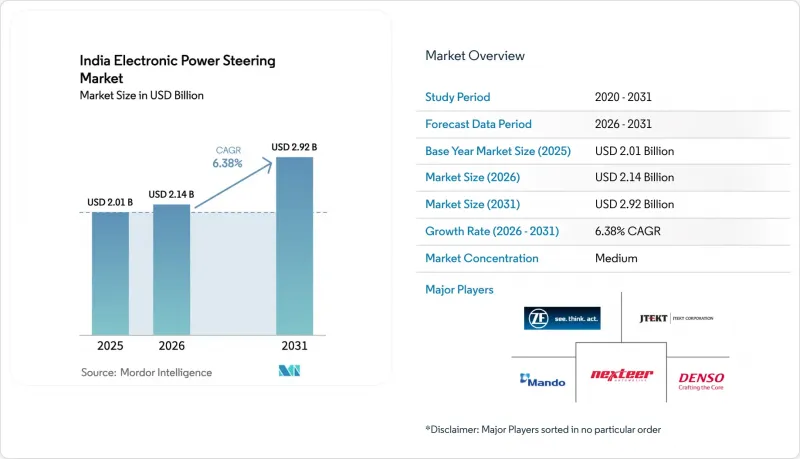
據 Mordor Intelligence 稱,印度電動方向盤市場預計到 2026 年價值 21.4 億美元,高於 2025 年的 20.1 億美元,預計到 2031 年將達到 29.2 億美元。
預計從 2026 年到 2031 年,其複合年成長率將達到 6.38%。
印度電子動力方向盤市場趨勢與洞察
乘用車產量激增
由於現代汽車產能的提升和塔塔汽車在多個邦的擴張,2024-2025會計年度印度國內乘用車組裝達到430萬輛。產量的成長使印度電動方向盤系統的供應商能夠享受規模經濟效益,降低單位成本,並允許在緊湊型掀背車中引入轉向柱輔助系統。隨著SUV和MPV車型產量佔比的提高,高扭力輔助轉向系統的需求也在增加。泰米爾納德邦、馬哈拉斯特拉邦和哈里亞納邦的區域叢集正在促進本地化供應鏈的構建,從而實現更快的準時交貨和更高的在地採購率。 CRISIL預測,2026會計年度乘用車產量將保持低成長,預計將維持對電動輔助轉向系統的中期需求。
嚴格的安全法規(AIS 145、CMVR)
AIS 145 強制要求配備電子穩定控制、車道偏離預警和自動緊急轉向等功能,這些功能僅需 EPS 提供的精確馬達控制。因此,儘管成本增加,整車製造商 (OEM) 仍在加速淘汰液壓單元。修訂後的 CMVR 法規進一步收緊了轉向反應標準,加速了向電子控制的過渡。先前依賴液壓系統的商用車製造商也在試行電動解決方案以符合法規要求。此外,這些安全功能需要更高的處理能力,增加了對電子控制單元 (ECU) 的需求,從而間接增加了每輛車的半導體數量。
與HPS入門汽車的價格比較
對於售價低於50萬印度盧比的掀背車,電動方向盤( EPS)的成本僅為液壓系統的四分之一。然而,注重預算的本地消費者仍然對長期燃油經濟性持懷疑態度,這阻礙了入門車型採用EPS。原物料價格上漲已經擠壓了汽車製造商的利潤空間,而這部分成本差異更是雪上加霜。不過,汽車零件生產關聯激勵計畫(PLI)對感測器和無刷直流馬達(BLDC馬達)的國產化激勵正在縮小這一差距。供應商預計,隨著電子控制單元(ECU)在地化生產的擴大,成本將在幾年內略有下降,價格差異將進一步縮小,從而緩解此限制因素。
細分市場分析
預計到2025年,柱式輔助轉向系統將佔據印度電動方向盤市場56.63%的佔有率。這反映了其在緊湊型和中型車輛平台上的卓越成本績效。該細分市場的主導地位也得益於其對底盤重新設計的極少要求,使得汽車製造商能夠快速地對現有的液壓平台進行改造。同時,齒條式輔助轉向系統則應用於對轉向精度和高扭力要求極高的高階SUV車型。齒輪式輔助轉向系統則介於兩者之間,尤其適用於注重路感回饋的轎車。線控轉向系統目前的搭載率不足1%,但其6.45%的複合年成長率顯示汽車製造商對其興趣日益濃厚。事實上,現代和Lexus已在2025年印度國際車展上發布了概念車型。監管部門的批准將成為一個轉捩點,推動其在大眾市場品牌中的應用。
間接優勢也正在顯現。線控轉向系統消除了轉向軸的干涉,從而可以重新設計正面碰撞區域的能量吸收機制,並安裝更大的資訊娛樂顯示器。像捷太格特這樣的供應商正在透過開發故障安全演算法來解決潛在的安全隱患,即使單一致動器發生故障也能保持方向控制。隨著法規的日益明確,特別是冗餘電源標準的建立,線控轉向系統也將擴展到齒條式轉向輔助領域。柱式轉向輔助仍將是注重成本的車型的基礎配置,並將繼續在印度電動方向盤市場中佔據主導地位。
截至2025年,轉向柱在印度電動方向盤市場中佔34.74%的佔有率。這是因為所有電動輔助轉向系統(EPS)都需要機械式或電子式轉向柱。然而,隨著高級駕駛輔助系統(ADAS)整合需要更高的處理能力,預計到2031年,電控系統將以6.51%的複合年成長率推動市場成長。英飛凌Aurix最新微型控制器符合ISO 26262 ASIL-D安全標準,支援汽車韌體的空中下載(OTA)更新,並大幅降低召回成本。扭矩和角度感測器也已發展為電感式設計,無需磁鐵即可提高精度。
在預測期內,隨著軟體定義汽車的普及,每輛車ECU的平均構成比預計將大幅上升。 KPIT和Tata Elxsi等國內供應商提供的中介軟體能夠縮短新轉向功能的上市時間。這些趨勢正在建立一個生態系統,使半導體設計公司、內建軟體公司和轉向系統製造商能夠在一個平台上協同合作,從而加快產品週期並增強印度電動方向盤市場的競爭力。
其他好處:
- Excel格式的市場預測(ME)表
- 3個月的分析師支持
目錄
第1章:引言
- 研究假設和市場定義
- 調查範圍
第2章:調查方法
第3章執行摘要
第4章 市場狀況
- 市場概覽
- 市場促進因素
- 乘用車產量激增
- 嚴格的安全法規(AIS 145、CMVR)
- 對節能型動力傳動系統的需求
- 車輛電氣化程度
- OEM廠商對本地化的推動促進了EPS的採用。
- L3級自動駕駛線控轉向系統測試運行
- 市場限制因素
- 入門級汽車和高性能汽車單價上漲對比
- 依賴進口的半導體供應鏈
- 二級/三級維修技術人員短缺
- 熱帶氣候下的熱可靠性
- 價值供應鏈分析
- 監理情勢
- 技術展望
- 波特五力分析
第5章 市場規模與成長預測
- 按類型
- 柱輔助EPS(C-EPS)
- 小齒輪輔助電動後輪驅動(P-EPS)
- 機架輔助 EPS(R-EPS)
- 整合式線控轉向
- 依組件類型
- 轉向柱
- 扭力和角度感測器
- 電動機
- 電控系統(ECU)
- 其他(線路、軸承、外殼)
- 車輛類型
- 搭乘用車
- 掀背車
- 轎車
- SUV 和 MPV
- 輕型商用車(LCV)
- 中型和重型商用車輛(MHCV)
- 搭乘用車
- 按銷售管道
- 適用於OEM
- 售後/改裝
- 馬達技術
- 有刷直流電機
- 無刷直流(BLDC)電機
第6章 競爭情勢
- 市場集中度
- 策略趨勢
- 市佔率分析
- 公司簡介
- JTEKT Corporation
- Nexteer Automotive
- DENSO Corporation
- ZF Steering Gear(India)Ltd
- Mando Automotive India(Anand Group)
- Robert Bosch GmbH
- Infineon Technologies AG
- Rane Group
- NSK Ltd.
- Hyundai Mobis
- Showa India
- Continental AG
- Thyssenkrupp Presta
- JNS Instruments
- Remsons Industries
- HL Mando
- Valeo
- Hitachi Astemo
- Timken India
- ATMA(Amalgamated Transmissions)
第7章 市場機會與未來展望
According to Mordor Intelligence, India electronic power steering market size in 2026 is estimated at USD 2.14 billion, growing from 2025 value of USD 2.01 billion with 2031 projections showing USD 2.92 billion, growing at 6.38% CAGR over 2026-2031.
India Electronic Power Steering Market Trends and Insights
Surging Passenger-Car Output
Domestic passenger-car assemblies reached 4.3 million units in FY 2024-25, aided by Hyundai's capacity build-out and Tata Motors' multiple state expansions . Higher volumes enable suppliers of the Indian electric power steering market to achieve scale benefits that trim per-unit costs and make column-assist systems viable even in compact hatchbacks. As SUVs and MPVs capture a rising share of production, demand for high-torque assistance grows. Regional clustering across Tamil Nadu, Maharashtra, and Haryana facilitates localized supply chains, allowing quicker just-in-time deliveries and higher localization content. CRISIL expects minimal passenger-vehicle output growth in FY 2026, ensuring sustained mid-term demand for electric steering units.
Stringent Safety Regulations (AIS 145, CMVR)
AIS 145 mandated features such as electronic stability control, lane-departure warning, and autonomous emergency steering, which only require the fine motor control provided by EPS . OEMs are therefore accelerating the phase-out of hydraulic units regardless of incremental cost. Updated CMVR rules impose tighter steering-response benchmarks, further tipping the scales toward electronic control. Commercial-vehicle OEMs, historically reliant on hydraulic setups, are piloting electric solutions to comply. ECU demand also rises because these safety features need higher processing capacities, creating a feed-through boost for semiconductor content per vehicle.
Higher Unit Cost vs HPS in Entry Cars
Electric power steering costs one-fourth more than hydraulic systems for hatchbacks priced below INR 500,000. Budget-focused rural buyers remain unconvinced by long-term fuel savings, hampering EPS penetration in entry trims. OEM margins already squeezed by rising commodity prices make absorbing the premium challenging. However, domestic fabrication incentives for sensors and BLDC motors under the automotive component PLI are narrowing the gap. Suppliers expect a minimal cost decline within a couple of years as ECU localization scales, bringing parity closer and easing this restraint.
Other drivers and restraints analyzed in the detailed report include:
- Demand for Fuel-Efficient Drivetrains
- Electrification of Vehicle Parc
- Import-Reliant Semiconductor Supply Chain
For complete list of drivers and restraints, kindly check the Table Of Contents.
Segment Analysis
Column-assist solutions captured 56.63% of the Indian electric power steering market share in 2025, reflecting their cost-performance sweet spot across compact and midsize platforms. The segment's dominance is reinforced by minimal chassis redesign requirements, allowing OEMs to retrofit existing hydraulic platforms swiftly. Rack-assist units cater to premium SUVs where steering precision and higher torque are vital. Pinion-assist designs occupy a niche between the two, particularly in sedan applications where road-feel refinement is prioritized. Although steer-by-wire currently represents less than 1% of installations, its 6.45% CAGR indicates growing OEM attention, with Hyundai and Lexus showcasing concept models at the 2025 Auto Expo. Regulatory acceptance will be the inflection point that elevates adoption rates among mass-market brands.
Second-order benefits also materialize: steer-by-wire removes the steering shaft intrusion, enabling frontal crash-zone energy-absorption redesigns and larger infotainment displays. Suppliers such as JTEKT are developing failsafe algorithms that maintain directional control even if a single actuator fails, addressing latent safety concerns. Once regulatory clarity emerges, especially regarding redundant power supply standards, steer-by-wire will likely encroach on the rack-assist space. The column-assist will underpin cost-sensitive variants, ensuring it remains a mainstay of the Indian electric power steering market.
Steering columns held 34.74% of the Indian electric power steering market in 2025, as every EPS facade requires a mechanical or electronic column. Yet electronic control units will outpace at a 6.51% CAGR through 2031 because ADAS integration needs higher processing headroom. The latest Infineon Aurix microcontrollers support ISO 26262 ASIL-D safety, allowing automotive firmware over-the-air updates that slash recall costs. Torque-and-angle sensors also evolve toward inductive designs, eliminating magnets and enhancing precision.
Over the forecast window, ECU average cost content per vehicle will jump exponentially as software-defined cars gain traction. Domestic suppliers like KPIT and Tata Elxsi provide middleware that reduces time-to-market for new steering functions. Such developments create an ecosystem wherein semiconductor design houses, embedded-software firms, and steering-system manufacturers collaborate under one roof, accelerating product cycles and reinforcing the Indian electric power steering market's competitiveness.
Complete Report Scope:
- By Type
- Column-Assist EPS (C-EPS)
- Pinion-Assist EPS (P-EPS)
- Rack-Assist EPS (R-EPS)
- Integrated Steer-by-Wire
- By Component Type
- Steering Column
- Torque & Angle Sensors
- Electric Motor
- Electronic Control Unit (ECU)
- Others (Wiring, Bearings, Housings)
- By Vehicle Type
- Passenger Cars
- Hatchbacks
- Sedans
- SUVs & MPVs
- Light Commercial Vehicles (LCVs)
- Medium and Heavy Commercial Vehicles (MHCV)
- Passenger Cars
- By Sales Channel
- OEM Fitment
- Aftermarket / Retrofit
- By Motor Technology
- Brushed DC Motor
- Brushless DC (BLDC) Motor
List of Companies Covered in this Report:
- JTEKT Corporation
- Nexteer Automotive
- DENSO Corporation
- ZF Steering Gear (India) Ltd
- Mando Automotive India (Anand Group)
- Robert Bosch GmbH
- Infineon Technologies AG
- Rane Group
- NSK Ltd.
- Hyundai Mobis
- Showa India
- Continental AG
- Thyssenkrupp Presta
- JNS Instruments
- Remsons Industries
- HL Mando
- Valeo
- Hitachi Astemo
- Timken India
- ATMA (Amalgamated Transmissions)
Additional Benefits:
- The market estimate (ME) sheet in Excel format
- 3 months of analyst support
TABLE OF CONTENTS
1 Introduction
- 1.1 Study Assumptions & Market Definition
- 1.2 Scope of the Study
2 Research Methodology
3 Executive Summary
4 Market Landscape
- 4.1 Market Overview
- 4.2 Market Drivers
- 4.2.1 Surging Passenger-Car Output
- 4.2.2 Stringent Safety Regulations (AIS 145, CMVR)
- 4.2.3 Demand For Fuel-Efficient Drivetrains
- 4.2.4 Electrification Of Vehicle PARC
- 4.2.5 OEM Localisation Push For EPS Content
- 4.2.6 Steer-By-Wire Pilots For L3 Autonomy
- 4.3 Market Restraints
- 4.3.1 Higher Unit Cost Vs HPS In Entry Cars
- 4.3.2 Import-Reliant Semiconductor Supply Chain
- 4.3.3 Scarcity Of Tier-2/3 Service Technicians
- 4.3.4 Thermal Reliability Under Tropical Climate
- 4.4 Value / Supply-Chain Analysis
- 4.5 Regulatory Landscape
- 4.6 Technological Outlook
- 4.7 Porter's Five Forces Analysis
- 4.7.1 Threat of New Entrants
- 4.7.2 Bargaining Power of Buyers/Consumers
- 4.7.3 Bargaining Power of Suppliers
- 4.7.4 Threat of Substitute Products
- 4.7.5 Intensity of Competitive Rivalry
5 Market Size & Growth Forecasts (Value (USD) and Volume (Units))
- 5.1 By Type
- 5.1.1 Column-Assist EPS (C-EPS)
- 5.1.2 Pinion-Assist EPS (P-EPS)
- 5.1.3 Rack-Assist EPS (R-EPS)
- 5.1.4 Integrated Steer-by-Wire
- 5.2 By Component Type
- 5.2.1 Steering Column
- 5.2.2 Torque & Angle Sensors
- 5.2.3 Electric Motor
- 5.2.4 Electronic Control Unit (ECU)
- 5.2.5 Others (Wiring, Bearings, Housings)
- 5.3 By Vehicle Type
- 5.3.1 Passenger Cars
- 5.3.1.1 Hatchbacks
- 5.3.1.2 Sedans
- 5.3.1.3 SUVs & MPVs
- 5.3.2 Light Commercial Vehicles (LCVs)
- 5.3.3 Medium and Heavy Commercial Vehicles (MHCV)
- 5.3.1 Passenger Cars
- 5.4 By Sales Channel
- 5.4.1 OEM Fitment
- 5.4.2 Aftermarket / Retrofit
- 5.5 By Motor Technology
- 5.5.1 Brushed DC Motor
- 5.5.2 Brushless DC (BLDC) Motor
6 Competitive Landscape
- 6.1 Market Concentration
- 6.2 Strategic Moves
- 6.3 Market Share Analysis
- 6.4 Company Profiles (Includes Global Level Overview, Market Level Overview, Core Segments, Financials as Available, Strategic Information, Market Rank/Share for Key Companies, Products and Services, SWOT Analysis, and Recent Developments)
- 6.4.1 JTEKT Corporation
- 6.4.2 Nexteer Automotive
- 6.4.3 DENSO Corporation
- 6.4.4 ZF Steering Gear (India) Ltd
- 6.4.5 Mando Automotive India (Anand Group)
- 6.4.6 Robert Bosch GmbH
- 6.4.7 Infineon Technologies AG
- 6.4.8 Rane Group
- 6.4.9 NSK Ltd.
- 6.4.10 Hyundai Mobis
- 6.4.11 Showa India
- 6.4.12 Continental AG
- 6.4.13 Thyssenkrupp Presta
- 6.4.14 JNS Instruments
- 6.4.15 Remsons Industries
- 6.4.16 HL Mando
- 6.4.17 Valeo
- 6.4.18 Hitachi Astemo
- 6.4.19 Timken India
- 6.4.20 ATMA (Amalgamated Transmissions)
7 Market Opportunities & Future Outlook
- 7.1 White-space & Unmet-Need Assessment

 電液伺服伺服器市場:全球市場預測,2026-2032年
 2026-2030年全球汽車動力方向盤機油市場
 動力方向盤市場:依產品類型、應用、通路、組件、電源、國家及地區分類-全球產業分析、市場規模、市場佔有率及2026年至2033年預測
 2026-2030年全球轉向機器人市場
 義大利汽車電液動力方向盤:市場佔有率分析、產業趨勢與統計及成長預測(2026-2031)汽車電動液壓式動力方向盤:市場佔有率分析、產業趨勢與統計、成長預測(2026-2031)
 對商用車 (CV) 主動式動力方向盤市場進行分析和預測,直至 2035 年:按類型、產品類型、技術、組件、應用、最終用戶、功能、安裝配置和解決方案進行分析和預測。
 2026年全球主動式動力方向盤市場報告
 全球動力輔助轉向系統市場規模、佔有率、趨勢和成長分析報告(2026-2034年)2026年商用車主動式動力方向盤全球市場報告