


 |
市場調查報告書
商品編碼
2121543
汽車電動液壓式動力方向盤:市場佔有率分析、產業趨勢與統計、成長預測(2026-2031)Automotive Electro-Hydraulic Power Steering - Market Share Analysis, Industry Trends & Statistics, Growth Forecasts (2026 - 2031) |
||||||

※ 本網頁內容可能與最新版本有所差異。詳細情況請與我們聯繫。
據 Mordor Intelligence 稱,2025 年汽車電動液壓式動力方向盤市場價值為 168.9 億美元,預計到 2031 年將達到 237.2 億美元,而 2026 年為 178.7 億美元,預測期(2026-2031 年)的複合年成長率為 5.83%。
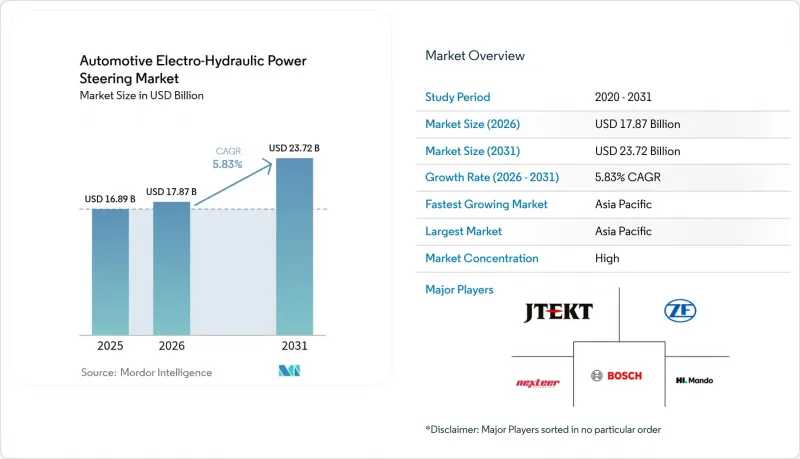
本報告按車輛類型(乘用車、輕型商用車等)、零件類型(方向盤馬達、液壓泵等)、驅動系統(內燃機等)、銷售管道(OEM、售後市場)和地區進行細分。市場預測以美元計價。
全球汽車電動液壓式動力方向盤市場趨勢及洞察
電動車產能擴張與12V輔助負載增加
隨著電池式電動車(BEV) 和插電式混合動力汽車(PHEV) 銷量的成長,空調、資訊娛樂和安全功能等輔助負載的需求也隨之增加,導致按需驅動式電動液壓輔助轉向系統 (EHPS) 幫浦與連續驅動式液壓幫浦之間的效率差距日益擴大。預計到 2024 年,全球電動車銷量將達到 1,400 萬輛,其中純電動交付將佔 73%,為電池式電動車系統創造了龐大的潛在市場。商用車領域也呈現類似的趨勢,預計到 2024 年電動巴士的出貨量將成長 30%,推動節能轉向解決方案的應用。目前,工程研發的重點是開發與車輛能量管理系統協同工作的泵浦控制演算法,以最大限度地降低車輛在勻速行駛時的電流消耗。
OEM廠商對L3+ ADAS轉向冗餘的需求
L3級以上自動駕駛對轉向系統提出了基於ISO 26262標準的「故障運行」要求,即轉向控制需符合ASIL-D等級標準。 EHPS架構採用雙馬達和液壓輔助迴路,提供冗餘和容錯能力,即使在斷電或致動器故障的情況下也能維持轉向性能。近期量產案例,例如蔚來ET9的線控轉向解決方案,凸顯了EHPS模組與電子驅動相結合,如何實現可變轉向比和緊急干預。因此,供應商正致力於研發診斷、感測器融合和故障轉移策略,以滿足功能安全審核的要求。
稀土元素永磁馬達供應鏈波動
由於2024年出口許可證制度的改革導致現貨價格上漲和庫存緊張,汽車製造商正在探索使用無磁同步磁阻馬達,並將泵總成供應商減少到兩家。轉向零件供應商則在增加安全庫存,並與礦商簽訂直接採購協議,以穩定前置作業時間。
細分市場分析
到2025年,乘用車將佔據電動液壓式動力方向盤(EHPS)市場63.86%的佔有率,主要得益於緊湊型、中型和豪華車型平台對EHPS的日益普及。汽車製造商採用EHPS是為了相容於怠速熄火功能、滿足輕度混合動力汽車日益成長的需求以及適應高級駕駛輔助系統(ADAS)的廣泛應用。由於小包裹遞送車輛在都市區駕駛循環中優先考慮能源效率,預計輕型商用車電動液壓式動力方向盤的市場規模將以7.18%的複合年成長率成長。
乘用車市場佔有率反映了高效的生產規模、車型更新周期以及足以抵消電子泵額外成本的高銷售量。隨著中國、歐洲和美國多個州對「最後一公里」配送的監管日益嚴格,商用車銷量正在加速成長。雖然重型卡車和客車市場成長相對滯後,但隨著電池組成本效益的提升和高壓轉向驅動技術的結合,未來仍有成長空間。
到2025年,方向盤馬達將佔據電動液壓式動力方向盤市場36.23%的佔有率。其高昂的材料價值和關鍵的性能作用構成了組件組合的基礎。受ISO 26262冗餘要求的推動,感測器和扭力模組預計到2031年將以7.61%的複合年成長率成長,該標準要求每個系統的位置和扭力感測通道數量翻倍。
由於永磁無刷馬達具有高功率密度和快速響應能力,因此仍然是行業標準。供應商正在投資研發基於鐵氧體或磁阻的設計,以避免依賴稀土元素。隨著線控轉向軟體層的擴展,控制ECU正轉向採用更高頻寬的微控制器,而密封泵殼則整合了冷卻水套,以延長運作週期。
區域分析
亞太地區仍是需求中心。預計到2025年,該地區將佔電動液壓式動力方向盤市場47.12%的佔有率,並在2031年之前以8.63%的複合年成長率持續成長,成為規模最大且成長最快的地區。中國電池式電動車和插電式混合動力汽車的大規模生產推動了對幫浦的強勁需求。印度的FAME-II和PLI計劃正在促進國內線控轉向系統和泵浦製造工廠的在地採購。日本為出口車型提供符合ISO 26262標準的高可靠性感測器和馬達控制設備。政府對集中在上海、廣州、清奈和名古屋的OEM工廠的獎勵,透過降低進口成本和縮短供應鏈,使區域供應商受益。
在北美,由於排放氣體法規日益嚴格,市場持續穩定成長。美國環保署的「多污染物排放標準」和加州的「先進清潔汽車II」計畫迫使汽車製造商對包括轉向系統在內的輔助系統進行電氣化改造,以滿足車隊目標。預計從2024年起,純電動外送車的數量將加倍,這將促使電動液壓動力轉向系統(EHPS)應用於小包裹和食品雜貨配送車隊。此外,美國本土汽車製造商也透過資助鐵氧體和磁阻馬達的研究來規避稀土元素風險,這有助於增強區域電動液壓式動力方向盤(EHPS)市場規模抵禦供應衝擊的能力。加拿大的清潔交通訊貸計畫反映了美國的政策,並加強了跨境生產的綜效。
歐洲在豪華車領域的創新方面處於領先地位。德國、瑞典和法國的汽車品牌正在部署線控轉向平台,並將電液動力系統(EHPS)幫浦整合到其中,作為安全冗餘執行器。採埃孚(ZF)已於2025年初開始為中國豪華車品牌量產相關產品。歐盟到2030年將車輛二氧化碳排放量減少55%的目標,持續推動供應商在零件層面提升效率。隨著豪華車和高性能車市場向800V架構轉型,配備智慧能量回收演算法的EHPS模組正與線控刹車和主動懸吊系統相輔相成。東歐和中東正在成為新興的組裝中心,但基礎設施差異和價格敏感度限制了短期內的普及,預計亞太地區將成為未來十年的主要成長引擎。
其他好處:
- Excel格式的市場預測(ME)表
- 3個月的分析師支持
目錄
第1章:引言
- 市場分析與定義的前提條件
- 分析範圍
第2章 分析方法
第3章執行摘要
第4章 市場狀況
- 市場概覽
- 市場促進因素
- OEM廠商對L3+ ADAS轉向冗餘功能的需求
- 電動車產量擴大和12V輔助電源負載增加
- 輕型商用車(ELCV)的快速電氣化
- 更嚴格的二氧化碳排放法規和燃油經濟法規將提高轉向效率。
- 線控轉向模組與電液動力幫浦的整合
- 中國和印度的在地採購獎勵措施(PLI、MIIT、FAME-II)
- 市場限制因素
- 稀土元素永磁電機供應鏈波動性
- 與傳統HPS相比,初始成本保費的比較
- 高溫運轉循環中的可靠性問題
- 來自B/C級車全電動方向盤(EPS)的競爭。
- 價值鍊和供應鏈分析
- 監理情勢
- 技術展望
- 波特五力分析
第5章:預測市場規模與成長率
- 按車輛類型
- 搭乘用車
- 輕型商用車
- 大型商用車輛
- 巴士和長途汽車
- 非公路用車及特殊車輛
- 依組件類型
- 方向盤馬達
- 液壓泵浦
- 感測器扭力模組
- ECU/控制器
- 水箱、軟管和其他物品
- 透過驅動系統
- 內燃機(ICE)
- 混合動力電動車(HEV)
- 電池式電動車(BEV)
- 插電式混合動力汽車
- 燃料電池汽車(FCEV)
- 按銷售管道
- OEM(原始設備製造商)
- 售後市場
- 按地區
- 北美洲
- 美國
- 加拿大
- 其他北美國家
- 南美洲
- 巴西
- 阿根廷
- 其他南美國家
- 歐洲
- 德國
- 英國
- 法國
- 義大利
- 西班牙
- 俄羅斯
- 其他歐洲國家
- 亞太地區
- 中國
- 日本
- 印度
- 韓國
- 印尼
- 越南
- 菲律賓
- 澳洲
- 紐西蘭
- 其他亞太國家
- 中東和非洲
- 阿拉伯聯合大公國
- 沙烏地阿拉伯
- 土耳其
- 南非
- 其他中東和非洲國家
- 北美洲
第6章 競爭情勢
- 市場集中度
- 策略趨勢
- 市佔率分析
- 公司簡介
- JTEKT Corporation
- Robert Bosch GmbH
- ZF Friedrichshafen AG
- Nexteer Automotive Corporation
- Mando Corporation
- NSK Ltd.
- Continental AG
- Thyssenkrupp Presta AG
- Hitachi Astemo
- Showa Corporation
- Knorr-Bremse Commercial Vehicle Systems GmbH
- Shanghai OE Industrial Co., Ltd.(Brogen EV Solutions)
第7章 市場機會與未來展望
According to Mordor Intelligence, the automotive electro-hydraulic power steering market size was valued at USD 16.89 billion in 2025 and estimated to grow from USD 17.87 billion in 2026 to reach USD 23.72 billion by 2031, at a CAGR of 5.83% during the forecast period (2026-2031).
This report is Segmented by Vehicle Type (Passenger Cars, Light Commercial Vehicles, and More), Component Type (Steering Motors, Hydraulic Pumps, and More ), Propulsion ( Internal Combustion Engine, and More), Sales Channel (Original Equipment Manufacturer (OEM), Aftermarket), and by Geography. The Market Forecasts are Provided in Terms of Value (USD).
Global Automotive Electro-Hydraulic Power Steering Market Trends and Insights
Growing EV Production and Higher Auxiliary-12 V Loads
Escalating battery electric and plug-in hybrid volumes raise auxiliary loads for climate, infotainment, and safety functions, which amplifies the efficiency gap between on-demand EHPS pumps and continuously driven hydraulic pumps. Global EV sales reached 14 million units in 2024, with battery electric vehicles taking 73% of deliveries, creating a sizeable addressable base for EHPS systems. Commercial segments follow a similar path as electric buses logged 30% shipment growth in 2024, encouraging the adoption of energy-saving steering solutions. The engineering priority now focuses on pump control algorithms coordinating with vehicle energy management to minimize current draw during steady-state cruising.
OEM Demand for Steering Redundancy for L3+ ADAS
Level 3 and above automated driving creates fail-operational steering requirements under ISO 26262, stipulating ASIL-D integrity for steering control. EHPS architecture, with its dual electric motor and hydraulic assist paths, delivers the redundancy and fault tolerance needed to maintain steerability during power interruptions or actuator faults. Recent production launches such as the steer-by-wire solution in NIO's ET9 highlight how EHPS modules pair with electronic actuation to achieve variable steering ratios and emergency intervention. Suppliers, therefore, align R&D toward diagnostics, sensor fusion, and fallback strategies that satisfy functional safety audits
Supply Chain Volatility of Rare-Earth Permanent Magnet Motors
Neodymium, dysprosium, and terbium supply remains concentrated in small mines, with China accounting for more than 60% of refined output. Export licensing changes in 2024 raised spot prices and strained inventory, prompting automakers to review magnet-free synchronous reluctance motors and to dual-source pump assemblies. Steering suppliers are lengthening safety stocks and entering direct offtake agreements with miners to stabilize lead times.
Other drivers and restraints analyzed in the detailed report include:
- Rapid Electrification of Light Commercial Vehicles
- Integration of Steer-By-Wire Modules With EHPS Pumps
- Up-Front Cost Premium vs Conventional HPS
For complete list of drivers and restraints, kindly check the Table Of Contents.
Segment Analysis
Passenger cars commanded 63.86% of the electric hydraulic power steering market in 2025 on the strength of widespread adoption across compact, mid-size, and luxury platforms. Carmakers integrate EHPS to unlock stop-start compatibility, mild hybrid gains, and growing ADAS content. Electric hydraulic power steering market size for light commercial vehicles is projected to expand at a 7.18% CAGR because parcel fleets favor energy savings during urban duty cycles.
The passenger car share reflects efficient scale, model refresh cadence, and high configuration volumes that absorb the added cost of electronic pumps. Commercial vehicle programs show faster unit growth as final mile delivery regulations tighten in China, Europe, and several United States states. Heavy trucks and buses trail but represent future upside once battery pack economics and high voltage steering actuation converge.
Steering motors held 36.23% electric hydraulic power steering market share in 2025. Their high material value and critical performance role anchor the component mix. Sensors and torque modules will record a 7.61% CAGR through 2031, driven by ISO 26262 redundancy targets that double the number of position and torque sensing channels per system.
Permanent magnet brushless motors remain the industry standard because they deliver high power density and rapid response. Suppliers are investing in ferrite-based or reluctance designs to sidestep rare-earth exposure. Control ECUs migrate toward higher bandwidth microcontrollers as steer-by-wire software layers expand, while sealed pump housings incorporate integrated cooling jackets to extend duty cycles.
Complete Report Scope:
- By Vehicle Type
- Passenger Cars
- Light Commercial Vehicles
- Heavy Commercial Vehicles
- Buses and Coaches
- Off-highway and Specialty Vehicles
- By Component Type
- Steering Motors
- Hydraulic Pumps
- Sensors and Torque Modules
- ECU / Controllers
- Reservoirs, Hoses and Others
- By Propulsion Type
- Internal-Combustion Engine (ICE)
- Hybrid Electric Vehicle (HEV)
- Battery Electric Vehicle (BEV)
- Plug-in Hybrid Electric Vehicles
- Fuel-Cell Electric Vehicle (FCEV)
- By Sales Channel
- Original Equipment Manufacturer (OEM)
- Aftermarket
- By Geography
- North America
- United States
- Canada
- Rest of North America
- South America
- Brazil
- Argentina
- Rest of South America
- Europe
- Germany
- United Kingdom
- France
- Italy
- Spain
- Russia
- Rest of Europe
- Asia-Pacific
- China
- Japan
- India
- South Korea
- Indonesia
- Vietnam
- Philippines
- Australia
- New Zealand
- Rest of Asia-Pacific
- Middle East and Africa
- United Arab Emirates
- Saudi Arabia
- Turkey
- South Africa
- Rest of Middle East and Africa
- North America
Geography Analysis
Asia-Pacific remains the clear demand center. The region accounted for 47.12% electric hydraulic power steering market share in 2025 and is projected to expand at an 8.63% CAGR through 2031, making it the largest and fastest-growing territory. China's battery-electric and plug-in hybrid production scale drives high pump volumes. India's FAME-II and PLI schemes channel local sourcing toward domestic steer-by-wire and pump facilities. Japan contributes high-reliability sensors and motor controls that meet ISO 26262 targets for export models. Regional suppliers benefit from government incentives that lower landed costs and shorten supply chains for OEM plants clustered in Shanghai, Guangzhou, Chennai, and Nagoya.
North America follows with steady expansion as emissions rules tighten. The EPA's Multi-Pollutant Standards and California's Advanced Clean Cars II program compel automakers to electrify auxiliaries, including steering, to meet fleet targets. Battery-electric delivery van adoption has doubled since 2024, pulling EHPS content into parcel and grocery fleets. Domestic automakers also hedge rare-earth risk by funding ferrite and reluctance motor research, which supports regional electric hydraulic power steering market size resilience against supply shocks. Canada's clean-transport credits mirror United States policy and reinforce cross-border production synergies.
Europe anchors premium vehicle innovation. German, Swedish, and French brands are rolling out steer-by-wire platforms that integrate EHPS pumps as safety-redundant actuators, and ZF began series production for a Chinese luxury marque in early 2025. The European Union target of a 55% fleet-wide CO2 cut by 2030 keeps pressure on suppliers to deliver efficiency gains at component level. As luxury and performance segments migrate to 800 V architectures, EHPS modules with smart energy-recovery algorithms complement brake-by-wire and active suspension systems. Eastern Europe and the Middle East provide emerging assembly bases, but infrastructure gaps and price sensitivity temper near-term penetration, positioning Asia-Pacific as the principal growth engine through the decade.
- JTEKT Corporation
- Robert Bosch GmbH
- ZF Friedrichshafen AG
- Nexteer Automotive Corporation
- Mando Corporation
- NSK Ltd.
- Continental AG
- Thyssenkrupp Presta AG
- Hitachi Astemo
- Showa Corporation
- Knorr-Bremse Commercial Vehicle Systems GmbH
- Shanghai OE Industrial Co., Ltd. (Brogen EV Solutions)
Additional Benefits:
- The market estimate (ME) sheet in Excel format
- 3 months of analyst support
TABLE OF CONTENTS
1 Introduction
- 1.1 Study Assumptions & Market Definition
- 1.2 Scope of the Study
2 Research Methodology
3 Executive Summary
4 Market Landscape
- 4.1 Market Overview
- 4.2 Market Drivers
- 4.2.1 OEM Demand For Steering Redundancy For L3+ ADAS
- 4.2.2 Growing EV Production and Higher Auxiliary-12 V Loads
- 4.2.3 Rapid Electrification Of Light Commercial Vehicles (Elcv)
- 4.2.4 Tightening CO2 / CAFE Regulations Pushing Steering Efficiency
- 4.2.5 Integration Of Steer-By-Wire Modules With EHPS Pumps
- 4.2.6 Local Sourcing Incentives In China and India (PLI, MIIT, FAME-II)
- 4.3 Market Restraints
- 4.3.1 Supply-Chain Volatility Of Rare-Earth PM Motors
- 4.3.2 Up-Front Cost Premium Vs. Conventional HPS
- 4.3.3 Reliability Concerns In High-Temperature Duty Cycles
- 4.3.4 Competition From Full-Electric Power Steering (EPS) In B-/C-Segment Cars
- 4.4 Value / Supply-Chain Analysis
- 4.5 Regulatory Landscape
- 4.6 Technological Outlook
- 4.7 Porter's Five Forces Analysis
- 4.7.1 Bargaining Power of Suppliers
- 4.7.2 Bargaining Power of Buyers
- 4.7.3 Threat of New Entrants
- 4.7.4 Threat of Substitutes
- 4.7.5 Intensity of Competitive Rivalry
5 Market Size and Growth Forecasts (Value, USD)
- 5.1 By Vehicle Type
- 5.1.1 Passenger Cars
- 5.1.2 Light Commercial Vehicles
- 5.1.3 Heavy Commercial Vehicles
- 5.1.4 Buses and Coaches
- 5.1.5 Off-highway and Specialty Vehicles
- 5.2 By Component Type
- 5.2.1 Steering Motors
- 5.2.2 Hydraulic Pumps
- 5.2.3 Sensors and Torque Modules
- 5.2.4 ECU / Controllers
- 5.2.5 Reservoirs, Hoses and Others
- 5.3 By Propulsion Type
- 5.3.1 Internal-Combustion Engine (ICE)
- 5.3.2 Hybrid Electric Vehicle (HEV)
- 5.3.3 Battery Electric Vehicle (BEV)
- 5.3.4 Plug-in Hybrid Electric Vehicles
- 5.3.5 Fuel-Cell Electric Vehicle (FCEV)
- 5.4 By Sales Channel
- 5.4.1 Original Equipment Manufacturer (OEM)
- 5.4.2 Aftermarket
- 5.5 By Geography
- 5.5.1 North America
- 5.5.1.1 United States
- 5.5.1.2 Canada
- 5.5.1.3 Rest of North America
- 5.5.2 South America
- 5.5.2.1 Brazil
- 5.5.2.2 Argentina
- 5.5.2.3 Rest of South America
- 5.5.3 Europe
- 5.5.3.1 Germany
- 5.5.3.2 United Kingdom
- 5.5.3.3 France
- 5.5.3.4 Italy
- 5.5.3.5 Spain
- 5.5.3.6 Russia
- 5.5.3.7 Rest of Europe
- 5.5.4 Asia-Pacific
- 5.5.4.1 China
- 5.5.4.2 Japan
- 5.5.4.3 India
- 5.5.4.4 South Korea
- 5.5.4.5 Indonesia
- 5.5.4.6 Vietnam
- 5.5.4.7 Philippines
- 5.5.4.8 Australia
- 5.5.4.9 New Zealand
- 5.5.4.10 Rest of Asia-Pacific
- 5.5.5 Middle East and Africa
- 5.5.5.1 United Arab Emirates
- 5.5.5.2 Saudi Arabia
- 5.5.5.3 Turkey
- 5.5.5.4 South Africa
- 5.5.5.5 Rest of Middle East and Africa
- 5.5.1 North America
6 Competitive Landscape
- 6.1 Market Concentration
- 6.2 Strategic Moves
- 6.3 Market Share Analysis
- 6.4 Company Profiles (includes Global level Overview, Market level overview, Core Segments, Financials as available, Strategic Information, Market Rank/Share for key companies, Products & Services, and Recent Developments)
- 6.4.1 JTEKT Corporation
- 6.4.2 Robert Bosch GmbH
- 6.4.3 ZF Friedrichshafen AG
- 6.4.4 Nexteer Automotive Corporation
- 6.4.5 Mando Corporation
- 6.4.6 NSK Ltd.
- 6.4.7 Continental AG
- 6.4.8 Thyssenkrupp Presta AG
- 6.4.9 Hitachi Astemo
- 6.4.10 Showa Corporation
- 6.4.11 Knorr-Bremse Commercial Vehicle Systems GmbH
- 6.4.12 Shanghai OE Industrial Co., Ltd. (Brogen EV Solutions)
7 Market Opportunities & Future Outlook

 拋光刷輥市場:全球市場預測,2026-2032年
 2026-2030年全球轉向機器人市場
 義大利汽車電液動力方向盤:市場佔有率分析、產業趨勢與統計及成長預測(2026-2031)
 2026年全球動力方向盤冷卻套件市場報告
 對商用車 (CV) 主動式動力方向盤市場進行分析和預測,直至 2035 年:按類型、產品類型、技術、組件、應用、最終用戶、功能、安裝配置和解決方案進行分析和預測。
 商用車主動式動力方向盤市場-全球產業規模、佔有率、趨勢、機會、預測:按類型、需求類別、車輛類型、地區和競爭格局分類,2021-2031年2026年全球主動式動力方向盤市場報告
 全球動力輔助轉向系統市場規模、佔有率、趨勢和成長分析報告(2026-2034年)2026年商用車主動式動力方向盤全球市場報告乘用車動力方向盤市場-全球產業規模、佔有率、趨勢、機會及預測(2021-2031)