

 |
市場調查報告書
商品編碼
2113664
義大利汽車電液動力方向盤:市場佔有率分析、產業趨勢與統計及成長預測(2026-2031)Italy Automotive Electro-Hydraulic Power Steering - Market Share Analysis, Industry Trends & Statistics, Growth Forecasts (2026 - 2031) |
||||||

※ 本網頁內容可能與最新版本有所差異。詳細情況請與我們聯繫。
根據 Mordor Intelligence 預測,義大利汽車電液動力方向盤市場規模將從 2025 年的 1.932 億美元成長到 2026 年的 2.014 億美元,到 2031 年達到 2.477 億美元,2026 年至 2031 年的年複合成長率(CAGR)率為 4.2%。
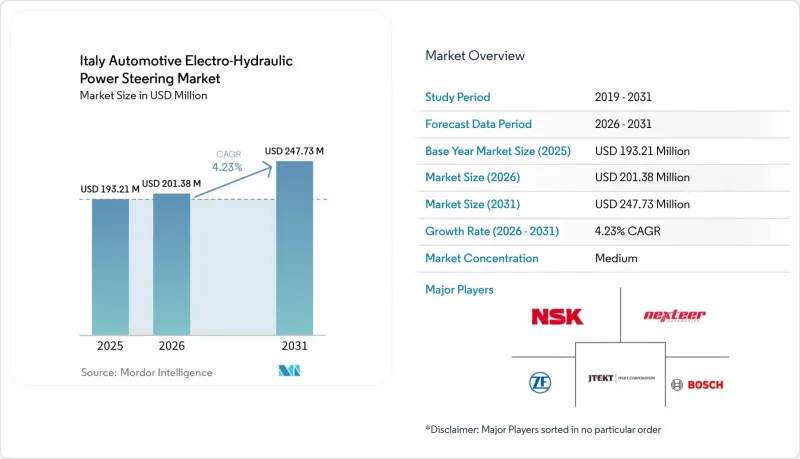
本報告按車輛類型(乘用車、輕型商用車等)、零件類型(轉向柱和齒條介面、電機、液壓泵等)、技術(傳統型、先進型、緊湊型、齒條輔助式電動液壓系統)以及銷售管道(原廠供應和售後市場替換件)進行分類。市場預測以美元計價。
義大利汽車電液動力方向盤市場趨勢與洞察
與電動車和混合動力平台相容
義大利混合動力汽車市場的蓬勃發展正在推動該國電液動力方向盤系統(EHPS)的需求。混合動力系統無需引擎驅動的液壓泵即可長時間運作。在這種情況下,EHPS 可以提供液壓輔助,尤其是在需要更高轉向負載的車型上。 2025 年上半年,混合動力汽車佔義大利新車銷售的 44.1%,為相容轉向系統的普及和未來的服務需求奠定了堅實的基礎。 2025 年,義大利插電式混合動力汽車的註冊量成長了 86.6%,2026 年上半年成長了 84.3%,進一步推動了向電氣化平台的轉型。在這種市場環境下,動力傳動系統選擇以及新車整體銷售對 EHPS 的需求都顯得尤為重要。
更嚴格的二氧化碳排放和燃油效率法規。
歐盟排放氣體法規為製造商提供了明確的過渡期,以符合車隊排放氣體法規的要求。這些法規維持了乘用車二氧化碳排放目標,並持續敦促製造商提供混合動力和其他低排放動力傳動系統。歐盟委員會的汽車產業一攬子計畫也維持著大幅減少排放的長期方向。商用車業者在比較營運成本時,也可以評估轉向效率。
緊湊型乘用車向電動輔助轉向的過渡
緊湊型乘用車正日益轉向柱式電動輔助轉向系統(EPS)。 EPS重量輕、無需液壓油,且在齒條負載較低的應用中校驗成本也較低。因此,電動輔助轉向系統(EHPS)在小型車平台上的實用性正在下降,而小型車在義大利仍佔有重要地位。 2026年,捷太格特(JTEKT)發布了其線控轉向品牌“Syncusteer”,展現了其在乘用車領域超越傳統EPS設計的持續發展。 Syncusteer在獲得ASIL D認證後,於2026年4月開始量產其線控轉向系統,為下一代乘用車轉向系統樹立了新的標竿。這項轉變導致城市汽車和小型汽車產品線中EHPS的搭載率下降。
細分市場分析
預計到2025年,乘用車將佔義大利電液動力方向盤市場62.22%的佔有率。這反映了義大利混合動力汽車的高佔比,儘管向電動輔助轉向(EPS)的轉變抑制了城市汽車和小型汽車領域的需求。中型和重型商用車、巴士和長途客車正受益於車輛電氣化政策和公共採購。在非道路設備領域,液壓轉向系統在嚴苛的負載和運作仍有需求。 AGCO最近獲得的一項專利包含一種用於農業車輛的可變轉向比電液轉向系統。這項進展表明,即使乘用車應用不斷發展,專用設備在義大利電液動力方向盤市場仍佔據重要地位。
在義大利電液動力方向盤市場,輕型商用車是成長最快的細分市場,預計到2031年複合年成長率將達到7.42%。車隊脫碳計畫的資金支持了電動車和混合動力廂型車平台的發展,這些平台在低引擎負荷或純電動模式下需要轉向輔助。 Stellantis已在其位於阿特薩的工廠開始生產其「Cargo Box」純電動車。 Stellantis Pro One和依維柯集團也已達成協議,將供應一系列純電動廂型車車型,並計劃在不久的將來投入商業營運。義大利針對重型商用車的獎勵計畫正在推動對重型商用車的需求。由於液壓輔助仍然是重型廂型車應用的實用選擇,因此義大利電液動力方向盤市場受益匪淺。
預計到2025年,義大利電液動力方向盤市場中,轉向柱和齒條介面組件將佔據32.51%的佔有率,成為市場主導組件。這些組件仍然是支撐系統結構安裝點和負載的基礎。馬達和液壓泵受益於整個汽車平臺系列的標準化。隨著製造商將速度感應和ADAS(高級駕駛輔助系統)邏輯整合到轉向單元中,ECU(電子控制單元)和控制器的應用日益普及。儲液罐、軟管及相關組件將繼續滿足原廠配套和售後市場的需求。 2026年,博世將發布商用車的全新服務產品和診斷解決方案,體現其對轉向系統持續的售後服務支援。
感測器和扭力模組是成長最快的組件類別,預計到2031年複合年成長率將達到7.22%。這一成長反映了即時扭力回饋、可變輔助控制和駕駛輔助功能介面的日益普及。先進的控制需求推動了新安裝和改造應用中對電子感測組件的需求。主動抗干擾控制可以提高電子液壓輔助轉向系統(EHPS)在動態負載下的角度追蹤精度,從而促進對響應更靈敏的轉向控制系統的投資。隨著電子技術的進步,系統的部分價值正從機械組件轉移到感測器和控制功能。
其他好處:
- Excel格式的市場預測(ME)表
- 3個月的分析師支持
目錄
第1章:引言
- 研究假設和市場定義
- 調查範圍
第2章:調查方法
第3章執行摘要
第4章 市場狀況
- 市場概覽
- 市場促進因素
- 電動車和混合動力汽車的平台相容性
- 加強對二氧化碳排放和燃油效率的監管
- 相容ADAS的轉向輔助
- 車輛現代化與商用車流動性
- 在傳統平台上改裝EHPS的可行性
- 汽車零件工程在義大利的本地化
- 市場限制因素
- 目前緊湊型乘用車電動輔助轉向系統(EPS)的採用情況
- 系統和校準成本不斷上升
- 義大利汽車生產的波動性
- 高壓和軟體檢驗中的區域規模限制。
- 價值供應鏈分析
- 監理情勢
- 技術展望
- 波特五力模型
第5章 市場規模與成長預測
- 車輛類型
- 搭乘用車
- 輕型商用車
- 中型和大型商用車輛
- 巴士和長途汽車
- 越野車
- 農業設備
- 工程機械
- 採礦設備
- 物料搬運設備
- 林業和通用越野設備
- 休閒越野車
- 依組件類型
- 轉向柱與齒條之間的介面
- 電動機
- 液壓泵浦
- 感測器和扭矩模組
- 電控系統和控制器
- 水箱、軟管和其他部件
- 透過技術
- 傳統 EHPS
- 高級 EHPS
- 緊湊型電液泵
- 齒輪齒條輔助及齒輪齒條輔助式電子液壓系統
- 按銷售管道
- OEM供應
- 售後替換零件
- 搭乘用車
第6章 競爭情勢
- 市場集中度
- 策略趨勢
- 市佔率分析
- 公司簡介
- JTEKT Corporation
- Nexteer Automotive Group Limited
- Robert Bosch GmbH
- ZF Friedrichshafen AG
- NSK Ltd.
- Mando Corporation
- Hyundai Mobis Co., Ltd.
- Mitsubishi Electric Corporation
- Hitachi Astemo, Ltd.
- thyssenkrupp Presta AG
- Continental AG
- GKN Automotive Limited
- KYB Corporation
- DENSO Corporation
- Valeo SE
- Knorr-Bremse AG
- Shanghai OE Industrial Co., Ltd.
- Marelli Holdings Co., Ltd.
第7章 市場機會與未來展望
According to Mordor Intelligence, the Italy automotive electro-hydraulic power steering market size is projected to expand from USD 193.2 million in 2025 to USD 201.4 million in 2026, and to USD 247.7 million by 2031, registering a CAGR of 4.2% between 2026 and 2031.
This report is Segmented by Vehicle Type (Passenger Cars, Light Commercial Vehicles, and More), Component Type (Steering Column and Rack Interface, Electric Motor, Hydraulic Pump, and More), Technology (Conventional, Advanced, Compact, and Rack-Assist EHPS), and Sales Channel (OEM Supply and Aftermarket Replacement). The Market Forecasts are in Terms of Value (USD).
Italy Automotive Electro-Hydraulic Power Steering Market Trends and Insights
EV and Hybrid Platform Compatibility
Italy's hybrid vehicle mix supports demand for the Italian electro-hydraulic power steering market. Hybrid systems can operate for extended periods without an engine-driven hydraulic pump. EHPS can provide hydraulic assist in those conditions on platforms that require higher steering loads. Hybrid-electric vehicles accounted for 44.1% of Italian new-car sales in H1 2025, establishing a large base for compatible steering fitment and future service demand. Plug-in hybrid registrations rose 86.6% in Italy in 2025 and increased 84.3% in the first half of 2026, supporting the shift toward electrified platforms . This mix makes powertrain choice more important to EHPS demand than overall new-vehicle volume alone.
Stricter CO2 and Fuel Efficiency Compliance
EU emissions regulation gives manufacturers a defined transition period to comply with fleet emissions rules. The regulation retains the carbon dioxide emissions target for passenger cars, keeping pressure on manufacturers to offer hybrid and other lower-emission powertrains. The European Commission's automotive package also maintains the long-term direction toward a substantial reduction in tailpipe emissions. Commercial vehicle operators can also assess steering efficiency when comparing operating costs.
EPS Migration in Compact Passenger Cars
Compact passenger vehicles are shifting toward column-mounted EPS. EPS is lighter, does not use hydraulic fluid, and is less costly to calibrate for lower rack-load applications. This makes EHPS less viable for the small-vehicle platforms that remain important in Italy. JTEKT introduced its Syncusteer steer-by-wire brand in 2026, indicating continued movement beyond established EPS designs in passenger vehicles. Nexteer began series production of its steer-by-wire system in April 2026 after ASIL D certification, creating another benchmark for next-generation passenger steering. The transition reduces EHPS fitment rates in city-car and subcompact vehicle lines.
Other drivers and restraints analyzed in the detailed report include:
- ADAS Ready Steering Assistance
- Fleet Renewal and Commercial Vehicle Maneuverability
- Higher System and Calibration Cost
For complete list of drivers and restraints, kindly check the Table Of Contents.
Segment Analysis
Passenger cars accounted for 62.22% of the Italian electro-hydraulic power steering market share in 2025. Their position reflects the large Italian hybrid-vehicle mix, although EPS migration limits demand in the city-car and subcompact ranges. Medium and heavy commercial vehicles, buses, and coaches benefit from fleet electrification policies and public procurement. Off-road equipment continues to require hydraulic steering under heavy loads and demanding operating conditions. A recent AGCO patent covers an electro-hydraulic steering system with a variable steering ratio for agricultural vehicles. This activity indicates that specialized equipment remains relevant to the Italian electro-hydraulic power steering market, even as passenger car applications evolve.
Light commercial vehicles are the fastest-growing vehicle type in the Italian electro-hydraulic power steering market, with a forecast CAGR of 7.42% through 2031. Fleet decarbonization funding supports electric and hybrid van platforms that require steering assistance during low engine load or electric operation. Stellantis began production of the Cargo Box BEV at its Atessa plant. Stellantis Pro One and Iveco Group also agreed to supply a range of battery-electric van models, with a commercial launch planned in the near term. Italy's incentive framework for heavier commercial vehicles reinforces demand in commercial weight classes. The Italian electro-hydraulic power steering market benefits from hydraulic assistance remaining practical for heavier van applications.
Steering column and rack interface components led with 32.51% of the Italian electro-hydraulic power steering market in 2025. These components remain the structural mounting and load-bearing base for the system. Electric motors and hydraulic pumps benefit from standardization across vehicle platform families. ECU and controller content rise as manufacturers place speed-sensitive and ADAS-compatible logic within the steering unit. Reservoirs, hoses, and related parts continue to support both original fitment and replacement demand. Bosch announced new commercial-vehicle workshop products and diagnostic solutions in 2026, reflecting continuing service support for steering systems.
Sensors and torque modules are the fastest-growing component category, with a 7.22% CAGR through 2031. Their growth reflects greater use of real-time torque feedback, variable-assist control, and interfaces for driver-assistance functions. Advanced control requirements are driving demand for electronic sensing components in both new fitment and retrofit applications. Active disturbance rejection control can improve the precision of EHPS angle tracking under dynamic loads. This supports investment in more responsive steering control systems. Higher electronic content is shifting part of the system's value from mechanical assemblies toward sensors and control functions.
Complete Report Scope:
- By Vehicle Type
- Passenger Cars
- Light Commercial Vehicles
- Medium and Heavy Commercial Vehicles
- Buses and Coaches
- Off-Road Vehicles
- Agricultural Equipment
- Construction Equipment
- Mining Equipment
- Material-Handling Equipment
- Forestry and Utility Off-Road Equipment
- Recreational Off-Road Vehicles
- By Component Type
- Steering Column and Rack Interface
- Electric Motor
- Hydraulic Pump
- Sensors and Torque Modules
- Electronic Control Unit and Controllers
- Reservoirs, Hoses, and Other Components
- By Technology
- Conventional EHPS
- Advanced EHPS
- Compact EHPS
- Rack-Assist and Pinion-Assist EHPS
- By Sales Channel
- OEM Supply
- Aftermarket Replacement
- Passenger Cars
List of Companies Covered in this Report:
- JTEKT Corporation
- Nexteer Automotive Group Limited
- Robert Bosch GmbH
- ZF Friedrichshafen AG
- NSK Ltd.
- Mando Corporation
- Hyundai Mobis Co., Ltd.
- Mitsubishi Electric Corporation
- Hitachi Astemo, Ltd.
- thyssenkrupp Presta AG
- Continental AG
- GKN Automotive Limited
- KYB Corporation
- DENSO Corporation
- Valeo SE
- Knorr-Bremse AG
- Shanghai OE Industrial Co., Ltd.
- Marelli Holdings Co., Ltd.
Additional Benefits:
- The market estimate (ME) sheet in Excel format
- 3 months of analyst support
TABLE OF CONTENTS
1 Introduction
- 1.1 Study Assumptions and Market Definition
- 1.2 Scope of the Study
2 Research Methodology
3 Executive Summary
4 Market Landscape
- 4.1 Market Overview
- 4.2 Market Drivers
- 4.2.1 EV and Hybrid Platform Compatibility
- 4.2.2 Stricter CO2 and Fuel-Efficiency Compliance
- 4.2.3 ADAS-Ready Steering Assistance
- 4.2.4 Fleet Renewal and Commercial Vehicle Maneuverability
- 4.2.5 EHPS Retrofitability Across Legacy Platforms
- 4.2.6 Regionalization of Italian Automotive Component Engineering
- 4.3 Market Restraints
- 4.3.1 EPS Migration in Compact Passenger Cars
- 4.3.2 Higher System and Calibration Cost
- 4.3.3 Italian Vehicle-Production Volatility
- 4.3.4 Limited Local Scale for High-Voltage and Software Validation
- 4.4 Value / Supply-Chain Analysis
- 4.5 Regulatory Landscape
- 4.6 Technological Outlook
- 4.7 Porter's Five Forces
- 4.7.1 Threat of New Entrants
- 4.7.2 Bargaining Power of Suppliers
- 4.7.3 Bargaining Power of Buyers
- 4.7.4 Threat of Substitutes
- 4.7.5 Competitive Rivalry
5 Market Size and Growth Forecasts (Value, USD)
- 5.1 By Vehicle Type
- 5.1.1 Passenger Cars
- 5.1.1.1 Light Commercial Vehicles
- 5.1.1.2 Medium and Heavy Commercial Vehicles
- 5.1.1.3 Buses and Coaches
- 5.1.1.4 Off-Road Vehicles
- 5.1.1.4.1 Agricultural Equipment
- 5.1.1.4.2 Construction Equipment
- 5.1.1.4.3 Mining Equipment
- 5.1.1.4.4 Material-Handling Equipment
- 5.1.1.4.5 Forestry and Utility Off-Road Equipment
- 5.1.1.4.6 Recreational Off-Road Vehicles
- 5.1.2 By Component Type
- 5.1.2.1 Steering Column and Rack Interface
- 5.1.2.2 Electric Motor
- 5.1.2.3 Hydraulic Pump
- 5.1.2.4 Sensors and Torque Modules
- 5.1.2.5 Electronic Control Unit and Controllers
- 5.1.2.6 Reservoirs, Hoses, and Other Components
- 5.1.3 By Technology
- 5.1.3.1 Conventional EHPS
- 5.1.3.2 Advanced EHPS
- 5.1.3.3 Compact EHPS
- 5.1.3.4 Rack-Assist and Pinion-Assist EHPS
- 5.1.4 By Sales Channel
- 5.1.4.1 OEM Supply
- 5.1.4.2 Aftermarket Replacement
- 5.1.1 Passenger Cars
6 Competitive Landscape
- 6.1 Market Concentration
- 6.2 Strategic Moves
- 6.3 Market Share Analysis
- 6.4 Company Profiles (Includes Global Level Overview, Market Level Overview, Core Segments, Financials as available, Strategic Information, Market Rank/Share, Products and Services, Recent Developments)
- 6.4.1 JTEKT Corporation
- 6.4.2 Nexteer Automotive Group Limited
- 6.4.3 Robert Bosch GmbH
- 6.4.4 ZF Friedrichshafen AG
- 6.4.5 NSK Ltd.
- 6.4.6 Mando Corporation
- 6.4.7 Hyundai Mobis Co., Ltd.
- 6.4.8 Mitsubishi Electric Corporation
- 6.4.9 Hitachi Astemo, Ltd.
- 6.4.10 thyssenkrupp Presta AG
- 6.4.11 Continental AG
- 6.4.12 GKN Automotive Limited
- 6.4.13 KYB Corporation
- 6.4.14 DENSO Corporation
- 6.4.15 Valeo SE
- 6.4.16 Knorr-Bremse AG
- 6.4.17 Shanghai OE Industrial Co., Ltd.
- 6.4.18 Marelli Holdings Co., Ltd.
7 Market Opportunities and Future Outlook

 2026年全球動力方向盤冷卻套件市場報告
 對商用車 (CV) 主動式動力方向盤市場進行分析和預測,直至 2035 年:按類型、產品類型、技術、組件、應用、最終用戶、功能、安裝配置和解決方案進行分析和預測。
 商用車主動式動力方向盤市場-全球產業規模、佔有率、趨勢、機會、預測:按類型、需求類別、車輛類型、地區和競爭格局分類,2021-2031年2026年全球主動式動力方向盤市場報告
 全球動力輔助轉向系統市場規模、佔有率、趨勢和成長分析報告(2026-2034年)2026年商用車主動式動力方向盤全球市場報告乘用車動力方向盤市場-全球產業規模、佔有率、趨勢、機會及預測(2021-2031)動力方向盤液市場 - 全球產業規模、佔有率、趨勢、機會及預測(按類型、應用、地區和競爭格局分類,2021-2031年)
 EPS轉向系統軸市場(按轉向系統類型、零件類型、材料、車輛類型和銷售管道),全球預測,2026-2032年OTR動力轉向市場-全球產業規模、佔有率、趨勢、機會和預測,按機制、零件、地區和競爭格局分類。 2021-2031年預測