


 |
市場調查報告書
商品編碼
2125709
印度車床市場:市場佔有率分析、產業趨勢與統計、成長預測(2026-2031)India Lathe Machines - Market Share Analysis, Industry Trends & Statistics, Growth Forecasts (2026 - 2031) |
||||||

※ 本網頁內容可能與最新版本有所差異。詳細情況請與我們聯繫。
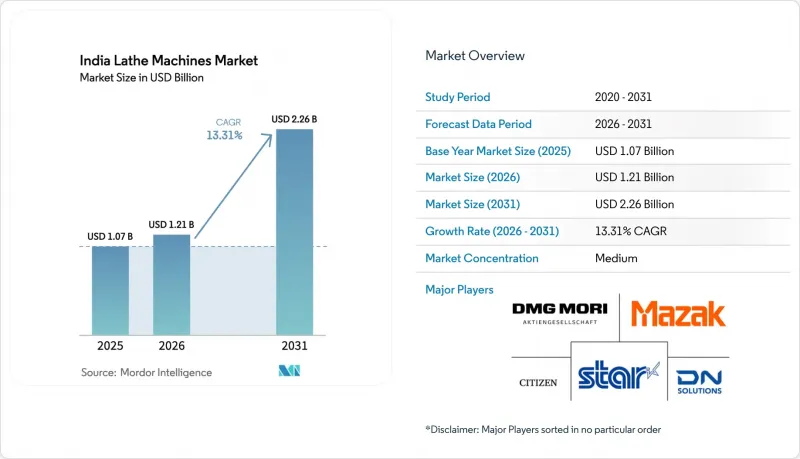
根據 Mordor Intelligence 預測,印度車床市場預計將從 2025 年的 10.7 億美元成長到 2026 年的 12.1 億美元,到 2031 年達到 22.6 億美元,2026 年至 2031 年的複合年成長率預計為 13.31%。
本報告依產品類型(數控車床、傳統車床、瑞士型自動車床)、控制方式(手動、半自動、全自動)、加工應用(車削、端面加工及其他)及終端用戶產業(汽車、航太與國防及其他)進行細分。市場預測以美元計價。
印度車床市場的趨勢與洞察
加速印度微企業製造業自動化技術的普及應用。
印度約有7,200萬家中小型微型企業(MSME),其中許多企業正在將傳統車床升級為數控車床,以滿足國內供應鏈和出口品質標準。 2024年在古吉拉突邦開展的一項試點項目,涉及750家工廠,結果顯示,數控改造後廢品率從8-12%降至2-3%,這促使印度政府制定了更廣泛的推廣計劃。 2025年,得益於信貸擔保基金信託為500萬印度盧比(約6萬美元)以下的貸款提供高達85%的設備成本擔保,中小微型企業安裝的數控機床數量同比成長18%。然而,CNC工具機的普及程度並不均衡,在拉傑科特和盧迪亞納等二線城市,仍有60-65%的企業在使用傳統車床。 「國家資本財政策」設定了國內工具機生產40億美元的目標,並將前置作業時間縮短至最短四個月,因此這些加速因素的影響預計將在2027年達到高峰。
政府生產關聯獎勵促進國內資本財生產
根據2024年生產連結獎勵計畫計畫(PLI),將向33個CNC工具機相關項目撥款120.7億印度盧比(約1,450萬美元),並在五年內按新增銷售額的4%至6%進行返還。 2023-24會計年度,印度進口了價值1535.2億印度盧比(約18.5億美元)的工具機,其中車床中心約佔三分之一。計劃在卡納塔克邦和泰米爾納待開發區新建工廠,生產配備國產FANUC相容控制器的四軸和五軸車床。同時,佔地530英畝的圖馬庫爾工具機園區旨在透過整合鑄造、機械加工和組裝服務,將零件前置作業時間縮短高達40%。由於產能需要 2-3 年才能運作,預計產量和出口的大部分成長將發生在 2027 年至 2029 年之間。
多軸數控系統需要大量的初始投資。
一台四軸到六軸車床的價格在8萬美元到25萬美元之間,這大約是印度一家典型合約加工公司年收入的兩到三倍。 2024年的一項調查發現,62%的微型、中型和微企業(MSME)認為購買價格是其向數控工具機轉型的主要障礙。租賃費率僅18%,遠低於德國50%的標準。此外,目前印度中央政府對印度企業和中小企業(CGTMSE)500萬盧比的融資上限不足以支付高階工具機的價格。高達40%的預付款正在拉傑科特、哥印拜陀和法裡達巴德等地的製造商造成融資緊張,導致許多公司儘管投資回收期為18到24個月,仍然推遲購買。由於利率波動導致風險溢價居高不下,預計未來兩年這些限制將最為嚴峻。
細分市場分析
預計到2025年,CNC車床將佔據印度車床市場62.34%的佔有率,這反映出其在汽車、通用機械和金屬加工領域的廣泛應用。然而,受植入和航太零件(需要棒料送料加工且公差小於5微米)需求的推動,瑞士型自動車床預計到2031年將超越印度車床市場,複合年成長率將達到13.86%。儘管傳統車床在約三分之一的泵浦軸和紡織輥製造車間仍然普遍使用,但ISO 9001和AS9100標準的審核正在增加被認為合格的非CNC設備的數量。
瑞士型車床市場仍以進口產品為主,其中西鐵城機械、津上機械和星光微電子佔據了近四分之三的市場。國內製造商,例如 Jyoti CNC Automation 和 Ace Micromatic,正在整合發那科和西門子的控制系統,以縮小性價比差距,並向中小微型微企業提供價格在 2.5 萬美元至 4 萬美元之間的入門級機型。包括與 Lakshmi Machine Works 就導向襯套達成 2024 年合作在內的許可授權舉措,旨在實現關鍵部件的本地化生產,並逐步削弱外國公司的主導地位。穿戴式裝置和導管接頭的微型化趨勢為瑞士型自動車床帶來了持續的成長溢價。
預計到2025年,自動化系統將佔據印度車床市場58.78%的佔有率,並將在2031年之前以13.98%的複合年成長率成長,因為工廠正在大力推行無人夜班以抵消不斷上漲的人事費用。半自動機床仍用於原型製作和小批量生產領域,但隨著機器人裝載機和托盤交換器的單價降至每單元2萬美元以下,其市場佔有率正在下降。手動機床仍在25-30%的小規模維修店中使用,但隨著年輕的機械師傾向於使用數控觸控螢幕操作,手動機床正面臨著代際技能差距的挑戰。
透過安裝成本在 8,000 美元至 15,000 美元之間的維修套件,微企業(MSME) 可以達到新型工具機 70-80% 的精度,並將鑄鐵床身的使用壽命延長 10 年。在古吉拉突邦的升級示範項目中,維修安裝後,加工週期縮短了 25-35%。由於主軸轉速限制和缺乏動力刀具功能,這些套件不適用於高規格電動車或整形外科的加工。在一級供應商中,越來越多的企業將預測性維護視為工業 4.0 的必要條件,從而加速全自動化平台的轉型。
其他好處
- Excel格式的市場預測(ME)表
- 3個月的分析師支持
目錄
第1章:引言
- 研究假設和市場定義
- 調查範圍
第2章:調查方法
第3章執行摘要
第4章 市場狀況
- 市場概覽
- 市場促進因素
- 加速印度中小製造業自動化技術的普及應用。
- 政府生產關聯獎勵促進國內資本財生產
- 電動動力傳動系統總成加工需求激增
- 泰米爾納德邦和特倫甘納邦醫療設備叢集的快速崛起
- 相容工業4.0的維修安裝套件可降低升級成本
- 國防抵銷合約中的在地採購義務
- 市場限制因素
- 多軸數控系統需要較高的初始資本投入。
- 全國範圍內工具機資金籌措選擇不足
- 熟練的CNC編程人員和操作員短缺
- 二線工業區持續的電能品質問題
- 產業規模、價值鏈分析
- 監理情勢
- 技術展望
- 波特五力分析
- 宏觀經濟因素對市場的影響
第5章 市場規模與成長預測
- 依產品類型
- CNC車床
- 傳統車床
- 瑞士型自動車床
- 控制類型
- 手動的
- 半自動
- 自動的
- 處理目的
- 轉彎
- 面對
- 保齡球
- 切割和分離
- 按最終用戶行業分類
- 車
- 航太/國防
- 一般製造業
- 金屬工業
- 其他
第6章 競爭情勢
- 市場集中度
- 策略趨勢
- 市佔率分析
- 公司簡介
- Yamazaki Mazak Corporation
- DMG MORI Aktiengesellschaft
- Doosan Machine Tools Co. Ltd.(DN Solutions)
- Citizen Machinery Co. Ltd.
- Star Micronics Co. Ltd.
- Okuma Corporation
- Haas Automation Inc.
- Tsugami Corporation
- Tornos Group SA
- Bharat Fritz Werner Ltd.
- Lakshmi Machine Works Ltd.
- Ace Micromatic Group(Ace Designers Ltd.)
- Jyoti CNC Automation Ltd.
- HMT Machine Tools Ltd.
- Galaxy-Tajmac India Pvt Ltd.
- Laxmi Metal and Machines
- Arrow Machine Tools Pvt Ltd.
- Micromatic Machine Tools Pvt Ltd.
- Emag India Pvt Ltd.
- Murata Machinery Ltd.
第7章 市場機會與未來展望
According to Mordor Intelligence, the India lathe machines market size is expected to increase from USD 1.07 billion in 2025 to USD 1.21 billion in 2026 and reach USD 2.26 billion by 2031, growing at a CAGR of 13.31% over 2026-2031.
This report is Segmented by Product Type (CNC Lathe, Conventional Lathe, and Swiss-Type Automatic Lathe), Control Type (Manual, Semi-Automatic, and Automatic), Operation (Turning, Facing, and More), End-User Industry (Automotive, Aerospace and Defence, and More). The Market Forecasts are Provided in Terms of Value (USD).
India Lathe Machines Market Trends and Insights
Accelerated Automation Adoption In Indian MSME Manufacturing
India hosts about 72 million registered MSMEs, many of which are upgrading from conventional to CNC lathes to meet domestic supply-chain and export quality norms. A 2024 Gujarat pilot covering 750 factories showed scrap rates falling from 8-12% to 2-3% after CNC conversion, prompting wider replication programs. CNC installations at MSMEs grew 18% year-over-year in 2025 as the Credit Guarantee Fund Trust covered up to 85% of equipment value on loans below INR 50 lakh (USD 60,000). Yet penetration remains uneven because tier-2 cities such as Rajkot and Ludhiana still run 60-65% conventional lathes. The National Capital Goods Policy, which targets domestic machine-tool output of USD 4 billion, is cutting lead times to as little as four months, so the influence of this driver peaks by 2027.
Government PLI Incentives For Domestic Capital-Goods Production
The 2024 PLI scheme earmarked INR 1,207 crore (USD 14.5 million) for 33 CNC-oriented projects, reimbursing 4-6% of incremental sales for five years. India imported machine tools worth INR 15,352 crore (USD 1.85 billion) in 2023-24, of which turning centers formed roughly one-third. New greenfield facilities in Karnataka and Tamil Nadu promise 4- and 5-axis lathes with home-grown Fanuc-compatible controllers, while the 530-acre Tumakuru Machine Tools Park integrates foundry, fabrication and assembly services to slash component lead times by up to 40% . Because capacity commissioning spans two to three years, the bulk of output and export push arrives between 2027 and 2029.
High Upfront Capex For Multi-Axis CNC Systems
Four- to six-axis lathes cost USD 80,000-250,000, roughly double or triple the annual turnover of a typical Indian job shop. A 2024 survey showed 62% of MSMEs quoting purchase price as the main block to CNC migration. Leasing penetration is barely 18%, far below the 50% norm in Germany, while the CGTMSE ceiling of INR 50 lakh falls short of premium machine prices. Advance payments of up to 40% strain liquidity for manufacturers in Rajkot, Coimbatore and Faridabad, so many defer purchases despite 18-24 month payback periods. The restraint bites hardest in the next two years as interest-rate volatility keeps risk premiums high.
Other drivers and restraints analyzed in the detailed report include:
- Surge In EV Power-Train Machining Demand
- Rapid Rise Of Medical-Device Clusters In Tamil Nadu And Telangana
- Shortage Of Trained CNC Programmers And Operators
For complete list of drivers and restraints, kindly check the Table Of Contents.
Segment Analysis
CNC lathes captured 62.34% of 2025 India lathe machines market share, reflecting their broad use across automotive, general engineering and metal fabrication. Swiss-type automatics, however, are forecast to outpace the India lathe machines market size with a 13.86% CAGR through 2031, fueled by implant and aerospace components that demand bar-fed machining and tolerances below 5 microns. Conventional lathes remain entrenched in roughly one-third of workshops that produce pump shafts and textile rolls, yet ISO 9001- and AS9100-driven audits increasingly disqualify non-CNC equipment.
Imports still dominate the Swiss segment, with Citizen Machinery, Tsugami and Star Micronics holding nearly three-quarters of sales. Domestic builders such as Jyoti CNC Automation and Ace Micromatic target MSMEs with entry-level models priced USD 25,000-40,000, integrating Fanuc or Siemens controls to bridge cost and capability gaps. Licensing moves, including Lakshmi Machine Works' 2024 guide-bushing collaboration, aim to localize critical components and chip away at foreign dominance. Miniaturization trends in wearables and catheter fittings ensure a durable growth premium for Swiss automatics.
Automatic systems commanded 58.78% of 2025 India lathe machines market share and are set for a 13.98% CAGR through 2031 as factories push unmanned night shifts to offset labor cost inflation. Semi-automatic units linger in prototype and short-run roles but lose share as robotic loaders and pallet changers drop below USD 20,000 per cell. Manual machines still serve 25-30% of small repair shops yet face a generational skills void, with younger machinists gravitating toward CNC touchscreens.
Retrofit kits costing USD 8,000-15,000 allow MSMEs to reach 70-80% of new-machine precision, extending the useful life of cast-iron beds by a decade. Gujarat's upgrade pilot showed cycle-time cuts of 25-35% after retrofit adoption. Still, limited spindle speeds and absence of live tooling restrict kits from high-spec EV and orthopedic work. Tier-1 suppliers increasingly treat Industry 4.0 predictive-maintenance readiness as table stakes, accelerating the pull toward fully automatic platforms.
Complete Report Scope:
- By Product Type
- CNC Lathe
- Conventional Lathe
- Swiss-Type Automatic Lathe
- By Control Type
- Manual
- Semi-automatic
- Automatic
- By Operation
- Turning
- Facing
- Boring
- Cutting / Parting
- By End-user Industry
- Automotive
- Aerospace and Defence
- General Manufacturing
- Metal Industry
- Other End-user Industries
List of Companies Covered in this Report:
- Yamazaki Mazak Corporation
- DMG MORI Aktiengesellschaft
- Doosan Machine Tools Co. Ltd. (DN Solutions)
- Citizen Machinery Co. Ltd.
- Star Micronics Co. Ltd.
- Okuma Corporation
- Haas Automation Inc.
- Tsugami Corporation
- Tornos Group SA
- Bharat Fritz Werner Ltd.
- Lakshmi Machine Works Ltd.
- Ace Micromatic Group (Ace Designers Ltd.)
- Jyoti CNC Automation Ltd.
- HMT Machine Tools Ltd.
- Galaxy-Tajmac India Pvt Ltd.
- Laxmi Metal and Machines
- Arrow Machine Tools Pvt Ltd.
- Micromatic Machine Tools Pvt Ltd.
- Emag India Pvt Ltd.
- Murata Machinery Ltd.
Additional Benefits:
- The market estimate (ME) sheet in Excel format
- 3 months of analyst support
TABLE OF CONTENTS
1 INTRODUCTION
- 1.1 Study Assumptions and Market Definition
- 1.2 Scope of the Study
2 RESEARCH METHODOLOGY
3 EXECUTIVE SUMMARY
4 MARKET LANDSCAPE
- 4.1 Market Overview
- 4.2 Market Drivers
- 4.2.1 Accelerated Automation Adoption in Indian MSME Manufacturing
- 4.2.2 Government PLI Incentives for Domestic Capital-Goods Production
- 4.2.3 Surge in EV Power-Train Machining Demand
- 4.2.4 Rapid Rise of Medical-Device Clusters in Tamil Nadu and Telangana
- 4.2.5 Industry 4.0 Retrofit Kits Lowering Upgrade Costs
- 4.2.6 Local Sourcing Mandates in Defence Offset Contracts
- 4.3 Market Restraints
- 4.3.1 High Upfront Capex for Multi-Axis CNC Systems
- 4.3.2 Inadequate Nationwide Machine-Tool Financing Instruments
- 4.3.3 Shortage of Trained CNC Programmers and Operators
- 4.3.4 Persistent Power-Quality Issues in Tier-2 Industrial Hubs
- 4.4 Industry Value, Supply-Chain Analysis
- 4.5 Regulatory Landscape
- 4.6 Technological Outlook
- 4.7 Porter's Five Forces Analysis
- 4.7.1 Bargaining Power of Suppliers
- 4.7.2 Bargaining Power of Buyers
- 4.7.3 Threat of New Entrants
- 4.7.4 Threat of Substitute Products
- 4.7.5 Intensity of Competitive Rivalry
- 4.8 Impact of Macroeconomic Factors on the Market
5 MARKET SIZE AND GROWTH FORECASTS (VALUE)
- 5.1 By Product Type
- 5.1.1 CNC Lathe
- 5.1.2 Conventional Lathe
- 5.1.3 Swiss-Type Automatic Lathe
- 5.2 By Control Type
- 5.2.1 Manual
- 5.2.2 Semi-automatic
- 5.2.3 Automatic
- 5.3 By Operation
- 5.3.1 Turning
- 5.3.2 Facing
- 5.3.3 Boring
- 5.3.4 Cutting / Parting
- 5.4 By End-user Industry
- 5.4.1 Automotive
- 5.4.2 Aerospace and Defence
- 5.4.3 General Manufacturing
- 5.4.4 Metal Industry
- 5.4.5 Other End-user Industries
6 COMPETITIVE LANDSCAPE
- 6.1 Market Concentration
- 6.2 Strategic Moves
- 6.3 Market Share Analysis
- 6.4 Company Profiles
- 6.4.1 Yamazaki Mazak Corporation
- 6.4.2 DMG MORI Aktiengesellschaft
- 6.4.3 Doosan Machine Tools Co. Ltd. (DN Solutions)
- 6.4.4 Citizen Machinery Co. Ltd.
- 6.4.5 Star Micronics Co. Ltd.
- 6.4.6 Okuma Corporation
- 6.4.7 Haas Automation Inc.
- 6.4.8 Tsugami Corporation
- 6.4.9 Tornos Group SA
- 6.4.10 Bharat Fritz Werner Ltd.
- 6.4.11 Lakshmi Machine Works Ltd.
- 6.4.12 Ace Micromatic Group (Ace Designers Ltd.)
- 6.4.13 Jyoti CNC Automation Ltd.
- 6.4.14 HMT Machine Tools Ltd.
- 6.4.15 Galaxy-Tajmac India Pvt Ltd.
- 6.4.16 Laxmi Metal and Machines
- 6.4.17 Arrow Machine Tools Pvt Ltd.
- 6.4.18 Micromatic Machine Tools Pvt Ltd.
- 6.4.19 Emag India Pvt Ltd.
- 6.4.20 Murata Machinery Ltd.
7 MARKET OPPORTUNITIES AND FUTURE OUTLOOK
- 7.1 White-Space and Unmet-Need Assessment

 拋光芯軸市場規模、佔有率和成長分析:按產品類型、材料、應用、最終用途產業、分銷管道和地區分類-2026-2033年產業預測
 全球車床市場規模、佔有率、趨勢和成長分析報告(2026-2034年)
 車床:市場佔有率分析、行業趨勢和統計數據、成長預測(2026-2031 年)
 車床市場報告:按類型、操作方式、負載、最終用戶和地區分類,2026-2034 年
 自動車床市場:按工具機類型、控制方式、操作方式、軸數、銷售管道、應用與最終用戶分類-2026-2032年全球市場預測車床市場:2026-2032年全球市場預測(依工具機類型、主軸方向、結構類型及最終用途產業分類)
 2026年全球車床市場報告
 車床市場規模、佔有率和成長分析(按類型、操作方式、產能、最終用戶和地區分類)-2026-2033年產業預測
 2032 年車床市場預測:按產品類型、營運類型、營運模式、最終用戶和地區進行的全球分析
 氣舉閥工作筒市場報告:趨勢、預測和競爭分析(至 2030 年)