


 |
市場調查報告書
商品編碼
2125605
中國電池製造設備:市場佔有率分析、產業趨勢與統計及成長預測(2026-2031年)China Battery Manufacturing Equipment - Market Share Analysis, Industry Trends & Statistics, Growth Forecasts (2026 - 2031) |
||||||

※ 本網頁內容可能與最新版本有所差異。詳細情況請與我們聯繫。
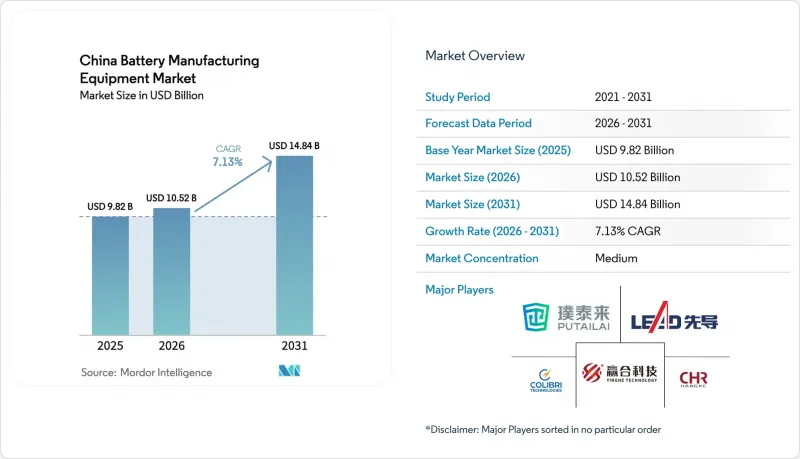
根據 Mordor Intelligence 預測,中國電池製造設備市場規模將從 2025 年的 98.2 億美元成長到 2026 年的 105.2 億美元,然後在 2031 年達到 148.4 億美元,2026 年至 2031 年的複合年成長率為 7.13%。
本報告按電池化學成分(鋰離子電池、全固體、液流電池等)、機器類型(塗層和乾燥系統、成型和測試線、組裝和搬運機器人等)、自動化水平(全自動、人工智慧監督的“無人值守”生產線等)和最終用戶(汽車原始設備製造商和一級供應商、能源儲存系統整合商等)進行分類。
中國電池製造設備市場趨勢與洞察
電動車主導超級工廠快速擴張
預計到2024年,中國將生產950萬輛電動車,這將促使寧德時代(CATL)計劃在2026年將其年產能提高200GWh,而比亞迪計劃同期提高150GWh的產能。超級工廠的每個擴建階段都需要30億至40億美元的新資本投資,這使得能夠在12至18個月內交付承包生產線的供應商更具優勢。江蘇、廣東和四川三省已建立了密集的供應鏈,能夠實現準時安裝,並鞏固了本地供應商的地位。省政府提供的補貼政策,最高可達符合條件的設備成本的30%,進一步加速了電池製造設備的普及。因此,儘管全國產能運轉率低於50%,但中國電池製造設備市場的短期訂單前景依然樂觀。
一套基於人工智慧的產量提升軟體。
將機器視覺分析功能與硬體捆綁銷售,可使平均售價提高 15-20%,並促使客戶簽訂多年服務合約。根據無錫勵訊的報告顯示,人工智慧監控生產線的初始良率高達 96-97%,而傳統系統的良率僅為 92-93%,這意味著一座 10 GWh 的工廠每年可節省 800 萬至 1,000 萬美元的成本。即時缺陷檢測可減少停機時間,而數據回饋循環則有助於最佳化電池化學成分,並加深供應商與客戶之間的關係。不具備自身軟體開發能力的供應商則需要收購新創公司或購買演算法許可,這會擠壓利潤空間,並進一步強化全端整合商的競爭優勢。
2023-2024年資本投資熱潮後產能過剩。
經過兩年的安裝熱潮,到2023年,全國電池運轉率下降至47%,導致供應商庫存積壓,被迫降價銷售,並消耗了其流動資金。特別是用於大宗商品的混合機、切斷機和塗佈機,面臨著最嚴重的供過於求的局面。同時,中國工業和資訊化部(工信部)的指導意見敦促企業,除非新建設能夠提升產品質量,否則不應進行新建。地方政府仍優先考慮就業,導致各省法規執行力不一致,加劇了電池製造設備市場的供過於求,並擴大了市場競爭。
細分市場分析
固態電池設備銷售額預計將以30.24%的複合年成長率成長。這反映了中國政府承諾投入60億元人民幣建造先導工廠,預計2026年產能將達到3-5吉瓦時。相較之下,受電動車和消費性電子產品強勁需求的推動,鋰離子電池在2025年仍將佔中國電池製造設備市場84.62%的佔有率。由於鈉離子電池設備易於維修,對注重成本的製造商來說極具吸引力,因此其需求正在加速成長。同時,液流電池在電網級儲能領域正蓬勃發展。鉛酸電池和鎳基電池則保持小眾但穩定的市場佔有率,主要用於工業和航太航太領域。
無錫鉛業、普泰來以及一級電芯廠商之間的強力政策支持和聯合開發夥伴關係,正在推動固態電池的快速普及。相關設備設計融合了無溶劑塗覆、真空沉澱和高壓壓延等技術,這些技術目前鮮有廠商掌握,使領先企業在把握中國電池製造設備市場下一波擴張浪潮中佔據優勢。
到2025年,塗覆和乾燥系統將佔銷售額的20.12%,反映出其高資本密集度和高精度要求。同時,組裝和運輸機器人以16.15%的複合年成長率位居榜首,因為製造商正在透過自動化勞動密集的層壓和包裝流程來抵消不斷上漲的人事費用。因此,隨著電池形狀的多樣化,中國電池製造設備市場中機器人的市場規模正在快速擴張。
雷射開槽和高精度切割技術有利於製造尺寸更大的電池結構,這些結構需要更嚴格的尺寸控制。人工智慧診斷功能已整合到成型和測試生產線中,透過及早發現缺陷,降低了電動車製造商的保固條款。同時,回收和黑料處理設備也受惠於2028年生效的強制性95%材料回收率政策帶來的利好,從而拓展了除一次電池生產之外的商機。
其他好處:
- Excel格式的市場預測(ME)表
- 3個月的分析師支持
目錄
第1章:引言
- 研究假設和市場定義
- 調查範圍
第2章:調查方法
第3章執行摘要
第4章 市場狀況
- 市場概覽
- 市場促進因素
- 電動車主導超級工廠快速擴張
- 政府在「中國製造2025」計劃下對自動化提供的補貼
- 一級電池製造商的垂直整合
- 固態中試生產線的投資
- 一套利用人工智慧技術提高產量的軟體組合。
- 鈉離子電池試點設施需求激增
- 市場限制因素
- 2023-2024年資本投資熱潮後產能過剩。
- 中國汽車製造商之間的價格競爭日益激烈
- 高級自動化工程師短缺
- 美國/歐盟製程相關智慧財產權的出口管制風險
- 供應鏈分析
- 監理情勢
- 技術展望
- 波特五力模型
- PESTLE分析
第5章 市場規模與成長預測
- 電池化學成分
- 鋰離子
- 固態電池
- 鈉離子
- 鉛酸
- 鎳基
- 液流電池(鋅溴電池、釩電池等)
- 按機器類型
- 塗層和乾燥系統
- 日曆出版社
- 攪拌機和均質機
- 分切機
- 雷射開槽和切割
- 電極堆疊
- 真空乾燥和脫氣
- 電解填充
- 組裝和運輸機器人
- 成型和測試線
- 包裝和密封
- 回收和黑體處理設備
- 按自動化級別
- 手排/實驗室規模
- 半自動
- 全自動
- 「熄燈」線路由人工智慧監控。
- 最終用戶
- 汽車製造商和一級供應商
- 能源儲存系統系統整合商
- 家用電子產品
- 工業和電動工具
- 航太/國防
- 其他最終用戶
第6章 競爭情勢
- 市場集中度
- 策略趨勢(併購、聯盟、購電協議)
- 市場佔有率分析(主要公司的市場排名和佔有率)
- 公司簡介
- Wuxi Lead Intelligent Equipment Co., Ltd.
- Shenzhen Yinghe Technology Co., Ltd.
- HangKe Technology Co., Ltd.
- Durr AG
- Xiamen Tmax Battery Equipments Ltd.
- Xiamen TOB New Energy Technology Co., Ltd.
- Xiamen ACEY New Energy Technology
- Schuler AG
- Hitachi Ltd.
- Andritz AG
- Shenzhen Colibri Technologies
- Putailai(PTL)Intelligent Equipment
- Manz AG
- NAURA Technology Group
第7章 市場機會與未來展望
According to Mordor Intelligence, the China battery manufacturing equipment market size is expected to grow from USD 9.82 billion in 2025 to USD 10.52 billion in 2026 and is forecast to reach USD 14.84 billion by 2031 at 7.13% CAGR over 2026-2031.
This report is Segmented by Battery Chemistry (Lithium-Ion, Solid-State, Flow Batteries, and More), Machine Type (Coating and Drying Systems, Formation and Testing Lines, Assembly and Handling Robots, and More), Automation Level (Fully-Automatic, AI-Supervised "lights-Out" Lines, and More), and End-User (Automotive OEMs and Tier-1s, Energy Storage System Integrators, and More).
China Battery Manufacturing Equipment Market Trends and Insights
Rapid EV-Led Gigafactory Expansion
China produced 9.5 million electric vehicles in 2024, spurring CATL to add 200 GWh of annual capacity by 2026 and BYD to plan 150 GWh over the same horizon. Each gigafactory wave requires USD 3-4 billion of fresh machinery, favoring suppliers able to deliver turnkey lines within 12-18 months. Jiangsu, Guangdong, and Sichuan host dense supply chains, enabling just-in-time installation that entrenches local vendors. Provincial incentives further accelerate deployments by offsetting up to 30% of qualifying equipment costs. As a result, the Chinese battery manufacturing equipment market enjoys near-term order visibility despite nationwide capacity utilization below 50%.
AI-Driven Yield-Improvement Software Bundling
Bundling machine-vision analytics with hardware lifts average selling prices 15-20% and locks customers into multi-year service contracts. Wuxi Lead reports first-pass yields of 96-97% on AI-supervised lines versus 92-93% on conventional systems, translating into USD 8-10 million in annual savings for a 10 GWh plant. Real-time defect detection shrinks downtime, while data feedback loops inform cell chemistry tweaks, deepening vendor-client ties. Suppliers lacking native software capabilities must acquire startups or license algorithms, both of which dilute margins and reinforce the competitive moat of full-stack integrators.
Equipment Over-Capacity After 2023-24 Capex Spree
Nationwide utilization fell to 47% in 2023 after a two-year installation boom, leaving vendors with idle inventory and forcing discounts that sliced working-capital buffers. Commodity mixers, slitters, and coaters face the deepest glut, while MIIT guidelines now discourage fresh builds unless tied to quality upgrades. Provincial enforcement remains uneven because local authorities still prioritize employment, prolonging oversupply and intensifying competition within the Chinese battery manufacturing equipment market.
Other drivers and restraints analyzed in the detailed report include:
- Surging Demand for Sodium-Ion Pilot Equipment
- Solid-State Pilot-Line Investments
- Intensifying Price-Cut Wars Among Chinese OEMs
For complete list of drivers and restraints, kindly check the Table Of Contents.
Segment Analysis
Solid-state equipment revenues are projected to climb at a 30.24% CAGR, reflecting China's CNY 6 billion commitment to pilot builds that could reach 3-5 GWh by 2026. In contrast, lithium-ion retained 84.62% of the Chinese battery manufacturing equipment market share in 2025 due to entrenched EV and consumer electronics demand. Sodium-ion demand is accelerating as retrofit-friendly tooling appeals to budget-conscious producers, while flow batteries gain traction in grid-scale storage. Lead-acid and nickel-based chemistries remain niche but stable, serving industrial and aerospace use cases.
Strong policy backing and co-development alliances between Wuxi Lead, Putailai, and Tier-1 cell makers underpin rapid solid-state adoption. Equipment designs feature solvent-free coating, vacuum deposition, and high-pressure calendaring that few vendors presently master, making early movers well-positioned to capture the next wave of China battery manufacturing equipment market expansion.
Coating and drying systems generated 20.12% of 2025 revenue, reflecting their capital intensity and precision requirements. Assembly and handling robots, however, post the quickest 16.15% CAGR as producers automate labor-heavy stacking and packaging to offset wage inflation. The Chinese battery manufacturing equipment market size for robots, therefore, expands rapidly alongside cell format diversification.
Laser notching and high-precision cutting benefit from large-format cell architectures that demand tighter dimensional control. Formation and testing lines integrate AI diagnostics to catch early-life defects, reducing warranty provisions for EV makers. Meanwhile, recycling and black-mass processing equipment gains policy tailwinds from the 95% material-recovery mandate effective 2028, broadening revenue opportunities beyond primary battery production.
Complete Report Scope:
- By Battery Chemistry
- Lithium-ion
- Solid-state
- Sodium-ion
- Lead-acid
- Nickel-based
- Flow Batteries (Zn-Br, Vanadium etc.)
- By Machine Type
- Coating and Drying Systems
- Calendaring Presses
- Mixing and Homogenizers
- Slitting Machines
- Laser Notching and Cutting
- Electrode Stacking
- Vacuum Drying and Degassing
- Electro-lyte Filling
- Assembly and Handling Robots
- Formation and Testing Lines
- Packaging and Sealing
- Recycling and Black-mass Processing Equipment
- By Automation Level
- Manual/Lab-scale
- Semi-automatic
- Fully-automatic
- AI-supervised "lights-out" lines
- By End-User
- Automotive OEMs and Tier-1s
- Energy Storage System Integrators
- Consumer Electronics
- Industrial and Power Tools
- Aerospace and Defense
- Other End Users
List of Companies Covered in this Report:
- Wuxi Lead Intelligent Equipment Co., Ltd.
- Shenzhen Yinghe Technology Co., Ltd.
- HangKe Technology Co., Ltd.
- Durr AG
- Xiamen Tmax Battery Equipments Ltd.
- Xiamen TOB New Energy Technology Co., Ltd.
- Xiamen ACEY New Energy Technology
- Schuler AG
- Hitachi Ltd.
- Andritz AG
- Shenzhen Colibri Technologies
- Putailai (PTL) Intelligent Equipment
- Manz AG
- NAURA Technology Group
Additional Benefits:
- The market estimate (ME) sheet in Excel format
- 3 months of analyst support
TABLE OF CONTENTS
1 Introduction
- 1.1 Study Assumptions & Market Definition
- 1.2 Scope of the Study
2 Research Methodology
3 Executive Summary
4 Market Landscape
- 4.1 Market Overview
- 4.2 Market Drivers
- 4.2.1 Rapid EV?led gigafactory expansion
- 4.2.2 Government "Made-in-China 2025" automation subsidies
- 4.2.3 Vertical integration by Tier-1 cell makers
- 4.2.4 Solid-state pilot-line investments
- 4.2.5 AI-driven yield-improvement software bundling
- 4.2.6 Surging demand for sodium-ion pilot equipment
- 4.3 Market Restraints
- 4.3.1 Equipment over-capacity after 2023-24 capex spree
- 4.3.2 Intensifying price-cut wars among Chinese OEMs
- 4.3.3 Scarcity of senior automation engineers
- 4.3.4 Export-control risks on US/?EU process IP
- 4.4 Supply-Chain Analysis
- 4.5 Regulatory Landscape
- 4.6 Technological Outlook
- 4.7 Porter's Five Forces
- 4.7.1 Threat of New Entrants
- 4.7.2 Bargaining Power of Suppliers
- 4.7.3 Bargaining Power of Buyers
- 4.7.4 Threat of Substitutes
- 4.7.5 Competitive Rivalry
- 4.8 PESTLE Analysis
5 Market Size & Growth Forecasts
- 5.1 By Battery Chemistry
- 5.1.1 Lithium-ion
- 5.1.2 Solid-state
- 5.1.3 Sodium-ion
- 5.1.4 Lead-acid
- 5.1.5 Nickel-based
- 5.1.6 Flow Batteries (Zn-Br, Vanadium etc.)
- 5.2 By Machine Type
- 5.2.1 Coating and Drying Systems
- 5.2.2 Calendaring Presses
- 5.2.3 Mixing and Homogenizers
- 5.2.4 Slitting Machines
- 5.2.5 Laser Notching and Cutting
- 5.2.6 Electrode Stacking
- 5.2.7 Vacuum Drying and Degassing
- 5.2.8 Electro-lyte Filling
- 5.2.9 Assembly and Handling Robots
- 5.2.10 Formation and Testing Lines
- 5.2.11 Packaging and Sealing
- 5.2.12 Recycling and Black-mass Processing Equipment
- 5.3 By Automation Level
- 5.3.1 Manual/Lab-scale
- 5.3.2 Semi-automatic
- 5.3.3 Fully-automatic
- 5.3.4 AI-supervised "lights-out" lines
- 5.4 By End-User
- 5.4.1 Automotive OEMs and Tier-1s
- 5.4.2 Energy Storage System Integrators
- 5.4.3 Consumer Electronics
- 5.4.4 Industrial and Power Tools
- 5.4.5 Aerospace and Defense
- 5.4.6 Other End Users
6 Competitive Landscape
- 6.1 Market Concentration
- 6.2 Strategic Moves (M&A, Partnerships, PPAs)
- 6.3 Market Share Analysis (Market Rank/Share for key companies)
- 6.4 Company Profiles (includes Global level Overview, Market level overview, Core Segments, Financials as available, Strategic Information, Products & Services, and Recent Developments)
- 6.4.1 Wuxi Lead Intelligent Equipment Co., Ltd.
- 6.4.2 Shenzhen Yinghe Technology Co., Ltd.
- 6.4.3 HangKe Technology Co., Ltd.
- 6.4.4 Durr AG
- 6.4.5 Xiamen Tmax Battery Equipments Ltd.
- 6.4.6 Xiamen TOB New Energy Technology Co., Ltd.
- 6.4.7 Xiamen ACEY New Energy Technology
- 6.4.8 Schuler AG
- 6.4.9 Hitachi Ltd.
- 6.4.10 Andritz AG
- 6.4.11 Shenzhen Colibri Technologies
- 6.4.12 Putailai (PTL) Intelligent Equipment
- 6.4.13 Manz AG
- 6.4.14 NAURA Technology Group
7 Market Opportunities & Future Outlook
- 7.1 White-space & Unmet-Need Assessment

 電池製造設備市場:全球市場預測,2026-2032年
 全球電池製造設備市場規模、佔有率、趨勢和成長分析報告(2026-2034年)
 電池混合設備:市場佔有率分析、產業趨勢與統計、成長預測(2026-2031)
 全球鋰電池製造設備市場規模、製造商、供應鏈、銷售管道與客戶:2021-2032年
 電池超級工廠市場:全球產業分析、市場規模及佔有率和預測(2026-2033 年),按製造流程、電池類型、應用、容量、國家和地區分類(2026-2033 年)電池製造設備:市場佔有率分析、產業趨勢與統計、成長預測(2026-2031)電池製造設備市場:依設備類型、電池類型、電芯形狀、產能、自動化程度及終端用戶產業分類-2026-2032年全球市場預測鋰電池滾動設備市場:按設備類型、電池化學成分、電池容量範圍、充電方式、應用、終端用戶產業分類,全球預測(2026-2032年)
 二次電池電極製造設備市場規模、佔有率及成長分析:按設備類型、應用、材料類型及地區分類-2026-2033年產業預測
 電池超級工廠市場分析及預測(至2035年):類型、產品、服務、技術、組件、應用、材料類型、製程與最終用戶