


 |
市場調查報告書
商品編碼
2073651
電池混合設備:市場佔有率分析、產業趨勢與統計、成長預測(2026-2031)Mixing Equipment For Battery Manufacturing - Market Share Analysis, Industry Trends & Statistics, Growth Forecasts (2026 - 2031) |
||||||

※ 本網頁內容可能與最新版本有所差異。詳細情況請與我們聯繫。
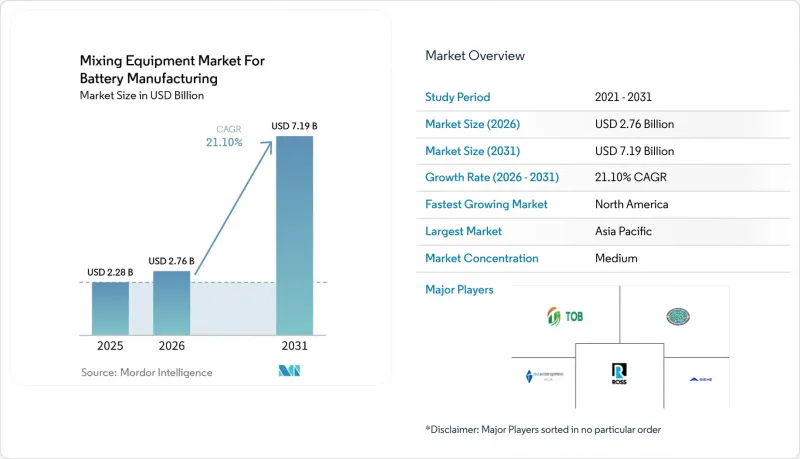
根據 Mordor Intelligence 預測,電池混合設備的市場規模預計將從 2025 年的 22.8 億美元成長到 2026 年的 27.6 億美元,然後在 2031 年達到 71.9 億美元,2026 年至 2031 年的複合年成長率為 21.1%。
本報告按攪拌機類型(例如,行星式攪拌機)、額定容量(例如,小於200公升)、電池化學成分(例如,磷酸鋰電池)、最終用途(例如,電動乘用車)和地區(北美、歐洲、亞太、中東和非洲、南美)進行細分。市場預測以美元計價。
電池混合設備市場洞察與趨勢
在通貨膨脹抑制法案 (IRA) 的推動下,超級工廠的建設正在重組設備採購。
受《通貨膨脹控制法案》(IRA)的影響,美國電池工廠建設計畫正在推動電池混合設備市場的發展。迄今為止,已宣佈興建23座電池工廠,計畫投資520億美元,年產能達490吉瓦時。這些項目形成了一個集中採購週期,因為所有新建電池工廠在塗覆製程之前都需要漿料製備設備,從而確保下游製程的生產線認證。目前,市場對大容量行星式和線上式系統的需求最為旺盛,尤其是那些需要1000-5000公升設備或5000公升以上平台以滿足產能擴張需求的業者。這一趨勢也凸顯了美國電池政策與美國機械設備訂單之間的差距。據Charles Ross & Son公司稱,美國位置電池項目正在流失部分新訂單,這些訂單流向了亞洲的承包工程競爭對手。這個問題對電池混合設備市場有重大影響。這是因為,儘管訂單量可能快速成長,但國內工廠的收入成長速度可能會放緩。 Envision AESC在南卡羅來納州的計畫就清晰地展現了這個問題的嚴重性。僅與寶馬合作建設的這家工廠計劃年產能為 30 GWh,價值 30 億美元,規模足夠大,足以對上游工程攪拌機產生相當大的需求。
高鎳陰極材料漿料的均勻性對高性能設備的需求日益成長。
此外,製備高鎳含量正極材料穩定、高品質漿料的難度也推動了電池混合設備市場的擴張。對水系NMC811電極的研究表明,鋰浸出可使漿料pH值升高至12左右。這會增加鋁電極集流體的腐蝕風險,使得快速的製程控制變得更加重要。在這些工況下,具有惰性處理、更精確的溫度控制和可靠的真空脫氣功能的設備比標準混合配置更為適用。鵬藝的電池漿料工藝指南也強調,最新的雙行星系統將乾濕填充、高黏度物料處理和真空脫氣整合到一個製程流程中,這也是買家願意為檢驗的系統支付更高價格的原因之一。弗勞恩霍夫IPA研究所2026年的研究發現,以高壓濕式噴射銑床磷酸鐵鋰電池正極漿料,可使平均粒徑減小39%,製程能耗降低42%,1C倍率容量提高12.8%。研究結果證實,即使化學成分成熟,引進先進的漿料製備設備也能有效提升性能。隨著水性製程和溶劑相關合規性在歐洲日益重要,預計2026年後,高階系統仍將在電池混合設備市場中繼續受到青睞。
高額的資本投入和前置作業時間是中型電池製造商面臨的障礙。
電池混合設備市場在廣泛應用方面仍面臨明顯的限制。這是因為客製化的高黏度系統價格昂貴,而且交貨週期通常過長,難以滿足小規模電池專案的需求。根據鵬宜的製程說明,成本增加的原因在於,先進的電池漿料混合器必須在單一設計中兼顧寬黏度範圍、真空脫氣、精確的填充順序以及潔淨的內表面。耐馳也將其超級工廠級設備定位為注重製程性能,這印證了頂級系統是工程資產而非標準容器的觀點。當新參與企業需要用於高鎳含量或全固態電池的專用系統時,這些額外的設計要求會延長採購週期,並拉大與更簡單替代方案的成本差距。因此,電池混合設備市場出現了一個局面:大型製造商比中小企業更容易獲得性能最高的系統。這種趨勢迫使許多中型買家依賴低成本的進口設備,即使製程差異化能為高性能設備帶來優勢。
細分市場分析
2025年,行星式攪拌機在電池混合設備市場佔據34.8%的佔有率,並持續保持其作為正負極漿料製備首選設備的領先地位。這一地位並非僅源自於傳統做法,而是得益於其工藝柔軟性。現代雙行星式設計能夠處理極高的黏度,具備真空脫氣功能,並可在同一容器內實現從乾式到濕式的逐步填充。這項功能在電池混合設備市場至關重要,因為它使製造商能夠在切換配方、固態含量和生產規模時最大限度地減少製程上的妥協。耐馳(NETZSCH)也表示,其PMH平台能夠縮短混合時間,並減少超級工廠規模所需的設備數量。這支撐了對大型行星式系統的持續需求,因為在這些系統中,一致性和工廠效率都至關重要。此類別與磷酸鐵鋰電池(LFP)和鎳基複合材料(NMC)的生產密切相關,買家仍然重視塗層前黏度控制和脫氣的成熟方法。
成長最快的細分市場是固體低剪切行星式攪拌,預計到2031年將以24.6%的複合年成長率成長,因為越來越多的固態電池專案將從實驗室階段過渡到設備訂購階段。這一成長速度反映了不同的製程要求,因為硫化物和乾式製程系統比許多濕式漿料生產線需要更溫和的操作、更好的密封性和更嚴格的環境控制。 SIEHE集團計劃於2026年進軍千噸級固體硫化物生產線的供應市場,這表明即使是老牌設備製造商也開始將這一細分市場視為真正的商業性機會,而不僅僅是實驗性的擴張。此外,在電池攪拌設備產業,對線上分散式平台的需求也不斷成長,因為這類平台對工廠面積和連續加工能力要求很高。 Ystral公司的Batt-TDS系統因其在檢驗測試中表現出的優異的長期循環性能而備受關注。雖然雙軸分散機和連續式線上混合機的應用場景仍然有限,但對於那些尋求縮小面積、提高加工速度或適應中等黏度配方的製造商而言,它們的重要性日益凸顯。因此,電池混合設備市場正在擴展,納入更多專業化的混合機類型,其中行星式混合系統仍是核心。
到2025年,1000-5000公升容量範圍的設備將佔銷售額的41.2%。這反映了介於中試規模生產和大型超級工廠建設之間的工廠的運作基礎。此容量範圍非常適合目前的商業電池生產,因為它可以在不給每家工廠配備超大型設備的情況下,以合理的規模為塗層製程提供原料。它還為生產商在處理能力、容器利用率、易於維護性和資本投資成本之間提供了切實可行的平衡。在電池混合設備市場,對於那些既需要可重複的產量,又需要柔軟性處理化學成分和生產線配置的工廠來說,這種中等容量的設備是最常見的選擇。因此,對於許多已投入運作的電池製造廠而言,該細分市場仍然是一個核心的切入點。
在電池混合設備市場中,容量超過5000公升的細分市場是成長最快的領域,預計到2031年將以25.3%的複合年成長率成長,這主要得益於大規模電池工廠尋求消除上游工程加工能力瓶頸。當生產線的經濟效益依賴於大規模生產、降低勞動密集度以及減少同一工廠內並聯混合單元的數量時,實施這些系統的優勢就顯得尤為明顯。 Rodighe已經指出,隨著電池產量目標的提高,對更大容量混合機的需求也在增加,這凸顯了商業性採購中對更大有效容器容量的需求趨勢。同時,容量小於200公升的系統在化學成分開發、製程驗證以及大規模資本投資前的小批量驗證中仍然發揮著至關重要的作用。歐洲的BATMACHINE計畫和研究計畫表明,當需要在實際生產條件下測試新配方時,小型系統仍然具有合格價值。 200-1000公升的容量範圍是實驗室研發和初步生產之間的橋樑,尤其適用於那些尚未達到超級工廠規模的電池製造商。因此,儘管電池混合設備產業涵蓋了廣泛的容量範圍,但需求成長最快的領域是那些旨在滿足超大年產能和更嚴格的資本效率要求的工廠。
區域分析
到2025年,亞太地區將佔據電池混合設備市場63.4%的佔有率,憑藉其電池製造規模、龐大的供應商基礎和快速的商業化能力,鞏固其作為全球需求中心的地位。中國憑藉其成熟的電池生產基地和遍布商業工廠的完善的漿料製備系統,繼續保持其中心地位。越南、印尼和泰國新增產能的擴張也推動了亞太地區電池混合設備市場的整體成長,這些國家的電池和材料相關項目正從投資規劃階段邁向工廠建設階段。印尼巴塘經濟特區對磷酸鐵鋰電池生產和研發能力的投資,就是一個很好的例子,它不僅吸引了政策制定者的關注,也創造了對上游工程電池製程設備的巨大需求。日本和韓國則各有優勢,其供應商在高階、專用於先進電池專案的系統方面更為積極主動。
北美是電池混合設備市場成長最快的區域,預計到2031年複合年成長率將達到26.4%。這一成長動能與《通膨控制法案》(IRA)實施後電池工廠的建設計畫密切相關。如果這些項目按計劃推進到建設階段,其規模足以支撐未來數年的設備訂單。 Charles Ross & Son公司在該地區擁有混合機及相關控制設備的本土製造地,但該公司注意到其訂單正被亞洲競爭對手蠶食,這表明北美市場的成長未必僅限於北美設備供應商。加拿大透過對礦產資源和加工產業的投資間接受益,而墨西哥仍然依賴與區域貿易規則相關的電動車組裝和近岸外包機會。
歐洲在電池混煉設備市場仍具有重要的戰略意義,因為法規、資金籌措和製程標準對買家決策的影響與工廠數量同樣重要。該地區一些最活躍的電池製造和調查計畫正在德國、義大利、法國和北歐國家開展,包括弗勞恩霍夫研究所的相關研究以及義大利用於磷酸鐵鋰(LFP)生產的連續混煉設備。歐盟委員會選定的2025年戰略性原料計畫也促進了中游產業的蓬勃發展,為電池製造領域的投資決策提供了支持。這項政策背景有利於那些不僅初始成本低,而且具備無塵室應對力、製程品質和本地支援能力的供應商。南美、中東和非洲目前的規模仍然小規模,但先導計畫和早期計畫表明,未來的需求將首先從研發和小規模商業生產線開始,然後逐步轉向採購大型工廠。
其他好處:
- Excel格式的市場預測(ME)表
- 3個月的分析師支持
目錄
第1章:引言
- 研究假設和市場定義
- 調查範圍
第2章:調查方法
第3章執行摘要
第4章 市場狀況
- 市場概覽
- 市場促進因素
- 通膨控制法案通過後,全球超級工廠建設蓬勃發展。
- 東南亞二級電池製造商產能快速擴張
- 要實現下一代高鎳正極材料迫切需要漿料均勻性。
- 歐盟推出獎勵措施,鼓勵將關鍵電池設備運回本國
- 隨著電動車(EV)的日益普及,對大型線上攪拌機的需求也不斷成長。
- 需要低剪切力行星式攪拌機的固相研發生線的出現。
- 市場限制因素
- 客製化高黏度混合機需要高額資本投入和較長的前置作業時間。
- 鋰、鎳和溶劑價格的波動給汽車製造商的現金流帶來了壓力。
- 缺乏負責最佳化電極漿料的熟練製程工程師
- 高能量密度電池技術的複雜出口許可證制度。
- 供應鏈分析
- 監理情勢
- 技術展望
- 波特五力模型
- 近期趨勢與發展
第5章 市場規模與成長預測
- 不同種類的攪拌機
- 行星攪拌機
- 雙軸分散器
- 高速攪拌濕式混合機
- 乾粉用皮帶混合機
- 連續式在線混合器
- 按額定容量
- 小於200公升
- 200~1,000 L
- 1 000~5 000 L
- 超過5000公升
- 按電池化學成分
- 磷酸鋰鐵電池
- 高鎳NMC電池
- 總固體/硫化物
- 其他(LTO、鈉離子)
- 按最終用途
- 電動乘用車
- 商用電動車和非公路用車輛
- 家用電子產品
- 固定式儲能
- 研發/中試生產線
- 按地區
- 北美洲
- 美國
- 加拿大
- 墨西哥
- 歐洲
- 德國
- 法國
- 英國
- 義大利
- 西班牙
- 北歐國家
- 土耳其
- 俄羅斯
- 其他歐洲國家
- 亞太地區
- 中國
- 印度
- 日本
- 韓國
- 澳洲
- 印尼
- 泰國
- 越南
- 其他亞太國家
- 中東和非洲
- 沙烏地阿拉伯
- 阿拉伯聯合大公國
- 南非
- 奈及利亞
- 埃及
- 其他中東和非洲國家
- 南美洲
- 巴西
- 阿根廷
- 哥倫比亞
- 其他南美國家
- 北美洲
第6章 競爭情勢
- 市場集中度
- 策略趨勢
- 市佔率分析
- 公司簡介
- Charles Ross & Son Company
- IKA-Werke GmbH
- SIEHE Group
- Xiamen TMAX Battery Equipment
- MIXACO Maschinenbau
- Xiangtan TOB New Energy
- NETZSCH-Feinmahltechnik
- Buhler Group
- Sharples Centrifugation/Andritz
- Ekato Group
- Ystral gmbh
- PRIMIX Corporation
- INOUE MFG., INC.
- TIPCO Engineering
- Jiangyin Fine Chemical Machinery
- Tonghui Machinery
- OnGoal Technology
- Jongia Mixing Technology
- Processall
- SCM Group HK
- Silverson Machines
第7章 市場機會與未來展望
According to Mordor Intelligence, the battery mixing equipment market size is expected to grow from USD 2.28 billion in 2025 to USD 2.76 billion in 2026 and is forecast to reach USD 7.19 billion by 2031 at 21.1% CAGR over 2026-2031.
This report is Segmented by Mixer Type (Planetary Mixers, and More), Capacity Rating (Less Than 200L, and More), Battery Chemistry (LFP, and More), End-Use Application (Electric Passenger Vehicles, and More), and Geography (North America, Europe, Asia-Pacific, Middle East and Africa, South America). The Market Forecasts are Provided in Terms of Value (USD).
Insights and Trends of Mixing Equipment Market For Battery Manufacturing
IRA-Driven Giga-Factory Build-Outs Reshape Equipment Procurement
The battery mixing equipment market is benefiting from the U.S. battery plant pipeline that followed the Inflation Reduction Act, with 23 announced cell factories tied to USD 52 billion in planned investment and 490 GWh of annual capacity. Those projects create concentrated equipment buying cycles because every new cell plant requires slurry preparation assets before coating, and downstream line qualification can move ahead. The largest pull is landing in high-capacity planetary and inline systems, especially where operators need 1,000-5,000 L units or more than 5,000 L platforms to support scaled output. This wave is also exposing a gap between U.S. battery policy and U.S. machinery capture, since Charles Ross & Son said domestic suppliers have lost some new orders to Asian turnkey competitors in U.S.-sited battery projects. That issue matters in the battery mixing equipment market because order flow may rise quickly while domestic equipment value capture grows more slowly. Envision AESC's South Carolina project shows the scale involved, because a single plant tied to BMW was planned at USD 3 billion and 30 GWh per year, which is large enough to create a meaningful upstream mixer requirement on its own.
Slurry Uniformity For High-Ni Cathodes Creates Premium Equipment Demand
The battery mixing equipment market is also being pushed higher by the difficulty of preparing stable, high-quality slurry for nickel-rich cathodes. Research on water-based NMC811 electrodes showed that lithium leaching can drive slurry pH toward 12, which raises corrosion risk at the aluminum current collector and makes fast process control more important. That operating window favors equipment with inert handling, tighter thermal control, and reliable vacuum deaeration rather than standard mixing configurations. Pengyi's battery slurry process guidance also highlights how modern dual planetary systems combine dry and wet charging, high-viscosity handling, and vacuum deaeration in one process sequence, which helps explain why buyers pay more for validated systems. Fraunhofer IPA work reported in 2026 found that high-pressure wet jet milling of LFP cathode slurry reduced average particle size by 39%, cut process energy by 42%, and improved 1C capacity by 12.8%, which supports the case for better slurry preparation hardware even in mature chemistries. The battery mixing equipment market is likely to keep favoring premium systems from 2026 onward as aqueous processing and solvent-related compliance become more important in Europe.
High Capex And Lead-Times Constrain Mid-Tier Cell Producers
The battery mixing equipment market still faces a clear adoption limit because custom high-viscosity systems are expensive and often take too long to arrive for smaller battery projects. Pengyi's process notes show why costs rise, since advanced battery slurry mixers must handle wide viscosity ranges, vacuum deaeration, precise charging sequences, and clean internal finishes in one design. NETZSCH also positions its gigafactory-grade equipment around process performance, which supports the view that top-tier systems are engineered assets rather than standard vessels. When new entrants need specialized systems for nickel-rich or solid-state work, those extra design requirements lengthen procurement schedules and widen the cost gap with simpler alternatives. The result is a battery mixing equipment market where tier-1 producers can secure the most capable systems more easily than smaller operators. That pattern leaves many mid-tier buyers dependent on lower-cost imported equipment, even when process differentiation would favor a better machine.
Other drivers and restraints analyzed in the detailed report include:
- Mainstream EV Penetration Accelerates Inline And Large-Format Mixer Adoption
- Solid-State Battery Industrialization Creates A Specialized Mixer Sub-Market
- Export Licensing Complexity Disrupts Global Equipment Sourcing
For complete list of drivers and restraints, kindly check the Table Of Contents.
Segment Analysis
Planetary mixers held 34.8% of the battery mixing equipment market share in 2025, which kept them in the lead across mixer types because they remain the default option for both anode and cathode slurry preparation. Their position comes from process flexibility rather than simple legacy use, since modern dual planetary designs can manage very high viscosities, support vacuum deaeration, and allow staged dry-to-wet charging in the same vessel. That ability matters in the battery mixing equipment market because manufacturers need fewer process compromises when switching between formulations, solids loading levels, and production scales. NETZSCH also reported that its PMH platform can shorten mixing time and reduce unit counts at gigafactory scale, which supports continued demand for large planetary systems where consistency and plant efficiency matter together. The category also remains well aligned with LFP and NMC production, where buyers still value a proven route to viscosity control and air removal before coating.
The fastest-growing sub-segment is solid-state low-shear planetary mixing, which is projected to advance at 24.6% CAGR through 2031 as more solid-state programs move from laboratory work into equipment ordering. That growth rate reflects a different set of process needs, because sulfide and dry-process systems require gentler handling, better sealing, and tighter environmental control than many wet-slurry lines. SIEHE Group's 2026 move into kiloton-scale solid-state sulfide production line supply shows that even established equipment makers now view this niche as a real commercial opportunity rather than an experimental extension. The battery mixing equipment industry is also seeing more room for inline dispersion platforms where plant footprint and continuous processing matter, and Ystral's Batt-TDS system has gained attention for improved long-term cycling performance in validated tests. Dual-shaft dispersers and continuous inline mixers still serve narrower use cases, but they are becoming more relevant where producers want a smaller footprint, faster flow, or a better fit for medium-viscosity formulations. The battery mixing equipment market is, therefore, keeping planetary systems at the center while still widening into more specialized mixer formats.
The 1,000-5,000 L range accounted for 41.2% of revenue in 2025, which reflects the operating base of plants that sit between pilot-scale work and the largest gigafactory builds. This capacity band fits well with current commercial battery production because it can feed coating operations at a meaningful scale without forcing every plant into the most extreme equipment size. It also gives producers a practical balance between throughput, vessel utilization, maintenance access, and capital cost. In the battery mixing equipment market, this middle band has become the most common answer for facilities that need repeatable output but still want flexibility across chemistries and line configurations. That is why this segment remains the core installed base for many commissioned cell plants.
The more than 5,000 L segment is the fastest-growing part of the battery mixing equipment market size, with 25.3% CAGR projected through 2031 as larger battery plants try to remove upstream throughput bottlenecks. The case for these systems is strongest where line economics depend on high volume output, lower labor intensity, and fewer parallel mixer units across the same plant. Lodige has already pointed to the demand for larger mixer configurations as battery production targets rise, which supports the move toward higher usable vessel volume in commercial procurement. At the other end, sub-200 L systems remain important for chemistry development, process validation, and small-batch qualification before larger capital commitments are made. The BATMACHINE project and research line work in Europe show how smaller systems still carry strategic value when new formulations must be tested under realistic production conditions. The 200-1,000 L range fills the bridge role between laboratory and early production, especially for regional cell makers that are not yet operating at gigafactory scale. The battery mixing equipment industry, therefore, spans a wide capacity curve, but demand is rising fastest where plants are designed for very large annual output and tighter capital efficiency.
Complete Report Scope:
- By Mixer Type
- Planetary Mixers
- Dual-shaft Dispersers
- High-speed Stirring Wet Mixers
- Dry Powder Ribbon Blenders
- Continuous Inline Mixers
- By Capacity Rating
- Less Than 200 L
- 200 - 1 000 L
- 1 000 - 5 000 L
- Greater Than 5 000 L
- By Battery Chemistry Served
- LFP
- NMC-811 & Higher Ni
- Solid-State / Sulfide
- Others (LTO, Na-ion)
- By End-use Application
- Electric Passenger Vehicles
- Commercial EV & Off-highway
- Consumer Electronics
- Stationary Energy Storage
- R&D / Pilot Lines
- By Geography
- North America
- United States
- Canada
- Mexico
- Europe
- Germany
- France
- United Kingdom
- Italy
- Spain
- Nordic Countries
- Turkey
- Russia
- Rest of Europe
- Asia-Pacific
- China
- India
- Japan
- South Korea
- Australia
- Indonesia
- Thailand
- Vietnam
- Rest of Asia-Pacific
- Middle East and Africa
- Saudi Arabia
- United Arab Emirates
- South Africa
- Nigeria
- Egypt
- Rest of Middle East and Africa
- South America
- Brazil
- Argentina
- Colombia
- Rest of South America
- North America
Geography Analysis
Asia-Pacific accounted for 63.4% of the battery mixing equipment market share in 2025, which kept the region as the clear center of global demand because it combines cell manufacturing scale, supplier depth, and faster commercial execution. China remains the core of that position, supported by its entrenched battery production base and its strong installed mix of slurry preparation systems across commercial plants. The battery mixing equipment market in the wider Asia-Pacific is also being lifted by new capacity additions in Vietnam, Indonesia, and Thailand, where battery and material projects are moving from investment plans into plant development. Indonesia's Batang SEZ investment in LFP output and research capacity is one example of how Southeast Asia is adding practical demand for upstream battery process equipment rather than only attracting policy attention. Japan and South Korea add a different strength, because their suppliers are more active in premium, application-specific systems for advanced battery programs.
North America is the fastest-growing regional block in the battery mixing equipment market, with 26.4% CAGR projected through 2031. That momentum is tied to the post-IRA battery plant pipeline, which is large enough to support several years of equipment orders if projects continue through planned construction phases. Charles Ross & Son gives the region a domestic manufacturing base for mixers and related controls, but its comments on losing orders to Asian competitors also show that North American growth does not automatically stay within North American equipment suppliers. Canada benefits more indirectly through mineral and processing investments, while Mexico remains linked to nearshoring opportunities tied to EV assembly and regional trade rules.
Europe remains a strategically important part of the battery mixing equipment market because regulation, funding, and process standards are shaping buyer decisions as much as plant count. Germany, Italy, France, and the Nordic countries host several of the region's most active battery manufacturing and research programs, including Fraunhofer-linked work and Italian continuous mixing installations for LFP production. The European Commission's strategic raw materials project selection in 2025 also supports the wider midstream base that feeds battery manufacturing investment decisions. That policy backdrop favors suppliers able to prove cleanroom readiness, process quality, and local support rather than low upfront cost alone. South America, the Middle East, and Africa remain much smaller today, though pilot and early-stage projects suggest that future demand will begin with R&D and small commercial lines before moving into full-scale plant procurement.
List of Companies Covered in this Report:
- Charles Ross & Son Company
- IKA-Werke GmbH
- SIEHE Group
- Xiamen TMAX Battery Equipment
- MIXACO Maschinenbau
- Xiangtan TOB New Energy
- NETZSCH-Feinmahltechnik
- Buhler Group
- Sharples Centrifugation / Andritz
- Ekato Group
- Ystral gmbh
- PRIMIX Corporation
- INOUE MFG., INC.
- TIPCO Engineering
- Jiangyin Fine Chemical Machinery
- Tonghui Machinery
- OnGoal Technology
- Jongia Mixing Technology
- Processall
- SCM Group HK
- Silverson Machines
Additional Benefits:
- The market estimate (ME) sheet in Excel format
- 3 months of analyst support
TABLE OF CONTENTS
1 Introduction
- 1.1 Study Assumptions & Market Definition
- 1.2 Scope of the Study
2 Research Methodology
3 Executive Summary
4 Market Landscape
- 4.1 Market Overview
- 4.2 Market Drivers
- 4.2.1 Surge in global giga-factory build-outs post-Inflation Reduction Act
- 4.2.2 Rapid capacity additions by tier-2 battery makers in Southeast Asia
- 4.2.3 Pressing need for slurry-uniformity to enable next-gen high-Ni cathodes
- 4.2.4 Re-shoring incentives for critical battery equipment in the EU
- 4.2.5 Mainstream EV penetration lifting demand for large-scale inline mixers
- 4.2.6 Emergence of solid-state R&D lines requiring low-shear planetary mixers
- 4.3 Market Restraints
- 4.3.1 High capex & long lead-times for custom high-viscosity mixers
- 4.3.2 Volatility in Li, Ni and solvent prices squeezing OEM cash-flows
- 4.3.3 Scarcity of skilled process engineers for electrode-slurry optimization
- 4.3.4 Complex export-license regimes for high-energy-density battery tech
- 4.4 Supply-Chain Analysis
- 4.5 Regulatory Landscape
- 4.6 Technological Outlook
- 4.7 Porter's Five Forces
- 4.7.1 Bargaining Power of Suppliers
- 4.7.2 Bargaining Power of Buyers
- 4.7.3 Threat of New Entrants
- 4.7.4 Threat of Substitutes
- 4.7.5 Intensity of Competitive Rivalry
- 4.8 Recent Trends & Developments
5 Market Size & Growth Forecasts
- 5.1 By Mixer Type
- 5.1.1 Planetary Mixers
- 5.1.2 Dual-shaft Dispersers
- 5.1.3 High-speed Stirring Wet Mixers
- 5.1.4 Dry Powder Ribbon Blenders
- 5.1.5 Continuous Inline Mixers
- 5.2 By Capacity Rating
- 5.2.1 Less Than 200 L
- 5.2.2 200 - 1 000 L
- 5.2.3 1 000 - 5 000 L
- 5.2.4 Greater Than 5 000 L
- 5.3 By Battery Chemistry Served
- 5.3.1 LFP
- 5.3.2 NMC-811 & Higher Ni
- 5.3.3 Solid-State / Sulfide
- 5.3.4 Others (LTO, Na-ion)
- 5.4 By End-use Application
- 5.4.1 Electric Passenger Vehicles
- 5.4.2 Commercial EV & Off-highway
- 5.4.3 Consumer Electronics
- 5.4.4 Stationary Energy Storage
- 5.4.5 R&D / Pilot Lines
- 5.5 By Geography
- 5.5.1 North America
- 5.5.1.1 United States
- 5.5.1.2 Canada
- 5.5.1.3 Mexico
- 5.5.2 Europe
- 5.5.2.1 Germany
- 5.5.2.2 France
- 5.5.2.3 United Kingdom
- 5.5.2.4 Italy
- 5.5.2.5 Spain
- 5.5.2.6 Nordic Countries
- 5.5.2.7 Turkey
- 5.5.2.8 Russia
- 5.5.2.9 Rest of Europe
- 5.5.3 Asia-Pacific
- 5.5.3.1 China
- 5.5.3.2 India
- 5.5.3.3 Japan
- 5.5.3.4 South Korea
- 5.5.3.5 Australia
- 5.5.3.6 Indonesia
- 5.5.3.7 Thailand
- 5.5.3.8 Vietnam
- 5.5.3.9 Rest of Asia-Pacific
- 5.5.4 Middle East and Africa
- 5.5.4.1 Saudi Arabia
- 5.5.4.2 United Arab Emirates
- 5.5.4.3 South Africa
- 5.5.4.4 Nigeria
- 5.5.4.5 Egypt
- 5.5.4.6 Rest of Middle East and Africa
- 5.5.5 South America
- 5.5.5.1 Brazil
- 5.5.5.2 Argentina
- 5.5.5.3 Colombia
- 5.5.5.4 Rest of South America
- 5.5.1 North America
6 Competitive Landscape
- 6.1 Market Concentration
- 6.2 Strategic Moves
- 6.3 Market Share Analysis
- 6.4 Company Profiles (includes Global level Overview, Market level overview, Core Segments, Financials as available, Strategic Information, Products & Services, Recent Developments)
- 6.4.1 Charles Ross & Son Company
- 6.4.2 IKA-Werke GmbH
- 6.4.3 SIEHE Group
- 6.4.4 Xiamen TMAX Battery Equipment
- 6.4.5 MIXACO Maschinenbau
- 6.4.6 Xiangtan TOB New Energy
- 6.4.7 NETZSCH-Feinmahltechnik
- 6.4.8 Buhler Group
- 6.4.9 Sharples Centrifugation / Andritz
- 6.4.10 Ekato Group
- 6.4.11 Ystral gmbh
- 6.4.12 PRIMIX Corporation
- 6.4.13 INOUE MFG., INC.
- 6.4.14 TIPCO Engineering
- 6.4.15 Jiangyin Fine Chemical Machinery
- 6.4.16 Tonghui Machinery
- 6.4.17 OnGoal Technology
- 6.4.18 Jongia Mixing Technology
- 6.4.19 Processall
- 6.4.20 SCM Group HK
- 6.4.21 Silverson Machines
7 Market Opportunities & Future Outlook
- 7.1 White-space & Unmet-Need Assessment

 中國電池製造設備:市場佔有率分析、產業趨勢與統計及成長預測(2026-2031年)
 電池製造設備市場:全球市場預測,2026-2032年
 全球電池製造設備市場規模、佔有率、趨勢和成長分析報告(2026-2034年)
 全球鋰電池製造設備市場規模、製造商、供應鏈、銷售管道與客戶:2021-2032年
 電池超級工廠市場:全球產業分析、市場規模及佔有率和預測(2026-2033 年),按製造流程、電池類型、應用、容量、國家和地區分類(2026-2033 年)電池製造設備:市場佔有率分析、產業趨勢與統計、成長預測(2026-2031)電池製造設備市場:依設備類型、電池類型、電芯形狀、產能、自動化程度及終端用戶產業分類-2026-2032年全球市場預測鋰電池滾動設備市場:按設備類型、電池化學成分、電池容量範圍、充電方式、應用、終端用戶產業分類,全球預測(2026-2032年)
 二次電池電極製造設備市場規模、佔有率及成長分析:按設備類型、應用、材料類型及地區分類-2026-2033年產業預測
 電池超級工廠市場分析及預測(至2035年):類型、產品、服務、技術、組件、應用、材料類型、製程與最終用戶