


 |
市場調查報告書
商品編碼
2125600
教育安全:市場佔有率分析、產業趨勢與統計、成長預測(2026-2031)Education Security - Market Share Analysis, Industry Trends & Statistics, Growth Forecasts (2026 - 2031) |
||||||

※ 本網頁內容可能與最新版本有所差異。詳細情況請與我們聯繫。
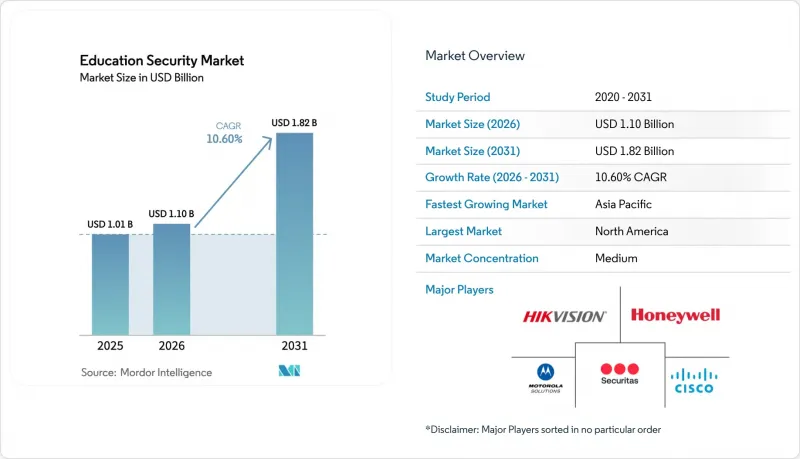
根據 Mordor Intelligence 預測,教育安全市場規模預計在 2025 年達到 10.1 億美元,2026 年達到 11 億美元,到 2031 年達到 18.2 億美元,2026 年至 2031 年的複合年成長率為 10.6%。
本報告按服務(安保、入職前篩檢等)、組件(硬體、軟體、服務)、安保解決方案(影像監控系統、門禁系統等)、部署方式(本地部署、雲端部署、混合部署)、設施(中小學教育設施、高等教育設施等)和地區進行細分。市場預測以美元計價。
全球教育安全市場趨勢與洞察
校園內對即時影像分析的需求激增。
教育機構正在採用人工智慧引擎,在幾秒鐘內識別武器、邊境入侵和人群異常情況,取代傳統的法醫重播。 ZeroEyes計劃在2025年底前在超過300個校園部署該系統,而Omnilert的VOLT AI正在與現有攝影機整合,以實現警報自動化。在2021-2022學年,美國學校每10萬名學生中就有10人持有槍支,這是近十年來的最高水準。密西根州和德克薩斯州的學區分別於2025年2月和7月部署了人工智慧槍支檢測系統,顯示該系統在地方管轄區也穩步推進。邊緣處理技術即使在頻寬有限的學校也能最大限度地減少頻寬消耗,而隱私保護演算法則符合伊利諾伊州和華盛頓州的生物識別法規。
學校暴力和破壞事件增多
儘管包括大規模槍擊事件和社群媒體威脅在內的暴力事件總數趨於平穩,但政治監督依然十分嚴格。 2021-2022學年,美國45%的學校配備了武裝保安,低於兩年前的51%,這表明安保工作正從依賴人員轉向依賴技術。匿名舉報熱線目前涵蓋了62%的學校,預計到2025年,有關行為威脅的諮詢服務將加速發展。密西根州實施的ZeroEyes系統和德克薩斯州建立的Verkada系統表明,安全系統正加速向主動式系統轉變,這些系統既能減少保全人員數量,又能縮短回應時間。
高昂的初始設定成本和生命週期成本
維護延誤、學生人數下降以及課程技術引入等問題,都與安全措施方面的支出形成競爭。雖然津貼通常可以涵蓋攝影機部署的初始成本,但多年的雲端訂閱、軟體授權和網路安全監控費用會推高整體擁有成本。無法獲得津貼的學校只能部署零散的解決方案,例如不具備分析功能的攝影機和孤立的存取控制系統,這使得未來的整合變得複雜。提供模組化、「按需付費」平台的供應商,憑藉其量身定做、符合預算實際情況的提案方案,贏得了合約。
細分市場分析
預計到2025年,安保服務將佔教育保全市場的37.71%。同時,諮詢收入預計將以每年10.73%的速度成長,這反映出學校董事會對全面風險評估、合規性審計以及透過環境設計預防犯罪(CPTED)藍圖的需求日益成長。隨著教育機構將遵守《家庭教育權利和隱私法案》(FERPA)和生物識別相關法律法規的工作外包給專家,教育安保諮詢產業的規模正在擴大。顧問公司正在將漏洞掃描與人工智慧攝影機、零信任網路和緊急呼叫平台結合,並提供桌面演練和網路安全藍圖等服務。隨著兒童安全法規日益嚴格,入職前背景調查也增加。將安保輪班管理、警報監控和事件報告分析整合到單一服務等級協定(SLA)中的託管服務協議正在提高客戶留存率。由於人手不足和工資上漲給安保企業的利潤率帶來了壓力,像 Allied Universal 和 Securitas 這樣的公司正在利用行動儀錶板來加強其巡邏系統,這些儀錶板可以直接將人工智慧驅動的警報傳輸到保全人員的智慧型手機上。
諮詢服務需求的不斷成長表明教育安保市場日趨成熟,管理者正將焦點從單純追求保全人員數量轉向可衡量的風險降低。能夠證明安保投資回報率(ROI)的服務提供者——例如降低事故發生率、縮短封鎖時間以及提高保險評級——正獲得多年期框架合約。隨著大學將高階主管薪酬與校園安保關鍵績效指標(KPI)掛鉤,提供行為健康諮詢和ESG相關安全報告的服務供應商正在挖掘尚未開發的市場機會。在需求不斷成長的背景下,全球系統整合商正在收購高度專業化的顧問公司,以整合評估和實施服務,從而加強端到端合作關係,並將獨立的安保合約擠出市場。
到2025年,硬體將佔教育安全市場45.64%的佔有率,這主要得益於新興市場對攝影機、門禁控制器和感測器的日益普及。然而,隨著基於雲端的影像管理、人工智慧分析和行動認證取代網路錄影機(NVR)機架和塑膠身分識別卡,預計到2031年,軟體收入將以10.95%的複合年成長率成長。 Kisi的B輪融資和Genea的A輪資金籌措正在推動它們向訂閱平台的擴張,這些平台允許管理員遠端頒發、撤銷和審核憑證。嵌入智慧攝影機的邊緣人工智慧縮短了決策週期,即使在頻寬有限的農村學校也能部署高階分析功能。隨著沒有內部IT部門的學區聘請整合商進行設定、更新和安全營運中心(SOC)監控,業務收益也隨之成長。
在成熟地區,持續的硬體更新正逐漸被持續的軟體和服務合約所取代,從而提升了供應商的生命週期價值。思科的Meraki MV產品組合和江森自控的OpenBlue套件透過捆綁攝影機和分析許可證,將客戶牢牢鎖定在其獨特的生態系統中。同時,亞太地區的各國政府仍在為大規模攝影機部署分配預算,預計硬體佔有率將逐步下降,而非快速下降。那些憑藉開放API和隱私保護型邊緣處理技術脫穎而出的供應商,正逐漸獲得受GDPR約束的歐洲買家的認可。
區域分析
教育安全市場仍是北美最大的收入來源。預計到2025年,該地區將獲得總計1.56億美元的聯邦STOP和FEMA津貼,用於支持約4000個學校計畫。加州和紐約州的都市區學區已加快採購進度,將部分債券發行資金用於人工智慧影像系統升級。加拿大各省也推出了類似的津貼計劃,以加速視訊管理系統(VMS)加密和資料保存政策的跨境標準化。墨西哥公共教育部已在15所聯邦學校試點應用了無生物識別物體檢測技術,這提升了拉丁美洲對符合GDPR(一般資料保護規範)解決方案的需求。
亞太地區仍是教育安全領域成長最快的市場,各國政府正將安全基礎設施納入數位學習和數位素養預算。中國的「校園安全」法規要求所有中小學在2027年前安裝人工智慧影像系統,這將為未來幾年國內攝影機製造商帶來利好。印度的「Vidya Raksha」計畫正利用州和聯邦政府的資金安裝訪客管理自助終端和電子鎖,而新加坡則正在將「SafeSchools@SG」藍圖推廣到所有公立和私立教育機構。日本文部科學省已發布指南,要求大學在2025年底前實現營運技術(OT)網路和資訊科技(IT)網路的分離,這將促進網路安全設備的銷售。
歐洲的生物辨識技術普及率介於北美成熟度和亞太地區擴張階段之間。遵守《一般資料保護規則》(GDPR) 限制了依賴生物識別的應用,而隱私權保護型分析技術正日益受到重視。英國即將生效的《馬丁法案》強制要求整合疏散通知系統,迫使大學以與當地警方合作的雲端通訊系統取代人工公共廣播系統。南歐國家正利用歐盟緊急預備金的津貼,對上世紀60年代建造的學校建築進行改造,加裝IP攝影機並加固入口大廳。斯堪地那維亞國家正在大學校園的公共區域試行應用人工智慧驅動的人群密度警報系統,以防止騷擾和破壞行為。
其他好處:
- Excel格式的市場預測(ME)表
- 3個月的分析師支持
目錄
第1章:引言
- 市場分析與定義的前提條件
- 分析範圍
第2章 分析方法
第3章執行摘要
第4章 市場狀況
- 市場概覽
- 市場促進因素
- 校園內對即時影像分析的需求正在激增。
- 學校暴力和破壞事件增多
- 政府安全津貼正在加速技術更新換代週期。
- 新興國家的基礎設施現代化計劃
- 利用人工智慧進行行為偵測,實現早期威脅識別
- 將與環境、社會及公司治理 (ESG) 相關的安全關鍵績效指標 (KPI) 用於指導資金籌措決策
- 市場限制因素
- 高昂的初始採購成本和生命週期成本
- 人們持續擔憂隱私和資料保護問題
- 實體安全和網路安全架構的碎片化
- 校園保全人員短缺
- 價值鏈分析
- 監理情勢
- 技術展望
- 波特五力分析
第5章:預測市場規模與成長率
- 按服務
- 安全
- 入職前篩檢
- 安全諮詢
- 系統整合與管理
- 警報監控服務
- 其他私人保全服務
- 按組件
- 硬體
- 軟體
- 服務
- 透過安全解決方案
- 影像監控系統
- 存取管理系統
- 應急通訊系統
- 網路安全解決方案
- 透過部署方法
- 現場
- 雲
- 混合
- 按設施
- 小學和中學教育設施
- 高等教育機構
- 其他教育設施
- 按地區
- 北美洲
- 美國
- 加拿大
- 墨西哥
- 南美洲
- 巴西
- 阿根廷
- 其他南美國家
- 歐洲
- 德國
- 英國
- 法國
- 義大利
- 西班牙
- 其他歐洲國家
- 亞太地區
- 中國
- 日本
- 印度
- 韓國
- 東南亞
- 其他亞太國家
- 中東
- 沙烏地阿拉伯
- 阿拉伯聯合大公國
- 土耳其
- 其他中東國家
- 非洲
- 南非
- 奈及利亞
- 其他非洲國家
- 北美洲
第6章 競爭情勢
- 市場集中度
- 策略趨勢
- 市佔率分析
- 公司簡介
- Cisco Systems Inc.
- Honeywell International Inc.
- Motorola Solutions Inc.
- Securitas AB
- Axis Communications AB
- Genetec Inc.
- Verkada Inc.
- Hangzhou Hikvision Digital Technology Co. Ltd.
- Johnson Controls International plc
- Robert Bosch GmbH
- ADT Inc.
- Allied Universal Topco LLC
- Prosegur Compania de Seguridad SA
- Hanwha Vision Co., Ltd.
- Zhejiang Dahua Technology Co. Ltd.
- Gallagher Group Limited
- Silverseal Corporation
- SEICO Inc.
- Kisi Inc.
- AxxonSoft LLC
- Eagle Eye Networks Inc.
第7章 市場機會與未來展望
According to Mordor Intelligence, the education security market size is projected to be USD 1.01 billion in 2025, USD 1.10 billion in 2026, and reach USD 1.82 billion by 2031, growing at a CAGR of 10.6% from 2026 to 2031.
This report is Segmented by Services (Guarding, Pre-Employment Screening, and More), Component (Hardware, Software, and Services), Security Solution (Video Surveillance Systems, Access Control Systems, and More), Deployment Mode (On-Premise, Cloud, and Hybrid), Facilities (Primary and Secondary Facilities, and More), and Geography. The Market Forecasts are Provided in Terms of Value (USD).
Global Education Security Market Trends and Insights
Surging Demand for Real-Time Video Analytics on Campuses
Institutions are replacing forensic playback with AI engines that identify weapons, perimeter breaches, and crowd anomalies in seconds. ZeroEyes exceeded 300 campus deployments by late 2025, and Omnilert's VOLT AI integrates with existing cameras to automate alerts. U.S. schools logged 10 firearm possessions per 100,000 students in 2021-22, the highest level in a decade. Districts in Michigan and Texas installed AI gun-detection systems in February and July 2025, showing adoption even in rural jurisdictions. Edge processing minimizes bandwidth consumption for schools with limited bandwidth, while privacy-preserving algorithms comply with biometric restrictions in Illinois and Washington.
Heightened Incidence of School Violence and Vandalism
Active-shooter events and viral social-media threats have kept political scrutiny high despite a plateau in overall violent-incident counts. Forty-five percent of U.S. schools employed armed resource officers in 2021-22, down from 51% two years earlier, indicating a shift toward technology rather than personnel. Anonymous tip lines now cover 62% of schools, and behavioral-threat consulting engagements accelerated in 2025. ZeroEyes deployments in Michigan and Verkada installs in Texas underscore the push toward proactive systems that lower guard headcount while improving response times.
High Upfront Procurement and Lifecycle Costs
Deferred maintenance, declining enrollments, and curriculum technology compete with safety spending. Grants often cover initial cameras, but multi-year cloud subscriptions, software licensing, and cybersecurity monitoring inflate the total cost of ownership. Schools without grant access deploy piecemeal solutions-cameras without analytics or siloed access control-that complicate future integrations. Vendors offering modular, pay-as-you-grow platforms win contracts by matching budget realities.
Other drivers and restraints analyzed in the detailed report include:
- Government Safety Grants Accelerating Technology Refresh Cycles
- Infrastructure Modernisation Programs in Emerging Economies
- Persistent Privacy and Data-Protection Concerns
For complete list of drivers and restraints, kindly check the Table Of Contents.
Segment Analysis
Guarding services accounted for 37.71% of Education Security market share in 2025. However, consulting revenues are forecast to grow 10.73% annually, reflecting boards' demand for holistic risk assessments, compliance audits, and Crime Prevention Through Environmental Design blueprints. The Education Security market size for consulting is rising as institutions outsource FERPA and biometric-law compliance to experts. Consulting firms bundle vulnerability scans, tabletop drills, and cybersecurity roadmaps that integrate AI cameras, Zero Trust networks, and emergency-notification platforms. Pre-employment background checks are expanding amid stricter child-safety statutes. Managed-services contracts that wrap guard scheduling, alarm monitoring, and incident-report analytics into a single SLA deepen client stickiness. Labor shortages and wage inflation squeeze guarding margins, prompting Allied Universal and Securitas to augment patrols with mobile dashboards that route AI alerts directly to officers' smartphones.
The consulting uptrend signifies a maturing Education Security market in which administrators value measurable risk reduction over badge counts. Service providers that demonstrate return on security investment-lower incident rates, faster lockdown times, higher insurance-rating scores-win multi-year frameworks. Start-ups offering behavioral-health consulting and ESG-linked safety reporting tap white-space opportunities as universities tie executive compensation to campus security KPIs. As demand rises, global systems integrators are acquiring boutique advisory firms to package assessments with deployment, cementing end-to-end relationships that crowd out standalone guard contracts.
Hardware held 45.64% of Education Security market size in 2025, supported by camera, door-controller, and sensor rollouts in emerging economies. Yet software revenues are projected to climb at a 10.95% CAGR through 2031 as cloud video management, AI analytics, and mobile credentialing displace NVR racks and plastic IDs. Kisi's Series B and Genea's Series A fund expansion into subscription platforms that let administrators issue, revoke, and audit credentials remotely. Edge AI embedded in smart cameras shortens decision loops, allowing rural schools with limited bandwidth to deploy advanced analytics. Services revenue grows in lock-step because districts lacking in-house IT hire integrators for configuration, updates, and SOC monitoring.
In mature regions, perpetual hardware refresh gives way to recurring software and services contracts, boosting vendor lifetime value. Cisco's Meraki MV portfolio and Johnson Controls' OpenBlue suite bundle cameras with analytics licenses, locking customers into proprietary ecosystems. Conversely, Asia-Pacific governments still earmark budgets for large-scale camera installations, ensuring hardware's share erodes gradually rather than precipitously. Vendors differentiating on open APIs and privacy-preserving edge processing capture mindshare among GDPR-constrained European buyers.
Complete Report Scope:
- By Services
- Guarding
- Pre-Employment Screening
- Security Consulting
- Systems Integration and Management
- Alarm Monitoring Services
- Other Private Security Services
- By Component
- Hardware
- Software
- Services
- By Security Solution
- Video Surveillance Systems
- Access Control Systems
- Emergency Communication Systems
- Cybersecurity Solutions
- By Deployment Mode
- On-Premise
- Cloud
- Hybrid
- By Facilities
- Primary and Secondary Facilities
- Higher Education Facilities
- Other Educational Facilities
- By Geography
- North America
- United States
- Canada
- Mexico
- South America
- Brazil
- Argentina
- Rest of South America
- Europe
- Germany
- United Kingdom
- France
- Italy
- Spain
- Rest of Europe
- APAC
- China
- Japan
- India
- South Korea
- South-East Asia
- Rest of APAC
- Middle East
- Saudi Arabia
- United Arab Emirates
- Turkey
- Rest of Middle East
- Africa
- South Africa
- Nigeria
- Rest of Africa
- North America
Geography Analysis
The Education Security market continues to anchor its highest revenue in North America, where USD 156 million in combined federal STOP and FEMA block grants underwrote nearly 4,000 school projects during 2025. Urban districts in California and New York redeployed a portion of bond issuances toward AI video upgrades, tightening procurement timelines. Canadian provinces replicated grant mechanisms, accelerating cross-border standardization of VMS encryption and data-retention policies. Mexico's Secretariat of Public Education piloted biometric-free object detection in 15 federal schools, catalyzing demand for GDPR-aligned solutions in Latin America.
Asia-Pacific remains the fastest-growing Education Security market, with governments bundling security infrastructure into e-learning and digital-literacy budgets. China's Safe Campus decree mandates AI-enabled video in all primary and secondary schools by 2027, ensuring multi-year tailwinds for domestic camera manufacturers. India's Vidya Raksha program channels state and federal funds to install visitor-management kiosks and electronic locks, while Singapore applies its SafeSchools@SG blueprint across public and private institutions. Japan's Ministry of Education issued guidance in late 2025 requiring universities to segment OT from IT networks, spurring sales of cybersecurity appliances.
Europe's adoption rate sits between North America's maturity and Asia-Pacific's expansion. GDPR compliance tempers rollouts that rely on biometrics, favoring privacy-preserving analytics. The United Kingdom's impending Martyn's Law compels evacuation-notification integrations, pushing universities to replace manual PA systems with cloud-triggered messaging that synchronizes with local constabularies. Southern European economies leverage EU resilience-fund grants to retrofit 1960s-era school buildings with IP cameras and reinforced entry vestibules. Scandinavia experiments with AI-driven crowd-density alerts in university commons to pre-empt harassment and vandalism.
- Cisco Systems Inc.
- Honeywell International Inc.
- Motorola Solutions Inc.
- Securitas AB
- Axis Communications AB
- Genetec Inc.
- Verkada Inc.
- Hangzhou Hikvision Digital Technology Co. Ltd.
- Johnson Controls International plc
- Robert Bosch GmbH
- ADT Inc.
- Allied Universal Topco LLC
- Prosegur Compania de Seguridad S.A.
- Hanwha Vision Co., Ltd.
- Zhejiang Dahua Technology Co. Ltd.
- Gallagher Group Limited
- Silverseal Corporation
- SEICO Inc.
- Kisi Inc.
- AxxonSoft LLC
- Eagle Eye Networks Inc.
Additional Benefits:
- The market estimate (ME) sheet in Excel format
- 3 months of analyst support
TABLE OF CONTENTS
1 INTRODUCTION
- 1.1 Study Assumptions and Market Definition
- 1.2 Scope of the Study
2 RESEARCH METHODOLOGY
3 EXECUTIVE SUMMARY
4 MARKET LANDSCAPE
- 4.1 Market Overview
- 4.2 Market Drivers
- 4.2.1 Surging Demand For Real-Time Video Analytics On Campuses
- 4.2.2 Heightened Incidence Of School Violence And Vandalism
- 4.2.3 Government Safety Grants Accelerating Technology Refresh Cycles
- 4.2.4 Infrastructure Modernisation Programs In Emerging Economies
- 4.2.5 AI-Enabled Behavioural Detection For Early Threat Identification
- 4.2.6 ESG-Linked Safety Kpis Guiding Funding Decisions
- 4.3 Market Restraints
- 4.3.1 High Upfront Procurement And Lifecycle Costs
- 4.3.2 Persistent Privacy And Data-Protection Concerns
- 4.3.3 Disjointed Physical-Cybersecurity Architectures
- 4.3.4 Shortage Of Skilled Campus Security Personnel
- 4.4 Value Chain Analysis
- 4.5 Regulatory Landscape
- 4.6 Technological Outlook
- 4.7 Porter's Five Forces
- 4.7.1 Bargaining Power of Suppliers
- 4.7.2 Bargaining Power of Buyers
- 4.7.3 Threat of New Entrants
- 4.7.4 Threat of Substitutes
- 4.7.5 Intensity of Competitive Rivalry
5 MARKET SIZE AND GROWTH FORECASTS (VALUE)
- 5.1 By Services
- 5.1.1 Guarding
- 5.1.2 Pre-Employment Screening
- 5.1.3 Security Consulting
- 5.1.4 Systems Integration and Management
- 5.1.5 Alarm Monitoring Services
- 5.1.6 Other Private Security Services
- 5.2 By Component
- 5.2.1 Hardware
- 5.2.2 Software
- 5.2.3 Services
- 5.3 By Security Solution
- 5.3.1 Video Surveillance Systems
- 5.3.2 Access Control Systems
- 5.3.3 Emergency Communication Systems
- 5.3.4 Cybersecurity Solutions
- 5.4 By Deployment Mode
- 5.4.1 On-Premise
- 5.4.2 Cloud
- 5.4.3 Hybrid
- 5.5 By Facilities
- 5.5.1 Primary and Secondary Facilities
- 5.5.2 Higher Education Facilities
- 5.5.3 Other Educational Facilities
- 5.6 By Geography
- 5.6.1 North America
- 5.6.1.1 United States
- 5.6.1.2 Canada
- 5.6.1.3 Mexico
- 5.6.2 South America
- 5.6.2.1 Brazil
- 5.6.2.2 Argentina
- 5.6.2.3 Rest of South America
- 5.6.3 Europe
- 5.6.3.1 Germany
- 5.6.3.2 United Kingdom
- 5.6.3.3 France
- 5.6.3.4 Italy
- 5.6.3.5 Spain
- 5.6.3.6 Rest of Europe
- 5.6.4 APAC
- 5.6.4.1 China
- 5.6.4.2 Japan
- 5.6.4.3 India
- 5.6.4.4 South Korea
- 5.6.4.5 South-East Asia
- 5.6.4.6 Rest of APAC
- 5.6.5 Middle East
- 5.6.5.1 Saudi Arabia
- 5.6.5.2 United Arab Emirates
- 5.6.5.3 Turkey
- 5.6.5.4 Rest of Middle East
- 5.6.6 Africa
- 5.6.6.1 South Africa
- 5.6.6.2 Nigeria
- 5.6.6.3 Rest of Africa
- 5.6.1 North America
6 COMPETITIVE LANDSCAPE
- 6.1 Market Concentration
- 6.2 Strategic Moves
- 6.3 Market Share Analysis
- 6.4 Company Profiles (includes Global level Overview, Market level overview, Core Segments, Financials as available, Strategic Information, Market Rank/Share for key companies, Products and Services, and Recent Developments)
- 6.4.1 Cisco Systems Inc.
- 6.4.2 Honeywell International Inc.
- 6.4.3 Motorola Solutions Inc.
- 6.4.4 Securitas AB
- 6.4.5 Axis Communications AB
- 6.4.6 Genetec Inc.
- 6.4.7 Verkada Inc.
- 6.4.8 Hangzhou Hikvision Digital Technology Co. Ltd.
- 6.4.9 Johnson Controls International plc
- 6.4.10 Robert Bosch GmbH
- 6.4.11 ADT Inc.
- 6.4.12 Allied Universal Topco LLC
- 6.4.13 Prosegur Compania de Seguridad S.A.
- 6.4.14 Hanwha Vision Co., Ltd.
- 6.4.15 Zhejiang Dahua Technology Co. Ltd.
- 6.4.16 Gallagher Group Limited
- 6.4.17 Silverseal Corporation
- 6.4.18 SEICO Inc.
- 6.4.19 Kisi Inc.
- 6.4.20 AxxonSoft LLC
- 6.4.21 Eagle Eye Networks Inc.
7 MARKET OPPORTUNITIES AND FUTURE OUTLOOK
- 7.1 White-space and Unmet-need Assessment

 安全啟動和韌體安全市場規模、佔有率和成長分析:按產品、部署、設備類型、最終用戶和地區分類 - 產業預測,2026-2033 年
 資料安全:市場佔有率分析、產業趨勢與統計、成長預測(2026-2031)泰國資訊科技與安全:市場佔有率分析、產業趨勢與統計及成長預測(2026-2031)
 全球資料安全態勢管理市場規模、佔有率、趨勢和成長分析報告(2026-2034)
 資料安全即服務 (DSaaS) 市場規模、佔有率和成長分析:按服務類型、部署模式、組織規模、應用、產業垂直領域和地區分類-2026-2033 年產業預測
 資料安全態勢管理 (DSPM) 市場規模、佔有率和趨勢分析報告:按組件、部署類型、組織規模、資料類型、應用程式、最終用戶、地區和細分市場預測 (2026–2033)
 資料安全與態勢管理市場預測至2034年-依資料環境、元件、組織規模、資料敏感程度、應用、最終使用者和地區分類的全球分析
 安全支出市場:按應用程式、部署模式、組件、安全支出類型、最終用戶和地區分類
 資料安全市場:按組件類型、部署模式、組織規模和產業分類 - 2026-2032年全球市場預測
 2026年全球IT安全諮詢服務市場報告