


 |
市場調查報告書
商品編碼
2124718
泰國資訊科技與安全:市場佔有率分析、產業趨勢與統計及成長預測(2026-2031)Thailand IT And Security - Market Share Analysis, Industry Trends & Statistics, Growth Forecasts (2026 - 2031) |
||||||

※ 本網頁內容可能與最新版本有所差異。詳細情況請與我們聯繫。
據 Mordor Intelligence 稱,2025 年泰國 IT 和安全市場價值為 99.2 億美元,預計到 2031 年將從 2026 年的 102.6 億美元成長至 167.2 億美元,預測期(2026-2031 年)的複合年成長率為 10.26%。
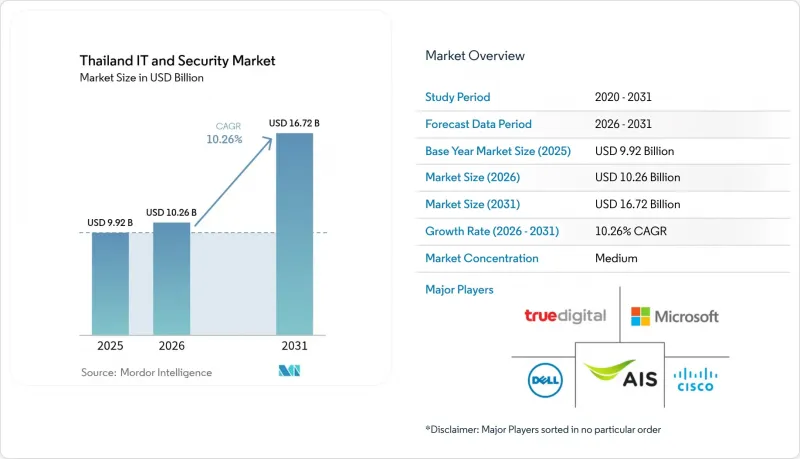
本報告按組件(硬體和設備、軟體、服務)、部署模式(本地部署、雲端部署、混合部署)、組織規模(大型企業、中小企業)、最終用戶產業(銀行、金融服務和保險、政府和國防、製造業、醫療保健、零售和電子商務等)以及地區進行細分。市場預測以美元計價。
泰國IT及安全市場趨勢及洞察
泰國公共部門的雲端優先政策
數位政府發展署要求到2027年,70%的新增公部門工作負載必須遷移到雲端基礎設施,並要求412個機構在2026年12月前至少遷移一個關鍵任務系統。與國家電信公司簽署的2025年合約已涵蓋18個部委和機構,其中包括通過ISO/IEC 27001認證的基礎設施,這將導致雲端安全態勢管理和特權存取控制方面的支出增加。公共部門對這些工具集的採購量每年成長41%,這清楚表明政策指令正在轉化為實際需求。然而,長達九個月的競標週期以及與傳統本地資產的共存增加了複雜性,需要對混合環境進行整合監控,同時也加速了託管安全營運中心(MSOC)的採用。此外,該指令中的要求,例如多因素身份驗證和保留五年審計日誌,進一步鞏固了對身份即服務(IaaS)和不可變存儲的需求。
5G部署的加速推進,使得從邊緣到雲端的各種應用場景成為可能。
True Corporation 和 Advanced Info Service 於 2024 年底完成了網路整合,從而建立了覆蓋 92% 人口的 5G 獨立組網,預計到 2025 年年中即可覆蓋。春武里府和羅勇府的工業園區已實現低於 10 毫秒的延遲,從而能夠開展基於機器視覺的品管、自動導引運輸車(AGV) 和遠端手術的試點運行。這些應用情境需要與邊緣防火牆進行加密遙測同步、微隔離和基於雲端的威脅分析,這些措施合計佔 2025 年邊緣安全預算成長的 62%。網路切片帶來了新的身份驗證挑戰。只有 19% 的公司實施了網路功能虛擬化 (NFV) 的安全措施,這表明存在尚未開發的服務機會。 2G/3G 服務於 2024 年結束,加速了工業控制器的升級,並迫使工廠緊急部署新的無線閘道器,擴大了泰國的 IT 和安全市場。
網路安全專業人員短缺3萬人
根據泰國國家網路安全局估計,到2027年,泰國將出現3萬名網路安全人員缺口,然而,2024年至2025年間,泰國持有CISSP認證的人員數量僅從385人增加到431人。曼谷安全營運中心(SOC)分析師的月薪中位數已上漲18%,達到6.5萬泰銖(約1,850美元),迫使中小企業依賴難以自行管理和評估的託管服務。外包業務預計到2025年將成長22%,但對第三方事件回應的依賴正在削弱企業內部的專業知識,並延長控制損失所需的時間。由於難以找到合適的專家,零信任網路存取的普及速度放緩(到2025年底,只有11%的組織實施了零信任網路存取),安全編配、自動化和回應的推廣也相對滯後。儘管政府獎學金計畫和廠商營運的學院正在擴張,但獲得高級認證的速度緩慢預計將繼續限制泰國 IT 和安全市場的成長軌跡。
細分市場分析
服務業成長最為迅猛,預計到2031年將以10.71%的複合年成長率成長,這主要得益於企業將漏洞評估、滲透測試以及託管檢測和響應服務外包給本地專家。在泰國國家網路安全局強制執行季度審計後,到2025年,泰國IT和安全市場的專業服務市場規模將達到21億泰銖(約6000萬美元)。相較之下,軟體產業仍保持最大的市場佔有率,達到41.72%,這主要歸功於訂閱式終端保護和雲端安全態勢管理平台,這些平台符合營運支出(OPEX)預算。同時,由於防火牆交貨週期長達14週,以及泰銖泰銖導致進口設備成本上升,硬體支出成長放緩。
服務業的成長也反映出監管複雜性的增加。政府競標現在要求企業獲得 ISO/IEC 27001 認證,這迫使企業聘請第三方審計機構和政策制定者,而這些機構可能缺乏內部專業知識。特別是針對雲端工作負載的託管檢測與回應 (MDR) 服務,預計到 2025 年將成長 28%,這主要得益於沒有安全營運中心 (SOC) 的中小企業 (SME) 尋求基於成長的收費合約。這一趨勢凸顯了泰國 IT 和安全市場的結構性轉變,即從單純的技術轉售轉向以專業知識主導的服務。
儘管到2025年雲端支出佔總支出的55.84%,但混合環境預計將以10.44%的複合年成長率成長。像開泰銀行這樣的金融機構正在將其詐欺偵測模型遷移到谷歌雲,同時保留本地客戶資料庫,凸顯了安全隧道、身分聯合和統一日誌管理的重要性。在雲端優先策略的推動下,越來越多的機構採用多重雲端策略,同時保持與現有資料中心的整合,這擴大了雲端工作負載保護平台在泰國IT和安全市場的佔有率。
儘管如此,由於主權和延遲問題,本地部署環境在國防、公共產業和醫療保健行業仍然普遍存在,工作負載駐留在私人叢集上。混合環境的複雜性意味著 62% 的企業面臨策略一致性挑戰,這推動了對跨 Kubernetes叢集和基於硬體的防火牆的雲端安全態勢管理的需求。符合泰國國家網路安全局 (NCS) 2025 年 1 月標準的身份即服務 (IaaS) 平台正在打破這些孤島,並凸顯出混合環境在泰國 IT 和安全市場中是一種永續的營運模式,而非過渡模式。
其他好處:
- Excel格式的市場預測(ME)表
- 3個月的分析師支持
目錄
第1章:引言
- 研究假設和市場定義
- 調查範圍
第2章:調查方法
第3章執行摘要
第4章 市場狀況
- 市場概覽
- 市場促進因素
- 泰國公共部門的雲端優先政策
- 5G部署的加速將使從邊緣到雲端的各種應用場景成為可能。
- 電子商務的快速成長正在推動超大規模資料中心建設的擴張。
- 在董事會層級實施 NIST CSF 和 ISO/IEC 27001,以滿足出口市場要求。
- 泰國崛起加上日本和美國製造商的近岸外包
- 金融科技監理沙箱正在促進對開放API的安全投資。
- 市場限制因素
- 中小企業IT預算週期碎片化
- 網路安全專業人員短缺3萬人
- 傳統的MPLS合約正在延緩雲端遷移。
- 在泰銖匯率持續波動的情況下,泰國仍高度依賴進口半導體。
- 產業價值鏈分析
- 監理情勢
- 技術展望
- 波特五力分析
第5章 市場規模與成長預測
- 按組件
- 硬體和設備
- 軟體
- 服務
- 按實現類型
- 現場
- 雲
- 混合
- 按組織規模
- 大公司
- 中小企業
- 按最終用戶行業分類
- BFSI
- 政府/國防
- 製造業
- 醫療保健
- 零售與電子商務
- 能源與公共產業
- 其他
第6章 競爭情勢
- 市場集中度
- 策略趨勢
- 市佔率分析
- 公司簡介
- Advanced Info Service Public Co. Ltd.(AIS)
- True Digital Group Co. Ltd.
- Dell Technologies Inc.
- Cisco Systems Inc.
- International Business Machines Corp.(IBM)
- Microsoft Corporation
- Hewlett Packard Enterprise Co.
- Fujitsu(Thailand)Co. Ltd.
- Fortinet Inc.
- Palo Alto Networks Inc.
- Check Point Software Technologies Ltd.
- Trend Micro Inc.
- Kaspersky Lab
- Samsung Electronics Co. Ltd.
- Acer Inc.
- Lenovo Group Ltd.
- G-Able Co. Ltd.
- MFEC Public Co. Ltd.
- Digital Government Development Agency(DGA)
- SIAMDATA Co. Ltd.
第7章 市場機會與未來展望
According to Mordor Intelligence, the Thailand IT and Security market size was valued at USD 9.92 billion in 2025 and is estimated to grow from USD 10.26 billion in 2026 to reach USD 16.72 billion by 2031, at a CAGR of 10.26% during the forecast period (2026-2031).
This report is Segmented by Component (Hardware and Devices, Software, and Services), Deployment Mode (On-Premises, Cloud, and Hybrid), Organization Size (Large Enterprises, and Small and Medium Enterprises), End-User Industry (BFSI, Government and Defense, Manufacturing, Healthcare, Retail and E-Commerce, and More), and Geography. The Market Forecasts are Provided in Terms of Value (USD).
Thailand IT And Security Market Trends and Insights
Cloud-First Policy in Thai Public Sector
The Digital Government Development Agency mandated that 70% of new public-sector workloads move to cloud infrastructure by 2027, compelling 412 agencies to migrate at least one mission-critical system before December 2026. Contracts signed with National Telecom in 2025 already span 18 ministries and include ISO/IEC 27001-certified infrastructure, elevating spend on cloud security posture management and privileged access controls. Annual growth of 41% in public-sector purchases of these toolsets underscores how policy edicts translate into addressable demand. Yet nine-month tender cycles and coexistence with legacy on-premises assets require integrated monitoring across hybrid environments, increasing complexity and fueling uptake of managed security operations centers. The directive's multi-factor authentication and five-year audit-log stipulations further lock in demand for identity-as-a-service and immutable storage.
Acceleration of 5G Rollout Enabling Edge-to-Cloud Use Cases
True Corporation and Advanced Info Service finished network consolidation in late 2024, resulting in a 5G standalone footprint that covered 92% of the population by mid-2025. Latency dropped below 10 milliseconds for industrial estates in Chonburi and Rayong, enabling machine-vision quality control, autonomous guided vehicles, and remote surgery pilots. These use cases require edge firewalls, micro-segmentation, and encrypted telemetry sync with cloud-based threat analytics, which together accounted for 62% of incremental edge-security budgets in 2025. Network slicing introduces fresh authentication challenges; only 19% of enterprises have deployed network-function-virtualization security, pointing to an untapped services opportunity. The 2G/3G shutdown completed in 2024 accelerated industrial controller upgrades, widening the Thailand IT and Security market as factories rushed to secure new radio gateways.
Shortage of 30,000 Cyber-Security Professionals
The National Cyber Security Agency calculated a 30,000-person talent gap through 2027, while Thailand's CISSP cohort rose only from 385 to 431 between 2024 and 2025. Median security-operations-center analyst pay in Bangkok jumped 18% to THB 65,000 (USD 1,850) per month, pushing small and medium enterprises toward managed services they often struggle to manage and assess. Outsourcing grew 22% in 2025, but reliance on third-party incident response dilutes institutional knowledge and extends containment times. Limited specialist availability slows adoption of zero-trust network access-implemented by just 11% of organizations as of end-2025-and drags on uptake of security orchestration, automation, and response. Government scholarship programs and vendor-run academies are scaling, yet the lag in advanced certifications will continue to temper the Thailand IT and Security market's growth trajectory.
Other drivers and restraints analyzed in the detailed report include:
- E-Commerce Boom Driving Hyperscale Data-Center Build-Outs
- Rise of Thailand PLUS Near-Shoring by Japanese and U.S. Manufacturers
- Fragmented SME IT Budget Cycles
For complete list of drivers and restraints, kindly check the Table Of Contents.
Segment Analysis
Services generated the fastest momentum, poised to rise at 10.71% CAGR to 2031 as enterprises outsource vulnerability assessments, penetration tests, and managed detection and response to local specialists. The Thailand IT and Security market size for professional services reached THB 2.1 billion (USD 60 million) in 2025 following the National Cyber Security Agency's quarterly audit mandate. In contrast, software maintained the largest slice at 41.72% thanks to subscription-based endpoint protection and cloud-security posture management platforms that match operating-expense budgets. Hardware spent softened amid 14-week firewall lead times and Baht depreciation that inflated imported appliance costs.
Growth in services also mirrors regulatory intricacy. Government tenders require ISO/IEC 27001 certification, pushing agencies to engage third-party auditors and policy architects they lack in-house. Managed detection and response, especially for cloud workloads, expanded 28% in 2025 as small and medium enterprises lacking security-operations centers sought pay-as-they-grow contracts. This dynamic reinforces a structural shift in the Thailand IT and Security market toward expertise-driven offerings over pure technology resale.
Hybrid environments are projected to grow at a 10.44% CAGR, even though cloud held 55.84% of 2025 spending. Banks such as Kasikornbank moved fraud-detection models to Google Cloud while retaining customer databases on-premises, illustrating why secure tunneling, identity federation, and unified logging are indispensable. The Thailand IT and Security market share for cloud workload protection platforms widened as agencies under the Cloud First Policy adopted multicloud strategies that still tether to existing data centers.
Nevertheless, on-premises estates persist in defense, utilities, and healthcare, where sovereignty and latency push workloads to private clusters. Hybrid complexity has 62% of enterprises reporting policy-consistency challenges, fuelling demand for cloud-security posture management that spans Kubernetes clusters and hardware-based firewalls. Identity-as-a-service platforms compliant with the National Cyber Security Agency's January 2025 standards are bridging these silos, underscoring how hybrid is not a transitional but a durable operating model within the Thailand IT and Security market.
Complete Report Scope:
- By Component
- Hardware and Devices
- Software
- Services
- By Deployment Mode
- On-premises
- Cloud
- Hybrid
- By Organization Size
- Large Enterprises
- Small and Medium Enterprises (SMEs)
- By End-user Industry
- BFSI
- Government and Defense
- Manufacturing
- Healthcare
- Retail and E-commerce
- Energy and Utilities
- Other End-User Industries
List of Companies Covered in this Report:
- Advanced Info Service Public Co. Ltd. (AIS)
- True Digital Group Co. Ltd.
- Dell Technologies Inc.
- Cisco Systems Inc.
- International Business Machines Corp. (IBM)
- Microsoft Corporation
- Hewlett Packard Enterprise Co.
- Fujitsu (Thailand) Co. Ltd.
- Fortinet Inc.
- Palo Alto Networks Inc.
- Check Point Software Technologies Ltd.
- Trend Micro Inc.
- Kaspersky Lab
- Samsung Electronics Co. Ltd.
- Acer Inc.
- Lenovo Group Ltd.
- G-Able Co. Ltd.
- MFEC Public Co. Ltd.
- Digital Government Development Agency (DGA)
- SIAMDATA Co. Ltd.
Additional Benefits:
- The market estimate (ME) sheet in Excel format
- 3 months of analyst support
TABLE OF CONTENTS
1 INTRODUCTION
- 1.1 Study Assumptions and Market Definition
- 1.2 Scope of the Study
2 RESEARCH METHODOLOGY
3 EXECUTIVE SUMMARY
4 MARKET LANDSCAPE
- 4.1 Market Overview
- 4.2 Market Drivers
- 4.2.1 Cloud-first policy in Thai public sector
- 4.2.2 Acceleration of 5G rollout enabling edge-to-cloud use-cases
- 4.2.3 E-commerce boom driving hyperscale data-center build-outs
- 4.2.4 Board-level adoption of NIST CSF and ISO/IEC 27001 to meet export-market mandates
- 4.2.5 Rise of "Thailand PLUS" near-shoring by Japanese and US manufacturers
- 4.2.6 FinTech regulatory sandbox pushing open-API security spend
- 4.3 Market Restraints
- 4.3.1 Fragmented SME IT budget cycles
- 4.3.2 Shortage of 30 000 cyber-security professionals
- 4.3.3 Legacy MPLS contracts delaying cloud migration
- 4.3.4 High dependence on imported semiconductors amid Baht volatility
- 4.4 Industry Value Chain Analysis
- 4.5 Regulatory Landscape
- 4.6 Technological Outlook
- 4.7 Porter's Five Forces Analysis
- 4.7.1 Threat of New Entrants
- 4.7.2 Bargaining Power of Buyers
- 4.7.3 Bargaining Power of Suppliers
- 4.7.4 Threat of Substitutes
- 4.7.5 Intensity of Competitive Rivalry
5 MARKET SIZE AND GROWTH FORECASTS (VALUE)
- 5.1 By Component
- 5.1.1 Hardware and Devices
- 5.1.2 Software
- 5.1.3 Services
- 5.2 By Deployment Mode
- 5.2.1 On-premises
- 5.2.2 Cloud
- 5.2.3 Hybrid
- 5.3 By Organization Size
- 5.3.1 Large Enterprises
- 5.3.2 Small and Medium Enterprises (SMEs)
- 5.4 By End-user Industry
- 5.4.1 BFSI
- 5.4.2 Government and Defense
- 5.4.3 Manufacturing
- 5.4.4 Healthcare
- 5.4.5 Retail and E-commerce
- 5.4.6 Energy and Utilities
- 5.4.7 Other End-User Industries
6 COMPETITIVE LANDSCAPE
- 6.1 Market Concentration
- 6.2 Strategic Moves
- 6.3 Market Share Analysis
- 6.4 Company Profiles (includes Global Level Overview, Market Level Overview, Core Segments, Financials as available, Strategic Information, Market Rank/Share, Products and Services, Recent Developments)
- 6.4.1 Advanced Info Service Public Co. Ltd. (AIS)
- 6.4.2 True Digital Group Co. Ltd.
- 6.4.3 Dell Technologies Inc.
- 6.4.4 Cisco Systems Inc.
- 6.4.5 International Business Machines Corp. (IBM)
- 6.4.6 Microsoft Corporation
- 6.4.7 Hewlett Packard Enterprise Co.
- 6.4.8 Fujitsu (Thailand) Co. Ltd.
- 6.4.9 Fortinet Inc.
- 6.4.10 Palo Alto Networks Inc.
- 6.4.11 Check Point Software Technologies Ltd.
- 6.4.12 Trend Micro Inc.
- 6.4.13 Kaspersky Lab
- 6.4.14 Samsung Electronics Co. Ltd.
- 6.4.15 Acer Inc.
- 6.4.16 Lenovo Group Ltd.
- 6.4.17 G-Able Co. Ltd.
- 6.4.18 MFEC Public Co. Ltd.
- 6.4.19 Digital Government Development Agency (DGA)
- 6.4.20 SIAMDATA Co. Ltd.
7 MARKET OPPORTUNITIES AND FUTURE OUTLOOK
- 7.1 White-space and Unmet-Need Assessment

 安全啟動和韌體安全市場規模、佔有率和成長分析:按產品、部署、設備類型、最終用戶和地區分類 - 產業預測,2026-2033 年
 教育安全:市場佔有率分析、產業趨勢與統計、成長預測(2026-2031)資料安全:市場佔有率分析、產業趨勢與統計、成長預測(2026-2031)
 全球資料安全態勢管理市場規模、佔有率、趨勢和成長分析報告(2026-2034)
 資料安全即服務 (DSaaS) 市場規模、佔有率和成長分析:按服務類型、部署模式、組織規模、應用、產業垂直領域和地區分類-2026-2033 年產業預測
 資料安全態勢管理 (DSPM) 市場規模、佔有率和趨勢分析報告:按組件、部署類型、組織規模、資料類型、應用程式、最終用戶、地區和細分市場預測 (2026–2033)
 資料安全與態勢管理市場預測至2034年-依資料環境、元件、組織規模、資料敏感程度、應用、最終使用者和地區分類的全球分析
 安全支出市場:按應用程式、部署模式、組件、安全支出類型、最終用戶和地區分類
 資料安全市場:按組件類型、部署模式、組織規模和產業分類 - 2026-2032年全球市場預測
 2026年全球IT安全諮詢服務市場報告