


 |
市場調查報告書
商品編碼
2117281
資料安全:市場佔有率分析、產業趨勢與統計、成長預測(2026-2031)Data Security - Market Share Analysis, Industry Trends & Statistics, Growth Forecasts (2026 - 2031) |
||||||

※ 本網頁內容可能與最新版本有所差異。詳細情況請與我們聯繫。
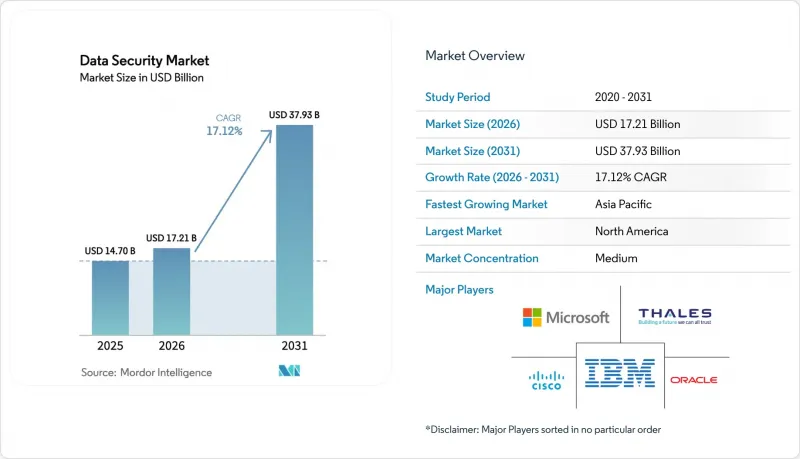
據 Mordor Intelligence 稱,2025 年資料安全市場價值為 147 億美元,預計到 2031 年將達到 379.3 億美元,而 2026 年為 172.1 億美元,預測期(2026-2031 年)的複合年成長率為 17.12%。
本報告按組件(解決方案、服務)、部署模式(本地部署、雲端部署)、組織規模(中小企業、大型企業)、應用程式(終端和可移動媒體保護、其他)、最終用戶產業(銀行、金融服務和保險業、其他)以及地區進行細分。市場預測以美元計價。
全球資料安全市場趨勢與洞察
多重雲端部署的加速普及推動了對雲端原生、以資料為中心的安全工具的需求。
目前,82% 的資料外洩事件涉及雲端託管的數據,平均每次事件的成本高達 488 萬美元。傳統的邊界防禦措施在 AWS、Azure 和 Google Cloud 等雲端平台上缺乏足夠的可見性,促使企業將控制權整合到一個平台中,以便在混合環境中強制執行統一的策略。微軟發布的《2024 年多重雲端風險調查》強調了責任共用模式造成的管治盲點,進一步加速了整合式零信任架構的轉變。隨著企業意識到僅僅擴展傳統的單點產品不足以保護雲端原生工作負載,能夠提供持續安全態勢管理、加密金鑰編配和以身分為中心的隔離的供應商正成為優先考慮的對象。因此,針對分散式、API 驅動環境最佳化的解決方案的預算分配正在發生重大轉變。
更嚴格的隱私法規使得資料發現和分類解決方案至關重要。
目前,80%的國家已製定了全面的資料保護法,預計到2025年,美國將有8個州實施新的隱私權法。光是歐洲的NIS2指令就將安全義務擴大到約30萬個營業單位,違規者最高可被處以1000萬歐元的罰款。這項廣泛的法規迫使企業從被動的、基於清單的合規模式轉向基於自動化檢測、分類和遮罩的即時管治。嚴重的人才短缺加劇了這項挑戰;73%的企業難以招募經驗豐富的隱私工程師,導致對低效率機器學習分類器和策略引擎的需求激增。能夠對結構化和非結構化儲存庫進行高精度掃描並繪製屬性來源的供應商,將能夠充分利用這波隱私主導支出激增的機會。
隱私工程和同構密碼學的技能差距阻礙了科技的普及應用。
網路安全專業人員缺口仍接近400萬,對量子安全防護和差分隱私專家的需求遠超過供應。過去三年,各組織在隱私保護項目上投入了120萬至270萬美元,但人員短缺迫使他們不斷推遲高級加密項目。經濟逆風阻礙了招聘,並加劇了技能缺口。人才短缺迫使企業依賴外包服務,減緩了內部能力建設,並延長了尖端安全防護技術的引進週期。
細分市場分析
以加密、預防資料外泄和資料庫保護套件為核心的解決方案構成了資料安全市場防禦的核心,預計到2025年仍將佔總收入的56.25%。然而,隨著董事會面臨嚴重的人才短缺以及向基本契約模式轉變,託管服務和專業服務正以18.23%的複合年成長率成長。 NIS2等法規的引入增加了對準備評估和全天候保全行動營運的需求,使服務供應商成為策略夥伴。雲端平台、用於即時支付的代幣化以及抗量子加密技術正在擴大託管服務的範圍,進一步降低了純軟體產品的佔有率。
從產品轉向服務反映了買家對高度擴充性且成本效益高(營運支出)的使用模式的偏好。供應商正在將固定費率的事件回應合約、自動化合規性和持續的安全態勢管理納入其訂閱模式。高成長的細分領域包括資料安全態勢管理 (DSPM),它透過託管偵測將漏洞潛伏時間縮短了 43%;以及指導加密技術現代化的諮詢服務。因此,資料安全市場正在經歷多層次的服務交付模式,該模式正趨向於整合工具、專業知識和專案管治的服務等級協定 (SLA)。
即使到了2025年,本地部署模式仍將佔據66.62%的收入佔有率,這反映出嚴格的資料主權法規以及難以遷移的關鍵業務工作負載的存在。然而,雲佔有率正以18.62%的複合年成長率成長,凸顯了混合環境的現實,在SaaS、PaaS和容器管道中,需要超越信任邊界的整合式保護層。在滿足資料加密要求的敏感運算安全措施的支援下,雲端部署中的資料安全市場預計將顯著成長。
企業正在採用架構解耦。高度敏感的分析處理在私有雲端或實體資料中心運行,而面向客戶的微服務則利用可擴展公共雲端的控制能力。整合的金鑰管理和策略編配工具彌合了不同環境之間的差距,減少了營運孤島。諸如 NIS2 之類的法規結構賦予能夠證明其具備即時監控能力的供應商柔軟性,這推動了雲端原生分析儀表板的發展。因此,供應商藍圖越來越強調獨立於供應商的控制平面和基於主機的身份驗證,從而能夠追蹤資料位於何處。
區域分析
預計到2025年,北美將佔全球收入的40.74%,這得益於先進分析技術的早期應用、強勁的創業融資以及涵蓋聯邦和州兩級的完善監管框架。財富500強企業廣泛採用零信任架構以及積極的雲端遷移藍圖進一步深化了市場。超大規模超大規模資料中心業者營運商對後量子密碼學和安全運算的策略性投資,鞏固了該地區的技術領先地位,同時也培育了一個充滿活力的區域性安全廠商生態系統。
亞太地區是成長最快的地區,預計到2031年複合年成長率將達到17.88%。中國、印度和東協的數位轉型(DX)專案正在推動大量資料的產生,但嚴格的資料居住要求需要本地化的加密和金鑰管理解決方案。國內法規,例如中國的《個人資料保護法》和越南的《網路安全條例》,正在推動境內資料保護設施和自主雲端架構的需求。區域性銀行和電商巨頭正在推動採用令牌化和資料保護策略(DSPM)來保護跨境支付流程。
在歐洲,受GDPR和近期擴展的NIS2指令(現已涵蓋公共產業、醫療設備製造商和中型服務供應商)的推動,資料安全市場呈現穩定成長態勢。為滿足指令規定的24小時報告要求,各公司正在加強事件回應手冊的完善,投資加密金鑰託管,並部署人工智慧驅動的資料外洩通知工具。同時,在中東和非洲,隨著沙烏地阿拉伯《個人資料保護法》的實施(該法規定最高罰款可達2,500萬沙烏地里亞爾),電信和能源公司正在加強其管理系統,市場發展勢頭強勁。在南美洲,巴西《通用資料保護法》(LGPD)的修訂以及阿根廷制裁力度的調整,促使各公司加強監控系統,並逐步增加資料檢測引擎和隱私儀表板的預算。這些區域性特徵共同凸顯了資料安全市場的全球性。
其他好處
- Excel格式的市場預測(ME)表
- 3個月的分析師支持
目錄
第1章:引言
- 研究假設和市場定義
- 調查範圍
第2章:調查方法
第3章執行摘要
第4章 市場狀況
- 市場概覽
- 市場促進因素
- 多重雲端部署的加速普及推動了對雲端原生、以資料為中心的安全工具的需求。
- 更嚴格的隱私法規使得資料發現和分類解決方案至關重要。
- 基於硬體的安全計算已經超越了試點階段,發展成熟。
- AI驅動的資料處理歷程可以減少資料外洩後的延遲,並降低合規審計成本。
- 代幣化在開放銀行 API 和即時支付基礎設施中正獲得越來越多的發展動力。
- 政府和通訊領域針對抗量子密碼技術的試點計畫正在創造一個新的升級週期。
- 市場限制因素
- 公司範圍內非結構化「暗資料」的資料發現總擁有成本高昂
- 隱私工程和同構密碼學的技能差距阻礙了科技的普及應用。
- 傳統大型主機和OT系統與最新的零信任架構不相容。
- 由於各地區關於資料居住的法律規定不盡相同,合規負擔加重。
- 產業價值鏈分析
- 監理情勢
- 技術展望
- 波特五力分析
- 評估宏觀經濟趨勢對市場的影響
第5章 市場規模與成長預測
- 按組件
- 解決方案
- 資料加密和令牌化
- 預防資料外泄(DLP)
- 資料遮罩/混淆
- 資料庫安全
- 雲端資料保護平台
- 服務
- 專業服務
- 資安管理服務
- 解決方案
- 依部署類型
- 現場
- 雲
- 按組織規模
- 中小企業
- 大公司
- 透過使用
- 資料庫安全
- 端點可移動介質保護
- 巨量資料分析工作負載
- DevOps 和容器安全
- SaaS協作套件
- 按最終用戶行業分類
- 銀行、金融服務和保險(BFSI)
- 醫療保健和生命科學
- 零售與電子商務
- 製造業和工業
- 政府/國防
- 資訊科技/通訊
- 能源與公共產業
- 其他
- 按地區
- 北美洲
- 美國
- 加拿大
- 墨西哥
- 歐洲
- 德國
- 英國
- 法國
- 義大利
- 西班牙
- 俄羅斯
- 其他歐洲國家
- 亞太地區
- 中國
- 日本
- 印度
- 韓國
- 澳洲和紐西蘭
- 其他亞太國家
- 南美洲
- 巴西
- 阿根廷
- 其他南美國家
- 中東和非洲
- 中東
- 沙烏地阿拉伯
- 阿拉伯聯合大公國
- 土耳其
- 其他中東國家
- 非洲
- 南非
- 奈及利亞
- 其他非洲國家
- 中東
- 北美洲
第6章 競爭情勢
- 市場集中度
- 策略性舉措(併購、資金籌措、合作)
- 市佔率分析
- 公司簡介
- IBM Corporation
- Microsoft Corporation
- Cisco Systems Inc.
- Thales Group
- Broadcom(Symantec Enterprise)
- Check Point Software Technologies Ltd.
- Oracle Corporation
- Palo Alto Networks
- Trend Micro Inc.
- McAfee LLC
- Varonis Systems Inc.
- Imperva Inc.
- Forcepoint LLC
- Digital Guardian
- Okta Inc.
- Proofpoint Inc.
- Sophos Ltd.
- Commvault Systems
- Cohesity Inc.
- Rubrik Inc.
第7章 市場機會與未來展望
According to Mordor Intelligence, the data security market size was valued at USD 14.70 billion in 2025 and estimated to grow from USD 17.21 billion in 2026 to reach USD 37.93 billion by 2031, at a CAGR of 17.12% during the forecast period (2026-2031).
This report is Segmented by Component (Solutions and Services), Deployment Mode (On-Premises and Cloud), Organization Size (Small and Medium Enterprises (SMEs) and Large Enterprises), Application (Endpoint and Removable-Media Protection, and More), End-User Industry (Banking, Financial Services and Insurance (BFSI), and More), and Geography. The Market Forecasts are Provided in Terms of Value (USD).
Global Data Security Market Trends and Insights
Acceleration of Multi-Cloud Adoption Drives Demand for Cloud-Native Data-Centric Security Tools
Eighty-two percent of breaches now involve cloud-hosted data, with average incident cost standing at USD 4.88 million. Traditional perimeter defenses lack visibility across AWS, Azure, and Google Cloud, prompting enterprises to consolidate controls into platforms that apply uniform policies across hybrid estates. Microsoft's 2024 multicloud risk study highlights governance blind spots created by the shared-responsibility model, intensifying the push toward integrated, zero-trust architectures. Vendors providing continuous posture management, encryption key orchestration, and identity-centric segmentation are gaining preference as organizations recognize that scaling legacy point products will not secure cloud-native workloads. The result is a decisive shift in budget allocation toward solutions optimized for distributed, API-driven environments.
Stricter Privacy Regimes Mandate Data Discovery and Classification Solutions
Eighty percent of countries now enforce comprehensive data-protection statutes, and eight new U.S. state privacy laws took effect in 2025. Europe's NIS2 Directive alone extends security obligations to about 300,000 entities, adding penalties up to EUR 10 million for non-compliance. Such breadth compels enterprises to move from reactive check-box compliance to real-time governance anchored in automated discovery, classification, and masking. Acute talent shortages aggravate the challenge; 73% of firms struggle to hire seasoned privacy engineers, so demand for low-touch machine-learning classifiers and policy engines is soaring. Vendors delivering high-fidelity scanning across structured and unstructured repositories while mapping attribute provenance are positioned to capture the surge in privacy-driven spend.
Skills Gap in Privacy Engineering and Homomorphic Encryption Hampers Deployments
The cybersecurity workforce deficit remains near 4 million roles, with demand for quantum-safe and differential-privacy specialists far outstripping supply. Organizations channel between USD 1.2 million and USD 2.7 million on privacy programs over three years yet still postpone advanced encryption projects due to staffing constraints. Economic headwinds have triggered hiring pauses that widen the capability gap. The scarcity presses enterprises to rely on managed services, delaying internal capacity building and lengthening deployment cycles for cutting-edge protections.
Other drivers and restraints analyzed in the detailed report include:
- Hardware-Based Confidential Computing Matures Beyond Pilots
- AI-Assisted Data Lineage Reduces Breach Dwell Time and Cuts Compliance Audit Costs
- High TCO of Enterprise-Wide Data Discovery for Unstructured "Dark Data"
For complete list of drivers and restraints, kindly check the Table Of Contents.
Segment Analysis
Solutions continued to contribute 56.25% of 2025 revenue, anchored by encryption, data-loss prevention, and database-protection suites that form the defensive core of the data security market. Nevertheless, managed and professional offerings are growing at an 18.23% CAGR as boards confront an acute talent shortage and shift toward outcome-based contracting models. Regulatory rollouts such as NIS2 are amplifying demand for readiness assessments and 24 X 7 security-operations coverage, positioning service providers as strategic partners. Cloud-centric platforms, tokenization for real-time payments, and quantum-ready encryption bundles are broadening the scope of managed portfolios, further diluting pure-software share.
The pivot from product to service also reflects buyer preference for scalable, OpEx-friendly consumption. Vendors embed incident-response retainers, compliance automation, and continuous posture management within subscription constructs. High-growth sub-segments include Data Security Posture Management, where managed detection cuts dwell time by 43%, and Advisory services guiding cryptographic modernization. As a result, the data security market is witnessing layered offerings that converge tooling, expertise, and program governance into unified SLAs.
On-premises models retained 66.62% revenue in 2025, reflecting strict data-sovereignty regimes and mission-critical workloads that resist relocation. Yet the cloud share is expanding at 18.62% CAGR, underscoring hybrid realities where SaaS, PaaS, and container pipelines demand integrated protection layers across trust boundaries. The data security market size for cloud deployments is set to widen markedly, helped by confidential-computing safeguards that satisfy encryption-in-use mandates.
Enterprises adopt architecture splits: sensitive analytics run in private clouds or physical data centers, whereas customer-facing microservices leverage scalable public-cloud controls. Unified key-management and policy-orchestration tools bridge environments, reducing operational silos. Regulatory frameworks such as NIS2 award flexibility to entities that can prove real-time monitoring, which favors cloud-native analytics dashboards. Consequently, vendor roadmaps increasingly highlight agnostic control planes and host-based attestation that follow data wherever it resides.
Complete Report Scope:
- By Component
- Solutions
- Data Encryption and Tokenisation
- Data Loss Prevention (DLP)
- Data Masking and Obfuscation
- Database Security
- Cloud Data Protection Platforms
- Services
- Professional Services
- Managed Security Services
- Solutions
- By Deployment Mode
- On-premises
- Cloud
- By Organization Size
- Small and Medium Enterprises (SMEs)
- Large Enterprises
- By Application
- Database Security
- Endpoint and Removable-media Protection
- Big-Data / Analytics Workloads
- DevOps and Container Security
- SaaS and Collaboration Suites
- By End-user Industry
- Banking, Financial Services and Insurance (BFSI)
- Healthcare and Life Sciences
- Retail and E-commerce
- Manufacturing and Industrial
- Government and Defense
- IT and Telecommunications
- Energy and Utilities
- Other End-User Industries
- By Geography
- North America
- United States
- Canada
- Mexico
- Europe
- Germany
- United Kingdom
- France
- Italy
- Spain
- Russia
- Rest of Europe
- Asia-Pacific
- China
- Japan
- India
- South Korea
- Australia and New Zealand
- Rest of Asia-Pacific
- South America
- Brazil
- Argentina
- Rest of South America
- Middle East and Africa
- Middle East
- Saudi Arabia
- United Arab Emirates
- Turkey
- Rest of Middle East
- Africa
- South Africa
- Nigeria
- Rest of Africa
- Middle East
- North America
Geography Analysis
North America retained 40.74% of 2025 revenue, buoyed by early adoption of advanced analytics, strong venture funding, and a dense regulatory tapestry spanning federal and state mandates. Market depth is reinforced by widespread zero-trust rollouts and aggressive cloud-migration roadmaps across Fortune 500 organizations. Strategic investments by hyperscalers in post-quantum encryption and confidential computing are cementing the region's technology leadership while catalyzing local ecosystems of niche security vendors.
Asia-Pacific is the fastest-growing geography at 17.88% CAGR through 2031. Digital transformation programs in China, India, and ASEAN stimulate enormous data creation, but strict residency provisions compel localized encryption and key-management solutions. National regulations, including China's Personal Information Protection Law and Vietnam's cybersecurity decrees, are spurring demand for on-shore data-protection facilities and sovereign-cloud architectures. Regional banks and e-commerce giants are driving tokenization and DSPM adoption to safeguard cross-border payment flows.
Europe records steady expansion, underpinned by the GDPR and, more recently, the NIS2 Directive, whose broadened scope captures utilities, medical device makers, and medium-sized service providers.Firms are bolstering incident-response playbooks, investing in encryption key escrow, and adopting AI-enabled breach-notification tools to meet the directive's 24-hour reporting rule. Meanwhile, Middle East and Africa markets gain momentum as Saudi Arabia's Personal Data Protection Law imposes fines up to SAR 25 million, prompting telcos and energy operators to uplift controls. South America is tightening oversight, with Brazil's LGPD updates and Argentina's revised sanction tiers generating incremental budget for discovery engines and privacy dashboards. These regional nuances together accentuate the global breadth of the data security market.
- IBM Corporation
- Microsoft Corporation
- Cisco Systems Inc.
- Thales Group
- Broadcom (Symantec Enterprise)
- Check Point Software Technologies Ltd.
- Oracle Corporation
- Palo Alto Networks
- Trend Micro Inc.
- McAfee LLC
- Varonis Systems Inc.
- Imperva Inc.
- Forcepoint LLC
- Digital Guardian
- Okta Inc.
- Proofpoint Inc.
- Sophos Ltd.
- Commvault Systems
- Cohesity Inc.
- Rubrik Inc.
Additional Benefits:
- The market estimate (ME) sheet in Excel format
- 3 months of analyst support
TABLE OF CONTENTS
1 INTRODUCTION
- 1.1 Study Assumptions and Market Definition
- 1.2 Scope of the Study
2 RESEARCH METHODOLOGY
3 EXECUTIVE SUMMARY
4 MARKET LANDSCAPE
- 4.1 Market Overview
- 4.2 Market Drivers
- 4.2.1 Acceleration of Multi-Cloud Adoption Drives Demand for Cloud-Native Data-Centric Security Tools
- 4.2.2 Stricter Privacy Regimes Mandate Data Discovery and Classification Solutions
- 4.2.3 Hardware-Based Confidential Computing Matures Beyond Pilots
- 4.2.4 AI-Assisted Data Lineage Reduces Breach Dwell Time and Cuts Compliance Audit Costs
- 4.2.5 Tokenisation Gains Traction in Open-Banking Apis and Real-Time Payments Rails
- 4.2.6 Quantum-Safe Cryptography Pilots in Government and Telecom Sectors Create New Upgrade Cycle
- 4.3 Market Restraints
- 4.3.1 High TCO of Enterprise-Wide Data Discovery for Unstructured "Dark Data"
- 4.3.2 Skills Gap in Privacy Engineering and Homomorphic Encryption Hampers Deployments
- 4.3.3 Legacy Mainframe and OT Systems Incompatible with Modern Zero-Trust Architectures
- 4.3.4 Fragmented Regional Data Residency Laws Inflate Compliance Overhead
- 4.4 Industry Value Chain Analysis
- 4.5 Regulatory Landscape
- 4.6 Technological Outlook
- 4.7 Porter's Five Forces Analysis
- 4.7.1 Bargaining Power of Suppliers
- 4.7.2 Bargaining Power of Buyers
- 4.7.3 Threat of New Entrants
- 4.7.4 Threat of Substitutes
- 4.7.5 Intensity of Competitive Rivalry
- 4.8 Assessment of the Impact of Macroeconomic Trends on the Market
5 MARKET SIZE AND GROWTH FORECASTS (VALUE)
- 5.1 By Component
- 5.1.1 Solutions
- 5.1.1.1 Data Encryption and Tokenisation
- 5.1.1.2 Data Loss Prevention (DLP)
- 5.1.1.3 Data Masking and Obfuscation
- 5.1.1.4 Database Security
- 5.1.1.5 Cloud Data Protection Platforms
- 5.1.2 Services
- 5.1.2.1 Professional Services
- 5.1.2.2 Managed Security Services
- 5.1.1 Solutions
- 5.2 By Deployment Mode
- 5.2.1 On-premises
- 5.2.2 Cloud
- 5.3 By Organization Size
- 5.3.1 Small and Medium Enterprises (SMEs)
- 5.3.2 Large Enterprises
- 5.4 By Application
- 5.4.1 Database Security
- 5.4.2 Endpoint and Removable-media Protection
- 5.4.3 Big-Data / Analytics Workloads
- 5.4.4 DevOps and Container Security
- 5.4.5 SaaS and Collaboration Suites
- 5.5 By End-user Industry
- 5.5.1 Banking, Financial Services and Insurance (BFSI)
- 5.5.2 Healthcare and Life Sciences
- 5.5.3 Retail and E-commerce
- 5.5.4 Manufacturing and Industrial
- 5.5.5 Government and Defense
- 5.5.6 IT and Telecommunications
- 5.5.7 Energy and Utilities
- 5.5.8 Other End-User Industries
- 5.6 By Geography
- 5.6.1 North America
- 5.6.1.1 United States
- 5.6.1.2 Canada
- 5.6.1.3 Mexico
- 5.6.2 Europe
- 5.6.2.1 Germany
- 5.6.2.2 United Kingdom
- 5.6.2.3 France
- 5.6.2.4 Italy
- 5.6.2.5 Spain
- 5.6.2.6 Russia
- 5.6.2.7 Rest of Europe
- 5.6.3 Asia-Pacific
- 5.6.3.1 China
- 5.6.3.2 Japan
- 5.6.3.3 India
- 5.6.3.4 South Korea
- 5.6.3.5 Australia and New Zealand
- 5.6.3.6 Rest of Asia-Pacific
- 5.6.4 South America
- 5.6.4.1 Brazil
- 5.6.4.2 Argentina
- 5.6.4.3 Rest of South America
- 5.6.5 Middle East and Africa
- 5.6.5.1 Middle East
- 5.6.5.1.1 Saudi Arabia
- 5.6.5.1.2 United Arab Emirates
- 5.6.5.1.3 Turkey
- 5.6.5.1.4 Rest of Middle East
- 5.6.5.2 Africa
- 5.6.5.2.1 South Africa
- 5.6.5.2.2 Nigeria
- 5.6.5.2.3 Rest of Africa
- 5.6.5.1 Middle East
- 5.6.1 North America
6 COMPETITIVE LANDSCAPE
- 6.1 Market Concentration
- 6.2 Strategic Moves (MandA, Funding, Alliances)
- 6.3 Market Share Analysis
- 6.4 Company Profiles (includes Global level Overview, Market level overview, Core Segments, Financials as available, Strategic Information, Market Rank/Share for key companies, Products and Services, and Recent Developments)
- 6.4.1 IBM Corporation
- 6.4.2 Microsoft Corporation
- 6.4.3 Cisco Systems Inc.
- 6.4.4 Thales Group
- 6.4.5 Broadcom (Symantec Enterprise)
- 6.4.6 Check Point Software Technologies Ltd.
- 6.4.7 Oracle Corporation
- 6.4.8 Palo Alto Networks
- 6.4.9 Trend Micro Inc.
- 6.4.10 McAfee LLC
- 6.4.11 Varonis Systems Inc.
- 6.4.12 Imperva Inc.
- 6.4.13 Forcepoint LLC
- 6.4.14 Digital Guardian
- 6.4.15 Okta Inc.
- 6.4.16 Proofpoint Inc.
- 6.4.17 Sophos Ltd.
- 6.4.18 Commvault Systems
- 6.4.19 Cohesity Inc.
- 6.4.20 Rubrik Inc.
7 MARKET OPPORTUNITIES AND FUTURE OUTLOOK
- 7.1 White-space and Unmet-Need Assessment

 2026-2030年全球資料安全態勢管理市場
 安全啟動和韌體安全市場規模、佔有率和成長分析:按產品、部署、設備類型、最終用戶和地區分類 - 產業預測,2026-2033 年
 教育安全:市場佔有率分析、產業趨勢與統計、成長預測(2026-2031)泰國資訊科技與安全:市場佔有率分析、產業趨勢與統計及成長預測(2026-2031)
 全球資料安全態勢管理市場規模、佔有率、趨勢和成長分析報告(2026-2034)
 資料安全即服務 (DSaaS) 市場規模、佔有率和成長分析:按服務類型、部署模式、組織規模、應用、產業垂直領域和地區分類-2026-2033 年產業預測
 資料安全態勢管理 (DSPM) 市場規模、佔有率和趨勢分析報告:按組件、部署類型、組織規模、資料類型、應用程式、最終用戶、地區和細分市場預測 (2026–2033)
 資料安全與態勢管理市場預測至2034年-依資料環境、元件、組織規模、資料敏感程度、應用、最終使用者和地區分類的全球分析
 安全支出市場:按應用程式、部署模式、組件、安全支出類型、最終用戶和地區分類
 資料安全市場:按組件類型、部署模式、組織規模和產業分類 - 2026-2032年全球市場預測