


 |
市場調查報告書
商品編碼
2125597
北美包裝膠帶:市場佔有率分析、產業趨勢與統計、成長預測(2026-2031)North America Packaging Tapes - Market Share Analysis, Industry Trends & Statistics, Growth Forecasts (2026 - 2031) |
||||||

※ 本網頁內容可能與最新版本有所差異。詳細情況請與我們聯繫。
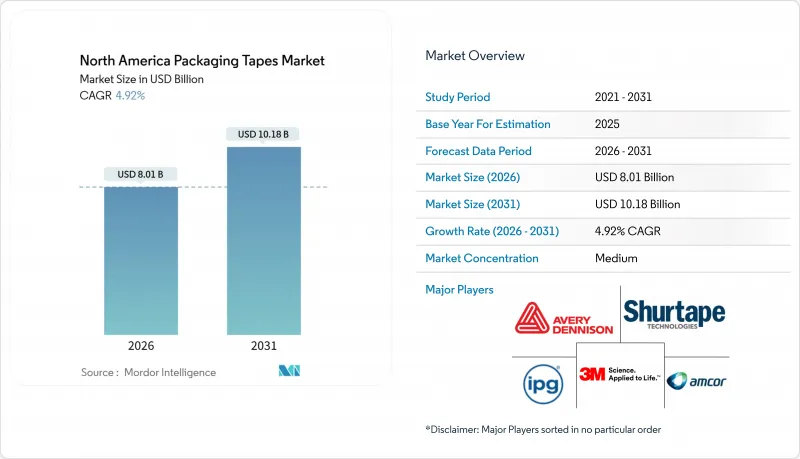
根據 Mordor Intelligence 估計,北美包裝膠帶市場在 2026 年的價值為 80.1 億美元,預計到 2031 年將達到 101.8 億美元,在預測期(2026-2031 年)內以 4.92% 的複合年成長率成長。
本報告按材料類型(塑膠和紙張)、黏合劑類型(丙烯酸、熱熔膠、橡膠及其他)、終端用戶行業(電子商務、食品飲料行業、零售業及其他)和地區(美國、加拿大和墨西哥)進行細分。市場預測以美元計價。
北美包裝膠帶市場趨勢與洞察
電子商務和全通路物流需求強勁。
自動化程度的提高推高了每個包裝箱的膠帶消耗量。亞馬遜在2024年擴建倉庫時,新增了配備封箱機的設備,這些封箱機能夠以恆定的速度處理包裝箱,而每個封箱機都需要熱熔膠帶進行即時黏合。履約業者正在將庫存集中到幾個大型配送中心,從而提高平均處理能力。即使電子商務的普及速度趨於平緩,包裝膠帶市場預計仍將持續擴張。隨著機器人技術的引入減少了人工等待時間,能夠在一秒鐘內完成黏合的膠帶更受歡迎。捲繞式膠帶也有助於高速設備的持續運作。由於停機成本可能相當高昂,營運商願意為能夠保證流程可靠性的無縫自動化膠帶支付更高的價格。
食品級監管合規性正在加速紙膠帶和 WAT 的採用。
為了符合美國FDA 21 CFR 175.105和加拿大CFIA的規定,人們對黏合劑不會滲入食品的證明需求日益成長。這一趨勢促使買家在牛皮紙基材上使用水性丙烯酸或水性活化黏合劑。儘管這些膠帶價格較高,但食品和飲料品牌願意承擔額外的成本以維持出口認證。漢高的AQUENCE PS系列產品已獲得食品接觸認證,在低溫黏合至關重要的飲料和冷藏食品產業中越來越受歡迎。隨著PFAS法規的日益嚴格,3M計劃在2025年底前徹底淘汰這類化學物質,這需要對現有產品進行配方調整。零售商正在將供應商評估標準與ESG指標結合,並將紙膠帶視為減少塑膠使用和避免EPR(生產者延伸責任)成本的有效解決方案,這使得紙膠帶成為包裝膠帶市場重組的關鍵參與者。
丙烯和橡膠原料價格波動
2024年,墨西哥灣沿岸各樞紐的丙烯現貨價格波動劇烈。這種價格波動導致雙向拉伸聚丙烯(BOPP)的季度利潤率下降。同樣,橡膠原料的價格也出現波動,主要原因是東南亞地區受天氣影響導致的供應中斷。大型製造商可以透過簽訂多年期合約來規避這些波動,但區域性加工商往往缺乏這種優勢。因此,區域性加工商不得不將價格波動轉嫁給買家,儘管有一定的延遲性。這種滯後性通常會影響與大宗零售商的關係,因為這些零售商會提前數月制定年度膠帶預算。因此,儘管包裝膠帶市場的銷售量有所成長,但原物料價格飆升正在拖累利潤預期。
細分市場分析
預計到2031年,紙膠帶的複合年成長率將達到5.61%,超過包裝膠帶市場的整體成長率,因為品牌商都在尋求能夠順利通過回收廠的原料。塑膠膠帶,尤其是雙向拉伸聚丙烯(BOPP)膠帶(具有防潮性能,即使在出口運輸中也能保持拉伸強度),在2025年佔據了77.11%的銷售額,但國內零售商已承諾到2030年淘汰不可回收材料。這些承諾使得紙膠帶能夠在低風險SKU(庫存單位)領域搶佔市場佔有率,尤其是在電商通路,膠帶的可見度有助於品牌推廣。
在實行生產者責任延伸(EPR)收費的州,以牛皮紙為基材、水性膠粘劑為粘合劑的膠帶是首選,因為它們可以密封再生瓦楞紙板,而不會污染紙張分銷流程。增強型紙膠帶彌補了強度上的不足,使紙張能夠承載以前只能用塑膠包裝的中等載重包裝。同時,冷凍食品和跨洲運輸仍需要能夠承受極端溫度的塑膠級膠帶。黏合劑製造商正在透過調整黏性來適應再生瓦楞紙板,隨著包裝膠帶市場日益多元化,兩種基材都能在各自的細分市場中保持市場佔有率。
其他好處:
- Excel格式的市場預測(ME)表
- 3個月的分析師支持
目錄
第1章:引言
- 研究假設和市場定義
- 調查範圍
第2章:調查方法
第3章執行摘要
第4章 市場狀況
- 市場概覽
- 市場促進因素
- 電子商務與全通路物流需求強勁
- 食品級適用性正在加速紙張和 WAT 的採用。
- 北美履約中心的自動化熱熔壓敏膠生產線
- 近岸外包正在擴大跨境貿易地區對膠帶的需求。
- 數位印刷品牌保護膠帶正變得越來越受歡迎。
- 市場限制因素
- 丙烯和橡膠原料價格波動
- 州政府提高BOPP/PVC膠帶塑膠廢棄物延伸制度(EPR)費用。
- 將傳統生產線改造為水基系統的資本成本
- 價值鏈分析
- 波特五力模型
第5章 市場規模與成長預測
- 材料類型
- 塑膠
- 紙
- 黏合劑類型
- 丙烯酸纖維
- 熱熔膠
- 橡膠基
- 其他
- 按最終用戶行業分類
- 電子商務
- 食品飲料業
- 零售業
- 其他
- 地區
- 美國
- 加拿大
- 墨西哥
第6章 競爭情勢
- 市場集中度
- 策略趨勢
- 市佔率和排名分析
- 公司簡介
- 3M
- Amcor plc
- Avery Dennison Corporation
- CCT Tapes
- Henkel AG & Co. KGaA
- Intertape Polymer Group Inc.
- LINTEC Corporation
- Mactac LLC
- Nitto Denko Corporation
- Scapa
- Shurtape Technologies LLC
- Tesa SE
第7章 市場機會與未來展望
According to Mordor Intelligence, the North America packaging tapes market size is estimated at USD 8.01 billion in 2026, and is expected to reach USD 10.18 billion by 2031, at a CAGR of 4.92% during the forecast period (2026-2031).
This report is Segmented by Material Type (Plastic and Paper), Adhesive Type (Acrylic, Hot-Melt, Rubber-Based, and Others), End-User Industry (E-Commerce, Food and Beverage Industry, Retail Industry, and Others), and Geography (United States, Canada, and Mexico). The Market Forecasts are Provided in Terms of Value (USD).
North America Packaging Tapes Market Trends and Insights
Resilient E-Commerce And Omni-Channel Logistics Demand
Automation is ratcheting up tape consumption per carton sealed. Amazon's 2024 warehouse expansion added additional capacity equipped with case sealers that process boxes at a steady rate, each requiring hot-melt tapes that deliver instant grab. Fulfillment providers consolidate inventory into fewer, larger hubs, raising average throughput and ensuring the packaging tapes market continues to expand even if e-commerce penetration levels off. Robotics eliminates manual dwell time, favoring adhesives that bond in under one second, while level-wound rolls support uninterrupted runs on high-speed equipment. Because downtime costs can be high, operators willingly pay premiums for splice-free, automation-grade tapes that guarantee process reliability.
Food-Grade Compliance Accelerating Paper And WAT Adoption
In response to FDA 21 CFR 175.105 and Canada's CFIA regulations, there's a heightened demand for proof that adhesives won't leach into food. This push has nudged buyers towards opting for water-based acrylics or water-activated chemistries on kraft backings. Despite these tapes commanding a price premium, food and beverage brands are willing to absorb the extra cost to safeguard their export certifications. Henkel's AQUENCE PS range, boasting food contact certification, is now penetrating beverage and chilled-food sectors, where a low-temperature tack is essential. With PFAS restrictions tightening, 3M is set to completely withdraw from that chemical class by the close of 2025, necessitating a reformulation of its legacy products. Retailers, aligning supplier scorecards with ESG metrics, view paper tapes as an efficient solution to reduce plastic usage and sidestep EPR fees, positioning them as pivotal players in reshaping the packaging tapes landscape.
Volatile Propylene And Rubber Feedstock Prices
In 2024, spot propylene prices fluctuated across Gulf Coast hubs. This volatility led to a reduction of BOPP margins within a single quarter. Similarly, rubber raw materials experienced price swings, largely attributed to weather disruptions in Southeast Asia. While larger manufacturers can hedge against these fluctuations using multi-year contracts, regional converters often lack this advantage. As a result, they are compelled to pass on the volatility to buyers, albeit with a delay. This delay strains their relationships with high-volume retailers, who typically budget for annual tape costs months in advance. Consequently, even as the packaging tapes market sees a rise in volume, spikes in feedstock prices dampen profit expectations.
Other drivers and restraints analyzed in the detailed report include:
- Automation-Ready Hot-Melt PSA Lines At NA Fulfillment Hubs
- Near-Shoring Boosts Tape Demand In Cross-Border Trade Zones
- Rising State Plastic-Waste EPR Fees On BOPP/PVC Tapes
For complete list of drivers and restraints, kindly check the Table Of Contents.
Segment Analysis
Paper tapes are forecast to rise 5.61% CAGR through 2031, eclipsing overall packaging tapes market growth as brands target substrates that move seamlessly through recycling mills. Plastic grades retained 77.11% of 2025 revenue because BOPP resists humidity and maintains tensile strength in export shipments, yet national retailers have committed to eliminating unrecyclable components by 2030. These pledges allow paper variants to cannibalize low-risk SKUs, especially in e-commerce channels where tape visibility also supports branding.
Kraft backings paired with water-activated adhesives seal fiber-based cartons without contaminating paper streams, making them a preferred option in states that impose EPR fees. Reinforced paper tape closes historical strength gaps, enabling paper to secure medium-duty loads previously reserved for plastic. Conversely, frozen food and cross-continent routes still demand plastic grades that withstand extreme temperatures. Adhesive formulators respond by tailoring tack to recycled corrugate, ensuring both substrates retain their share in their respective niches as the packaging tapes market diversifies.
Complete Report Scope:
- By Material Type
- Plastic
- Paper
- By Adhesive Type
- Acrylic
- Hot-Melt
- Rubber-Based
- Others
- By End-User Industry
- E-Commerce
- Food and Beverage Industry
- Retail Industry
- Others
- Geography
- United States
- Canada
- Mexico
List of Companies Covered in this Report:
- 3M
- Amcor plc
- Avery Dennison Corporation
- CCT Tapes
- Henkel AG & Co. KGaA
- Intertape Polymer Group Inc.
- LINTEC Corporation
- Mactac LLC
- Nitto Denko Corporation
- Scapa
- Shurtape Technologies LLC
- Tesa SE
Additional Benefits:
- The market estimate (ME) sheet in Excel format
- 3 months of analyst support
TABLE OF CONTENTS
1 Introduction
- 1.1 Study Assumptions and Market Definition
- 1.2 Scope of the Study
2 Research Methodology
3 Executive Summary
4 Market Landscape
- 4.1 Market Overview
- 4.2 Market Drivers
- 4.2.1 Resilient e-commerce and omni-channel logistics demand
- 4.2.2 Food-grade compliance accelerating paper and WAT adoption
- 4.2.3 Automation-ready hot-melt PSA lines at NA fulfillment hubs
- 4.2.4 Near-shoring boosts tape demand in cross-border trade zones
- 4.2.5 Digitally-printed, brand-protection tapes gain traction
- 4.3 Market Restraints
- 4.3.1 Volatile propylene and rubber feedstock prices
- 4.3.2 Rising state plastic-waste EPR fees on BOPP/PVC tapes
- 4.3.3 Capital cost of converting legacy lines to water-based systems
- 4.4 Value Chain Analysis
- 4.5 Porter's Five Forces
- 4.5.1 Bargaining Power of Suppliers
- 4.5.2 Bargaining Power of Consumers
- 4.5.3 Threat of New Entrants
- 4.5.4 Threat of Substitute Products
- 4.5.5 Degree of Competition
5 Market Size and Growth Forecasts (Value)
- 5.1 By Material Type
- 5.1.1 Plastic
- 5.1.2 Paper
- 5.2 By Adhesive Type
- 5.2.1 Acrylic
- 5.2.2 Hot-Melt
- 5.2.3 Rubber-Based
- 5.2.4 Others
- 5.3 By End-User Industry
- 5.3.1 E-Commerce
- 5.3.2 Food and Beverage Industry
- 5.3.3 Retail Industry
- 5.3.4 Others
- 5.4 Geography
- 5.4.1 United States
- 5.4.2 Canada
- 5.4.3 Mexico
6 Competitive Landscape
- 6.1 Market Concentration
- 6.2 Strategic Moves
- 6.3 Market Share (%)/Ranking Analysis
- 6.4 Company Profiles (includes Global level Overview, Market level overview, Core Segments, Financials as available, Strategic Information, Products and Services, Recent Developments)
- 6.4.1 3M
- 6.4.2 Amcor plc
- 6.4.3 Avery Dennison Corporation
- 6.4.4 CCT Tapes
- 6.4.5 Henkel AG & Co. KGaA
- 6.4.6 Intertape Polymer Group Inc.
- 6.4.7 LINTEC Corporation
- 6.4.8 Mactac LLC
- 6.4.9 Nitto Denko Corporation
- 6.4.10 Scapa
- 6.4.11 Shurtape Technologies LLC
- 6.4.12 Tesa SE
7 Market Opportunities and Future Outlook
- 7.1 White-Space and Unmet-Need Assessment

 包裝膠帶:市場佔有率分析、產業趨勢與統計、成長預測(2026-2031)密封和捆紮包裝膠帶:市場佔有率分析、行業趨勢和統計數據、成長預測(2026-2031)
 塑膠捆紮帶市場分析及預測(至2035年):類型、產品、技術、應用、材料類型、製程、最終用戶、功能、設備
 包裝膠帶印刷市場:2026-2032年全球市場預測(按印刷技術、材料、油墨類型、黏合劑類型、塗佈方法、印刷表面、應用和最終用途行業分類)包裝膠帶市場:2026-2032年全球市場預測(按產品類型、黏合劑類型、基材、應用、終端用戶產業和分銷管道分類)
 全球包裝帶材料市場:市場規模、佔有率、趨勢和成長分析(2026-2034)PVC包裝膠帶印刷市場規模、佔有率、成長率、全球產業分析、區域分析及未來預測(2026-2034)包裝膠帶印刷市場規模、佔有率、成長、全球產業分析、區域趨勢及2026年至2034年預測
 包裝膠帶市場:市場規模、佔有率、成長和行業分析:按材料、產品類型、黏合劑、應用和區域分類,預測至2034年
 包裝帶材料市場規模、佔有率和趨勢分析報告:按原料、產品、應用、地區和細分市場分類(2026-2033 年)