


 |
市場調查報告書
商品編碼
2114615
密封和捆紮包裝膠帶:市場佔有率分析、行業趨勢和統計數據、成長預測(2026-2031)Sealing And Strapping Packaging Tapes - Market Share Analysis, Industry Trends & Statistics, Growth Forecasts (2026 - 2031) |
||||||

※ 本網頁內容可能與最新版本有所差異。詳細情況請與我們聯繫。
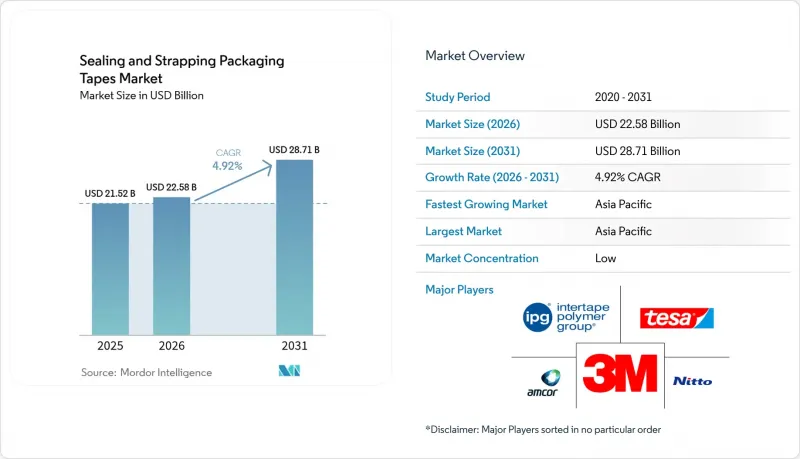
根據 Mordor Intelligence 預測,密封和捆紮包裝膠帶市場將從 2025 年的 215.2 億美元成長到 2026 年的 225.8 億美元,然後在 2031 年達到 287.1 億美元,2026 年至 2031 年的複合年成長率為 4.92%。
本報告按材料類型(塑膠、紙張、箔材/長絲等)、黏合劑類型(丙烯酸、橡膠、熱熔膠等)、基材(雙向拉伸聚丙烯薄膜、牛皮紙、聚對苯二甲酸乙二醇酯、聚氯乙烯、玻璃纖維長絲)、終端用戶產業(物流/倉儲、電子商務/零售履約等)和地區進行細分。市場預測以美元計價。
全球封口及捆紮包裝膠帶市場趨勢及洞察
電子商務的快速發展正在推動紙板封口膠帶的消費量成長。
數位零售的擴張加速了小包裹處理的量,每個包裹都需要初步密封、加固和防篡改處理,導致每次出貨使用的膠帶量增加一倍。高速履約中心需要能夠承受從低溫運輸樞紐到沙漠配送路線溫度波動的膠帶,同時也要具備低噪音和高黏性。客製化印刷的膠帶既是安全裝置,也是品牌資產,能夠支援直接面對消費者的行銷策略。跨境經銷商要求產品具備多項認證,符合食品接觸和藥品相關法規,這為能夠證明產品符合規定的供應商創造了一個高階細分市場。因此,密封和捆紮包裝膠帶市場與最後一公里配送業務的規模和複雜程度密切相關。
全球物流和倉儲中心的擴張
自動化倉庫正在採用機器人膠帶應用系統,這要求基材具有一致的展開特性和可控的黏合曲線。對冷藏倉庫和藥品配銷中心的投資推動了對低溫黏合劑的需求,這種黏合劑即使在零度以下的條件下也不會變脆。阿拉伯聯合大公國和沙烏地阿拉伯的區域中心正在擴大供應網路,並促進中東和非洲的膠帶消費。同時,準時制 (JIT) 庫存模式正在縮短生產批量,並傾向於提高訂單頻率(儘管每次訂單規模較小),這為具有靈活調度能力的加工商創造了有利環境。預計到 2030 年,密封和捆紮包裝膠帶市場將隨著全球倉庫占地面積的成長而擴張。
石油基原物料價格波動
由於聚丙烯和聚乙烯佔原料成本的大部分,丙烯和乙烯價格的波動正對加工商的利潤率構成壓力。東南亞裂解裝置的停產加劇了供應風險,迫使生產商對沖庫存並根據混合比例協商合約。黏合劑原料也面臨類似的價格波動,其中用於高黏性膠帶的天然橡膠受影響尤為嚴重。短期價格上漲可能會加重購買力有限的中小型製造商的負擔,並減緩密封和捆紮包裝膠帶市場產能的擴張。
細分市場分析
2025年,塑膠膠帶的銷售額佔比達到51.78%,這主要得益於兼具防潮性和價格優勢的高耐久性雙向拉伸聚丙烯(BOPP)和聚對苯二甲酸乙二醇酯(PET)薄膜。雖然隨著電子商務中瓦楞紙箱使用量的增加,塑膠膠帶市場規模預計將會擴大,但由於法規傾向於紡織品,其市場佔有率預計將會逐漸下降。紙膠帶,尤其是水性紙膠帶,預計到2031年將以8.78%的複合年成長率成長,這主要得益於回收的強制性規定以及品牌所有者的無塑膠承諾。歐洲要求在2030年實現包裝完全可回收的法規正在推動紙膠帶的普及,而北美零售商則在積極推廣紡織密封產品,以實現企業ESG目標。一種新型的混合基材正在興起,這種基材以牛皮紙為基底,表面塗覆一層薄薄的聚合物塗層,兼具阻隔性能和易於再製漿的特點。材料創新者正致力於透過混合再生材料和生物樹脂來研發碳中和配方,使紙膠帶能夠在高階消費品領域擴大市場佔有率。在整個預測期內,塑膠製造商正專注於與減薄和化學回收相關的合作,以保持其市場地位。
丙烯酸類黏合劑因其優異的紫外線穩定性和在高溫低溫供應鏈中的儲存耐久性而備受青睞,預計2025年將佔總銷售額的46.92%。橡膠體系(包括合成樹脂)正以每年7.94%的速度成長,因為高速自動化生產線需要快速成型以加快外殼成型週期,而即時黏著度是關鍵。熱熔膠因其能避免冷凝造成的缺陷,在冷藏環境中越來越廣泛的應用。矽酮黏合劑目前仍屬於小眾市場,但已被用於汽車電池和電子設備組裝等極端溫度條件(-300°F至1000°F)的應用領域。水活化黏合劑黏合劑和紙基黏合劑正重新受到關注,加工商正在投資高精度點膠機以縮短生產週期。據陶氏公司稱,像陶氏-漢高這樣的合作夥伴正在開發生物基聚合物,旨在將從原料採購到工廠出貨的整個過程中的排放量減少25%。因此,供應商正試圖透過按應用對產品進行分類和最佳化樹脂混合物,來抓住密封和捆紮包裝膠帶行業的各種商機。
區域分析
預計到2025年,亞太地區將以38.10%的市佔率主導密封和捆紮包裝膠帶市場,並在2031年之前以8.55%的複合年成長率持續成長。中國透過出口導向製造業維持市場需求,而印度則因數位商務的快速發展,小包裹量和紙膠帶滲透率不斷提高。區域各國政府正集中投資建設智慧倉庫和5G物流走廊等基礎設施,刺激了對RFID膠帶的需求。跨境電商的興起加劇了服務水準的競爭,承運商正朝著使用全球通用黏合劑的標準化方向發展,以最大限度地減少運輸過程中的損壞。本地供應商受益於樹脂和薄膜生產能力的鄰近優勢,而跨國公司則在擴大其區域工廠的規模。例如,Tesa在孟買和班加羅爾新建的工廠正在加強技術支援並縮短前置作業時間。
儘管北美市場已趨於成熟,但由於積極採用智慧和永續解決方案,其盈利仍然豐厚。與加拿大和墨西哥的關稅趨勢正在影響原料流動和籌資策略,迫使加工商平衡國內採購和進口原料的比例。零售業的重組提高了供應商認證標準,但同時也有利於那些能夠提供全國性服務和數據驅動績效報告的供應商。大型零售連鎖店強制推行智慧包裝,正加速RFID標籤帶的普及,將倉庫轉變為全通路庫存管理的即時視覺化中心。
其他好處:
- Excel格式的市場預測(ME)表
- 3個月的分析師支持
目錄
第1章:引言
- 研究假設和市場定義
- 調查範圍
第2章:調查方法
第3章執行摘要
第4章 市場狀況
- 市場概覽
- 市場促進因素
- 電子商務的快速發展帶動了紙箱封箱膠帶的消費量成長。
- 全球物流和倉儲中心的擴張
- 轉向使用成本績效拉伸聚丙烯(BOPP)和聚對苯二甲酸乙二醇酯(PET)膠帶
- 帶有RFID/QR碼的智慧防篡改膠帶,用於追溯
- 可回收水活化紙膠帶的成長
- 市場限制因素
- 石油基原物料價格波動
- 對一次性塑膠製品實施嚴格監管
- 與遵守黏合劑揮發性有機化合物(VOC)排放法規相關的成本
- 紙帶供應線的自動化瓶頸
- 供應鏈分析
- 監理情勢
- 技術展望
- 波特五力模型
第5章 市場規模與成長預測
- 依材料類型
- 塑膠
- BOPP
- PP
- PET
- PVC
- 紙
- 箔和絲
- 其他
- 塑膠
- 黏合劑類型
- 丙烯酸類(水性/溶劑型/UV固化型)
- 橡膠基材(天然和合成)
- 熱熔型
- 矽基
- 水活化澱粉基
- 按基礎材料
- 雙軸延伸聚丙烯(BOPP)
- 牛皮紙
- 聚酯(PET)
- PVC
- 玻璃纖維絲
- 按最終用途行業分類
- 物流/倉儲
- 電子商務與零售履約
- 食品/飲料
- 藥品和醫療設備
- 電子設備和電氣裝置
- 汽車和工業
- 其他
- 按地區
- 北美洲
- 美國
- 加拿大
- 墨西哥
- 歐洲
- 德國
- 英國
- 法國
- 義大利
- 西班牙
- 俄羅斯
- 其他歐洲國家
- 亞太地區
- 中國
- 印度
- 日本
- 韓國
- 澳洲和紐西蘭
- 其他亞太國家
- 中東和非洲
- 中東
- 阿拉伯聯合大公國
- 沙烏地阿拉伯
- 土耳其
- 其他中東國家
- 非洲
- 南非
- 奈及利亞
- 埃及
- 其他非洲國家
- 中東
- 南美洲
- 巴西
- 阿根廷
- 其他南美國家
- 北美洲
第6章 競爭情勢
- 市場集中度
- 策略趨勢
- 市佔率分析
- 公司簡介
- 3M Company
- Tesa SE(Beiersdorf)
- Nitto Denko Corporation
- Intertape Polymer Group
- Berry Global Inc.
- Avery Dennison Corporation
- Shurtape Technologies
- Scapa Group plc
- Nichiban Co., Ltd.
- CCT Tapes
- Mactac LLC
- Ajit Industries
- Saint-Gobain Performance Plastics
- Henkel AG & Co. KGaA
- Rogers Corporation
- You-San Technology
- Dow Inc.(Hot-melt resins)
- Bostik SA
- UPM Raflatac(Paper-backed tapes)
- Duck Brand(ShurTech)
第7章 市場機會與未來展望
According to Mordor Intelligence, the sealing and strapping packaging tapes market size is expected to grow from USD 21.52 billion in 2025 to USD 22.58 billion in 2026 and is forecast to reach USD 28.71 billion by 2031 at 4.92% CAGR over 2026-2031.
This report is Segmented by Material Type (Plastic, Paper, Foil and Filament, and More), Adhesive Type (Acrylic, Rubber-Based, Hot-Melt, and More), Backing Substrate (BOPP, Kraft Paper, PET, PVC, Glass-Fibre Filament), End-Use Industry (Logistics and Warehousing, E-Commerce and Retail Fulfilment, and More), and by Geography. The Market Forecasts are Provided in Terms of Value (USD).
Global Sealing And Strapping Packaging Tapes Market Trends and Insights
E-commerce boom boosting carton-sealing tape consumption
Digital retail accelerates parcel counts, multiplying tape usage per shipment as each box requires primary sealing, reinforcement, and tamper evidence. High-speed fulfillment centers specify low-noise, high-adhesion tapes capable of withstanding temperature swings from cold-chain nodes to desert delivery routes. Custom-printed tapes double as security devices and brand assets, supporting direct-to-consumer marketing strategies. Cross-border sellers demand multi-certified products that comply with food-contact and pharmaceutical rules, creating premium niches for suppliers able to verify conformity. The sealing and strapping packaging tapes market is therefore tightly coupled to the volume and sophistication of last-mile delivery operations.
Expansion of global logistics and warehousing hubs
Automated warehouses rely on robotic taping systems that require substrates with consistent unwind profiles and controlled adhesion curves. Investments in cold-storage and pharma distribution centers spur demand for low-temperature adhesives that avoid brittleness at sub-zero conditions. Regional hubs in the UAE and Saudi Arabia broaden supply footprints, lifting tape consumption in the Middle East and Africa. Meanwhile, just-in-time inventory models shorten production lots, driving smaller but more frequent tape orders that benefit converters with flexible scheduling capabilities. Through 2030, the sealing and strapping packaging tapes market is expected to shadow global warehouse square-footage growth.
Volatile petroleum-based raw-material prices
Propylene and ethylene cost swings squeeze converters' margins as polypropylene and polyethylene account for a significant slice of input spnd. Cracker shutdowns in Southeast Asia heighten supply risk, forcing producers to hedge inventories or negotiate formula-based contracts. Adhesive ingredients follow similar volatility, particularly natural rubber used in high-tack tapes. Short-term price spikes strain smaller manufacturers with limited purchasing leverage, potentially slowing capacity additions in the sealing and strapping packaging tapes market.
Other drivers and restraints analyzed in the detailed report include:
- Cost-performance shift toward BOPP and PET tapes
- Smart tamper-evident tapes with RFID/QR for traceability
- Strict regulations on single-use plastics
For complete list of drivers and restraints, kindly check the Table Of Contents.
Segment Analysis
Plastic tapes retained 51.78% of revenue in 2025 thanks to durable BOPP and PET films that combine moisture resistance and competitive pricing. The sealing and strapping packaging tapes market size attributed to plastics is set to climb alongside e-commerce corrugated box usage, though its share gradually erodes as regulations favor fiber-based products. Paper tapes, especially water-activated varieties, post a 8.78% CAGR to 2031, buoyed by recyclability mandates and brand owners' zero-plastic pledges. European rules calling for fully recyclable packaging by 2030 catalyze paper adoption, while North American retailers promote fiber-based sealing options to meet corporate ESG targets. Hybrid substrates that apply thin poly coatings onto kraft backings emerge, marrying barrier performance with easy repulpability. Material innovators target carbon-neutral formulations by blending recycled content with bio-resins, positioning paper to capture incremental share across premium consumer segments. Over the forecast horizon, plastic producers focus on downgauging and chemical-recycling alliances to maintain relevance within the sealing and strapping packaging tapes market.
Acrylic chemistries delivered 46.92% of 2025 sales, favored for UV stability and storage durability in hot and cold supply chains. Rubber-based systems, including synthetic variants, grow 7.94% annually as high-speed automated lines demand instant tack for faster case-forming cycles. Hot-melt grades gain traction in refrigerated environments, avoiding condensation-related failures. Silicone adhesives, though niche, serve automotive battery and electronics assemblies that face extremes from -300°F to 1000°F. Water-activated starch glues resurge alongside paper backings, with converters investing in precision dispensers to improve cycle times. Partnerships such as Dow-Henkel pursue bio-based polymer designs to cut cradle-to-gate emissions by 25% Dow. Suppliers therefore segment offerings by application, optimizing resin blends to capture diverse opportunities within the sealing and strapping packaging tapes industry.
Complete Report Scope:
- By Material Type
- Plastic
- BOPP
- PP
- PET
- PVC
- Paper
- Foil and Filament
- Others
- Plastic
- By Adhesive Type
- Acrylic (Water-/Solvent-/UV)
- Rubber-based (Natural and Synthetic)
- Hot-melt
- Silicone
- Water-activated Starch-based
- By Backing Substrate
- Biaxially-oriented Polypropylene (BOPP)
- Kraft Paper
- Polyester (PET)
- PVC
- Glass-fibre Filament
- By End-use Industry
- Logistics and Warehousing
- E-commerce and Retail Fulfilment
- Food and Beverage
- Pharmaceuticals and Medical Devices
- Electronics and Electricals
- Automotive and Industrial
- Others
- By Geography
- North America
- United States
- Canada
- Mexico
- Europe
- Germany
- United Kingdom
- France
- Italy
- Spain
- Russia
- Rest of Europe
- Asia-Pacific
- China
- India
- Japan
- South Korea
- Australia and New Zealand
- Rest of Asia-Pacific
- Middle East and Africa
- Middle East
- United Arab Emirates
- Saudi Arabia
- Turkey
- Rest of Middle East
- Africa
- South Africa
- Nigeria
- Egypt
- Rest of Africa
- Middle East
- South America
- Brazil
- Argentina
- Rest of South America
- North America
Geography Analysis
Asia-Pacific dominated the sealing and strapping packaging tapes market with 38.10% share in 2025 and is projected to advance at 8.55% CAGR to 2031. China sustains volume demand through export-oriented manufacturing, while India's digital commerce boom elevates parcel counts and paper-tape penetration. Regional governments channel infrastructure spending toward smart warehouses and 5G-enabled logistics corridors, stimulating demand for RFID-compatible tapes. Cross-border e-marketplaces intensify service-level competition, prompting carriers to standardize on global adhesives to minimize in-transit failures. Local suppliers benefit from proximate resin and film capacity, yet multinationals scale up regional plants, as evidenced by tesa's new Mumbai and Bengaluru hubs that bolster technical support and cut lead times.
North America, though mature, remains lucrative due to premium adoption of smart and sustainable solutions. Tariff dynamics with Canada and Mexico influence raw-material flows and sourcing strategies, pushing converters to balance domestic and imported substrate. Retail consolidation amplifies vendor qualification hurdles, but it also rewards suppliers capable of nationwide service and data-driven performance reporting. Smart-packaging mandates from big-box chains accelerate RFID tape rollouts, turning warehouses into real-time visibility nodes for omnichannel inventory.
- 3M Company
- Tesa SE (Beiersdorf)
- Nitto Denko Corporation
- Intertape Polymer Group
- Berry Global Inc.
- Avery Dennison Corporation
- Shurtape Technologies
- Scapa Group plc
- Nichiban Co., Ltd.
- CCT Tapes
- Mactac LLC
- Ajit Industries
- Saint-Gobain Performance Plastics
- Henkel AG & Co. KGaA
- Rogers Corporation
- You-San Technology
- Dow Inc. (Hot-melt resins)
- Bostik SA
- UPM Raflatac (Paper-backed tapes)
- Duck Brand (ShurTech)
Additional Benefits:
- The market estimate (ME) sheet in Excel format
- 3 months of analyst support
TABLE OF CONTENTS
1 INTRODUCTION
- 1.1 Study Assumptions and Market Definition
- 1.2 Scope of the Study
2 RESEARCH METHODOLOGY
3 EXECUTIVE SUMMARY
4 MARKET LANDSCAPE
- 4.1 Market Overview
- 4.2 Market Drivers
- 4.2.1 E-commerce boom boosting carton-sealing tape consumption
- 4.2.2 Expansion of global logistics and warehousing hubs
- 4.2.3 Cost-performance shift toward BOPP and PET tapes
- 4.2.4 Smart tamper-evident tapes with RFID/QR for traceability
- 4.2.5 Growth in recyclable water-activated paper tapes
- 4.3 Market Restraints
- 4.3.1 Volatile petroleum-based raw-material prices
- 4.3.2 Strict regulations on single-use plastics
- 4.3.3 Adhesive-VOC emission compliance costs
- 4.3.4 Automation bottlenecks in paper-tape dispensing lines
- 4.4 Supply-Chain Analysis
- 4.5 Regulatory Landscape
- 4.6 Technological Outlook
- 4.7 Porter's Five Forces
- 4.7.1 Threat of New Entrants
- 4.7.2 Bargaining Power of Buyers
- 4.7.3 Bargaining Power of Suppliers
- 4.7.4 Threat of Substitutes
- 4.7.5 Intensity of Competitive Rivalry
5 MARKET SIZE AND GROWTH FORECASTS (VALUE)
- 5.1 By Material Type
- 5.1.1 Plastic
- 5.1.1.1 BOPP
- 5.1.1.2 PP
- 5.1.1.3 PET
- 5.1.1.4 PVC
- 5.1.2 Paper
- 5.1.3 Foil and Filament
- 5.1.4 Others
- 5.1.1 Plastic
- 5.2 By Adhesive Type
- 5.2.1 Acrylic (Water-/Solvent-/UV)
- 5.2.2 Rubber-based (Natural and Synthetic)
- 5.2.3 Hot-melt
- 5.2.4 Silicone
- 5.2.5 Water-activated Starch-based
- 5.3 By Backing Substrate
- 5.3.1 Biaxially-oriented Polypropylene (BOPP)
- 5.3.2 Kraft Paper
- 5.3.3 Polyester (PET)
- 5.3.4 PVC
- 5.3.5 Glass-fibre Filament
- 5.4 By End-use Industry
- 5.4.1 Logistics and Warehousing
- 5.4.2 E-commerce and Retail Fulfilment
- 5.4.3 Food and Beverage
- 5.4.4 Pharmaceuticals and Medical Devices
- 5.4.5 Electronics and Electricals
- 5.4.6 Automotive and Industrial
- 5.4.7 Others
- 5.5 By Geography
- 5.5.1 North America
- 5.5.1.1 United States
- 5.5.1.2 Canada
- 5.5.1.3 Mexico
- 5.5.2 Europe
- 5.5.2.1 Germany
- 5.5.2.2 United Kingdom
- 5.5.2.3 France
- 5.5.2.4 Italy
- 5.5.2.5 Spain
- 5.5.2.6 Russia
- 5.5.2.7 Rest of Europe
- 5.5.3 Asia-Pacific
- 5.5.3.1 China
- 5.5.3.2 India
- 5.5.3.3 Japan
- 5.5.3.4 South Korea
- 5.5.3.5 Australia and New Zealand
- 5.5.3.6 Rest of Asia-Pacific
- 5.5.4 Middle East and Africa
- 5.5.4.1 Middle East
- 5.5.4.1.1 United Arab Emirates
- 5.5.4.1.2 Saudi Arabia
- 5.5.4.1.3 Turkey
- 5.5.4.1.4 Rest of Middle East
- 5.5.4.2 Africa
- 5.5.4.2.1 South Africa
- 5.5.4.2.2 Nigeria
- 5.5.4.2.3 Egypt
- 5.5.4.2.4 Rest of Africa
- 5.5.4.1 Middle East
- 5.5.5 South America
- 5.5.5.1 Brazil
- 5.5.5.2 Argentina
- 5.5.5.3 Rest of South America
- 5.5.1 North America
6 COMPETITIVE LANDSCAPE
- 6.1 Market Concentration
- 6.2 Strategic Moves
- 6.3 Market Share Analysis
- 6.4 Company Profiles (includes Global level Overview, Market level overview, Core Segments, Financials as available, Strategic Information, Market Rank/Share, Products and Services, Recent Developments)
- 6.4.1 3M Company
- 6.4.2 Tesa SE (Beiersdorf)
- 6.4.3 Nitto Denko Corporation
- 6.4.4 Intertape Polymer Group
- 6.4.5 Berry Global Inc.
- 6.4.6 Avery Dennison Corporation
- 6.4.7 Shurtape Technologies
- 6.4.8 Scapa Group plc
- 6.4.9 Nichiban Co., Ltd.
- 6.4.10 CCT Tapes
- 6.4.11 Mactac LLC
- 6.4.12 Ajit Industries
- 6.4.13 Saint-Gobain Performance Plastics
- 6.4.14 Henkel AG & Co. KGaA
- 6.4.15 Rogers Corporation
- 6.4.16 You-San Technology
- 6.4.17 Dow Inc. (Hot-melt resins)
- 6.4.18 Bostik SA
- 6.4.19 UPM Raflatac (Paper-backed tapes)
- 6.4.20 Duck Brand (ShurTech)
7 MARKET OPPORTUNITIES AND FUTURE OUTLOOK
- 7.1 White-space and Unmet-need Assessment

 北美包裝膠帶:市場佔有率分析、產業趨勢與統計、成長預測(2026-2031)包裝膠帶:市場佔有率分析、產業趨勢與統計、成長預測(2026-2031)
 塑膠捆紮帶市場分析及預測(至2035年):類型、產品、技術、應用、材料類型、製程、最終用戶、功能、設備
 包裝膠帶印刷市場:2026-2032年全球市場預測(按印刷技術、材料、油墨類型、黏合劑類型、塗佈方法、印刷表面、應用和最終用途行業分類)包裝膠帶市場:2026-2032年全球市場預測(按產品類型、黏合劑類型、基材、應用、終端用戶產業和分銷管道分類)
 全球包裝帶材料市場:市場規模、佔有率、趨勢和成長分析(2026-2034)PVC包裝膠帶印刷市場規模、佔有率、成長率、全球產業分析、區域分析及未來預測(2026-2034)包裝膠帶印刷市場規模、佔有率、成長、全球產業分析、區域趨勢及2026年至2034年預測
 包裝膠帶市場:市場規模、佔有率、成長和行業分析:按材料、產品類型、黏合劑、應用和區域分類,預測至2034年
 包裝帶材料市場規模、佔有率和趨勢分析報告:按原料、產品、應用、地區和細分市場分類(2026-2033 年)