


 |
市場調查報告書
商品編碼
2116913
包裝膠帶:市場佔有率分析、產業趨勢與統計、成長預測(2026-2031)Packaging Tapes - Market Share Analysis, Industry Trends & Statistics, Growth Forecasts (2026 - 2031) |
||||||

※ 本網頁內容可能與最新版本有所差異。詳細情況請與我們聯繫。
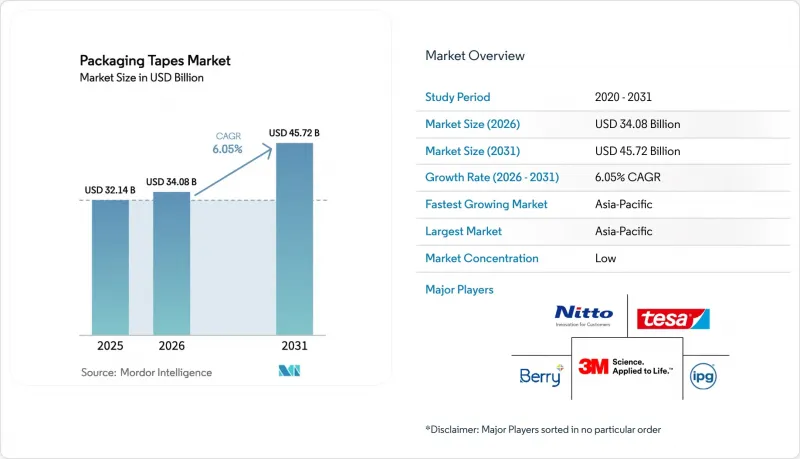
根據 Mordor Intelligence 估計,包裝膠帶市場在 2026 年的價值為 340.8 億美元,高於 2025 年的 321.4 億美元,預計到 2031 年將達到 457.2 億美元。
預計 2026 年至 2031 年的複合年成長率為 6.05%。
本報告按材料類型(塑膠、紙張)、黏合劑類型(丙烯酸、熱熔膠、橡膠和其他黏合劑類型)、產品形式(瓦楞紙板密封膠帶、遮蔽膠帶和油漆膠帶、捆紮膠帶)、最終用戶行業(電子商務、食品和飲料、零售和其他最終用戶行業)以及地區(亞太地區、北美、歐洲、南美以及中東和非洲)進行分類。
全球包裝膠帶市場趨勢與洞察
電子商務帶來的紙板運輸量激增,加速了紙板對二、三線城市的滲透。
印度、巴西和印尼等區域城市的物流樞紐正成為電子商務網路的關鍵樞紐。印度電子商務的包裝成本預計將從2019年的4.514億美元增加到2025年的9.754億美元,這將推動該地區對壓敏密封條的需求。履約中心正在將基於機器學習的紙箱尺寸演算法與紙捲分配器結合,從而減少35%的紙板用量。在北美和歐洲,此類設備的應用減少了空隙填充材,縮短了揀貨時間,並保持了兩位數的小包裹處理能力,促使採購負責人簽訂長期膠帶合約。像Tesa這樣的亞洲供應商已在孟買和班加羅爾開設服務中心,以確保為目前正在遷往二線工業園區的電子產品OEM廠商提供24小時配送服務。
對溫控食品履約中心的需求正在激增。
超級市場連鎖店正在部署微型倉配中心,這些中心需要在整個最後一公里配送過程中將生鮮食品的溫度保持在-25 度C至+8 度C的範圍內。 2024年,UPS在其「Temperature True」系列中新增了四款產品,其中「Med 100」紙箱針對常溫藥品進行了最佳化,「Med 400」紙箱針對冷凍生技藥品了最佳化。這些紙箱需要使用丙烯酸或橡膠基黏合劑,以在-20 度C以下保持黏性,從而取代在零下低溫環境下容易開裂的黏合劑。這一趨勢正在向拉丁美洲和東南亞蔓延,當地的都市區食品新創公司正在簽署訂閱契約,訂購基於ISTA 7D低溫運輸協議的預認證膠帶。
旨在淘汰運輸中瓦楞紙箱的舉措,引發了人們對傳統包裝模式的質疑。
亞馬遜在北美地區淘汰了95%的塑膠氣墊,並擴大了「自有貨櫃出貨」協議的覆蓋範圍,此舉正在降低部分商品的膠帶消耗量。自推出以來,亞馬遜的「無挫折」計畫已減少了18.1萬噸的包裝材料浪費,並避免使用了3.07億瓦楞紙箱。如今,市場上的競爭對手正在試用無需黏合劑即可封口的按需紙袋填充機,這很可能導致包裝膠帶市場長期銷售量下滑。
細分市場分析
2025年,塑膠基材佔據了包裝膠帶市場64.02%的佔有率。這主要歸功於雙向拉伸聚丙烯(BOPP)薄膜的高拉伸強度、高透明度和低成本。雖然BOPP封條在北美小包裹中心的表現優於聚氯乙烯(PVC)封條,但由於其優異的耐化學性,硬質PVC在歐洲藥品分銷領域仍廣泛應用。預計到2031年,塑膠包裝膠帶市場規模將達到291.2億美元,但由於稅收法規趨於嚴格,其市場佔有率預計將會萎縮。
紙基替代品正以6.79%的複合年成長率成長。儘管存在潮濕方面的擔憂,但其可回收性、與生活垃圾收集的兼容性以及東南亞牛皮紙供應量的增加,正推動著紙基替代品的普及。製造商目前正在添加可生物分解的阻隔塗層,這些塗層能夠經得起90%相對濕度下24小時的測試。
丙烯酸樹脂具有優異的抗紫外線性能,並符合歐盟最佳利用技術(BAT)指令中「溶劑含量不超過5%(重量比)」的規定,因此預計到2025年,丙烯酸樹脂將佔據包裝膠帶市場44.12%的佔有率。此外,水性丙烯酸樹脂對再生瓦楞紙板具有良好的黏合性,而再生瓦楞紙板在歐洲的應用正在不斷擴展。
此橡膠基系統採用苯乙烯基嵌段共聚物,即使在-25 度C的低溫下仍能保持黏性,實現了6.58%的最高複合年成長率。科騰的SIBS平台減少了30%的有機溶劑用量,並符合加州空氣資源委員會(CARB)的監管標準。 Tex Year的生物基可堆肥橡膠黏合劑生物含量高達85%,180天內可分解90%,使其成為循環經濟的理想包裝材料。
區域分析
受行動優先零售和大規模的契約製造通路的推動,亞太地區預計將在 2025 年佔據包裝膠帶市場佔有率的 39.10%。中國加工商向大灣區的智慧型手機工廠供應防靜電 BOPP 膠帶,該地區的智慧型手機產量在 2024 年超過了 2.5 億部。
在北美,重點在於實現裝箱機的自動化,以彌補人手不足。該地區也開始引入符合美國職業安全與健康管理局 (OSHA) 75 分貝噪音限制的低噪音膠帶,以滿足人體工學方面的監管要求。亞馬遜將塑膠氣枕的使用量減少了 95%,這推動了膠帶產業向美國牛皮紙漿廠生產的紙基捲材的轉變,從而重振了國內的膠帶塗佈生產線。
歐洲引入嚴格的塑膠稅正在加速推廣使用含有再生材料和無溶劑黏合劑的薄膜。西班牙、法國和義大利已經實施了與英國類似的課稅措施,以促進纖維基材的使用並提高牛皮紙生產線的運轉率。
其他好處:
- Excel格式的市場預測(ME)表
- 3個月的分析師支持
目錄
第1章:引言
- 研究假設和市場定義
- 調查範圍
第2章:調查方法
第3章執行摘要
第4章 市場狀況
- 市場概覽
- 市場促進因素
- 二、三線城市電子商務瓦楞紙箱出貨量激增
- 對溫控食品履約中心的需求激增
- 從手動到自動箱體封口生產線的過渡
- 零售商在新興市場拓展自有品牌
- 用於保障工人安全的靜音釋放膠帶的OEM規格
- 市場限制因素
- 經合組織國家的塑膠包裝稅
- 溶劑型丙烯酸樹脂的VOC排放限值
- 病害爆發導致天然橡膠供應緊張
- 各大電商平台正在試行「瓦楞紙箱出貨」。
- 價值鏈分析
- 波特五力模型
第5章 市場規模與成長預測
- 材料類型
- 塑膠
- 紙
- 黏合劑類型
- 丙烯酸纖維
- 熱熔膠
- 橡膠基
- 其他類型的黏合劑
- 按產品形式
- 紙板封條
- 遮蔽膠帶和油漆膠帶
- 捆紮帶和商品搭售膠帶
- 按最終用戶行業分類
- 電子商務
- 食品/飲料
- 零售
- 其他終端用戶產業
- 按地區
- 亞太地區
- 中國
- 印度
- 日本
- 韓國
- 其他亞太國家
- 北美洲
- 美國
- 加拿大
- 墨西哥
- 歐洲
- 德國
- 英國
- 法國
- 義大利
- 其他歐洲國家
- 南美洲
- 巴西
- 阿根廷
- 其他南美國家
- 中東和非洲
- 沙烏地阿拉伯
- 南非
- 其他中東和非洲國家
- 亞太地區
第6章 競爭情勢
- 市場集中度
- 策略趨勢
- 市佔率(%)/排名分析
- 公司簡介
- 3M
- Avery Dennison Corporation
- Berry Global Inc.
- CCT
- Essentra PLC
- Intertape Polymer Group Inc.
- Lohmann GmbH & Co. KG
- Nitto Denko Corporation
- Packman Packaging Pvt. Ltd.
- Pact Group Holdings
- PPM Industries SpA
- Saint-Gobain
- Scapa Group plc
- Shurtape Technologies LLC
- tesa SE
- Vibac Group
- Worthen Industries
第7章 市場機會與未來展望
According to Mordor Intelligence, packaging tapes market size in 2026 is estimated at USD 34.08 billion, growing from 2025 value of USD 32.14 billion with 2031 projections showing USD 45.72 billion, growing at 6.05% CAGR over 2026-2031.
This report is Segmented by Material Type (Plastic, Paper), Adhesive Type (Acrylic, Hot-Melt, Rubber-Based, Other Adhesive Types), Product Form (Carton-Sealing Tapes, Masking and Painter's Tapes, Strapping and Bundling Tapes), End-User Industry (E-Commerce, Food and Beverage, Retail, Other End-User Industries), and Geography (Asia-Pacific, North America, Europe, South America, and Middle-East and Africa).
Global Packaging Tapes Market Trends and Insights
E-commerce Carton-Volume Boom Drives Tier-2 and Tier-3 Penetration
Secondary-city logistics hubs in India, Brazil, and Indonesia are becoming critical nodes in e-commerce networks. India's e-commerce packaging spending is projected to climb from USD 451.4 million in 2019 to USD 975.4 million in 2025, raising localized demand for pressure-sensitive seals. Fulfillment centers are pairing machine-learning box-sizing algorithms with paper-reel dispensers that cut corrugate usage by 35% in North America and Europe. These installations reduce void fill, shorten pick times, and sustain double-digit parcel throughput, spurring procurement managers to lock in long-term tape contracts. Asian suppliers such as tesa have opened Mumbai and Bengaluru service hubs to stay within 24-hour reach of electronics OEMs now shifting to tier-2 industrial corridors.
Demand Spike from Temperature-Controlled Grocery Fulfillment Centers
Supermarket chains are rolling out micro-fulfillment assets that must keep perishables between -25 °C and +8 °C across last-mile routes. UPS added four Temperature True lines in 2024, tailoring Med 100 cartons for ambient medicines and Med 400 for frozen biologics. These box styles need acrylic or rubber adhesives that retain tack below -20 °C, prompting a shift away from hot-melt grades that crack at sub-zero loading docks. The trend penetrates Latin America and Southeast Asia where urban grocery startups sign subscription deals for tapes pre-qualified under ISTA 7D cold-chain protocols.
Carton-Free Shipping Initiatives Challenge Traditional Packaging Models
Amazon's policy to eradicate 95% of plastic air pillows in North America and broaden Ships in Own Container protocols cuts tape consumption on certain SKUs. Its frustration-free program has eliminated 181,000 tons of excess material and avoided 307 million boxes since launch. Marketplace rivals now pilot on-demand paper-bagging machines that seal without adhesive, presenting a long-term volume drag for the packaging tapes market.
Other drivers and restraints analyzed in the detailed report include:
- Shift From Manual to Automated Case-Sealing Lines
- Retailers' Private-Label Expansion in Emerging Markets
- OECD-Level Plastic Packaging Taxes Reshape Material Selection
For complete list of drivers and restraints, kindly check the Table Of Contents.
Segment Analysis
Plastic substrates captured 64.02% of the packaging tapes market share in 2025 because BOPP films deliver high tensile strength, optical clarity, and low cost. BOPP seals overtake PVC in North American parcel centers, while rigid PVC persists in European pharma distribution due to chemical resistance. The packaging tapes market size for plastic grades is projected to reach USD 29.12 billion in 2031, though its share will erode as taxes bite.
Paper-based alternatives are growing 6.79% CAGR. Recyclability, curbside acceptance, and rising Kraft supply in Southeast Asia encourage adoption despite moisture concerns. Producers now add biodegradable barrier coatings that withstand 24-hour 90%-RH testing.
Acrylic chemistries accounted for 44.12% of the packaging tapes market size in 2025, thanks to UV stability and compliance with more than 5 wt% solvent rules under EU BAT directives. Water-based acrylics also bond well to recycled corrugate, a rising substrate in Europe.
Rubber-based systems post the fastest 6.58% CAGR by leveraging styrenic block copolymers that maintain tack down to -25 °C. KRATON's SIBS platform cuts organosolvent use 30%, meeting California's Air Resources Board limits. Tex Year's bio-based compostable rubber adhesive reaches 85% bio-content with 90% degradation in 180 days, suiting circular-economy packaging
Complete Report Scope:
- By Material Type
- Plastic
- Paper
- By Adhesive Type
- Acrylic
- Hot-Melt
- Rubber-Based
- Other Adhesive Types
- By Product Form
- Carton-Sealing Tapes
- Masking and Painter's Tapes
- Strapping and Bundling Tapes
- By End-user Industry
- E-commerce
- Food and Beverage
- Retail
- Other End-user Industries
- By Geography
- Asia-Pacific
- China
- India
- Japan
- South Korea
- Rest of Asia-Pacific
- North America
- United States
- Canada
- Mexico
- Europe
- Germany
- United Kingdom
- France
- Italy
- Rest of Europe
- South America
- Brazil
- Argentina
- Rest of South America
- Middle-East and Africa
- Saudi Arabia
- South Africa
- Rest of Middle-East and Africa
- Asia-Pacific
Geography Analysis
Asia Pacific held 39.10% of the packaging tapes market share in 2025, fueled by mobile-first retail and a sizable contract-manufacturing pipeline. Chinese converters supply antistatic BOPP tapes to smartphone plants in the Greater Bay Area, where 2024 output exceeded 250 million handsets.
North America focuses on case-sealer automation to offset labor scarcity. The region introduces noise-reduced tapes that meet OSHA 75 dB limits, supporting ergonomic mandates. Amazon's 95% plastic-air-pillow removal shifts uptake toward paper-based rolls sourced from U.S. kraft mills, stimulating domestic tape coating lines.
Europe's stringent plastic taxes intensify trials of recycled-content films and solvent-free adhesives. Spain, France, and Italy replicate the UK levy, incentivizing fiber substrates and bumping up kraft-line utilization.
- 3M
- Avery Dennison Corporation
- Berry Global Inc.
- CCT
- Essentra PLC
- Intertape Polymer Group Inc.
- Lohmann GmbH & Co. KG
- Nitto Denko Corporation
- Packman Packaging Pvt. Ltd.
- Pact Group Holdings
- PPM Industries SpA
- Saint-Gobain
- Scapa Group plc
- Shurtape Technologies LLC
- tesa SE
- Vibac Group
- Worthen Industries
Additional Benefits:
- The market estimate (ME) sheet in Excel format
- 3 months of analyst support
TABLE OF CONTENTS
1 Introduction
- 1.1 Study Assumptions and Market Definition
- 1.2 Scope of the Study
2 Research Methodology
3 Executive Summary
4 Market Landscape
- 4.1 Market Overview
- 4.2 Market Drivers
- 4.2.1 E-Commerce Carton?Volume Boom in Tier-2 and Tier-3 Cities
- 4.2.2 Demand Spike from Temperature-Controlled Grocery Fulfilment Centers
- 4.2.3 Shift From Manual to Automated Case-Sealing Lines
- 4.2.4 Retailers' Private-Label Expansion in Emerging Markets
- 4.2.5 OEM Specification of Quiet-Release Tapes for Worker Safety
- 4.3 Market Restraints
- 4.3.1 OECD-Level Plastic-Packaging Taxes
- 4.3.2 VOC-Emission Caps on Solvent-Based Acrylics
- 4.3.3 Supply Crunch of Natural Rubber Due To Disease Outbreaks
- 4.3.4 Carton-Free Shipping Pilots by Leading Marketplaces
- 4.4 Value Chain Analysis
- 4.5 Porter's Five Forces
- 4.5.1 Bargaining Power of Suppliers
- 4.5.2 Bargaining Power of Buyers
- 4.5.3 Threat of New Entrants
- 4.5.4 Threat of Substitute Products and Services
- 4.5.5 Degree of Competition
5 Market Size and Growth Forecasts (Value)
- 5.1 By Material Type
- 5.1.1 Plastic
- 5.1.2 Paper
- 5.2 By Adhesive Type
- 5.2.1 Acrylic
- 5.2.2 Hot-Melt
- 5.2.3 Rubber-Based
- 5.2.4 Other Adhesive Types
- 5.3 By Product Form
- 5.3.1 Carton-Sealing Tapes
- 5.3.2 Masking and Painter's Tapes
- 5.3.3 Strapping and Bundling Tapes
- 5.4 By End-user Industry
- 5.4.1 E-commerce
- 5.4.2 Food and Beverage
- 5.4.3 Retail
- 5.4.4 Other End-user Industries
- 5.5 By Geography
- 5.5.1 Asia-Pacific
- 5.5.1.1 China
- 5.5.1.2 India
- 5.5.1.3 Japan
- 5.5.1.4 South Korea
- 5.5.1.5 Rest of Asia-Pacific
- 5.5.2 North America
- 5.5.2.1 United States
- 5.5.2.2 Canada
- 5.5.2.3 Mexico
- 5.5.3 Europe
- 5.5.3.1 Germany
- 5.5.3.2 United Kingdom
- 5.5.3.3 France
- 5.5.3.4 Italy
- 5.5.3.5 Rest of Europe
- 5.5.4 South America
- 5.5.4.1 Brazil
- 5.5.4.2 Argentina
- 5.5.4.3 Rest of South America
- 5.5.5 Middle-East and Africa
- 5.5.5.1 Saudi Arabia
- 5.5.5.2 South Africa
- 5.5.5.3 Rest of Middle-East and Africa
- 5.5.1 Asia-Pacific
6 Competitive Landscape
- 6.1 Market Concentration
- 6.2 Strategic Moves
- 6.3 Market Share(%) / Ranking Analysis
- 6.4 Company Profiles (includes Global level Overview, Market level overview, Core Segments, Financials as available, Strategic Information, Market Rank/Share for key companies, Products and Services, and Recent Developments)
- 6.4.1 3M
- 6.4.2 Avery Dennison Corporation
- 6.4.3 Berry Global Inc.
- 6.4.4 CCT
- 6.4.5 Essentra PLC
- 6.4.6 Intertape Polymer Group Inc.
- 6.4.7 Lohmann GmbH & Co. KG
- 6.4.8 Nitto Denko Corporation
- 6.4.9 Packman Packaging Pvt. Ltd.
- 6.4.10 Pact Group Holdings
- 6.4.11 PPM Industries SpA
- 6.4.12 Saint-Gobain
- 6.4.13 Scapa Group plc
- 6.4.14 Shurtape Technologies LLC
- 6.4.15 tesa SE
- 6.4.16 Vibac Group
- 6.4.17 Worthen Industries
7 Market Opportunities and Future Outlook
- 7.1 White-space and Unmet-Need Assessment
- 7.2 Research and Development of Sustainable Packaging Tapes

 北美包裝膠帶:市場佔有率分析、產業趨勢與統計、成長預測(2026-2031)密封和捆紮包裝膠帶:市場佔有率分析、行業趨勢和統計數據、成長預測(2026-2031)
 塑膠捆紮帶市場分析及預測(至2035年):類型、產品、技術、應用、材料類型、製程、最終用戶、功能、設備
 包裝膠帶印刷市場:2026-2032年全球市場預測(按印刷技術、材料、油墨類型、黏合劑類型、塗佈方法、印刷表面、應用和最終用途行業分類)包裝膠帶市場:2026-2032年全球市場預測(按產品類型、黏合劑類型、基材、應用、終端用戶產業和分銷管道分類)
 全球包裝帶材料市場:市場規模、佔有率、趨勢和成長分析(2026-2034)PVC包裝膠帶印刷市場規模、佔有率、成長率、全球產業分析、區域分析及未來預測(2026-2034)包裝膠帶印刷市場規模、佔有率、成長、全球產業分析、區域趨勢及2026年至2034年預測
 包裝膠帶市場:市場規模、佔有率、成長和行業分析:按材料、產品類型、黏合劑、應用和區域分類,預測至2034年
 包裝帶材料市場規模、佔有率和趨勢分析報告:按原料、產品、應用、地區和細分市場分類(2026-2033 年)