


 |
市場調查報告書
商品編碼
2125491
海上油田服務:市場佔有率分析、產業趨勢與統計、成長預測(2026-2031)Offshore Oilfield Services - Market Share Analysis, Industry Trends & Statistics, Growth Forecasts (2026 - 2031) |
||||||

※ 本網頁內容可能與最新版本有所差異。詳細情況請與我們聯繫。
根據 Mordor Intelligence 估計,2026 年海上油田服務市值將達到 454.6 億美元,高於 2025 年的 425.7 億美元,預計到 2031 年將達到 631.3 億美元。
預計 2026 年至 2031 年的複合年成長率為 6.78%。
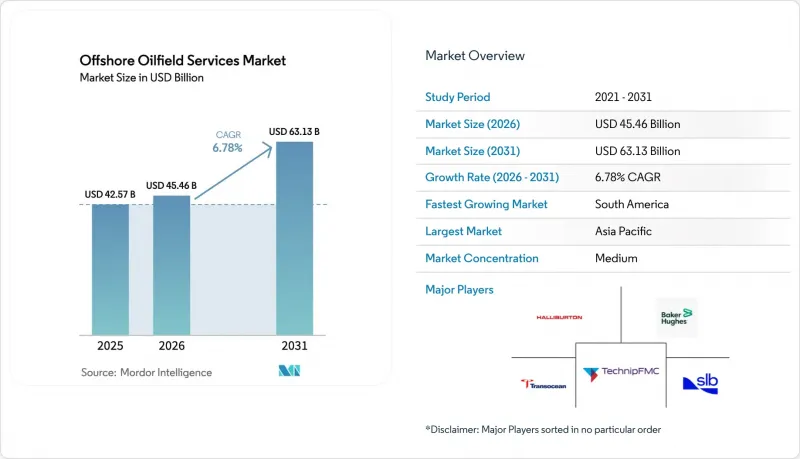
本報告按服務類型(鑽井服務、精加工服務、生產和乾預服務以及其他服務)、水深(淺海、深海和超深海)以及地區(北美、歐洲、亞太、南美以及中東和非洲)進行細分。市場規模和預測均以美元計價。
全球海上油田服務市場趨勢與洞察
深海和超深海鑽井合約呈現成長趨勢
隨著SLB在墨西哥價值8億美元的Trion項目以及BP的Kaskida開發項目等項目重回執行階段,預計到2025年鑽井船運轉率將達到97%,較2020年的低迷水準大幅回升。近期在奈米比亞發現的數十億桶蘊藏量為深海開發平臺儲備了新的區域。承包商正利用雙防噴器(BOP)、動態定位和海底處理技術來開發先前無利可圖的資源。由於對長期需求充滿信心,營運商願意接受更長的前置作業時間以換取更高的產量,並正在實施數位孿生技術以確保油井成本的可預測性。因此,5000英尺(約1500公尺)以上的超深海儲存正成為未來增產的核心區域。
最新型自升式鑽機和第七代鑽井船供需緊張。
第七代鑽井船目前的日租金接近50萬美元,並已簽訂多年合約。諾布爾公司收購鑽石海上公司及其價值75億美元的累積訂單後,船隊規模的擴張就是一個典型的例子。在東南亞和中東,淺水需求依然強勁,預計到2025年,自升式鑽機的利用率將達到86%。自2015年以來新鑽井船建造量的下滑以及老舊鑽機拆解速度的加快,凸顯了供需緊張的局面。因此,營運商更早、更長時間地鎖定鑽機,而承包商則加快了鑽井平台的運作進程,並投資進行雙用途升級改造,以確保獲得溢價。
由於艦隊供應過剩,半潛艦日租金價格下降
隨著深海作業客戶轉向用途更廣泛的鑽井船,第五代和第六代半潛式鑽機的需求成長乏力。墨西哥灣的多座半潛式鑽井平台將於2025年合約到期,但尚未找到合適的後續項目,導致該地區運轉率低於船隊平均水準。半潛式鑽機的營運成本仍然高於同等深度的鑽井船,這限制了其在特定惡劣環境下的小眾市場之外的競爭。承包商正在推遲升級改造,在某些情況下甚至會重複使用舊設備以穩定供應。這種供需失衡對盈利造成壓力,並阻礙了對新技術的投資。
細分市場分析
鑽井服務,尤其是那些對油田開發至關重要的資本密集型鑽井鑽機,持續推動海上油田服務市場的發展,預計2025年將佔據40.12%的銷售佔有率。與鑽井相關的海上油田服務市場規模主要受週期較長的深海項目驅動,這些項目需要在數年內使用高規格設備。高額的日租金提高了承包商的利潤率,並使其能夠對雙功能作業和自動化升級進行再投資。隨著設計日趨複雜,精修和維修工作的範圍也不斷擴大,而數據豐富的測井技術則為提高採收率的激勵計畫指南。
預計到2031年,生產和乾預服務將以7.25%的複合年成長率成長,營運商將利用撓曲油管、有線和液壓干預設備來最大限度地提高現有油井的產量。這種轉變符合資本紀律的要求,並且與新油田開發相比,具有投資回收期更短的優勢。地震探勘、航空探勘、海上支援船和退役等輔助服務增強了海上油田服務市場的韌性,並擴大了承包商的業務範圍。 Seedrill和Transocean之間的合併談判標誌著該行業的整合趨勢,旨在實現營運協同效應,並在鑽井和生產服務方面企業發展。
區域分析
預計到2025年,亞太地區將佔全球銷售額的47.15%,憑藉中國主導供應的努力、東南亞成熟的現有油田以及澳洲價值600億美元的新興退役項目,該地區將佔據領先地位。中國海洋石油總公司(中海油)計畫在2025年實現日產超過200萬桶油當量(BOE),為此將投入1250億至1350億元人民幣(約合174億至188億美元)的資金,重點用於「渤中26-6」、「墾利「10-2」等。中國新建的鑽井鑽機,例如「夢翔號」,正在提升國內產能,減少對外國鑽機的依賴,而長期租船協議則確保了液化天然氣(LNG)擴建計畫的鑽井能力。
南美洲是成長最快的地區,預計年複合成長率將達7.62%。巴西石油公司(Petrobras)已為2025-2029年累計1,110億美元,其中Búzios 7和Méro Phase計畫需要大規模海底設施、浮式生產儲卸油船(FPSO)和油井建造服務。預計到2025年,圭亞那的日產量將達到80萬桶,這將對海底採油樹、支援船和上部模組改造產生顯著需求。蘇利南和特立尼達在探勘具有巨大的發展潛力,多個鑽機為探勘活動提供支持,並持續創造區域計畫機會。
北美墨西哥灣仍然擁有豐富的深海資源核心區,這些資源由高產油田組成,透過持續的評估井和現有油田的再開發,為海上油田服務市場帶來收益。在歐洲,北海產量下降,但不斷成長的退役項目積壓需要封井技術來彌補這一缺口。中東和非洲地區呈現出多元化的成長態勢。卡達、阿拉伯聯合大公國和沙烏地阿拉伯正在加大對天然氣產能的投資,而奈米比亞、安哥拉和奈及利亞則致力於為前沿油氣探勘計畫爭取探勘預算。
其他好處
- Excel格式的市場預測(ME)表
- 3個月的分析師支持
目錄
第1章:引言
- 研究假設和市場定義
- 調查範圍
第2章:調查方法
第3章執行摘要
第4章 市場狀況
- 市場概覽
- 市場促進因素
- 深海和超深海鑽井合約呈現成長趨勢
- 最新型自升式鑽機和第七代鑽井船供需緊張。
- 亞洲、中東和北非(MENA)地區的國家能源安全計劃(長期包租合約)
- 數位化優先整合服務合約(即時油井現場作業)
- 成熟海盆(英國大陸棚、澳洲)的設備移除浪潮
- 海上作業船強制性甲烷減量積分
- 市場限制因素
- 由於艦隊供應過剩,半潛艦日租金受到壓縮
- 外匯波動導致船員和物資成本增加。
- 歐洲和美國貸款機構基於ESG因素對資本配置施加的限制
- HPHT標準防噴器零件長期短缺。
- 供應鏈分析
- 監理情勢
- 技術展望
- 波特五力模型
第5章 市場規模與成長預測
- 按服務類型
- 鑽井服務
- 完井服務(固井、水力壓裂)
- 生產和乾預服務
- 其他服務(海上支援船、地震探勘、退役、航空)
- 按水深
- 淺水區(小於400英尺)
- 深海(400-5000英尺)
- 超深海(超過5000英尺)
- 按地區
- 北美洲
- 美國
- 加拿大
- 墨西哥
- 歐洲
- 德國
- 英國
- 挪威
- 俄羅斯
- 其他歐洲國家
- 亞太地區
- 中國
- 印度
- 泰國
- 越南
- 澳洲
- 其他亞太國家
- 南美洲
- 巴西
- 千里達及托巴哥
- 其他南美國家
- 中東和非洲
- 沙烏地阿拉伯
- 阿拉伯聯合大公國
- 卡達
- 埃及
- 奈及利亞
- 安哥拉
- 奈米比亞
- 其他中東和非洲國家
- 北美洲
第6章 競爭情勢
- 市場集中度
- 策略趨勢(併購、聯盟、購電協議)
- 市場佔有率分析(主要公司的市場排名和佔有率)
- 公司簡介
- Schlumberger
- Halliburton
- Baker Hughes
- Weatherford
- Transocean
- Valaris
- Seadrill
- Noble Corp
- China Oilfield Services(COSL)
- TechnipFMC
- Subsea 7
- Saipem
- ADES Holding
- Shelf Drilling
- Nabors Industries
- Expro Group
- Oceaneering Intl.
- Petrofac
- Borr Drilling
- KCA Deutag
- Fluor E&C
第7章 市場機會與未來展望
According to Mordor Intelligence, offshore oilfield services market size in 2026 is estimated at USD 45.46 billion, growing from 2025 value of USD 42.57 billion with 2031 projections showing USD 63.13 billion, growing at 6.78% CAGR over 2026-2031.
This report is Segmented by Service Type (Drilling Services, Completion Services, Production and Intervention Services, and Other Services), Water Depth (Shallow Water, Deepwater, and Ultra-Deepwater), and Geography (North America, Europe, Asia-Pacific, South America, and Middle East and Africa). The Market Sizes and Forecasts are Provided in Terms of Value (USD).
Global Offshore Oilfield Services Market Trends and Insights
Up-cycle in Deep- & Ultra-Deepwater Drilling Commitments
Drillship utilisation is on track to hit 97% in 2025, a sharp reversal from the lows of 2020, as projects such as SLB's USD 800 million Trion contract in Mexico and BP's Kaskida development re-enter execution phases. Namibia's recent multi-billion-barrel finds add fresh acreage to the deepwater pipeline. Contractors lean on dual-BOP drillships, dynamic positioning, and subsea processing to unlock once uneconomic resources. Operators, confident in long-run demand, accept longer lead times in exchange for scalable barrels and inject digital twins to keep well costs predictable. Ultra-deepwater reservoirs above 5,000 ft therefore emerge as core acreage for future production growth.
Supply-Demand Crunch for Modern Jack-ups & 7G Drillships
Seventh-generation drillships now command day rates near USD 500,000 and secure multi-year deals, exemplified by Noble Corporation's fleet expansion and USD 7.5 billion backlog following its Diamond Offshore purchase. Jack-up utilisation is projected to be 86% in 2025 across Southeast Asia and the Middle East, where shallow-water demand remains resilient. Limited newbuild activity since 2015, combined with the accelerated scrapping of older rigs, underpins the tightness. Operators therefore lock in rigs earlier and for longer terms, while contractors fast-track reactivations and invest in dual-activity upgrades to capture premium pricing.
Semi-Sub Day-Rate Compression Amid Fleet Over-Capacity
Fifth- and sixth-generation semi-submersibles face muted demand as deepwater clients pivot to more versatile drillships. Several Gulf of Mexico units roll off contract in 2025 without timely follow-up work, pulling regional utilisation below fleet averages. Operating costs for semi-submersibles remain higher than those of drillships at comparable water depths, limiting their competitiveness outside specific harsh-environment niches. Contractors defer upgrades and, in some cases, recycle ageing units to stabilise supply. The imbalance weighs on profitability and acts as a drag on new technology investment.
Other drivers and restraints analyzed in the detailed report include:
- National Energy-Security Push in Asia & MENA
- Digital-First Integrated Service Contracts
- ESG-Driven Capital Rationing by Western Lenders
For complete list of drivers and restraints, kindly check the Table Of Contents.
Segment Analysis
Drilling services continued to lead the offshore oilfield services market with 40.12% revenue share in 2025, supported by capital-intensive rigs that remain indispensable for field development. The offshore oilfield services market size tied to drilling is driven by long-cycle deepwater projects that require high-specification assets for several years. High day-rates improve contractor margins and enable reinvestment in dual-activity and automation upgrades. Completion and workover scopes expand as designs become more complex, while data-rich logging guides stimulation programs that enhance recovery factors.
Production and intervention services are poised for a 7.25% CAGR through 2031 as operators maximise output from existing wells using coiled-tubing, wireline, and hydraulic intervention packages. This pivot aligns with capital discipline, offering shorter payback windows compared with new field developments. Ancillary services-such as seismic, aviation, offshore support vessels, and decommissioning-add resilience to the offshore oilfield services market, broadening contractor portfolios. Seadrill's merger talks with Transocean exemplify the sector's consolidation drive, aiming for operating synergies and balanced exposure across drilling and production services.
Complete Report Scope:
- By Service Type
- Drilling Services
- Completion Services (Cementing, Hydraulic Fracturing)
- Production and Intervention Services
- Other Services (OSV, seismic, decomm., aviation)
- By Water Depth
- Shallow Water (Below 400 ft)
- Deepwater (400 to 5,000 ft)
- Ultra-deepwater (Above 5,000 ft)
- By Geography
- North America
- United States
- Canada
- Mexico
- Europe
- Germany
- United Kingdom
- Norway
- Russia
- Rest of Europe
- Asia-Pacific
- China
- India
- Thailand
- Vietnam
- Australia
- Rest of Asia-Pacific
- South America
- Brazil
- Trinidad and Tobago
- Rest of South America
- Middle East and Africa
- Saudi Arabia
- United Arab Emirates
- Qatar
- Egypt
- Nigeria
- Angola
- Namibia
- Rest of Middle East and Africa
- North America
Geography Analysis
Asia-Pacific accounted for 47.15% of 2025 revenue, a leadership position anchored by China's drive for supply security, Southeast Asia's mature brownfields, and Australia's emerging USD 60 billion decommissioning opportunity. CNOOC plans to exceed 2 million BOE per day in 2025, backed by RMB 125-135 billion (USD 17.4-18.8 billion) capital expenditure focused on Bozhong 26-6, Kenli 10-2, and Yellowtail. New Chinese rigs, such as Meng Xiang, lift domestic capability and reduce reliance on foreign units, while long-term charters secure drilling capacity for LNG-expansion projects.
South America is the fastest-growing region, projected to grow at a 7.62% CAGR. Petrobras has earmarked USD 111 billion for the 2025-2029 period, with the Buzios 7 and Mero phases requiring extensive subsea, FPSO, and well-construction services. Guyana is expected to reach an output of 800,000 bpd by 2025, creating significant demand for subsea trees, support vessels, and topside modifications. Suriname and Trinidad add exploration upside, sustaining multi-rig campaigns that feed the regional project queue.
North America's Gulf of Mexico retains a deepwater core of high-productivity assets, benefiting the offshore oilfield services market through steady appraisal wells and brownfield redevelopments. Europe balances the decline in the North Sea with a growing decommissioning backlog that requires plug-and-abandonment expertise. The Middle East and Africa see diversified growth: Qatar, UAE, and Saudi Arabia invest in gas capacity, while Namibia, Angola, and Nigeria court exploration budgets for frontier plays.
- Schlumberger
- Halliburton
- Baker Hughes
- Weatherford
- Transocean
- Valaris
- Seadrill
- Noble Corp
- China Oilfield Services (COSL)
- TechnipFMC
- Subsea 7
- Saipem
- ADES Holding
- Shelf Drilling
- Nabors Industries
- Expro Group
- Oceaneering Intl.
- Petrofac
- Borr Drilling
- KCA Deutag
- Fluor E&C
Additional Benefits:
- The market estimate (ME) sheet in Excel format
- 3 months of analyst support
TABLE OF CONTENTS
1 Introduction
- 1.1 Study Assumptions & Market Definition
- 1.2 Scope of the Study
2 Research Methodology
3 Executive Summary
4 Market Landscape
- 4.1 Market Overview
- 4.2 Market Drivers
- 4.2.1 Up-cycle in deep- & ultra-deepwater drilling commitments
- 4.2.2 Supply-demand crunch for modern Jack-ups & 7G drillships
- 4.2.3 National energy-security push in Asia & MENA (long-term charters)
- 4.2.4 Digital-first integrated service contracts (real-time well-site ops)
- 4.2.5 Decommissioning wave in mature basins (UKCS, Australia)
- 4.2.6 Mandatory methane abatement credits for OSVs
- 4.3 Market Restraints
- 4.3.1 SEMI-sub day-rate compression amid fleet over-capacity
- 4.3.2 FX-driven cost inflation for crew & consumables
- 4.3.3 ESG-driven capital rationing by Western lenders
- 4.3.4 Chronic shortage of HPHT-graded BOP spare parts
- 4.4 Supply-Chain Analysis
- 4.5 Regulatory Landscape
- 4.6 Technological Outlook
- 4.7 Porter's Five Forces
- 4.7.1 Bargaining Power of Suppliers
- 4.7.2 Bargaining Power of Buyers
- 4.7.3 Threat of New Entrants
- 4.7.4 Threat of Substitutes
- 4.7.5 Competitive Rivalry
5 Market Size & Growth Forecasts
- 5.1 By Service Type
- 5.1.1 Drilling Services
- 5.1.2 Completion Services (Cementing, Hydraulic Fracturing)
- 5.1.3 Production and Intervention Services
- 5.1.4 Other Services (OSV, seismic, decomm., aviation)
- 5.2 By Water Depth
- 5.2.1 Shallow Water (Below 400 ft)
- 5.2.2 Deepwater (400 to 5,000 ft)
- 5.2.3 Ultra-deepwater (Above 5,000 ft)
- 5.3 By Geography
- 5.3.1 North America
- 5.3.1.1 United States
- 5.3.1.2 Canada
- 5.3.1.3 Mexico
- 5.3.2 Europe
- 5.3.2.1 Germany
- 5.3.2.2 United Kingdom
- 5.3.2.3 Norway
- 5.3.2.4 Russia
- 5.3.2.5 Rest of Europe
- 5.3.3 Asia-Pacific
- 5.3.3.1 China
- 5.3.3.2 India
- 5.3.3.3 Thailand
- 5.3.3.4 Vietnam
- 5.3.3.5 Australia
- 5.3.3.6 Rest of Asia-Pacific
- 5.3.4 South America
- 5.3.4.1 Brazil
- 5.3.4.2 Trinidad and Tobago
- 5.3.4.3 Rest of South America
- 5.3.5 Middle East and Africa
- 5.3.5.1 Saudi Arabia
- 5.3.5.2 United Arab Emirates
- 5.3.5.3 Qatar
- 5.3.5.4 Egypt
- 5.3.5.5 Nigeria
- 5.3.5.6 Angola
- 5.3.5.7 Namibia
- 5.3.5.8 Rest of Middle East and Africa
- 5.3.1 North America
6 Competitive Landscape
- 6.1 Market Concentration
- 6.2 Strategic Moves (M&A, Partnerships, PPAs)
- 6.3 Market Share Analysis (Market Rank/Share for key companies)
- 6.4 Company Profiles (includes Global level Overview, Market level overview, Core Segments, Financials as available, Strategic Information, Products & Services, and Recent Developments)
- 6.4.1 Schlumberger
- 6.4.2 Halliburton
- 6.4.3 Baker Hughes
- 6.4.4 Weatherford
- 6.4.5 Transocean
- 6.4.6 Valaris
- 6.4.7 Seadrill
- 6.4.8 Noble Corp
- 6.4.9 China Oilfield Services (COSL)
- 6.4.10 TechnipFMC
- 6.4.11 Subsea 7
- 6.4.12 Saipem
- 6.4.13 ADES Holding
- 6.4.14 Shelf Drilling
- 6.4.15 Nabors Industries
- 6.4.16 Expro Group
- 6.4.17 Oceaneering Intl.
- 6.4.18 Petrofac
- 6.4.19 Borr Drilling
- 6.4.20 KCA Deutag
- 6.4.21 Fluor E&C
7 Market Opportunities & Future Outlook
- 7.1 White-Space & Unmet-Need Assessment

 旋轉傾斜台市場:全球市場預測,2026-2032年
 油田設備:市場佔有率分析、產業趨勢與統計、成長預測(2026-2031)油田設備市場:2026-2032年全球市場預測(按設備類型、作業階段、鑽井技術、服務類型、應用和最終用戶分類)
 油田租賃服務市場:全球產業規模、市場佔有率、趨勢、機會和預測(按設備、應用和地區分類)、競爭格局(2021-2031 年)油田設備租賃服務:市場佔有率分析、產業趨勢及統計、成長預測(2026-2031)
 油田設備租賃市場規模、佔有率和成長分析:按設備、應用、最終用戶產業和地區分類-2026-2033年產業預測高膨脹可回收橋塞市場:依設定深度、回收機制、材料、額定壓力和應用分類-全球預測,2026-2032年按鑽機移動性、井架類型、負載能力、應用、鑽井深度和最終用戶分類的油井鑽井架市場-全球預測,2026-2032年
 油田設備租賃服務市場規模、佔有率及成長分析(依設備、服務類型、應用、最終用戶及地區分類)-2026-2033年產業預測橋塞市場 - 全球產業規模、佔有率、趨勢、機會、預測(按類型、現狀、材料、應用、地區和競爭格局分類),2021-2031年