

 |
市場調查報告書
商品編碼
2125436
薪酬管理:市場佔有率分析、產業趨勢與統計、成長預測(2026-2031)Payroll And Compensation Management - Market Share Analysis, Industry Trends & Statistics, Growth Forecasts (2026 - 2031) |
||||||

※ 本網頁內容可能與最新版本有所差異。詳細情況請與我們聯繫。
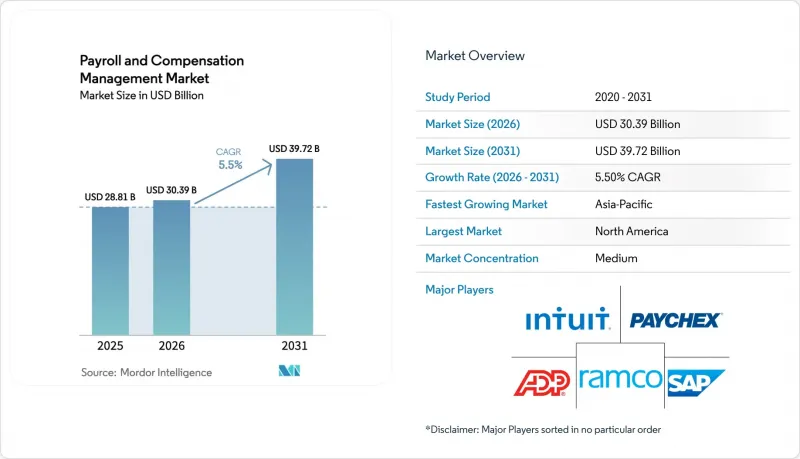
根據 Mordor Intelligence 預測,薪資和薪資管理市場規模將從 2025 年的 288.1 億美元成長到 2026 年的 303.9 億美元,然後在 2031 年達到 397.2 億美元,2026 年至 2031 年的複合年成長率為 5.5%。
本報告按類型(軟體和服務)、應用(薪資核算、員工福利、稅務申報、績效評估、考勤管理、休假管理等)、部署方式(本地部署和雲端託管)、最終用戶行業(銀行、金融服務和保險、零售、製造、運輸和物流等)以及地區進行細分。市場預測以美元計價。
全球薪資管理市場趨勢與洞察
雲端全球薪資核算平台的普及應用日益廣泛
到2024年,雲端解決方案已佔交易總量的71.36%,這表明大多數企業現在更傾向於基於訂閱的續訂,而非常規的本地升級。 Oracle的HCM雲在2024財政年度實現了23%的營收成長,與跨國企業將多個國家薪資核算系統整合到單一租戶平台的趨勢相符。 ADP的GlobalView為遍佈140個國家的400多萬名員工處理薪資,展現了雲端技術為複雜跨國環境中的雇主帶來的規模經濟效益。其自動化規則庫還能減輕人工負擔,並實現近乎即時的合規性,即使在新加坡或澳洲等地臨時宣布稅收政策變更的情況下也能如此。
嚴格的多邊稅收和勞工合規要求
諸如《一般資料保護規範》(GDPR) 和「數位化稅務申報」(Making Tax Digital) 等法律法規要求薪資核算系統必須採用「隱私權設計」編碼,同時即時向稅務機關傳輸報告資料。馬來西亞的《2024 年電子帳單法案》進一步加重了數位化負擔,使擁有專門的區域監管合規團隊的供應商更具優勢。在歐洲,ISO 27001 認證已成為買家的一項標準先決條件,因為違規可能導致高達全球銷售額 4% 的罰款。
法律報告格式因地區而異。
在歐盟,27個不同的薪資稅法各自適用,並要求以特定的電子格式申報。這迫使供應商並行維護多個合規模組,導致開發成本增加。澳洲的「薪資名冊)和其他國家特定的框架加劇了這種混亂局面,阻礙了通用整合申報中心的建立。
細分市場分析
預計到2025年,服務業將佔總收入的61.72%,這反映出管理服務的持久吸引力,因為企業必須應對不同的稅收政策、工會規則和外匯波動。儘管外包合約日趨成熟,但薪資服務市場仍維持著4.95%的成長率。相較之下,軟體產業的複合年成長率更高,達到6.32%,這主要得益於人工智慧引擎實現的自動化檢驗以及人工干預的減少。這種構成比表明,許多公司正在逐步從完全外包轉向技術主導的自助服務,但並未完全放棄專業諮詢服務。 ADP和Paychex等供應商正在透過將基於訂閱的分析升級和按需合規指導打包在一起,模糊產品和服務之間的傳統界限。
此外,該軟體的普及度也得益於其彈性價格設定,這對先前無法使用企業級功能的中型企業極具吸引力。其API優先架構支援與考勤、績效和財務管理模組的快速整合,幫助薪資核算團隊制定一體化的支付策略。 Paychex報告稱,其2024會計年度的SaaS收入成長了7%,凸顯了市場向配置主導平台的轉變。一種混合營運模式正在興起,該模式在提供跨國套件許可的同時,在最複雜的司法管轄區保留了服務疊加層,從而進一步推動了薪資市場的發展勢頭。
到2025年,核心薪資核算功能將佔46.01%的市場佔有率,這意味著準確的淨薪資計算仍將是薪資管理市場的基礎。然而,績效評估工具的成長速度最快,複合年成長率達6.46%,這主要得益於需要即時評估數據的績效掛鉤薪酬系統。隨著人力資源經理將獎金與可衡量的行為掛鉤,這種轉變正在擴大綜合薪酬解決方案在薪資管理市場的佔有率。
隨著雇主利用全面的健康保險計劃和退休計劃來吸引頂尖人才,福利管理持續穩定成長。輪班制產業對考勤管理工具的需求日益成長,但目前的創新重點在於人工智慧臉部認證技術,以減少打卡詐欺。在監管環境不斷變化的情況下,稅務申報模組仍然至關重要,而預支薪資選項正在重塑薪水支付工作流程。供應商將這些曾經獨立的模組整合到單一帳簿中,從而提高了客戶留存率並提升了交叉銷售盈利。
區域分析
北美地區擁有複雜的聯邦和州稅收體係以及成熟的外包文化,預計到2025年將佔全球銷售額的35.82%,從而推動對平台的需求。美國雇主需繳納聯邦和州兩級的工資稅,因此必須選擇能夠自動更新不同司法管轄區的系統。由於強制性雙語工資單和國家退休金繳款等要求,加拿大企業越來越依賴專業供應商。墨西哥的出口型製造商正在將薪資核算與海關發票整合,這需要跨境工資核對功能。 ADP的規模尤其引人注目,其在2024會計年度從該地區累計了122億美元的收入。
亞太地區預計將成為該地區成長最快的地區,到2031年年複合成長率(CAGR)將達到6.20%。新加坡針對中小企業的「數位轉型」(Go Digital)補貼計畫為訂閱費用提供補貼,根據新加坡資訊通訊媒體發展局(IMDA)報告顯示,該計畫已將微企業的數位化採用率提升至2025年中期的60%以上。在馬來西亞,2024年引進電子帳單正促使企業遷移到整合薪資核算和數位稅務帳簿的雲端套件。在印度,大型IT境外外包公司需要大量運算功能,以便將波動的專案獎金與客戶帳單週期相匹配,從而推動了對高度可自訂的毛利淨利運算引擎的需求。在中國,龐大的勞動力正在樹立規模化發展的標桿,一些國內供應商現在每月處理超過5000萬份薪資單。在日本,勞動力老化正在推動自動化,以彌補人力資源部門的人員短缺。同時,在澳大利亞,重點正從基礎設施現代化轉向增加分析能力。
在歐洲,合規性是關注的重點,業務也持續穩定成長。 GDPR 使得隱私審計報告能夠整合到所有薪資處理流程中,並促進了持續監控模組的採用。英國脫歐後,報告要求的碎片化增加了英吉利海峽對岸企業的複雜性。德國的工人委員會系統要求版本控制,以便精確記錄薪資規則的變更;法國的社保扣款則需要對未繳款項進行全面的重新計算。南美、中東和非洲仍在發展中,但前景廣闊。巴西 eSocial 要求的更新正在推動在當地採購的跨國公司向雲端遷移;阿拉伯聯合大公國作為樞紐城市,正在推動對三語和多幣種處理引擎的需求,以滿足外籍員工的需求。
其他好處:
- Excel格式的市場預測(ME)表
- 3個月的分析師支持
目錄
第1章:引言
- 研究假設和市場定義
- 調查範圍
第2章:調查方法
第3章執行摘要
第4章 市場狀況
- 市場概覽
- 市場促進因素
- 擴展基於雲端的全球薪資核算平台
- 多個國家/地區有嚴格的稅收和勞動合規要求
- 跨國遠距辦公的擴張與「名義雇主(EoR)」模式的推廣
- 中小企業的數位化計畫和政府關於電子帳單的強制性規定。
- 人工智慧驅動的自主薪資核算,可減少錯誤並進行即時審計。
- 工資預支系統的整合正在推動薪資核算的現代化。
- 市場限制因素
- 法律報告表格因地區而異。
- 公司內部長期勞動力短缺
- 網路安全漏洞導致高度敏感的薪資資料洩露,成本增加
- 傳統ERP系統鎖定正在延緩雲端遷移。
- 產業生態系分析
- 監理情勢
- 技術展望
- 宏觀經濟因素的影響
- 波特五力分析
- 投資分析
第5章 市場規模與成長預測
- 按類型
- 軟體
- 服務
- 透過使用
- 薪資核算
- 員工福利
- 報稅表
- 績效考核
- 考勤管理
- 假期管理
- 還款和貸款
- 不同的發展
- 本地部署
- 雲端託管部署
- 按最終用戶行業分類
- BFSI
- 零售
- 製造業
- 運輸/物流
- IT/通訊
- 衛生保健
- 其他終端用戶產業
- 按地區
- 北美洲
- 美國
- 加拿大
- 墨西哥
- 南美洲
- 巴西
- 阿根廷
- 其他南美國家
- 歐洲
- 德國
- 英國
- 法國
- 義大利
- 西班牙
- 俄羅斯
- 其他歐洲國家
- 亞太地區
- 中國
- 日本
- 印度
- 韓國
- 澳洲
- 其他亞太國家
- 中東
- 沙烏地阿拉伯
- 阿拉伯聯合大公國
- 土耳其
- 其他中東國家
- 非洲
- 南非
- 奈及利亞
- 埃及
- 其他非洲國家
- 北美洲
第6章 競爭情勢
- 市場集中度
- 策略趨勢
- 市佔率分析
- 公司簡介
- Automatic Data Processing, Inc.(ADP)
- Paychex, Inc.
- SAP SE
- Intuit Inc.
- Paycom Software, Inc.
- Paylocity Holding Corporation
- The Ultimate Kronos Group(UKG Inc.)
- Oracle Corporation
- Ceridian HCM Holding Inc.
- Workday, Inc.
- Rippling Technologies, Inc.
- Gusto, Inc.
- BambooHR LLC
- Deel, Inc.
- Alight Solutions LLC
- TriNet Group, Inc.
- TMF Group BV
- Ramco Systems Limited
- Patriot Software Company
- Zoho Corporation Pvt. Ltd.
第7章 市場機會與未來展望
According to Mordor Intelligence, the payroll and Compensation Management market size is expected to grow from USD 28.81 billion in 2025 to USD 30.39 billion in 2026 and is forecast to reach USD 39.72 billion by 2031 at 5.5% CAGR over 2026-2031.
This report is Segmented by Type (Software, and Services), Application (Payroll, Employee Benefits, Tax Filings, Performance Review, Time and Attendance, Leave Management, and More), Deployment (On-Premises, and Cloud Hosted), End-User Industry (BFSI, Retail, Manufacturing, Transportation and Logistics, and More), and Geography. The Market Forecasts are Provided in Terms of Value (USD).
Global Payroll And Compensation Management Market Trends and Insights
Growing Adoption of Cloud-Hosted Global Payroll Platforms
Cloud solutions already process 71.36% of 2024 transactions, showing that most organizations now value subscription updates over periodic on-premises upgrades. Oracle's HCM Cloud posted 23% revenue growth during fiscal 2024 in step with multinationals collapsing multiple domestic payroll engines into a single tenant platform. ADP's GlobalView processes salaries for more than 4 million workers across 140 countries, proving the scale efficiencies cloud affords to complex multi-jurisdiction employers. Automated rule libraries also limit human effort when Singapore or Australia release last-minute tax amendments, enabling near-real-time compliance
Stringent Multi-Country Tax and Labor Compliance Requirements
GDPR, Making Tax Digital, and similar laws force payroll engines to embed privacy-by-design coding while providing real-time submission feeds to revenue agencies. Malaysia's 2024 e-invoicing law broadens the digital burden, rewarding vendors that field dedicated regional regulatory teams. ISO 27001 certification has become a standard buyer prerequisite because compliance lapses can trigger fines of up to 4% of global revenue in Europe.
Fragmented Regional Statutory Reporting Formats
The European Union manages 27 distinct payroll tax codes that must be filed in unique electronic layouts, compelling vendors to maintain parallel compliance modules and pushing development costs higher. Australia's Single Touch Payroll and other unilateral frameworks add to the patchwork, hindering the creation of a universally consolidated reporting hub.
Other drivers and restraints analyzed in the detailed report include:
- Expansion of Cross-Border Remote Work and Employer-of-Record Models
- AI-Enabled Autonomous Payroll for Error Reduction and Real-Time Audits
- Rising Cyber-Security Breach Costs for Sensitive Pay Data
For complete list of drivers and restraints, kindly check the Table Of Contents.
Segment Analysis
Services retained 61.72% of 2025 revenue, reflecting the enduring appeal of managed offerings when enterprises must reconcile divergent tax schedules, union rules and currency fluctuations. The Payroll Management market size for services still grows at 4.95% despite the maturity of outsourcing deals. In contrast, software posts a faster 6.32% CAGR as AI engines automate validations and shrinks manual interventions. The mix signals that many firms progressively shift from full-outsourcing to technology-led self-service without abandoning expert advisory altogether. Providers including ADP and Paychex now bundle subscription analytics upgrades and on-demand compliance coaching, blurring the historical boundaries between product and service.
Software uptake also benefits from flexible per-employee pricing that appeals to mid-market adopters once locked out of enterprise-grade capabilities. API-first architectures support rapid links to time-tracking, performance and treasury modules, helping payroll teams craft integrated payment strategies. Paychex reported 7% SaaS revenue growth in fiscal 2024, echoing the market's tilt toward configuration-driven platforms. Hybrid operating models are emerging in which organizations license multi-country suites yet retain a services overlay in the most complex jurisdictions, extending the Payroll Management market momentum.
Core salary calculation accounted for a 46.01% share in 2025, illustrating that accurate net-pay remains the anchor of the Payroll Management market. However, performance review tools are scaling fastest at a 6.46% CAGR, fueled by merit-based pay schemes that demand instantaneous appraisal data. This shift extends the Payroll Management market share of holistic compensation suites as HR leaders align bonuses to measured behaviors.
Benefits administration continues to grow consistently as employers leverage richer medical plans and retirement perks to woo scarce talent. Time and attendance tools capture demand from shift-based industries, but innovation now resides in AI facial recognition that lowers clock-in fraud. Tax filing modules remain indispensable under persistent legislative change, while earned-wage access options reshape reimbursement workflows. Vendors that fuse these once-separate modules on a single ledger achieve stickier client contracts and stronger cross-sell economics.
Complete Report Scope:
- By Type
- Software
- Services
- By Application
- Payroll
- Employee Benefits
- Tax Filings
- Performance Review
- Time and Attendance
- Leave Management
- Reimbursement and Loans
- By Deployment
- On-Premises Deployment
- Cloud Hosted Deployment
- By End-User Industry
- BFSI
- Retail
- Manufacturing
- Transportation and Logistics
- IT and Telecom
- Healthcare
- Other End-User Industries
- By Geography
- North America
- United States
- Canada
- Mexico
- South America
- Brazil
- Argentina
- Rest of South America
- Europe
- Germany
- United Kingdom
- France
- Italy
- Spain
- Russia
- Rest of Europe
- Asia Pacific
- China
- Japan
- India
- South Korea
- Australia
- Rest of Asia Pacific
- Middle East
- Saudi Arabia
- United Arab Emirates
- Turkey
- Rest of Middle East
- Africa
- South Africa
- Nigeria
- Egypt
- Rest of Africa
- North America
Geography Analysis
North America represented 35.82% of global 2025 revenue as intricate federal-state taxation and mature outsourcing cultures bolster platform demand. United States employers face payroll tax at both national and state levels, compelling them to select engines capable of automatic jurisdiction updates. Canadian firms add bilingual payslip mandates and provincial pension contributions that spur reliance on specialized vendors. Mexico's export-oriented manufacturers link payroll with customs invoicing, requiring cross-border wage reconciliation abilities. ADP generated USD 12.2 billion from the region in fiscal 2024, highlighting its commercial scale.
Asia Pacific posts the swiftest regional CAGR at 6.20% through 2031. Singapore's SMEs Go Digital vouchers reimburse subscription fees and helped lift micro-business adoption rates above 60% by mid-2025 IMDA. Malaysia's 2024 e-invoicing rollout pushes companies onto cloud suites that integrate payroll with digital tax ledgers. In India, IT offshoring majors require batch calculations that align variable project bonuses with client billing cycles, spurring demand for highly configurable gross-to-net engines. China's sheer worker base enforces scale benchmarks, with some domestic vendors now processing in excess of 50 million payslips each month. Japan's aging labor pool prompts automation to offset HR headcount shortages, while Australia pivots toward analytics overlays rather than base modernization.
Europe maintains stable, compliance-centric growth. GDPR embeds privacy audit reporting into every payslip sequence, encouraging continuous monitoring modules. Fragmented post-Brexit filing divergence raises complexity for firms straddling the English Channel. Germany's works-council environment necessitates versioning that logs each pay-rule change, and France's social-security deductions demand extensive arrears recalculation functions. South America and the Middle East and Africa remain nascent yet promising. Brazil's updated eSocial requirements have driven cloud conversions among multinationals sourcing labor locally, and the UAE's hub status fuels demand for tri-lingual, multi-currency processing engines to serve expatriate populations.
- Automatic Data Processing, Inc. (ADP)
- Paychex, Inc.
- SAP SE
- Intuit Inc.
- Paycom Software, Inc.
- Paylocity Holding Corporation
- The Ultimate Kronos Group (UKG Inc.)
- Oracle Corporation
- Ceridian HCM Holding Inc.
- Workday, Inc.
- Rippling Technologies, Inc.
- Gusto, Inc.
- BambooHR LLC
- Deel, Inc.
- Alight Solutions LLC
- TriNet Group, Inc.
- TMF Group B.V.
- Ramco Systems Limited
- Patriot Software Company
- Zoho Corporation Pvt. Ltd.
Additional Benefits:
- The market estimate (ME) sheet in Excel format
- 3 months of analyst support
TABLE OF CONTENTS
1 INTRODUCTION
- 1.1 Study Assumptions and Market Definition
- 1.2 Scope of the Study
2 RESEARCH METHODOLOGY
3 EXECUTIVE SUMMARY
4 MARKET LANDSCAPE
- 4.1 Market Overview
- 4.2 Market Drivers
- 4.2.1 Growing Adoption of Cloud-Hosted Global Payroll Platforms
- 4.2.2 Stringent Multi-Country Tax and Labor Compliance Requirements
- 4.2.3 Expansion of Cross-Border Remote Work and "Employer-of-Record" Models
- 4.2.4 SME Digitization Programs and Government e-Invoicing Mandates
- 4.2.5 AI-Enabled Autonomous Payroll for Error Reduction and Real-Time Audits
- 4.2.6 Earned-Wage Access Integration Driving Payroll Modernization
- 4.3 Market Restraints
- 4.3.1 Fragmented Regional Statutory Reporting Formats
- 4.3.2 Persistent Payroll Talent Shortage Inside Enterprises
- 4.3.3 Rising Cyber-Security Breach Costs for Sensitive Pay Data
- 4.3.4 Legacy ERP Lock-In Slowing Cloud Migration
- 4.4 Industry Ecosystem Analysis
- 4.5 Regulatory Landscape
- 4.6 Technological Outlook
- 4.7 Impact of Macroeconomic Factors
- 4.8 Porter's Five Forces Analysis
- 4.8.1 Threat of New Entrants
- 4.8.2 Bargaining Power of Buyers
- 4.8.3 Bargaining Power of Suppliers
- 4.8.4 Threat of Substitute Products
- 4.8.5 Intensity of Competitive Rivalry
- 4.9 Investment Analysis
5 MARKET SIZE AND GROWTH FORECASTS (VALUE)
- 5.1 By Type
- 5.1.1 Software
- 5.1.2 Services
- 5.2 By Application
- 5.2.1 Payroll
- 5.2.2 Employee Benefits
- 5.2.3 Tax Filings
- 5.2.4 Performance Review
- 5.2.5 Time and Attendance
- 5.2.6 Leave Management
- 5.2.7 Reimbursement and Loans
- 5.3 By Deployment
- 5.3.1 On-Premises Deployment
- 5.3.2 Cloud Hosted Deployment
- 5.4 By End-User Industry
- 5.4.1 BFSI
- 5.4.2 Retail
- 5.4.3 Manufacturing
- 5.4.4 Transportation and Logistics
- 5.4.5 IT and Telecom
- 5.4.6 Healthcare
- 5.4.7 Other End-User Industries
- 5.5 By Geography
- 5.5.1 North America
- 5.5.1.1 United States
- 5.5.1.2 Canada
- 5.5.1.3 Mexico
- 5.5.2 South America
- 5.5.2.1 Brazil
- 5.5.2.2 Argentina
- 5.5.2.3 Rest of South America
- 5.5.3 Europe
- 5.5.3.1 Germany
- 5.5.3.2 United Kingdom
- 5.5.3.3 France
- 5.5.3.4 Italy
- 5.5.3.5 Spain
- 5.5.3.6 Russia
- 5.5.3.7 Rest of Europe
- 5.5.4 Asia Pacific
- 5.5.4.1 China
- 5.5.4.2 Japan
- 5.5.4.3 India
- 5.5.4.4 South Korea
- 5.5.4.5 Australia
- 5.5.4.6 Rest of Asia Pacific
- 5.5.5 Middle East
- 5.5.5.1 Saudi Arabia
- 5.5.5.2 United Arab Emirates
- 5.5.5.3 Turkey
- 5.5.5.4 Rest of Middle East
- 5.5.6 Africa
- 5.5.6.1 South Africa
- 5.5.6.2 Nigeria
- 5.5.6.3 Egypt
- 5.5.6.4 Rest of Africa
- 5.5.1 North America
6 COMPETITIVE LANDSCAPE
- 6.1 Market Concentration
- 6.2 Strategic Moves
- 6.3 Market Share Analysis
- 6.4 Company Profiles (includes Global level Overview, Market level overview, Core Segments, Financials as available, Strategic Information, Market Rank/Share for key companies, Products and Services, and Recent Developments)
- 6.4.1 Automatic Data Processing, Inc. (ADP)
- 6.4.2 Paychex, Inc.
- 6.4.3 SAP SE
- 6.4.4 Intuit Inc.
- 6.4.5 Paycom Software, Inc.
- 6.4.6 Paylocity Holding Corporation
- 6.4.7 The Ultimate Kronos Group (UKG Inc.)
- 6.4.8 Oracle Corporation
- 6.4.9 Ceridian HCM Holding Inc.
- 6.4.10 Workday, Inc.
- 6.4.11 Rippling Technologies, Inc.
- 6.4.12 Gusto, Inc.
- 6.4.13 BambooHR LLC
- 6.4.14 Deel, Inc.
- 6.4.15 Alight Solutions LLC
- 6.4.16 TriNet Group, Inc.
- 6.4.17 TMF Group B.V.
- 6.4.18 Ramco Systems Limited
- 6.4.19 Patriot Software Company
- 6.4.20 Zoho Corporation Pvt. Ltd.
7 MARKET OPPORTUNITIES AND FUTURE OUTLOOK
- 7.1 White-Space and Unmet-Need Assessment

 ESG與人力資本資訊揭露平台:市場佔有率分析、產業趨勢與統計、成長預測(2026-2031年)
 人力資本管理市場:按組件、授權模式、組織規模、部署和產業分類-2026-2032年全球市場預測AI原生HCM平台:市場佔有率分析、產業趨勢與統計及成長預測(2026-2031年)可組合式 HCM 平台:市場佔有率分析、產業趨勢與統計資料、成長預測(2026-2031 年)科技業薪酬管理:市場佔有率分析、產業趨勢與統計及成長預測(2026-2031)銀行、金融服務和保險 (BFSI) 行業的薪酬管理:市場佔有率分析、行業趨勢與統計數據、成長預測 (2026-2031)人力資本管理(HCM)企業資源規劃:市場佔有率分析、產業趨勢與統計資料、成長預測(2026-2031)
 薪資和薪酬管理平台市場預測至2034年-按薪資處理階段、薪酬類型、平台功能、部署模式和最終用戶分類的全球分析雲端HCM平台:市場佔有率分析、產業趨勢與統計、成長預測(2026-2031年)
 人力資本管理市場規模、佔有率和成長分析:按交付類型、部署類型、最終用戶產業、組織規模和地區分類-2026-2033年產業預測