


 |
市場調查報告書
商品編碼
2125404
北美線上約會服務:市場佔有率分析、產業趨勢與統計及成長預測(2026-2031 年)North America Online Dating Services - Market Share Analysis, Industry Trends & Statistics, Growth Forecasts (2026 - 2031) |
||||||

※ 本網頁內容可能與最新版本有所差異。詳細情況請與我們聯繫。
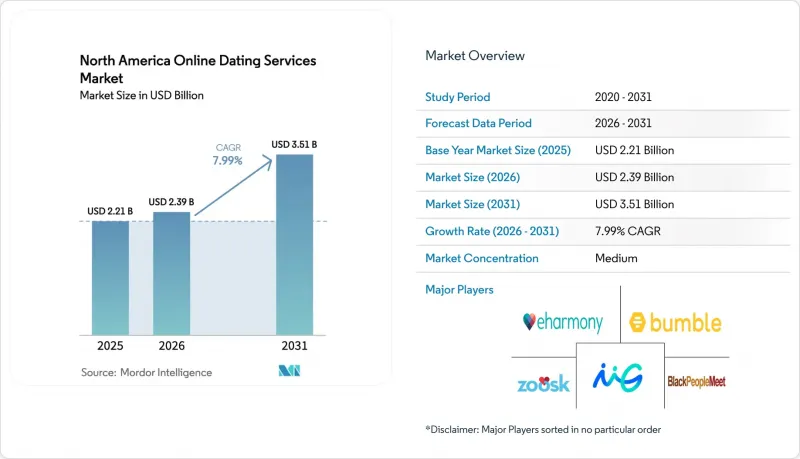
根據 Mordor Intelligence 估計,北美線上約會服務市場在 2026 年的價值將達到 23.9 億美元,高於 2025 年的 22.1 億美元,預計到 2031 年將達到 35.1 億美元。
預計 2026 年至 2031 年的複合年成長率為 7.99%。
本報告按服務類型(免費線上交友、付費線上交友)、收入模式(訂閱、免費增值、廣告收入、單項微交易)、設備類型(行動應用程式、桌面/網頁平台)、年齡層(18-30歲、30-40歲、40歲以上)和國家/地區進行細分。市場預測以美元計價。
北美線上約會服務市場的趨勢和洞察
針對北美文化差異而客製化的AI驅動匹配演算法的應用正在迅速增加。
目前,各平台都在部署深度學習引擎,這些引擎超越了簡單的使用者畫像篩選,融入了對話語境、通用價值觀以及特定地區的溝通線索。 eHarmony 和 OkCupid 採用協同過濾模型,已被證明能有效提升北美地區的長期配對成功率。 Match Group 正在試點一項「AI僚機」功能,該功能可以即時產生初始訊息,降低首次聯繫的門檻,並提高訂閱轉換率。這些工具解決了用戶在眾多選擇中難以抉擇的問題,提升了平台的感知價值,鼓勵用戶升級以利用高階演算法獲取更深入的洞察。因此,即使使用者成長趨於平緩,經常性收入仍呈現可觀的成長。
在美國的 Z 世代中,越來越能接受專注於特定信仰或種族群體的利基平台。
對具有文化親和性的社區的需求正在重塑用戶獲取策略。經營 ChristianMingle 和 JDate 的 Spark Networks 公司,儘管短期收入有所下降,但仍將行銷預算轉向微型網紅和校園活動,以吸引 Z 世代用戶。以社群為中心的平台具有許多優勢,例如更高的用戶忠誠度和更長的單次會話時長,這反過來又增加了提升銷售專屬功能的可能性。這一趨勢標誌著應用的發展方向正在從追求規模的大眾市場應用轉向服務特定身分群體的深度生態系統。
加強對資料本地化和跨境資料傳輸的監管。
在加拿大,除非獲得明確書面同意,否則公司目前必須將個人資料保留在省界內,這增加了基礎設施成本並使資料科學工作流程複雜化。美國聯邦貿易委員會 (FTC) 於 2025 年 5 月推出的「垃圾費用」規則強制要求預先揭露訂閱總費用,這限制了隱性提升銷售策略,並增加了客戶流失風險。合規成本正在佔用原本可用於功能創新的資源,並在調整期間內給利潤率帶來壓力。
細分市場分析
免費套餐仍然是大眾普及的入門途徑,但付費套餐能帶來更高的單位盈利。到2025年,北美線上約會服務市場62.10%的交易量將來自免費用戶。由於利用人工智慧驅動的推薦、已讀回執和匹配度分析等轉換引擎,Grindr付費用戶的平均每用戶收入(ARPU)已升至20.05美元。因此,付費用戶群預計將以10.35%的複合年成長率成長,超過整體市場成長率。
每個平台都將廣告收入支援的免費存取與精心設計的付費功能(例如個人資料上的「超級喜歡」和高級搜尋篩選器)相結合,引導高意向用戶選擇定期收費計劃。訂閱服務的深度,加上身份驗證和反詐騙功能,提高了用戶留存率並降低了監管合規風險。因此,預計到2031年,北美線上約會服務市場的付費用戶規模將穩定成長。
由於透明度法規限制了隱藏的付費升級,訂閱市佔率已穩定在 53.60%。為了應對這一局面,企業正將重心放在 1 美元至 5 美元價位的單次購買銷售上,使用戶能夠體驗特定的增值提案。預計這一微交易領域將以每年 12.35% 的速度成長,成為北美線上約會服務市場中成長最快的細分領域。
精細化定價符合更廣泛的數位經濟中不斷變化的消費者行為,用戶往往更傾向於只為他們認為立即有用的功能付費。對經營團隊而言,微交易提供了一個豐富的分析資料環境,有助於完善功能組合併最佳化產品與市場的契合度。這有助於在不增加訂閱總成本的情況下提高用戶留存率。
其他好處:
- Excel格式的市場預測(ME)表
- 3個月的分析師支持
目錄
第1章:引言
- 研究假設和市場定義
- 調查範圍
第2章:調查方法
第3章執行摘要
第4章 市場狀況
- 市場概覽
- 市場促進因素
- 針對北美文化差異而客製化的AI驅動匹配演算法的應用正在迅速增加。
- 在美國的 Z 世代中,越來越能接受專注於特定信仰或種族群體的利基平台。
- 隨著加拿大民眾對詐騙的認知不斷提高,透過高級安全功能實現獲利的潛力也隨之而來。
- 短影片和發送類型配對服務的融合正在提升用戶參與度。
- LGBTQ+ 群體的日益壯大正在加速都市區平台的擴張。
- 市場限制因素
- 加強對資料本地化和跨境資料傳輸的監管。
- 滑動式介面造成的使用者疲勞正在降低每位顧客的終身價值。
- 由於社交媒體(例如 Facebook Dating)中整合了匹配功能,競爭加劇。
- 數位廣告管道獲客成本的不斷上漲給小規模應用程式帶來了壓力。
- 價值鏈分析
- 監理展望
- 波特五力分析
- 投資分析
- 市場宏觀經濟趨勢的評估
- 主要用例和案例研究
第5章 市場規模與成長預測
- 按服務類型
- 免費線上約會
- 付費線上約會
- 按收入模式
- 訂閱制
- 免費增值
- 基於廣告
- 單項微交易
- 依設備類型
- 行動應用
- 桌面/Web平台
- 按年齡層
- 18-30歲
- 30-40歲
- 40歲以上
- 國家
- 美國
- 加拿大
- 墨西哥
第6章 競爭情勢
- 市場集中度
- 策略性舉措與資金籌措趨勢
- 市佔率分析
- 公司簡介
- Match Group, Inc.
- Zoosk, Inc.
- Badoo
- BlackPeopleMeet.com, Inc.
- Bumble Inc.
- The Meet Group, Inc.
- Coffee Meets Bagel, Inc.
- The League App, Inc.
- HER(Dattch Ltd.)
- Taimi Inc.
- Grindr LLC
- eHarmony, Inc.
- Hily Corp.
- Raya App, Inc.
- PlentyOfFish Media ULC
- OkCupid LLC
- Spark Networks SE
- OurTime.com
- SilverSingles
- ChristianMingle(Spark)
- Ashley Madison(Ruby Corp.)
第7章 市場機會與未來展望
According to Mordor Intelligence, North America online dating services market size in 2026 is estimated at USD 2.39 billion, growing from 2025 value of USD 2.21 billion with 2031 projections showing USD 3.51 billion, growing at 7.99% CAGR over 2026-2031.
This report is Segmented by Service Type (Non-Paying Online Dating, Paying Online Dating), Revenue Model (Subscription-Based, Freemium, Advertising-Based, A-La-Carte Micro-Transactions), Device Type (Mobile Applications, Desktop / Web Platforms), Demographic Age Group (18-30 Years, 30-40 Years, More Than 40 Years) and Country. The Market Forecasts are Provided in Terms of Value (USD).
North America Online Dating Services Market Trends and Insights
Surging Adoption of AI-Driven Matchmaking Algorithms Tailored to North American Cultural Nuances
Platforms now deploy deep-learning engines that move beyond simple demographic filters to incorporate conversational context, shared values, and region-specific communication cues. eHarmony and OkCupid apply collaborative-filtering models proven to raise long-term match success rates in North America. Match Group is piloting "AI wingmen" that draft opening messages in real time, reducing first-contact friction and boosting subscription conversions. These tools address choice overload and improve perceived value, encouraging users to upgrade for premium algorithmic insights. The result is a measurable uplift in recurring revenue even as overall user growth normalizes.
Rising Acceptance of Niche Faith- & Ethnicity-Focused Platforms among U.S. Gen Z
Demand for culturally aligned communities is reshaping acquisition strategies. Spark Networks, owner of ChristianMingle and JDate, has redirected marketing budgets toward micro-influencers and on-campus events to attract Gen Z users despite short-term revenue contraction. Community-specific platforms gain loyalty advantages and higher engagement time per session, which translate into stronger upsell potential for exclusive features. The trend signals a shift from scale-seeking mass apps to depth-oriented ecosystems serving distinct identity groups.
Intensifying Regulatory Scrutiny around Data Localization & Cross-Border Transfers
Canada now requires personal data to stay within provincial borders unless explicit consent is documented, adding infrastructure costs and complicating data-science workflows. The U.S. Federal Trade Commission's May 2025 "junk-fee" rule demands up-front disclosure of total subscription pricing, constraining stealth upsell tactics and raising churn risk. Compliance spending diverts resources from feature innovation, pressuring margins during the adjustment window.
Other drivers and restraints analyzed in the detailed report include:
- Monetization Upside from Premium Safety Features amid Rising Scam Awareness in Canada
- Integration of Short-Form Video & Livestream Dating Driving User Engagement
- User Fatigue from Swipe-Based Interfaces Reducing Lifetime Value per Customer
For complete list of drivers and restraints, kindly check the Table Of Contents.
Segment Analysis
Non-paying formats remain the on-ramp for mass adoption, yet premium tiers capture superior unit economics. In 2025, non-paying users generated 62.10% of transaction volume across the North America online dating services market. Conversion engines leveraging AI-curated boosts, read receipts, and compatibility analytics lifted paying user ARPU to USD 20.05 at Grindr. The paying category is therefore forecast to grow at a 10.35% CAGR, outpacing overall market momentum.
Platforms blend ad-supported free access with strategically placed paywalls-such as profile super-likes or advanced search filters-to shift high-intent users into recurring plans. Subscription stack depth, bundled with identity verification and fraud protections, enhances stickiness and reduces regulatory compliance risk. Consequently, the North America online dating services market size for paying users is expected to climb steadily through 2031.
Subscription dominance is plateauing at 53.60% market contribution as transparency regulation limits hidden premium upgrades. In response, operators emphasize a-la-carte offerings priced between USD 1 and USD 5, allowing users to test specific value propositions. This micro-transaction segment is projected to expand 12.35% annually, making it the fastest-growing component of the North America online dating services market.
Granular pricing aligns with shifting consumer behavior in the broader digital economy, where users favor paying only for features they perceive as immediately useful. For management teams, micro-transactions provide an analytics-rich environment to refine feature portfolios and optimize product-market fit, thereby lifting retention without inflating headline subscription costs.
Complete Report Scope:
- By Service Type
- Non-Paying Online Dating
- Paying Online Dating
- By Revenue Model
- Subscription-Based
- Freemium
- Advertising-Based
- A-la-Carte Micro-Transactions
- By Device Type
- Mobile Applications
- Desktop / Web Platforms
- By Demographic Age Group
- 18-30 Years
- 30-40 Years
- More than 40 Years
- By Country
- United States
- Canada
- Mexico
List of Companies Covered in this Report:
- Match Group, Inc.
- Zoosk, Inc.
- Badoo
- BlackPeopleMeet.com, Inc.
- Bumble Inc.
- The Meet Group, Inc.
- Coffee Meets Bagel, Inc.
- The League App, Inc.
- HER (Dattch Ltd.)
- Taimi Inc.
- Grindr LLC
- eHarmony, Inc.
- Hily Corp.
- Raya App, Inc.
- PlentyOfFish Media ULC
- OkCupid LLC
- Spark Networks SE
- OurTime.com
- SilverSingles
- ChristianMingle (Spark)
- Ashley Madison (Ruby Corp.)
Additional Benefits:
- The market estimate (ME) sheet in Excel format
- 3 months of analyst support
TABLE OF CONTENTS
1 INTRODUCTION
- 1.1 Study Assumptions and Market Definition
- 1.2 Scope of the Study
2 RESEARCH METHODOLOGY
3 EXECUTIVE SUMMARY
4 MARKET LANDSCAPE
- 4.1 Market Overview
- 4.2 Market Drivers
- 4.2.1 Surging Adoption of AI-driven Matchmaking Algorithms Tailored to North American Cultural Nuances
- 4.2.2 Rising Acceptance of Niche Faith- & Ethnicity-Focused Platforms among U.S. Gen-Z
- 4.2.3 Monetization Upside from Premium Safety Features amid Rising Scam Awareness in Canada
- 4.2.4 Integration of Short-Form Video & Livestream Dating Driving User Engagement
- 4.2.5 Growing LGBTQ+ Community Visibility Accelerating Platform Expansion in Urban Corridors
- 4.3 Market Restraints
- 4.3.1 Intensifying Regulatory Scrutiny around Data Localization & Cross-Border Transfers
- 4.3.2 User Fatigue from Swipe-Based Interfaces Reducing Lifetime Value per Customer
- 4.3.3 Heightened Competition from Social-Media-Embedded Dating Features (e.g., Facebook Dating)
- 4.3.4 Rising Acquisition Costs on Digital Ad Channels Pressuring Smaller Apps
- 4.4 Value Chain Analysis
- 4.5 Regulatory Outlook
- 4.6 Porter's Five Forces Analysis
- 4.6.1 Bargaining Power of Suppliers
- 4.6.2 Bargaining Power of Consumers
- 4.6.3 Threat of New Entrants
- 4.6.4 Intensity of Competitive Rivalry
- 4.6.5 Threat of Substitutes
- 4.7 Investment Analysis
- 4.8 Assessment of Macro Economic Trends on the Market
- 4.9 Major Use-Cases & Case-Studies
5 MARKET SIZE AND GROWTH FORECASTS (VALUES)
- 5.1 By Service Type
- 5.1.1 Non-Paying Online Dating
- 5.1.2 Paying Online Dating
- 5.2 By Revenue Model
- 5.2.1 Subscription-Based
- 5.2.2 Freemium
- 5.2.3 Advertising-Based
- 5.2.4 A-la-Carte Micro-Transactions
- 5.3 By Device Type
- 5.3.1 Mobile Applications
- 5.3.2 Desktop / Web Platforms
- 5.4 By Demographic Age Group
- 5.4.1 18-30 Years
- 5.4.2 30-40 Years
- 5.4.3 More than 40 Years
- 5.5 By Country
- 5.5.1 United States
- 5.5.2 Canada
- 5.5.3 Mexico
6 COMPETITIVE LANDSCAPE
- 6.1 Market Concentration
- 6.2 Strategic Moves & Funding Activity
- 6.3 Market Share Analysis
- 6.4 Company Profiles (includes Global Level Overview, Market Level Overview, Core Segments, Financials as available, Strategic Information, Market Rank/Share for key companies, Products & Services, and Recent Developments)
- 6.4.1 Match Group, Inc.
- 6.4.2 Zoosk, Inc.
- 6.4.3 Badoo
- 6.4.4 BlackPeopleMeet.com, Inc.
- 6.4.5 Bumble Inc.
- 6.4.6 The Meet Group, Inc.
- 6.4.7 Coffee Meets Bagel, Inc.
- 6.4.8 The League App, Inc.
- 6.4.9 HER (Dattch Ltd.)
- 6.4.10 Taimi Inc.
- 6.4.11 Grindr LLC
- 6.4.12 eHarmony, Inc.
- 6.4.13 Hily Corp.
- 6.4.14 Raya App, Inc.
- 6.4.15 PlentyOfFish Media ULC
- 6.4.16 OkCupid LLC
- 6.4.17 Spark Networks SE
- 6.4.18 OurTime.com
- 6.4.19 SilverSingles
- 6.4.20 ChristianMingle (Spark)
- 6.4.21 Ashley Madison (Ruby Corp.)
7 MARKET OPPORTUNITIES AND FUTURE OUTLOOK
- 7.1 White-Space and Unmet-Need Assessment
- 7.2 Scenario Outlook: Metaverse Dating & Virtual Reality Integration

 歐洲線上約會服務:市場佔有率分析、產業趨勢與統計及成長預測(2026-2031 年)
 線上約會市場:2026-2032年全球市場預測(按平台、服務類型、收入模式、年齡層和最終用戶分類)線上約會服務市場:2026-2032年全球市場預測(按服務類型、平台類型、收入模式、使用者群體和應用程式分類)線上約會服務市場:按服務、配對技術、收費模式、婚姻狀況、年齡層和平台分類-2026-2032年全球市場預測
 2026-2030年全球線上約會服務市場線上配對服務:市場佔有率分析、產業趨勢與統計、成長預測(2026-2031)
 2026年全球線上約會與婚介市場報告
 線上約會應用程式市場分析及預測(至2035年):按類型、產品類型、服務、技術、組件、應用、設備、部署類型、最終用戶和解決方案分類線上約會服務市場分析及預測(至2035年):按類型、產品類型、服務、技術、組件、應用、設備、最終用戶分類
 全球線上約會應用市場規模、佔有率、趨勢和成長分析報告(2026-2034)