


 |
市場調查報告書
商品編碼
2116831
歐洲線上約會服務:市場佔有率分析、產業趨勢與統計及成長預測(2026-2031 年)Europe Online Dating Services - Market Share Analysis, Industry Trends & Statistics, Growth Forecasts (2026 - 2031) |
||||||

※ 本網頁內容可能與最新版本有所差異。詳細情況請與我們聯繫。
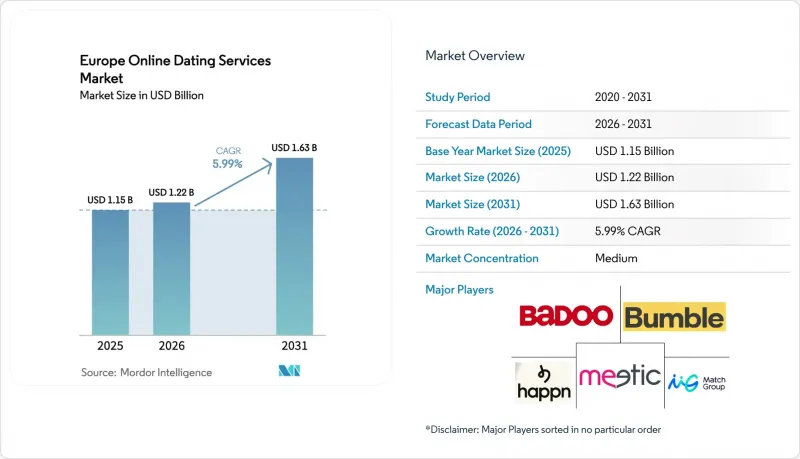
2025 年歐洲線上約會服務市場價值 11.5 億美元,預計到 2031 年將達到 16.3 億美元,而 2026 年為 12.2 億美元,預測期(2026-2031 年)複合年成長率為 5.99%。
本報告按類型(免費線上約會、付費線上約會)、裝置平台(行動應用程式等)、年齡層(18-24歲、25-34歲等)、關係目的(短期約會、長期關係等)、性取向(異性戀平台、LGBTQ+平台)和國家分類。市場預測以美元計價。
歐洲線上約會服務市場的趨勢和洞察
千禧世代和Z世代用戶對數位化優先互動方式的需求激增
千禧世代和Z世代將約會應用程式視為重要的社交工具,而不僅僅是錦上添花。根據歐盟統計局(Eurostat)的數據顯示,到2024年,16至29歲族群的網路使用率將達到97%,其中83%的人會積極使用社群網路。英國通訊管理局(Ofcom)的一項調查發現,截至2024年5月,英國18至24歲用戶中有18%的人使用約會服務,25至34歲用戶中有17%的人使用約會服務。 Hinge在2024年第三季的營收成長了36%,達到1.45億美元,這表明其強調「有目的的邂逅」的服務設計正在贏得這一群體的青睞。隨著平均結婚年齡的上升,德國、法國和英國的初婚平均年齡都超過30歲,這延長了約會服務的商業化週期。 HER 的用戶群已達 1500 萬,其中 60% 的用戶年齡在 18 至 24 歲之間,這凸顯了用戶群的不斷擴大以及年輕一代參與度的不斷加深。
人工智慧驅動的匹配演算法可提高用戶參與度。
人工智慧正處於產品差異化的前沿,驅動著匹配度預測、對話開場白和個人化使用者引導流程。 Match Group 的人工智慧「Matchmaker」提案用戶最佳化個人資料,而 Bumble 的聊天教練則提供關於對話語氣的即時建議。 Tinder 引入了基於人工智慧的生物識別進行身份驗證,到 2024 年,英國和其他市場已驗證用戶的匹配率提高了 67%。 Schrems 裁決限制了無限制的資料聚合,迫使平台轉向聯邦學習和設備內推理,以符合 GDPR 的框架。擁有足夠財力重新訓練模式的成熟公司比小規模的新興企業更具執行優勢。
人們越來越擔心資料隱私和安全漏洞
2024年,挪威對Grindr處以6,500萬挪威克朗(約643萬美元)的罰款,原因是其未經用戶同意共用地點和性取向數據。同年2月,義大利監管機構對Nirvam處以20萬歐元(約23.291萬美元)的罰款,因為其非法處理了100萬份用戶資料。 2024年10月,歐洲資料保護委員會發表聲明,指出「同意或付費」模式不符合GDPR的要求。魯汶大學的一項研究發現,2024年有15款熱門應用程式洩露了敏感數據,其中6款洩露了精確的位置資訊。這些事態發展迫使各平台轉向僅提供訂閱服務的獲利模式,或實施更嚴格的資料最小化措施。
細分市場分析
預計到2025年,付費服務將佔總收入的60.72%,複合年成長率(CAGR)為7.72%,主要得益於人工智慧配對、視訊通話以及訂閱捆綁的優先展示功能。在歐洲線上約會服務市場,預計到2031年,付費方案的市場規模成長速度將超過免費增值模式。 Tinder的付費用戶數量在Match平台維持在1,000萬,而Hinge的付費用戶數在2024年第三季成長了38%,達到190萬。 Bumble擁有400萬付費用戶,但其用戶總數下降了7%。經過價格調整,Tinder Platinum的月費現為32.99英鎊(約41美元)。
免費套餐目前佔據39.28%的市場佔有率,但它們正面臨日益嚴格的廣告監管。在歐洲線上約會市場,「同意還是收費」的爭論日益受到關注。如果監管機構禁止資料密集型廣告,免費方案將僅保留基本的滑動功能,迫使用戶轉向付費方案。目前,已有3-5%的免費用戶轉換為付費用戶,而這些用戶貢獻了平台高達90%的收入。
預計到2025年,行動應用將佔總營收的71.15%,年複合成長率(CAGR)為7.88%,這主要得益於5G普及率的提高以及推播通知帶來的用戶參與度的提升。歐洲線上約會服務市場依賴於行動端的定位搜尋、基於攝影機的影片內容以及應用程式內收費等優勢,這些優勢在桌面端是無法實現的。 Bumble公佈的行動端收入為2.21億美元,而網頁端收入則較為平淡。
桌面和網頁服務佔28.85%的市場佔有率,深受老年用戶的青睞,他們更喜歡使用大螢幕來完成冗長的問卷。響應式網頁設計和漸進式網頁應用程式(PWA)可協助以桌面端為主的品牌避免支付30%的應用程式商店費用。 《數位服務法案》下的監管平等化政策消除了先前純網頁端企業享有的合規優勢,確保了兩種平台都能保持競爭力。
其他好處:
- Excel格式的市場預測(ME)表
- 3個月的分析師支持
目錄
第1章:引言
- 研究假設和市場定義
- 調查範圍
第2章:調查方法
第3章執行摘要
第4章 市場狀況
- 市場概覽
- 市場促進因素
- 尋求以數位化為中心的互動方式的千禧世代和Z世代用戶數量正在迅速成長。
- 智慧型手機普及率不斷提高,行動資料方案價格也越來越實惠
- 歐洲社會對網路約會的接受度日益提高,並逐漸成為社會規範。
- 疫情後視訊約會和直播功能的融合
- 透過人工智慧驅動的匹配演算法提高用戶參與度
- 針對特定群體的利基約會應用程式正在提升其收入。
- 市場限制因素
- 人們越來越擔心資料隱私和安全漏洞
- 假帳號氾濫和「網路釣魚」事件頻傳
- 都市區市場的飽和導致用戶獲取成本飆升。
- 對匹配演算法中個人資料使用的監管
- 產業價值鏈分析
- 監理情勢
- 宏觀經濟因素的影響
- 技術展望
- 波特五力分析
第5章 市場規模與成長預測
- 按類型
- 免費線上約會
- 付費線上約會
- 按設備平台
- 行動應用
- 桌面和網路平台
- 按年齡層
- 18-24歲
- 25-34歲
- 35-44歲
- 45歲或以上
- 與關係相關的意圖
- 隨意約會
- 長期關係
- 基於小眾興趣的匹配
- 按性取向
- 異性戀平台
- LGBTQ+平台
- 國家
- 德國
- 英國
- 法國
- 西班牙
- 義大利
- 荷蘭
- 北歐國家(丹麥、瑞典、挪威、芬蘭)
- 其他歐洲國家
第6章 競爭情勢
- 市場集中度
- 策略趨勢
- 市佔率分析
- 公司簡介(全球概覽、市場概覽、業務細分、財務狀況、策略、市場排名/佔有率、產品與服務、近期發展)
- Match Group Inc.
- Bumble Inc.
- Badoo Ltd
- FTW and Co(happn)
- Meetic SA
- LOVOO GmbH and Co. KG
- Plentyoffish Media ULC
- Hinge Inc.
- eHarmony Inc.
- OkCupid LLC
- Grindr LLC
- Dattch Ltd(HER)
- Once Dating AG
- Parship GmbH
- EliteMedianet GmbH(ElitePartner)
- Zoosk Inc.
- Spark Networks SE
- The Meet Group Inc.
- Feeld Ltd
第7章 市場機會與未來展望
According to Mordor Intelligence, the Europe online dating services market size was valued at USD 1.15 billion in 2025 and estimated to grow from USD 1.22 billion in 2026 to reach USD 1.63 billion by 2031, at a CAGR of 5.99% during the forecast period (2026-2031).
This report is Segmented by Type (Non-Paying Online Dating, and Paying Online Dating), Device Platform (Mobile Applications, and More), Age Group (18-24 Years, 25-34 Years, and More), Relationship Intent (Casual Dating, Long-Term Relationship, and More), Sexual Orientation (Heterosexual Platforms, and LGBTQ+ Platforms), and Country. The Market Forecasts are Provided in Terms of Value (USD).
Europe Online Dating Services Market Trends and Insights
Surge in Millennial and Gen Z Users Seeking Digital-first Socialization
Millennial and Gen Z cohorts treat dating apps as primary social infrastructure rather than add-on experiences. Eurostat reported 97% daily internet usage among 16-29-year-olds in 2024, with 83% of them actively using social networks. Ofcom found that 18% of UK users aged 18-24 and 17% aged 25-34 visited dating services in May 2024. Hinge's 36% revenue jump to USD 145 million in Q3 2024 demonstrates how intentional-dating design resonates with this audience. Delayed marriage, average first-marriage age now above 30 in Germany, France, and the UK, extends monetization windows. HER reached 15 million users, 60% of whom fall in the 18-24 bracket, underscoring youth-driven volume and engagement depth.
AI-driven Matching Algorithms Enhancing User Engagement
Artificial intelligence has moved to the front end of product differentiation, guiding compatibility predictions, conversational nudges, and personalized onboarding flows. Match Group's AI "Matchmaker" suggests profile tweaks, while Bumble's chat coach offers real-time tone advice. Tinder's ID-verification rollout, which uses AI-based liveness checks, lifted matches 67% for verified users in the UK and other markets in 2024. The Schrems decision limits indefinite data aggregation, pressing platforms toward federated learning and on-device inference to stay within GDPR bounds. Incumbents with capital to retrain models enjoy an execution edge over smaller challengers.
Escalating Concerns over Data Privacy and Security Breaches
Norway upheld a NOK 65 million (USD 6.43 million) fine on Grindr in 2024 for sharing location and sexual-orientation data without consent. Italy's regulator fined Nirvam EUR 200,000 (USD 232910) in February 2024 for unlawful processing of 1 million profiles. The European Data Protection Board's October 2024 opinion declared "consent-or-pay" models incompatible with GDPR. A KU Leuven study found that 15 popular apps leaked sensitive data in 2024, six of them revealing precise location. These moves pressure platforms toward subscription-only revenue and stricter data minimization.
Other drivers and restraints analyzed in the detailed report include:
- Integration of Video Dating and Live Streaming Features Post Pandemic
- Niche Dating Apps Targeting Specific Communities Fuel Monetization
- Proliferation of Fake Profiles and Catfishing Incidents
For complete list of drivers and restraints, kindly check the Table Of Contents.
Segment Analysis
Paying services represented 60.72% of 2025 revenue and are forecast to grow at an 7.72% CAGR, buoyed by AI matching, video calls, and priority visibility bundled into subscriptions. The Europe online dating services market size attributable to paying tiers is set to outstrip freemium growth through 2031. Match retained 10 million paying Tinder users, while Hinge's paying base climbed 38% to 1.9 million in Q3 2024. Bumble counted 4 million paying users, although the total number slipped 7%. Price hikes saw Tinder Platinum reach GBP 32.99 (USD 41) per month.
Non-paying tiers held a 39.28% share but face tighter advertising rules. The Europe online dating services market is watching the consent-or-pay debate; should regulators outlaw data-heavy ads, free tiers will shrink to basic swipes, nudging users toward subscriptions. Already, 3-5% of free users convert to paid users, yet they generate up to 90% of the platform's revenue.
Mobile applications captured 71.15% of 2025 revenue and will post an 7.88% CAGR as 5G spreads and push-notification engagement deepens. The Europe online dating services market relies on mobile location discovery, camera-enabled content, and in-app billing, advantages desktop cannot match. Bumble reported USD 221 million mobile revenue versus modest web totals.
Desktop and web kept a 28.85% share, favored by older users who complete long questionnaires on larger screens. Responsive web design and progressive web apps help desktop-heavy brands avoid 30% app-store fees. Regulatory parity under the Digital Services Act removes historic compliance advantages for web-only operators, keeping both platforms in play.
Complete Report Scope:
- By Type
- Non-paying Online Dating
- Paying Online Dating
- By Device Platform
- Mobile Applications
- Desktop and Web Platforms
- By Age Group
- 18-24 Years
- 25-34 Years
- 35-44 Years
- 45 Years and Above
- By Relationship Intent
- Casual Dating
- Long-term Relationship
- Niche Interest Matchmaking
- By Sexual Orientation
- Heterosexual Platforms
- LGBTQ+ Platforms
- By Country
- Germany
- United Kingdom
- France
- Spain
- Italy
- Netherlands
- Nordics (Denmark, Sweden, Norway, Finland)
- Rest of Europe
List of Companies Covered in this Report:
- Match Group Inc.
- Bumble Inc.
- Badoo Ltd
- FTW and Co (happn)
- Meetic SA
- LOVOO GmbH and Co. KG
- Plentyoffish Media ULC
- Hinge Inc.
- eHarmony Inc.
- OkCupid LLC
- Grindr LLC
- Dattch Ltd (HER)
- Once Dating AG
- Parship GmbH
- EliteMedianet GmbH (ElitePartner)
- Zoosk Inc.
- Spark Networks SE
- The Meet Group Inc.
- Feeld Ltd
Additional Benefits:
- The market estimate (ME) sheet in Excel format
- 3 months of analyst support
TABLE OF CONTENTS
1 INTRODUCTION
- 1.1 Study Assumptions and Market Definition
- 1.2 Scope of the Study
2 RESEARCH METHODOLOGY
3 EXECUTIVE SUMMARY
4 MARKET LANDSCAPE
- 4.1 Market Overview
- 4.2 Market Drivers
- 4.2.1 Surge in Millennial and Gen Z Users Seeking Digital-first Socialization
- 4.2.2 Rising Smartphone Penetration and Affordable Mobile Data Plans
- 4.2.3 Increasing Acceptance of Online Dating as Social Norm in Europe
- 4.2.4 Integration of Video Dating and Live Streaming Features Post-Pandemic
- 4.2.5 AI-driven Matching Algorithms Enhancing User Engagement
- 4.2.6 Niche Dating Apps Targeting Specific Communities Fuel Monetization
- 4.3 Market Restraints
- 4.3.1 Escalating Concerns over Data Privacy and Security Breaches
- 4.3.2 Proliferation of Fake Profiles and Catfishing Incidents
- 4.3.3 Saturation of Urban Markets Leading to User Acquisition Costs Inflation
- 4.3.4 Regulatory Scrutiny on Use of Personal Data for Matchmaking Algorithms
- 4.4 Industry Value Chain Analysis
- 4.5 Regulatory Landscape
- 4.6 Impact of Macroeconomic Factors
- 4.7 Technological Outlook
- 4.8 Porter's Five Forces Analysis
- 4.8.1 Bargaining Power of Suppliers
- 4.8.2 Bargaining Power of Consumers
- 4.8.3 Threat of New Entrants
- 4.8.4 Intensity of Competitive Rivalry
- 4.8.5 Threat of Substitutes
5 MARKET SIZE AND GROWTH FORECASTS (VALUE)
- 5.1 By Type
- 5.1.1 Non-paying Online Dating
- 5.1.2 Paying Online Dating
- 5.2 By Device Platform
- 5.2.1 Mobile Applications
- 5.2.2 Desktop and Web Platforms
- 5.3 By Age Group
- 5.3.1 18-24 Years
- 5.3.2 25-34 Years
- 5.3.3 35-44 Years
- 5.3.4 45 Years and Above
- 5.4 By Relationship Intent
- 5.4.1 Casual Dating
- 5.4.2 Long-term Relationship
- 5.4.3 Niche Interest Matchmaking
- 5.5 By Sexual Orientation
- 5.5.1 Heterosexual Platforms
- 5.5.2 LGBTQ+ Platforms
- 5.6 By Country
- 5.6.1 Germany
- 5.6.2 United Kingdom
- 5.6.3 France
- 5.6.4 Spain
- 5.6.5 Italy
- 5.6.6 Netherlands
- 5.6.7 Nordics (Denmark, Sweden, Norway, Finland)
- 5.6.8 Rest of Europe
6 COMPETITIVE LANDSCAPE
- 6.1 Market Concentration
- 6.2 Strategic Moves
- 6.3 Market Share Analysis
- 6.4 Company Profiles (Global Overview, Market Overview, Segments, Financials, Strategy, Market Rank/Share, Products and Services, Recent Developments)
- 6.4.1 Match Group Inc.
- 6.4.2 Bumble Inc.
- 6.4.3 Badoo Ltd
- 6.4.4 FTW and Co (happn)
- 6.4.5 Meetic SA
- 6.4.6 LOVOO GmbH and Co. KG
- 6.4.7 Plentyoffish Media ULC
- 6.4.8 Hinge Inc.
- 6.4.9 eHarmony Inc.
- 6.4.10 OkCupid LLC
- 6.4.11 Grindr LLC
- 6.4.12 Dattch Ltd (HER)
- 6.4.13 Once Dating AG
- 6.4.14 Parship GmbH
- 6.4.15 EliteMedianet GmbH (ElitePartner)
- 6.4.16 Zoosk Inc.
- 6.4.17 Spark Networks SE
- 6.4.18 The Meet Group Inc.
- 6.4.19 Feeld Ltd
7 MARKET OPPORTUNITIES AND FUTURE OUTLOOK
- 7.1 White-space and Unmet-need Assessment

 北美線上約會服務:市場佔有率分析、產業趨勢與統計及成長預測(2026-2031 年)
 線上約會市場:2026-2032年全球市場預測(按平台、服務類型、收入模式、年齡層和最終用戶分類)線上約會服務市場:2026-2032年全球市場預測(按服務類型、平台類型、收入模式、使用者群體和應用程式分類)線上約會服務市場:按服務、配對技術、收費模式、婚姻狀況、年齡層和平台分類-2026-2032年全球市場預測
 2026-2030年全球線上約會服務市場線上配對服務:市場佔有率分析、產業趨勢與統計、成長預測(2026-2031)
 2026年全球線上約會與婚介市場報告
 線上約會應用程式市場分析及預測(至2035年):按類型、產品類型、服務、技術、組件、應用、設備、部署類型、最終用戶和解決方案分類線上約會服務市場分析及預測(至2035年):按類型、產品類型、服務、技術、組件、應用、設備、最終用戶分類
 全球線上約會應用市場規模、佔有率、趨勢和成長分析報告(2026-2034)