


 |
市場調查報告書
商品編碼
2125353
美國住宅暖氣設備:市場佔有率分析、產業趨勢與統計及成長預測(2026-2031 年)United States Residential Heating Equipment - Market Share Analysis, Industry Trends & Statistics, Growth Forecasts (2026 - 2031) |
||||||

※ 本網頁內容可能與最新版本有所差異。詳細情況請與我們聯繫。
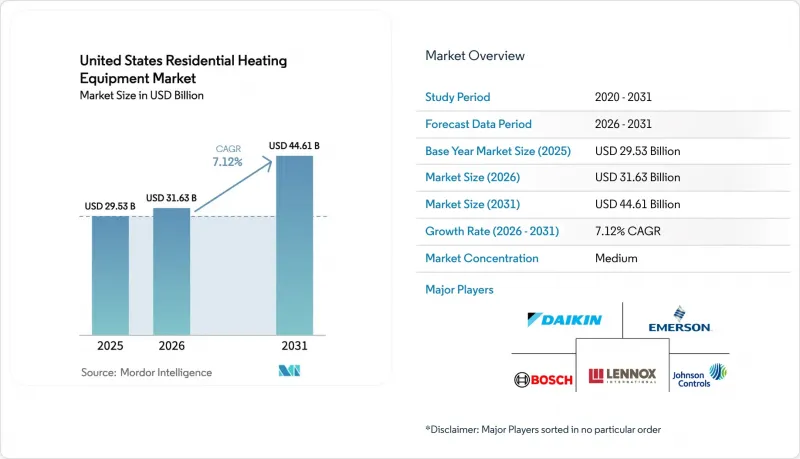
據 Mordor Intelligence 稱,美國住宅供暖設備市場預計到 2026 年價值 316.3 億美元,高於 2025 年的 295.3 億美元,預計到 2031 年將達到 446.1 億美元。
預計從 2026 年到 2031 年,其複合年成長率將達到 7.12%。
本報告按產品類型(燃氣爐、電爐、鍋爐等)、技術(冷凝式、非冷凝式、變頻式、智慧互聯)、最終用戶(獨戶房屋住宅、多用戶住宅等)和分銷管道(替換/售後市場、新建建築OEM)進行細分。市場預測以美元計價。
美國住宅暖氣設備市場趨勢與洞察
高效熱泵可享有聯邦稅額扣抵和IRA退稅
由於稅收優惠政策,目前項目成本最高可獲得30%的補貼(最高可達2000美元),中低收入家庭還可以透過額外退稅獲得超過安裝成本50%的補貼。 2025年生效的新合格規則強制要求「能源之星」最高效認證,這促使製造商採用更高性能的壓縮機和變頻控制技術,從而縮短產品更新周期。更新後的美國國稅局認證製造商名單包括開利(Carrier)、倫諾克斯(Lennox)和瑞姆(Ream),確保了符合標準的型號能夠進入主流市場。
州級電氣化建築規範
加州的「2025年建築能源效率標準」強制要求從2026年1月起在住宅中安裝熱泵,華盛頓州、奧勒岡州和紐約州已採納該標準作為參考。 2024年國際節能規範(IECC)可選附錄包含預先編寫的措辭,允許各州在維修許可證中添加「電氣相容」要求,從而將該政策的適用範圍擴展到空調市場。
初始投資成本高,且與傳統燃氣暖氣爐相比
雖然安裝熱泵的成本在 8,000 美元到 15,000 美元之間,但燃氣熱水器的成本在 4,000 美元到 8,000 美元之間,即使稅額扣抵後,這種價格差異仍然存在。在天然氣價格較低的地區,更換面板和冷媒處理的額外成本會延長投資回收期。能源效率與經濟委員會 (ACEEE) 指出,在供暖度日數低於 7,000 的地區,成本效益會顯著提高。
細分市場分析
截至2025年,瓦斯暖氣系統占美國住宅暖氣市場的44.35%,但寒冷氣候熱泵正以10.78%的複合年成長率快速成長,並有可能迅速蠶食其市場佔有率。隨著美國能源部(DOE)的努力證實寒冷氣候熱泵即使在零度以下的溫度下也具有實用性,預計其在美國住宅供暖市場的規模將顯著擴大。混合系統將熱泵與輔助燃氣加熱相結合,為那些不願完全採用電氣化供暖的住宅提供了一條過渡途徑,即使在極地渦旋現象期間也能保持舒適的室內環境。
聯邦政府對熱泵熱水器提供高達 2000 美元的稅額扣抵,這鼓勵了供暖和熱水一體化維修,從而提高了承包商的平均訂單金額。在可再生能源豐富的州,由於分時電費低於季節性天然氣價格,電熱水器仍然具有競爭力,但鍋爐在傳統熱水供暖市場之外的市場佔有率正在萎縮。能夠同時提供 240V 管道式和 120V 無管道式系統的製造商正獲得更有利的地位,受到尋求更高效庫存管理的經銷商的青睞。
截至2025年,非冷凝式空調仍占美國住宅暖氣設備市場佔有率的56.05%,但隨著聯邦政府即將修訂最低能源效率標準,訂單正轉向冷凝式和變頻式空調。變速壓縮機的年複合成長率(CAGR)為12.15%,可實現負載追蹤運行,減少循環損耗,並在某些獨立系統運營商(ISO)轄區內提供每年50至100美元的需量反應補償。
由於電力公司向用戶提供折扣電價,允許在電網過載時將室內溫度降低兩小時,美國住宅暖氣系統市場中智慧連結系統的市場規模預計將加速成長。為符合A2L法規,系統設計正在改變,整合了多感測器洩漏偵測功能;同時,雲端分析技術可提供預測性維護警報,從而減少維修人員的上門服務次數。在此轉型過程中,能夠認證包含回收裝置和培訓模組在內的完整生態系統(確保冷媒安全)的原始設備製造商(OEM)將佔優勢。
其他好處:
- Excel格式的市場預測(ME)表
- 3個月的分析師支持
目錄
第1章:引言
- 研究假設和市場定義
- 調查範圍
第2章:調查方法
第3章執行摘要
第4章 市場狀況
- 市場概覽
- 市場促進因素
- 高效熱泵可享有聯邦稅額扣抵和IRA退稅
- 州級電氣裝置建築規範
- 能源之星認證系統的轉售價值溢價
- 寒冷氣候下熱泵技術的進步
- 利用智慧恆溫器實現需量反應所產生的收入。
- 老舊住宅存量的重建週期
- 市場限制因素
- 初始投資成本高(與傳統瓦斯暖爐相比)
- 天然氣價格波動導致投資難以回收。
- 極端寒冷天氣下電網面臨的限制
- 熱泵安裝業技術純熟勞工短缺
- 價值鏈分析
- 監理情勢
- 技術展望
- 波特五力分析
- 市場宏觀經濟趨勢的評估
第5章 市場規模與成長預測
- 依產品類型
- 氣體反應器
- 電爐
- 鍋爐
- 空氣和熱水加熱器
- 熱泵
- 混合系統
- 其他
- 透過技術
- 冷凝式
- 非冷凝型
- 變頻器
- 智慧互聯
- 最終用戶
- 獨戶房屋住宅
- 多用戶住宅
- 預製住宅
- 其他
- 透過分銷管道
- 替換件/售後市場
- 新建工程(OEM)
第6章 競爭情勢
- 市場集中度
- 策略趨勢
- 市佔率分析
- 公司簡介
- Carrier Global Corporation
- Trane Technologies plc
- Lennox International Inc.
- Daikin Industries Ltd.
- Rheem Manufacturing Company
- Johnson Controls International plc
- Bosch Thermotechnology Corp.
- Bradford White Corporation
- Burnham Holdings Inc.
- Mitsubishi Electric Trane HVAC US LLC
- American Standard Heating and Air Conditioning
- Emerson Electric Co.
- Honeywell International Inc.(Smart Controls)
- Nortek Global HVAC
- Navien Inc.
- Viessmann Manufacturing Co.(US)Inc.
- Robert Bosch LLC
- WaterFurnace International Inc.
- LG Electronics USA-HVAC
- Panasonic USA-Heating and Cooling
第7章 市場機會與未來展望
According to Mordor Intelligence, the US residential heating equipment market size in 2026 is estimated at USD 31.63 billion, growing from 2025 value of USD 29.53 billion with 2031 projections showing USD 44.61 billion, growing at 7.12% CAGR over 2026-2031.
This report is Segmented by Product Type (Gas Furnaces, Electric Furnaces, Boilers, and More), Technology (Condensing, Non-Condensing, Variable-Speed Inverter, Smart Connected), End-User (Single-Family Detached Homes, Multi-Family Residential, and More), Distribution Channel (Replacement/Aftermarket, New Construction OEM). The Market Forecasts are Provided in Terms of Value (USD).
United States Residential Heating Equipment Market Trends and Insights
Federal Tax Credits and IRA Rebates for High-Efficiency Heat Pumps
Tax incentives now cover 30% of project costs up to USD 2,000, and low-to-moderate income households can tap additional rebates that raise total support beyond 50% of installed cost. New 2025 eligibility rules that require ENERGY STAR Most Efficient certification push manufacturers toward higher-performance compressors and inverter logic, shortening product-refresh cycles. An updated IRS qualified-manufacturer list features Carrier, Lennox, and Rheem, ensuring mainstream distribution of compliant models.
State-Level Electrification Building Codes
California's 2025 Building Energy Efficiency Standards obligate builders to install heat pumps in new homes beginning January 2026, a template Washington, Oregon, and New York are already adapting. Optional appendices in the 2024 IECC provide ready-made language that allows states to layer electric-ready requirements onto renovation permits, extending policy reach to the replacement market.
High Upfront Capital Cost Versus Baseline Gas Furnaces
Installed heat-pump prices run USD 8,000-15,000 compared with USD 4,000-8,000 for gas furnaces, and the gap endures even after credits. Additional expenses for panel upgrades and refrigerant handling prolong payback in low-gas-price regions. The American Council for an Energy-Efficient Economy notes that cost-effectiveness improves markedly in zones with fewer than 7,000 heating degree days.
Other drivers and restraints analyzed in the detailed report include:
- Cold-Climate Heat-Pump Technology Advances
- Aging Housing-Stock Replacement Cycle
- Skilled Labor Shortage for Heat-Pump Installation
For complete list of drivers and restraints, kindly check the Table Of Contents.
Segment Analysis
Gas furnaces accounted for 44.35% of the US Residential Heating Equipment market in 2025, yet cold-climate heat pumps are running an 10.78% CAGR that threatens to erode that share quickly. The US Residential Heating Equipment market size for cold-climate heat pumps is projected to widen substantially as the Department of Energy challenge proves viability at sub-zero temperatures. Hybrid systems that pair a heat pump with a secondary gas stage offer a migration path for homeowners wary of full electrification, and they preserve comfort during polar vortex events.
Federal credits of up to USD 2,000 on heat-pump water heaters are encouraging bundled space-and-water-heating retrofits, lifting average order value for contractors. Electric furnaces hold ground in renewable-rich states where time-of-use electricity rates track below seasonal gas pricing, while boilers see attrition except in legacy hydronic markets. Manufacturers that can supply both 240 V ducted and 120 V ductless formats occupy a stronger position with distributors eager to streamline stocking decisions.
Non-condensing platforms still represented 56.05% of the US Residential Heating Equipment market share in 2025, but impending federal minimum-efficiency updates skew orders toward condensing and inverter units. Variable-speed compressors are climbing at a 12.15% CAGR, enabling load-following operation that cuts cycling losses and unlocks demand-response payments worth USD 50-100 per year in select ISO territories.
The US Residential Heating Equipment market size for smart connected systems is set to accelerate as utilities offer bill credits to households that allow 2-hour temperature setbacks during grid stress. A2L compliance drives redesigns that integrate multi-sensor leak detection, while cloud analytics deliver predictive maintenance alerts that reduce truck rolls for service contractors. The transition phase favors OEMs that can certify a complete refrigerant-safe ecosystem, including recovery equipment and training modules.
Complete Report Scope:
- By Product Type
- Gas Furnaces
- Electric Furnaces
- Boilers
- Air and Water Heaters
- Heat Pumps
- Hybrid Systems
- Other Types
- By Technology
- Condensing
- Non-Condensing
- Variable-Speed Inverter
- Smart Connected
- By End-User
- Single-Family Detached Homes
- Multi-Family Residential
- Manufactured Housing
- Other Ed-users
- By Distribution Channel
- Replacement / Aftermarket
- New Construction (OEM)
List of Companies Covered in this Report:
- Carrier Global Corporation
- Trane Technologies plc
- Lennox International Inc.
- Daikin Industries Ltd.
- Rheem Manufacturing Company
- Johnson Controls International plc
- Bosch Thermotechnology Corp.
- Bradford White Corporation
- Burnham Holdings Inc.
- Mitsubishi Electric Trane HVAC US LLC
- American Standard Heating and Air Conditioning
- Emerson Electric Co.
- Honeywell International Inc. (Smart Controls)
- Nortek Global HVAC
- Navien Inc.
- Viessmann Manufacturing Co. (U.S.) Inc.
- Robert Bosch LLC
- WaterFurnace International Inc.
- LG Electronics USA - HVAC
- Panasonic USA - Heating and Cooling
Additional Benefits:
- The market estimate (ME) sheet in Excel format
- 3 months of analyst support
TABLE OF CONTENTS
1 INTRODUCTION
- 1.1 Study Assumptions and Market Definition
- 1.2 Scope of the Study
2 RESEARCH METHODOLOGY
3 EXECUTIVE SUMMARY
4 MARKET LANDSCAPE
- 4.1 Market Overview
- 4.2 Market Drivers
- 4.2.1 Federal tax credits and IRA rebates for high-efficiency heat pumps
- 4.2.2 State-level electrification building codes
- 4.2.3 Resale-value premium for ENERGY STAR-certified systems
- 4.2.4 Cold-climate heat-pump technology advances
- 4.2.5 Smart-thermostat enabled demand-response revenues
- 4.2.6 Aging housing-stock replacement cycle
- 4.3 Market Restraints
- 4.3.1 High upfront capital cost vs. baseline gas furnaces
- 4.3.2 Natural-gas price volatility complicating pay-back
- 4.3.3 Electric-grid constraints during extreme cold events
- 4.3.4 Skilled labor shortage for heat-pump installation
- 4.4 Value Chain Analysis
- 4.5 Regulatory Landscape
- 4.6 Technological Outlook
- 4.7 Porter's Five Forces Analysis
- 4.7.1 Bargaining Power of Suppliers
- 4.7.2 Bargaining Power of Buyers/Consumers
- 4.7.3 Threat of New Entrants
- 4.7.4 Threat of Substitutes
- 4.7.5 Intensity of Competitive Rivalry
- 4.8 Assessment of Macro Economic Trends on the Market
5 MARKET SIZE AND GROWTH FORECASTS (VALUES)
- 5.1 By Product Type
- 5.1.1 Gas Furnaces
- 5.1.2 Electric Furnaces
- 5.1.3 Boilers
- 5.1.4 Air and Water Heaters
- 5.1.5 Heat Pumps
- 5.1.6 Hybrid Systems
- 5.1.7 Other Types
- 5.2 By Technology
- 5.2.1 Condensing
- 5.2.2 Non-Condensing
- 5.2.3 Variable-Speed Inverter
- 5.2.4 Smart Connected
- 5.3 By End-User
- 5.3.1 Single-Family Detached Homes
- 5.3.2 Multi-Family Residential
- 5.3.3 Manufactured Housing
- 5.3.4 Other Ed-users
- 5.4 By Distribution Channel
- 5.4.1 Replacement / Aftermarket
- 5.4.2 New Construction (OEM)
6 COMPETITIVE LANDSCAPE
- 6.1 Market Concentration
- 6.2 Strategic Moves
- 6.3 Market Share Analysis
- 6.4 Company Profiles (includes Global-level Overview, Market-level Overview, Core Segments, Financials as available, Strategic Information, Market Rank/Share, Products and Services, Recent Developments)
- 6.4.1 Carrier Global Corporation
- 6.4.2 Trane Technologies plc
- 6.4.3 Lennox International Inc.
- 6.4.4 Daikin Industries Ltd.
- 6.4.5 Rheem Manufacturing Company
- 6.4.6 Johnson Controls International plc
- 6.4.7 Bosch Thermotechnology Corp.
- 6.4.8 Bradford White Corporation
- 6.4.9 Burnham Holdings Inc.
- 6.4.10 Mitsubishi Electric Trane HVAC US LLC
- 6.4.11 American Standard Heating and Air Conditioning
- 6.4.12 Emerson Electric Co.
- 6.4.13 Honeywell International Inc. (Smart Controls)
- 6.4.14 Nortek Global HVAC
- 6.4.15 Navien Inc.
- 6.4.16 Viessmann Manufacturing Co. (U.S.) Inc.
- 6.4.17 Robert Bosch LLC
- 6.4.18 WaterFurnace International Inc.
- 6.4.19 LG Electronics USA - HVAC
- 6.4.20 Panasonic USA - Heating and Cooling
7 MARKET OPPORTUNITIES AND FUTURE OUTLOOK
- 7.1 White-space and Unmet-Need Assessment


