


 |
市場調查報告書
商品編碼
2125321
藥品泡殼包裝:市佔率分析、產業趨勢與統計、成長預測(2026-2031)Pharmaceutical Blister Packaging - Market Share Analysis, Industry Trends & Statistics, Growth Forecasts (2026 - 2031) |
||||||

※ 本網頁內容可能與最新版本有所差異。詳細情況請與我們聯繫。
根據 Mordor Intelligence 估計,到 2026 年,藥品泡殼包裝市值將達到 249.7 億美元,從 2025 年的 233.1 億美元成長到 2031 年的 351.7 億美元。
預計 2026 年至 2031 年的複合年成長率為 7.10%。
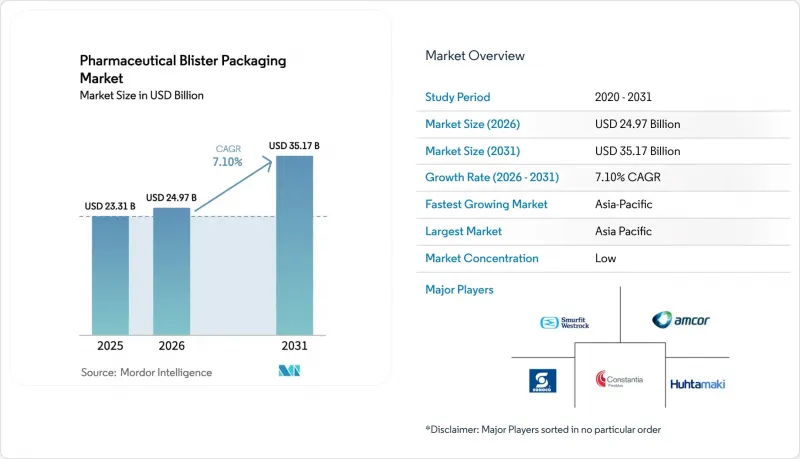
本報告按材料(塑膠、紙/紙板、鋁箔)、技術(冷成型、熱封/熱收縮、熱成型)、應用(片劑、膠囊等)、最終用戶(品牌藥/學名藥生產商等)和地區(北美、歐洲、亞太地區、中東和非洲、南美)進行分類。
全球藥品泡殼包裝市場趨勢及洞察
單劑量藥物依從性包裝的需求增加
監管機構認為單劑量包裝是減少用藥錯誤的有效方法,美國食品藥物管理局(FDA)提案的一項規則草案要求市售的口溶錠和口崩膜必須以單劑量包裝運輸。醫院和零售藥劑師也證實,可視化的劑量指引可以減少老年病患漏服藥物的情況。保險公司歡迎降低再入院風險,因為這是他們提供報銷獎勵的依據。為此,合約包裝公司正在增加多產品泡殼包裝生產線,這種包裝可以將一天的劑量集中在一個泡殼卡上。雖然這種趨勢在北美最為顯著,但隨著用藥依從性數據被整合到電子處方箋平台中,類似的趨勢也正在歐洲出現。
擴大可回收阻隔性塑膠的使用
歐盟的《包裝和包裝廢棄物法規》規定,2030年後投放市場的所有醫療包裝都必須設計成可回收的。 TekniPlex等供應商現在提供中等阻隔性的吸塑薄膜,其中含有30%的消費後回收樹脂,且不影響其防潮性能。北歐化工的「Bornewables」等級產品採用可再生原料製造,為尋求減少碳足跡的製造商提供了可控來源的聚合物選擇。一家日本加工商實施了閉合迴路系統,用於收集廢鋁箔並將其重熔成顆粒,與使用原生材料相比,可減少約20%的二氧化碳排放。
鋁聚合物原料價格波動
鋁箔是吸塑包裝的標準阻隔材料,但由於地緣政治關稅和中國出口政策的變化,其價格正面臨上漲。歐洲鋁箔生產商報告稱,2024年前九個月的產量將達到約72.4萬噸,但由於能源價格飆升,供應仍然緊張。樹脂生產商也將石腦油成本的上漲轉嫁到PVC和PET樹脂的價格上。品牌商正在將採購來源多元化,轉向東南亞和拉丁美洲,同時也測試聚丙烯複合材料,這種材料可以在不影響阻隔性能的前提下減少鋁箔的厚度。
細分市場分析
塑膠藥品泡殼包裝市場由成熟的PVC-PVDC價值鍊和成熟的熱成型性能所驅動。市場規模與大規模生產的學名藥密切相關,低成型溫度和可預測的密封強度是關鍵。然而,隨著品牌所有者要求包裝材料可回收(作為生活垃圾)並減少範圍3排放,紙基包裝結構正逐漸獲得市場認可。覆有薄聚合物或鋁層的紙板複合材料的保存期限已接近9個月,其應用範圍也從維生素擴展到處方箋消化器官系統藥物。
由於深拉伸型腔能夠保護對水分敏感的化合物,因此對鋁箔和塑膠冷成型鋁箔的需求仍然強勁。然而,隨著加工商採用奈米層塗層以較少的金屬即可達到類似的阻隔性能,鋁箔厚度正呈下降趨勢。 Ecobliss 的冷封卡片表明,黏合劑無需加熱工藝,從而降低了包裝車間的能耗。 TekniPlex 的吸塑包裝膜含有 30% 的 PCR(再生塑膠),在維持藥劑師目視檢查所需的透明度的同時,也為樹脂的循環利用指明了方向。
到2025年,熱成型製程將佔據藥品泡殼包裝市場72.45%的佔有率。這主要得益於其生產線速度快,且透明腔體便於目視檢查。成型-填充-封口(FFS)生產線以每分鐘600包的速度持續生產,以滿足重磅藥物片劑的生產需求。然而,由於活性成分(API)對水分敏感,製造商正被迫轉向冷成型工藝,因為鋁箔在冷成型過程中幾乎不透水蒸氣。儘管材料成本不斷上漲,但隨著特學名藥和孤兒藥產量的成長,冷成型生產線的藥品泡殼包裝市場規模仍在擴大。
目前,冷泡設備的供應商正在整合伺服驅動分度器,這提高了鋁箔的使用效率,並減少了高達15%的廢料。 Aptar CSP Technologies公司已擴大其活性泡殼包裝在歐洲的生產規模,以滿足該地區對整合式乾燥劑通道的需求,該通道無需使用額外的乾燥劑袋即可防止水解。連續生產的倡導者正在推廣「粉末到包裝」的一體化生產線,在該生產線上,片劑可在幾分鐘內完成壓片、稱重和泡殼密封工序,從而最大限度地減少等待時間檢驗。
區域分析
預計到2025年,亞太地區將成為全球最大的市場,佔全球銷售額的33.97%,並預計到2031年將以8.87%的複合年成長率成長。印度、中國和新加坡政府正在為自動化包裝生產線提供稅額扣抵,而當地的合約研發生產機構(CDMO)正在為歐洲的學名藥爭取供應合約。在東京國際藥品包裝展(Interphex Tokyo)上,日本供應商重點介紹了數位化工具如何降低缺陷率,並著重介紹了透明阻隔膜和人工智慧檢測技術。與PIC/S GMP的區域協調正在加速跨境分銷,使跨國公司能夠在多個東協市場檢驗單一包裝。
北美憑藉其高價值的生物製藥產品線和對智慧黏合包裝的早期應用,佔據第二大市場佔有率。美國也受益於製造業回流,縮短了供應鏈並避免了地緣政治風險。隨著鋁關稅的重新實施,加工商正透過確保國內鋁箔軋延產能或改用聚合物基蓋材料來降低進口價格波動的風險。加拿大工廠正在採用再生能源,從而能夠宣傳其「碳中和」包裝,並獲得了公共保險公司的支持。歐洲憑藉嚴格的品質標準和對永續材料的投資,保持著較大的市場佔有率。 TekniPlex位於摩德納的新工廠新增了具有中等阻隔性的PCR薄膜生產線,而Faller Packaging正在德國擴建其折疊式紙盒的生產空間,以滿足對宣傳單的需求。該地區的循環經濟指令正在推動符合藍色回收箱計畫的單一材料吸塑包裝的試點實施。東歐的合約包裝公司正在幫助中小型創新企業獲得歐盟「合格人員」認證,以降低其成本。
其他好處:
- Excel格式的市場預測(ME)表
- 3個月的分析師支持
目錄
第1章:引言
- 研究假設和市場定義
- 調查範圍
第2章:調查方法
第3章執行摘要
第4章 市場狀況
- 市場概覽
- 市場促進因素
- 單劑量依從性包裝的需求增加
- 擴大可回收阻隔性塑膠的使用
- 全球慢性病口服療法的推廣
- 人口老化推動了對非處方固態劑型藥物的需求。
- 隆重推出配備感光元件的智慧「數位吸塑」包裝。
- 整合在線吸塑成型的連續生產線
- 市場限制因素
- 一次性塑膠製品的相關法規、禁令和課稅
- 鋁聚合物原料價格波動
- 加強對新薄膜萃取物和洗脫液的監測
- 地緣政治因素導致鋁箔供應鏈中斷
- 供應鏈分析
- 監理情勢
- 技術展望
- 波特五力分析
- 永續性和回收的趨勢
第5章 市場規模與成長預測
- 材料
- 塑膠
- 鋁箔
- 紙張和紙板
- 透過技術
- 熱成型
- 冷成型
- 熱封/熱縮
- 透過使用
- 藥片
- 膠囊
- 口服薄膜劑和錠劑
- 診斷試劑盒和其他
- 最終用戶
- 品牌藥/學名藥生產商
- 合約研發生產組織(CDMO)
- 合約包裝營運商 (CPO)
- 按地區
- 北美洲
- 美國
- 加拿大
- 墨西哥
- 歐洲
- 德國
- 英國
- 法國
- 義大利
- 西班牙
- 俄羅斯
- 其他歐洲國家
- 亞太地區
- 中國
- 印度
- 日本
- 韓國
- 澳洲和紐西蘭
- 其他亞太國家
- 中東和非洲
- 中東
- 阿拉伯聯合大公國
- 沙烏地阿拉伯
- 土耳其
- 其他中東國家
- 非洲
- 南非
- 奈及利亞
- 埃及
- 其他非洲國家
- 中東
- 南美洲
- 巴西
- 阿根廷
- 其他南美國家
- 北美洲
第6章 競爭情勢
- 市場集中度
- 策略趨勢
- 市佔率分析
- 公司簡介
- Amcor plc
- Smurfit Westrock
- Constantia Flexibles
- Sonoco Products Company
- Huhtamaki Oyj
- Tekni-Plex Inc.
- ACG Pharmapack
- Aptar CSP Technologies
- Klockner Pentaplast
- Perlen Packaging
- Honeywell International(Aclar Films)
- Bilcare Research
- Bemis Healthcare(now Amcor Flexibles)
- Uhlmann Packaging Systems
- IMA Group
- Syntegon Technology
- Marchesini Group
- Romaco Group
- PharmaWorks(ProMach)
第7章 市場機會與未來展望
According to Mordor Intelligence, pharmaceutical blister packaging market size in 2026 is estimated at USD 24.97 billion, growing from 2025 value of USD 23.31 billion with 2031 projections showing USD 35.17 billion, growing at 7.10% CAGR over 2026-2031.
This report is Segmented by Material (Plastic, Paper and Paperboard, and Aluminum Foil), Technology (Cold Form, Heat-Seal / Heat-Shrink, and Thermoforming), Application (Tablets, Capsules, and More), End-User (Branded / Generic Pharma Manufacturers, and More), and Geography (North America, Europe, Asia-Pacific, Middle East and Africa, and South America).
Global Pharmaceutical Blister Packaging Market Trends and Insights
Rise in demand for unit-dose adherence packs
Regulators see unit-dose formats as an effective way to lower dosing errors, so proposed FDA rules would require over-the-counter orally disintegrating tablets and films to ship only in single-unit packaging. Hospital and retail pharmacists confirm that visual dose cues reduce skipped administrations among seniors. Payers also welcome lower readmission risk, which anchors reimbursement incentives. Contract packers respond by adding multi-product blister lines that let one card hold an entire daily regimen. The effect is quickest in North America, but Europe follows as e-prescription platforms integrate adherence data.
Growing adoption of recyclable high-barrier plastics
The EU Packaging and Packaging Waste Regulation mandates that all healthcare packs placed on the market after 2030 must be designed for recycling. Suppliers such as TekniPlex now commercialize mid-barrier blister films containing 30% post-consumer resin without sacrificing moisture protection. Borealis' Bornewables grades, produced from renewable feedstock, give origin-controlled polymer options to manufacturers seeking carbon-footprint cuts. Japanese converters add closed-loop systems that collect foil scrap and re-smelt it into pellets, cutting CO2 emissions nearly 20% versus virgin routes.
Volatility in aluminum and polymer feed-stock prices
Aluminum foil is the classic blister barrier but faces price spikes linked to geopolitical tariffs and Chinese export policy shifts. Europe's foil mills reported almost 724 thousand tonnes of nine-month output in 2024, yet supply still tightened after energy-price shocks. Resin makers also pass higher naphtha costs into PVC and PET grades. Brand owners diversify sourcing toward Southeast Asia and Latin America and test polypropylene-based laminates that cut foil gauge without hurting barrier performance.
Other drivers and restraints analyzed in the detailed report include:
- Expansion of chronic-disease oral therapies worldwide
- Aging population boosting OTC solid-dose demand
- Heightened scrutiny on novel-film extractables and leachables
For complete list of drivers and restraints, kindly check the Table Of Contents.
Segment Analysis
supported by mature PVC-PVDC supply chains and proven thermoforming behavior. The pharmaceutical blister packaging market size for plastics aligns with high-volume generic production that values low forming temperatures and predictable seal integrity. Yet paper-based structures are gaining momentum because brand owners want curbside recyclability and lower Scope 3 emissions. Paperboard laminates coated with thin polymer or aluminum layers now approach nine-month shelf-life performance, expanding their use beyond vitamins into prescription gastroenterology drugs.
Demand for aluminum-plastic cold-form foil remains solid because deep-draw cavities shield moisture-sensitive compounds. However, foil gauges are trending lower as converters add nanolayer coatings that deliver equal barrier with less metal. Cold-seal cards from Ecobliss illustrate how pressure-activated adhesive eliminates heat while cutting energy consumption in pack rooms. TekniPlex's 30% PCR blister films demonstrate the direction of resin circularity and keep clarity that pharmacists prefer for visual inspection.
Thermoforming owned 72.45% of the pharmaceutical blister packaging market share in 2025 because it offers high line speeds and clear cavities that support visual confirmation. Form-fill-seal lines routinely cross 600 packs per minute, matching blockbuster tablet volumes. Even so, moisture-sensitive APIs push manufacturers toward cold-forming where aluminum foil delivers near-zero water vapor transmission rates. The pharmaceutical blister packaging market size for cold-form lines grows as specialty generics and orphan-drug volumes climb, despite higher material costs.
Cold-form equipment vendors now integrate servo-driven indexers that improve foil usage, trimming scrap by up to 15%. Aptar CSP Technologies expanded its Active Blister production into Europe to meet regional demand for built-in desiccant channels that prevent hydrolysis without extra sachets. Continuous-manufacturing advocates link powder-to-pack trains where tablets exit compression, pass through weight checks, and reach blister sealing within minutes, minimizing hold-time validation.
Complete Report Scope:
- By Material
- Plastic
- Aluminum Foil
- Paper and Paperboard
- By Technology
- Thermoforming
- Cold-form
- Heat-seal / Heat-shrink
- By Application
- Tablets
- Capsules
- Oral Thin Films and Lozenges
- Diagnostic Kits and Others
- By End-User
- Branded / Generic Pharma Manufacturers
- Contract Development and Manufacturing Organizations (CDMOs)
- Contract Packaging Organizations (CPOs)
- By Geography
- North America
- United States
- Canada
- Mexico
- Europe
- Germany
- United Kingdom
- France
- Italy
- Spain
- Russia
- Rest of Europe
- Asia-Pacific
- China
- India
- Japan
- South Korea
- Australia and New Zealand
- Rest of Asia-Pacific
- Middle East and Africa
- Middle East
- United Arab Emirates
- Saudi Arabia
- Turkey
- Rest of Middle East
- Africa
- South Africa
- Nigeria
- Egypt
- Rest of Africa
- Middle East
- South America
- Brazil
- Argentina
- Rest of South America
- North America
Geography Analysis
Asia-Pacific led with 33.97% of global revenue in 2025 and shows a 8.87% CAGR through 2031. Governments in India, China, and Singapore offer tax credits for automated packaging lines, while local CDMOs win supply contracts for Europe's generics. Japanese suppliers spotlight transparent barrier films and AI inspection at Interphex Tokyo, revealing how digital tools shrink defect rates. Regional harmonization with PIC/S GMP accelerates cross-border distribution, so multinationals can validate a single pack across several ASEAN markets.
North America ranks second due to high-value biologic pipelines and the early rollout of smart adherence packs. The United States also benefits from reshoring moves that shorten supply chains and hedge geopolitical risk. Aluminum tariff reinstatements push converters to secure domestic foil rolling capacity or switch to polymer-based lidding, limiting exposure to import price swings. Canadian facilities integrate renewable electricity, enabling carbon-neutral pack claims that resonate with public payers. Europe maintains significant share thanks to strict quality norms and investment in sustainable materials. TekniPlex's new Modena plant adds mid-barrier PCR film, while Faller Packaging expands folding-carton space in Germany to handle leaflet demand. The region's circular-economy directives drive trials of mono-material blisters that qualify for blue-bin collection schemes. Eastern European contract packers provide cost relief for small and mid-sized innovators seeking EU Qualified Person release.
- Amcor plc
- Smurfit Westrock
- Constantia Flexibles
- Sonoco Products Company
- Huhtamaki Oyj
- Tekni-Plex Inc.
- ACG Pharmapack
- Aptar CSP Technologies
- Klockner Pentaplast
- Perlen Packaging
- Honeywell International (Aclar Films)
- Bilcare Research
- Bemis Healthcare (now Amcor Flexibles)
- Uhlmann Packaging Systems
- IMA Group
- Syntegon Technology
- Marchesini Group
- Romaco Group
- PharmaWorks (ProMach)
Additional Benefits:
- The market estimate (ME) sheet in Excel format
- 3 months of analyst support
TABLE OF CONTENTS
1 INTRODUCTION
- 1.1 Study Assumptions and Market Definition
- 1.2 Scope of the Study
2 RESEARCH METHODOLOGY
3 EXECUTIVE SUMMARY
4 MARKET LANDSCAPE
- 4.1 Market Overview
- 4.2 Market Drivers
- 4.2.1 Rise in demand for unit-dose adherence packs
- 4.2.2 Growing adoption of recyclable high-barrier plastics
- 4.2.3 Expansion of chronic-disease oral therapies worldwide
- 4.2.4 Aging population driving OTC solid-dose demand
- 4.2.5 Emergence of smart, sensor-enabled "digital blister" packs
- 4.2.6 Continuous-manufacturing lines integrating inline blistering
- 4.3 Market Restraints
- 4.3.1 Regulatory bans/taxes on single-use plastics
- 4.3.2 Volatility in aluminum and polymer feed-stock prices
- 4.3.3 Heightened scrutiny on novel-film extractables and leachables
- 4.3.4 Geopolitical disruption of aluminum-foil supply chains
- 4.4 Supply-Chain Analysis
- 4.5 Regulatory Landscape
- 4.6 Technological Outlook
- 4.7 Porter's Five Forces Analysis
- 4.7.1 Bargaining Power of Suppliers
- 4.7.2 Bargaining Power of Buyers
- 4.7.3 Threat of New Entrants
- 4.7.4 Threat of Substitutes
- 4.7.5 Intensity of Competitive Rivalry
- 4.8 Sustainability and Recycling Trends
5 MARKET SIZE AND GROWTH FORECASTS (VALUE)
- 5.1 By Material
- 5.1.1 Plastic
- 5.1.2 Aluminum Foil
- 5.1.3 Paper and Paperboard
- 5.2 By Technology
- 5.2.1 Thermoforming
- 5.2.2 Cold-form
- 5.2.3 Heat-seal / Heat-shrink
- 5.3 By Application
- 5.3.1 Tablets
- 5.3.2 Capsules
- 5.3.3 Oral Thin Films and Lozenges
- 5.3.4 Diagnostic Kits and Others
- 5.4 By End-User
- 5.4.1 Branded / Generic Pharma Manufacturers
- 5.4.2 Contract Development and Manufacturing Organizations (CDMOs)
- 5.4.3 Contract Packaging Organizations (CPOs)
- 5.5 By Geography
- 5.5.1 North America
- 5.5.1.1 United States
- 5.5.1.2 Canada
- 5.5.1.3 Mexico
- 5.5.2 Europe
- 5.5.2.1 Germany
- 5.5.2.2 United Kingdom
- 5.5.2.3 France
- 5.5.2.4 Italy
- 5.5.2.5 Spain
- 5.5.2.6 Russia
- 5.5.2.7 Rest of Europe
- 5.5.3 Asia-Pacific
- 5.5.3.1 China
- 5.5.3.2 India
- 5.5.3.3 Japan
- 5.5.3.4 South Korea
- 5.5.3.5 Australia and New Zealand
- 5.5.3.6 Rest of Asia-Pacific
- 5.5.4 Middle East and Africa
- 5.5.4.1 Middle East
- 5.5.4.1.1 United Arab Emirates
- 5.5.4.1.2 Saudi Arabia
- 5.5.4.1.3 Turkey
- 5.5.4.1.4 Rest of Middle East
- 5.5.4.2 Africa
- 5.5.4.2.1 South Africa
- 5.5.4.2.2 Nigeria
- 5.5.4.2.3 Egypt
- 5.5.4.2.4 Rest of Africa
- 5.5.4.1 Middle East
- 5.5.5 South America
- 5.5.5.1 Brazil
- 5.5.5.2 Argentina
- 5.5.5.3 Rest of South America
- 5.5.1 North America
6 COMPETITIVE LANDSCAPE
- 6.1 Market Concentration
- 6.2 Strategic Moves
- 6.3 Market Share Analysis
- 6.4 Company Profiles (includes Global level Overview, Market level overview, Core Segments, Financials as available, Strategic Information, Market Rank/Share for key companies, Products and Services, and Recent Developments)
- 6.4.1 Amcor plc
- 6.4.2 Smurfit Westrock
- 6.4.3 Constantia Flexibles
- 6.4.4 Sonoco Products Company
- 6.4.5 Huhtamaki Oyj
- 6.4.6 Tekni-Plex Inc.
- 6.4.7 ACG Pharmapack
- 6.4.8 Aptar CSP Technologies
- 6.4.9 Klockner Pentaplast
- 6.4.10 Perlen Packaging
- 6.4.11 Honeywell International (Aclar Films)
- 6.4.12 Bilcare Research
- 6.4.13 Bemis Healthcare (now Amcor Flexibles)
- 6.4.14 Uhlmann Packaging Systems
- 6.4.15 IMA Group
- 6.4.16 Syntegon Technology
- 6.4.17 Marchesini Group
- 6.4.18 Romaco Group
- 6.4.19 PharmaWorks (ProMach)
7 MARKET OPPORTUNITIES AND FUTURE OUTLOOK
- 7.1 White-space and Unmet-Need Assessment

 南美洲藥品泡殼包裝:市佔率分析、產業趨勢與統計及成長預測(2026-2031 年)
 藥品泡殼包裝市場機會、成長要素、產業趨勢分析及2026-2035年預測。
 全球藥品泡殼包裝市場規模、佔有率、趨勢和成長分析報告(2026-2034年)
 藥品泡殼包裝市場規模、佔有率、成長分析(按產品類型、技術類型、材料類型、應用和地區分類)-2026-2033年產業預測泡罩包裝藥品市場規模、佔有率、成長及全球產業分析:按類型、應用和地區劃分的洞察,以及2024年至2032年的預測
 醫藥泡殼包裝市場規模、佔有率、成長分析(按類型、按材料、按最終用途、按技術和按地區)- 行業預測,2025 年至 2032 年
 全球藥品泡殼包裝市場:按材料、技術、產品、應用、最終用戶、地區 - 趨勢分析、競爭格局、預測,2019-2030