


 |
市場調查報告書
商品編碼
2125302
AC馬達:市場佔有率分析、產業趨勢與統計、成長預測(2026-2031)Alternating Current (AC) Motor - Market Share Analysis, Industry Trends & Statistics, Growth Forecasts (2026 - 2031) |
||||||

※ 本網頁內容可能與最新版本有所差異。詳細情況請與我們聯繫。
根據 Mordor Intelligence 預測,AC馬達市場規模將從 2025 年的 182.3 億美元和 2026 年的 188.9 億美元成長到 2031 年的 222.4 億美元,2026 年至 2031 年的年複合成長率(CAGR)為 3.32%。
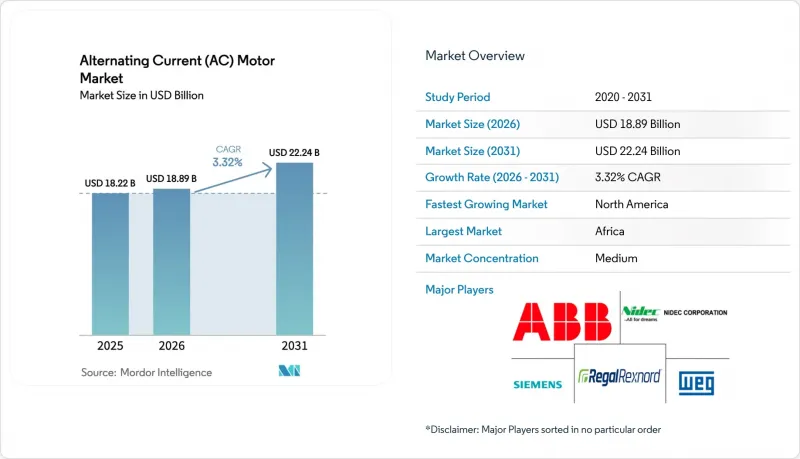
本報告按馬達類型(感應交流AC馬達和同步AC馬達)、電壓等級(低壓、中壓和高壓)、額定功率(小於1千瓦、1至100千瓦和以上)、能源效率等級(IE1、IE2和以上)、終端用戶產業(石油天然氣、化學、發電等)和地區進行細分。市場預測以美元計價。
全球交流電機市場趨勢與洞察
強制性能源效率法規正在加速設備更新換代週期。
在歐盟,功率超過0.75千瓦的馬達必須符合IE4標準;而中國、美國和印度的最低IE3標準也加速了老舊IE1-IE2馬達的淘汰。法規的合規性正促使全球產品線向超高階平台靠攏,這有利於那些擁有大規模生產能力和統一認證的供應商。對於終端用戶而言,一台75千瓦的IE4馬達每年運作7000小時,可以節省近1200美元的電費,使其能夠在三年內收回初始成本。因此,電力公司和流程工業(其營運預算的60%以上都用於馬達電力消耗)正在製定多年採購計畫。隨著監管標準的不斷提高,交流馬達市場正經歷向高效設計方向的結構性轉變。
工業自動化和機器人技術的快速普及正在重塑對馬達的需求。
到2024年,全球部署的機器人數量將超過54萬台,這些機器人將配備數百萬台定位精度達亞毫秒的永磁伺服馬達。汽車和電子產品組裝正從氣壓缸轉向伺服驅動器,從而將循環時間縮短15%以上,能耗降低高達50%。協作機器人的部署成長最為迅速,對低慣量無框馬達提出了更高的要求,其安全停止反應時間需達到10毫秒。倉儲自動化也在推動對交流馬達的需求,每台自主移動機器人都整合了多個小型交流變頻器。亞太地區在中國、韓國和日本的集中部署,使其成為交流電機需求的重要支柱。
銅和稀土元素的價格波動給利潤率帶來壓力,並導致訂單延遲。
2024年至2025年間,銅價在每噸8000美元至10500美元之間波動,削弱了固定價格合約的盈利,並導致供應商將報價有效期縮短至30天以內。中國收緊出口配額導致釹鐵硼磁鐵價格上漲12%至18%,使永磁電機的材料成本每20千瓦單元增加高達120美元。在價格敏感型市場,買家指定IE3感應電動機作為售後選項,以避免依賴稀土元素,減緩了交流馬達市場效率提升的進程。製造商正在探索鐵氧體磁體和銅轉子等替代方案,但這些方案會導致扭力密度降低和散熱設計更加複雜。
細分市場分析
到2025年,感應交流電機將憑藉其堅固的結構和低維護成本,以67.23%的市佔率引領交流電機市場。它們在各種工業環境中廣泛運作泵浦、風扇和輸送機。儘管產量較低,同步馬達技術仍以3.68%的複合年成長率穩定發展,因為永磁轉子在滿載時可帶來高達4個百分點的效率提升。由於磁鐵帶來的靈敏扭矩響應和緊湊的機身結構,機器人製造商、工具機製造商和電動車(EV)OEM廠商現在都開始指定使用同步驅動裝置。
政策壓力也在加速這項轉型。歐盟的IE4法規和美國提案標準使採用同步馬達的企業受益,全球原始設備製造商(OEM)正致力於產品線標準化和庫存精簡。礦物加工企業正在將兆瓦級同步馬達與中壓碳化矽驅動器結合,以降低電氣損耗和開關設備面積(IEC.CH)。隨著千瓦時節能在生命週期分析中變得越來越重要,預計未來十年交流馬達市場將進一步向同步馬達傾斜。
到2025年,1千伏以下的低壓馬達將佔總銷量的84.23%,這反映出它們在暖通空調、食品加工和包裝行業的廣泛應用。變頻驅動器與這些馬達配合使用,可實現軟啟動和節能調速。同時,1千伏特至11千伏特的中壓平台成長最快,複合年成長率達3.89%。這是因為石油、天然氣和金屬行業的營運商正在將多個低壓饋線整合到一個高功率軸上,從而在每個裝置中減少高達30%的銅用量。
目前,能源效率法規僅適用於1千伏特及以下電壓等級,這使得專案業主可以自行協商性能標準,例如優先選擇能夠透過數位孿生技術檢驗現場能源效率的供應商。目前應用於6.6千伏特和11千伏驅動裝置的碳化矽(SiC)功率裝置,可將開關損耗降低一半,因此可使用更小的散熱器和機櫃。這些空間和能源優勢,加上中東地區的大型企劃、液化天然氣(LNG)項目和海水淡化項目,正鞏固中壓馬達在交流電機市場戰略成長領域的地位。
區域分析
到2025年,亞太地區將佔全球銷售額的56.41%,這主要得益於中國國內產量超過3億台。在韓國,機器人部署密度(每千名工人3.8台)鞏固了伺服的需求;而在印度,強制採用功率超過0.75千瓦的馬達IE3標準,推動了紡織和鋼鐵業的早期升級熱潮。在日本,精密設備快速採用IE5標準維持了產品的高價;在澳大利亞,採礦業依賴功率超過500千瓦的驅動裝置進行運輸和破碎作業,從而提高了區域附加價值。
預計到2025年,北美和歐洲合計約佔總銷售額的35%。在美國,一項針對水務產業的500億美元津貼已進行過半,預計採購量將在2025年至2026年間達到峰值,這將加速市政污水處理廠採用IE4節能系統。歐盟生態設計法規2019/1781已規定,到2025年中期,IE4的能耗必須低於0.12千瓦,這加快了建築設備和輕工業的升級改造步伐。德國的銷售額佔其歐洲總銷售額的28%,這得益於該國機械出口商對其伺服系統的現代化改造;同時,英國正轉向使用熱泵壓縮機,以實現建築供暖的脫碳。
非洲是成長最快的地區,預計到2031年將維持4.22%的複合年成長率,這得益於非洲開發銀行250億美元的電氣化項目,該項目主要針對埃及、南非和奈及利亞。在南非的礦山,通風風扇正在升級到符合IE3-IE4標準的型號,以降低電力成本。目前,電力成本佔營運支出的40%以上。埃及規劃中的工業城市預計將需要數萬台馬達用於供水和暖通空調系統。奈及利亞新建的鐵路走廊正在促進水泥、食品加工和紡織業的集中發展。中東地區海水淡化和區域供冷的需求穩定成長,而南美洲的成長則主要由巴西推動,當地製造商WEG憑藉著五週的前置作業時間,銷量超過了進口產品。
其他好處:
- Excel格式的市場預測(ME)表
- 3個月的分析師支持
目錄
第1章:引言
- 研究假設和市場定義
- 調查範圍
第2章:調查方法
第3章執行摘要
第4章 市場狀況
- 市場概覽
- 市場促進因素
- 關於能源效率(IE3/IE4)的強制性法規
- 工業自動化機器人的快速普及
- 擴大可再生能源資產(風能、太陽能)
- 商業地產中暖通空調/冷凍設施的開發
- 軸流式永磁交流AC馬達在電動車領域的興起
- 人工智慧驅動的預測性維護生態系統
- 市場限制因素
- 銅和稀土元素的價格波動很大。
- 高效率馬達的初始成本高
- 電力電子(IGBT)供應鏈中的瓶頸
- 遵守廢舊產品回收及收集義務
- 宏觀經濟因素對市場的影響
- 產業價值/價值鏈分析
- 監管情勢和標準
- 技術趨勢(邊緣人工智慧分析)
- 波特五力分析
第5章 市場規模與成長預測
- 依馬達類型
- 感應交流AC馬達
- 單相
- 多相
- 同步AC馬達
- 直流勵磁轉子
- 永磁型
- 滯後現象
- 鬆弛
- 感應交流AC馬達
- 電壓等級
- 低電壓(低於1千伏特)
- 中壓(1-11千伏特)
- 高壓(11千伏特或更高)
- 額定功率
- 小於1千瓦
- 1~100 kW
- 100~500 kW
- 超過500千瓦
- 能源效率等級
- IE1(標準)
- IE2(高)
- IE3(高級版)
- IE4(超級高級版)
- IE5(超高級版)
- 按最終用戶行業分類
- 石油和天然氣
- 化工/石油化工
- 發電
- 水和污水處理
- 金屬和採礦
- 食品/飲料
- 離散製造
- 其他終端用戶產業
- 按地區
- 北美洲
- 美國
- 加拿大
- 墨西哥
- 南美洲
- 巴西
- 阿根廷
- 其他南美國家
- 歐洲
- 德國
- 英國
- 法國
- 俄羅斯
- 其他歐洲國家
- 亞太地區
- 中國
- 日本
- 印度
- 韓國
- 澳洲
- 其他亞太國家
- 中東
- 沙烏地阿拉伯
- 阿拉伯聯合大公國
- 其他中東國家
- 非洲
- 南非
- 埃及
- 其他非洲國家
- 北美洲
第6章 競爭情勢
- 市場集中度
- 策略趨勢
- 市佔率分析
- 供應商排名分析
- 公司簡介
- ABB Ltd.
- Siemens AG
- WEG Equipamentos Eletricos SA
- Nidec Corporation
- Regal Rexnord Corporation
- Johnson Electric Holdings Limited
- Yaskawa Electric Corporation
- Rockwell Automation, Inc.
- Franklin Electric Co., Inc.
- Bosch Rexroth AG
- Kirloskar Electric Company Ltd.
- SEVA-tec GmbH
- Toshiba Corporation
- Mitsubishi Electric Corporation
- TECO Electric and Machinery Co., Ltd.
- Leroy-Somer Holding(Nidec)
- ATB Austria Antriebstechnik AG
- Getriebebau NORD GmbH and Co. KG
- Oriental Motor Co., Ltd.
- Brook Crompton UK Ltd.
第7章 市場機會與未來展望
According to Mordor Intelligence, the alternating current motor market size is projected to expand from USD 18.23 billion in 2025 and USD 18.89 billion in 2026 to USD 22.24 billion by 2031, registering a CAGR of 3.32% between 2026 to 2031.
This report is Segmented by Motor Type (Induction AC Motors, and Synchronous AC Motors), Voltage Class (Low Voltage, Medium Voltage, and High Voltage), Power Rating (less Than 1 KW, 1 To 100 KW, and More), Efficiency Class (IE1, IE2, and More), End-User Industry (Oil and Gas, Chemicals, Power Generation, and More), and Geography. The Market Forecasts are Provided in Terms of Value (USD).
Global Alternating Current (AC) Motor Market Trends and Insights
Mandatory Energy-Efficiency Regulations Drive Accelerated Replacement Cycles
IE4 rules are now obligatory for motors above 0.75 kilowatts in the European Union, and IE3 minimums in China, the United States, and India are triggering early retirement of legacy IE1-IE2 fleets. Compliance converges global product lines on super-premium platforms, favoring suppliers with scale manufacturing and harmonized certifications. For end users, a 75-kilowatt IE4 motor running 7,000 hours per year saves close to USD 1,200 in electricity costs, recovering the upfront price delta in under 3 years. Utilities and process industries that spend 60% or more of their operating budgets on motor power are therefore locking in multi-year procurement pipelines. As a result, the alternating current (AC) motor market is witnessing a structural pivot toward higher-efficiency design as the regulatory floor continues to rise.
Rapid Industrial Automation and Robotics Uptake Reshapes Motor Demand
Global robot installations topped 540,000 units in 2024, embedding millions of permanent-magnet servo motors with sub-millisecond positional accuracy. Automotive and electronics assembly lines are shifting from pneumatic cylinders to servo actuation, cutting cycle times by more than 15% and energy draw by up to 50%. Collaborative-robot deployments are scaling fastest, requiring low-inertia frameless motors capable of a 10-millisecond safe-stop response. Warehouse automation adds further pull, with each autonomous mobile robot containing multiple small AC drives. Concentrated adoption in China, South Korea, and Japan ensures that Asia-Pacific remains the volume anchor of the alternating current (AC) motor market.
Copper and Rare-Earth Volatility Compresses Margins and Delays Orders
Copper traded between USD 8,000 and USD 10,500 per metric ton during 2024-2025, eroding the profitability of fixed-price contracts and prompting vendors to shorten quote validity to less than 30 days. Neodymium-iron-boron magnet prices rose 12-18% on tighter Chinese export quotas, raising material cost in permanent-magnet motors by up to USD 120 for a 20-kilowatt unit. In price-sensitive markets, buyers are back-specifying IE3 induction motors to sidestep rare-earth exposure, slowing the premium-efficiency trajectory of the alternating current (AC) motor market. Manufacturers are exploring ferrite-magnet or copper-rotor alternatives, but these options sacrifice torque density and complicate thermal design.
Other drivers and restraints analyzed in the detailed report include:
- Expansion of Renewable-Energy Assets Multiplies Auxiliary-Motor Demand
- HVAC/R Build-Out in Commercial Real Estate Sustains Baseline Growth
- High Upfront Cost of Premium-Efficiency Motors Limits Penetration in Capital-Constrained Segments
For complete list of drivers and restraints, kindly check the Table Of Contents.
Segment Analysis
Induction AC motors led the alternating current (AC) motor market in 2025 with a 67.23% revenue share, underpinned by their rugged construction and low maintenance needs. They dominate pumps, fans, and conveyors that run across every industrial floor. Synchronous technology, although smaller in volume, is advancing at a 3.68% CAGR because permanent-magnet rotors add up to four percentage points of efficiency at full load. Robot builders, machine-tool makers, and electric-vehicle OEMs now specify synchronous drives for the tight torque response and compact frames that magnets enable.
Policy pressure is amplifying the shift. IE4 rules in the European Union and proposed U.S. mandates for IE4 reward synchronous adopters, prompting global OEMs to harmonize product lines and streamline inventory. Minerals processors are pairing megawatt-class synchronous motors with medium-voltage silicon-carbide drives, trimming electrical losses and switchgear footprints IEC.CH. As life-cycle analyses place a premium on kilowatt-hour savings, the alternating current (AC) motor market size is likely to tilt further toward synchronous formats through the decade.
Low-voltage motors below 1 kV captured 84.23% of 2025 revenue, reflecting their ubiquity in HVAC, food processing, and packaging. Variable-frequency drives coupled to these units allow soft starts and energy-saving speed control. Medium-voltage platforms between 1 kV and 11 kV are, however, the fastest risers at a 3.89% CAGR, as oil, gas, and metals operators consolidate several low-voltage feeders into single high-horsepower shafts, slicing copper mass by as much as 30% per installation.
Efficiency mandates currently stop at 1 kV, giving project owners latitude to negotiate bespoke performance benchmarks that favor vendors able to verify field efficiency through digital twins. Silicon-carbide power devices now featured in 6.6 kV and 11 kV drives cut switching losses by half, enabling smaller heat sinks and cabinets. These space and energy benefits dovetail with refinery, LNG, and desalination megaprojects in the Middle East and Asia, cementing medium-voltage as a strategic growth segment of the alternating current (AC) motor market.
Complete Report Scope:
- By Motor Type
- Induction AC Motors
- Single-Phase
- Poly-Phase
- Synchronous AC Motors
- DC-Excited Rotor
- Permanent-Magnet
- Hysteresis
- Reluctance
- Induction AC Motors
- By Voltage Class
- Low Voltage (Less Than 1 kV)
- Medium Voltage (1 to 11 kV)
- High Voltage (More Than 11 kV)
- By Power Rating
- Less Than 1 kW
- 1 to 100 kW
- 100 to 500 kW
- Greater Than 500 kW
- By Efficiency Class
- IE1 (Standard)
- IE2 (High)
- IE3 (Premium)
- IE4 (Super-Premium)
- IE5 (Ultra-Premium)
- By End-User Industry
- Oil and Gas
- Chemicals and Petrochemicals
- Power Generation
- Water and Wastewater
- Metals and Mining
- Food and Beverage
- Discrete Manufacturing
- Other End-User Industries
- By Geography
- North America
- United States
- Canada
- Mexico
- South America
- Brazil
- Argentina
- Rest of South America
- Europe
- Germany
- United Kingdom
- France
- Russia
- Rest of Europe
- Asia-Pacific
- China
- Japan
- India
- South Korea
- Australia
- Rest of Asia-Pacific
- Middle East
- Saudi Arabia
- United Arab Emirates
- Rest of Middle East
- Africa
- South Africa
- Egypt
- Rest of Africa
- North America
Geography Analysis
Asia-Pacific produced 56.41% of global revenue in 2025, headlined by China's domestic output of more than 300 million units. Robot deployment density, 3.8 units per 1,000 workers in South Korea, locks in servo demand, while India's IE3 mandate for motors above 0.75 kW is driving an early replacement wave across textiles and steel. Japan commands premium pricing thanks to the rapid uptake of IE5 frames in precision equipment, and Australia's mining sector relies on >500 kW drives for haulage and crushing, boosting regional value intensity.
North America and Europe together delivered about 35% of 2025 revenue. The United States is mid-cycle on USD 50 billion in water-sector grants, with procurements peaking in 2025-2026, advancing the adoption of IE4 in municipal treatment works. Europe's Ecodesign Regulation 2019/1781 already requires IE4 to be down to 0.12 kW by mid-2025, tightening upgrade timetables for building services and light manufacturing. Germany alone accounted for 28% of European sales as its machinery exporters modernize servo footprints, while the United Kingdom is pivoting toward heat-pump compressors to decarbonize building heating.
Africa is the fastest-growing region, charting a 4.22% CAGR to 2031 on the back of USD 25 billion in African Development Bank electrification projects targeting Egypt, South Africa, and Nigeria. South African mines are retrofitting IE3-IE4 ventilators to curb power costs that exceed 40% of operating expense, and Egypt's planned industrial cities will need tens of thousands of motors for water and HVAC loads. Nigeria's new rail corridor is stimulating cement, food-processing, and textiles clusters. The Middle East adds steady volume from desalination and district-cooling, while South America's growth is anchored by Brazil, where local producer WEG leverages five-week lead times to outsell imports.
- ABB Ltd.
- Siemens AG
- WEG Equipamentos Eletricos S.A.
- Nidec Corporation
- Regal Rexnord Corporation
- Johnson Electric Holdings Limited
- Yaskawa Electric Corporation
- Rockwell Automation, Inc.
- Franklin Electric Co., Inc.
- Bosch Rexroth AG
- Kirloskar Electric Company Ltd.
- SEVA-tec GmbH
- Toshiba Corporation
- Mitsubishi Electric Corporation
- TECO Electric and Machinery Co., Ltd.
- Leroy-Somer Holding (Nidec)
- ATB Austria Antriebstechnik AG
- Getriebebau NORD GmbH and Co. KG
- Oriental Motor Co., Ltd.
- Brook Crompton UK Ltd.
Additional Benefits:
- The market estimate (ME) sheet in Excel format
- 3 months of analyst support
TABLE OF CONTENTS
1 INTRODUCTION
- 1.1 Study Assumptions and Market Definition
- 1.2 Scope of the Study
2 RESEARCH METHODOLOGY
3 EXECUTIVE SUMMARY
4 MARKET LANDSCAPE
- 4.1 Market Overview
- 4.2 Market Drivers
- 4.2.1 Mandatory Energy-Efficiency Regulations (IE3/IE4)
- 4.2.2 Rapid Industrial Automation and Robotics Uptake
- 4.2.3 Expansion of Renewable-Energy Assets (Wind, Solar)
- 4.2.4 HVAC/R Build-Out in Commercial Real Estate
- 4.2.5 Rise of Axial-Flux PM AC Motors in E-Mobility
- 4.2.6 AI-Enabled Predictive-Maintenance Ecosystems
- 4.3 Market Restraints
- 4.3.1 Volatile Copper and Rare-Earth Metal Prices
- 4.3.2 High Upfront Cost of Premium-Efficiency Motors
- 4.3.3 Power-Electronics (IGBT) Supply-Chain Bottlenecks
- 4.3.4 End-of-Life Recycling and Take-Back Compliance
- 4.4 Impact of Macroeconomic Factors on the Market
- 4.5 Industry Value / Supply-Chain Analysis
- 4.6 Regulatory Landscape and Standards
- 4.7 Technological Outlook (Edge and AI Analytics)
- 4.8 Porter's Five Forces Analysis
- 4.8.1 Bargaining Power of Suppliers
- 4.8.2 Bargaining Power of Buyers
- 4.8.3 Threat of New Entrants
- 4.8.4 Threat of Substitutes
- 4.8.5 Degree of Competition
5 MARKET SIZE AND GROWTH FORECASTS (VALUE)
- 5.1 By Motor Type
- 5.1.1 Induction AC Motors
- 5.1.1.1 Single-Phase
- 5.1.1.2 Poly-Phase
- 5.1.2 Synchronous AC Motors
- 5.1.2.1 DC-Excited Rotor
- 5.1.2.2 Permanent-Magnet
- 5.1.2.3 Hysteresis
- 5.1.2.4 Reluctance
- 5.1.1 Induction AC Motors
- 5.2 By Voltage Class
- 5.2.1 Low Voltage (Less Than 1 kV)
- 5.2.2 Medium Voltage (1 to 11 kV)
- 5.2.3 High Voltage (More Than 11 kV)
- 5.3 By Power Rating
- 5.3.1 Less Than 1 kW
- 5.3.2 1 to 100 kW
- 5.3.3 100 to 500 kW
- 5.3.4 Greater Than 500 kW
- 5.4 By Efficiency Class
- 5.4.1 IE1 (Standard)
- 5.4.2 IE2 (High)
- 5.4.3 IE3 (Premium)
- 5.4.4 IE4 (Super-Premium)
- 5.4.5 IE5 (Ultra-Premium)
- 5.5 By End-User Industry
- 5.5.1 Oil and Gas
- 5.5.2 Chemicals and Petrochemicals
- 5.5.3 Power Generation
- 5.5.4 Water and Wastewater
- 5.5.5 Metals and Mining
- 5.5.6 Food and Beverage
- 5.5.7 Discrete Manufacturing
- 5.5.8 Other End-User Industries
- 5.6 By Geography
- 5.6.1 North America
- 5.6.1.1 United States
- 5.6.1.2 Canada
- 5.6.1.3 Mexico
- 5.6.2 South America
- 5.6.2.1 Brazil
- 5.6.2.2 Argentina
- 5.6.2.3 Rest of South America
- 5.6.3 Europe
- 5.6.3.1 Germany
- 5.6.3.2 United Kingdom
- 5.6.3.3 France
- 5.6.3.4 Russia
- 5.6.3.5 Rest of Europe
- 5.6.4 Asia-Pacific
- 5.6.4.1 China
- 5.6.4.2 Japan
- 5.6.4.3 India
- 5.6.4.4 South Korea
- 5.6.4.5 Australia
- 5.6.4.6 Rest of Asia-Pacific
- 5.6.5 Middle East
- 5.6.5.1 Saudi Arabia
- 5.6.5.2 United Arab Emirates
- 5.6.5.3 Rest of Middle East
- 5.6.6 Africa
- 5.6.6.1 South Africa
- 5.6.6.2 Egypt
- 5.6.6.3 Rest of Africa
- 5.6.1 North America
6 COMPETITIVE LANDSCAPE
- 6.1 Market Concentration
- 6.2 Strategic Moves
- 6.3 Market Share Analysis
- 6.4 Vendor Ranking Analysis
- 6.5 Company Profiles (includes Global Level Overview, Market Level Overview, Core Segments, Financials as available, Strategic Information, Market Rank/Share, Products and Services, Recent Developments)
- 6.5.1 ABB Ltd.
- 6.5.2 Siemens AG
- 6.5.3 WEG Equipamentos Eletricos S.A.
- 6.5.4 Nidec Corporation
- 6.5.5 Regal Rexnord Corporation
- 6.5.6 Johnson Electric Holdings Limited
- 6.5.7 Yaskawa Electric Corporation
- 6.5.8 Rockwell Automation, Inc.
- 6.5.9 Franklin Electric Co., Inc.
- 6.5.10 Bosch Rexroth AG
- 6.5.11 Kirloskar Electric Company Ltd.
- 6.5.12 SEVA-tec GmbH
- 6.5.13 Toshiba Corporation
- 6.5.14 Mitsubishi Electric Corporation
- 6.5.15 TECO Electric and Machinery Co., Ltd.
- 6.5.16 Leroy-Somer Holding (Nidec)
- 6.5.17 ATB Austria Antriebstechnik AG
- 6.5.18 Getriebebau NORD GmbH and Co. KG
- 6.5.19 Oriental Motor Co., Ltd.
- 6.5.20 Brook Crompton UK Ltd.
7 MARKET OPPORTUNITIES AND FUTURE OUTLOOK
- 7.1 White-Space and Unmet-Need Assessment

 全球氣動馬達市場(2026-2030 年)
 農業馬達市場規模、佔有率和成長分析:按產品類型、額定功率、應用、安裝方式、分銷管道和地區分類-2026-2033年產業預測
 亞太交易所(AC)驅動:市場佔有率分析、行業趨勢和統計數據以及成長預測(2026-2031 年)歐洲交流馬達:市場佔有率分析、產業趨勢與統計及成長預測(2026-2031)
 防爆伺服馬達市場規模、佔有率和成長分析:按馬達類型、保護類型、應用、最終用戶、額定功率和地區分類 - 產業預測,2026-2033年
 石油天然氣產業交流電機市場:類型、輸出、額定電壓、相數、安裝方式、應用、最終用途-2026-2032年全球市場預測交流馬達市場:馬達類型、輸出功率、電壓等級、控制方式、相數、調速、應用、通路、最終用途-2026-2032年全球市場預測
 2026年全球馬達測試設備市場報告
 氣動馬達市場規模、佔有率和成長分析:按產品類型、功率、應用、終端用戶產業、馬達配置、安裝方式和地區分類-2026-2033年產業預測
 2026-2030年全球扭力馬達市場