


 |
市場調查報告書
商品編碼
2125282
歐洲交流馬達:市場佔有率分析、產業趨勢與統計及成長預測(2026-2031)Europe Alternating Current (AC) Motor - Market Share Analysis, Industry Trends & Statistics, Growth Forecasts (2026 - 2031) |
||||||

※ 本網頁內容可能與最新版本有所差異。詳細情況請與我們聯繫。
根據 Mordor Intelligence 預測,歐洲交流馬達市場規模將從 2025 年的 246 億美元成長到 2026 年的 262.9 億美元,然後在 2031 年達到 366.6 億美元,2026 年至 2031 年的複合年成長率為 6.85%。
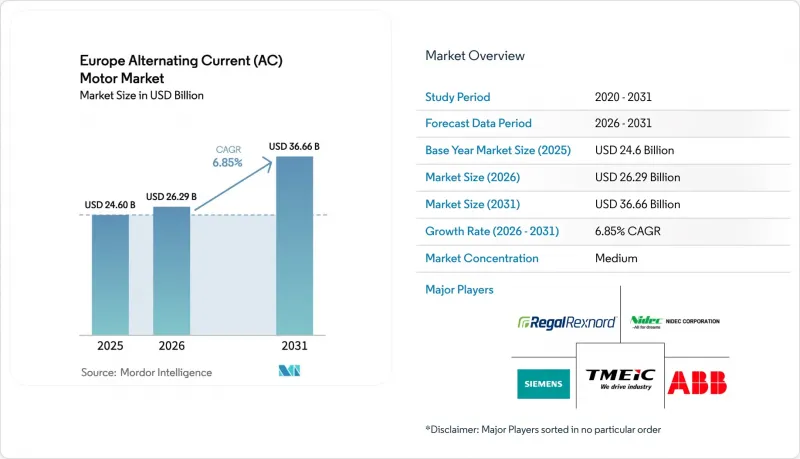
本報告按類型(感應交流馬達、同步交流馬達)、額定功率(小於1kW、1-100kW、其他)、電壓等級(低壓、中壓、高壓)、終端用戶產業(石油天然氣、化學和石化、發電、水和污水處理、金屬和採礦、其他)以及地區進行細分。市場預測以美元(USD)計價。
歐洲交流電機市場趨勢與洞察
加速工業自動化和物聯網的普及應用
歐洲工廠正在部署智慧驅動系統,該系統能夠收集振動、溫度和負載數據,從而實現預測性維護並最佳化生產線切換。早期專案報告顯示,隨著資產性能系統(由邊緣運算節點支援)從恆速運行過渡到變速運行,節能效果顯著,投資回收期不到四年。一家德國汽車零件供應商正在主導進行試點部署,指定使用支援乙太網路的IE5平台,該平台可將診斷標籤直接髮送到製造執行系統 (MES),從而實現即時品管迴路。隨著配備眾多感測器並支援韌體升級的新型電機取代傳統的感應馬達,歐洲交流電機市場也從中受益。一級供應商正在積極響應這一趨勢,提供基於訂閱的分析模組,將硬體、韌體和人工智慧 (AI) 監控功能整合到單一服務合約中。
對電動機制定嚴格的能源效率法規
歐盟法規2019/1781將功率超過0.75kW的三相馬達的最低能源效率要求提高至IE3,並將適用範圍擴大至潛水馬達和直驅馬達。國家監管機構對不合格產品實施的處罰,正在加速化工、食品和建築服務等行業設施的維修。供應商正透過推出符合IE4和IE5標準的產品線來凸顯自身優勢,並將這些產品線宣傳為「前瞻性」產品;而安裝商則推廣「按需付費」的合約模式,以幫助客戶規避初始投資門檻。提供快速合格評定的檢測實驗室,也為歐洲交流電機市場的本土品牌帶來了競爭優勢。
高昂的初始採購和安裝成本
高階IE4+馬達比標準產品貴20-40%,而強制性的變頻器(VFD)可能會使專案的硬體成本翻倍。改造逆變器通常需要升級配電盤、諧波濾波和機械調整,這會延長利潤率較低的中小型企業的投資回收期。能源績效合約透過將付款分攤到多個節能收益中來減輕高額前期成本的負擔,但除高績效公司外,其他行業的採用率仍然參差不齊。在資金籌措模式成熟之前,前期成本問題可能會減緩歐洲交流電機市場現有設備的更換速度。
細分市場分析
到2025年,同步馬達將佔總銷售額的27.32%,但預計在工具機、氫氣和暖通空調驅動領域,其複合年成長率將達到8.67%,成為成長最快的應用領域。這是因為市場對精確扭矩響應、低噪音和主軸轉速的要求不斷提高,超過了其較高的初始投資成本。整合式馬達驅動裝置具備自動功率因數調節功能,可提高生產線效率,並實現感應馬達無法實現的全扭力零速啟動。
感應馬達憑藉其堅固耐用和便捷的維修方案,在風機、水泵和輸送機等基礎應用中仍佔有一席之地。然而,日益嚴格的法規和對預測性維護的日益重視,正促使歐洲交流電機市場訂單穩步成長。 ABB 的「MV Titanium」概念將中壓逆變器整合於馬達機架內,展示了同步架構如何整合機械和電子元件,從而降低整體擁有成本。
功率低於1kW的馬達佔了大部分銷量,預計到2025年將佔歐洲交流馬達市場規模的37.02%。然而,101-500kW功率段的成長最為迅猛,年複合成長率高達8.29%。這主要得益於水泥、鋼鐵和化工廠中,以往由蒸氣或液壓驅動的機械驅動裝置正日益電氣化。營運商高度重視諸如可變扭矩演算法(用於降低空載負荷)以及將兆瓦級壓縮機直接整合到工廠整體能源管理系統等功能。
同時,500千瓦以上的大型機組正滿足老舊汽電共生電廠和抽水蓄能電站的現代化改造需求,但由於工程週期較長,其成長速度較為緩慢。因此,目前的發電量範圍反映了歐洲的產業結構,中等規模的設施正在進行現代化改造以實現淨零排放目標。
其他好處
- Excel格式的市場預測(ME)表
- 3個月的分析師支持
目錄
第1章:引言
- 研究假設和市場定義
- 調查範圍
第2章:調查方法
第3章執行摘要
第4章 市場狀況
- 市場概覽
- 市場促進因素
- 加速工業自動化和物聯網的普及應用
- 對電動機制定嚴格的能源效率法規
- 暖通空調和冷凍基礎設施的擴建
- 汽車製造業復甦與對電動車動力傳動系統的需求
- 由於工具機回歸國內市場,歐洲對高頻主軸馬達的採用率不斷提高。
- 需要大型同步馬達的氫氣電解設備專案的興起
- 市場限制因素
- 高昂的初始採購和安裝成本
- 原物料價格波動(銅、稀土元素)
- 來自永磁直流驅動裝置和伺服驅動裝置的競爭壓力
- 高效率馬達。
- 產業價值鏈分析
- 宏觀經濟因素的影響
- 技術展望
- 監理情勢
- 波特五力分析
第5章 市場規模與成長預測
- 按類型
- 感應交流電機
- 單相
- 多相
- 同步交流電機
- 直流勵磁轉子
- 永久磁鐵
- 滯後電機
- 磁阻馬達
- 感應交流電機
- 按類型分類的額定輸出
- 小於1千瓦
- 1~100kW
- 101~500kW
- 超過500千瓦
- 電壓等級
- 低電壓(低於1千伏特)
- 中壓(1-6kV)
- 高壓(超過6千伏特)
- 按最終用戶行業分類
- 石油和天然氣
- 化工/石油化工
- 發電
- 水和污水處理
- 金屬和採礦
- 飲食
- 各行業
- 其他
- 國家
- 英國
- 德國
- 義大利
- 法國
- 俄羅斯
- 其他歐洲國家
第6章 競爭情勢
- 市場集中度
- 策略趨勢
- 市佔率分析
- 公司簡介
- ABB Ltd.
- Siemens AG
- Nidec Corporation
- Regal Rexnord Corporation
- Toshiba Mitsubishi-Electric Industrial Systems Corporation
- WEG SA
- Leroy-Somer SAS
- Brook Crompton UK Ltd.
- Nord Drivesystems Group
- Bonfiglioli SpA
- SEW-Eurodrive GmbH and Co KG
- TECO Electric Machinery Co., Ltd.
- VEM Gruppe
- Cantoni Group
- Wolong Electric Group Co., Ltd.
- Lafert Group
- Oemer SpA
- Hoyer Motors A/S
- ZF Friedrichshafen AG
- Johnson Electric Holdings Limited
第7章 市場機會與未來展望
According to Mordor Intelligence, the Europe alternating current motor market size is expected to grow from USD 24.6 billion in 2025 to USD 26.29 billion in 2026 and is forecast to reach USD 36.66 billion by 2031 at 6.85% CAGR over 2026-2031.
This report is Segmented by Type (Induction AC Motors, and Synchronous AC Motors), Power Rating (less Than 1 KW, 1-100 KW, and More), Voltage Class (Low Voltage, Medium Voltage, High Voltage), End-User Industry (Oil and Gas, Chemical and Petrochemical, Power Generation, Water and Wastewater, Metal and Mining, and More), and Geography. The Market Forecasts are Provided in Terms of Value (USD).
Europe Alternating Current (AC) Motor Market Trends and Insights
Accelerating Industrial Automation and IoT Adoption
European factories are incorporating smart drives that collect data on vibration, temperature, and load to enable predictive maintenance and optimize line changeovers. Early projects report double-digit energy savings and sub-four-year paybacks as asset performance systems shift from fixed-speed to variable-speed regimes supported by edge computing nodes. German automotive suppliers have led pilot deployments, specifying Ethernet-ready IE5 platforms that publish diagnostic tags directly to manufacturing execution systems for real-time quality loops. The Europe alternating current motor market benefits from the resulting replacement cycle for legacy induction units with sensor-rich, firmware-upgradable models. Tier-one vendors are responding with subscription-based analytics modules that bundle hardware, firmware, and artificial-intelligence monitoring in a single service contract.
Stringent Energy-Efficiency Regulations for Electric Motors
EU Regulation 2019/1781 elevated the minimum requirement for three-phase motors above 0.75 kW to IE3 and extended coverage to submersible and close-coupled configurations. Penalties for non-compliance, enforced through national surveillance authorities, have accelerated retrofit programs across chemical, food, and building services sites. Suppliers now differentiate on IE4 and IE5 lines marketed as "future-proof," while installers promote pay-per-savings contracting that sidesteps upfront capital hurdles. Certification-ready testing labs offer fast-track conformity assessments, giving domestically rooted brands an edge in the Europe alternating current motor market.
High Initial Procurement and Installation Costs
Premium IE4-plus motors cost 20-40% more than standard units, and the prerequisite variable-frequency drives can double a project's hardware bill. Retrofitting drives often necessitate switchboard upgrades, harmonic filters, and mechanical realignment, which can stretch payback models for small enterprises operating on tight margins. Energy-performance contracting mitigates sticker shock by spreading payments across multiple savings streams, but adoption remains uneven outside blue-chip industries. Until financing models mature, upfront economics will temper the pace at which the Europe alternating current motor market converts its installed base.
Other drivers and restraints analyzed in the detailed report include:
- Expansion of HVAC and Refrigeration Infrastructure
- Revival of Automotive Manufacturing and EV Powertrain Demand
- Rising Raw-Material Price Volatility (Copper, Rare Earths)
For complete list of drivers and restraints, kindly check the Table Of Contents.
Segment Analysis
Synchronous units controlled 27.32% of 2025 revenue yet are forecast for the highest 8.67% CAGR because precise torque response, low acoustic signature, and rising spindle-speed requirements outweigh higher capital costs in machine-tool, hydrogen, and HVAC drives. Integrated motor-drive packages that auto-tune power factors boost line-level efficiency and enable full-torque zero-speed starts that induction machines cannot match.
Induction units defend baseline duties such as fans, pumps, and conveyors thanks to their ruggedness and commoditized repair ecosystem. However, regulatory tightening, combined with predictive-maintenance preferences, is steadily redirecting orders to synchronous alternatives in the Europe alternating current motor market. ABB's MV Titanium concept, which embeds a medium-voltage inverter within the motor frame, illustrates how synchronous architectures are converging mechanical and electronic components to lower total ownership cost.
Sub-1 kW models dominate the volumes, accounting for 37.02% of the Europe alternating current motor market size in 2025. Yet the 101-500 kW slice is the fastest climber, expanding at 8.29% CAGR as cement, steel, and chemical sites electrify mechanical drives formerly powered by steam or hydraulics. Operators appreciate the ability to curtail idle loads through variable-torque algorithms and to synchronize multi-megawatt compressors directly with plant-wide energy-management systems.
In parallel, packages exceeding 500 kW win replacement business in legacy cogeneration plants and pumped-storage facilities, although growth is steadier due to longer project cycles. The power-rating spectrum, therefore, mirrors Europe's industrial makeup, with mid-sized sites modernizing toward net-zero objectives.
Complete Report Scope:
- By Type
- Induction AC Motors
- Single Phase
- Poly Phase
- Synchronous AC Motors
- DC Excited Rotor
- Permanent Magnet
- Hysteresis Motor
- Reluctance Motor
- Induction AC Motors
- By Power Rating
- less than 1 kW
- 1-100 kW
- 101-500 kW
- above 500 kW
- By Voltage Class
- Low Voltage (<1 kV)
- Medium Voltage (1-6 kV)
- High Voltage (>6 kV)
- By End-user Industry
- Oil and Gas
- Chemical and Petrochemical
- Power Generation
- Water and Wastewater
- Metal and Mining
- Food and Beverage
- Discrete Industries
- Other End-user Industries
- By Country
- United Kingdom
- Germany
- Italy
- France
- Russia
- Rest of Europe
List of Companies Covered in this Report:
- ABB Ltd.
- Siemens AG
- Nidec Corporation
- Regal Rexnord Corporation
- Toshiba Mitsubishi-Electric Industrial Systems Corporation
- WEG S.A.
- Leroy-Somer SAS
- Brook Crompton UK Ltd.
- Nord Drivesystems Group
- Bonfiglioli S.p.A.
- SEW-Eurodrive GmbH and Co KG
- TECO Electric Machinery Co., Ltd.
- VEM Gruppe
- Cantoni Group
- Wolong Electric Group Co., Ltd.
- Lafert Group
- Oemer S.p.A.
- Hoyer Motors A/S
- ZF Friedrichshafen AG
- Johnson Electric Holdings Limited
Additional Benefits:
- The market estimate (ME) sheet in Excel format
- 3 months of analyst support
TABLE OF CONTENTS
1 INTRODUCTION
- 1.1 Study Assumptions and Market Definition
- 1.2 Scope of the Study
2 RESEARCH METHODOLOGY
3 EXECUTIVE SUMMARY
4 MARKET LANDSCAPE
- 4.1 Market Overview
- 4.2 Market Drivers
- 4.2.1 Accelerating Industrial Automation and IoT Adoption
- 4.2.2 Stringent Energy Efficiency Regulations for Electric Motors
- 4.2.3 Expansion of HVAC and Refrigeration Infrastructure
- 4.2.4 Revival of Automotive Manufacturing and EV Powertrain Demand
- 4.2.5 Growing Adoption of High-Frequency Spindle Motors in European Machine Tool Re-shoring
- 4.2.6 Emergence of Hydrogen Electrolyzer Projects Requiring Large Synchronous Motors
- 4.3 Market Restraints
- 4.3.1 High Initial Procurement and Installation Costs
- 4.3.2 Rising Raw Material Prices Volatility (Copper, Rare Earths)
- 4.3.3 Competitive Pressure from Permanent Magnet DC and Servo Drives
- 4.3.4 Supply Chain Tightness in Insulated Lamination Steel for High-Efficiency Motors
- 4.4 Industry Value Chain Analysis
- 4.5 Impact of Macroeconomic Factors
- 4.6 Technological Outlook
- 4.7 Regulatory Landscape
- 4.8 Porter's Five Forces Analysis
- 4.8.1 Bargaining Power of Suppliers
- 4.8.2 Bargaining Power of Buyers / Consumers
- 4.8.3 Threat of New Entrants
- 4.8.4 Threat of Substitutes
- 4.8.5 Intensity of Competitive Rivalry
5 MARKET SIZE AND GROWTH FORECASTS (VALUE)
- 5.1 By Type
- 5.1.1 Induction AC Motors
- 5.1.1.1 Single Phase
- 5.1.1.2 Poly Phase
- 5.1.2 Synchronous AC Motors
- 5.1.2.1 DC Excited Rotor
- 5.1.2.2 Permanent Magnet
- 5.1.2.3 Hysteresis Motor
- 5.1.2.4 Reluctance Motor
- 5.1.1 Induction AC Motors
- 5.2 By Power Rating
- 5.2.1 less than 1 kW
- 5.2.2 1-100 kW
- 5.2.3 101-500 kW
- 5.2.4 above 500 kW
- 5.3 By Voltage Class
- 5.3.1 Low Voltage (<1 kV)
- 5.3.2 Medium Voltage (1-6 kV)
- 5.3.3 High Voltage (>6 kV)
- 5.4 By End-user Industry
- 5.4.1 Oil and Gas
- 5.4.2 Chemical and Petrochemical
- 5.4.3 Power Generation
- 5.4.4 Water and Wastewater
- 5.4.5 Metal and Mining
- 5.4.6 Food and Beverage
- 5.4.7 Discrete Industries
- 5.4.8 Other End-user Industries
- 5.5 By Country
- 5.5.1 United Kingdom
- 5.5.2 Germany
- 5.5.3 Italy
- 5.5.4 France
- 5.5.5 Russia
- 5.5.6 Rest of Europe
6 COMPETITIVE LANDSCAPE
- 6.1 Market Concentration
- 6.2 Strategic Moves
- 6.3 Market Share Analysis
- 6.4 Company Profiles (includes Global level Overview, Market level overview, Core Segments, Financials as available, Strategic Information, Market Rank/Share for key companies, Products and Services, and Recent Developments)
- 6.4.1 ABB Ltd.
- 6.4.2 Siemens AG
- 6.4.3 Nidec Corporation
- 6.4.4 Regal Rexnord Corporation
- 6.4.5 Toshiba Mitsubishi-Electric Industrial Systems Corporation
- 6.4.6 WEG S.A.
- 6.4.7 Leroy-Somer SAS
- 6.4.8 Brook Crompton UK Ltd.
- 6.4.9 Nord Drivesystems Group
- 6.4.10 Bonfiglioli S.p.A.
- 6.4.11 SEW-Eurodrive GmbH and Co KG
- 6.4.12 TECO Electric Machinery Co., Ltd.
- 6.4.13 VEM Gruppe
- 6.4.14 Cantoni Group
- 6.4.15 Wolong Electric Group Co., Ltd.
- 6.4.16 Lafert Group
- 6.4.17 Oemer S.p.A.
- 6.4.18 Hoyer Motors A/S
- 6.4.19 ZF Friedrichshafen AG
- 6.4.20 Johnson Electric Holdings Limited
7 MARKET OPPORTUNITIES AND FUTURE OUTLOOK

 全球氣動馬達市場(2026-2030 年)
 農業馬達市場規模、佔有率和成長分析:按產品類型、額定功率、應用、安裝方式、分銷管道和地區分類-2026-2033年產業預測
 AC馬達:市場佔有率分析、產業趨勢與統計、成長預測(2026-2031)亞太交易所(AC)驅動:市場佔有率分析、行業趨勢和統計數據以及成長預測(2026-2031 年)
 防爆伺服馬達市場規模、佔有率和成長分析:按馬達類型、保護類型、應用、最終用戶、額定功率和地區分類 - 產業預測,2026-2033年
 石油天然氣產業交流電機市場:類型、輸出、額定電壓、相數、安裝方式、應用、最終用途-2026-2032年全球市場預測交流馬達市場:馬達類型、輸出功率、電壓等級、控制方式、相數、調速、應用、通路、最終用途-2026-2032年全球市場預測
 2026年全球馬達測試設備市場報告
 氣動馬達市場規模、佔有率和成長分析:按產品類型、功率、應用、終端用戶產業、馬達配置、安裝方式和地區分類-2026-2033年產業預測
 2026-2030年全球扭力馬達市場