


 |
市場調查報告書
商品編碼
2125297
伺服馬達:市場佔有率分析、產業趨勢與統計、成長預測(2026-2031)Servo Motor - Market Share Analysis, Industry Trends & Statistics, Growth Forecasts (2026 - 2031) |
||||||

※ 本網頁內容可能與最新版本有所差異。詳細情況請與我們聯繫。
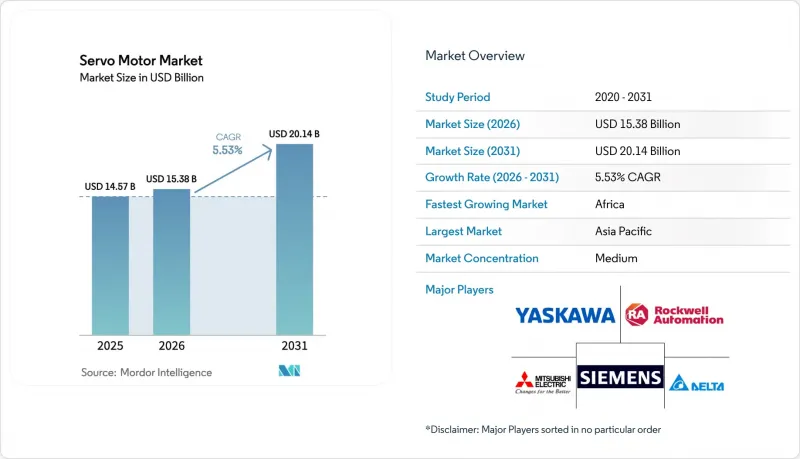
根據 Mordor Intelligence 預測,伺服馬達市場規模將從 2025 年的 145.7 億美元成長到 2026 年的 153.8 億美元,到 2031 年將達到 201.4 億美元,2026 年至 2031 年的複合年成長率為 5.53%。
本報告按馬達類型(交流伺服馬達和直流伺服馬達)、軸配置(單軸和多軸)、額定功率(750W以下、750W至2kW、2kW以上)、通訊介面(類比/PWM、數位現場匯流排)、終端用戶產業(石油天然氣、化學和石化等)以及地區(北美、歐洲等)進行分類。市場預測以美元計價。
全球伺服馬達市場趨勢及洞察
採用國際能源效率標準
IEC 61800-9-2:2025 定義了 IE4 和 IE5 基準,迫使供應商重新設計繞組、磁鐵和韌體,以降低驅動系統損耗。歐盟成員國預計將在 2025 年年中之前將此標準納入其公共採購法規,這將加速市政供水網路的大規模維修。在日本和韓國,將稅額扣抵與符合該標準相結合,正在加速汽車噴漆車間和半導體製造廠對該標準的採用。該法規還強制要求揭露滿載效率曲線,從而將競爭的重點從標價轉移到生命週期營運成本。北美目前落後,但隨著美國能源局在 2027 年的法規中引用該標準,北美有望迎頭趕上。
各產業努力實現智慧靈活的自動化
製造商正在逐步淘汰固定式生產線,轉而採用可重構工作單元,這些工作單元配備伺服驅動龍門架和透過確定性乙太網路連接的協作機器人。 2023年底,全球將有428萬台工業機器人投入運作中。 2024年,德國機械製造商對EtherCAT的採用率達到62%,顯示分散式時鐘運動網路正發生顯著轉變。整合到驅動器中的邊緣AI晶片可以提前30天預測軸承故障,從而將試生產生產線的意外停機時間減少40%。因此,伺服馬達市場不僅受益於機械精度的提升,也受益於數據驅動的運轉率。
低成本步進馬達和無刷直流馬達替代方案的廣泛應用。
開放回路步進馬達和基於感測器的無刷直流馬達比伺服系統便宜 40% 至 60%,這種價格差異對非洲和南美洲等價格敏感型買家極具吸引力。中國供應商在 2024 年出貨了超過 1,200 萬台步進電機,主要用於 3D 列印機、CNC 路由器和紡織機械維護。德州儀器 (TI) 售價 5 美元的編碼器 IC 透過為無刷直流馬達添加封閉回路型回饋,模糊了兩者之間的界限。因此,在成本彈性較大的市場,伺服馬達的普及化被延後了長達三年。
細分市場分析
在伺服馬達市場,無刷直流馬達正經歷最快成長,年複合成長率高達6.47%,這主要得益於醫療、農業和移動機器人領域的原始設備製造商(OEM)對緊湊外形規格的優先考慮。同時,AC馬達仍將佔據市場主導地位,到2025年將佔總銷量的71.47%,這反映了其在採用三相電源的重工業流程中的強勢地位。無框無刷直流馬達是電池供電的手術機器人和外骨骼機器人的首選。碳化矽逆變器正在縮小與傳統感應馬達平台之間的效率差距。
交流伺服馬達在能源回收方面依然保持優勢,這對於立軸數控機床和高架起重機應用而言至關重要。安川馬達等廠商正透過將23位編碼器和碳化矽驅動裝置整合到新一代伺服市場的地位,並將平均故障間隔時間(MTBF)延長至10萬小時。
即使到了2025年,單軸系統仍將佔據63.41%的市場佔有率,主要用於輸送機分度和閥門操作。然而,多軸架構正以7.32%的複合年成長率快速成長,這主要得益於需要協調六個關節的協作機器人的普及。 EtherCAT和PROFINET骨幹網路能夠實現軸間亞微秒級的同步,進而實現靈活、無籠式操作。
汽車焊接生產線正從固定式點焊槍轉向能夠即時適應面板變形的多軸龍門系統。西門子推出了承包解決方案,可將編程時間縮短 60%,並進一步鞏固其在伺服馬達市場的領先地位。
區域分析
預計到2025年,亞太地區將佔全球銷售額的43.74%,這主要得益於中國在智慧型手機組裝領域的領先地位以及韓國高達440億美元的半導體資本支出。在印度,政府透過生產連結獎勵計畫計畫(PLI)提供的補貼(可報銷25%的自動化成本)正在加速汽車和製藥業生產線採用伺服系統。
目前,非洲在伺服市場中所佔佔有率較小,但預計到2031年將以8.13%的複合年成長率成長,這主要得益於南非的電動汽車計劃、奈及利亞食品加工設施的現代化以及肯尼亞紡織品出口的成長。然而,電網可靠性不足和維護技術欠缺正在減緩市場成長,因為低成本的步進馬達仍然是可行的選擇。
北美和歐洲市場依然成熟,但部分地區的醫療設備和航太領域正經歷兩位數成長。這些領域願意為符合IP69K防護等級的不銹鋼馬達和DO-178認證的軟體堆疊支付更高的價格。南美洲因宏觀經濟波動導致進口設備成本上升而發展落後,但如果借貸成本降至10%以下,巴西汽車產業可望再次加速成長。在中東,以沙烏地阿拉伯的「2030願景」為指導,伺服驅動數控工具機和積層製造單元正被選擇性地引進新的工業園區。
其他好處
- Excel格式的市場預測(ME)表
- 3個月的分析師支持
目錄
第1章:引言
- 研究假設和市場定義
- 調查範圍
第2章:調查方法
第3章執行摘要
第4章 市場狀況
- 市場概覽
- 產業價值鏈分析
- 市場促進因素
- 採用國際能源效率標準
- 各產業努力實現智慧靈活的自動化
- 擴大工業機器人和協作機器人的應用
- 為了實現對馬達的分析,整合伺服驅動器和邊緣人工智慧晶片。
- 用於醫療外骨骼的小型伺服解決方案
- 高扭矩伺服在自主農業機械中的應用
- 市場限制因素
- 低成本步進馬達和無刷直流馬達替代方案的廣泛應用。
- 多軸伺服系統需要大量的初始資本投入。
- 地緣政治緊張局勢背景下稀土元素磁鐵的供應風險。
- 網路化運動控制中的網路安全問題
- 宏觀經濟因素對市場的影響
- 監理情勢
- 技術展望
- 波特五力分析
第5章 市場規模與成長預測
- 依馬達類型
- 交流伺服電機
- 直流伺服電機
- 按軸配置
- 單軸
- 多軸
- 按類型分類的額定輸出
- 750瓦或以下
- 750W~2kW
- 超過2千瓦
- 透過通訊介面
- 模擬/PWM
- 數位現場匯流排(CANopen、EtherCAT、PROFINET)
- 按最終用戶行業分類
- 石油和天然氣
- 化工/石油化工
- 發電
- 水和污水處理
- 金屬和採礦
- 飲食
- 各行業
- 車
- 電子和半導體
- 包裝
- 按地區
- 北美洲
- 美國
- 加拿大
- 墨西哥
- 南美洲
- 巴西
- 阿根廷
- 其他南美國家
- 歐洲
- 德國
- 英國
- 法國
- 義大利
- 西班牙
- 俄羅斯
- 其他歐洲國家
- 亞太地區
- 中國
- 日本
- 韓國
- 印度
- 澳洲
- 紐西蘭
- 其他亞太國家
- 中東
- 阿拉伯聯合大公國
- 沙烏地阿拉伯
- 土耳其
- 其他中東國家
- 非洲
- 南非
- 奈及利亞
- 肯亞
- 其他非洲地區
- 北美洲
第6章 競爭情勢
- 市場集中度
- 策略趨勢
- 市佔率分析
- 公司簡介
- Yaskawa Electric Corporation
- Mitsubishi Electric Corp.
- Siemens AG
- Rockwell Automation Inc.
- Delta Electronics Inc.
- ABB Ltd.
- FANUC Corp.
- Schneider Electric SE
- Bosch Rexroth AG
- Kollmorgen Corporation
- Omron Corporation
- Parker Hannifin Corp.
- Nidec Corporation
- Oriental Motor Co. Ltd.
- Lenze SE
- Panasonic Industry Co.
- Toshiba Infrastructure Systems
- Estun Automation Co. Ltd.
- Maxon Group
- Sanyo Denki(SANMOTION)
第7章 市場機會與未來展望
According to Mordor Intelligence, the servo motor market size is expected to increase from USD 14.57 billion in 2025 to USD 15.38 billion in 2026 and reach USD 20.14 billion by 2031, growing at a CAGR of 5.53% over 2026-2031.
This report is Segmented by Motor Type (AC Servo Motor, and DC Servo Motor), Axis Configuration (Single-Axis, and Multi-Axis), Power Rating (<=750 W, 750 W - 2 KW, and >2 KW), Communication Interface (Analog/PWM, and Digital Fieldbus), End-User Industry (Oil and Gas, Chemical and Petrochemical, and More), and Geography (North America, Europe, and More). The Market Forecasts are Provided in Terms of Value (USD).
Global Servo Motor Market Trends and Insights
Adoption Of International Energy-Efficiency Standards
IEC 61800-9-2:2025 established IE4 and IE5 benchmarks, forcing vendors to redesign windings, magnets, and firmware to lower drivetrain losses. EU member states are expected to embed the standard in public procurement rules by mid-2025, triggering large-scale retrofits in municipal water networks. Japan and South Korea linked tax credits to compliance, accelerating adoption across automotive paint shops and semiconductor fabs. The rule also mandates the disclosure of full-load efficiency curves, shifting competition from sticker price to life-cycle operating costs. North America is lagging but is likely to catch up as the U.S. Department of Energy references the standard in its 2027 rulemaking.
Industry-Wide Drive Toward Smart And Flexible Automation
Manufacturers are abandoning hard-tooled transfer lines for reconfigurable work-cells equipped with servo-driven gantries and cobots connected over deterministic Ethernet. Operational industrial robots reached 4.28 million units by the end of 2023. EtherCAT penetration among German machine builders reached 62% in 2024, underscoring the shift toward distributed-clock motion networks. Edge AI chips mounted on drives are predicting bearing failures up to 30 days in advance, cutting unplanned stoppages by 40% in pilot lines. The servo motor market, therefore, benefits not only from mechanical precision but from data-driven uptime improvements.
Proliferation Of Low-Cost Stepper And BLDC Alternatives
Open-loop stepper and sensor-based BLDC motors cost 40-60% less than servo systems, a gap that appeals to price-sensitive buyers in Africa and South America. Chinese suppliers shipped over 12 million steppers in 2024, primarily for use in servicing 3D printers, CNC routers, and textile machinery. Texas Instruments' USD 5 encoder IC blurs the line by adding closed-loop feedback to BLDC motors. As a result, servo adoption is deferred in cost-elastic markets by up to three years.
Other drivers and restraints analyzed in the detailed report include:
- Rising Deployment Of Industrial And Collaborative Robots
- Integration Of Servo Drives With Edge AI Chips For On-Motor Analytics
- Rare-Earth Magnet Supply Risks Amid Geopolitical Tensions
For complete list of drivers and restraints, kindly check the Table Of Contents.
Segment Analysis
Brushless DC motors accounted for the fastest-growing share within the servo motor market, advancing at a 6.47% CAGR as medical, agricultural, and mobile-robot OEMs prioritize compact form factors. AC counterparts still dominated with 71.47% revenue share in 2025, reflecting their hold on heavy industrial processes that tap three-phase grids. Battery-powered surgical robots and exoskeletons favor frameless BLDC units, while silicon-carbide inverters narrow the efficiency gap to legacy induction platforms.
AC designs nonetheless retain an advantage in regenerative energy recovery, a decisive feature in vertical-axis CNC and high-bay crane applications. Vendors such as Yaskawa integrated 23-bit encoders and silicon-carbide drives into next-gen AC platforms, extending mean time between failures to 100,000 hours and reinforcing their presence in the servo motor market.
Single-axis systems still accounted for 63.41% of installations in 2025, primarily used for conveyor indexing and valve actuation tasks. Yet, multi-axis architectures are expanding at a 7.32% CAGR, propelled by cobots that require six coordinated joints. EtherCAT and PROFINET backbones deliver sub-microsecond synchronization across axes, enabling compliant motion without the need for cages.
Automotive welding lines are transitioning from fixed spot guns to multi-axis gantries that adapt in real-time to panel distortion. Siemens launched turnkey packages integrating vision guidance with multi-axis drives, reducing programming labor by 60% and deepening penetration of the servo motor market.
Complete Report Scope:
- By Motor Type
- AC Servo Motor
- DC Servo Motor
- By Axis Configuration
- Single-Axis
- Multi-Axis
- By Power Rating
- <750 W
- 750 W - 2 kW
- >2 kW
- By Communication Interface
- Analog / PWM
- Digital Fieldbus (CANopen, EtherCAT, PROFINET)
- By End-User Industry
- Oil and Gas
- Chemical and Petrochemical
- Power Generation
- Water and Wastewater
- Metal and Mining
- Food and Beverage
- Discrete Industries
- Automotive
- Electronics and Semiconductor
- Packaging
- By Geography
- North America
- United States
- Canada
- Mexico
- South America
- Brazil
- Argentina
- Rest of South America
- Europe
- Germany
- United Kingdom
- France
- Italy
- Spain
- Russia
- Rest of Europe
- Asia Pacific
- China
- Japan
- South Korea
- India
- Australia
- New Zealand
- Rest of Asia Pacific
- Middle East
- United Arab Emirates
- Saudi Arabia
- Turkey
- Rest of Middle East
- Africa
- South Africa
- Nigeria
- Kenya
- Rest of Africa
- North America
Geography Analysis
Asia Pacific generated 43.74% of 2025 revenue, anchored by China's dominance in smartphone assembly and South Korea's USD 44 billion semiconductor CAPEX wave. Government subsidies in India under the Production-Linked Incentive scheme reimburse 25% of automation spend, accelerating servo adoption across automotive and pharma lines.[3]
Africa, although only a small portion of the current servo motor market, is forecast to expand at an 8.13% CAGR through 2031, driven by South Africa's EV program, Nigerian food-processing upgrades, and Kenyan textile exports. Limited grid reliability and servicing expertise, however, keep low-cost stepper alternatives in contention, tempering upside.
North America and Europe remain mature but show pockets of double-digit growth in medical devices and aerospace, segments willing to pay premiums for IP69K stainless motors or DO-178-certified software stacks. South America lags as macro volatility lifts imported-equipment costs, although Brazil's automotive sector could reaccelerate once borrowing costs retreat below 10%. The Middle East, led by Saudi Arabia's Vision 2030, is selectively installing servo-driven CNC and additive manufacturing cells in new industrial zones.
- Yaskawa Electric Corporation
- Mitsubishi Electric Corp.
- Siemens AG
- Rockwell Automation Inc.
- Delta Electronics Inc.
- ABB Ltd.
- FANUC Corp.
- Schneider Electric SE
- Bosch Rexroth AG
- Kollmorgen Corporation
- Omron Corporation
- Parker Hannifin Corp.
- Nidec Corporation
- Oriental Motor Co. Ltd.
- Lenze SE
- Panasonic Industry Co.
- Toshiba Infrastructure Systems
- Estun Automation Co. Ltd.
- Maxon Group
- Sanyo Denki (SANMOTION)
Additional Benefits:
- The market estimate (ME) sheet in Excel format
- 3 months of analyst support
TABLE OF CONTENTS
1 INTRODUCTION
- 1.1 Study Assumptions and Market Definition
- 1.2 Scope of the Study
2 RESEARCH METHODOLOGY
3 EXECUTIVE SUMMARY
4 MARKET LANDSCAPE
- 4.1 Market Overview
- 4.2 Industry ValueChain Analysis
- 4.3 Market Drivers
- 4.3.1 Adoption of International Energy-Efficiency Standards
- 4.3.2 Industry-Wide Drive Toward Smart and Flexible Automation
- 4.3.3 Rising Deployment of Industrial and Collaborative Robots
- 4.3.4 Integration of Servo Drives with Edge AI Chips for On-motor Analytics
- 4.3.5 Miniaturized Servo Solutions for Medical Exoskeletons
- 4.3.6 High-Torque Servo Use in Autonomous Agricultural Equipment
- 4.4 Market Restraints
- 4.4.1 Proliferation of Low-Cost Stepper and BLDC Alternatives
- 4.4.2 High Upfront Capital Expenditure for Multi-Axis Servo Systems
- 4.4.3 Rare-Earth Magnet Supply Risks Amid Geopolitical Tensions
- 4.4.4 Cyber-Security Concerns in Networked Motion Control
- 4.5 Impact of Macroeconomic Factors on the Market
- 4.6 Regulatory Landscape
- 4.7 Technological Outlook
- 4.8 Porter's Five Forces Analysis
- 4.8.1 Bargaining Power of Suppliers
- 4.8.2 Bargaining Power of Buyers
- 4.8.3 Threat of New Entrants
- 4.8.4 Threat of Substitutes
- 4.8.5 Intensity of Competitive Rivalry
5 MARKET SIZE AND GROWTH FORECASTS (VALUE)
- 5.1 By Motor Type
- 5.1.1 AC Servo Motor
- 5.1.2 DC Servo Motor
- 5.2 By Axis Configuration
- 5.2.1 Single-Axis
- 5.2.2 Multi-Axis
- 5.3 By Power Rating
- 5.3.1 <750 W
- 5.3.2 750 W - 2 kW
- 5.3.3 >2 kW
- 5.4 By Communication Interface
- 5.4.1 Analog / PWM
- 5.4.2 Digital Fieldbus (CANopen, EtherCAT, PROFINET)
- 5.5 By End-User Industry
- 5.5.1 Oil and Gas
- 5.5.2 Chemical and Petrochemical
- 5.5.3 Power Generation
- 5.5.4 Water and Wastewater
- 5.5.5 Metal and Mining
- 5.5.6 Food and Beverage
- 5.5.7 Discrete Industries
- 5.5.7.1 Automotive
- 5.5.7.2 Electronics and Semiconductor
- 5.5.7.3 Packaging
- 5.6 By Geography
- 5.6.1 North America
- 5.6.1.1 United States
- 5.6.1.2 Canada
- 5.6.1.3 Mexico
- 5.6.2 South America
- 5.6.2.1 Brazil
- 5.6.2.2 Argentina
- 5.6.2.3 Rest of South America
- 5.6.3 Europe
- 5.6.3.1 Germany
- 5.6.3.2 United Kingdom
- 5.6.3.3 France
- 5.6.3.4 Italy
- 5.6.3.5 Spain
- 5.6.3.6 Russia
- 5.6.3.7 Rest of Europe
- 5.6.4 Asia Pacific
- 5.6.4.1 China
- 5.6.4.2 Japan
- 5.6.4.3 South Korea
- 5.6.4.4 India
- 5.6.4.5 Australia
- 5.6.4.6 New Zealand
- 5.6.4.7 Rest of Asia Pacific
- 5.6.5 Middle East
- 5.6.5.1 United Arab Emirates
- 5.6.5.2 Saudi Arabia
- 5.6.5.3 Turkey
- 5.6.5.4 Rest of Middle East
- 5.6.6 Africa
- 5.6.6.1 South Africa
- 5.6.6.2 Nigeria
- 5.6.6.3 Kenya
- 5.6.6.4 Rest of Africa
- 5.6.1 North America
6 COMPETITIVE LANDSCAPE
- 6.1 Market Concentration
- 6.2 Strategic Moves
- 6.3 Market Share Analysis
- 6.4 Company Profiles (includes Global Level Overview, Market Level Overview, Core Segments, Financials, Strategic Information, Market Rank/Share, Products and Services, Recent Developments)
- 6.4.1 Yaskawa Electric Corporation
- 6.4.2 Mitsubishi Electric Corp.
- 6.4.3 Siemens AG
- 6.4.4 Rockwell Automation Inc.
- 6.4.5 Delta Electronics Inc.
- 6.4.6 ABB Ltd.
- 6.4.7 FANUC Corp.
- 6.4.8 Schneider Electric SE
- 6.4.9 Bosch Rexroth AG
- 6.4.10 Kollmorgen Corporation
- 6.4.11 Omron Corporation
- 6.4.12 Parker Hannifin Corp.
- 6.4.13 Nidec Corporation
- 6.4.14 Oriental Motor Co. Ltd.
- 6.4.15 Lenze SE
- 6.4.16 Panasonic Industry Co.
- 6.4.17 Toshiba Infrastructure Systems
- 6.4.18 Estun Automation Co. Ltd.
- 6.4.19 Maxon Group
- 6.4.20 Sanyo Denki (SANMOTION)
7 MARKET OPPORTUNITIES AND FUTURE OUTLOOK
- 7.1 White-Space and Unmet-Need Assessment

 2026-2030年全球伺服馬達及驅動器市場
 伺服馬達及驅動器:市場佔有率分析、產業趨勢及統計數據、成長預測(2026-2031)
 伺服馬達及驅動器市場:全球市場預測,2026-2032年
 伺服馬達及驅動器市場預測至2034年-按組件、電壓範圍、產業、應用、最終用戶和地區分類的全球分析
 伺服馬達市場規模、佔有率和成長分析:按產品類型、電壓範圍、額定功率、通訊協定、系統類型、最終用戶產業、應用和地區分類-2026-2033年產業預測
 數位伺服馬達及驅動器市場機會、成長要素、產業趨勢分析及2026-2035年預測
 2026年全球房車減速機市場研究報告
 伺服馬達和步進馬達市場規模、佔有率和成長分析:按馬達類型、最終用戶細分市場、技術、銷售管道和地區分類-2026-2033年產業預測無鐵心直線伺服馬達市場:依馬達類型、行程長度、工作電壓、組件、安裝方式、應用、終端用戶產業分類,全球預測,2026-2032年
 數位伺服馬達及驅動器市場分析及預測(至2035年):依類型、產品類型、服務、技術、組件、應用、最終用戶、功能、安裝類型、設備分類