


 |
市場調查報告書
商品編碼
2123400
伺服馬達及驅動器:市場佔有率分析、產業趨勢及統計數據、成長預測(2026-2031)Servo Motors And Drives - Market Share Analysis, Industry Trends & Statistics, Growth Forecasts (2026 - 2031) |
||||||

※ 本網頁內容可能與最新版本有所差異。詳細情況請與我們聯繫。
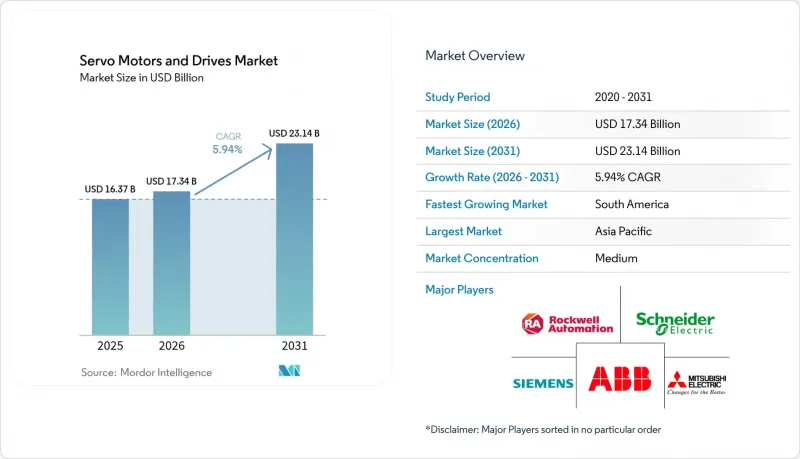
根據 Mordor Intelligence 預測,伺服馬達和驅動器市場規模預計將在 2025 年達到 163.7 億美元,2026 年達到 173.4 億美元,到 2031 年達到 231.4 億美元,2026 年至 2031 年的複合年成長率為 5.94%。
本報告按產品類型(馬達和驅動器)、電壓範圍(低壓、中壓、高壓)、終端用戶行業(包裝和標籤、半導體和電子、化學和石化、食品和飲料、紡織和印刷等)、額定功率(小於1千瓦、15千瓦及以上等)以及地區進行細分。市場預測以美元(USD)計價。
全球伺服馬達和驅動器市場趨勢及洞察
快速的工業自動化和智慧工廠應用
製造商正在加速採用無人化生產模式,伺服也從可選升級轉變為必不可少的基礎設施。德勤的一項調查顯示,68%的製造業計劃在兩年內實現物料輸送自動化。電子產品組裝現在每季都會重新配置,伺服系統能夠實現固定自動化無法達到的亞毫米級重複精度。汽車和家用電子電器工廠預計到2026年,配備伺服的生產線數量將增加23%,以取代氣壓執行器來應對日益成長的變異性。 2025年,全球部署的機器人數量將達到55.3萬台,每年新增伺服馬達超過330萬台。在中國,150億元人民幣(約21億美元)的定向補貼加速了伺服驅動器與工業IoT整合的升級改造,從而開拓了二、三線市場。
協作機器人和移動機器人的應用日益普及
從大型工廠到中小企業,協作式和自主式移動機器人正日益普及,每台機器人配備6至8個無框伺服電機,以實現靈活的運動。預計2025年,全球移動機器人出貨量將達到14萬台。 ABB報告稱,其移動機器人部門的銷售額成長了41%,這主要得益於每個地點運行50至100台機器人的系統。波士頓動力公司(Boston Dynamics)的「Stretch」機器人已被多家大型物流公司採用,該機器人配備了11軸伺服,這表明每台機器人的伺服數量正在增加。移動性和控制功能的結合正在推動市場需求,預計物流行業的兩位數成長將持續到2028年。
與感應馬達和步進馬達等替代方案相比,初始成本較高。
5千瓦伺服馬達的平均價格為2800美元,而感應馬達價格為950美元,步進馬達價格為600美元,中等負載工況下的投資回收期為3-5年。新興市場的中小型企業通常選擇步行馬達以節省資金,尤其是在低成本勞動成本超過自動化優勢的情況下。由於採購團隊並不總是清楚全生命週期效益,因此決策往往傾向於選擇前期成本最低的方案。供應商目前提供基於績效的契約,但預計到2025年,此類合約的採用率將低於15%。
細分市場分析
到2025年,伺服馬達和驅動器市場銷售額將達到103.9億美元,佔市場佔有率的63.47%。預計到2031年,這一佔有率將以6.37%的複合年成長率成長。交流旋轉馬達佔據主導地位,因為其高扭矩慣量比使其適用於需要毫秒響應時間的多軸數控工具機和關節機器人。無刷直流馬達雖然產量較小,但在手術機器人和航太機構中越來越受到關注,因為這些應用對低氣體排放和極端溫度下的性能要求很高。線性馬達的銷售額佔比不到5%,但由於其亞微米級的精度和消除機械反沖的特性,在半導體微影術領域實現了兩位數的成長。
預計到2025年,驅動市場銷售額將達到59.8億美元,並發展成為一個集安全、分析和多軸協調功能於一體的智慧運動控制中心。交流伺服驅動器是這項轉型的基礎,而可調式多軸平台正經歷最快的成長,因為機器製造商將多達64個軸整合到單一機架中。整合式馬達驅動執行器佔新安裝量的18%,它減少了機櫃空間,並簡化了對IEC 61800-5-2功能安全標準的合規性。供應商現在透過捆綁雲端連接的診斷功能來獲得訂閱收入,而新的差異化前沿正在從硬體轉向軟體。
到2025年,1000V以下的低壓系統將佔銷售額的72.38%。這主要得益於標準化的400V和480V工業電網以及縮短認證週期的既定安全標準。這些平台正逐漸成為機器人、包裝和移動自動化領域的主流選擇,在這些領域,緊湊的外形尺寸和低衝擊風險比單純的輸出功率更為重要。電池供電的協作機器人和自動導引運輸車(AGV)普遍採用低壓伺服,儘管平均售價下降,但銷量仍居高不下。此外,在成熟工廠的維修中,600V以下的解決方案更受歡迎,因為它們無需昂貴的開關設備升級,可以直接整合到現有的配電盤佈局中。
中壓產品系列(1,000 V 至 10,000 V)正以 6.54% 的複合年成長率 (CAGR) 成長,是該電壓等級中成長最快的。這主要歸功於金屬加工、採礦以及石油和天然氣行業中,直流 (DC) 和液壓驅動正被精密交流 (AC)伺服所取代。例如,新型鋼帶軋延正在採用兆瓦級伺服機架,以提高產量並顯著減少停機時間,從而證明了其高昂價格的合理性。主動前端整流器和通用直流母線架構使得工廠能夠將中壓電源與低壓馬達結合,從而最佳化面積並提高效率。 10 kV 以上的高壓產品目前仍主要面向粒子加速器和航太發電機等專業細分市場,但碳化矽絕緣技術的逐步進步預計將在本十年後半期推動其在更廣泛的工業應用領域的應用。
區域分析
預計到2025年,亞太地區將佔全球銷售額的39.73%,凸顯其作為電子、機械和機器人生產中心的地位。光是中國預計到2025年就將生產450萬台伺服電機,中國產品牌將滿足國內55%的需求,這主要得益於其在解析度和熱穩定性方面不斷縮小差距。 「中國製造2025」計畫提供80億元人民幣(約11億美元)的設備升級補貼,優先扶持配備高精度伺服驅動器的數控工具機和機器人。日本伺服產品出口額達2,870億日圓(約20億美元),在需要奈米級定位精度的半導體和醫療設備領域保持主導地位。印度的「生產連結獎勵計畫(PLI)」計畫預計到 2025 年將貢獻 12,500 印度盧比(15 億美元),為組裝增加 18,0000 個軸提供資金,從而顯著擴大該地區的伺服馬達和驅動器市場。
在《晶片與科學法案》提供的390億美元半導體製造激勵措施的支持下,北美預計將在2025年佔據近24%的銷售額。英特爾、台積電和三星的新晶圓廠均整合了5000至8000個軸,用於晶圓處理、光刻和測量,從而推動了高精度伺服訂單的成長。羅克韋爾自動化公司報告稱,由於汽車和食品加工行業加速自動化以彌補技術純熟勞工短缺,該地區的訂單激增了18%。預計在2024年至2025年間,墨西哥將吸引350億美元的近岸外包投資,透過在待開發區建廠部署最先進的自動化設備,提升其在北美伺服馬達和驅動器市場的佔有率。
到2025年,歐洲將佔全球銷售額的約22%,並正在加速現有設施的維修,以滿足2027年生效的IE4能源效率標準。西門子在德國和義大利的伺服驅動器銷量成長了14%,出口商紛紛將「Sinamics S210」平台整合到其包裝設備和數控機床中。英國斥資45億英鎊(57億美元)的「先進製造計畫」正在投資航太複合材料以及製藥業的填充/包裝生產線,這些領域都需要高頻寬伺服馬達。預計到2031年,以巴西和阿根廷為首的南美洲將達到最高的複合年成長率,達到6.91%。這主要得益於2025年182億美元的投資流入以及對自動化水準的強勁需求,其自動化需求將達到全球標準。雖然其在中東和非洲地區的佔有率仍然低於 8%,但隨著沙烏地阿拉伯和阿拉伯聯合大公國(阿拉伯聯合大公國)在經濟多元化計畫中指定使用伺服驅動裝置作為建築材料和製藥產品,其佔有率仍在繼續成長。
其他好處:
- Excel格式的市場預測(ME)表
- 3個月的分析師支持
目錄
第1章:引言
- 研究假設和市場定義
- 調查範圍
第2章:調查方法
第3章執行摘要
第4章 市場狀況
- 市場概覽
- 市場促進因素
- 工業自動化的快速發展和智慧工廠的引入
- 協作機器人和移動機器人的廣泛應用
- 全球和區域層面的嚴格能源效率法規
- 伺服驅動器向碳化矽功率模組的過渡
- 利用數位孿生技術對伺服系統進行預測性尺寸設計
- 微型倉配中心的擴張需要緊湊型伺服驅動器。
- 市場限制因素
- 與感應式和步進式等替代技術相比,初始成本較高。
- 高等級稀土永磁體的供應鏈風險
- 網路連接伺服驅動器的網路漏洞會導致停機
- 整合伺服-步進混合產品的市場佔有率不斷成長,正在蠶食入門級伺服系統的市場佔有率。
- 產業價值鏈分析
- 監理情勢
- 技術展望
- 波特五力分析
- 宏觀經濟因素對市場的影響
- 主要用例和案例研究
- 投資分析
第5章 市場規模與成長預測
- 依產品類型
- 引擎
- 交流伺服電機
- 直流無刷伺服電機
- 有刷直流伺服電機
- 直線伺服電機
- 駕駛
- 交流伺服驅動器
- 直流伺服驅動器
- 可調/多軸伺服驅動器
- 引擎
- 按電壓範圍
- 低電壓
- 中壓
- 高壓
- 按最終用戶行業分類
- 汽車和電動汽車製造
- 石油和天然氣
- 醫療保健和醫療設備
- 包裝和標籤
- 半導體和電子學
- 化工/石油化工
- 食品/飲料
- 紡織和印刷
- 額定功率
- 小於1千瓦
- 1 kW~5 kW
- 5 kW~15 kW
- 15千瓦或以上
- 按地區
- 北美洲
- 美國
- 加拿大
- 墨西哥
- 南美洲
- 巴西
- 阿根廷
- 其他南美國家
- 歐洲
- 英國
- 德國
- 法國
- 義大利
- 其他歐洲國家
- 亞太地區
- 中國
- 日本
- 印度
- 韓國
- 其他亞太國家
- 中東和非洲
- 中東
- 阿拉伯聯合大公國
- 沙烏地阿拉伯
- 其他中東國家
- 非洲
- 南非
- 埃及
- 其他非洲國家
- 中東
- 北美洲
第6章 競爭情勢
- 市場集中度
- 策略趨勢
- 市佔率分析
- 公司簡介
- Yaskawa Electric Corporation
- Mitsubishi Electric Corporation
- Siemens AG
- Schneider Electric SE
- Rockwell Automation, Inc.
- ABB Ltd.
- Delta Electronics, Inc.
- FANUC Corporation
- Kollmorgen Corporation
- Bosch Rexroth AG
- Panasonic Holdings Corporation
- Nidec Corporation
- Omron Corporation
- Oriental Motor Co., Ltd.
- Lenze SE
- Parker-Hannifin Corporation
- Inovance Technology Co., Ltd.
- Moog Inc.
- WEG Equipamentos Eletricos SA
- Emerson Electric Co.
- AMETEK, Inc.
- TECO Electric & Machinery Co., Ltd.
- Nanotec Electronic GmbH & Co. KG
- SANYO DENKI Co., Ltd.
- Fuji Electric Co., Ltd.
第7章 市場機會與未來展望
According to Mordor Intelligence, the servo motors and drives market size is projected to be USD 16.37 billion in 2025, USD 17.34 billion in 2026, and reach USD 23.14 billion by 2031, growing at a CAGR of 5.94% from 2026 to 2031.
This report is Segmented by Product Type (Motor, and Drive), Voltage Range (Low Voltage, Medium Voltage, High Voltage), End-User Industry (Packaging and Labelling, Semiconductor and Electronics, Chemicals and Petrochemicals, Food and Beverage, Textile and Printing, and More), Power Rating (Below 1 KW, Above 15 KW, and More), and Geography. The Market Forecasts are Provided in Terms of Value (USD).
Global Servo Motors And Drives Market Trends and Insights
Rapid Industrial Automation and Smart-Factory Rollout
Manufacturers are accelerating the adoption of lights-out production models, elevating servos from optional upgrades to mandatory infrastructure. Deloitte found that 68% of producers intend to deploy autonomous material-handling within two years. Electronics assembly lines now reconfigure quarterly, and servo systems enable sub-millimeter repeatability that fixed automation cannot match. Automotive and consumer-electronics plants boosted servo content per line by 23% in 2026, replacing pneumatic actuators to handle the proliferation of variants. Global robot installations hit 553,000 units in 2025, adding more than 3.3 million new servo motors annually. Targeted subsidies worth CNY 15 billion (USD 2.1 billion) in China accelerated upgrades that integrate servo drives with industrial IoT, opening Tier-2 and Tier-3 markets.
Rising Adoption of Collaborative and Mobile Robotics
Collaborative robots and autonomous mobile robots are spreading beyond large factories into small and medium enterprises, each unit containing 6-8 frameless servo motors for compliant motion. Global shipments of mobile robots reached 140,000 units in 2025, and ABB reported a 41% revenue jump in its mobile-robot division driven by fleets of 50-100 vehicles per site. Boston Dynamics' Stretch, adopted by major logistics firms, carries 11 servo axes, highlighting the rising servo count per robot. The combination of locomotion and manipulation intensifies demand, sustaining double-digit logistics growth through 2028.
High Upfront Cost versus Induction or Stepper Alternatives
A 5 kW servo package averages USD 2,800, versus USD 950 for an induction motor with a VFD and USD 600 for a stepper, yielding 3-5 year payback horizons for moderate-duty tasks. Emerging-market SMEs frequently choose steppers to conserve capital, especially when low-cost labor offsets the benefits of automation. Lifecycle advantages are not always visible to procurement teams, so decisions tend to skew toward the lowest upfront price. Vendors now offer performance-based contracts, but penetration remained below 15% in 2025.
Other drivers and restraints analyzed in the detailed report include:
- Stringent Global and Regional Energy-Efficiency Mandates
- Transition to Silicon-Carbide Power Modules in Servo Drives
- Supply-Chain Risk for High-Grade Rare-Earth Permanent Magnets
For complete list of drivers and restraints, kindly check the Table Of Contents.
Segment Analysis
Motors generated USD 10.39 billion of the servo motors and drives market in 2025, translating into a 63.47% market share, which is projected to widen at a 6.37% CAGR through 2031. AC rotary models dominate because their high torque-to-inertia ratios suit multi-axis CNC machines and articulated robots that demand millisecond response times. Brushless DC variants, though smaller in volume, are gaining traction in surgical robots and aerospace mechanisms where low outgassing and extreme-temperature performance are critical. Linear motors occupy less than 5% of revenue yet post double-digit growth in semiconductor lithography owing to their sub-micron accuracy and elimination of mechanical backlash.
Drives contributed USD 5.98 billion in 2025 and are evolving into intelligent motion hubs that embed safety, analytics, and multi-axis coordination. AC servo drives form the backbone of this shift, while adjustable multi-axis platforms are the fastest risers as machine builders condense up to 64 axes into one rack. Adoption of integrated motor-drive actuators climbed to 18% of new installations, cutting cabinet space and simplifying compliance with IEC 61800-5-2 functional-safety rules. Vendors now bundle cloud-connected diagnostics that unlock subscription revenue, making software, not hardware, the new frontier for differentiation.
Low-voltage systems below 1,000 V controlled 72.38% of revenue in 2025, driven by standardized 400 V and 480 V industrial grids and well-established safety norms that shorten certification cycles. These platforms dominate robotics, packaging, and mobile automation, where compact form factors and lower shock risk outweigh raw power. Battery-powered collaborative robots and automated guided vehicles universally use low-voltage servos, helping sustain high unit volumes even as average selling prices erode. Retrofits in mature factories also favor sub-600 V solutions because they drop into existing panel layouts without costly switchgear upgrades.
Medium-voltage products ranging from 1,000 V to 10,000 V are expanding at a 6.54% CAGR, the quickest rate among voltage classes, as metals processing, mining, and oil and gas replace DC and hydraulic drives with precision AC servos. New steel strip mills, for instance, deploy megawatt-class servo stands that boost yield and slash downtime, justifying their premium. Active front-end rectifiers and common DC-bus architectures now let plants combine medium-voltage mains with low-voltage motors, optimizing both footprint and efficiency. High-voltage offerings above 10 kV remain a specialized niche serving particle accelerators and aerospace dynos, but incremental gains in silicon-carbide insulation may unlock broader industrial use later in the decade.
Complete Report Scope:
- By Product Type
- Motor
- AC Servo Motor
- DC Brushless Servo Motor
- Brushed DC Servo Motor
- Linear Servo Motor
- Drive
- AC Servo Drive
- DC Servo Drive
- Adjustable / Multi-Axis Servo Drive
- Motor
- By Voltage Range
- Low Voltage
- Medium Voltage
- High Voltage
- By End-User Industry
- Automotive and EV Manufacturing
- Oil and Gas
- Healthcare and Medical Devices
- Packaging and Labelling
- Semiconductor and Electronics
- Chemicals and Petrochemicals
- Food and Beverage
- Textile and Printing
- By Power Rating
- Below 1 kW
- 1 kW-5 kW
- 5 kW-15 kW
- Above 15 kW
- By Geography
- North America
- United States
- Canada
- Mexico
- South America
- Brazil
- Argentina
- Rest of South America
- Europe
- United Kingdom
- Germany
- France
- Italy
- Rest of Europe
- Asia Pacific
- China
- Japan
- India
- South Korea
- Rest of Asia Pacific
- Middle East and Africa
- Middle East
- United Arab Emirates
- Saudi Arabia
- Rest of Middle East
- Africa
- South Africa
- Egypt
- Rest of Africa
- Middle East
- North America
Geography Analysis
Asia-Pacific led with 39.73% of global revenue in 2025, underscoring the region's role as the production hub for electronics, machinery, and robotics. China alone manufactured 4.5 million servo motors in 2025, and domestic brands accounted for 55% of local demand by narrowing the gap in resolution and thermal stability. The Made in China 2025 program disbursed CNY 8 billion (USD 1.1 billion) in upgrade subsidies, prioritizing CNC machines and robots equipped with precision servo drives. Japan exported JPY 287 billion (USD 2.0 billion) in servo products, maintaining leadership in semiconductor and medical equipment that need nanometer positioning accuracy. India's Production-Linked Incentive scheme released INR 12,500 crore (USD 1.5 billion) in 2025, funding assembly lines that added 180,000 new axes and substantially enlarged the regional servo motors and drives market.
North America held close to 24% of 2025 revenue, buoyed by USD 39 billion in semiconductor-fabrication incentives under the CHIPS and Science Act. New fabs from Intel, TSMC, and Samsung each integrate 5,000-8,000 axes for wafer handling, lithography, and metrology, driving incremental orders for high-precision servos. Rockwell Automation reported an 18% regional order spike, with automotive and food processors automating to offset skilled-labor shortages. Mexico attracted USD 35 billion in nearshoring investment during 2024-2025, equipping greenfield plants with state-of-the-art automation and lifting the country's servo motors and drives market share within North America.
Europe captured about 22% of global revenue in 2025 and is accelerating retrofits to meet IE4 efficiency mandates effective 2027. Siemens logged 14% servo-drive growth in Germany and Italy as exporters embedded the Sinamics S210 platform in packaging and CNC machinery. The United Kingdom's GBP 4.5 billion (USD 5.7 billion) Advanced Manufacturing Plan channels funds into aerospace composites and pharmaceutical fill-finish lines that favor high-bandwidth servos. South America, led by Brazil and Argentina, is forecast to post the fastest CAGR of 6.91% through 2031, as USD 18.2 billion in inbound investment in 2025 demands automation on par with global benchmarks. The Middle East and Africa remain below 8% share but are growing as Saudi and Emirati diversification programs specify servo-driven equipment for construction materials and pharmaceuticals.
- Yaskawa Electric Corporation
- Mitsubishi Electric Corporation
- Siemens AG
- Schneider Electric SE
- Rockwell Automation, Inc.
- ABB Ltd.
- Delta Electronics, Inc.
- FANUC Corporation
- Kollmorgen Corporation
- Bosch Rexroth AG
- Panasonic Holdings Corporation
- Nidec Corporation
- Omron Corporation
- Oriental Motor Co., Ltd.
- Lenze SE
- Parker-Hannifin Corporation
- Inovance Technology Co., Ltd.
- Moog Inc.
- WEG Equipamentos Eletricos S.A.
- Emerson Electric Co.
- AMETEK, Inc.
- TECO Electric & Machinery Co., Ltd.
- Nanotec Electronic GmbH & Co. KG
- SANYO DENKI Co., Ltd.
- Fuji Electric Co., Ltd.
Additional Benefits:
- The market estimate (ME) sheet in Excel format
- 3 months of analyst support
TABLE OF CONTENTS
1 INTRODUCTION
- 1.1 Study Assumptions and Market Definition
- 1.2 Scope of the Study
2 RESEARCH METHODOLOGY
3 EXECUTIVE SUMMARY
4 MARKET LANDSCAPE
- 4.1 Market Overview
- 4.2 Market Drivers
- 4.2.1 Rapid Industrial Automation and Smart-Factory Rollout
- 4.2.2 Rising Adoption of Collaborative and Mobile Robotics
- 4.2.3 Stringent Global and Regional Energy-Efficiency Mandates
- 4.2.4 Transition to Silicon-Carbide Power Modules in Servo Drives
- 4.2.5 Digital-Twin-Enabled Predictive Sizing of Servo Systems
- 4.2.6 Growth of Micro-Fulfilment Centres Requiring Compact Servo Actuation
- 4.3 Market Restraints
- 4.3.1 High Upfront Cost versus Induction or Stepper Alternatives
- 4.3.2 Supply-Chain Risk for High-Grade Rare-Earth Permanent Magnets
- 4.3.3 Cyber-Vulnerabilities in Networked Servo Drives Causing Downtime
- 4.3.4 Rising Share of Integrated Servo-Stepper Hybrids Cannibalising Entry-Level Servo Systems
- 4.4 Industry Value Chain Analysis
- 4.5 Regulatory Landscape
- 4.6 Technological Outlook
- 4.7 Porter's Five Forces Analysis
- 4.7.1 Bargaining Power of Suppliers
- 4.7.2 Bargaining Power of Buyers
- 4.7.3 Threat of New Entrants
- 4.7.4 Threat of Substitutes
- 4.7.5 Competitive Rivalry
- 4.8 Impact of Macroeconomic Factors on the Market
- 4.9 Key Use Cases and Case Studies
- 4.10 Investment Analysis
5 MARKET SIZE AND GROWTH FORECASTS (VALUE)
- 5.1 By Product Type
- 5.1.1 Motor
- 5.1.1.1 AC Servo Motor
- 5.1.1.2 DC Brushless Servo Motor
- 5.1.1.3 Brushed DC Servo Motor
- 5.1.1.4 Linear Servo Motor
- 5.1.2 Drive
- 5.1.2.1 AC Servo Drive
- 5.1.2.2 DC Servo Drive
- 5.1.2.3 Adjustable / Multi-Axis Servo Drive
- 5.1.1 Motor
- 5.2 By Voltage Range
- 5.2.1 Low Voltage
- 5.2.2 Medium Voltage
- 5.2.3 High Voltage
- 5.3 By End-User Industry
- 5.3.1 Automotive and EV Manufacturing
- 5.3.2 Oil and Gas
- 5.3.3 Healthcare and Medical Devices
- 5.3.4 Packaging and Labelling
- 5.3.5 Semiconductor and Electronics
- 5.3.6 Chemicals and Petrochemicals
- 5.3.7 Food and Beverage
- 5.3.8 Textile and Printing
- 5.4 By Power Rating
- 5.4.1 Below 1 kW
- 5.4.2 1 kW-5 kW
- 5.4.3 5 kW-15 kW
- 5.4.4 Above 15 kW
- 5.5 By Geography
- 5.5.1 North America
- 5.5.1.1 United States
- 5.5.1.2 Canada
- 5.5.1.3 Mexico
- 5.5.2 South America
- 5.5.2.1 Brazil
- 5.5.2.2 Argentina
- 5.5.2.3 Rest of South America
- 5.5.3 Europe
- 5.5.3.1 United Kingdom
- 5.5.3.2 Germany
- 5.5.3.3 France
- 5.5.3.4 Italy
- 5.5.3.5 Rest of Europe
- 5.5.4 Asia Pacific
- 5.5.4.1 China
- 5.5.4.2 Japan
- 5.5.4.3 India
- 5.5.4.4 South Korea
- 5.5.4.5 Rest of Asia Pacific
- 5.5.5 Middle East and Africa
- 5.5.5.1 Middle East
- 5.5.5.1.1 United Arab Emirates
- 5.5.5.1.2 Saudi Arabia
- 5.5.5.1.3 Rest of Middle East
- 5.5.5.2 Africa
- 5.5.5.2.1 South Africa
- 5.5.5.2.2 Egypt
- 5.5.5.2.3 Rest of Africa
- 5.5.5.1 Middle East
- 5.5.1 North America
6 COMPETITIVE LANDSCAPE
- 6.1 Market Concentration
- 6.2 Strategic Moves
- 6.3 Market Share Analysis
- 6.4 Company Profiles (includes Global Level Overview, Market Level Overview, Core Segments, Financials as available, Strategic Information, Market Rank/Share, Products and Services, Recent Developments)
- 6.4.1 Yaskawa Electric Corporation
- 6.4.2 Mitsubishi Electric Corporation
- 6.4.3 Siemens AG
- 6.4.4 Schneider Electric SE
- 6.4.5 Rockwell Automation, Inc.
- 6.4.6 ABB Ltd.
- 6.4.7 Delta Electronics, Inc.
- 6.4.8 FANUC Corporation
- 6.4.9 Kollmorgen Corporation
- 6.4.10 Bosch Rexroth AG
- 6.4.11 Panasonic Holdings Corporation
- 6.4.12 Nidec Corporation
- 6.4.13 Omron Corporation
- 6.4.14 Oriental Motor Co., Ltd.
- 6.4.15 Lenze SE
- 6.4.16 Parker-Hannifin Corporation
- 6.4.17 Inovance Technology Co., Ltd.
- 6.4.18 Moog Inc.
- 6.4.19 WEG Equipamentos Eletricos S.A.
- 6.4.20 Emerson Electric Co.
- 6.4.21 AMETEK, Inc.
- 6.4.22 TECO Electric & Machinery Co., Ltd.
- 6.4.23 Nanotec Electronic GmbH & Co. KG
- 6.4.24 SANYO DENKI Co., Ltd.
- 6.4.25 Fuji Electric Co., Ltd.
7 MARKET OPPORTUNITIES AND FUTURE OUTLOOK
- 7.1 White-Space and Unmet-Need Assessment

 2026-2030年全球伺服馬達及驅動器市場
 伺服馬達:市場佔有率分析、產業趨勢與統計、成長預測(2026-2031)
 伺服馬達及驅動器市場:全球市場預測,2026-2032年
 伺服馬達及驅動器市場預測至2034年-按組件、電壓範圍、產業、應用、最終用戶和地區分類的全球分析
 伺服馬達市場規模、佔有率和成長分析:按產品類型、電壓範圍、額定功率、通訊協定、系統類型、最終用戶產業、應用和地區分類-2026-2033年產業預測
 數位伺服馬達及驅動器市場機會、成長要素、產業趨勢分析及2026-2035年預測
 2026年全球房車減速機市場研究報告
 伺服馬達和步進馬達市場規模、佔有率和成長分析:按馬達類型、最終用戶細分市場、技術、銷售管道和地區分類-2026-2033年產業預測無鐵心直線伺服馬達市場:依馬達類型、行程長度、工作電壓、組件、安裝方式、應用、終端用戶產業分類,全球預測,2026-2032年
 數位伺服馬達及驅動器市場分析及預測(至2035年):依類型、產品類型、服務、技術、組件、應用、最終用戶、功能、安裝類型、設備分類