


 |
市場調查報告書
商品編碼
2124966
歐洲精密農業:市場佔有率分析、產業趨勢與統計及成長預測(2026-2031)Europe Precision Farming - Market Share Analysis, Industry Trends & Statistics, Growth Forecasts (2026 - 2031) |
||||||

※ 本網頁內容可能與最新版本有所差異。詳細情況請與我們聯繫。
據 Mordor Intelligence 稱,歐洲精密農業市場預計在 2026 年達到 26.2 億美元,預計到 2031 年將達到 47.5 億美元,複合年成長率為 12.64%。
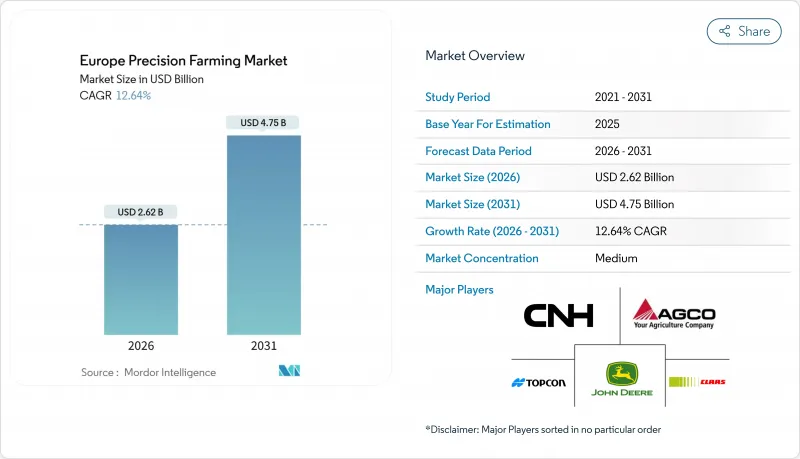
本報告按技術(導航系統、遙感探測等)、組件(硬體、軟體、服務)、應用(產量監測、變數施肥等)、農場規模(小規模等)、作物類型(穀物等)和地區(德國、法國等)進行細分。市場預測以美元計價。
歐洲精密農業市場趨勢與洞察
政府補貼加速數位化普及
歐盟成員國正從通用農業政策(CAP)預算中撥出數十億歐元,用於支持精密農業,為小規模農戶補貼相當一部分硬體成本。法國實施了軟體使用費稅額扣抵制度,鼓勵更多農民使用數位化平台。到2024年,這些稅額扣抵已收回7.56億歐元(8.3億美元),高於該制度五年前推出時的2.77億歐元(3.05億美元)。德國啟動了大規模的自主農業機械津貼計劃,優先扶持生產合作社,以加速推廣應用。補貼計畫在東歐尤為有效,當地企業透過直接採用先進的感測器網路,縮短了引進週期。這些財政支持降低了風險認知,促進了銀行貸款,並提升了精密農業市場的基本需求。
利用人工智慧、物聯網和5G技術的分析技術正在快速發展
目前,5G農村網路覆蓋範圍正在歐洲大部分農田擴展,實現了從曳引機到雲端模型的即時影片傳輸。物聯網土壤感測器與氣象數據相連,已證實能夠在不降低產量的情況下顯著節約用水,展現了互聯系統的直接效益。採用先進噴灑技術的農民報告稱,除草劑用量大幅減少,證實了成本節約和環境效益。邊緣運算已將延遲降低至毫秒級,使自主系統能夠逐行調整播種量。人工智慧和互聯技術的結合,正在推動精密農業從單純的態勢感知發展到具體的行動指南,進一步拉大了數位化農場與傳統農場之間的差距。
勞動力短缺正在推動自動化機械的普及。
農業工人數量持續下降,加劇了薪資上漲和旺季勞動力短缺的局面。在人事費用高的國家,自動駕駛曳引機已經無人駕駛運行數千小時,減輕了農場管理的負擔。新的系統允許一名操作員同時監控多台機器,使現場效率提高三倍。隨著人事費用的持續上漲,機器人收割機正在蔬果農場中得到應用。自動駕駛車輛的監管批准正在為其更廣泛的應用鋪平道路,這表明自動化將在解決勞動力短缺問題上發揮核心作用。
細分市場分析
導航系統仍然是歐洲精密農業市場的核心組成部分,預計到2025年將佔據43.5%的最大佔有率。其主導地位源自於穀物農場的廣泛應用,自動駕駛聯合收割機能夠即時降低燃油和人事費用。由於對數位素養要求極低,導航系統易於使用,因此確保了強勁的升級需求。然而,隨著使用者群體的成熟,導航系統的成長速度正在放緩,市場重心也從新安裝轉向分階段升級。導航系統仍然是重要的傳統收入來源,進一步鞏固了其作為最成熟技術的地位。
相較之下,無人機是成長最快的技術,預計到2031年將以11.1%的複合年成長率成長。其吸引力在於對創新的投入,先進的農民將無人機影像與衛星地圖結合,以最佳化可變施肥方案。將原始影像轉化為可操作施肥區域的企業級軟體,正在推動無人機技術從最初的業餘愛好者群體擴展到更廣泛的應用領域。遙感探測、邊緣感測器和數位孿生等新興工具正蓬勃發展,這得益於低成本處理器和不斷擴展的5G連接。無人機生動地展現了對創新投入如何改變精密農業的技術格局。
硬體支出仍佔歐洲精密農業市場的大部分,預計2025年將佔市場48.2%的佔有率。 接收器、攝影機和控制器等耐用設備對田間作業仍然至關重要。儘管單價下降,但由於農場需要實質的工具來維持生產力,整體需求仍然強勁。硬體的既有地位確保了其重要性,儘管其成長速度較數位解決方案略慢。這一領域反映了精密農業對實體基礎設施的強勁需求,從而支撐了市場基礎。
同時,軟體產業是成長最快的領域,預計到2031年將以11.2%的複合年成長率成長。供應商正在轉向基於訂閱的雲端模式,以實現持續升級並降低前期成本。這種架構正在吸引那些先前面臨財務障礙的中型農業營運商。隨著農場對校準、資料清洗和農業化學品解讀的需求增加,業務收益也同步成長。隨著預測性保護和分析服務訂閱逐漸成為主流,軟體顯然是成長的主要驅動力。這種快速變化凸顯了數位平台如何重構其組件的基本組成。
其他好處:
- Excel格式的市場預測(ME)表
- 3個月的分析師支持
目錄
第1章:引言
- 研究假設和市場定義
- 調查範圍
第2章:調查方法
第3章執行摘要
第4章 市場狀況
- 市場概覽
- 市場促進因素
- 政府補貼正在加速數位轉型。
- 利用人工智慧、物聯網和5G技術進行農場現場分析的快速發展
- 以最少投入材料實現永續食品轉型
- 勞動力短缺正在推動全自動機器的普及。
- 對農業機器人新創企業的創業融資正在增加。
- 精密農業氣候風險保險折扣
- 市場限制因素
- 維修所需的初始硬體成本很高。
- 資料隱私互通性規則的碎片化
- 老齡農民的數字技能差距
- 中型生產商的資金籌措選擇有限。
- 監理情勢
- 技術展望
- 波特五力分析
第5章 市場規模與成長預測
- 透過技術
- 導航系統
- GPS/GNSS
- GIS決策支援平台
- 遙感探測(衛星和近地)
- 可變利率技術
- 變數施肥技術
- 可變播種率技術
- 可變施用量農藥
- 無人機/無人飛行器
- 農場邊緣感測器和物聯網網路
- 其他/新興技術(除草機器人、數位孿生)
- 導航系統
- 按組件
- 硬體
- 軟體
- 服務
- 透過使用
- 產量監測
- 變數應用
- 實地測繪(GIS)
- 土壤和作物健康監測
- 作物生長調查和病蟲害檢測
- 農業管理和合規管理
- 按農場規模
- 小規模
- 中號
- 大規模
- 按作物類型
- 穀類和穀類食品
- 油籽/豆類
- 水果和蔬菜
- 葡萄園和特色作物
- 其他
- 按地區
- 德國
- 法國
- 英國
- 義大利
- 西班牙
- 荷蘭
- 波蘭
- 其他歐洲國家
第6章 競爭情勢
- 市場集中度
- 策略趨勢
- 市佔率分析
- 公司簡介
- AGCO Corporation
- Deere & Company
- CNH Industrial NV
- Topcon Corporation
- CLAAS KGaA mbH
- AG Leader Technology Inc.
- Hexagon AB
- Corteva Agriscience
- SZ DJI Technology Co., Ltd.
- Yara International ASA
- Kubota Holdings Co., Ltd.
- Farmers Edge Inc.
- Pottinger Landtechnik GmbH
- Agrifac Machinery BV
- Spraying Systems Co.(TeeJet Technologies)
第7章 市場機會與未來展望
According to Mordor Intelligence, the Europe precision farming market size is estimated to be USD 2.62 billion in 2026 and is forecast to climb to USD 4.75 billion by 2031, delivering a 12.64% CAGR.
This report is Segmented by Technology (Guidance System, Remote Sensing, and More), by Components (Hardware, Software, and Services), by Application (Yield Monitoring, Variable Rate Application, and More), by Farm Size (Small Scale, and More), by Crop Type (Cereals and Grains, and More) and by Geography (Germany, France, and More). The Market Forecasts are Provided in Terms of Value (USD).
Europe Precision Farming Market Trends and Insights
Government Subsidies Accelerating Digital Adoption
European Union member states have earmarked billions from the Common Agricultural Policy budget to support precision farming, reimbursing a significant share of the hardware costs for smallholdings. France offers tax credits on software fees, which encourage more farmers to enroll in digital platforms. In 2024, it collected €756 million (USD 830 million) from these tax credits, up from €277 million (USD 305 million) at its introduction five years earlier. Germany launched a major grant program for autonomous machinery, prioritizing producer cooperatives to accelerate adoption. Subsidies are particularly influential in Eastern Europe, where operators leapfrog directly to advanced sensor networks, compressing adoption cycles. This financial support reduces risk perceptions, unlocks bank lending, and lifts baseline demand across the precision farming market.
Rapid AI, IoT, and 5G Enabled Analytics
Rural 5G coverage now extends across much of European farmland, enabling real-time video streams from tractors to cloud-based models. IoT soil sensors linked with weather data have demonstrated significant water savings without yield loss, showing the immediate benefits of connected systems. Farmers using advanced spraying technologies have reported sharp reductions in herbicide use, confirming cost savings and environmental gains. Edge computing trims latency to milliseconds, allowing autonomous systems to adjust seeding row by row. Together, AI and connectivity elevate precision farming from descriptive mapping to prescriptive action, widening the gap between digitized and analog farms.
Labor Scarcity Spurring Autonomous Machinery
The agricultural workforce has declined steadily, raising wages and magnifying peak-season bottlenecks. Autonomous tractors are now operating thousands of driverless hours in countries where labor costs are high, easing pressure on farm operations. New systems allow one operator to supervise multiple machines simultaneously, tripling efficiency in the field. Robotic harvesters are being adopted in fruit and vegetable operations as wage bills continue to climb. Regulatory approvals for autonomous vehicles are paving the way for wider rollouts, signaling that automation will play a central role in addressing labor shortages.
Other drivers and restraints analyzed in the detailed report include:
- Shift Toward Low Input Sustainable Food Systems
- High Upfront Retrofit Hardware Costs
- Fragmented Data Privacy and Interoperability Rules
For complete list of drivers and restraints, kindly check the Table Of Contents.
Segment Analysis
Guidance systems remain the backbone of the Europe precision farming market share, with the largest share in 2025 at 43.5%. Their dominance stems from widespread adoption across cereal farms, where auto-steer combines deliver immediate fuel and labor savings. Minimal digital literacy requirements make them accessible, ensuring strong replacement demand. Yet growth is moderating as the installed base matures, shifting focus toward incremental upgrades rather than new installations. Guidance systems continue to anchor legacy revenue streams, reinforcing their role as the most established technology.
Drones, by contrast, represent the fastest-growing technology, advancing at an 11.1% CAGR through 2031. Their appeal lies in innovation spending, as progressive growers integrate drone imagery with satellite maps to refine variable rate prescriptions. Enterprise software converts raw imagery into actionable zones, driving adoption beyond early enthusiasts. Emerging tools such as remote sensing, edge sensors, and digital twins are gaining traction, supported by low-cost processors and expanding 5G connectivity. Drones illustrate how innovation spending is reshaping the technology mix in precision farming.
Hardware continues to dominate spending, capturing the largest share in the 2025 Europe precision farming market size at 48.2%. Durable equipment such as GPS receivers, cameras, and controllers remains essential for field operations. Even as unit prices decline, aggregate demand is resilient because farms require tangible tools to sustain productivity. Hardware's entrenched role ensures its continued importance, though its growth trajectory is slower compared to digital solutions. The segment reflects the enduring need for physical infrastructure in precision farming, anchoring the market's foundation.
Software, however, is the fastest-growing component, expanding at an 11.2% CAGR through 2031. Vendors are migrating to subscription-based cloud models, which enable continuous upgrades and reduce upfront costs. This architecture attracts medium-scale operators who previously faced capital hurdles. Service revenue also rises in parallel, as farms require calibration, data cleaning, and agronomic interpretation. Predictive maintenance and analytics subscriptions are becoming mainstream, positioning software as the clear growth engine. The accelerating shift highlights how digital platforms are reshaping the component landscape.
Complete Report Scope:
- By Technology
- Guidance System
- GPS / GNSS
- GIS Decision-Support Platforms
- Remote Sensing (Satellite and Proximal)
- Variable-Rate Technology
- Variable-Rate Fertilizer
- Variable-Rate Seeding
- Variable-Rate Pesticide
- Drones / UAV
- On-farm Edge Sensors and IoT Networks
- Other / Emerging Tech (Robotic Weeders, Digital Twins)
- Guidance System
- By Component
- Hardware
- Software
- Services
- By Application
- Yield Monitoring
- Variable-Rate Application
- Field Mapping (GIS)
- Soil and Crop-Health Monitoring
- Crop Scouting and Pest Detection
- Farm Business and Compliance Management
- By Farm Size
- Small-scale
- Medium-scale
- Large-scale
- By Crop Type
- Cereals and Grains
- Oilseeds and Pulses
- Fruits and Vegetables
- Vineyards and Specialty Crops
- Others
- By Geography
- Germany
- France
- United Kingdom
- Italy
- Spain
- Netherlands
- Poland
- Rest of Europe
List of Companies Covered in this Report:
- AGCO Corporation
- Deere & Company
- CNH Industrial N.V.
- Topcon Corporation
- CLAAS KGaA mbH
- AG Leader Technology Inc.
- Hexagon AB
- Corteva Agriscience
- SZ DJI Technology Co., Ltd.
- Yara International ASA
- Kubota Holdings Co., Ltd.
- Farmers Edge Inc.
- Pottinger Landtechnik GmbH
- Agrifac Machinery B.V.
- Spraying Systems Co. (TeeJet Technologies)
Additional Benefits:
- The market estimate (ME) sheet in Excel format
- 3 months of analyst support
TABLE OF CONTENTS
1 Introduction
- 1.1 Study Assumptions and Market Definition
- 1.2 Scope of the Study
2 Research Methodology
3 Executive Summary
4 Market Landscape
- 4.1 Market Overview
- 4.2 Market Drivers
- 4.2.1 Government subsidies are accelerating digital adoption
- 4.2.2 Rapid AI, IoT- and 5G-enabled on-farm analytics
- 4.2.3 Shift toward low-input, sustainable food
- 4.2.4 Labor scarcity spurring fully autonomous machinery
- 4.2.5 Growing venture funding for ag-robotics startups
- 4.2.6 Climate-risk insurance discounts for precision farms
- 4.3 Market Restraints
- 4.3.1 High upfront retrofit hardware costs
- 4.3.2 Fragmented data-privacy interoperability rules
- 4.3.3 Digital-skills gap among aging farmers
- 4.3.4 Limited financing options for mid-size growers
- 4.4 Regulatory Landscape
- 4.5 Technological Outlook
- 4.6 Porter's Five Forces Analysis
- 4.6.1 Bargaining Power of Suppliers
- 4.6.2 Bargaining Power of Buyers
- 4.6.3 Threat of New Entrants
- 4.6.4 Threat of Substitutes
- 4.6.5 Intensity of Competitive Rivalry
5 Market Size and Growth Forecasts (Value)
- 5.1 By Technology
- 5.1.1 Guidance System
- 5.1.1.1 GPS / GNSS
- 5.1.1.2 GIS Decision-Support Platforms
- 5.1.2 Remote Sensing (Satellite and Proximal)
- 5.1.3 Variable-Rate Technology
- 5.1.3.1 Variable-Rate Fertilizer
- 5.1.3.2 Variable-Rate Seeding
- 5.1.3.3 Variable-Rate Pesticide
- 5.1.4 Drones / UAV
- 5.1.5 On-farm Edge Sensors and IoT Networks
- 5.1.6 Other / Emerging Tech (Robotic Weeders, Digital Twins)
- 5.1.1 Guidance System
- 5.2 By Component
- 5.2.1 Hardware
- 5.2.2 Software
- 5.2.3 Services
- 5.3 By Application
- 5.3.1 Yield Monitoring
- 5.3.2 Variable-Rate Application
- 5.3.3 Field Mapping (GIS)
- 5.3.4 Soil and Crop-Health Monitoring
- 5.3.5 Crop Scouting and Pest Detection
- 5.3.6 Farm Business and Compliance Management
- 5.4 By Farm Size
- 5.4.1 Small-scale
- 5.4.2 Medium-scale
- 5.4.3 Large-scale
- 5.5 By Crop Type
- 5.5.1 Cereals and Grains
- 5.5.2 Oilseeds and Pulses
- 5.5.3 Fruits and Vegetables
- 5.5.4 Vineyards and Specialty Crops
- 5.5.5 Others
- 5.6 By Geography
- 5.6.1 Germany
- 5.6.2 France
- 5.6.3 United Kingdom
- 5.6.4 Italy
- 5.6.5 Spain
- 5.6.6 Netherlands
- 5.6.7 Poland
- 5.6.8 Rest of Europe
6 Competitive Landscape
- 6.1 Market Concentration
- 6.2 Strategic Moves
- 6.3 Market Share Analysis
- 6.4 Company Profiles (Includes Global Level Overview, Market Level Overview, Core Segments, Financials as Available, Strategic Information, Market Rank/Share for Key Companies, Products and Services, and Recent Developments)
- 6.4.1 AGCO Corporation
- 6.4.2 Deere & Company
- 6.4.3 CNH Industrial N.V.
- 6.4.4 Topcon Corporation
- 6.4.5 CLAAS KGaA mbH
- 6.4.6 AG Leader Technology Inc.
- 6.4.7 Hexagon AB
- 6.4.8 Corteva Agriscience
- 6.4.9 SZ DJI Technology Co., Ltd.
- 6.4.10 Yara International ASA
- 6.4.11 Kubota Holdings Co., Ltd.
- 6.4.12 Farmers Edge Inc.
- 6.4.13 Pottinger Landtechnik GmbH
- 6.4.14 Agrifac Machinery B.V.
- 6.4.15 Spraying Systems Co. (TeeJet Technologies)
7 Market Opportunities and Future Outlook

 精密農業:市場佔有率分析、產業趨勢與統計、成長預測(2026-2031)
 精密農業市場:2026-2032年全球市場預測(按產品形式、產品類型、技術、農場規模、應用和最終用戶分類)
 全球精密農業市場規模、佔有率、趨勢和成長分析報告(2026-2034)精密農業設備市場:按設備類型、技術、產品、應用和最終用戶分類-2026-2032年全球市場預測
 即時農業監測感測器市場預測至 2034 年:按感測器類型、連接方式、農場類型、動力來源、應用、最終用戶和地區進行全球分析。
 衛星和地理空間技術在農業生產力中的作用:分析與預測(2025-2035 年)
 精密農業市場規模、佔有率和成長分析:按產品、技術、應用、最終用途和地區分類-2026-2033年產業預測人工智慧精密農業市場預測至2034年:按組件、技術、應用、最終用戶和區域分類的全球分析
 精密農業市場:依產品、應用和區域分類
 2026年全球人工智慧精密農業市場報告