

 |
市場調查報告書
商品編碼
2124946
中東智慧卡市場:市場佔有率分析、產業趨勢與統計及成長預測(2026-2031 年)Middle East Smart Card - Market Share Analysis, Industry Trends & Statistics, Growth Forecasts (2026 - 2031) |
||||||

※ 本網頁內容可能與最新版本有所差異。詳細情況請與我們聯繫。
根據 Mordor Intelligence 預測,中東智慧卡市場規模將從 2025 年的 10.7 億美元成長到 2026 年的 11.6 億美元,然後在 2031 年達到 17.7 億美元,2026 年至 2031 年的複合年成長率為 8.79%。
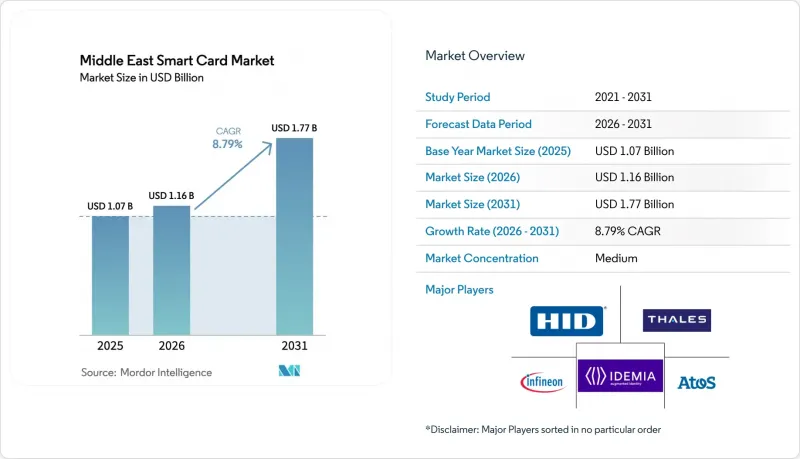
本報告按介面類型(接觸式、非接觸式、雙介面)、晶片類型(基於記憶體的智慧卡、基於微控制器的智慧卡等)、功能/應用(支付/銀行、身分驗證/認證等)、終端用戶產業(銀行、金融服務和保險、IT/電信、政府機構等)以及國家/地區進行細分。市場預測以美元計價。
中東智慧卡市場趨勢與洞察
海灣合作理事會國家引入國家電子身分證和電子護照
海灣合作理事會(GCC)各國政府正將生物辨識公民身分置於其數位化公共服務體系的核心地位。在阿拉伯聯合大公國,實體阿拉伯聯合大公國ID卡計畫於2025年底前逐步淘汰,過渡到透過臉部認證和指紋識別進行生物識別身分驗證,用戶可透過安全的行動錢包存取這些身分驗證方式。在阿曼,泰雷茲公司的多功能智慧身分證已覆蓋100%的人口。科威特的「我的科威特身分證」(MY KUWAIT ID)應用程式整合了多層身分驗證機制,以增強使用者對70多項電子政府服務的存取。隨著各部會尋求能夠實現跨境身分驗證的互通性解決方案,這些專案正在推動中東智慧卡市場的銷售成長。
沙烏地阿拉伯和阿拉伯聯合大公國在「2030願景」的指導主導,強制推行無現金支付。
沙烏地阿拉伯「Mada」網路的擴張以及杜拜到2026年實現90%無現金交易的目標,正在推動零售、交通和公共服務領域基於銀行卡的支付方式製度化。同時,阿拉伯聯合大公國中央銀行計劃在2025年下半年推出“數位迪拉姆”,該貨幣將融合代幣化和智慧合約功能,並需要與先進的銀行卡硬體無縫相容。中東和北非地區(MENA)的貨到付款使用率已從2020年的41%下降到2023年的20%,凸顯了消費者行為轉變非接觸感應卡支付方式的趨勢。
海灣合作理事會和黎凡特地區卡片標準之間的互通性差距
儘管GCCNET統一了ATM支付處理流程,但鄰近市場之間的卡片認證協議仍然分散,迫使發卡機構處理多種產品SKU,並阻礙了跨境服務的協調統一。黎巴嫩採用不同的生物識別標準進行邊境管制就是一個典型的例子,說明技術差異如何增加認證成本和複雜性。
細分市場分析
儘管傳統銀行和電子識別專案的影響使得接觸式認證方式仍佔據主導地位,但非接觸式技術的浪潮勢不可擋。到2025年,非接觸感應卡的發行率將達到48.00%,年複合成長率達9.41%。隨著交通運輸業者和零售商對現有設備進行NFC讀卡機改造,預計2026年至2031年間,中東地區非接觸式智慧卡市場規模將成長2.586億美元。為降低過渡風險,同時具備兩種支付模式的雙介面卡目前已佔新發行卡的19.00%。
交通運輸公司傾向於採用非接觸式支付,因為這有助於簡化乘客流動並支援多模態。零售連鎖店也開始採用“輕觸支付”,以順應疫情期間各地採取的保持社交距離的趨勢。同時,掌紋辨識和臉部認證等生物識別技術的結合,開始確保高額非接觸式支付限額,從而增強了人們對無摩擦支付的信心。這些因素將促使非接觸式支付領域在2031年之前超越傳統支付方式,鞏固其作為中東智慧卡市場長期成長引擎的地位。
微控制器單元目前佔據市場主導地位,預計到2025年將佔據65.28%的市場佔有率,這主要得益於其在身份驗證領域的成熟應用以及在支付、通訊和身份識別等領域的廣泛應用。然而,SoC架構的成長速度最快,複合年成長率高達11.06%,這主要歸功於其能夠將CPU、安全元件和無線介面整合到單一晶片上,從而降低物料清單(BOM)成本並縮小晶片尺寸。預計到2031年,中東智慧卡市場中SoC平台的市場規模將達到2.234億美元。
區域政府對半導體設計中心的投資,例如沙烏地阿拉伯斥資10億沙幣(約2.66億美元)興建的國家半導體中心,預示未來將更加重視本土智慧財產權和封裝能力。為此,歐洲科技巨頭正在推動價值鏈在地化。 IDEMIA投資2,000萬歐元(約2,160萬美元)用於生產,以確保其產品為歐洲製造,並符合海灣合作理事會(GCC)的資料保護要求。英飛凌的SECORA Pay Green計畫則反映了其對永續性的堅定承諾,該計畫減少了60%的原生塑膠使用和二氧化碳排放。
其他好處:
- Excel格式的市場預測(ME)表
- 3個月的分析師支持
目錄
第1章:引言
- 研究假設和市場定義
- 調查範圍
第2章:調查方法
第3章執行摘要
第4章 市場狀況
- 市場概覽
- 市場促進因素
- 海灣合作理事會國家引入電子身分證和電子護照
- 「2030願景」率先在沙烏地阿拉伯和阿拉伯聯合大公國強制推行無現金支付。
- 大型企劃的公共交通智慧票務系統
- 5G SIM卡更換週期正在推動高階微控制器卡市場的發展。
- 「智慧朝覲/副朝身分證」計畫推動了身分證發放數量的激增。
- 市場限制因素
- 海灣合作理事會和黎凡特卡標準之間的互通性差距
- 大量假冒銀行卡從灰色市場湧入,正在削弱人們對安全的信心。
- 由於全球出口限制和物流問題,進口積體電路供不應求。
- 海灣國家富人階級透過行動錢包遭受蠶食
- 價值供應鏈分析
- 監理情勢
- 技術趨勢(近場通訊、生物識別、金屬和環保材料)
- 波特五力分析
第5章 市場規模與成長預測
- 按介面類型
- 聯繫類型
- 非接觸式
- 雙介面
- 按晶片類型
- 內建記憶體的智慧卡
- 配備微控制器的智慧卡
- 系統晶片(SoC) 及其他
- 按功能/用途
- 支付和銀行服務
- 身分識別與認證
- SIM卡和通訊
- 交通和門票
- 衛生保健
- 物聯網及其他細分應用
- 按最終用戶行業分類
- BFSI
- IT/通訊
- 政府/公共部門
- 運輸/物流
- 衛生保健
- 零售和版稅
- 其他
- 國家
- 阿拉伯聯合大公國
- 沙烏地阿拉伯
- 卡達
- 科威特
- 阿曼
- 巴林
- 以色列
- 其他中東國家
第6章 競爭情勢
- 市場集中度
- 策略趨勢
- 市佔率分析
- 公司簡介
- Thales Group
- IDEMIA
- Eviden(Atos Group)
- Giesecke+Devrient GmbH
- NXP Semiconductors NV
- Infineon Technologies AG
- HID Global Corporation
- Secura Key
- Eastcompeace Smart Card Co. Ltd.
- CPI Card Group Inc.
- Watchdata Technologies Pte Ltd.
- Muehlbauer Group
- Mastercard Inc.
- Visa Inc.
- Samsung Electronics Co. Ltd.
- Cardz Group ME LLC
- OT-Morpho(Gemalto)
- Zwipe AS
第7章 市場機會與未來展望
According to Mordor Intelligence, the Middle East smart card market size is expected to grow from USD 1.07 billion in 2025 to USD 1.16 billion in 2026 and is forecast to reach USD 1.77 billion by 2031 at 8.79% CAGR over 2026-2031.
This report is Segmented by Interface Type (Contact-Based, Contactless, Dual-Interface), Chip Type (Memory Smart Cards, Microcontroller Smart Cards, and More), Function/Application (Payment and Banking, Identification and Authentication, and More), End-User Vertical (BFSI, IT and Telecommunication, Government, and More), and by Country. The Market Forecasts are Provided in Terms of Value (USD).
Middle East Smart Card Market Trends and Insights
National e-ID & e-Passport Roll-outs across GCC
GCC governments have made biometric civil ID a centrepiece of digital public-service delivery. The UAE will decommission physical Emirates ID cards by late 2025, transitioning to face- and fingerprint-verified digital credentials that remain accessible through secure mobile wallets. Oman already maintains 100% population coverage with multi-application smart IDs supplied by Thales. Kuwait's MY KUWAIT ID app embeds additional verification layers that strengthen access to more than 70 e-government services. Such programmes elevate unit volumes and drive the Middle East smart card market as ministries demand interoperable solutions capable of cross-border authentication.
Vision-2030-Led Cashless Payment Mandates in Saudi Arabia & UAE
Saudi Arabia's Mada network expansion and Dubai's target of 90% cashless transactions by 2026 institutionalise card-based payments across retail, transport, and government service payments. Simultaneously, the Central Bank of the UAE will introduce the Digital Dirham in late 2025, embedding tokenisation and smart-contract capabilities that must interface seamlessly with advanced card hardware. Cash-on-delivery usage in MENA halved from 41% in 2020 to 20% in 2023, underscoring behavioural shifts favouring contactless card infrastructure.
Interoperability Gaps between GCC & Levant Card Standards
While GCCNET unifies ATM clearing, card certification protocols remain fragmented across neighbouring markets, forcing issuers to carry multiple product SKUs and slowing cross-border service harmonisation. Lebanon's adoption of alternate biometric standards for border control exemplifies the technical divergence that elevates certification cost and complexity.
Other drivers and restraints analyzed in the detailed report include:
- Mass-Transit Smart-Ticketing for Mega-Projects
- 5G SIM Replacement Cycle Boosting High-End Micro-controller Cards
- Mobile-Wallet Cannibalisation in Affluent Gulf States
For complete list of drivers and restraints, kindly check the Table Of Contents.
Segment Analysis
Contact-based credentials remain dominant due to legacy bank and e-ID programmes, yet the contactless wave is unmistakable. In 2025, contactless cards represented 48.00% issuance and are advancing at 9.41% CAGR. The Middle East smart card market size for contactless platforms is forecast to add USD 258.6 million between 2026 and 2031 as transit operators and retailers retrofit NFC readers. Dual-interface cards mitigate migration risk by embedding both modes and already account for 19.00% of new volumes.
Transit agencies favour contactless because it speeds passenger flow and supports multi-modal integration. Retail chains deploy tap-to-pay because it aligns with regional social-distancing preferences adopted during the pandemic. Meanwhile, biometric overlays-such as palm-vein or facial match-are beginning to secure high-value contactless limits, reinforcing confidence in frictionless payment. These factors ensure the contactless segment will overtake contact-based share well before 2031, cementing its status as the long-term growth engine of the Middle East smart card market.
Microcontroller units currently dominate with a share of 65.28% in 2025 due to established certification pedigree and broad application across payments, telecom, and ID. Nevertheless, SoC architectures are growing fastest at 11.06% CAGR because they consolidate CPU, secure element, and wireless interface in one die, reducing BOM and footprint. The Middle East smart card market size for SoC platforms is poised to reach USD 223.4 million by 2031.
Regional sovereign investment in semiconductor design hubs-exemplified by Saudi Arabia's SAR 1 billion (USD 266 million) National Semiconductor Hub-signals a future shift toward domestic IP and packaging capacity. European technology leaders respond by localising value chains; IDEMIA invested EUR 20 million (USD 21.6 million) in capacity that guarantees European source traceability while serving GCC data-protection mandates. Infineon's SECORA Pay Green exemplifies the parallel sustainability imperative, cutting virgin plastic and CO2 by 60%
Complete Report Scope:
- By Interface Type
- Contact-Based
- Contactless
- Dual-Interface
- By Chip Type
- Memory Smart Cards
- Micro-controller Smart Cards
- System-on-Chip and Others
- By Function / Application
- Payment and Banking
- Identification and Authentication
- SIM and Telecommunications
- Transit and Ticketing
- Healthcare
- IoT and Other Niche Uses
- By End-User Vertical
- BFSI
- IT and Telecommunications
- Government and Public Sector
- Transportation and Logistics
- Healthcare
- Retail and Loyalty
- Others
- By Country
- United Arab Emirates
- Saudi Arabia
- Qatar
- Kuwait
- Oman
- Bahrain
- Israel
- Rest of Middle-East
List of Companies Covered in this Report:
- Thales Group
- IDEMIA
- Eviden (Atos Group)
- Giesecke + Devrient GmbH
- NXP Semiconductors N.V.
- Infineon Technologies AG
- HID Global Corporation
- Secura Key
- Eastcompeace Smart Card Co. Ltd.
- CPI Card Group Inc.
- Watchdata Technologies Pte Ltd.
- Muehlbauer Group
- Mastercard Inc.
- Visa Inc.
- Samsung Electronics Co. Ltd.
- Cardz Group ME LLC
- OT-Morpho (Gemalto)
- Zwipe AS
Additional Benefits:
- The market estimate (ME) sheet in Excel format
- 3 months of analyst support
TABLE OF CONTENTS
1 INTRODUCTION
- 1.1 Study Assumptions and Market Definition
- 1.2 Scope of the Study
2 RESEARCH METHODOLOGY
3 EXECUTIVE SUMMARY
4 MARKET LANDSCAPE
- 4.1 Market Overview
- 4.2 Market Drivers
- 4.2.1 National e-ID and e-Passport Roll-outs across GCC
- 4.2.2 Vision-2030 led Cashless Payment Mandates in Saudi Arabia and UAE
- 4.2.3 Mass-Transit Smart-Ticketing for Mega-Projects
- 4.2.4 5G SIM Replacement Cycle Boosting High-End Micro-controller Cards
- 4.2.5 Smart Hajj/Umrah ID Initiatives Driving High-Volume Issuance Peaks
- 4.3 Market Restraints
- 4.3.1 Inter-operability Gaps between GCC and Levant Card Standards
- 4.3.2 Grey-Market Counterfeit Card Inflows Undermining Security Trust
- 4.3.3 Imported IC Shortages due to Global Export Controls and Logistics
- 4.3.4 Mobile-Wallet Cannibalisation in Affluent Gulf States
- 4.4 Value / Supply-Chain Analysis
- 4.5 Regulatory Landscape
- 4.6 Technological Outlook (NFC, Biometric, Metal and Eco Materials)
- 4.7 Porter's Five Forces Analysis
- 4.7.1 Bargaining Power of Suppliers
- 4.7.2 Bargaining Power of Buyers
- 4.7.3 Threat of New Entrants
- 4.7.4 Threat of Substitutes
- 4.7.5 Intensity of Competitive Rivalry
5 MARKET SIZE AND GROWTH FORECASTS (VALUE)
- 5.1 By Interface Type
- 5.1.1 Contact-Based
- 5.1.2 Contactless
- 5.1.3 Dual-Interface
- 5.2 By Chip Type
- 5.2.1 Memory Smart Cards
- 5.2.2 Micro-controller Smart Cards
- 5.2.3 System-on-Chip and Others
- 5.3 By Function / Application
- 5.3.1 Payment and Banking
- 5.3.2 Identification and Authentication
- 5.3.3 SIM and Telecommunications
- 5.3.4 Transit and Ticketing
- 5.3.5 Healthcare
- 5.3.6 IoT and Other Niche Uses
- 5.4 By End-User Vertical
- 5.4.1 BFSI
- 5.4.2 IT and Telecommunications
- 5.4.3 Government and Public Sector
- 5.4.4 Transportation and Logistics
- 5.4.5 Healthcare
- 5.4.6 Retail and Loyalty
- 5.4.7 Others
- 5.5 By Country
- 5.5.1 United Arab Emirates
- 5.5.2 Saudi Arabia
- 5.5.3 Qatar
- 5.5.4 Kuwait
- 5.5.5 Oman
- 5.5.6 Bahrain
- 5.5.7 Israel
- 5.5.8 Rest of Middle-East
6 COMPETITIVE LANDSCAPE
- 6.1 Market Concentration
- 6.2 Strategic Moves
- 6.3 Market Share Analysis
- 6.4 Company Profiles {(includes Global level Overview, Market level overview, Core Segments, Financials as available, Strategic Information, Market Rank/Share for key companies, Products and Services, and Recent Developments)}
- 6.4.1 Thales Group
- 6.4.2 IDEMIA
- 6.4.3 Eviden (Atos Group)
- 6.4.4 Giesecke + Devrient GmbH
- 6.4.5 NXP Semiconductors N.V.
- 6.4.6 Infineon Technologies AG
- 6.4.7 HID Global Corporation
- 6.4.8 Secura Key
- 6.4.9 Eastcompeace Smart Card Co. Ltd.
- 6.4.10 CPI Card Group Inc.
- 6.4.11 Watchdata Technologies Pte Ltd.
- 6.4.12 Muehlbauer Group
- 6.4.13 Mastercard Inc.
- 6.4.14 Visa Inc.
- 6.4.15 Samsung Electronics Co. Ltd.
- 6.4.16 Cardz Group ME LLC
- 6.4.17 OT-Morpho (Gemalto)
- 6.4.18 Zwipe AS
7 MARKET OPPORTUNITIES AND FUTURE OUTLOOK
- 7.1 White-space and Unmet-Need Assessment

 公共交通卡市場:按產品類型、組成部分和地區分類
 智慧卡MCU:市場佔有率分析、產業趨勢與統計、成長預測(2026-2031年)智慧卡:市場佔有率分析、產業趨勢與統計、成長預測(2026-2031)
 智慧卡和自動收費系統市場:按類型、網路類型、組件、技術、應用和銷售管道分類-2026-2032年全球市場預測智慧卡市場:2026-2032年全球市場預測(依介面類型、卡片類型、材料、功能、應用及通路分類)
 全球智慧卡市場規模、佔有率、趨勢和成長分析報告(2026-2034年,面向政府機構)智慧電視市場:按作業系統、技術、解析度、螢幕大小、應用和地區分類
 語音辨識銀行和支付解決方案市場預測至2034年-全球分析(按組件、技術、認證方法、銀行功能、支付類型、應用和地區分類)
 2026年全球非接觸式無線光纖(RoF)儲存積體電路(IC)卡市場報告
 智慧卡市場-全球產業規模、佔有率、趨勢、機會、預測:按類型、最終用戶產業、地區和競爭格局分類,2021-2031年