

 |
市場調查報告書
商品編碼
2124902
智慧卡MCU:市場佔有率分析、產業趨勢與統計、成長預測(2026-2031年)Smartcard MCU - Market Share Analysis, Industry Trends & Statistics, Growth Forecasts (2026 - 2031) |
||||||

※ 本網頁內容可能與最新版本有所差異。詳細情況請與我們聯繫。
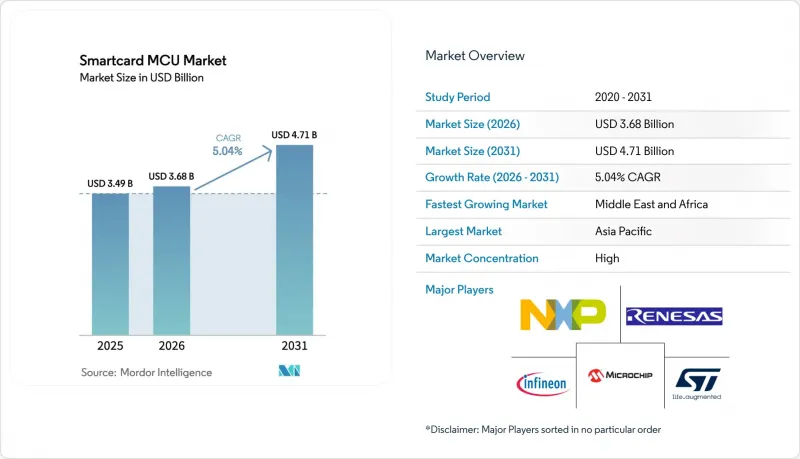
根據 Mordor Intelligence 預測,智慧卡 MCU 市場規模預計將在 2025 年達到 34.9 億美元,2026 年達到 36.8 億美元,到 2031 年達到 47.1 億美元,2026 年至 2031 年的複合年成長率為 5.04%。
本報告按產品類型(8 位、16 位、32 位)、功能(交易、通訊、安全和訪問控制)、最終用戶行業(銀行、金融服務和保險 (BFSI)、電訊、政府/醫療保健、教育、零售及其他)、安全認證級別(通用準則 EAL4+ 及其他)、內存容量(16KB 或更小、32KB 及其他)和地區容量進行細分。市場預測以美元 (USD) 為單位。
全球智慧卡MCU市場趨勢與洞察
過渡到符合EMV標準的支付卡
隨著晶片整合在巴西、墨西哥和大多數海灣合作理事會波灣合作理事會成為強制性要求,數千萬簽帳金融卡和信用卡帳戶已從磁條介質遷移到晶片介質。發卡銀行正在推廣具有更大EEPROM容量的雙介面安全元件,用於存儲動態密文,這導致每張卡的矽晶圓用量增加,平均售價(ASP)也隨之上升,儘管價格普遍下降。
各國引入電子身分證和電子護照
歐盟數位身分法規要求成員國將儲存生物識別影像並支援電子簽章的安全元件升級到符合 EAL6+ 標準,並設定了 10 至 15 年的升級週期。印度 Aadhaar 計畫的擴展和日本 My Number 系統的審查,導致整合公鑰基礎設施 (PKI) 和多應用分區功能的安全元件訂單激增,從而擴大了認證供應商的收入來源。
快速過渡到行動錢包
行動支付預計將在2024年達到1兆美元,這表明「一觸即付」錢包在北美和西歐的普及程度。雖然基礎簽帳金融卡外形規格,而非整體潛在市場規模的完全消失。
細分市場分析
預計到2025年,32位元元件將佔總收入的62.01%,並將以5.62%的複合年成長率成長,這主要得益於交易延遲和加密處理能力需求的不斷提高。這一主導地位意味著32位元元件在智慧卡MCU市場佔據主導地位,尤其是在EMV雙介面卡、eSIM卡和政府頒發的電子身分認證資訊領域。恩智浦半導體的SmartMX3和英飛凌的SLC38整合了AES、RSA和ECC引擎,突破了EMV Level 1非接觸感應卡的限制,同時功耗低於100mW。後量子演算法的出現進一步鞏固了32位元元件的統治地位,因為格運算的執行能力已經超過了16位元元件的指令執行能力。
生物識別的普及速度正在加快。卡片匹配演算法需要40-60KB的閃存,且模板檢驗不到一秒,促使發卡機構採用128KB或更大的快閃記憶體配置。 IDEMIA F.CODE 2025年初的出貨量資料證實了高級產品線目前所需的性能標準。雖然由於行動錢包的普及,已開發國家的初始發卡量有所下降,但200億張支付卡的龐大部署規模確保了強勁的續卡需求。這使得續卡週期從3年延長至5年,抵銷了雙介面的成本。
預計到2025年,安全和存取控制領域將佔總收入的44.34%,並維持6.02%的年成長率,這主要得益於企業將門禁控制器和邏輯存取系統升級為結合智慧卡和生物識別的多因素認證流程。歐盟的NIS2指令將於2024年10月生效,屆時關鍵基礎設施營運商將需要實施基於硬體的身份驗證憑證,這將推動對EAL5+認證晶片的需求。交易功能(主要以支付卡為代表)的複合年成長率與整體智慧卡MCU市場相近,但行動錢包需求的激增限制了其成長。通訊模組(包括eSIM)正受益於5G的發展勢頭,加速成長。 GSMA SGP.32遠端設定規則增加了無線電的記憶體開銷,將記憶體密度從32KB提升至64KB。
功能整合正在加速發展。如今,交通票務媒體、版稅和身分識別小程式都整合在單一晶片上,而國家電子ID卡也整合了用於電子政府服務的數位簽章功能。意法半導體(STMicroelectronics)的ST31P450晶片,憑藉其128KB EEPROM和沙盒化的小程式域,正是平台化方案的典範,該方案允許發卡機構透過附加價值服務將剩餘容量貨幣化。
區域分析
到2025年,亞太地區將佔全球收入的37.82%,這主要得益於印度的「Aadhaar」支付基礎設施和中國在安全元件領域所推動的自主化策略。中國公共安全已認證華大電子和北京復旦微電子的組件,用於14億張國民身分證的市場,這實際上將西方供應商排除在了全球最大的身份驗證憑證市場之一。印度的統一支付介面(UPI)到2025年12月將處理167億筆交易,儘管中國參與企業試圖透過價格競爭,但仍將推動對國產RuPay雙界面卡的需求。日本和韓國也將分別透過升級後量子技術總合和強制推行全非接觸式支付,全部區域做出貢獻。
中東和非洲地區的複合年成長率最高,達6.74%。沙烏地阿拉伯的「Absher」平台和阿拉伯聯合大公國的生物識別「阿拉伯聯合大公國身分證」將安全元素整合到電子政府和交通身分證中,兩國的網路安全機構均要求達到EAL5+或更高標準。土耳其正在進行一項利用eSIM安全元素的行動數位身分證試點項目,這表明該地區對混合型身分證方案的需求很高。
在歐洲,該公司受益於「數位身分錢包」法規,該法規要求成員國在2026年前發行此類錢包。由於德國電子病歷卡和法國生物識別“Carte Vital”卡的更新,公共部門的訂單正在成長。在北美,儘管公共識別的普及速度較慢,但對支付卡更新和工業安全啟動解決方案的需求仍然強勁。在拉丁美洲,EMV晶片的普及正在推進,但都市區的錢包使用率正在下降。同時,非洲的普及主要集中在南非和奈及利亞,這兩個國家在普惠金融計畫中使用EAL4+晶片,以平衡安全性和單位成本效益。
其他好處
- Excel格式的市場預測(ME)表
- 3個月的分析師支持
目錄
第1章:引言
- 研究假設和市場定義
- 調查範圍
第2章:調查方法
第3章執行摘要
第4章 市場狀況
- 市場概覽
- 市場促進因素
- 過渡到符合EMV標準的支付卡
- 全國推廣電子身分證和電子護照
- SIM卡向相容5G的eSIM外形規格的過渡
- 公共運輸非接觸式收費系統升級
- 後量子相容安全元件藍圖
- 新興市場付費電視智慧卡的更新
- 生物識別雙介面卡的興起
- 關鍵基礎設施身分驗證憑證的強制性網路彈性。
- 市場限制因素
- 快速過渡到行動錢包
- 中國半導體工廠對平均售價施加壓力
- 缺乏認證測試能力(CC、FIPS)
- 地緣政治出口限制
- 加強對傳統8吋晶圓廠碳足跡的監管
- 產業價值鏈分析
- 監理情勢
- 技術展望
- 宏觀經濟因素對市場的影響
- 波特五力分析
第5章 市場規模與成長預測
- 依產品
- 8 位元
- 16 位元
- 32 位元
- 按功能
- 交易
- 溝通
- 安全和存取控制
- 按最終用戶行業分類
- 銀行、金融服務和保險(BFSI)
- 電訊
- 政府和醫療保健
- 教育
- 零售
- 運輸
- 其他
- 安全認證級別
- 通用標準 EAL4+
- EAL5+
- EAL6+
- EAL7
- 按內存密度
- 16KB 或更小
- 32KB
- 64KB
- 128KB 或以上
- 按地區
- 北美洲
- 美國
- 加拿大
- 墨西哥
- 南美洲
- 巴西
- 阿根廷
- 南美洲其他地區
- 歐洲
- 德國
- 英國
- 法國
- 義大利
- 西班牙
- 俄羅斯
- 其他歐洲國家
- 亞太地區
- 中國
- 日本
- 印度
- 韓國
- 亞太其他地區
- 中東
- 沙烏地阿拉伯
- 阿拉伯聯合大公國
- 土耳其
- 其他中東國家
- 非洲
- 南非
- 奈及利亞
- 其他非洲地區
- 北美洲
第6章 競爭情勢
- 市場集中度
- 策略趨勢
- 市佔率分析
- 公司簡介
- NXP Semiconductors NV
- Infineon Technologies AG
- STMicroelectronics NV
- Samsung Electronics Co., Ltd.
- Renesas Electronics Corporation
- Microchip Technology Incorporated
- IDEMIA Group SAS
- Thales Group(Gemalto Division)
- Giesecke+Devrient GmbH
- Zilog, Inc.
- Beijing Fudan Microelectronics Group Co., Ltd.
- EM Microelectronic-Marin SA
- CEC Huada Electronic Design Co., Ltd.
- Shanghai Huahong Integrated Circuit Co., Ltd.
- Watchdata Technologies Co., Ltd.
- Wuhan Tianyu Information Industry Co., Ltd.
- Valid SA
- Siltech Corporation
- Hengbao Co., Ltd.
- CPI Card Group Inc.
第7章 市場機會與未來展望
According to Mordor Intelligence, the smartcard MCU market size is projected to be USD 3.49 billion in 2025, USD 3.68 billion in 2026, and reach USD 4.71 billion by 2031, growing at a CAGR of 5.04% from 2026 to 2031.
This report is Segmented by Product (8-Bit, 16-Bit, and 32-Bit), Functionality (Transaction, Security and Access Control and More), End-User Industry (BFSI, Telecommunications, Government and Healthcare, Education, Retail, and More), Security Certification Level (Common Criteria EAL4+, and More), Memory Density (<=16 KB, 32 KB, and More), and Geography. The Market Forecasts are Provided in Terms of Value (USD).
Global Smartcard MCU Market Trends and Insights
Migration to EMV-compliant payment cards
Mandated chip enablement in Brazil, Mexico, and most Gulf Cooperation Council states moved tens of millions of debit and credit accounts away from magnetic stripe media. Card-issuing banks are standardizing on dual-interface secure elements with larger EEPROM footprints to store dynamic cryptograms, thereby increasing silicon content per unit and raising the per-card ASP despite broader price erosion.
National e-ID and e-passport roll-outs
The EU Digital Identity Regulation obligates member states to upgrade credentials to EAL6+ secure elements that store biometric images and enable electronic signatures, locking in 10- to 15-year replacement cycles. India's Aadhaar expansion and Japan's My Number revamp trigger orders for secure elements that integrate on-card Public Key Infrastructure and multi-application partitioning, widening revenue streams for certification-ready suppliers.
Rapid shift toward mobile wallets
The USD 1 trillion mobile payment milestone in 2024 signals wallet preference for tap-to-pay in North America and Western Europe. Card volumes slide on basic debit portfolios; however, embedded secure elements in phones reclaim part of the silicon demand, altering form-factor mix rather than erasing total addressable volume.
Other drivers and restraints analyzed in the detailed report include:
- SIM swap to 5G eSIM form-factors
- Contactless transit fare-collection upgrades
- ASP pressure from Chinese fabs
For complete list of drivers and restraints, kindly check the Table Of Contents.
Segment Analysis
32-bit devices accounted for 62.01% of 2025 revenue, and the segment is set to expand at a 5.62% CAGR as transaction latency and cryptographic-throughput requirements climb. This leadership underpins 32-bit control of the Smartcard MCU market size, especially in EMV dual-interface cards, eSIMs, and government e-ID credentials. NXP SmartMX3 and Infineon SLC38 integrate AES, RSA, and ECC engines that clear EMV Level 1 contactless limits while drawing under 100 mW. Post-quantum algorithms further lock in 32-bit supremacy, since lattice math outstrips the instruction headroom of 16-bit alternatives.
Biometric rollouts quicken the pace. Match-on-card algorithms demand 40-60 KB flash and sub-one-second template verification, driving issuers toward >=128 KB configurations. IDEMIA F.CODE shipments in early 2025 demonstrate the performance bar premium portfolios now expect. Although mobile-wallet substitution trims first-issue volumes in developed economies, the installed base of 20 billion payment cards ensures a resilient replacement flow, stretching refresh cycles from three to five years to defray dual-interface costs.
Security and Access Control claimed 44.34% of 2025 revenue, rising at a 6.02% trajectory as enterprises retrofit door-controllers and logical-access systems with smartcard-plus-biometric multi-factor flows. The European Union's NIS2 directive, effective October 2024, obliges critical-infrastructure operators to deploy hardware-rooted credentials, elevating demand for EAL5+-certified chips. Transaction functionality, largely payment cards, matches the overall Smartcard MCU market CAGR, its upside capped by mobile-wallet cannibalization. Communication modules, including eSIMs, accelerate on 5G momentum; GSMA SGP.32 remote-provisioning rules add over-the-air memory overheads that nudge densities from 32 KB to 64 KB.
Functional convergence gathers speed. Transit fare media now co-reside with loyalty and ID applets on a single chip, and national e-ID cards embed digital-signature capabilities for e-government services. STMicroelectronics ST31P450, packing 128 KB EEPROM and sandboxed applet domains, typifies the platform approach that lets issuers monetize spare capacity via value-added services.
Complete Report Scope:
- By Product
- 8-bit
- 16-bit
- 32-bit
- By Functionality
- Transaction
- Communication
- Security and Access Control
- By End-User Industry
- Banking, Financial Services and Insurance (BFSI)
- Telecommunications
- Government and Healthcare
- Education
- Retail
- Transportation
- Other End-User Industries
- By Security Certification Level
- Common Criteria EAL4+
- EAL5+
- EAL6+
- EAL7
- By Memory Density
- <=16 FB
- 32 KB
- 64 KB
- >=128 KB
- By Geography
- North America
- United States
- Canada
- Mexico
- South America
- Brazil
- Argentina
- Rest of South America
- Europe
- Germany
- United Kingdom
- France
- Italy
- Spain
- Russia
- Rest of Europe
- Asia Pacific
- China
- Japan
- India
- South Korea
- Rest of Asia Pacific
- Middle East
- Saudi Arabia
- United Arab Emirates
- Turkey
- Rest of Middle East
- Africa
- South Africa
- Nigeria
- Rest of Africa
- North America
Geography Analysis
Asia Pacific controlled 37.82% of 2025 revenue, its scale anchored by India's Aadhaar payments rail and China's secure-element self-reliance push. China's Ministry of Public Security endorses CEC Huada and Beijing Fudan Microelectronics parts for a market of 1.4 billion national IDs, locking Western vendors out of one of the largest credential pools. India's Unified Payments Interface processed 16.7 billion transactions in December 2025, reinforcing demand for domestic-fabricated RuPay dual-interface cards, even as Chinese entrants test price competitiveness. Japan and South Korea add to the regional total with post-quantum passport upgrades and full contactless mandates, respectively.
The Middle East and Africa posts the highest 6.74% CAGR. Saudi Arabia's Absher platform and the UAE's biometric Emirates ID bundle secure elements across e-government and transit credentials, with national cybersecurity agencies stipulating EAL5+ minimums. Turkey pilots mobile digital IDs that lean on eSIM secure elements, illustrating regional appetite for hybrid credential schemes.
Europe benefits from the Digital Identity Wallet regulation that compels member-state issuance by 2026. Germany's e-patient cards and France's biometric Carte Vitale updates amplify public-sector orders. North America trails on public-ID momentum yet records steady payment-card replacement and industrial secure-boot demand. Latin America shows high EMV thesis but faces wallet erosion in urban hubs, while Africa's adoption concentrates in South Africa and Nigeria, where financial-inclusion projects rely on EAL4+ chips to balance security with unit economics.
- NXP Semiconductors N.V.
- Infineon Technologies AG
- STMicroelectronics N.V.
- Samsung Electronics Co., Ltd.
- Renesas Electronics Corporation
- Microchip Technology Incorporated
- IDEMIA Group S.A.S.
- Thales Group (Gemalto Division)
- Giesecke+Devrient GmbH
- Zilog, Inc.
- Beijing Fudan Microelectronics Group Co., Ltd.
- EM Microelectronic-Marin SA
- CEC Huada Electronic Design Co., Ltd.
- Shanghai Huahong Integrated Circuit Co., Ltd.
- Watchdata Technologies Co., Ltd.
- Wuhan Tianyu Information Industry Co., Ltd.
- Valid S.A.
- Siltech Corporation
- Hengbao Co., Ltd.
- CPI Card Group Inc.
Additional Benefits:
- The market estimate (ME) sheet in Excel format
- 3 months of analyst support
TABLE OF CONTENTS
1 INTRODUCTION
- 1.1 Study Assumptions and Market Definition
- 1.2 Scope of the Study
2 RESEARCH METHODOLOGY
3 EXECUTIVE SUMMARY
4 MARKET LANDSCAPE
- 4.1 Market Overview
- 4.2 Market Drivers
- 4.2.1 Migration to EMV-Compliant Payment Cards
- 4.2.2 National e-ID and e-Passport Roll-Outs
- 4.2.3 SIM Swap to 5G-Enabled eSIM Form-Factors
- 4.2.4 Contactless Transit Fare-Collection Upgrades
- 4.2.5 Post-Quantum-Ready Secure Element Roadmaps
- 4.2.6 Pay-TV Smart-Card Refresh in Emerging Markets
- 4.2.7 Rise of Biometric Dual-Interface Cards
- 4.2.8 Mandated Cyber-Resilience for Critical Infrastructure Credentials
- 4.3 Market Restraints
- 4.3.1 Rapid Shift Toward Mobile Wallets
- 4.3.2 ASP Pressure From Chinese Fabs
- 4.3.3 Shortage of Certified Testing Capacity (CC, FIPS)
- 4.3.4 Geopolitical Export-Control Restrictions
- 4.3.5 Adverse Carbon-Footprint Regulations on Legacy 8-inch Fabs
- 4.4 Industry Value-Chain Analysis
- 4.5 Regulatory Landscape
- 4.6 Technological Outlook
- 4.7 Impact of Macroeconomic Factors on the Market
- 4.8 Porter's Five Forces Analysis
- 4.8.1 Bargaining Power of Suppliers
- 4.8.2 Bargaining Power of Consumers
- 4.8.3 Threat of New Entrants
- 4.8.4 Intensity of Competitive Rivalry
- 4.8.5 Threat of Substitutes
5 MARKET SIZE AND GROWTH FORECASTS (VALUE)
- 5.1 By Product
- 5.1.1 8-bit
- 5.1.2 16-bit
- 5.1.3 32-bit
- 5.2 By Functionality
- 5.2.1 Transaction
- 5.2.2 Communication
- 5.2.3 Security and Access Control
- 5.3 By End-User Industry
- 5.3.1 Banking, Financial Services and Insurance (BFSI)
- 5.3.2 Telecommunications
- 5.3.3 Government and Healthcare
- 5.3.4 Education
- 5.3.5 Retail
- 5.3.6 Transportation
- 5.3.7 Other End-User Industries
- 5.4 By Security Certification Level
- 5.4.1 Common Criteria EAL4+
- 5.4.2 EAL5+
- 5.4.3 EAL6+
- 5.4.4 EAL7
- 5.5 By Memory Density
- 5.5.1 <=16 FB
- 5.5.2 32 KB
- 5.5.3 64 KB
- 5.5.4 >=128 KB
- 5.6 By Geography
- 5.6.1 North America
- 5.6.1.1 United States
- 5.6.1.2 Canada
- 5.6.1.3 Mexico
- 5.6.2 South America
- 5.6.2.1 Brazil
- 5.6.2.2 Argentina
- 5.6.2.3 Rest of South America
- 5.6.3 Europe
- 5.6.3.1 Germany
- 5.6.3.2 United Kingdom
- 5.6.3.3 France
- 5.6.3.4 Italy
- 5.6.3.5 Spain
- 5.6.3.6 Russia
- 5.6.3.7 Rest of Europe
- 5.6.4 Asia Pacific
- 5.6.4.1 China
- 5.6.4.2 Japan
- 5.6.4.3 India
- 5.6.4.4 South Korea
- 5.6.4.5 Rest of Asia Pacific
- 5.6.5 Middle East
- 5.6.5.1 Saudi Arabia
- 5.6.5.2 United Arab Emirates
- 5.6.5.3 Turkey
- 5.6.5.4 Rest of Middle East
- 5.6.6 Africa
- 5.6.6.1 South Africa
- 5.6.6.2 Nigeria
- 5.6.6.3 Rest of Africa
- 5.6.1 North America
6 COMPETITIVE LANDSCAPE
- 6.1 Market Concentration
- 6.2 Strategic Moves
- 6.3 Market Share Analysis
- 6.4 Company Profiles (includes Global Level Overview, Market Level Overview, Core Segments, Financials as Available, Strategic Information, Market Rank/Share for Key Companies, Products and Services, and Recent Developments)
- 6.4.1 NXP Semiconductors N.V.
- 6.4.2 Infineon Technologies AG
- 6.4.3 STMicroelectronics N.V.
- 6.4.4 Samsung Electronics Co., Ltd.
- 6.4.5 Renesas Electronics Corporation
- 6.4.6 Microchip Technology Incorporated
- 6.4.7 IDEMIA Group S.A.S.
- 6.4.8 Thales Group (Gemalto Division)
- 6.4.9 Giesecke+Devrient GmbH
- 6.4.10 Zilog, Inc.
- 6.4.11 Beijing Fudan Microelectronics Group Co., Ltd.
- 6.4.12 EM Microelectronic-Marin SA
- 6.4.13 CEC Huada Electronic Design Co., Ltd.
- 6.4.14 Shanghai Huahong Integrated Circuit Co., Ltd.
- 6.4.15 Watchdata Technologies Co., Ltd.
- 6.4.16 Wuhan Tianyu Information Industry Co., Ltd.
- 6.4.17 Valid S.A.
- 6.4.18 Siltech Corporation
- 6.4.19 Hengbao Co., Ltd.
- 6.4.20 CPI Card Group Inc.
7 MARKET OPPORTUNITIES AND FUTURE OUTLOOK
- 7.1 White-Space and Unmet-Need Assessment

 公共交通卡市場:按產品類型、組成部分和地區分類
 中東智慧卡市場:市場佔有率分析、產業趨勢與統計及成長預測(2026-2031 年)智慧卡:市場佔有率分析、產業趨勢與統計、成長預測(2026-2031)
 智慧卡和自動收費系統市場:按類型、網路類型、組件、技術、應用和銷售管道分類-2026-2032年全球市場預測智慧卡市場:2026-2032年全球市場預測(依介面類型、卡片類型、材料、功能、應用及通路分類)
 全球智慧卡市場規模、佔有率、趨勢和成長分析報告(2026-2034年,面向政府機構)智慧電視市場:按作業系統、技術、解析度、螢幕大小、應用和地區分類
 語音辨識銀行和支付解決方案市場預測至2034年-全球分析(按組件、技術、認證方法、銀行功能、支付類型、應用和地區分類)
 2026年全球非接觸式無線光纖(RoF)儲存積體電路(IC)卡市場報告
 智慧卡市場-全球產業規模、佔有率、趨勢、機會、預測:按類型、最終用戶產業、地區和競爭格局分類,2021-2031年