


 |
市場調查報告書
商品編碼
2122911
智慧卡:市場佔有率分析、產業趨勢與統計、成長預測(2026-2031)Smart Card - Market Share Analysis, Industry Trends & Statistics, Growth Forecasts (2026 - 2031) |
||||||

※ 本網頁內容可能與最新版本有所差異。詳細情況請與我們聯繫。
根據 Mordor Intelligence 預測,智慧卡市場規模預計將在 2026 年達到 218.2 億美元,在 2031 年達到 300.3 億美元,2026 年至 2031 年的複合年成長率為 6.6%。
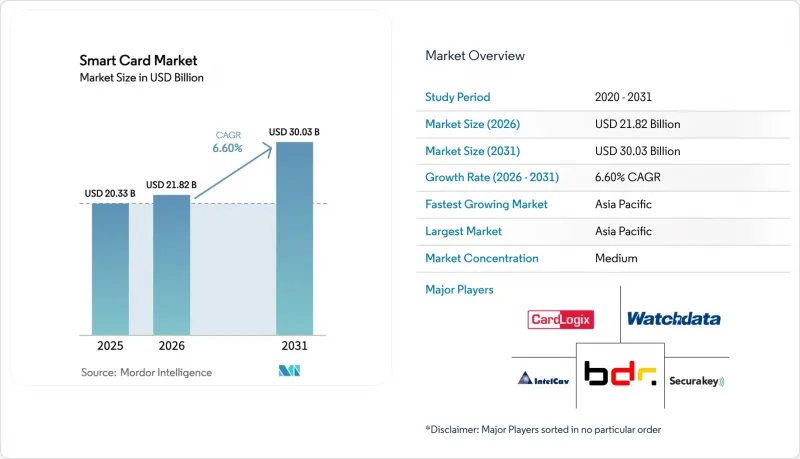
本報告按介面類型(接觸式、非接觸式、雙介面、混合式)、卡片晶片類型(記憶體、微控制器、安全元件)、材料(PVC、聚碳酸酯、ABS、PETG、金屬)、功能(支付、門禁、通訊等)、最終用戶(銀行、金融服務和保險 (BFSI)、IT、政府、交通運輸、醫療保健、零售教育市場預測以美元 (USD) 為單位。
全球智慧卡市場趨勢及洞察
新興亞洲經濟體向非接觸式EMV過渡
印度、印尼、菲律賓和越南的監管機構都設定了嚴格的最後期限,敦促發卡機構用非接觸式雙介面卡取代數億張傳統的磁條卡。光是在印度,就有4.5億張RuPay簽帳金融卡計畫在2026年12月前完成升級,同時強制安裝POS終端機以確保卡片的使用。印尼和菲律賓也採取了類似的措施,監管強制和財政獎勵相結合,使得發卡機構的新卡採用率超過了60%。越南一家銀行在2025年第三季領先了3,500萬張非接觸感應卡,以便在政府設定的2027年最後期限前完成升級。這些法規正在加速市場需求,並使那些能夠維持天線和嵌體供應鏈並提供在地化個人化服務的製造商受益。因此,一條可預測的多年需求曲線正在形成,提高了智慧卡市場的基準需求。
歐盟和海灣合作理事會國家引入國家電子身分證和數位健康卡
歐洲的eIDAS 2.0法規要求所有成員國在2026年前發行數位錢包,德國和法國等國正在推動整合生物識別功能的聚碳酸酯卡的發行。德國計劃更換4500萬張卡片,法國已與IDEMIA公司簽訂契約,採購3000萬張卡片。在波灣合作理事會(GCC)成員國中,沙烏地阿拉伯將於2025年發行1,200萬張「Absher」數位ID卡,而阿拉伯聯合大公國(阿拉伯聯合大公國)已交付850萬張多功能「阿拉伯聯合大公國身分證」。這些項目將支付、醫療和旅行認證資訊整合到一個安全元件中,從而降低了高價值組件的成本,並建立了8-10年的更換週期。已獲得通用準則認證的供應商已獲得先發優勢,而後續供應商將面臨較長的認證週期。
代幣化虛擬卡的興起導致實體卡的需求下降。
Visa、萬事達卡和美國運通均預測,到2025年,純虛擬企業卡的發行量將實現兩位數成長,其中美國運通的虛擬卡發行量將首次超過實體企業卡發行量。旅行和採購平台傾向於使用一次性代幣進行即時支出管理,從而減少了對大量發行實體卡的需求。雖然消費者卡的再發行仍受到監管,但企業卡發行量(曾經佔發卡機構總發行量的20%)在成熟市場正以每年8%至12%的速度萎縮。發卡機構正在透過將代幣發行功能整合到實體卡中來應對這項挑戰,但這種混合模式延長了卡片的使用壽命,導致續訂延遲。嚴重依賴北美和歐洲企業卡發行的供應商正經歷著發行量最顯著的下降。
細分市場分析
到2025年,非接觸感應卡將主導智慧卡市場,佔56.78%的市場。雙介面卡的複合年成長率(CAGR)為6.82%,這反映出東歐、南美和部分亞洲地區對與僅支援接觸式終端的向下相容性的需求。隨著銀行尋求避免在仍依賴晶片和密碼讀卡機的商家處出現交易失敗,預計雙介面產品的智慧卡市場規模將穩定擴大。德國的SparkAssen銀行和日本的兆豐銀行已訂購了超過4000萬張雙界面卡,以彌補基礎設施方面的不足。製造商可獲得25%至35%的價格溢價,超過15%至20%的成本成長,從而提高了毛利率。僅支援接觸式的卡片仍然僅限於小眾福利項目和閉合迴路項目,預計將繼續以2.1%的複合年成長率下降。複合卡整合了支付、存取和 IT 身份驗證功能,市場佔有率為 4.2%,年複合成長率為 5.8%,對於尋求一套憑證用於多種服務的企業客戶而言,仍然是一個有吸引力的選擇。
在政府和國防領域,實體介面增加了一層抵禦中繼繼電器的安全保障,從而推動了發卡機構對非接觸式卡的持續需求。將多種技術整合於單塊基板的複合卡,滿足了尋求邏輯和實體存取整合的細分市場企業的需求。因此,競爭的焦點正從單純的介面類型轉向卡內生物識別匹配和發卡後個性化等增值功能,這些功能有助於供應商在智慧卡市場維持利潤率。
到2025年,微控制器卡將佔66.59%的市場佔有率,但隨著生物識別在韓國成為強制性要求並在歐洲推廣,安全元件和系統級卡(SoC)設計正以7.21%的複合年成長率成長。安全元件智慧卡市場佔有率的成長得益於其能夠在卡內進行符合FIDO2標準的指紋匹配,從而無需後端檢驗。法國的「Carte Vitale 2」和韓國的居民登記卡標誌著架構正從依賴伺服器轉向其他模式。隨著安全性較低的會員忠誠度計畫轉向行動應用程式,記憶卡的佔有率正在下降。擁有晶圓代工廠生產能力的晶片供應商,例如英飛凌和三星,透過將後量子密碼技術藍圖與有保障的晶片供應捆綁在一起,獲得了巨大的價值。
在公共交通和預付禮品卡等應用中,成本比處理能力更為重要,因此專用記憶卡仍然發揮著至關重要的作用。像恩智浦半導體 (NXP) 的 MOB10 這樣的超薄模組,透過提高抗彎曲應力能力,為護照應用開闢了新的可能性。總體而言,產品配置向安全元件的轉變,使擁有通用準則 (Common Criteria) 認證產品線的半導體供應商受益,從而使他們在智慧卡市場中保持技術主導的競爭優勢。
區域分析
至2025年,亞太地區將佔智慧卡市場收入的54.11%,複合年成長率達7.44%。在印度,持卡人數將達到10.8億,其中非接觸感應卡佔新發卡量的64%。在中國,已有4.2億張SIM卡升級為5G網路認證所需的安全元件。在日本,已發行2,200萬張雙介面銀行卡,而在韓國,生物識別支付卡的引入將於2027年成為強制性要求。這一成長趨勢並非由自願消費驅動,而是由監管強制措施推動。
預計到2025年,歐洲將佔據23.7%的市場佔有率,年複合成長率達6.8%,這主要得益於eIDAS 2.0強制要求全面支持數位錢包。至2025年,德國ID卡生產1,200萬張電子ID卡;法國將生產3,000萬張;英國將生產920萬張生物識別居住證。東歐國家正受益於歐盟的團結基金,該基金正在加速向EMV晶片卡的過渡,並提高雙界面卡的產量。高安全標準和聚碳酸酯材料的應用正在推高平均售價。
預計到2025年,北美將佔全球銷售額的14.8%,複合年成長率(CAGR)適中,為5.9%。由於美國在10年前就完成了EMV晶片卡的轉換,目前的銀行卡續約主要由卡片到期而非技術升級驅動。在加拿大,非接觸式支付普及率已達87%,限制了其進一步成長。墨西哥的非接觸式支付普及目標為2025年,全部區域的需求維持穩定。南美、中東和非洲總合目前佔比不到10%,但隨著SIM卡更換和電子識別(eID)計劃抵消經濟逆風的影響,這些地區的市場佔有率將持續成長。
其他好處:
- Excel格式的市場預測(ME)表
- 3個月的分析師支持
目錄
第1章:引言
- 研究假設和市場定義
- 調查範圍
第2章:調查方法
第3章執行摘要
第4章 市場狀況
- 市場概覽
- 市場促進因素
- 新興亞洲經濟體向非接觸式EMV過渡
- 歐盟和海灣合作理事會國家引入國家電子身分證和數位健康卡
- 拉丁美洲預付SIM卡的普及推動了對安全元件的需求。
- 歐盟採納eIDAS-2.0數位錢包法規
- 以永續性為驅動力,向再生塑膠和生質塑膠卡片過渡。
- 北歐國家FIDO2卡上生物識別認證的採用率。
- 市場限制因素
- 代幣化虛擬卡的興起正在降低實體卡的需求。
- 應對MCU供應鏈的波動
- 由於GDPR,跨境發卡平台出現延誤。
- 詐欺活動向非接觸式支付管道的轉移正在阻礙北美地區的信用卡升級。
- 供應鏈分析
- 監管和技術展望
- 波特五力分析
- 供應商定位分析
- 投資分析
第5章 市場規模與成長預測
- 按介面類型
- 聯繫類型
- 非接觸式
- 雙介面
- 混合
- 按卡晶片類型
- 記憶
- 微控制器
- 安全元件/卡上系統
- 材料
- PVC
- 聚碳酸酯(PC)
- ABS
- PETG和生物基塑膠
- 金屬和複合材料
- 按功能/用途
- 支付和銀行服務
- 身份驗證和電子身份識別
- 門禁控制和物理安全
- 通訊和SIM卡
- 發放交通票
- 醫療保健和保險
- 零售和版稅
- 按最終用戶行業分類
- BFSI
- 資訊科技/通訊
- 政府/公共部門
- 運輸/物流
- 衛生保健
- 零售和酒店
- 教育及其他
- 按地區
- 北美洲
- 美國
- 加拿大
- 墨西哥
- 歐洲
- 英國
- 德國
- 法國
- 義大利
- 其他歐洲國家
- 亞太地區
- 中國
- 印度
- 日本
- 韓國
- 其他亞太國家
- 南美洲
- 巴西
- 阿根廷
- 其他南美國家
- 中東
- GCC
- 土耳其
- 其他中東國家
- 非洲
- 南非
- 奈及利亞
- 肯亞
- 其他非洲國家
- 北美洲
第6章 競爭情勢
- 市場集中度
- 策略趨勢
- 市佔率分析
- Vendor Positioning Analysis
- 公司簡介
- Thales Group(Gemalto)
- IDEMIA
- Giesecke and Devrient GmbH
- Infineon Technologies AG
- HID Global(Assa Abloy AB)
- NXP Semiconductors NV
- CPI Card Group Inc.
- Watchdata Technologies
- Bundesdruckerei GmbH
- Fingerprint Cards AB
- Samsung Electronics Co., Ltd.
- KONA I Co., Ltd.
- CardLogix Corporation
- IntelCav
- Secura Key
- Alioth LLC
- Eastcompeace Technology Co., Ltd.
- American Banknote Corporation(ABCorp)
- Paragon ID(ASK)
- Shenzhen Hengbao Co., Ltd.
- VALID SA
第7章 市場機會與未來展望
According to Mordor Intelligence, the smart cards market size is USD 21.82 billion in 2026 and is projected to reach USD 30.03 billion in 2031, registering a 6.6% CAGR during 2026-2031.
This report is Segmented by Interface Type (Contact, Contactless, Dual Interface, Hybrid), Card Chip Type (Memory, Microcontroller, Secure Element), Material (PVC, Polycarbonate, ABS, PETG, Metal), Function (Payment, Access Control, Telecom, and More), End-User (BFSI, IT, Government, Transportation, Healthcare, Retail, Education), and Geography. The Market Forecasts are Provided in Terms of Value (USD).
Global Smart Card Market Trends and Insights
Contactless EMV Migration in Emerging Asian Economies
Regulators in India, Indonesia, the Philippines, and Vietnam have set hard deadlines that push issuers to replace hundreds of millions of legacy magnetic-stripe cards with contactless dual-interface variants. India alone is upgrading 450 million RuPay debit cards by December 2026, synchronized with point-of-sale terminal mandates that guarantee acceptance. Similar moves in Indonesia and the Philippines pair regulatory compulsion with financial incentives, driving issuer adoption rates beyond 60% of new cards. Vietnam's banks pre-ordered 35 million contactless cards in Q3 2025 to front-run a 2027 government deadline. These mandates accelerate volume demand, sustain antenna and inlay supply chains, and favor manufacturers that can bundle personalization services locally. The result is a predictable multi-year demand curve that lifts baseline volumes for the smart cards market.
EU & GCC National eID and Digital Health Card Roll-outs
Europe's eIDAS 2.0 regulation requires every member state to issue digital wallets by 2026, pushing Germany, France, and others to distribute polycarbonate cards with embedded biometrics. Germany plans 45 million replacements, while France has a 30 million-card contract with IDEMIA. In the Gulf Cooperation Council, Saudi Arabia issued 12 million Absher Digital ID cards in 2025, and the United Arab Emirates shipped 8.5 million multi-application Emirates IDs. These programs embed payment, health, and travel credentials on a single secure element, locking in higher-value bill-of-materials and creating 8- to 10-year replacement cycles. Vendors that already hold Common Criteria certifications capture the first mover advantage, while laggards face long qualification timelines.
Rise of Tokenised Virtual Cards Reducing Physical Demand
Visa, Mastercard, and American Express each reported double-digit growth in virtual-only commercial cards during 2025, with Amex issuing more virtual than physical corporate cards for the first time. Travel and procurement platforms prefer single-use tokens for real-time spend controls, reducing the need for bulk plastic. While consumer reissuance remains regulated, commercial volumes once 20% of issuer output are shrinking 8-12% annually in mature markets. Issuers counter by embedding token provisioning inside physical cards, yet that hybrid model extends card life, delaying reorders. Vendors that rely heavily on North American and European corporate issuance face the steepest volume erosion.
Other drivers and restraints analyzed in the detailed report include:
- Pre-paid SIM Expansion Driving Secure Elements in Latin America
- EU eIDAS-2.0 digital wallet regulation adoption
- Secure MCU Supply-chain Volatility
For complete list of drivers and restraints, kindly check the Table Of Contents.
Segment Analysis
Contactless cards dominated the smart cards market with a 56.78% share in 2025. Dual-interface variants are rising at a 6.82% CAGR, reflecting issuers' need for backward compatibility with contact-only terminals in Eastern Europe, South America, and parts of Asia. The smart cards market size for dual-interface products is forecast to climb steadily as banks avoid transaction failures at merchants that still rely on chip-and-PIN readers. Germany's Sparkassen and Japan's megabanks ordered more than 40 million dual-interface cards in 2025 to straddle the infrastructure divide. Manufacturers benefit from 25-35% price premiums that outpace the 15-20% cost increase, thereby improving their gross margins. Contact-only cards are locked into niche welfare or closed-loop programs and will continue falling at a 2.1% CAGR. Hybrid cards used for converged payment, access, and IT authentication hold a 4.2% share and grow at a 5.8% CAGR, remaining attractive to corporate buyers that seek a single credential for multiple services.
The issuer's appetite for contact-only cards persists in government and defense, where a physical interface adds a security layer against relay attacks. Hybrid cards, embedding multiple technologies on a single substrate, satisfy niche enterprise requirements for logical and physical access convergence. The competitive narrative, therefore, shifts from mere interface type to value-added capabilities, such as biometric match-on-card and post-issuance personalization, themes that enable vendors to defend their margins in the smart card market.
Microcontroller cards commanded 66.59% market share in 2025, but secure-element and system-on-card designs are expanding at 7.21% CAGR as biometric authentication becomes mandatory in South Korea and popular across Europe. The smart cards market share for secure elements rises because they enable FIDO2-compliant fingerprint matching inside the card, avoiding backend verification. France's Carte Vitale 2 and South Korea's resident registration card exemplify migration away from server-dependent architectures. Memory cards decline as low-security loyalty programs move to mobile apps. Chip vendors that own foundry capacity, such as Infineon and Samsung, capture disproportionate value by bundling post-quantum cryptography roadmaps with silicon supply guarantees.
Memory-only cards remain relevant for mass transit and prepaid gift applications where cost sensitivity outweighs processing needs. Ultra-thin modules such as NXP's MOB10 unlock new passport applications by improving durability against bending stress. Overall, the product-mix shift toward secure elements benefits semiconductor suppliers with certified Common Criteria product lines, sustaining a technology-led competitive moat within the smart card market.
Complete Report Scope:
- By Interface Type
- Contact
- Contactless
- Dual Interface
- Hybrid
- By Card Chip Type
- Memory
- Microcontroller
- Secure Element/System-on-Card
- By Material
- PVC
- Polycarbonate (PC)
- ABS
- PETG and Bio-based Plastics
- Metal and Composite
- By Function/Application
- Payment and Banking
- Identification and eID
- Access Control and Physical Security
- Telecom and SIM
- Transportation Ticketing
- Healthcare and Insurance
- Retail and Loyalty
- By End-user Industry
- BFSI
- IT and Telecommunications
- Government and Public Sector
- Transportation and Logistics
- Healthcare
- Retail and Hospitality
- Education and Others
- By Geography
- North America
- United States
- Canada
- Mexico
- Europe
- United Kingdom
- Germany
- France
- Italy
- Rest of Europe
- Asia-Pacific
- China
- India
- Japan
- South Korea
- Rest of Asia-Pacific
- South America
- Brazil
- Argentina
- Rest of South America
- Middle East
- GCC
- Turkey
- Rest of Middle East
- Africa
- South Africa
- Nigeria
- Kenya
- Rest of Africa
- North America
Geography Analysis
Asia-Pacific accounted for 54.11% of the smart card market revenue in 2025 and is growing at a 7.44% CAGR. India's card base hit 1.08 billion, with contactless representing 64% of new issues. China upgraded 420 million SIM cards to secure elements to authenticate 5G networks. Japan processed 22 million dual-interface bank cards, and South Korea mandated biometric payment cards by 2027. Regulatory mandates, not discretionary spend, underpin this trajectory.
Europe accounted for a 23.7% share in 2025, advancing at a 6.8% CAGR as eIDAS 2.0 mandates universal digital wallet support. Germany produced 12 million eID cards in 2025, France issued 30 million eID cards, and the United Kingdom issued 9.2 million biometric residence permits. Eastern Europe benefits from EU cohesion funds, which accelerate EMV migration and lift dual-interface volumes. High security standards and the adoption of polycarbonate enhance average selling prices.
North America delivered 14.8% revenue share in 2025 and is forecast at a modest 5.9% CAGR. The United States completed EMV migration a decade earlier, so replacement now hinges on card expiration rather than technology upgrades. Canada already logs 87% contactless penetration, capping incremental growth. Mexico's 2025 contactless deadline keeps regional demand steady. South America, the Middle East, and Africa collectively contribute less than 10% today, yet they are growing, as SIM churn and eID programs offset economic headwinds.
- Thales Group (Gemalto)
- IDEMIA
- Giesecke and Devrient GmbH
- Infineon Technologies AG
- HID Global (Assa Abloy AB)
- NXP Semiconductors N.V.
- CPI Card Group Inc.
- Watchdata Technologies
- Bundesdruckerei GmbH
- Fingerprint Cards AB
- Samsung Electronics Co., Ltd.
- KONA I Co., Ltd.
- CardLogix Corporation
- IntelCav
- Secura Key
- Alioth LLC
- Eastcompeace Technology Co., Ltd.
- American Banknote Corporation (ABCorp)
- Paragon ID (ASK)
- Shenzhen Hengbao Co., Ltd.
- VALID S.A.
Additional Benefits:
- The market estimate (ME) sheet in Excel format
- 3 months of analyst support
TABLE OF CONTENTS
1 INTRODUCTION
- 1.1 Study Assumptions and Market Definition
- 1.2 Scope of the Study
2 RESEARCH METHODOLOGY
3 EXECUTIVE SUMMARY
4 MARKET LANDSCAPE
- 4.1 Market Overview
- 4.2 Market Drivers
- 4.2.1 Contactless EMV Migration in Emerging Asian Economies
- 4.2.2 EU and GCC National eID and Digital Health Card Roll-outs
- 4.2.3 Pre-paid SIM Expansion Driving Secure Elements in LATAM
- 4.2.4 EU eIDAS-2.0 Digital Wallet Regulation Adoption
- 4.2.5 Sustainability-Driven Shift to Recycled and Bio-Plastic Cards
- 4.2.6 Biometric FIDO2 On-card Authentication Uptake in Nordics
- 4.3 Market Restraints
- 4.3.1 Rise of Tokenised Virtual Cards Reducing Physical Demand
- 4.3.2 Secure MCU Supply-Chain Volatility
- 4.3.3 GDPR-Driven Delays in Cross-border Issuance Platforms
- 4.3.4 Fraud Migration to CNP Channels Curtailing NA Card Upgrades
- 4.4 Supply Chain Analysis
- 4.5 Regulatory and Technological Outlook
- 4.6 Porter's Five Forces Analysis
- 4.6.1 Bargaining Power of Suppliers
- 4.6.2 Bargaining Power of Buyers
- 4.6.3 Threat of New Entrants
- 4.6.4 Threat of Substitutes
- 4.6.5 Intensity of Competitive Rivalry
- 4.7 Vendor Positioning Analysis
- 4.8 Investment Analysis
5 MARKET SIZE AND GROWTH FORECASTS (VALUE)
- 5.1 By Interface Type
- 5.1.1 Contact
- 5.1.2 Contactless
- 5.1.3 Dual Interface
- 5.1.4 Hybrid
- 5.2 By Card Chip Type
- 5.2.1 Memory
- 5.2.2 Microcontroller
- 5.2.3 Secure Element/System-on-Card
- 5.3 By Material
- 5.3.1 PVC
- 5.3.2 Polycarbonate (PC)
- 5.3.3 ABS
- 5.3.4 PETG and Bio-based Plastics
- 5.3.5 Metal and Composite
- 5.4 By Function/Application
- 5.4.1 Payment and Banking
- 5.4.2 Identification and eID
- 5.4.3 Access Control and Physical Security
- 5.4.4 Telecom and SIM
- 5.4.5 Transportation Ticketing
- 5.4.6 Healthcare and Insurance
- 5.4.7 Retail and Loyalty
- 5.5 By End-user Industry
- 5.5.1 BFSI
- 5.5.2 IT and Telecommunications
- 5.5.3 Government and Public Sector
- 5.5.4 Transportation and Logistics
- 5.5.5 Healthcare
- 5.5.6 Retail and Hospitality
- 5.5.7 Education and Others
- 5.6 By Geography
- 5.6.1 North America
- 5.6.1.1 United States
- 5.6.1.2 Canada
- 5.6.1.3 Mexico
- 5.6.2 Europe
- 5.6.2.1 United Kingdom
- 5.6.2.2 Germany
- 5.6.2.3 France
- 5.6.2.4 Italy
- 5.6.2.5 Rest of Europe
- 5.6.3 Asia-Pacific
- 5.6.3.1 China
- 5.6.3.2 India
- 5.6.3.3 Japan
- 5.6.3.4 South Korea
- 5.6.3.5 Rest of Asia-Pacific
- 5.6.4 South America
- 5.6.4.1 Brazil
- 5.6.4.2 Argentina
- 5.6.4.3 Rest of South America
- 5.6.5 Middle East
- 5.6.5.1 GCC
- 5.6.5.2 Turkey
- 5.6.5.3 Rest of Middle East
- 5.6.6 Africa
- 5.6.6.1 South Africa
- 5.6.6.2 Nigeria
- 5.6.6.3 Kenya
- 5.6.6.4 Rest of Africa
- 5.6.1 North America
6 COMPETITIVE LANDSCAPE
- 6.1 Market Concentration
- 6.2 Strategic Moves
- 6.3 Market Share Analysis
- 6.4 Vendor Positioning Analysis
- 6.5 Company Profiles (includes Global level Overview, Market level overview, Core Segments, Financials as available, Strategic Information, Market Rank/Share for key companies, Products and Services, and Recent Developments)
- 6.5.1 Thales Group (Gemalto)
- 6.5.2 IDEMIA
- 6.5.3 Giesecke and Devrient GmbH
- 6.5.4 Infineon Technologies AG
- 6.5.5 HID Global (Assa Abloy AB)
- 6.5.6 NXP Semiconductors N.V.
- 6.5.7 CPI Card Group Inc.
- 6.5.8 Watchdata Technologies
- 6.5.9 Bundesdruckerei GmbH
- 6.5.10 Fingerprint Cards AB
- 6.5.11 Samsung Electronics Co., Ltd.
- 6.5.12 KONA I Co., Ltd.
- 6.5.13 CardLogix Corporation
- 6.5.14 IntelCav
- 6.5.15 Secura Key
- 6.5.16 Alioth LLC
- 6.5.17 Eastcompeace Technology Co., Ltd.
- 6.5.18 American Banknote Corporation (ABCorp)
- 6.5.19 Paragon ID (ASK)
- 6.5.20 Shenzhen Hengbao Co., Ltd.
- 6.5.21 VALID S.A.
7 MARKET OPPORTUNITIES AND FUTURE OUTLOOK
- 7.1 White-space and Unmet-Need Assessment

 複合卡讀卡機市場:全球市場預測,2026-2032年
 公共交通卡市場:按產品類型、組成部分和地區分類
 中東智慧卡市場:市場佔有率分析、產業趨勢與統計及成長預測(2026-2031 年)智慧卡MCU:市場佔有率分析、產業趨勢與統計、成長預測(2026-2031年)智慧卡和自動收費系統市場:按類型、網路類型、組件、技術、應用和銷售管道分類-2026-2032年全球市場預測智慧卡市場:2026-2032年全球市場預測(依介面類型、卡片類型、材料、功能、應用及通路分類)
 全球智慧卡市場規模、佔有率、趨勢和成長分析報告(2026-2034年,面向政府機構)智慧電視市場:按作業系統、技術、解析度、螢幕大小、應用和地區分類
 語音辨識銀行和支付解決方案市場預測至2034年-全球分析(按組件、技術、認證方法、銀行功能、支付類型、應用和地區分類)
 2026年全球非接觸式無線光纖(RoF)儲存積體電路(IC)卡市場報告