


 |
市場調查報告書
商品編碼
2124936
中國智慧型手機市場重生:市場佔有率分析、產業趨勢與統計及成長預測(2026-2031年)China Refurbished Smartphone - Market Share Analysis, Industry Trends & Statistics, Growth Forecasts (2026 - 2031) |
||||||

※ 本網頁內容可能與最新版本有所差異。詳細情況請與我們聯繫。
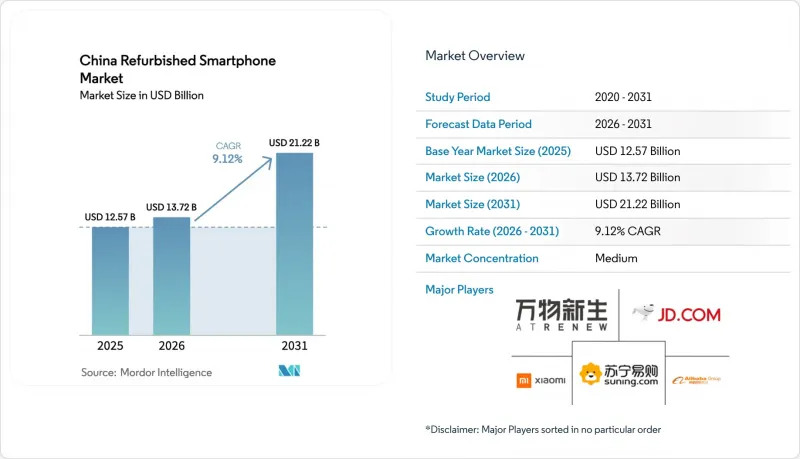
根據 Mordor Intelligence 預測,中國翻新智慧型手機市場規模將從 2025 年的 125.7 億美元成長到 2026 年的 137.2 億美元,然後在 2031 年達到 212.2 億美元,2026 年至 2031 年的複合年成長率為 9.12%。
本報告按作業系統(Android、iOS、鴻蒙作業系統及其他)、價格區間(1,000元以下、1,000-1999元及其他)、分銷管道(線上市場、線下)、網路技術(5G、4G LTE、3G及以下)、最終用戶(一般消費者B2C、企業B2B)及地區進行細分。市場預測以美元計價。
中國翻新智慧型手機市場趨勢及洞察
電子商務和擔保交易服務的日益普及有助於建立信任
數位支付和基於區塊鏈的認證技術能夠即時驗證設備狀態和所有權,從而提升消費者信心。閒魚的信用系統評估使用者信譽,並整合投票機制解決糾紛,確保24小時內解決索賠。第三方檢測機構將審核影片上傳至不可竄改的帳本,方便買家透明地查看檢測結果。這些措施在合法零售店仍稀少的內陸小規模城市尤為有效,從而將中國翻新智慧型手機市場拓展至沿海主要大都會圈。
與新款智慧型手機競爭中的價格差異
隨著高階設備快速貶值,二手市場湧現出極具吸引力的性價比提案。預計到2025年中期,iPhone 13在各大平台的交易價格約為1720元人民幣,比2024年的上市價格低45%,但仍可享受五年的iOS系統更新。隨著消費者逐漸習慣高性能攝影機和高刷新率螢幕,舊款旗艦機型能夠以遠低於新款的價格滿足用戶對性能的期待,從而支撐了中國翻新智慧型手機市場的穩定需求。
仿冒品和平行輸入損害了品牌聲譽
庫存分級評級以及線上報價與最終回購價格之間存在顯著差異,削弱了消費者信心,尤其是在點對點交易平台上。 2025年3月,在針對京東以舊換新合作夥伴愛回手的申訴激增後,監管機構要求其提交可審核的品質報告並解釋價格調整的原因。在監管力度加強之前,懷疑的買家可能會推遲購買,或透過認證管道支付過高的價格,這預計將嚴重抑制中國翻新智慧型手機市場的成長。
細分市場分析
預計到2025年,安卓設備將佔中國翻新機市場74.05%的佔有率。這主要得益於國內高性能安卓設備的豐富供應,以及鴻蒙操作系統的整合,後者有助於保持安卓設備的二手價值。 2025年第二季度,光是華為一家就供應了超過18%的翻新安卓庫存。這一市場受益於廣泛的運營商相容性以及eSIM卡的緩慢普及,後者簡化了激活流程。同時,iOS預計將以11.25%的複合年成長率成長,這主要得益於注重性價比的消費者購買價格在1700元人民幣左右的二手iPhone 13。這一成長勢頭使蘋果有望擴大其在中國翻新智慧型手機市場的佔有率,而鴻蒙作業系統也在探索跨裝置協同效應,以延長安卓裝置的使用壽命。
預計到2031年,中國翻新智慧型手機市場中iOS設備的市場規模將達到76.2億美元,佔該細分市場總價值的三分之一以上。儘管安卓系統仍佔據主導地位,但iOS市場佔有率的成長表明,以價值為導向的定價策略能夠推動高階生態系統的廣泛普及。
預計到2025年,1000-1999元價位段的手機銷售量將佔總銷售量的43.25%。這反映出上市一年以上的旗艦機型供應充足,以及消費者對認證二手產品的高度信任。以舊換新補貼和快速的創新週期推動著幾乎每季都有新款機型進入這一價位段,進一步擴大了該價位段的市場佔有率。同時,預計2000-2999元價位段的手機銷售量將以每年11.35%的速度成長,因為消費者正在增加對5G連線和大容量儲存的預算。該價位段包括小米「Ultra」系列和三星「S22」系列,雖然這些機型的貶值速度比超高階機型更快,但它們將在未來四年內獲得軟體支援。
在中國翻新智慧型手機市場,售價在2,000元至2,999元人民幣之間的手機市場佔有率預計將從2025年的22.15%上升到2031年的28.60%。隨著新機型功能與二手機型之間的差距縮小,1,000元以下手機的需求正在放緩,這顯示消費者正逐漸轉向中價位的二手產品。
其他好處
- Excel格式的市場預測(ME)表
- 3個月的分析師支持
目錄
第1章:引言
- 本研究的假設與市場定義
- 調查範圍
第2章:調查方法
第3章執行摘要
第4章 市場狀況
- 市場概覽
- 市場促進因素
- 電子商務和擔保交易服務的日益普及有助於建立信任
- 與新款智慧型手機競爭中的價格差異
- 政府關於電子廢棄物和循環經濟的政策
- OEM支援的認證二手計劃
- 5G部署縮短了升級週期
- 在三、四線城市擴大實施範圍
- 市場限制因素
- 仿冒品和平行輸入損害了品牌聲譽
- 缺乏統一的品質評級標準
- 由於中國的PIPL資料擦除法規,資料恢復成本飆升。
- 由於來自價格極低的新型設備的競爭,價格差距正在縮小。
- 產業價值鏈分析
- 監理情勢
- 宏觀經濟因素的影響
- 技術展望
- 波特五力分析
第5章 市場規模與成長預測
- 透過作業系統
- Android
- iOS
- HarmonyOS
- 其他
- 按價格範圍
- 少於1000元人民幣
- 1,000–1,999 元人民幣
- 2,000–2,999 元人民幣
- 3,000–3,999 元人民幣
- 超過4000元人民幣
- 透過分銷管道
- 網路市集
- C2C平台
- B2C平台
- 開利網路商店
- 離線
- 品牌自營店
- 營運商自營商店
- 獨立零售商
- 網路市集
- 網路科技
- 5G
- 4G LTE
- 3G 或更低
- 最終用戶
- 一般消費者(B2C)
- 學生
- 社會成員
- 老年人
- 企業(B2B)
- 小型企業
- 大公司
- 一般消費者(B2C)
第6章 競爭情勢
- 市場集中度
- 策略趨勢
- 市佔率分析
- 公司簡介
- ATRenew Inc.
- Alibaba Group Holding Limited
- JD.com Inc.
- Suning.com Co. Ltd.
- Xiaomi Corporation
- Huawei Device Co. Ltd.
- Apple Inc.
- Samsung Electronics Co. Ltd.
- Oppo Guangdong Mobile Telecommunications Corp., Ltd.
- Vivo Mobile Communication Co., Ltd.
- Honor Device Co., Ltd.
- TCL Communication Technology Holdings Limited
- China Mobile Communications Group Co., Ltd.
- China United Network Communications Group Co., Ltd.
- China Telecommunications Corporation
- YH Global Supply Chain Co., Ltd.
- Fenqile(Shenzhen Fenqile E-Commerce Co., Ltd.)
- Dangdang Information Technology Co., Ltd.
- Zhuanzhuan Group
- Aukte Limited
第7章 市場機會與未來展望
According to Mordor Intelligence, the China refurbished smartphone market size is expected to grow from USD 12.57 billion in 2025 to USD 13.72 billion in 2026 and is forecast to reach USD 21.22 billion by 2031 at 9.12% CAGR over 2026-2031.
This report is Segmented by Operating System (Android, IOS, Harmony OS, and More), Price Band (Below CNY 1, 000, CNY 1, 000-1, 999, and More), Sales Channel (Online Marketplace, and Offline), Network Technology (5G, 4G LTE, and 3G and Below), End User (Consumer B2C, and Enterprise B2B), and Region. The Market Forecasts are Provided in Terms of Value (USD).
China Refurbished Smartphone Market Trends and Insights
Growing E-commerce Penetration and Trust-Building Escrow Services
Digital payments and blockchain authentication have raised consumer confidence by enabling real-time verification of device condition and ownership. Xianyu's credit system evaluates user reliability and integrates dispute-resolution voting panels that settle claims within 24 hours. Third-party labs upload video audits to immutable ledgers, giving buyers transparent access to inspection results. These measures are most impactful in smaller inland cities, where formal retail options remain scarce, thereby broadening the China refurbished smartphone market footprint beyond coastal metropolitan areas.
Competitive Pricing Gap Versus New Smartphones
Premium devices depreciate rapidly, creating a compelling value proposition in the secondary channel. An iPhone 13 traded at roughly CNY 1,720 on leading platforms in mid-2025, a level 45% below its 2024 launch price yet still supported by five years of iOS updates. As consumers become accustomed to better cameras and higher refresh-rate screens, older flagships meet performance expectations at a fraction of the cost of new devices, reinforcing steady demand across the Chinese refurbished smartphone market.
Counterfeit and Grey-Market Devices Harming Brand Trust
Instances of misgraded stock and significant discrepancies between online quotes and final payouts have eroded consumer confidence, particularly on peer-to-peer forums. A March 2025 spike in complaints against JD.com's trade-in partner Aihuishou prompted regulators to call for auditable quality reports and mandatory price-adjustment explanations. Until enforcement tightens, skeptical buyers may defer purchases or pay a premium for certified channels, which will weigh on the trajectory of the China refurbished smartphone market.
Other drivers and restraints analyzed in the detailed report include:
- Government E-waste and Circular-Economy Policies
- OEM-backed Certified Pre-owned Programs
- Lack of Unified Quality-Grading Standards
For complete list of drivers and restraints, kindly check the Table Of Contents.
Segment Analysis
Android accounted for 74.05% of 2025 revenue, underpinned by an abundance of high-spec domestic devices and HarmonyOS integration, which sustains resale value. Huawei alone supplied more than 18% of refurbished Android inventory in Q2 2025. The segment benefits from wide carrier compatibility and delayed eSIM uptake, which simplifies activation. Conversely, iOS posted an 11.25% forecast CAGR as budget shoppers tap second-hand iPhone 13 units priced close to CNY 1,700. That momentum positions Apple to capture incremental share within the China refurbished smartphone market, even as HarmonyOS explores cross-device synergies that may extend Android's asset life.
The China refurbished smartphone market size for iOS devices is projected to reach USD 7.62 billion by 2031, equivalent to more than one-third of the total segment value. Android remains dominant, yet incremental iOS uptake demonstrates how value-pricing can democratize premium ecosystems.
The CNY 1,000-1,999 tier accounted for 43.25% of 2025 sales, reflecting an ample supply of year-old flagships and strong consumer confidence in the certified pre-owned status. Trade-in subsidies and rapid innovation cycles funnel nearly new devices into this band every quarter, reinforcing its scale. Meanwhile, the CNY 2,000-2,999 range is forecast to grow at an annual rate of 11.35% as shoppers stretch their budgets for 5G connectivity and larger storage. This tier captures Xiaomi Ultra and Samsung S22 series units that depreciate faster than ultra-premium counterparts but still deliver four more years of software support.
The China refurbished smartphone market share for the CNY 2,000-2,999 tier is expected to rise to 28.60% by 2031, up from 22.15% in 2025. The demand below CNY 1,000 is moderating as new devices close the feature gap, indicating a gradual shift toward mid-priced refurbished options.
Complete Report Scope:
- By Operating System
- Android
- iOS
- HarmonyOS
- Others
- By Price Band
- Below CNY 1,000
- CNY 1,000-1,999
- CNY 2,000-2,999
- CNY 3,000-3,999
- CNY 4,000 and Above
- By Sales Channel
- Online Marketplace
- C2C Platforms
- B2C Platforms
- Carrier Online Stores
- Offline
- Brand Stores
- Carrier Stores
- Independent Retailers
- Online Marketplace
- By Network Technology
- 5G
- 4G LTE
- 3G and Below
- By End User
- Consumer (B2C)
- Student Segment
- Working Professionals
- Seniors
- Enterprise (B2B)
- Small and Medium Enterprises
- Large Enterprises
- Consumer (B2C)
List of Companies Covered in this Report:
- ATRenew Inc.
- Alibaba Group Holding Limited
- JD.com Inc.
- Suning.com Co. Ltd.
- Xiaomi Corporation
- Huawei Device Co. Ltd.
- Apple Inc.
- Samsung Electronics Co. Ltd.
- Oppo Guangdong Mobile Telecommunications Corp., Ltd.
- Vivo Mobile Communication Co., Ltd.
- Honor Device Co., Ltd.
- TCL Communication Technology Holdings Limited
- China Mobile Communications Group Co., Ltd.
- China United Network Communications Group Co., Ltd.
- China Telecommunications Corporation
- YH Global Supply Chain Co., Ltd.
- Fenqile (Shenzhen Fenqile E-Commerce Co., Ltd.)
- Dangdang Information Technology Co., Ltd.
- Zhuanzhuan Group
- Aukte Limited
Additional Benefits:
- The market estimate (ME) sheet in Excel format
- 3 months of analyst support
TABLE OF CONTENTS
1 INTRODUCTION
- 1.1 Study Assumptions and Market Definitions
- 1.2 Scope of the Study
2 RESEARCH METHODOLOGY
3 EXECUTIVE SUMMARY
4 MARKET LANDSCAPE
- 4.1 Market Overview
- 4.2 Market Drivers
- 4.2.1 Growing e-commerce penetration and trust-building escrow services
- 4.2.2 Competitive pricing gap versus new smartphones
- 4.2.3 Government e-waste and circular-economy policies
- 4.2.4 OEM-backed certified pre-owned programs
- 4.2.5 Shortened upgrade cycles created by 5G rollout
- 4.2.6 Rising adoption in tier-3 and tier-4 cities
- 4.3 Market Restraints
- 4.3.1 Counterfeit and grey-market devices harming brand trust
- 4.3.2 Lack of unified quality-grading standards
- 4.3.3 Higher refurbishment costs due to China PIPL data-wipe rules
- 4.3.4 Competition from ultra-low-cost new devices narrowing price gap
- 4.4 Industry Value Chain Analysis
- 4.5 Regulatory Landscape
- 4.6 Impact of Macroeconomic Factors
- 4.7 Technological Outlook
- 4.8 Porter's Five Forces Analysis
- 4.8.1 Bargaining Power of Buyers
- 4.8.2 Bargaining Power of Suppliers
- 4.8.3 Threat of New Entrants
- 4.8.4 Threat of Substitutes
- 4.8.5 Intensity of Competitive Rivalry
5 MARKET SIZE AND GROWTH FORECASTS (VALUE)
- 5.1 By Operating System
- 5.1.1 Android
- 5.1.2 iOS
- 5.1.3 HarmonyOS
- 5.1.4 Others
- 5.2 By Price Band
- 5.2.1 Below CNY 1,000
- 5.2.2 CNY 1,000-1,999
- 5.2.3 CNY 2,000-2,999
- 5.2.4 CNY 3,000-3,999
- 5.2.5 CNY 4,000 and Above
- 5.3 By Sales Channel
- 5.3.1 Online Marketplace
- 5.3.1.1 C2C Platforms
- 5.3.1.2 B2C Platforms
- 5.3.1.3 Carrier Online Stores
- 5.3.2 Offline
- 5.3.2.1 Brand Stores
- 5.3.2.2 Carrier Stores
- 5.3.2.3 Independent Retailers
- 5.3.1 Online Marketplace
- 5.4 By Network Technology
- 5.4.1 5G
- 5.4.2 4G LTE
- 5.4.3 3G and Below
- 5.5 By End User
- 5.5.1 Consumer (B2C)
- 5.5.1.1 Student Segment
- 5.5.1.2 Working Professionals
- 5.5.1.3 Seniors
- 5.5.2 Enterprise (B2B)
- 5.5.2.1 Small and Medium Enterprises
- 5.5.2.2 Large Enterprises
- 5.5.1 Consumer (B2C)
6 COMPETITIVE LANDSCAPE
- 6.1 Market Concentration
- 6.2 Strategic Moves
- 6.3 Market Share Analysis
- 6.4 Company Profiles (includes Global level Overview, Market level overview, Core Segments, Financials as available, Strategic Information, Market Rank/Share for key companies, Products and Services, and Recent Developments)
- 6.4.1 ATRenew Inc.
- 6.4.2 Alibaba Group Holding Limited
- 6.4.3 JD.com Inc.
- 6.4.4 Suning.com Co. Ltd.
- 6.4.5 Xiaomi Corporation
- 6.4.6 Huawei Device Co. Ltd.
- 6.4.7 Apple Inc.
- 6.4.8 Samsung Electronics Co. Ltd.
- 6.4.9 Oppo Guangdong Mobile Telecommunications Corp., Ltd.
- 6.4.10 Vivo Mobile Communication Co., Ltd.
- 6.4.11 Honor Device Co., Ltd.
- 6.4.12 TCL Communication Technology Holdings Limited
- 6.4.13 China Mobile Communications Group Co., Ltd.
- 6.4.14 China United Network Communications Group Co., Ltd.
- 6.4.15 China Telecommunications Corporation
- 6.4.16 YH Global Supply Chain Co., Ltd.
- 6.4.17 Fenqile (Shenzhen Fenqile E-Commerce Co., Ltd.)
- 6.4.18 Dangdang Information Technology Co., Ltd.
- 6.4.19 Zhuanzhuan Group
- 6.4.20 Aukte Limited
7 MARKET OPPORTUNITIES AND FUTURE OUTLOOK
- 7.1 White-space and Unmet-need assessment

 二手及翻新智慧型手機市場-2026-2032年全球市場預測
 2026-2030年全球翻新智慧型手機市場
 二手及翻新智慧型手機:市佔率分析、產業趨勢及統計、成長預測(2026-2031)
 翻新及二手行動電話市場規模、佔有率及成長分析(按類型、價格分佈範圍、銷售管道及地區分類)-2026-2033年產業預測
 翻新智慧型手機市場規模、佔有率和成長分析(按作業系統、智慧型手機類型、銷售管道和地區分類)-2026-2033年產業預測
 全球二手行動電話市場
 全球翻新和行動電話市場:行業分析、規模、佔有率、成長、趨勢和預測(2025-2032 年)全球翻新智慧型手機市場