

 |
市場調查報告書
商品編碼
2124921
電腦及周邊設備用標準邏輯積體電路:市場佔有率分析、產業趨勢與統計及成長預測(2026-2031)Computer And Peripherals Standard Logic IC - Market Share Analysis, Industry Trends & Statistics, Growth Forecasts (2026 - 2031) |
||||||

※ 本網頁內容可能與最新版本有所差異。詳細情況請與我們聯繫。
根據 Mordor Intelligence 預測,電腦及周邊設備設備用標準邏輯積體電路的市場規模預計將從 2025 年的 354.4 億美元成長到 2026 年的 373.7 億美元,然後在 2031 年達到 487.2 億美元,2026 年至 2031 年的複合年成長率為 5.4%。
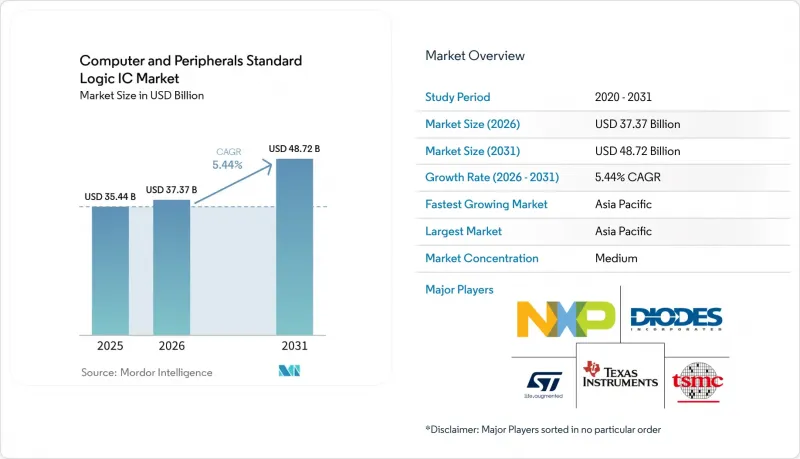
本報告按邏輯系列(電晶體、電晶體邏輯 (TTL/LS/ALS) 及其他)、功能類型(閘反相器、觸發器、鎖存器及其他)、封裝類型(直插式 DIP/CDIP、SOIC/TSSOP 及其他)、最終用途設備(個人電腦、筆記型電腦、印表機、掃描器、多功能一體機及其他)和地區進行細分。市場預測以美元 (USD) 為單位。
周邊設備。
超薄周邊設備對低壓LVC邏輯的需求正在激增。
在超薄周邊設備,1.65V 至 5.5V 的 74LVC/AUP 裝置備受青睞,它們不僅滿足嚴格的散熱設計要求,還能實現奈秒開關速度,預計到 2030 年將以 6.73% 的年複合成長率(CAGR)成長。 USB4 和 Thunderbolt 5 集線器便是此轉變的典型例證,它們需要在緊湊的外殼內實現 40Gbps 或更高的訊號傳輸速率。分散式低電壓邏輯架構在功耗和發熱量方面優於單晶片架構,從而滿足了全球設計中心和亞太地區組裝工廠的需求。
人工智慧驅動的自動化路由正在增加可配置多門積體電路的出貨量。
機器學習驅動的PCB設計工具可在數分鐘內評估數千種拓撲結構,並經常選擇不常見的閘電路組合。這導致可配置多門裝置的需求增加了23%。隨著設計週期的縮短,提供豐富的參數庫和快速樣品交付的供應商正在贏得訂單。
分立邏輯SoC整合設計採用延遲
先進的SoC晶片現在整合了可程式邏輯塊,這些邏輯塊可以複製常見的74系列晶片的功能,從而減少了批量生產設備中分立元件的使用,儘管整體電子裝置的複雜性日益增加。然而,對於需要電氣隔離和高壓開關的功能,它們仍然依賴獨立的積體電路,因此,雖然替代品的威脅有所緩解,但並未完全消除。
細分市場分析
根據2025年的預測,高速74HC/HCT元件的銷售額佔比達30.62%。受惠於節能型先進製程工藝,低壓74LVC/AUP系列預計將以6.51%的複合年成長率成長,該類別中用於電腦和周邊設備的標準邏輯IC市場規模預計將比傳統TTL產品線成長更快。混合電壓設計結合了多個CMOS系列,以平衡成本和時序,而人工智慧主導的CAD技術正在加速這一趨勢,因為它減輕了設計負擔。
向異構電壓域的轉變維持了對分立元件的需求,因為僅靠SoC引腳無法滿足隔離度和抗噪性要求。 ECL/MECL在對抖動敏感的測量系統中保持著獨特的地位,而4000系列CMOS則滿足了工業界對寬電壓範圍的需求。封裝尺寸的持續小型化確保了電腦和周邊設備的標準邏輯IC市場保持產品系列的多樣性,而不是趨向於單一的主導架構。
到2025年,閘電路和反相器將佔據25.98%的市場佔有率,這反映了它們的通用性。隨著多電壓SoC與混合訊號周邊設備的介面日益普及,訊號開關和電平轉換器預計將在2031年之前以6.74%的複合年成長率推動該細分市場的成長,從而提升這些裝置在電腦和周邊設備標準邏輯IC市場的佔有率。多工器和解碼器支援多顯示器擴充塢,而緩衝器則用於維護高速差分對的訊號完整性。
設計團隊越來越傾向於選擇具有自適應閾值追蹤功能的轉換器積體電路,這可以減少因電源軌轉換而導致的基板設計迭代次數。這種轉變反映了人們對介面管理而非單純閘數的需求日益成長,即使電晶體整合密度不斷提高,介面管理仍然具有價值。
區域分析
預計到2025年,亞太地區將成為電腦及周邊設備設備標準邏輯積體電路市場的領導者,市佔率將達到50.72%,並有望以8.45%的複合年成長率成長。這主要得益於中國大陸、台灣和韓國從晶圓代工廠到組裝的完整產業鏈生態系統。一級供應商,尤其是日本汽車產業的供應商,正在推動對寬溫域產品組合的需求,而台灣則憑藉其面板級封裝產業叢集進一步鞏固了其市場領先地位。
在北美,隨著美國設計公司推動以人工智慧為中心的、需要可配置多門邏輯的周邊設備的發展,預計複合年成長率將保持成長。儘管晶圓產能有限,加拿大和墨西哥仍利用其與美國原始設備製造商(OEM)的地理位置接近性,以進行基板級組裝,從而滿足區域需求。
在歐洲,受汽車電氣化和工業自動化的推動,預計複合年成長率將上升。德國一級供應商正在對符合AEC-Q100標準的設備進行認證,法國正在支持航太領域的衍生產品,而義大利則在面板級封裝領域吸引投資,從而實現供應來源多元化,擺脫對亞洲的依賴。儘管拉丁美洲、中東和非洲等新興地區在2024年的總銷售額中所佔佔有率較小,但基礎設施主導的網路周邊設備預計將成為未來需求成長的主要驅動力。
其他好處
- Excel格式的市場預測(ME)表
- 3個月的分析師支持
目錄
第1章:引言
- 研究假設和市場定義
- 調查範圍
第2章:調查方法
第3章執行摘要
第4章 市場狀況
- 市場概覽
- 市場促進因素
- 超薄周邊設備對低電壓LVC邏輯電路的需求激增
- 左移PCB設計工作流程正在推高單門(1G)邏輯的平均售價(ASP)。
- 利用人工智慧驅動的自動化佈線技術,可配置多門積體電路的出貨量顯著增加。
- USB-C/Thunderbolt 集線器的主流升級週期
- 採用低功耗緩衝器的無線鍵盤和滑鼠越來越受歡迎。
- 透過 ODM 印表機成本降低計劃,74HC/HCT 即插即用產品得到了更廣泛的應用。
- 市場限制因素
- 分立邏輯SoC整合設計採用延遲
- 汽車標準(AEC-Q100)認證的等待名單越來越長。
- 傳統邏輯節點200mm晶圓代工廠工廠產能波動
- 大量仿冒品湧入市場
- 工業供應鏈分析
- 監理情勢
- 技術展望
- 波特五力分析
- 對宏觀經濟影響的評估
第5章 市場規模與成長預測
- 按邏輯家族
- 電晶體和電晶體邏輯電路(TTL/LS/ALS)
- 高速CMOS(74HC/HCT)
- 低電壓CMOS(74LVC/AUP)
- 先進高速CMOS(74AC/ACT)
- 高壓4000系列CMOS
- ECL/MECL 和其他雙極邏輯
- 依功能類型
- 門反相器
- 觸發器鎖存器
- 櫃檯隔板
- 值班報到表
- 緩衝器/驅動器/收發器
- 多工器解碼器編碼器
- 比較器和算術邏輯電路
- 訊號開關和電平轉換器
- 按包裝類型
- 通孔DIP/CDIP
- SOIC/TSSOP
- SOT-23/SOT-353 和其他微型封裝
- QFN/XSON/DFN
- WLCSP/晶圓級晶片規模
- BGA/LGA
- 按最終用途設備
- 個人電腦/筆記型電腦
- 印表機、掃描器、多功能一體機
- 外置儲存擴充塢
- 遊戲主機及周邊設備
- 網路周邊設備(路由器、集線器)
- POS終端機和自助服務終端
- 工業用電腦和加固型周邊設備
- 按地區
- 北美洲
- 美國
- 加拿大
- 墨西哥
- 南美洲
- 巴西
- 阿根廷
- 哥倫比亞
- 南美洲其他地區
- 歐洲
- 英國
- 德國
- 法國
- 義大利
- 西班牙
- 其他歐洲國家
- 亞太地區
- 中國
- 日本
- 韓國
- 印度
- 亞太其他地區
- 中東和非洲
- 中東
- 沙烏地阿拉伯
- 阿拉伯聯合大公國
- 其他中東國家
- 非洲
- 南非
- 埃及
- 其他非洲地區
- 中東
- 北美洲
第6章 競爭情勢
- 市場集中度
- 策略趨勢
- 市佔率分析
- 公司簡介
- Texas Instruments Incorporated
- Nexperia BV
- onsemi Corporation
- STMicroelectronics NV
- Toshiba Electronic Devices and Storage Corporation
- ROHM Co., Ltd.
- Diodes Incorporated
- Microchip Technology Inc.
- Infineon Technologies AG
- Renesas Electronics Corporation
- Maxim Integrated(Analog Devices, Inc.)
- Vishay Intertechnology, Inc.
- Lattice Semiconductor Corporation
- Skyworks Solutions, Inc.
- Taiwan Semiconductor Manufacturing Co., Ltd.(Foundry Perspective)
- Teledyne e2v Semiconductor
- Samsung Electronics Co., Ltd.(System LSI)
- NXP Semiconductors NV
- Broadcom Inc.
- Analog Devices, Inc.
第7章 市場機會與未來展望
According to Mordor Intelligence, the computer and Peripherals Standard Logic IC market size is expected to grow from USD 35.44 billion in 2025 to USD 37.37 billion in 2026 and is forecast to reach USD 48.72 billion by 2031 at 5.44% CAGR over 2026-2031.
This report is Segmented by Logic Family (Transistor-Transistor Logic (TTL / LS / ALS), and More), Function Type (Gates/Inverters, Flip-Flops/Latches, and More), Package Type (Through-Hole DIP / CDIP, SOIC/TSSOP, and More), End-Use Device (Personal Computers and Laptops, Printers, Scanners and MFPs, and More), and Geography. The Market Forecasts are Provided in Terms of Value (USD).
Global Computer And Peripherals Standard Logic IC Market Trends and Insights
Surging demand for low-voltage LVC logic in ultra-thin peripherals
Ultra-thin peripherals favor 1.65 V-5.5 V 74LVC/AUP devices that deliver nanosecond switching while fitting strict thermal envelopes, propelling a 6.73% CAGR through 2030. USB4 and Thunderbolt 5 hubs exemplify this shift by requiring 40 Gbps-plus signaling in compact enclosures. Distributed low-voltage logic architectures outperform monolithic alternatives on power and heat, sustaining demand across global design centers and APAC assembly bases.
AI-assisted auto-routing increasing configurable multi-gate IC volume
Machine-learning PCB tools evaluate thousands of topologies in minutes and frequently choose uncommon gate combinations, driving a 23% rise in demand for configurable multi-gate devices. Vendors supplying broad parametric libraries and rapid samples win sockets as design cycles compress.
Design-in inertia toward SoC integration of discrete logic
Advanced SoCs now embed programmable logic blocks that replicate common 74-series functions, cutting discrete content in high-volume devices despite rising overall electronics complexity. Yet functions needing galvanic isolation or high-voltage switching still rely on stand-alone ICs, tempering but not eliminating the substitution threat.
Other drivers and restraints analyzed in the detailed report include:
- Mainstream USB-C/Thunderbolt hub upgrade cycles
- Rising attach rate of wireless keyboards and mice using low-power buffers
- Lengthening automotive-grade qualification queues (AEC-Q100)
For complete list of drivers and restraints, kindly check the Table Of Contents.
Segment Analysis
2025 results showed high-speed 74HC/HCT devices occupying 30.62% revenue. Low-voltage 74LVC/AUP families, benefiting from energy-sensitive edge nodes, are forecast to add 6.51% CAGR, driving the Computer and Peripherals Standard Logic IC market size in this category to outpace legacy TTL lines. Mixed-voltage designs combine multiple CMOS families to balance cost and timing, a pattern accelerated by AI-guided CAD that lowers design effort.
The migration toward heterogeneous voltage domains preserves discrete demand where SoC pins cannot satisfy isolation or noise immunity. ECL/MECL retains niche roles in jitter-sensitive acquisition systems, whereas 4000-series CMOS fulfills wide-voltage industrial needs. Continued package shrinkage ensures the Computer and Peripherals Standard Logic IC market retains family diversity rather than converging on a single dominant architecture.
Gates and inverters held a 25.98% share in 2025, reflecting their universality. Signal switches and level translators will lead segment expansion with a 6.74% CAGR to 2031 as multi-voltage SoCs interface with mixed-signal peripherals, raising the Computer and Peripherals Standard Logic IC market share for these devices. Multiplexers and decoders support multi-display docks, while buffers maintain integrity on high-speed differential pairs.
Design teams increasingly prefer translator ICs with adaptive threshold tracking, trimming board spins caused by supply-rail migrations. The shift signals demand growth rooted in interface management rather than raw gate count, sustaining value even as transistor integration climbs.
Complete Report Scope:
- By Logic Family
- Transistor-Transistor Logic (TTL / LS / ALS)
- High-Speed CMOS (74HC / HCT)
- Low-Voltage CMOS (74LVC / AUP)
- Advanced High-Speed CMOS (74AC / ACT)
- Wide-Voltage 4000-Series CMOS
- ECL / MECL and Other Bipolar Logic
- By Function Type
- Gates and Inverters
- Flip-Flops and Latches
- Counters and Dividers
- Shift Registers
- Buffers / Drivers / Transceivers
- Multiplexers / Decoders and Encoders
- Comparators and Arithmetic Logic
- Signal Switches and Level Translators
- By Package Type
- Through-Hole DIP / CDIP
- SOIC / TSSOP
- SOT-23 / SOT-353 and Other Micro-Packages
- QFN / XSON / DFN
- WLCSP / Wafer-Level Chip-Scale
- BGA / LGA
- By End-Use Device
- Personal Computers and Laptops
- Printers, Scanners and MFPs
- External Storage and Docking Stations
- Gaming Consoles and Accessories
- Networking Peripherals (Routers, Hubs)
- POS Terminals and Kiosks
- Industrial PCs and Rugged Peripherals
- By Geography
- North America
- United States
- Canada
- Mexico
- South America
- Brazil
- Argentina
- Colombia
- Rest of South America
- Europe
- United Kingdom
- Germany
- France
- Italy
- Spain
- Rest of Europe
- Asia-Pacific
- China
- Japan
- South Korea
- India
- Rest of Asia-Pacific
- Middle East and Africa
- Middle East
- Saudi Arabia
- United Arab Emirates
- Rest of Middle East
- Africa
- South Africa
- Egypt
- Rest of Africa
- Middle East
- North America
Geography Analysis
Asia-Pacific led with 50.72% Computer and Peripherals Standard Logic IC market share in 2025 and is forecast to rise at an 8.45% CAGR, underpinned by integrated foundry-to-assembly ecosystems in China, Taiwan, and South Korea. Japan's automotive-centric tier-1s sustain demand for extended-temperature families, while Taiwan extends leadership through panel-level packaging clusters.
North America delivered a growing CAGR outlook as design houses in the United States push AI-centric peripherals that require configurable multi-gate logic. Canada and Mexico leverage proximity to U.S. OEMs for board-level assembly, anchoring regional demand despite limited wafer capacity.
Europe posted a growing CAGR trajectory driven by automotive electrification and industrial automation. Germany's Tier-1 suppliers qualify AEC-Q100 devices, France supports aerospace variants, and Italy attracts panel-level packaging investment that diversifies supply beyond Asia. Emerging regions in Latin America, the Middle East, and Africa collectively formed a small part of the 2024 revenue, with infrastructure-driven networking peripherals stimulating future uptake.
- Texas Instruments Incorporated
- Nexperia B.V.
- onsemi Corporation
- STMicroelectronics N.V.
- Toshiba Electronic Devices and Storage Corporation
- ROHM Co., Ltd.
- Diodes Incorporated
- Microchip Technology Inc.
- Infineon Technologies AG
- Renesas Electronics Corporation
- Maxim Integrated (Analog Devices, Inc.)
- Vishay Intertechnology, Inc.
- Lattice Semiconductor Corporation
- Skyworks Solutions, Inc.
- Taiwan Semiconductor Manufacturing Co., Ltd. (Foundry Perspective)
- Teledyne e2v Semiconductor
- Samsung Electronics Co., Ltd. (System LSI)
- NXP Semiconductors N.V.
- Broadcom Inc.
- Analog Devices, Inc.
Additional Benefits:
- The market estimate (ME) sheet in Excel format
- 3 months of analyst support
TABLE OF CONTENTS
1 INTRODUCTION
- 1.1 Study Assumptions and Market Definition
- 1.2 Scope of the Study
2 RESEARCH METHODOLOGY
3 EXECUTIVE SUMMARY
4 MARKET LANDSCAPE
- 4.1 Market Overview
- 4.2 Market Drivers
- 4.2.1 Surging demand for low-voltage LVC logic in ultra-thin peripherals
- 4.2.2 Shift-left PCB design workflows boosting single-gate (1G) logic ASPs
- 4.2.3 AI-assisted auto-routing increasing volume of configurable multi-gate ICs
- 4.2.4 Mainstream upgrade cycles for USB-C/Thunderbolt hubs
- 4.2.5 Rising attach-rate of wireless keyboards and mice using low-power buffers
- 4.2.6 Cost-down programs in ODM printers favouring 74HC/HCT drop-ins
- 4.3 Market Restraints
- 4.3.1 Design-in inertia toward SoC integration of discrete logic
- 4.3.2 Lengthening automotive-grade qualification queues (AEC-Q100)
- 4.3.3 Volatility in 200 mm foundry capacity for legacy logic nodes
- 4.3.4 Counterfeit 74-series influx in secondary channels
- 4.4 Industry Supply Chain Analysis
- 4.5 Regulatory Landscape
- 4.6 Technological Outlook
- 4.7 Porter's Five Forces Analysis
- 4.7.1 Bargaining Power of Suppliers
- 4.7.2 Bargaining Power of Buyers
- 4.7.3 Threat of New Entrants
- 4.7.4 Threat of Substitutes
- 4.7.5 Degree of Competition
- 4.8 Assessment of Macroeconomic Impact
5 MARKET SIZE AND GROWTH FORECASTS (VALUE)
- 5.1 By Logic Family
- 5.1.1 Transistor-Transistor Logic (TTL / LS / ALS)
- 5.1.2 High-Speed CMOS (74HC / HCT)
- 5.1.3 Low-Voltage CMOS (74LVC / AUP)
- 5.1.4 Advanced High-Speed CMOS (74AC / ACT)
- 5.1.5 Wide-Voltage 4000-Series CMOS
- 5.1.6 ECL / MECL and Other Bipolar Logic
- 5.2 By Function Type
- 5.2.1 Gates and Inverters
- 5.2.2 Flip-Flops and Latches
- 5.2.3 Counters and Dividers
- 5.2.4 Shift Registers
- 5.2.5 Buffers / Drivers / Transceivers
- 5.2.6 Multiplexers / Decoders and Encoders
- 5.2.7 Comparators and Arithmetic Logic
- 5.2.8 Signal Switches and Level Translators
- 5.3 By Package Type
- 5.3.1 Through-Hole DIP / CDIP
- 5.3.2 SOIC / TSSOP
- 5.3.3 SOT-23 / SOT-353 and Other Micro-Packages
- 5.3.4 QFN / XSON / DFN
- 5.3.5 WLCSP / Wafer-Level Chip-Scale
- 5.3.6 BGA / LGA
- 5.4 By End-Use Device
- 5.4.1 Personal Computers and Laptops
- 5.4.2 Printers, Scanners and MFPs
- 5.4.3 External Storage and Docking Stations
- 5.4.4 Gaming Consoles and Accessories
- 5.4.5 Networking Peripherals (Routers, Hubs)
- 5.4.6 POS Terminals and Kiosks
- 5.4.7 Industrial PCs and Rugged Peripherals
- 5.5 By Geography
- 5.5.1 North America
- 5.5.1.1 United States
- 5.5.1.2 Canada
- 5.5.1.3 Mexico
- 5.5.2 South America
- 5.5.2.1 Brazil
- 5.5.2.2 Argentina
- 5.5.2.3 Colombia
- 5.5.2.4 Rest of South America
- 5.5.3 Europe
- 5.5.3.1 United Kingdom
- 5.5.3.2 Germany
- 5.5.3.3 France
- 5.5.3.4 Italy
- 5.5.3.5 Spain
- 5.5.3.6 Rest of Europe
- 5.5.4 Asia-Pacific
- 5.5.4.1 China
- 5.5.4.2 Japan
- 5.5.4.3 South Korea
- 5.5.4.4 India
- 5.5.4.5 Rest of Asia-Pacific
- 5.5.5 Middle East and Africa
- 5.5.5.1 Middle East
- 5.5.5.1.1 Saudi Arabia
- 5.5.5.1.2 United Arab Emirates
- 5.5.5.1.3 Rest of Middle East
- 5.5.5.2 Africa
- 5.5.5.2.1 South Africa
- 5.5.5.2.2 Egypt
- 5.5.5.2.3 Rest of Africa
- 5.5.5.1 Middle East
- 5.5.1 North America
6 COMPETITIVE LANDSCAPE
- 6.1 Market Concentration
- 6.2 Strategic Moves
- 6.3 Market Share Analysis
- 6.4 Company Profiles (includes Global level Overview, Market level overview, Core Segments, Financials as available, Strategic Information, Market Rank/Share for key companies, Products and Services, and Recent Developments)
- 6.4.1 Texas Instruments Incorporated
- 6.4.2 Nexperia B.V.
- 6.4.3 onsemi Corporation
- 6.4.4 STMicroelectronics N.V.
- 6.4.5 Toshiba Electronic Devices and Storage Corporation
- 6.4.6 ROHM Co., Ltd.
- 6.4.7 Diodes Incorporated
- 6.4.8 Microchip Technology Inc.
- 6.4.9 Infineon Technologies AG
- 6.4.10 Renesas Electronics Corporation
- 6.4.11 Maxim Integrated (Analog Devices, Inc.)
- 6.4.12 Vishay Intertechnology, Inc.
- 6.4.13 Lattice Semiconductor Corporation
- 6.4.14 Skyworks Solutions, Inc.
- 6.4.15 Taiwan Semiconductor Manufacturing Co., Ltd. (Foundry Perspective)
- 6.4.16 Teledyne e2v Semiconductor
- 6.4.17 Samsung Electronics Co., Ltd. (System LSI)
- 6.4.18 NXP Semiconductors N.V.
- 6.4.19 Broadcom Inc.
- 6.4.20 Analog Devices, Inc.
7 MARKET OPPORTUNITIES AND FUTURE OUTLOOK
- 7.1 White-Space and Unmet-Need Assessment

 汽車專用邏輯積體電路:市場佔有率分析、產業趨勢與統計及成長預測(2026-2031 年)
 2026-2030年全球標準邏輯積體電路市場邏輯積體電路(IC):市場佔有率分析、產業趨勢與統計資料、成長預測(2026-2031)
 5G半導體市場預測至2034年-全球分析(按組件、材料、頻段、製程節點、元件類型、網路基礎設施、應用、最終用戶和地區分類)邏輯積體電路市場預測至2034年-按產品類型、邏輯系列、元件類型、整合深度、晶圓尺寸、應用、最終用戶和地區分類的全球分析
 2026年全球金屬氧化物半導體(MOS)專用邏輯市場報告
 邏輯積體電路市場:按類型、應用、技術、最終用戶、產品類型和地區分類5G基礎設施和半導體組件市場:預測(至2034年)-按組件、類型、頻段、網路架構、最終用戶和地區分類的全球分析
 全球邏輯積體電路市場:按類型、技術、應用、國家和地區分類-產業分析、市場規模、佔有率及未來預測(2025-2032年)
 全球邏輯積體電路市場規模、佔有率、產業分析報告:按類型、通用邏輯積體電路類型、按技術、按應用、按地區分類,展望與預測(2025-2032年)