


 |
市場調查報告書
商品編碼
2116785
汽車專用邏輯積體電路:市場佔有率分析、產業趨勢與統計及成長預測(2026-2031 年)Automotive Special Purpose Logic IC - Market Share Analysis, Industry Trends & Statistics, Growth Forecasts (2026 - 2031) |
||||||

※ 本網頁內容可能與最新版本有所差異。詳細情況請與我們聯繫。
預計到 2026 年,汽車專用邏輯 IC 市場規模將達到 37.2 億美元,高於 2025 年的 36 億美元,預計到 2031 年將達到 44 億美元。
預計從 2026 年到 2031 年,其複合年成長率將達到 3.39%。
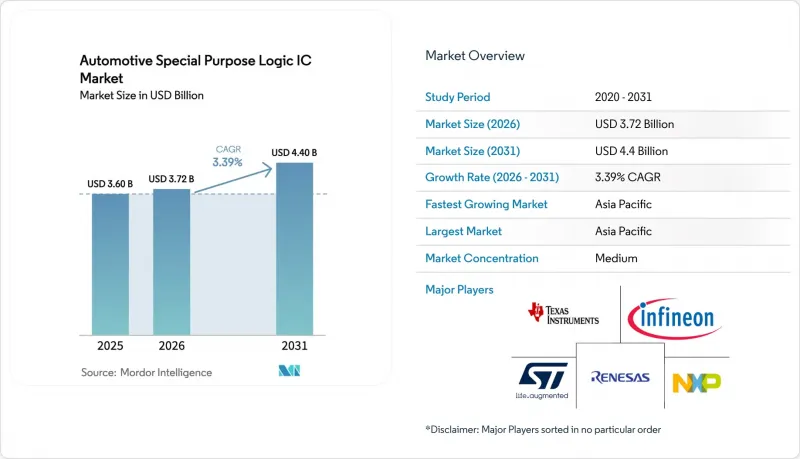
本報告按邏輯積體電路類型(ASSP、ASIC 等)、應用(ADAS、資訊娛樂和互聯、動力傳動系統和電池管理等)、車輛類型(乘用車、輕型商用車等)、封裝技術(SiP、MCM 等)以及地區(北美、南美等)進行細分。市場預測以美元計價。
全球汽車應用邏輯積體電路市場趨勢及洞察
ADAS和自動駕駛技術的應用正在迅速擴展。
隨著 Euro NCAP 協議更新強制要求商用車輛配備自動緊急煞車系統,能夠整合雷達、攝影機和雷射雷達輸入並滿足 ASIL-D 安全標準的邏輯裝置需求激增。隨著雙核心鎖步架構在向 L3 級自動駕駛過渡的過程中逐漸標準化,以及發達市場高級駕駛輔助系統 (ADAS) 的搭載率接近新車銷量,原始設備製造商 (OEM) 越來越傾向於採用客製化 ASIC,因為與通用 MCU 相比,ASIC 可以降低功耗和物料清單成本。
動力傳動系統的快速電氣化增加了可安裝的邏輯積體電路的數量。
每款電池式電動車車型都整合了更高價值的邏輯控制器,用於電池組監控、馬達逆變器和車載充電器。光是特斯拉的 4680 電池設計一項,就使每輛車在電池管理半導體邏輯方面的成本增加了 150 至 200 美元。高階電動車中 800V 架構的普及,催生了對隔離式閘極驅動器和容錯邏輯的新需求。 SiC 和 GaN 裝置正在突破開關頻率和散熱性能的極限,這是傳統裝置無法比擬的。
由於製造流程複雜且缺陷密度高,因此存在嚴格的限制。
AEC-Q100 0級標準要求在-40 度C至+150 度C的溫度範圍內,DPPM(每分鐘缺陷數)必須保持在個位數。這項要求迫使台積電對其汽車級生產線進行特殊調整,導致運轉率降低、單位成本上升,以及在需求高峰期備用產能受限。此外,與消費級邏輯電路相比,更長的老化時間和更嚴格的SPC(統計製程控制)流程可能會使晶圓製造週期增加高達60%。這些因素共同導致了汽車級半導體製造製程複雜性和成本的增加。
細分市場分析
預計到2025年,ASIC將佔總銷售額的35.82%,凸顯了OEM廠商更傾向大規模生產的成本優勢,而非FPGA的可程式設計便利性。然而,由於空中下載(OTA)更新推動了無需機械召回即可重新配置的需求,FPGA的採用率正以3.58%的複合年成長率快速成長。英特爾最新的汽車FPGA系列將功耗降低了30%,並縮小了成本差距,從而在演算法靈活性至關重要的領域提高了設計採用率。隨著L3級自動駕駛需要程式碼自適應性來微調感測器融合,基於FPGA的汽車專用邏輯IC市場規模預計將穩定成長。
二級CPLD用於確定性任務,例如安全氣囊展開邏輯。在這些應用中,奈秒的反應時間和近乎零待機功耗比純粹的運算能力更為重要。即使客製化ASIC的經濟性下降,ASSP仍然是中等批量生產的預設選擇,為一級供應商提供了單位成本和進度風險之間的平衡。在所有類別中,汽車專用邏輯IC市場的機會都傾向於整合嵌入式安全監控器和安全啟動功能的裝置,這是聯合國歐洲經濟委員會網路安全法規的要求。
到2025年,ADAS將佔行業收入的29.55%,預計到2031年將以3.88%的複合年成長率成長,因為自動緊急煞車和車道維持功能在全球變得越來越必要。 ADAS的運算負載不再分別處理視覺和雷達資料。集中式網域控制站現在可以在50毫秒的延遲內執行異質感測器融合和決策循環。高通驍龍Ride將邏輯架構、AI加速器和連接PHY整合到單一SoC中,體現了這種融合趨勢,並使OEM廠商能夠將PCB面積減少高達30%。
資訊娛樂和互聯功能也隨之發展,雙屏駕駛座和5G車載資訊系統的應用需要更高的記憶體頻寬和多核心邏輯。動力傳動系統和電池管理邏輯積體電路在電動車產品線中迅速擴展,尤其是在豪華車以外的領域,800V平台的應用日益普及。車身電子元件保持穩定成長,電動門、環境燈和空調分區控制等增強功能的出現提高了每輛車的邏輯密度。安全邏輯晶片由於需要達到最高的ASIL等級,因此能夠維持較高的平均售價,即使在經濟週期導致出貨量下降的情況下也能保證獲利。
區域分析
預計到2025年,亞太地區將佔全球銷售額的32.05%,並在2031年之前以3.46%的複合年成長率成長。這主要得益於中國超過3000萬台的年產量、對電動車的大力補貼以及日益壯大的國內無晶圓廠生態系統。日本正透過瑞薩電子和羅姆電子等公司加強其工程能力,出口構成全球供應鏈基礎的邏輯積體電路。韓國提供後端生產能力,但其產能嚴重偏向記憶體領域。儘管如此,三星的汽車晶圓代工服務正在贏得來自歐洲和美國原始設備製造商的設計訂單。
北美排名第二,這得益於嚴格的聯邦汽車安全標準 (FMVSS) 和消費者對高階高級駕駛輔助系統 (ADAS) 的需求。美墨加協定 (USMCA) 框架促進了在地採購,《晶片法案》(CHIPS Act) 的補貼正在向 28 奈米和 16 奈米汽車晶片產能投資數十億美元,儘管具體的晶圓生產預計將推遲到本十年下半葉。特斯拉位於奧斯汀的超級工廠正在推動對牽引逆變器和高壓閘極驅動器邏輯積體電路的需求,其中部分晶片來自美國本土供應商。
歐洲依然是科技中心,德國奢侈品牌在主導著舉足輕重的角色。嚴格的二氧化碳排放標準和「綠色新政」正在加速電動車的銷售,進而推動了對電池管理邏輯積體電路和高效能功率電子產品的需求。英國脫歐使跨管道元件流通變得複雜,並為供應穩定性帶來了挑戰,但歐洲大陸的原始設備製造商(OEM)正在透過與意法半導體(STMicroelectronics)、恩智浦半導體(NXP)和格羅方德(GlobalFoundries)等公司成立合資企業,實現晶圓來源的節點多元化,並確保製程圓的節點。
其他好處:
- Excel格式的市場預測(ME)表
- 3個月的分析師支持
目錄
第1章:引言
- 研究假設和市場定義
- 調查範圍
第2章:調查方法
第3章執行摘要
第4章 市場狀況
- 市場概覽
- 市場促進因素
- ADAS和自動駕駛技術的普及率迅速提高
- 動力傳動系統的快速電氣化正在增加邏輯積體電路的使用。
- 政府對安全標準的強制性規定正在加速半導體需求的成長。
- 朝向基於區域/集中式電子電氣架構的過渡
- 基於晶片組的系統級封裝 (SiP) 可實現經濟高效的客製化。
- 採用汽車乙太網路PHY實現高速資料骨幹網
- 市場限制因素
- 製造流程高度複雜,對缺陷密度有嚴格限制。
- AEC-Q認證週期越來越長,延長了產品上市時間。
- 成熟節點(28/16 奈米)晶圓供應面臨的地緣政治風險
- 小批量生產車輛專用積體電路的非經常性工程成本不斷上漲
- 產業生態系分析
- 監理情勢
- 技術展望
- 宏觀經濟因素對市場的影響
- 波特五力分析
第5章 市場規模與成長預測
- 依邏輯積體電路類型
- 應用特定標準產品 (ASSP)
- 專用積體電路(ASIC)
- 現場可程式閘陣列(FPGA)
- 複合可程式邏輯裝置(CPLD)
- 透過使用
- 高級駕駛輔助系統(ADAS)
- 資訊娛樂和互聯
- 動力傳動系統和電池管理
- 車輛電子設備及舒適性設備
- 安全保障系統
- 按車輛類型
- 搭乘用車
- 輕型商用車
- 大型商用車輛
- 電動車(純電動車、插電式混合動力車、燃料電池電動車)
- 產品技術
- 系統級封裝 (SiP)
- 多晶片模組(MCM)
- 分離式積體電路封裝
- 按地區
- 北美洲
- 美國
- 加拿大
- 墨西哥
- 南美洲
- 巴西
- 阿根廷
- 其他南美國家
- 歐洲
- 德國
- 英國
- 法國
- 義大利
- 西班牙
- 俄羅斯
- 其他歐洲國家
- 亞太地區
- 中國
- 日本
- 印度
- 韓國
- 東南亞
- 其他亞太國家
- 中東和非洲
- 中東
- 沙烏地阿拉伯
- 阿拉伯聯合大公國
- 其他中東國家
- 非洲
- 南非
- 埃及
- 其他非洲國家
- 中東
- 北美洲
第6章 競爭情勢
- 市場集中度
- 策略趨勢
- 市佔率分析
- 公司簡介
- Infineon Technologies AG
- NXP Semiconductors NV
- Renesas Electronics Corporation
- STMicroelectronics NV
- Texas Instruments Incorporated
- Analog Devices, Inc.
- Qualcomm Incorporated
- Broadcom Inc.
- NVidia Corporation
- Marvell Technology, Inc.
- Intel Corporation
- ON Semiconductor Corporation
- Microchip Technology Inc.
- Rohm Co., Ltd.
- Lattice Semiconductor Corporation
- MediaTek Inc.
- Toshiba Electronic Devices & Storage Corporation
- Skyworks Solutions, Inc.
- Socionext Inc.
- Himax Technologies, Inc.
- Synaptics Incorporated
- HiSilicon Technologies Co., Ltd.
- Achronix Semiconductor Corporation
第7章 市場機會與未來展望
According to Mordor Intelligence, automotive special-purpose logic IC market size in 2026 is estimated at USD 3.72 billion, growing from 2025 value of USD 3.6 billion with 2031 projections showing USD 4.4 billion, growing at 3.39% CAGR over 2026-2031.
This report is Segmented by Logic IC Type (ASSP, ASIC, and More), Application (ADAS, Infotainment and Connectivity, Powertrain and Battery Management, and More), Vehicle Type (Passenger Cars, Light Commercial Vehicles, and More), Packaging Technology (SiP, MCM, and More), and Geography (North America, South America, and More). The Market Forecasts are Provided in Terms of Value (USD).
Global Automotive Special Purpose Logic IC Market Trends and Insights
Surging ADAS and autonomous-driving penetration
Euro NCAP protocol updates now require automatic emergency braking on commercial vehicles, instantly boosting demand for logic devices that fuse radar, camera, and LiDAR inputs while meeting ASIL-D safety targets.Level 3 autonomy shifts have normalized dual-core lockstep architectures, prompting OEMs to specify custom ASICs that reduce power budgets and BOM costs compared to general-purpose MCUs, as ADAS availability nears that of new-car sales in developed markets.
Rapid electrification of powertrains elevating logic-IC content
Each battery electric model introduces higher-value logic controllers for pack monitoring, motor inverters, and on-board chargers; Tesla's 4680 cell design alone adds USD 150-200 of semiconductor logic per vehicle for battery management. Wider 800 V architectures in premium EVs create fresh demand for isolated gate drivers and fault-tolerant logic, with SiC and GaN components pushing switching frequencies and thermal limits that legacy devices cannot match.
Stringent manufacturing-process complexity and defect-density limits
AEC-Q100 Grade 0 mandates single-digit DPPM rates from -40 °C to +150 °C. This requirement pushes TSMC to implement specialized tweaks in its automotive lines, resulting in lower utilization rates, increased unit costs, and constrained spare capacity during demand surges. Additionally, extended burn-in periods and tighter SPC loops can extend the fab cycle time by as much as 60% when compared to flows used for consumer logic. These factors collectively contribute to the increased complexity and higher costs associated with manufacturing processes for automotive-grade semiconductors.
Other drivers and restraints analyzed in the detailed report include:
- Government safety mandates accelerating semiconductor demand
- Transition to zonal/centralized E/E architectures
- Lengthy AEC-Q qualification cycle prolonging time-to-market
For complete list of drivers and restraints, kindly check the Table Of Contents.
Segment Analysis
ASICs accounted for 35.82% of 2025 revenue, underscoring OEM preference for high-volume economies over the programmable convenience of FPGAs. FPGA uptake, however, is rising fastest at 3.58% CAGR as over-the-air update requirements force reconfigurability without mechanical recalls. Intel's latest automotive FPGA family cuts power consumption by 30% and narrows the cost gap, inviting wider design-ins where algorithm agility is paramount. The automotive special-purpose logic IC market size for FPGA-based implementations is projected to increase steadily as Level 3 autonomy layers demand code adaptability for sensor fusion tweaks.
Second-tier CPLDs serve deterministic tasks such as airbag trigger logic, where nanosecond response times and near-zero standby power outweigh raw computational power. ASSPs remain mid-volume default picks when custom ASIC economics falter, giving Tier 1 suppliers a balance between per-unit cost and schedule risk. Across all categories, the automotive special-purpose logic IC market opportunities tilt toward devices that integrate embedded safety monitors and secure boot features mandated under the UNECE cybersecurity regulation.
ADAS generated 29.55% of industry revenue in 2025 and is poised for a 3.88% CAGR through 2031 as mandatory automatic emergency braking and lane-keeping rules are implemented worldwide. ADAS compute loads no longer isolate vision or radar; centralized domain controllers now perform heterogeneous sensor fusion and decision loops within 50 ms latency. Qualcomm's Snapdragon Ride blends logic fabric, AI accelerators, and connectivity PHYs in one SoC, reflecting the convergence trend and enabling OEMs to shrink PCB real estate by up to 30%.
Infotainment and connectivity follow closely, driven by dual-screen cockpits and 5G telematics that expand memory bandwidth and necessitate multicore logic. Powertrain and battery management logic ICs are expanding rapidly in EV lineups, particularly as 800 V platforms proliferate beyond the luxury tier. Body electronics maintain a steady clip, yet feature creep-powered doors, ambient lighting, and HVAC zonal control still lift logic density per car. Safety and security logic segments command the highest ASIL grades and therefore sustain premium ASPs, cushioning revenue when unit volumes soften in cyclical markets.
Complete Report Scope:
- By Logic IC Type
- Application-Specific Standard Products (ASSP)
- Application-Specific Integrated Circuits (ASIC)
- Field-Programmable Gate Arrays (FPGA)
- Complex Programmable Logic Devices (CPLD)
- By Application
- Advanced Driver-Assistance Systems (ADAS)
- Infotainment and Connectivity
- Powertrain and Battery Management
- Body Electronics and Comfort
- Safety and Security Systems
- By Vehicle Type
- Passenger Cars
- Light Commercial Vehicles
- Heavy Commercial Vehicles
- Electric Vehicles (BEV, PHEV, FCEV)
- By Packaging Technology
- System-in-Package (SiP)
- Multi-Chip Module (MCM)
- Discrete IC Package
- By Geography
- North America
- United States
- Canada
- Mexico
- South America
- Brazil
- Argentina
- Rest of South America
- Europe
- Germany
- United Kingdom
- France
- Italy
- Spain
- Russia
- Rest of Europe
- Asia-Pacific
- China
- Japan
- India
- South Korea
- South-East Asia
- Rest of Asia-Pacific
- Middle East and Africa
- Middle East
- Saudi Arabia
- United Arab Emirates
- Rest of Middle East
- Africa
- South Africa
- Egypt
- Rest of Africa
- Middle East
- North America
Geography Analysis
Asia-Pacific generated 32.05% of global revenue in 2025 and is on track for a 3.46% CAGR through 2031, lifted by China's production scale exceeding 30 million vehicles, aggressive EV subsidies, and an expanding domestic fabless ecosystem. Japan adds engineering heft through Renesas and Rohm, exporting logic ICs that anchor global supply chains. South Korea supplies backend capacity yet skews toward memory; nevertheless, Samsung's automotive foundry services attract Western OEM design wins.
North America ranks second, buoyed by stringent Federal Motor Vehicle Safety Standards and consumer appetite for premium ADAS packages. The USMCA framework incentivizes localized semiconductor sourcing, and CHIPS Act subsidies funnel billions into 28 nm and 16 nm automotive capacity, though tangible wafer starts lag until the late-decade horizon. Tesla's Austin Gigafactory drives demand for traction inverter logic and high-voltage gate drivers, which are sourced partly from domestic suppliers.
Europe remains a technology crucible led by Germany's luxury brands. Tight CO2 norms and the Green Deal are accelerating EV sales, thereby bolstering demand for battery-management logic ICs and high-efficiency power electronics. Supply resilience challenges surface as Brexit complicates cross-channel component flows; however, continental OEMs diversify wafer sources through joint ventures with STMicroelectronics, NXP, and GlobalFoundries to lock mature-node output.
- Infineon Technologies AG
- NXP Semiconductors N.V.
- Renesas Electronics Corporation
- STMicroelectronics N.V.
- Texas Instruments Incorporated
- Analog Devices, Inc.
- Qualcomm Incorporated
- Broadcom Inc.
- NVidia Corporation
- Marvell Technology, Inc.
- Intel Corporation
- ON Semiconductor Corporation
- Microchip Technology Inc.
- Rohm Co., Ltd.
- Lattice Semiconductor Corporation
- MediaTek Inc.
- Toshiba Electronic Devices & Storage Corporation
- Skyworks Solutions, Inc.
- Socionext Inc.
- Himax Technologies, Inc.
- Synaptics Incorporated
- HiSilicon Technologies Co., Ltd.
- Achronix Semiconductor Corporation
Additional Benefits:
- The market estimate (ME) sheet in Excel format
- 3 months of analyst support
TABLE OF CONTENTS
1 INTRODUCTION
- 1.1 Study Assumptions and Market Definition
- 1.2 Scope of the Study
2 RESEARCH METHODOLOGY
3 EXECUTIVE SUMMARY
4 MARKET LANDSCAPE
- 4.1 Market Overview
- 4.2 Market Drivers
- 4.2.1 Surging ADAS and autonomous-driving penetration
- 4.2.2 Rapid electrification of powertrains elevating logic-IC content
- 4.2.3 Government safety mandates accelerating semiconductor demand
- 4.2.4 Transition to zonal/centralized E/E architectures
- 4.2.5 Chiplet-based SiP enabling cost-efficient customization
- 4.2.6 Automotive-Ethernet PHY adoption for high-speed data backbones
- 4.3 Market Restraints
- 4.3.1 Stringent manufacturing-process complexity and defect-density limits
- 4.3.2 Lengthy AEC-Q qualification cycle prolonging time-to-market
- 4.3.3 Geopolitical risks around mature-node (28/16 nm) wafer supply
- 4.3.4 Escalating ASIC NRE costs for low-volume vehicle programs
- 4.4 Industry Ecosystem Analysis
- 4.5 Regulatory Landscape
- 4.6 Technological Outlook
- 4.7 Impact of Macroeconomic Factors on the Market
- 4.8 Porter's Five Forces Analysis
- 4.8.1 Threat of New Entrants
- 4.8.2 Bargaining Power of Buyers
- 4.8.3 Bargaining Power of Suppliers
- 4.8.4 Threat of Substitute Products
- 4.8.5 Intensity of Competitive Rivalry
5 MARKET SIZE AND GROWTH FORECASTS (VALUE)
- 5.1 By Logic IC Type
- 5.1.1 Application-Specific Standard Products (ASSP)
- 5.1.2 Application-Specific Integrated Circuits (ASIC)
- 5.1.3 Field-Programmable Gate Arrays (FPGA)
- 5.1.4 Complex Programmable Logic Devices (CPLD)
- 5.2 By Application
- 5.2.1 Advanced Driver-Assistance Systems (ADAS)
- 5.2.2 Infotainment and Connectivity
- 5.2.3 Powertrain and Battery Management
- 5.2.4 Body Electronics and Comfort
- 5.2.5 Safety and Security Systems
- 5.3 By Vehicle Type
- 5.3.1 Passenger Cars
- 5.3.2 Light Commercial Vehicles
- 5.3.3 Heavy Commercial Vehicles
- 5.3.4 Electric Vehicles (BEV, PHEV, FCEV)
- 5.4 By Packaging Technology
- 5.4.1 System-in-Package (SiP)
- 5.4.2 Multi-Chip Module (MCM)
- 5.4.3 Discrete IC Package
- 5.5 By Geography
- 5.5.1 North America
- 5.5.1.1 United States
- 5.5.1.2 Canada
- 5.5.1.3 Mexico
- 5.5.2 South America
- 5.5.2.1 Brazil
- 5.5.2.2 Argentina
- 5.5.2.3 Rest of South America
- 5.5.3 Europe
- 5.5.3.1 Germany
- 5.5.3.2 United Kingdom
- 5.5.3.3 France
- 5.5.3.4 Italy
- 5.5.3.5 Spain
- 5.5.3.6 Russia
- 5.5.3.7 Rest of Europe
- 5.5.4 Asia-Pacific
- 5.5.4.1 China
- 5.5.4.2 Japan
- 5.5.4.3 India
- 5.5.4.4 South Korea
- 5.5.4.5 South-East Asia
- 5.5.4.6 Rest of Asia-Pacific
- 5.5.5 Middle East and Africa
- 5.5.5.1 Middle East
- 5.5.5.1.1 Saudi Arabia
- 5.5.5.1.2 United Arab Emirates
- 5.5.5.1.3 Rest of Middle East
- 5.5.5.2 Africa
- 5.5.5.2.1 South Africa
- 5.5.5.2.2 Egypt
- 5.5.5.2.3 Rest of Africa
- 5.5.5.1 Middle East
- 5.5.1 North America
6 COMPETITIVE LANDSCAPE
- 6.1 Market Concentration
- 6.2 Strategic Moves
- 6.3 Market Share Analysis
- 6.4 Company Profiles (includes Global level Overview, Market level overview, Core Segments, Financials as available, Strategic Information, Market Rank/Share for key companies, Products and Services, and Recent Developments)
- 6.4.1 Infineon Technologies AG
- 6.4.2 NXP Semiconductors N.V.
- 6.4.3 Renesas Electronics Corporation
- 6.4.4 STMicroelectronics N.V.
- 6.4.5 Texas Instruments Incorporated
- 6.4.6 Analog Devices, Inc.
- 6.4.7 Qualcomm Incorporated
- 6.4.8 Broadcom Inc.
- 6.4.9 NVidia Corporation
- 6.4.10 Marvell Technology, Inc.
- 6.4.11 Intel Corporation
- 6.4.12 ON Semiconductor Corporation
- 6.4.13 Microchip Technology Inc.
- 6.4.14 Rohm Co., Ltd.
- 6.4.15 Lattice Semiconductor Corporation
- 6.4.16 MediaTek Inc.
- 6.4.17 Toshiba Electronic Devices & Storage Corporation
- 6.4.18 Skyworks Solutions, Inc.
- 6.4.19 Socionext Inc.
- 6.4.20 Himax Technologies, Inc.
- 6.4.21 Synaptics Incorporated
- 6.4.22 HiSilicon Technologies Co., Ltd.
- 6.4.23 Achronix Semiconductor Corporation
7 MARKET OPPORTUNITIES AND FUTURE OUTLOOK
- 7.1 White-Space and Unmet-Need Assessment

 2026-2030年全球標準邏輯積體電路市場
 電腦及周邊設備用標準邏輯積體電路:市場佔有率分析、產業趨勢與統計及成長預測(2026-2031)邏輯積體電路(IC):市場佔有率分析、產業趨勢與統計資料、成長預測(2026-2031)
 5G半導體市場預測至2034年-全球分析(按組件、材料、頻段、製程節點、元件類型、網路基礎設施、應用、最終用戶和地區分類)邏輯積體電路市場預測至2034年-按產品類型、邏輯系列、元件類型、整合深度、晶圓尺寸、應用、最終用戶和地區分類的全球分析
 2026年全球金屬氧化物半導體(MOS)專用邏輯市場報告
 邏輯積體電路市場:按類型、應用、技術、最終用戶、產品類型和地區分類5G基礎設施和半導體組件市場:預測(至2034年)-按組件、類型、頻段、網路架構、最終用戶和地區分類的全球分析
 全球邏輯積體電路市場:按類型、技術、應用、國家和地區分類-產業分析、市場規模、佔有率及未來預測(2025-2032年)
 全球邏輯積體電路市場規模、佔有率、產業分析報告:按類型、通用邏輯積體電路類型、按技術、按應用、按地區分類,展望與預測(2025-2032年)