


 |
市場調查報告書
商品編碼
2124881
歐洲區域供熱:市場佔有率分析、產業趨勢與統計及成長預測(2026-2031 年)Europe District Heating - Market Share Analysis, Industry Trends & Statistics, Growth Forecasts (2026 - 2031) |
||||||

※ 本網頁內容可能與最新版本有所差異。詳細情況請與我們聯繫。
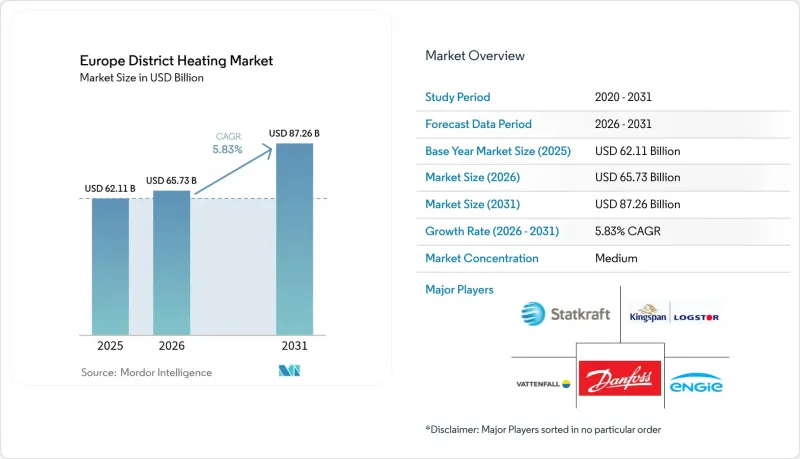
根據 Mordor Intelligence 估計,到 2026 年,歐洲區域供熱市場價值將達到 657.3 億美元,高於 2025 年的 621.1 億美元,預計到 2031 年將達到 872.6 億美元。
預計從 2026 年到 2031 年,其複合年成長率將達到 5.83%。
本報告按熱源(石化燃料、可再生能源、其他)、電廠類型(熱電聯產、鍋爐房、大型熱泵、其他)、供熱技術(保溫鋼管、軟質塑膠管道、其他)、終端用戶(住宅、商業、其他)和地區進行細分。市場預測以美元計價。
歐洲區域供熱市場趨勢與洞察
斯堪地那維亞第四代冷鏈網路的快速發展
斯堪地那維亞公共產業正在推廣第四代供熱網路,其運作溫度比傳統系統低攝氏20-45度C,可減少高達30%的熱損失,並實現環境熱和廢熱資源的高效利用。例如,隆德的「Cool DH」項目和瑞典耗資180億瑞典克朗的「EcoDataCenter 2」項目,將大型熱泵(能源效率比COP > 4.0)與回收的工業餘熱相結合,顯著降低了燃料成本,同時為未來供熱網路的擴展創造了穩定的負載基礎。北歐設計標準現已成為歐盟技術規範的基礎,並正在加速向中歐的技術轉移。
德國和荷蘭強制逐步淘汰家用燃氣鍋爐
德國的《建築能源法》規定,自2024年起,新建供暖系統必須65%的可再生消耗來自再生能源,實際上淘汰了新的石化燃料鍋爐,並促使土地資源有限的城市中心區域供熱系統接入量激增。荷蘭也採取了類似措施,強制要求新建住宅在2025年前全部採用電力供暖,並在2026年前在維修房屋中安裝混合式熱泵,從而增強人口密集城市供熱網路的經濟可行性。聯邦和地方政府為可再生能源供暖提供高達21,000歐元(約24,700美元)的津貼,使投資能夠在八年內收回成本。
維修老舊的第三代網路成本高昂
在中歐和東歐,拆除老舊鍋爐和更換管道網路中的管道,每米成本在 500 至 800 歐元之間,這給市政債務帶來了壓力,並導致計劃中的改造工程推遲了數年。
細分市場分析
到2025年,石化燃料在歐洲區域供熱市場仍佔51.45%的佔有率。這主要是由於現有燃氣和燃煤鍋爐的持續使用,鑑於低碳價格,這些鍋爐仍然經濟實惠。然而,可再生能源預計將達到最高成長率,到2031年複合年成長率將達到10.8%。這主要得益於與現有爐膛相容的生質能混燒、潘諾尼亞盆地豐富的地熱能以及工業廢熱回收合約的增加。在北歐電網中,可再生能源的採用率已超過42.6%,為歐盟其他地區樹立了典範。目前造價20-50歐元/兆瓦時的太陽熱能發電發電廠正在西班牙和法國迅速擴張,並透過季節性儲能來緩解夏季需求下降。混合系統將生質基本負載與高溫熱泵結合,提供石化燃料的、可控的供熱,以滿足新的減排目標。
在區域層面,匈牙利和克羅埃西亞正在獲得歐盟地熱試點井現代化改造津貼,而義大利和德國正在測試深層鑽井鑽機,目標是溫度高達攝氏200度C的含水層。資料中心的廢熱也被納入可再生能源組合,為4GDH迴路提供65-80度C的穩定熱流。為了解決季節性間歇性問題,丹麥正在建造容量超過10萬立方公尺的儲存槽,使邊際供電成本降低5-7歐元/兆瓦時。
到2025年,熱電聯產(CHP)機組在歐洲區域供熱市場仍佔56.75%的佔有率。這主要得益於兩種能源來源供應方式的價值以及其在電網平衡方面的柔軟性。同時,大型熱泵以14.05%的複合年成長率快速成長,這主要得益於再生能源價格的下降以及冷媒技術的進步,使得能源效率比(COP)超過5。柏林一座75兆瓦的污水熱泵機組象徵著向集中式電加熱的轉變。此混合式機組結合了熱電聯產汽輪機以滿足冬季高峰需求,並採用變速熱泵來應對季節性變化,從而將管網回水溫度最佳化至55度C以下。
北歐原始設備製造商正在擴大產能,瑞典一座年產50萬台的新工廠展現出規模經濟效益,預計在2027年將每千瓦的資本成本降至500歐元以下。丹麥一家研究機構開發了一種基於二氧化碳的系統,旨在為人口稠密的都市區地區,合成冷媒的使用受到限制,主要是由於其易燃性問題。電力公司正在對現有的熱電聯產設施進行改造,加裝燃燒後二氧化碳捕集系統,以在保護現有資產的同時降低排放因子。
其他好處
- Excel格式的市場預測(ME)表
- 3個月的分析師支持
目錄
第1章:引言
- 研究假設和市場定義
- 調查範圍
第2章:調查方法
第3章執行摘要
第4章 市場狀況
- 市場概覽
- 市場促進因素
- 斯堪地那維亞第四代冷鏈網路的快速發展
- 德國和荷蘭強制逐步淘汰家用燃氣鍋爐
- 透過歐盟碳邊境調節機制加速產業轉型
- 斯堪的納維亞資料中心廢熱回收合約激增
- 區域供冷在南歐城市改造的綜效
- 透過綠色債券融資支持地方政府網路的擴展。
- 市場限制因素
- 維修老舊的第三代網路成本高昂。
- 特許經營合約授予週期過長以及地方政府競標延誤。
- 大直徑普通鋼管熟練焊工短缺
- 溫暖氣候區現場熱泵競爭的經濟性
- 產業價值鏈分析
- 監理展望
- 政府關於向區域供暖和製冷過渡的舉措和計劃。
- 技術展望
- 區域供熱技術的發展
- 波特五力分析
- 宏觀經濟趨勢對市場的影響
- 投資分析
第5章 市場規模與成長預測
- 透過熱源
- 石化燃料
- 可再生能源(生質能、地熱能、太陽能)
- 工業和資料中心產生的廢熱
- 按植物類型
- 熱電聯產(CHP)
- 鍋爐房
- 大型熱泵
- 透過供應技術
- 保溫鋼管
- 軟質塑膠管道
- 變電站熱交換器
- 控制和監控系統
- 最終用戶
- 住宅
- 商業
- 產業
- 公共和公共機構
- 國家
- 德國
- 法國
- 奧地利
- 瑞典
- 英國
- 義大利
- 其他歐洲國家
第6章 競爭情勢
- 市場集中度
- 策略趨勢
- 市佔率分析
- 公司簡介
- Vattenfall AB
- Engie SA
- Danfoss A/S
- Veolia Environnement SA
- Fortum Oyj
- Statkraft AS
- E.ON SE
- Logstor A/S
- Vital Energi Ltd
- Goteborg Energi
- Alfa Laval AB
- Ramboll Group A/S
- Kelvion Holding GmbH
- Savosolar Oyj
- Isoplus Piping Systems
- Uponor Infra Oy
- Thermaflex International
- REHAU AG
- Cory Group
- Cetetherm AB
- NIBE Industrier AB
第7章 市場機會與未來展望
According to Mordor Intelligence, european district heating market size in 2026 is estimated at USD 65.73 billion, growing from 2025 value of USD 62.11 billion with 2031 projections showing USD 87.26 billion, growing at 5.83% CAGR over 2026-2031.
This report is Segmented by Heat Source (Fossil Fuels, Renewable Energy, and More), Plant Type (Combined Heat and Power, Boiler-Based Plants, and Large-Scale Heat Pumps), Distribution Technology (Pre-Insulated Steel Pipes, Flexible Plastic Piping, and More), End User (Residential, Commercial, and More), and Geography. The Market Forecasts are Provided in Terms of Value (USD).
Europe District Heating Market Trends and Insights
Rapid Build-out of 4th-Gen Low-Temperature Networks in Scandinavia
Scandinavian utilities are standardizing 4th-generation networks that operate 20-45 °C below legacy systems, reducing distribution losses by up to 30% and enabling the cost-effective use of ambient and waste-heat resources. Projects such as Lund's Cool DH and Sweden's SEK 18 billion EcoDataCenter 2 combine large-scale heat pumps (COP> 4.0) with recycled industrial heat, slashing fuel costs while creating anchor loads for future grid extensions. Nordic design codes now form the basis of EU technical specifications, accelerating technology transfer into Central Europe.
Mandatory Phase-out of Individual Gas Boilers in Germany and Netherlands
Germany's Building Energy Act obliges new heating systems to source 65% renewable energy from 2024, effectively eliminating new fossil boilers and triggering a surge in district heating connections in land-constrained urban cores. The Netherlands follows with a fully electric mandate for new builds by 2025 and hybrid heat-pump requirements for retrofits by 2026, reinforcing network economics in dense municipalities. Federal and local grants of up to EUR 21,000 (about USD 24,700) for renewable heating support payback periods under eight years.
High Retrofit Costs for Legacy 3rd-Gen Networks
Central- and Eastern-European grids require EUR 500-800 per meter to re-pipe and decouple outdated boilers, stretching municipal debt envelopes and causing multi-year postponements of planned conversions.
Other drivers and restraints analyzed in the detailed report include:
- EU Carbon Border Adjustment Mechanism Accelerating Industrial Switching
- Surging Data-Centre Waste-Heat Recovery Contracts in Northern Europe
- Lengthy Concession-Award Cycles and Municipal Tender Delays
For complete list of drivers and restraints, kindly check the Table Of Contents.
Segment Analysis
Fossil fuels retained 51.45% of the European district heating market share in 2025, primarily due to the continued use of entrenched gas and coal boilers, which remain economical when carbon prices are low. However, renewables post the fastest 10.8% CAGR to 2031, driven by the compatibility of biomass co-firing with existing furnaces, the abundance of geothermal energy in the Pannonian Basin, and growing industrial-waste heat offtake contracts. Nordic grids already surpass 42.6% renewable penetration, setting a precedent for the rest of the bloc. Solar-thermal fields, now costing EUR 20-50/MWh, scale quickly in Spain and France, smoothing summer demand dips through seasonal storage. Hybrid setups combine biomass baseloads with high-temperature heat pumps, enabling fossil-free, dispatchable heat that meets new emission reduction targets.
Geographically, geothermal pilot wells in Hungary and Croatia gain EU modernization grants, while Italy and Germany test deep-drilling rigs for 200 °C aquifers. Data-center waste heat joins the renewable basket, supplying stable 65-80 °C streams into 4GDH circuits. Seasonal intermittency drives the buildup of water-pit storage tanks with a capacity exceeding 100,000 m3 in Denmark, resulting in a 5-7 EUR/MWh reduction in marginal supply costs.
Combined heat and power units retained a 56.75% share of the European district heating market size in 2025, valued for dual energy streams and grid-balancing flexibility. Yet large heat pumps expand at 14.05% CAGR, spurred by cheaper renewable electricity and refrigerant advances that lift COPs above 5. Berlin's 75 MW wastewater heat pump underscores a shift toward centralized electrified heat. Hybrid plants blend CHP turbines for winter peaks with variable-speed heat pumps for shoulder seasons, optimizing network return temperatures below 55 °C.
Nordic OEMs are ramping up production capacity; Sweden's new 500,000-unit factory signals economies of scale that will push capital costs below EUR 500/kW by 2027. CO2-based systems from Danish research institutes target dense urban neighborhoods, where flammability limits the use of synthetic refrigerants. Utilities retrofit existing CHPs with post-combustion carbon capture to protect sunk assets while reducing emission factors.
Complete Report Scope:
- By Heat Source
- Fossil Fuels
- Renewable Energy (Biomass, Geothermal, Solar-Thermal)
- Industrial and Data-Centre Waste Heat
- By Plant Type
- Combined Heat and Power (CHP)
- Boiler-Based Plants
- Large-Scale Heat Pumps
- By Distribution Technology
- Pre-insulated Steel Pipes
- Flexible Plastic Piping
- Substations and Heat Exchangers
- Control and Monitoring Systems
- By End User
- Residential
- Commercial
- Industrial
- Public and Institutional
- By Country
- Germany
- France
- Austria
- Sweden
- United Kingdom
- Italy
- Rest of Europe
List of Companies Covered in this Report:
- Vattenfall AB
- Engie SA
- Danfoss A/S
- Veolia Environnement SA
- Fortum Oyj
- Statkraft AS
- E.ON SE
- Logstor A/S
- Vital Energi Ltd
- Goteborg Energi
- Alfa Laval AB
- Ramboll Group A/S
- Kelvion Holding GmbH
- Savosolar Oyj
- Isoplus Piping Systems
- Uponor Infra Oy
- Thermaflex International
- REHAU AG
- Cory Group
- Cetetherm AB
- NIBE Industrier AB
Additional Benefits:
- The market estimate (ME) sheet in Excel format
- 3 months of analyst support
TABLE OF CONTENTS
1 INTRODUCTION
- 1.1 Study Assumptions and Market Definition
- 1.2 Scope of the Study
2 RESEARCH METHODOLOGY
3 EXECUTIVE SUMMARY
4 MARKET LANDSCAPE
- 4.1 Market Overview
- 4.2 Market Drivers
- 4.2.1 Rapid Build-out of 4th-Gen Low-Temperature Networks in Scandinavia
- 4.2.2 Mandatory Phase-out of Individual Gas Boilers in Germany and Netherlands
- 4.2.3 EU Carbon Border Adjustment Mechanism Accelerating Industrial Switching
- 4.2.4 Surging Data-Centre Waste-Heat Recovery Contracts in Northern Europe
- 4.2.5 District Cooling Synergies in Southern Europe's Urban Redevelopments
- 4.2.6 Green-Bond Financing Windows Driving Municipal Network Expansions
- 4.3 Market Restraints
- 4.3.1 High Retrofit Costs for Legacy 3rd-Gen Networks
- 4.3.2 Lengthy Concession-Award Cycles and Municipal Tender Delays
- 4.3.3 Skills Shortage in Large-Diameter Pre-insulated Pipe Welding
- 4.3.4 Competing On-Site Heat-Pump Economics in Mild-Climate Zones
- 4.4 Industry Value Chain Analysis
- 4.5 Regulatory Outlook
- 4.5.1 Government Initiatives and Programs on District Heating/Cooling Transition
- 4.6 Technological Outlook
- 4.6.1 Development of District Heating Technology
- 4.7 Porter's Five Forces Analysis
- 4.7.1 Bargaining Power of Suppliers
- 4.7.2 Bargaining Power of Buyers
- 4.7.3 Threat of New Entrants
- 4.7.4 Threat of Substitute Products
- 4.7.5 Intensity of Competitive Rivalry
- 4.8 Impact of Macroeconomic Trends on the Market
- 4.9 Investment Analysis
5 MARKET SIZE AND GROWTH FORECASTS (VALUE)
- 5.1 By Heat Source
- 5.1.1 Fossil Fuels
- 5.1.2 Renewable Energy (Biomass, Geothermal, Solar-Thermal)
- 5.1.3 Industrial and Data-Centre Waste Heat
- 5.2 By Plant Type
- 5.2.1 Combined Heat and Power (CHP)
- 5.2.2 Boiler-Based Plants
- 5.2.3 Large-Scale Heat Pumps
- 5.3 By Distribution Technology
- 5.3.1 Pre-insulated Steel Pipes
- 5.3.2 Flexible Plastic Piping
- 5.3.3 Substations and Heat Exchangers
- 5.3.4 Control and Monitoring Systems
- 5.4 By End User
- 5.4.1 Residential
- 5.4.2 Commercial
- 5.4.3 Industrial
- 5.4.4 Public and Institutional
- 5.5 By Country
- 5.5.1 Germany
- 5.5.2 France
- 5.5.3 Austria
- 5.5.4 Sweden
- 5.5.5 United Kingdom
- 5.5.6 Italy
- 5.5.7 Rest of Europe
6 COMPETITIVE LANDSCAPE
- 6.1 Market Concentration
- 6.2 Strategic Moves
- 6.3 Market Share Analysis
- 6.4 Company Profiles
- 6.4.1 Vattenfall AB
- 6.4.2 Engie SA
- 6.4.3 Danfoss A/S
- 6.4.4 Veolia Environnement SA
- 6.4.5 Fortum Oyj
- 6.4.6 Statkraft AS
- 6.4.7 E.ON SE
- 6.4.8 Logstor A/S
- 6.4.9 Vital Energi Ltd
- 6.4.10 Goteborg Energi
- 6.4.11 Alfa Laval AB
- 6.4.12 Ramboll Group A/S
- 6.4.13 Kelvion Holding GmbH
- 6.4.14 Savosolar Oyj
- 6.4.15 Isoplus Piping Systems
- 6.4.16 Uponor Infra Oy
- 6.4.17 Thermaflex International
- 6.4.18 REHAU AG
- 6.4.19 Cory Group
- 6.4.20 Cetetherm AB
- 6.4.21 NIBE Industrier AB
7 MARKET OPPORTUNITIES AND FUTURE OUTLOOK
- 7.1 White-space and Unmet-Need Assessment

 區域供熱:市場佔有率分析、產業趨勢與統計、成長預測(2026-2031)
 區域供熱市場-2026-2032年全球市場預測
 住宅區域供熱市場-全球產業規模、佔有率、趨勢、機會、預測:按熱源、設備類型、地區和競爭格局分類,2021-2031年區域供熱市場-全球產業規模、佔有率、趨勢、機會、預測:按熱源、工廠類型、應用、地區和競爭格局分類,2021-2031年商業區域供熱市場-全球產業規模、佔有率、趨勢、機會與預測:按熱源、電站類型、地區和競爭格局分類,2021-2031年
 區域供熱管網市場規模、佔有率及成長分析:按管道類型、管道直徑、安裝類型、網路類型、熱源整合、應用及地區分類-2026-2033年產業預測
 區域供熱市場:按電站類型、熱源、應用和區域分類
 區域供熱市場規模及預測(2021-2034年)、全球及區域佔有率、趨勢及成長機會分析報告:依熱源、電站類型、應用及區域分類
 區域供熱市場規模、佔有率、成長及全球產業分析:按類型、應用和地區分類的洞察,2026-2034 年預測英國區域供熱:市場佔有率分析、產業趨勢與統計、成長預測(2026-2031)