


 |
市場調查報告書
商品編碼
2123760
區域供熱:市場佔有率分析、產業趨勢與統計、成長預測(2026-2031)District Heating - Market Share Analysis, Industry Trends & Statistics, Growth Forecasts (2026 - 2031) |
||||||

※ 本網頁內容可能與最新版本有所差異。詳細情況請與我們聯繫。
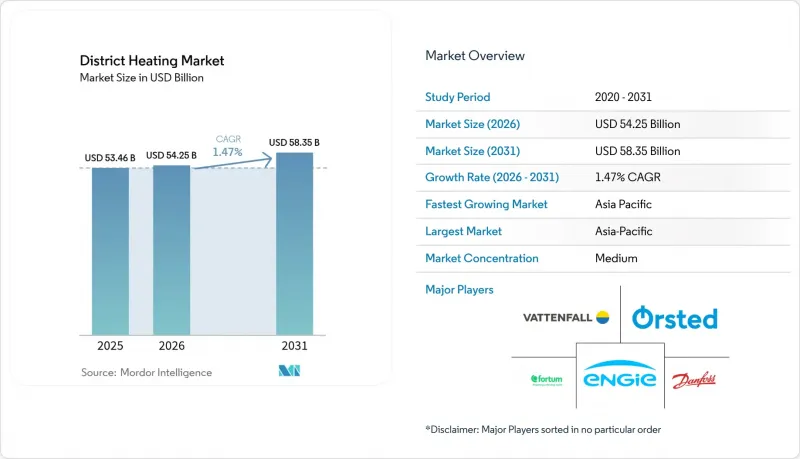
2025年區域供熱市場價值為534.6億美元,預計到2031年將達到583.5億美元,而2026年為542.5億美元,預測期(2026-2031年)複合年成長率為1.47%。
本報告按電廠類型(鍋爐房、熱電聯產等)、熱源(煤、天然氣等)、應用領域(住宅、商業、工業)、供熱溫度範圍(高溫、低溫等)及地區細分。報告提供市場預測和市場規模(以美元計)。
全球區域供熱市場趨勢與洞察
歐盟範圍內強制逐步淘汰石化燃料鍋爐,刺激了維修的需求。
歐盟加速推進對燃油和燃氣鍋爐的禁令,推動了區域供熱市場的維修需求。成員國的目標是到2030年新增4000多萬戶家庭接入區域供熱系統,從而降低現有燃氣供應網路中「擱淺資產」的風險。在人口密度高的都市區,由於空間限制難以安裝獨立式熱泵,維修計畫尤其具有吸引力。新規要求大型資料中心向城市供熱網路輸送餘熱,從而改善負載多元化和收入穩定性。因此,丹麥、德國和法國的公共產業正優先考慮擴展低溫供熱網路,以履行業主義務並利用歐盟創新基金的碳中和供熱津貼。
中國向超低排放熱電聯產轉型
中國的清潔供熱政策正引領區域供熱市場向混合供熱模式轉型,該模式融合了電鍋爐、熱泵和低排放熱電聯產設施。河北和山東兩省的先導計畫表明,與傳統燃煤電廠相比,混合供熱模式可減少近90%的顆粒物排放,同時併網熱泵也提高了可再生能源的利用率。根據學術研究中提出的“低煤情景”,預計到2030年,電力技術將能夠滿足中國34%的區域供熱需求,這將為設備出口東南亞市場鋪平道路。因此,各省政府在發放區域供熱許可證的同時,也為屋頂太陽能發電和儲熱系統提供激勵措施,以使空氣品質目標與抑低尖峰負載目標保持一致。
美國低人口密度地區電網連接費用高昂
美國郊區新建區域供熱線面臨超過800歐元/千瓦的接入費,削弱了人口稀少地區計畫的可行性。各州監管差異以及聯邦獎勵的缺乏加劇了財務風險,儘管脫碳潛力巨大,但推廣速度仍然緩慢。很少有地方公用事業公司擁有足夠的財力在沒有收入擔保的情況下獲得長期貸款。加州的「氣候催化劑計畫」已開始降低資料中心餘熱再利用計畫的風險,但要將其成功經驗推廣到中西部和東北部地區,還需要更廣泛的政策協調。缺乏明確的收費系統正在阻礙潛在客戶,減緩校園和軍事設施以外區域的管網發展。
細分市場分析
預計2026年至2031年間,餘熱回收站的複合年成長率將達到4.57%,顯著高於區域供熱市場的整體成長率。新的購電協議(CPPA)模式將脫碳特性貨幣化,並降低了一次燃料成本,這些都為專案的經濟效益提供了支撐。相較之下,到2025年,熱電聯產(CHP)仍將佔據區域供熱市場61.35%的佔有率,在基本負載供應和電網調節服務方面支撐著區域供熱市場的規模。目前,資產業者正在將儲熱系統與熱電聯產相結合,以將運作時間調整到高峰時段,並吸收過剩的可再生能源發電。專用餘熱鍋爐房在平衡高峰需求以及小規模電網中具有獨特的價值,因為在這些小型電網中,完整的熱電聯產循環在經濟上不可行。
在區域供熱市場,模組化熱泵叢集及其與資料中心的整合正日益受到關注。這些系統能夠降低供熱溫度,並實現靈活的多向配置。工業設施看重這些系統能夠同時冷卻製程並產生蒸氣,而市政當局則透過供熱來源多元化來增強供熱系統的韌性。標準化的撬裝式設計縮短了建設週期,並為基礎設施建設資金提供了極具吸引力的「建設-擁有-營運-移交」合約。在預測期內,分層緩衝槽的引入可望平抑日間負載波動,降低營運成本,並提高可變可再生能源的採用率。
預計可再生能源將成為區域供熱市場成長最快的組成部分,年複合成長率將達到5.42%,其中地熱能、農業生質能鍋爐和太陽熱能發電發電廠預計將併入現有供熱網路。歐洲城市正透過將地熱鑽探風險納入國家擔保基金,降低資金籌措成本並加速專案核准。光是2023年就有28座大型太陽能熱發電廠投入運作,推動了太陽能熱發電的成長,為清潔供熱區域供熱市場規模增加了139兆瓦熱容量。到2025年,天然氣仍將佔區域供熱市場規模的44.10%,但將面臨不斷上漲的碳價和甲烷外洩問題的審查。
工業廢熱正逐漸成為一種「過渡」能源,以填補可再生能源進一步整合先前的供熱缺口。雖然其經濟可行性取決於管道輸送距離和溫升,但不斷上漲的碳價正在縮短投資回收期。利用小型模組化反應器(SMR)的核能供熱因其在製程蒸氣應用方面的潛力而備受政策制定者的關注,但仍需獲得位置批准。整體而言,熱源多元化有助於降低地緣政治風險,並符合歐盟分類法規,這些法規正日益影響區域供熱產業的資本流入。
區域分析
北美區域供熱市場正從校園蒸氣網路轉向混合溫度供熱系統,該系統可回收工業和資料中心的餘熱。例如,華盛頓州貝靈厄姆濱水區改造計畫正在部署比傳統燃氣鍋爐效率高四倍的供熱網路。然而,該地區高昂的併網費用是一大挑戰,阻礙了郊區的普及,凸顯了統一獎勵和價格體系改革的必要性,以釋放更多潛力。加州在政策方面堪稱先驅,該州已頒布新法,使資料中心餘熱回收有資格獲得州政府資助,從而開闢了新的成長途徑。
由於其龐大的現有管道網路和雄心勃勃的脫碳目標,歐洲仍佔據區域供熱市場最大的佔有率。丹麥堪稱典範,全國63%的資料中心計畫承接餘熱利用合約。德國的目標是到2030年使可再生能源和循環熱能佔其供熱網路的50%,這刺激了對生質氣化廠、地熱能和大型太陽熱能發電發電廠的需求。丹麥的市政所有權和荷蘭的私有財產等多元化的所有權結構,造就了多樣化的投資模式,同時維持了整體技術領先地位和出口能力。
以中國為中心的亞太地區預計將成為區域供熱市場成長最快的地區。自2003年以來,市場導向改革已使中國供熱企業的全要素生產力提高了7.4%,為向清潔能源轉型奠定了基礎。日本和韓國正在推動高密度城市供熱網路的建設,以充分利用高負載率;而土耳其和紐西蘭則在試點深層地熱能源供應。目前,區域政策正將空氣品質目標與可再生能源的採用掛鉤,推動制定綜合計劃,以加速供熱網路的擴建和現代化。
其他好處:
- Excel格式的市場預測(ME)表
- 3個月的分析師支持
目錄
第1章:引言
- 研究假設和市場定義
- 調查範圍
第2章:調查方法
第3章執行摘要
第4章 市場狀況
- 市場概覽
- 市場促進因素
- 歐盟範圍內強制逐步淘汰石化燃料鍋爐將促進維修(歐洲)
- 中國向低排放量汽電共生轉型(亞洲)
- 北歐和比荷盧經濟聯盟城市中市政垃圾發電的整合
- 利用資料中心廢熱的第四代和第五代低溫網路(北美和歐洲)
- 土耳其和匈牙利的地熱發電競標已將 LCOH(損失成本)降低到 25 歐元/兆瓦時以下。
- 美國和歐盟石化產業叢集異地工業過程熱的購電協議 (PPA)
- 市場限制因素
- 美國人口稀少地區的併網成本很高(超過 800 歐元/千瓦)。
- 東歐不透明的天然氣價格上限制度正在影響熱電聯產(燃燒能源淨化)的經濟可行性。
- 由於技術純熟勞工短缺,低溫維修被推遲(德國和英國)。
- 暖氣用戶對「鎖定效應」的認知限制了透過綠色債券資金籌措。
- 價值供應鏈分析
- 對監管和政府措施的展望
- 技術展望與關鍵創新
- 投資分析
- 新冠疫情對區域供熱的影響
- 波特五力分析
第5章 市場規模與成長預測
- 按植物類型
- 鍋爐
- 熱電聯產(CHP)
- 熱水鍋爐
- 餘熱回收裝置
- 透過熱源
- 煤炭
- 天然氣
- 可再生能源
- 生質能
- 地熱
- 太陽熱能
- 工業廢熱
- 石油和石油產品
- 核能(小型模組化反應器供熱)
- 分佈溫度範圍
- 高溫(>100 度C)
- 中等溫度(80-100 度C)
- 低溫(低於 80 度C,4G/5G)
- 依網路類型
- 封閉回路型
- 開放回路型
- 以產能計算
- 50兆瓦熱功率或更低
- 51~200 MWth
- 201~500 MWth
- 500兆瓦熱功率或以上
- 自有車型
- 公共產業
- 私人公共產業
- 官民合作關係
- 透過使用
- 住宅
- 商業
- 產業
- 對於公共機構
- 按地區
- 北美洲
- 美國
- 加拿大
- 墨西哥
- 南美洲
- 巴西
- 阿根廷
- 其他南美國家
- 歐洲
- 德國
- 瑞典
- 丹麥
- 芬蘭
- 英國
- 法國
- 其他歐洲國家
- 亞太地區
- 中國
- 日本
- 韓國
- 印度
- 其他亞太國家
- 中東
- 沙烏地阿拉伯
- 阿拉伯聯合大公國
- 土耳其
- 其他中東國家
- 非洲
- 南非
- 埃及
- 其他非洲國家
- 北美洲
第6章 競爭情勢
- 市場集中度
- 策略舉措和趨勢
- 市佔率分析
- 公司簡介
- Vattenfall AB
- ENGIE SA
- Fortum Oyj
- Orsted A/S
- Danfoss A/S
- Veolia Environnement SA
- Statkraft AS
- NRG Energy Inc.
- Keppel Corporation Ltd.
- SP Group
- Korean District Heating Corp.
- Copenhagen Energy
- Logstor A/S
- Vital Energi Ltd.
- Alfa Laval AB
- Ramboll Group A/S
- Shinryo Corporation
- FVB Energy Inc.
- FortisBC Energy Inc.
- Kelag Waerme GmbH
- Empower Energy Solutions(Dubai)
- Helen Oy
第7章 市場機會與未來展望
According to Mordor Intelligence, the district heating market size was valued at USD 53.46 billion in 2025 and estimated to grow from USD 54.25 billion in 2026 to reach USD 58.35 billion by 2031, at a CAGR of 1.47% during the forecast period (2026-2031).
This report is Segmented by Plant Type (Boiler Plant, Combined Heat and Power (CHP), and More), Heat Source (Coal, Natural Gas, and More), Application (Residential, Commercial, and Industrial), Distribution Temperature Tier (High, Low and More) and by Geography. The Report Offers Market Forecasts and Size in Value (USD)
Global District Heating Market Trends and Insights
Mandated Phase-out of Fossil Boilers Across EU Boosting Retrofits
The European Union's accelerated ban on oil and gas boilers is funneling retrofit demand into the district heating market. Member states aim to connect more than 40 million additional households by 2030, reducing stranded-asset risk for legacy gas grids. Retrofit programs are especially appealing in dense cities where individual heat pumps face space constraints. New rules compel large data centers to feed excess heat into municipal grids, enhancing load diversity and revenue security. Utilities in Denmark, Germany and France are therefore prioritizing low-temperature network expansion to satisfy building-owner obligations and to tap EU Innovation Fund grants for carbon-neutral heat.
China's Ultra-low-emission CHP Conversions
China's clean-heating policy is steering the district heating market toward a hybrid portfolio of electric boilers, heat pumps and low-emission CHP facilities. Pilot projects in Hebei and Shandong demonstrate particulate-matter cuts near 90% compared with earlier coal units, while grid-connected heat pumps improve capacity-factor utilization of renewable power. The low-coal scenario outlined by academic research suggests electric technologies could supply 34% of China's district-heat load by 2030, unlocking equipment exports to Southeast Asia. Provincial authorities are therefore bundling rooftop solar and thermal-storage incentives with district-heat licenses to align air-quality targets and peak-shaving goals.
High grid-connection fees in low-density U.S. regions
New district-heating lines in suburban America face connection fees above €800/kW, undermining project feasibility where density is low. Fragmented state regulations and lack of federal incentives amplify financial risk, slowing adoption despite high decarbonization potential. Few municipal utilities possess the balance-sheet strength to underwrite long-tenor loans without revenue guarantees. The Climate Catalyst Program in California has begun to de-risk data-center heat-reuse schemes, but broader policy harmonization is required to transplant those gains to the Midwest and Northeast. Without a clear tariff model, prospective customers hesitate, dampening network build-out beyond campus and military installations.
Other drivers and restraints analyzed in the detailed report include:
- Municipal Waste-to-energy Integration in Nordic & Benelux Cities
- 4th and 5th-generation low-temperature networks using data-center waste heat
- Uncertain gas-price-cap regimes in Eastern Europe affecting CHP economics
For complete list of drivers and restraints, kindly check the Table Of Contents.
Segment Analysis
Waste-heat recovery stations are forecast to expand at a 4.57% CAGR from 2026-2031, well above the overall district heating market. Project economics benefit from avoided primary-fuel costs and new corporate-power-purchase-agreement models that monetise decarbonization attributes. In contrast, CHP retained 61.35% of the district heating market share in 2025, anchoring the district heating market size for baseload supply and grid-balancing services. Asset operators are now pairing thermal storage with CHP to shift run-times toward peak-price hours and to accommodate surplus renewable generation. Heat-only boiler houses hold niche value for peak-shaving and for small networks where full CHP cycles are uneconomic.
The district heating market sees heightened interest in modular heat-pump clusters and data-center tie-ins, which reduce distribution temperatures and enable flexible, multi-vector configurations. Industrial sites appreciate these systems for simultaneous process cooling and steam-raising, while municipalities gain resilience from supply diversification. Standardised skid designs shorten construction cycles and unlock Build-Own-Operate-Transfer contracts attractive to infrastructure funds. Over the forecast period, integration of stratified buffer tanks is expected to smooth diurnal load swings, reducing operational expenditure and permitting higher variable-renewable-energy penetration.
Renewables are projected to be the fastest-growing component of the district heating market, delivering a 5.42% CAGR and adding geothermal doublets, agro-biomass boilers and solar-thermal fields to existing grids. European cities are bundling geothermal drilling risk into national guarantee funds, cutting financing costs and accelerating project sanction. Solar-thermal growth is propelled by 28 large fields commissioned in 2023 alone, adding 139 MWth to the district heating market size for clean heat. Natural gas, while still holding 44.10% of the district heating market size in 2025, faces carbon-price escalation and methane-leak scrutiny.
Industrial waste heat is emerging as a bridge resource, filling gaps until deeper renewable integration materialises. Economics depend on pipeline distance and temperature lift, but rising carbon prices improve payback. Nuclear-based heat using small modular reactors garners policymaker interest for process-steam applications yet remains contingent on siting approvals. Overall, heat-source diversification lowers geopolitical exposure and aligns with EU taxonomy rules that will increasingly shape capital flows into the district heating industry.
Complete Report Scope:
- By Plant Type
- Boiler
- Combined Heat and Power (CHP)
- Heat-Only Boiler
- Waste-Heat Recovery Plants
- By Heat Source
- Coal
- Natural Gas
- Renewables
- Biomass
- Geothermal
- Solar Thermal
- Industrial Waste-Heat
- Oil and Petroleum Products
- Nuclear (SMR-based heat)
- By Distribution Temperature Tier
- High Temperature (> 100 °C)
- Medium Temperature (80-100 °C)
- Low Temperature (< 80 °C, 4G/5G)
- By Network Type
- Closed-Loop
- Open-Loop
- By Plant Capacity
- less than equals to 50 MWth
- 51-200 MWth
- 201-500 MWth
- greater than equals to 500 MWth
- By Ownership Model
- Public Utility
- Private Utility
- Public-Private Partnership
- By Application
- Residential
- Commercial
- Industrial
- Public and Institutional
- By Geography
- North America
- United States
- Canada
- Mexico
- South America
- Brazil
- Argentina
- Rest of South America
- Europe
- Germany
- Sweden
- Denmark
- Finland
- United Kingdom
- France
- Rest of Europe
- Asia-Pacific
- China
- Japan
- South Korea
- India
- Rest of Asia-Pacific
- Middle East
- Saudi Arabia
- United Arab Emirates
- Turkey
- Rest of Middle East
- Africa
- South Africa
- Egypt
- Rest of Africa
- North America
Geography Analysis
North America's district heating market is pivoting from campus-based steam networks to mixed-temperature systems that recover industrial and data-center waste heat. Projects such as the Bellingham Waterfront redevelopment in Washington showcase heat networks four times more efficient than legacy gas boilers. Yet the region grapples with high grid-connection fees that dampen suburban uptake, highlighting the need for harmonised incentives and tariff reform to unlock broader potential. California's new statute qualifying data-center heat capture for state finance exemplifies progressive policy carving out new corridors of growth.
Europe continues to command the largest share of the district heating market owing to extensive legacy pipework and ambitious decarbonization mandates. Denmark illustrates best practice, with 63% of its data centers planning surplus-heat offtake agreements. Germany targets 50% renewable and recycled heat in its grids by 2030, stimulating demand for biomass gasifiers, geothermal, and large-scale solar-thermal parks. Ownership diversity-municipal in Denmark, private in the Netherlands-yields heterogeneous investment models but collectively sustains technology leadership and export capability.
Asia-Pacific, anchored by China, offers the strongest volumetric growth prospects for the district heating market. Market-oriented reforms have lifted total-factor productivity among Chinese heating enterprises by up to 7.4% since 2003, setting the stage for cleaner fuel substitution. Japan and South Korea pursue dense urban networks that capitalise on high load factors, while Turkey and New Zealand pilot deep-geothermal feeds. Regional policy now links air-quality targets with renewables uptake, encouraging integrated planning that accelerates network expansion and modernisation.
- Vattenfall AB
- ENGIE SA
- Fortum Oyj
- Orsted A/S
- Danfoss A/S
- Veolia Environnement SA
- Statkraft AS
- NRG Energy Inc.
- Keppel Corporation Ltd.
- SP Group
- Korean District Heating Corp.
- Copenhagen Energy
- Logstor A/S
- Vital Energi Ltd.
- Alfa Laval AB
- Ramboll Group A/S
- Shinryo Corporation
- FVB Energy Inc.
- FortisBC Energy Inc.
- Kelag Waerme GmbH
- Empower Energy Solutions (Dubai)
- Helen Oy
Additional Benefits:
- The market estimate (ME) sheet in Excel format
- 3 months of analyst support
TABLE OF CONTENTS
1 INTRODUCTION
- 1.1 Study Assumptions and Market Definition
- 1.2 Scope of the Study
2 RESEARCH METHODOLOGY
3 EXECUTIVE SUMMARY
4 MARKET LANDSCAPE
- 4.1 Market Overview
- 4.2 Market Drivers
- 4.2.1 Mandated phase-out of fossil boilers across EU boosting retrofits (Europe)
- 4.2.2 China's ultra-low-emission CHP conversions (Asia)
- 4.2.3 Municipal waste-to-energy integration in Nordic and Benelux cities
- 4.2.4 4-/5-Generation low-temperature networks using data-center waste heat (N.America and Europe)
- 4.2.5 Geothermal heat tenders in Turkey and Hungary cutting LCOH < €25/MWh
- 4.2.6 Off-site industrial process-heat PPAs in petro-chemical clusters (US and EU)
- 4.3 Market Restraints
- 4.3.1 High grid-connection fees (> €800/kW) in low-density U.S. regions
- 4.3.2 Uncertain gas-price-cap regimes in Eastern Europe affecting CHP economics
- 4.3.3 Skilled-labour shortages delaying low-temperature retrofits (DE and UK)
- 4.3.4 Heat-user lock-in perceptions limiting green-bond financing
- 4.4 Value / Supply-Chain Analysis
- 4.5 Regulatory and Government Initiatives Outlook
- 4.6 Technological Outlook and Key Innovations
- 4.7 Investment Analysis
- 4.8 Impact of COVID-19 on District Heating
- 4.9 Porter's Five Forces Analysis
- 4.9.1 Bargaining Power of Suppliers
- 4.9.2 Bargaining Power of Consumers
- 4.9.3 Threat of New Entrants
- 4.9.4 Threat of Substitute Products
- 4.9.5 Intensity of Competitive Rivalry
5 MARKET SIZE AND GROWTH FORECASTS (VALUE)
- 5.1 By Plant Type
- 5.1.1 Boiler
- 5.1.2 Combined Heat and Power (CHP)
- 5.1.3 Heat-Only Boiler
- 5.1.4 Waste-Heat Recovery Plants
- 5.2 By Heat Source
- 5.2.1 Coal
- 5.2.2 Natural Gas
- 5.2.3 Renewables
- 5.2.3.1 Biomass
- 5.2.3.2 Geothermal
- 5.2.3.3 Solar Thermal
- 5.2.3.4 Industrial Waste-Heat
- 5.2.4 Oil and Petroleum Products
- 5.2.5 Nuclear (SMR-based heat)
- 5.3 By Distribution Temperature Tier
- 5.3.1 High Temperature (> 100 °C)
- 5.3.2 Medium Temperature (80-100 °C)
- 5.3.3 Low Temperature (< 80 °C, 4G/5G)
- 5.4 By Network Type
- 5.4.1 Closed-Loop
- 5.4.2 Open-Loop
- 5.5 By Plant Capacity
- 5.5.1 less than equals to 50 MWth
- 5.5.2 51-200 MWth
- 5.5.3 201-500 MWth
- 5.5.4 greater than equals to 500 MWth
- 5.6 By Ownership Model
- 5.6.1 Public Utility
- 5.6.2 Private Utility
- 5.6.3 Public-Private Partnership
- 5.7 By Application
- 5.7.1 Residential
- 5.7.2 Commercial
- 5.7.3 Industrial
- 5.7.4 Public and Institutional
- 5.8 By Geography
- 5.8.1 North America
- 5.8.1.1 United States
- 5.8.1.2 Canada
- 5.8.1.3 Mexico
- 5.8.2 South America
- 5.8.2.1 Brazil
- 5.8.2.2 Argentina
- 5.8.2.3 Rest of South America
- 5.8.3 Europe
- 5.8.3.1 Germany
- 5.8.3.2 Sweden
- 5.8.3.3 Denmark
- 5.8.3.4 Finland
- 5.8.3.5 United Kingdom
- 5.8.3.6 France
- 5.8.3.7 Rest of Europe
- 5.8.4 Asia-Pacific
- 5.8.4.1 China
- 5.8.4.2 Japan
- 5.8.4.3 South Korea
- 5.8.4.4 India
- 5.8.4.5 Rest of Asia-Pacific
- 5.8.5 Middle East
- 5.8.5.1 Saudi Arabia
- 5.8.5.2 United Arab Emirates
- 5.8.5.3 Turkey
- 5.8.5.4 Rest of Middle East
- 5.8.6 Africa
- 5.8.6.1 South Africa
- 5.8.6.2 Egypt
- 5.8.6.3 Rest of Africa
- 5.8.1 North America
6 COMPETITIVE LANDSCAPE
- 6.1 Market Concentration
- 6.2 Strategic Moves and Developments
- 6.3 Market Share Analysis
- 6.4 Company Profiles (includes Global level Overview, Market level overview, Core Segments, Financials as available, Strategic Information, Market Rank/Share for key companies, Products and Services, Recent Developments)
- 6.4.1 Vattenfall AB
- 6.4.2 ENGIE SA
- 6.4.3 Fortum Oyj
- 6.4.4 Orsted A/S
- 6.4.5 Danfoss A/S
- 6.4.6 Veolia Environnement SA
- 6.4.7 Statkraft AS
- 6.4.8 NRG Energy Inc.
- 6.4.9 Keppel Corporation Ltd.
- 6.4.10 SP Group
- 6.4.11 Korean District Heating Corp.
- 6.4.12 Copenhagen Energy
- 6.4.13 Logstor A/S
- 6.4.14 Vital Energi Ltd.
- 6.4.15 Alfa Laval AB
- 6.4.16 Ramboll Group A/S
- 6.4.17 Shinryo Corporation
- 6.4.18 FVB Energy Inc.
- 6.4.19 FortisBC Energy Inc.
- 6.4.20 Kelag Waerme GmbH
- 6.4.21 Empower Energy Solutions (Dubai)
- 6.4.22 Helen Oy
7 MARKET OPPORTUNITIES AND FUTURE OUTLOOK
- 7.1 White-space and Unmet-Need Assessment

 歐洲區域供熱:市場佔有率分析、產業趨勢與統計及成長預測(2026-2031 年)
 區域供熱市場-2026-2032年全球市場預測
 住宅區域供熱市場-全球產業規模、佔有率、趨勢、機會、預測:按熱源、設備類型、地區和競爭格局分類,2021-2031年區域供熱市場-全球產業規模、佔有率、趨勢、機會、預測:按熱源、工廠類型、應用、地區和競爭格局分類,2021-2031年商業區域供熱市場-全球產業規模、佔有率、趨勢、機會與預測:按熱源、電站類型、地區和競爭格局分類,2021-2031年
 區域供熱管網市場規模、佔有率及成長分析:按管道類型、管道直徑、安裝類型、網路類型、熱源整合、應用及地區分類-2026-2033年產業預測
 區域供熱市場:按電站類型、熱源、應用和區域分類
 區域供熱市場規模及預測(2021-2034年)、全球及區域佔有率、趨勢及成長機會分析報告:依熱源、電站類型、應用及區域分類
 區域供熱市場規模、佔有率、成長及全球產業分析:按類型、應用和地區分類的洞察,2026-2034 年預測英國區域供熱:市場佔有率分析、產業趨勢與統計、成長預測(2026-2031)