


 |
市場調查報告書
商品編碼
1940811
英國區域供熱:市場佔有率分析、產業趨勢與統計、成長預測(2026-2031)United Kingdom District Heating - Market Share Analysis, Industry Trends & Statistics, Growth Forecasts (2026 - 2031) |
||||||

※ 本網頁內容可能與最新版本有所差異。詳細情況請與我們聯繫。
2025年英國區域供熱市場價值為15.4億美元,預計將從2026年的15.9億美元成長到2031年的18.6億美元。
預計在預測期(2026-2031 年)內,複合年成長率將達到 3.17%。
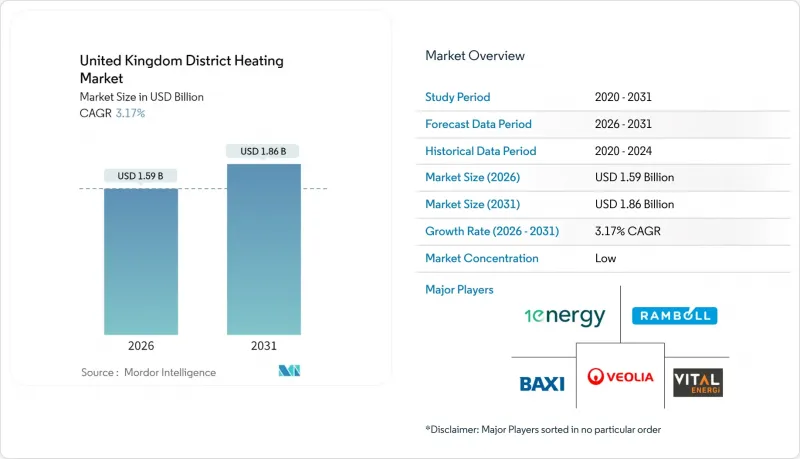
這項預測反映了整個系統正從依賴天然氣的資產轉向低碳熱泵、餘熱回收和大規模儲熱。強制性供熱網路分區確立了具有法律約束力的連接區域,降低了客戶獲取的風險。同時,綠色供熱網路基金降低了利用廢棄物發電和再生能源計劃的資本支出。政府補貼現在優先考慮能夠實現檢驗碳減排的計劃,鼓勵營運商部署將河流、礦井水和污水熱源與聯網地源熱泵結合的系統。投資者正在響應這些政策訊號。機構投資者正在加強資產整合,將分散的網路整合到專業管理之下,並加速技術升級,例如建造12小時儲熱坑。熟練勞動力和金屬商品的供應鏈限制仍然是不利因素,但英國天然氣和電力市場管理局(英國)即將推出的消費者保護計畫有望增強終端用戶的信心,並促進連接率的提高。
英國區域供熱市場趨勢及展望
2025-2026 年法定供熱網路區域指定
供熱管網分區賦予地方政府法律權力,強制規定使用者在特定區域內接入供熱管網,從而確保商業性可行性所需的供熱密度。英國能源安全與淨零排放部發布了一份針對16個地區的機會報告,指導伯明罕、利茲和紐卡斯爾等城市製定強制性分區方案,涵蓋新建築和許多維修項目。分區將區域供熱從自願性技術轉變為強制性要求,降低了營運商的需求風險,並為長期投資者提供了可觀且可預測的收入來源。開發商可以更清楚地了解管網規模和分階段擴建計劃,而現有建築業主則面臨明確的脫碳期限。因此,這項政策將市場優勢轉移到了擁有快速資本投入和成熟營運能力的管網所有者手中。
綠色供熱網路基金和 HNES津貼
自成立以來,綠色熱力網路基金已撥款超過3.8億英鎊(4.75億美元),其中包括為利茲的艾爾河谷熱電網路提供的1950萬英鎊,以及為倫敦大學布魯姆斯伯里能源網路提供的720萬英鎊。津貼降低了加權平均資本成本,鼓勵開發大規模的廢棄物發電熱源,並將內部收益率提高至多兩個百分點。遴選標準評估那些將廢熱回收與熱泵結合的計劃,引導市場設計朝著混合配置方向發展,以實現低於50克二氧化碳/千瓦時的目標。資金籌措的確定性也鼓勵了私人貸款機構參與,目前已有幾家商業銀行在建立優先債務時將綠色熱力網路基金的津貼作為風險緩解工具。
初始資本投資增加
材料通膨導致隔熱材料價格在2024年至2025年間上漲了2%至11.7%,而銅和鋼價格的波動進一步加劇了資產負債表的壓力。 Arloop估計,地熱網路建置成本為每兆瓦熱容量200萬至400萬英鎊,其中鑽井成本就佔總支出的45%之多。這種高資本投入延長了投資回收期,並限制了小規模開發商的資金籌措管道。 GHNF津貼可以緩解但無法完全消除可行性研究和核准階段的沉沒成本風險。因此,股權投資者要求更高的內部收益率,並推遲了沒有錨定負載或長期購熱協議的計劃的資金籌措完成。
細分市場分析
截至2025年,住宅用戶佔英國區域供熱市場的57.60%,這主要得益於城市住宅和混合用途改造項目的高熱密度。社會住宅試點計畫也印證了區域供熱的提案,其中SHIELD試點計畫表明,在滿足房東維修義務的同時,低收入租戶的租金預計將降低40%。非住宅需求正以每年4.41%的複合年成長率成長,這主要受環境、社會和治理(ESG)要求以及公共部門淨零排放目標的推動。大學和醫院正在推動兆瓦級擴建,以滿足基本負載需求,並得到了政府撥款和長期資本規劃的支持。
商業房地產所有者越來越將供熱網路視為應對未來建築排放稅的有效手段。租賃協議中強制性的營運碳排放要求,促使企業轉向碳係數有保障的低碳供熱網路。同時,地方政府透過整合住宅和公共需求,實現了規模經濟效益,進一步擴大了目標基本客群。這種多元化的客戶組合有助於穩定現金流,並使其能夠在私人債務市場進行再融資,從而支持英國區域供熱市場的成長。
截至2025年,燃氣熱電聯產將佔英國區域供熱市場的70.85%,但由於碳定價和生質能永續性法規的加強,其主導地位正在下降。低碳熱泵和餘熱系統正以5.08%的複合年成長率成長,這反映了它們較高的綠色能源網路(GHNF)評分資格和較低的生命週期排放。 MEL Heat Networks公司從米勒山垃圾焚化發電回收餘熱,並利用大型熱泵為其供熱,為肖費爾鎮供熱。 Vattenfall公司估計,這種混合系統可以將基準排放減少高達90%。
地熱系統正透過在住宅區內共用垂直鑽孔的網路化佈局而擴大規模,從而將單位鑽井成本降低三分之一。空氣源熱泵擴大被用作夏季的輔助能源,而非唯一能源,從而最佳化了跨季節的性能。由於顆粒物排放限制,生質能在都市區仍屬於小眾選擇,但農村住宅區仍持續使用當地材料。備用燃氣鍋爐仍然用於故障恢復,但由於儲熱技術和需量反應的改進,運作時間正在減少。
其他福利:
- Excel格式的市場預測(ME)表
- 3個月的分析師支持
目錄
第1章 引言
- 研究假設和市場定義
- 調查範圍
第2章調查方法
第3章執行摘要
第4章 市場情勢
- 市場概覽
- 市場促進因素
- 2025-2026會計年度法定供熱網路區域劃定
- 綠色供熱網路基金和 HNES津貼
- 廢熱回收義務(能源回收廠和污水處理)
- 降低河水和礦井水熱泵的成本
- 向房東揭露費用的義務
- 將熱能儲存整合到ESO的柔軟性中
- 市場限制
- 早期階段的高資本投入
- 天然氣和電力價格差異波動
- 技術純熟勞工短缺(管道焊工/高壓管道工)
- 消費者對「壟斷收費」的看法
- 產業價值鏈分析
- 監管環境
- 技術展望
- 五力分析
- 供應商的議價能力
- 買方的議價能力
- 新進入者的威脅
- 替代品的威脅
- 競爭對手之間的競爭
第5章 市場規模與成長預測
- 最終用戶
- 適用於住宅/一般家庭
- 非住宅
- 透過一次熱源
- 瓦斯熱電聯產
- 低碳熱泵和廢熱
- 生質能/沼氣
- 其他備用方案(瓦斯、電力)
- 按行業和客戶
- 混合用途重建區
- 公共和住宅住宅
- 大學和醫院
- 商業/零售設施
- 利用蓄熱設備
- 無整合存儲
- 熱水箱超過2小時
- 坑/罐存放 12 小時或以上
第6章 競爭情勢
- 市場集中度
- 策略趨勢
- 市佔率分析
- 公司簡介
- Vital Energi Utilities Ltd.
- 1Energy Group Ltd.
- Baxi Heating UK Ltd.
- Ramboll UK Ltd.
- Veolia Environnement SA
- Sweco UK Ltd.
- Vattenfall Heat UK Ltd.
- Equans Services Ltd.
- E.ON UK plc
- SSE Heat Networks Ltd.
- Metropolitan Infrastructure Ltd.
- ThamesWey Energy Ltd.
- Pinnacle Power Ltd.
- Fortum Carlisle Heat Networks Ltd.
- Cory Heat Networks Ltd.
- Kensa Utilities Ltd.
- Ener-Vate Ltd.
- Centrica Business Solutions UK Ltd.
- ENGIE(Energy Solutions UK)Ltd.
- Danpower UK Ltd.
第7章 市場機會與未來展望
The UK district heating market was valued at USD 1.54 billion in 2025 and estimated to grow from USD 1.59 billion in 2026 to reach USD 1.86 billion by 2031, at a CAGR of 3.17% during the forecast period (2026-2031).
This measured trajectory reflects the systemwide pivot from gas-dominant assets toward low-carbon heat pumps, waste-heat recovery, and large-scale thermal storage. Mandatory heat-network zoning is creating legally enforceable connection areas that de-risk customer acquisition, while the Green Heat Network Fund reduces capital outlay for projects integrating energy-from-waste heat or renewable electricity. Government grants now prioritize schemes delivering verifiable carbon cuts, prompting operators to blend river, mine-water, and wastewater heat with networked ground-source heat pumps. Investors are responding to these policy signals: institutional capital has intensified asset roll-ups that pool fragmented networks under professional management, accelerating technology upgrades such as 12-hour storage pits. Supply-chain constraints in skilled labour and metal commodities remain headwinds, yet Ofgem's incoming consumer-protection regime is expected to strengthen end-user confidence and encourage higher connection rates.
United Kingdom District Heating Market Trends and Insights
Statutory heat-network zoning from 2025-26
Heat-network zoning gives local authorities legal power to mandate customer connections within defined boundaries, securing the heat density essential for commercial viability. The Department for Energy Security and Net Zero released opportunity reports for 16 areas, guiding Birmingham, Leeds, and Newcastle to map mandatory zones that cover new builds and many retrofit sites. Zoning transforms district heating from an optional technology into a compliance obligation, lowering demand risk for operators and offering predictable revenue streams attractive to long-term investors. Developers gain clarity on network sizing and phased expansion, while existing building owners face clear deadlines to decarbonize. The policy, therefore, shifts market power toward network owners capable of rapid capital deployment and proven operational competence.
Green Heat Network Fund and HNES grants
The Green Heat Network Fund has disbursed more than GBP 380 million (USD 475 million) since launch, including GBP 19.5 million for Leeds's Aire Valley Heat and Power Network and GBP 7.2 million for the University of London's Bloomsbury Energy Network. Grants reduce the weighted average cost of capital, unlock large energy-from-waste heat sources, and improve internal rates of return by up to 2 percentage points. Award criteria reward projects that combine waste-heat capture with heat pumps, pushing market design toward hybrid configurations that can meet sub-50 gCO2/kWh targets. Funding certainty has also catalysed private lenders; several commercial banks now accept GHNF awards as de-risking instruments when structuring senior debt.
High front-end capex
Material inflation lifted insulation prices by 2-11.7% during 2024-2025, while copper and steel volatility added further strain to balance sheets. Arup estimates geothermal networks cost GBP 2-4 million per MWth, with drilling alone accounting for up to 45% of expenditure. The capital intensity lengthens payback horizons and limits bankability for smaller developers. GHNF grants soften but do not eliminate the risk of sunk costs during feasibility and permitting. Equity investors, therefore, demand higher internal returns, slowing financial close for projects without anchor loads or long-term heat-offtake agreements.
Other drivers and restraints analyzed in the detailed report include:
- Waste-heat capture mandate (EfW and sewage)
- Falling cost of river and mine-water heat pumps
- Gas-power price-spread volatility
For complete list of drivers and restraints, kindly check the Table Of Contents.
Segment Analysis
Residential connections delivered 57.60% of UK district heating market share in 2025, benefiting from higher heat density in urban housing estates and mixed-use regeneration schemes. Social housing pilots underline the value proposition: the SHIELD trial indicates potential bill cuts of 40% for low-income tenants while meeting landlord retrofit obligations. Non-domestic demand is gaining momentum at 4.41% CAGR, driven by ESG imperatives and public-sector net-zero targets. Universities and hospitals, armed with capital grants and long asset-life planning horizons, now underwrite multi-megawatt expansions that lock in baseload demand.
Commercial property owners increasingly view heat networks as a hedge against future building-emissions taxes. Mandatory disclosure of operational carbon in leasing contracts pushes landlords toward networks that guarantee low-carbon coefficients. Meanwhile, local authorities bundle residential and municipal loads to unlock economies of scale, further widening the addressable base. The resulting blended customer mix stabilizes cash flows, positioning schemes for refinancing in private debt markets, and supporting the UK district heating market growth trajectory.
Gas-fired CHP retained 70.85% of UK district heating market size in 2025, though its dominance is eroding as carbon pricing and biomass-sustainability rules tighten. Low-carbon heat pumps and waste-heat systems expand at 5.08% CAGR, reflecting their eligibility for higher GHNF scoring and lower lifecycle emissions. The MEL Heat Network captures waste heat from the Millerhill Energy-from-Waste facility and boosts it with large heat pumps to serve Shawfair Town; Vattenfall calculates the hybrid system will avoid up to 90% of baseline emissions.
Ground-source configurations gain scale through networked arrays that share vertical boreholes across housing clusters, cutting per-dwelling drill costs by one-third. Air-source units increasingly act as summer top-up rather than sole supply, optimizing seasonal performance. Biomass remains niche in urban areas due to particulate limits, though rural estates still exploit local feedstock. Backup gas boilers persist for resilience, yet their runtime falls as storage and demand response improve.
The United Kingdom District Heating Market Report is Segmented by End User (Residential/Domestic, and Non-Domestic), Primary Heat Source (Gas-CHP, Low-Carbon HP and Waste-Heat, and More), Sector and Customer (Mixed-Use Regeneration District, Public and Social Housing, and More), Thermal-Storage Usage (No Integrated Storage, >=2 H Hot-Water Tanks, and >=12 H Pit/Tank Storage). The Market Forecasts are Provided in Terms of Value (USD).
List of Companies Covered in this Report:
- Vital Energi Utilities Ltd.
- 1Energy Group Ltd.
- Baxi Heating UK Ltd.
- Ramboll UK Ltd.
- Veolia Environnement SA
- Sweco UK Ltd.
- Vattenfall Heat UK Ltd.
- Equans Services Ltd.
- E.ON UK plc
- SSE Heat Networks Ltd.
- Metropolitan Infrastructure Ltd.
- ThamesWey Energy Ltd.
- Pinnacle Power Ltd.
- Fortum Carlisle Heat Networks Ltd.
- Cory Heat Networks Ltd.
- Kensa Utilities Ltd.
- Ener-Vate Ltd.
- Centrica Business Solutions UK Ltd.
- ENGIE (Energy Solutions UK) Ltd.
- Danpower UK Ltd.
Additional Benefits:
- The market estimate (ME) sheet in Excel format
- 3 months of analyst support
TABLE OF CONTENTS
1 INTRODUCTION
- 1.1 Study Assumptions and Market Definition
- 1.2 Scope of the Study
2 RESEARCH METHODOLOGY
3 EXECUTIVE SUMMARY
4 MARKET LANDSCAPE
- 4.1 Market Overview
- 4.2 Market Drivers
- 4.2.1 Statutory heat-network zoning from 2025-26
- 4.2.2 Green Heat Network Fund and HNES grants
- 4.2.3 Waste-heat capture mandate (EfW and sewage)
- 4.2.4 Falling cost of river/mine-water heat pumps
- 4.2.5 Mandatory landlord tariff disclosure
- 4.2.6 Aggregation of thermal storage into ESO flexibility
- 4.3 Market Restraints
- 4.3.1 High front-end capex
- 4.3.2 Gas-power price-spread volatility
- 4.3.3 Skilled-labour shortage (pipe-welders/HIU)
- 4.3.4 Consumer "monopoly billing" perception
- 4.4 Industry Value-Chain Analysis
- 4.5 Regulatory Landscape
- 4.6 Technological Outlook
- 4.7 Porter"s Five Forces Analysis
- 4.7.1 Bargaining Power of Suppliers
- 4.7.2 Bargaining Power of Buyers
- 4.7.3 Threat of New Entrants
- 4.7.4 Threat of Substitutes
- 4.7.5 Intensity of Competitive Rivalry
5 MARKET SIZE AND GROWTH FORECASTS (VALUE)
- 5.1 By End User
- 5.1.1 Residential / Domestic
- 5.1.2 Non-domestic
- 5.2 By Primary Heat Source
- 5.2.1 Gas-CHP
- 5.2.2 Low-carbon HP and Waste-heat
- 5.2.3 Biomass / Biogas
- 5.2.4 Other back-up (gas, electric)
- 5.3 By Sector and Customer
- 5.3.1 Mixed-use regeneration districts
- 5.3.2 Public and Social Housing
- 5.3.3 Universities and Hospitals
- 5.3.4 Commercial / Retail Parks
- 5.4 By Thermal-Storage Usage
- 5.4.1 No integrated storage
- 5.4.2 >=2 h hot-water tanks
- 5.4.3 >=12 h pit / tank storage
6 COMPETITIVE LANDSCAPE
- 6.1 Market Concentration
- 6.2 Strategic Moves
- 6.3 Market Share Analysis
- 6.4 Company Profiles (includes Global level Overview, Market level overview, Core Segments, Financials as available, Strategic Information, Market Rank/Share for key companies, Products and Services, and Recent Developments)
- 6.4.1 Vital Energi Utilities Ltd.
- 6.4.2 1Energy Group Ltd.
- 6.4.3 Baxi Heating UK Ltd.
- 6.4.4 Ramboll UK Ltd.
- 6.4.5 Veolia Environnement SA
- 6.4.6 Sweco UK Ltd.
- 6.4.7 Vattenfall Heat UK Ltd.
- 6.4.8 Equans Services Ltd.
- 6.4.9 E.ON UK plc
- 6.4.10 SSE Heat Networks Ltd.
- 6.4.11 Metropolitan Infrastructure Ltd.
- 6.4.12 ThamesWey Energy Ltd.
- 6.4.13 Pinnacle Power Ltd.
- 6.4.14 Fortum Carlisle Heat Networks Ltd.
- 6.4.15 Cory Heat Networks Ltd.
- 6.4.16 Kensa Utilities Ltd.
- 6.4.17 Ener-Vate Ltd.
- 6.4.18 Centrica Business Solutions UK Ltd.
- 6.4.19 ENGIE (Energy Solutions UK) Ltd.
- 6.4.20 Danpower UK Ltd.
7 MARKET OPPORTUNITIES AND FUTURE OUTLOOK
- 7.1 White-space and Unmet-Need Assessment

 歐洲區域供熱:市場佔有率分析、產業趨勢與統計及成長預測(2026-2031 年)區域供熱:市場佔有率分析、產業趨勢與統計、成長預測(2026-2031)
 區域供熱市場-2026-2032年全球市場預測
 住宅區域供熱市場-全球產業規模、佔有率、趨勢、機會、預測:按熱源、設備類型、地區和競爭格局分類,2021-2031年區域供熱市場-全球產業規模、佔有率、趨勢、機會、預測:按熱源、工廠類型、應用、地區和競爭格局分類,2021-2031年商業區域供熱市場-全球產業規模、佔有率、趨勢、機會與預測:按熱源、電站類型、地區和競爭格局分類,2021-2031年
 區域供熱管網市場規模、佔有率及成長分析:按管道類型、管道直徑、安裝類型、網路類型、熱源整合、應用及地區分類-2026-2033年產業預測
 區域供熱市場:按電站類型、熱源、應用和區域分類
 區域供熱市場規模及預測(2021-2034年)、全球及區域佔有率、趨勢及成長機會分析報告:依熱源、電站類型、應用及區域分類
 區域供熱市場規模、佔有率、成長及全球產業分析:按類型、應用和地區分類的洞察,2026-2034 年預測