


 |
市場調查報告書
商品編碼
2124873
汽車MCU:市場佔有率分析、產業趨勢與統計及成長預測(2026-2031年)Automotive MCU - Market Share Analysis, Industry Trends & Statistics, Growth Forecasts (2026 - 2031) |
||||||

※ 本網頁內容可能與最新版本有所差異。詳細情況請與我們聯繫。
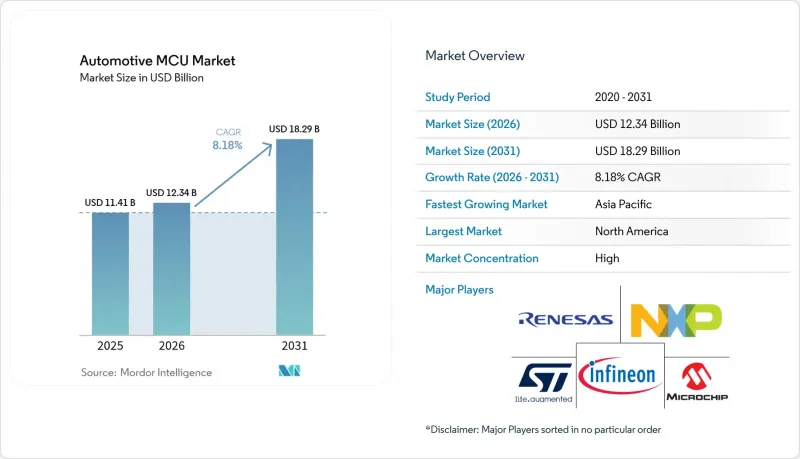
據 Mordor Intelligence 稱,2025 年汽車 MCU 市值為 114.1 億美元,預計到 2031 年將達到 182.9 億美元,而 2026 年為 123.4 億美元,預測期(2026-2031 年)的複合年成長率為 8.18%。
本報告按位數(8 位、16 位、32 位)、應用領域(動力傳動系統/底盤、安全/ADAS、其他)、車輛傳動系統(乘用車(內燃機)、商用車(內燃機)、其他)、製程節點技術、核心架構(ARM Cortex-M、ARM Cortex-R/A、其他)和地區進行細分。市場預測以美元 (USD) 為單位。
全球汽車MCU市場趨勢與洞察
電氣化和電動車的快速普及
與內燃機汽車相比,電池式電動車需要超過 300 個控制器,對微控制器 (MCU) 的需求量是其四倍。 800V 牽引系統的熱負載要求設計中結溫超過 150 度C。恩智浦半導體 (NXP) 的 S32K39/37 可控制頻率超過 200kHz 的六相電機,展現了所需的高速迴路。採用 48V 分區主幹網路可減少 85% 的佈線重量,從而釋放出更多功率預算用於加熱、通風和電池調節迴路。
擴展ADAS和自動駕駛能力
二級平台已經整合了價值約 500 美元的半導體,比基礎車輛的成本高出一個數量級以上。向四級自動駕駛過渡需要感測器融合、冗餘設計以及 ASIL-D 安全等級認證。德州儀器 (TI) 的 AWRL6844 雷達將邊緣人工智慧整合到微控制器 (MCU) 中,即時處理車內嬰兒是否存在的資料。將感知和控制程式碼整合到單一 MCU 中,加速了從分散式運算轉向集中式運算的轉變。
功能安全認證週期越來越長。
獲得 ASIL-D 認證需要 18 到 24 個月,這會導致創新進程的延遲。混合關鍵型工作負載需要硬體分區和形態學驗證,這會增加成本和進度風險。
細分市場分析
2025年,16位MCU市場仍維持35.40%的銷售額,主要集中在汽車電子領域。相較之下,32位MCU的複合年成長率(CAGR)為11.2%,主要得益於ADAS(高級駕駛輔助系統)和軟體定義車輛工作負載的需求。 ARM Cortex-R5在安全關鍵型應用中佔據主導地位,而英飛凌的TriCore則在動力傳動系統領域表現出色。預計到2031年,32位MCU市場規模將達到106.2億美元。融合控制和AI神經處理的異構計算進一步拉大了16位MCU與8位MCU之間的差距。 8位元MCU目前仍用於低速感測器介面,但隨著整合度的提高,其市佔率正在下降。
擴展的周邊設備、確定性延遲和硬體防火牆意味著 32 位元產品在 ASIL-D 系統中仍然是首選。英飛凌最新的 AURIX-3 裝置採用三核心同步運行,每瓦 1500 DMIPS,凸顯了效率的重要性。在汽車 MCU 市場,16 位元產品正日益被視為注重成本效益的選擇,而 32 位元產品則因其高級加密和乙太網路 TSN 支援等功能而被高階市場廣泛採用。
受自動煞車和車道維持輔助系統強制法規的推動,安全和高級駕駛輔助系統(ADAS)領域在2026年至2031年間實現了13.6%的複合年成長率。動力傳動系統和底盤領域由於其通用性,仍然佔據最大的銷售佔有率。儘管截至2025年,動力傳動系統總成用汽車微控制器(MCU)的市佔率仍維持在25.60%,但隨著電氣化進程的推進,支出轉向電池管理單元,其成長速度正在放緩。
軟體堆疊正在模糊應用之間的界線。預測性維護運行在動力傳動系統微控制器 (MCU) 上,而語音人工智慧則運行在資訊娛樂系統微控制器上。德州儀器 (TI) 的 AM275x-Q1 整合了用於駕駛員監控的圖形渲染和神經網路,展現了不同領域之間日益增強的融合。邊緣學習減少了雲端流量,並確保了在資料主權法律日益嚴格的領域中符合隱私法規。
區域分析
預計到2025年,北美將佔全球銷售額的18.80%,這主要得益於自動駕駛汽車測試區和《晶片和整合產品法案》(CHIPS Act),該法案為美國本土半導體製造工廠津貼。 Microchip公司投資8.8億美元擴建其位於科羅拉多的碳化矽(SiC)製造地,將確保電動車牽引逆變器的本地供應。墨西哥的成本控制型組裝廠與美國的設計基地形成互補,而加拿大則受惠於零排放汽車購買獎勵。
亞太地區是成長最快的地區,複合年成長率達13.2%。中國在2025年實現25%的國產晶片使用率目標,正在刺激本土MCU新創企業和合資企業的發展。 Vision Power Semiconductor在新加坡投資78億美元建造的300毫米晶圓廠,正助力汽車混合訊號產品的生產。日本瑞薩電子預計2024年汽車晶片銷量將年增50%,而韓國正利用其電池芯技術,將高密度控制器整合到電池組管理系統中。印度雖然仍在發展中,但隨著產量增加和進口關稅的推高,在地採購採購需求也隨之成長,因此蘊藏著巨大的戰略機會。
為實現歐洲到2030年將電動車普及率提升至65%的目標,增加每輛車的MCU數量至關重要。 2025年3月公佈的「產業行動計畫」強制要求為數位化和網路安全提供資金,並強制OEM廠商採用符合ISO 21434標準的控制器。德國憑藉與中國競爭對手的成本差距,正在大力推廣自動化和以軟體為中心的設計,優先考慮基於區域的運算。歐盟的「晶片法」旨在2030年佔據全球半導體產量的20%,但跨境合作仍面臨挑戰。成員國嚴格執行聯合國R155號條例正在加速硬體安全技術的普及。
其他好處
- Excel格式的市場預測(ME)表
- 3個月的分析師支持
目錄
第1章:引言
- 研究假設和市場定義
- 調查範圍
第2章:調查方法
第3章執行摘要
第4章 市場狀況
- 市場概覽
- 市場促進因素
- 電氣化和電動車的快速普及
- ADAS和自動駕駛功能的擴展
- 軟體定義車輛 (SDV) 和 OTA 架構
- 透過網路安全法規加快更新周期
- 向區域電氣/電氣架構遷移
- 在地化獎勵(例如 CHIPS 法案)
- 市場限制因素
- 功能安全認證週期越來越長。
- 150毫米晶圓代工廠產能長期受阻
- 結溫超過 150 度C時會出現降額問題
- 符合 ISO 26262/21434 標準的成本增加
- 價值供應鏈分析
- 監理情勢
- 技術展望
- 波特五力分析
第5章 市場規模與成長預測
- 位元類
- 8 位元
- 16 位元
- 32 位元
- 透過使用
- 動力傳動系統和底盤
- 安全/ADAS
- 車身及舒適性相關電子設備
- 車載資訊娛樂系統
- 車輛驅動系統
- 乘用車(內燃機)
- 商用車輛(內燃機)
- 電池式電動車(BEV)
- 混合動力電動車(HEV)
- 插電式混合動力車(PHEV)
- 燃料電池汽車(FCEV)
- 製程節點技術
- 180奈米或以上
- 90~65nm
- 40~22nm
- 16奈米或更小(FinFET)
- 透過核心架構
- ARM Cortex-M
- ARM Cortex-R/A
- 專有的 16/32 位元規範
- RISC-V
- 按地區
- 北美洲
- 美國
- 加拿大
- 墨西哥
- 歐洲
- 英國
- 德國
- 法國
- 義大利
- 其他歐洲國家
- 亞太地區
- 中國
- 日本
- 印度
- 韓國
- 亞太其他地區
- 中東
- 以色列
- 沙烏地阿拉伯
- 阿拉伯聯合大公國
- 土耳其
- 其他中東國家
- 非洲
- 南非
- 埃及
- 其他非洲地區
- 南美洲
- 巴西
- 阿根廷
- 南美洲其他地區
- 北美洲
第6章 競爭情勢
- 市場集中度
- 策略趨勢
- 市佔率分析
- 公司簡介
- Infineon Technologies AG
- Microchip Technology Inc.
- NXP Semiconductors NV
- Renesas Electronics Corporation
- STMicroelectronics NV
- Texas Instruments Incorporated
- Toshiba Electronic Devices and Storage Corporation
- Analog Devices, Inc.
- ROHM Semiconductor Co., Ltd.
- Broadcom Inc.
- ON Semiconductor Corp.
- Qualcomm Technologies, Inc.
第7章 市場機會與未來展望
According to Mordor Intelligence, the automotive MCU market size was valued at USD 11.41 billion in 2025 and estimated to grow from USD 12.34 billion in 2026 to reach USD 18.29 billion by 2031, at a CAGR of 8.18% during the forecast period (2026-2031).
This report is Segmented by Bit Class (8-Bit, 16-Bit, 32-Bit), Application (Powertrain and Chassis, Safety and ADAS, and More), Vehicle Propulsion Type (Passenger ICE, Commercial ICE, and More), Process-Node Technology, Core Architecture (ARM Cortex-M, ARM Cortex-R/A and More), and Geography. The Market Forecasts are Provided in Terms of Value (USD).
Global Automotive MCU Market Trends and Insights
Electrification and xEV Penetration Surge
Battery-electric cars need more than 300 controllers compared with 70 in ICE vehicles, quadrupling MCU unit demand. Thermal loads in 800 V traction systems drive designs rated for junctions beyond 150°C. NXP's S32K39/37 controls six-phase motors at >200 kHz, illustrating the high-speed loops required. Moving to 48 V zonal backbones trims wiring mass by 85% and frees power budget for heating, ventilation, and battery-conditioning loops.
Growing ADAS and Autonomous Feature Content
Level 2 platforms already embed about USD 500 in semiconductors, an order of magnitude above basic vehicles. Progression to Level 4 autonomy mandates sensor-fusion, redundancy, and ASIL-D conformance. Texas Instruments' AWRL6844 radar integrates edge AI in its MCU, processing in-cabin child-presence data in real time. Consolidating perception and control code on single MCUs accelerates the pivot from distributed to centralized compute.
Lengthy Functional-Safety Qualification Cycles
Achieving ASIL-D certification stretches 18-24 months, delaying innovation. Mixed-critical workloads need hardware partitioning and formal proofs, inflating cost and schedule risk.
Other drivers and restraints analyzed in the detailed report include:
- Software-Defined Vehicle and OTA Architecture
- Cyber-Security Regulation-Driven Refresh Cycles
- Persistent 150 mm Foundry Capacity Bottlenecks
For complete list of drivers and restraints, kindly check the Table Of Contents.
Segment Analysis
The 16-bit segment maintained 35.40% revenue in 2025, mainly in body electronics. In contrast, 32-bit devices recorded an 11.2% CAGR, riding ADAS demand and software-defined-vehicle workloads. ARM Cortex-R5 dominates safety-critical roles, while Infineon's TriCore excels in powertrain. The automotive MCU market size for 32-bit controllers is forecast to expand to USD 10.62 billion by 2031. Heterogeneous computing that blends control and AI neural processing widens the gap with 16-bit devices. 8-bit MCUs linger in low-speed sensor interfaces yet see declining share as integration rises.
Extended peripherals, deterministic latency, and hardware firewalls keep 32-bit parts preferable for ASIL-D systems. Infineon's latest AURIX-3 devices deliver triple-core lockstep and 1,500 DMIPS per watt, underscoring the efficiency imperative. The automotive MCU market increasingly treats 16-bit as cost bins, while premium tiers pursue 32-bit for advanced cryptography and Ethernet TSN support.
Safety and ADAS logged a 13.6% CAGR between 2026-2031, climbing on mandatory automated-brake and lane-keep assist regulations. Powertrain and chassis still hold the largest revenue due to universal fitment. The automotive MCU market share for powertrain remained 25.60% in 2025, yet its growth moderates as electrification shifts spend to battery-management units.
Software stacks now blur application lines; predictive maintenance RUNs on powertrain MCUs, while infotainment MCUs host speech AI. Texas Instruments' AM275x-Q1 merges graphics rendering and driver-monitoring neural nets, evidencing cross-domain convergence. Edge-learning reduces cloud traffic and ensures privacy compliance in regions tightening data-sovereignty laws.
Complete Report Scope:
- By Bit Class
- 8-bit
- 16-bit
- 32-bit
- By Application
- Powertrain and Chassis
- Safety and ADAS
- Body and Comfort Electronics
- Telematics and Infotainment
- By Vehicle Propulsion Type
- Passenger ICE
- Commercial ICE
- Battery Electric Vehicle (BEV)
- Hybrid Electric Vehicle (HEV)
- Plug-in Hybrid (PHEV)
- Fuel-Cell Electric Vehicle (FCEV)
- By Process-Node Technology
- >=180 nm
- 90-65 nm
- 40-22 nm
- <=16 nm (FinFET)
- By Core Architecture
- ARM Cortex-M
- ARM Cortex-R/A
- Proprietary 16/32-bit
- RISC-V
- By Geography
- North America
- United States
- Canada
- Mexico
- Europe
- United Kingdom
- Germany
- France
- Italy
- Rest of Europe
- Asia-Pacific
- China
- Japan
- India
- South Korea
- Rest of Asia-Pacific
- Middle East
- Israel
- Saudi Arabia
- United Arab Emirates
- Turkey
- Rest of Middle East
- Africa
- South Africa
- Egypt
- Rest of Africa
- South America
- Brazil
- Argentina
- Rest of South America
- North America
Geography Analysis
North America held 18.80% of revenue in 2025, propelled by autonomous-vehicle pilot zones and the CHIPS Act that subsidizes domestic fabs. Microchip's USD 880 million Colorado silicon-carbide expansion secures local supply for EV traction inverters. Mexico's cost-based assembly plants complement U.S. design hubs, while Canada benefits from zero-emission purchase incentives.
Asia-Pacific is the fastest-rising region with a 13.2% CAGR. China's 25% domestic-chip-content mandate for 2025 energizes local MCU startups and joint ventures; VisionPower Semiconductor's USD 7.8 billion 300 mm fab in Singapore underpins mixed-signal automotive output. Japan's Renesas reported 50% year-on-year automotive growth in 2024, while South Korea leverages battery-cell expertise to embed high-density controllers into pack-management systems. India represents a nascent but strategic opportunity as production volumes climb and import duties favour localized sourcing.
Europe's path to 65% EV penetration by 2030 necessitates heavier MCU content per car. The Industrial Action Plan announced March 2025 directs funds toward digitalization and cybersecurity, compelling OEMs to adopt ISO 21434-compliant controllers. Germany's cost gap versus Chinese rivals pushes automation and software-centric designs that prioritize zonal compute. The EU Chips Act aims for 20% global semiconductor output by 2030, but cross-border coordination remains a headwind. Strict UN R155 enforcement across member states accelerates hardware security adoption.
- Infineon Technologies AG
- Microchip Technology Inc.
- NXP Semiconductors N.V.
- Renesas Electronics Corporation
- STMicroelectronics N.V.
- Texas Instruments Incorporated
- Toshiba Electronic Devices and Storage Corporation
- Analog Devices, Inc.
- ROHM Semiconductor Co., Ltd.
- Broadcom Inc.
- ON Semiconductor Corp.
- Qualcomm Technologies, Inc.
Additional Benefits:
- The market estimate (ME) sheet in Excel format
- 3 months of analyst support
TABLE OF CONTENTS
1 INTRODUCTION
- 1.1 Study Assumptions and Market Definition
- 1.2 Scope of the Study
2 RESEARCH METHODOLOGY
3 EXECUTIVE SUMMARY
4 MARKET LANDSCAPE
- 4.1 Market Overview
- 4.2 Market Drivers
- 4.2.1 Electrification and xEV penetration surge
- 4.2.2 Growing ADAS and autonomous feature content
- 4.2.3 Software-defined vehicle and OTA architecture
- 4.2.4 Cyber-security regulation-driven refresh cycles
- 4.2.5 Zonal E/E architecture transition
- 4.2.6 Localization incentives (CHIPS Acts, etc.)
- 4.3 Market Restraints
- 4.3.1 Lengthy functional-safety qualification cycles
- 4.3.2 Persistent 150 mm foundry capacity bottlenecks
- 4.3.3 Junction-temperature derating issues >150 C
- 4.3.4 Rising ISO 26262/21434 compliance costs
- 4.4 Value / Supply-Chain Analysis
- 4.5 Regulatory Landscape
- 4.6 Technological Outlook
- 4.7 Porter's Five Forces Analysis
- 4.7.1 Threat of New Entrants
- 4.7.2 Bargaining Power of Suppliers
- 4.7.3 Bargaining Power of Buyers
- 4.7.4 Threat of Substitutes
- 4.7.5 Competitive Rivalry
5 MARKET SIZE AND GROWTH FORECASTS (VALUE)
- 5.1 By Bit Class
- 5.1.1 8-bit
- 5.1.2 16-bit
- 5.1.3 32-bit
- 5.2 By Application
- 5.2.1 Powertrain and Chassis
- 5.2.2 Safety and ADAS
- 5.2.3 Body and Comfort Electronics
- 5.2.4 Telematics and Infotainment
- 5.3 By Vehicle Propulsion Type
- 5.3.1 Passenger ICE
- 5.3.2 Commercial ICE
- 5.3.3 Battery Electric Vehicle (BEV)
- 5.3.4 Hybrid Electric Vehicle (HEV)
- 5.3.5 Plug-in Hybrid (PHEV)
- 5.3.6 Fuel-Cell Electric Vehicle (FCEV)
- 5.4 By Process-Node Technology
- 5.4.1 >=180 nm
- 5.4.2 90-65 nm
- 5.4.3 40-22 nm
- 5.4.4 <=16 nm (FinFET)
- 5.5 By Core Architecture
- 5.5.1 ARM Cortex-M
- 5.5.2 ARM Cortex-R/A
- 5.5.3 Proprietary 16/32-bit
- 5.5.4 RISC-V
- 5.6 By Geography
- 5.6.1 North America
- 5.6.1.1 United States
- 5.6.1.2 Canada
- 5.6.1.3 Mexico
- 5.6.2 Europe
- 5.6.2.1 United Kingdom
- 5.6.2.2 Germany
- 5.6.2.3 France
- 5.6.2.4 Italy
- 5.6.2.5 Rest of Europe
- 5.6.3 Asia-Pacific
- 5.6.3.1 China
- 5.6.3.2 Japan
- 5.6.3.3 India
- 5.6.3.4 South Korea
- 5.6.3.5 Rest of Asia-Pacific
- 5.6.4 Middle East
- 5.6.4.1 Israel
- 5.6.4.2 Saudi Arabia
- 5.6.4.3 United Arab Emirates
- 5.6.4.4 Turkey
- 5.6.4.5 Rest of Middle East
- 5.6.5 Africa
- 5.6.5.1 South Africa
- 5.6.5.2 Egypt
- 5.6.5.3 Rest of Africa
- 5.6.6 South America
- 5.6.6.1 Brazil
- 5.6.6.2 Argentina
- 5.6.6.3 Rest of South America
- 5.6.1 North America
6 COMPETITIVE LANDSCAPE
- 6.1 Market Concentration
- 6.2 Strategic Moves
- 6.3 Market Share Analysis
- 6.4 Company Profiles (includes Global level Overview, Market level overview, Core Segments, Financials as available, Strategic Information, Market Rank/Share for key companies, Products and Services, and Recent Developments)
- 6.4.1 Infineon Technologies AG
- 6.4.2 Microchip Technology Inc.
- 6.4.3 NXP Semiconductors N.V.
- 6.4.4 Renesas Electronics Corporation
- 6.4.5 STMicroelectronics N.V.
- 6.4.6 Texas Instruments Incorporated
- 6.4.7 Toshiba Electronic Devices and Storage Corporation
- 6.4.8 Analog Devices, Inc.
- 6.4.9 ROHM Semiconductor Co., Ltd.
- 6.4.10 Broadcom Inc.
- 6.4.11 ON Semiconductor Corp.
- 6.4.12 Qualcomm Technologies, Inc.
7 MARKET OPPORTUNITIES AND FUTURE OUTLOOK
- 7.1 White-space and Unmet-Need Assessment

 中國汽車微控制器市場:市場佔有率分析、產業趨勢與統計及成長預測(2026-2031)
 汽車微控制器市場:依架構、工作電壓、位元深度、分配通道和功能分類-2026-2032年全球市場預測
 汽車MCU市場規模、佔有率和成長分析:按位級配置、功能、應用領域、製程節點技術、核心處理器架構、車輛驅動系統和地區分類-2026-2033年產業預測
 2026年全球遠端無線連接微控制器單元(MCU)市場報告
 汽車微控制器市場預測至2034年:按架構、車輛類型、技術、應用和地區分類的全球分析2026年全球可程式自動化控制器市場報告2026年全球可程式自動化控制器(PAC)程式設計軟體市場報告可程式自動化控制器市場按產品類型、通訊協定、架構、應用和最終用戶產業分類,全球預測(2026-2032年)
 可程式自動化控制器 (PAC) 程式設計軟體市場分析及預測(至 2035 年):按類型、產品、服務、技術、元件、應用、部署模式、最終用戶和功能分類汽車微控制器市場分析及預測(至2035年):依類型、產品類型、技術、組件、應用、最終用戶、功能、安裝類型及設備分類