


 |
市場調查報告書
商品編碼
2114896
中國汽車微控制器市場:市場佔有率分析、產業趨勢與統計及成長預測(2026-2031)China Automotive Microcontroller - Market Share Analysis, Industry Trends & Statistics, Growth Forecasts (2026 - 2031) |
||||||

※ 本網頁內容可能與最新版本有所差異。詳細情況請與我們聯繫。
根據 Mordor Intelligence 預測,中國汽車微控制器市場規模預計將從 2025 年的 34.2 億美元成長到 2026 年的 36.6 億美元,然後從 2026 年到 2031 年以 7.11% 的複合年成長率成長,到 2031 億美元達到 51.7 億美元。
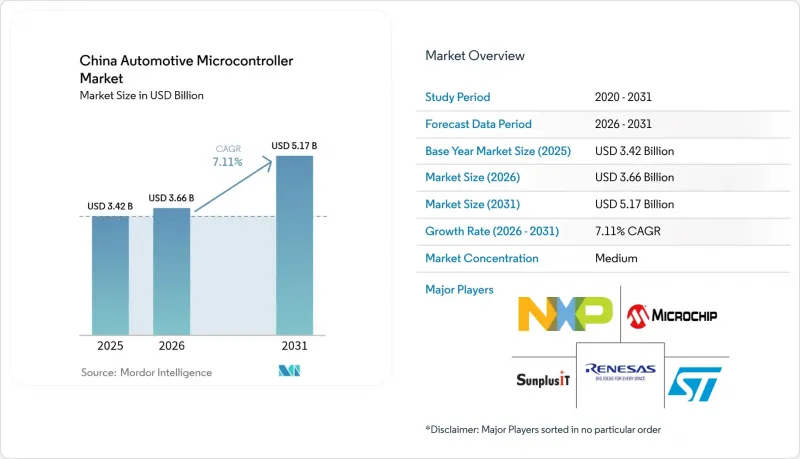
本報告按位數(8 位、16 位、32 位、64 位)、應用領域(安全/ADAS、汽車電子、車載資訊系統/資訊娛樂系統、動力傳動系統/底盤等)、車輛類型(乘用車、輕型商用車等)和驅動技術(內燃機車輛等)進行細分。市場預測以美元計價。
中國汽車微控制器市場趨勢與洞察
擴大新能源汽車的普及應用
2024年,中國新能源汽車產量達1,040萬輛,佔全國汽車總產量的35%。每輛電池式電動車使用50至80個微控制器,而內燃機汽車僅使用30至50個。這其中還包括牽引逆變器、充電器和熱迴路控制器。比亞迪的「刀鋒」電池採用分散式晶片,可對200多個電芯的電壓和溫度進行採樣,以防止熱失控。中國工業和資訊化部(工信部)的目標是到2030年新能源汽車普及率達到40%,這將確保對矽晶片的長期需求。寧德時代的「神星」電池組可在10分鐘內充電至80%,並採用32位元控制器,可在毫秒內完成電流平衡。
高級駕駛輔助系統(ADAS)的整合正在穩步推進。
中國2024年版GB 7258標準修正案強制要求配備自動緊急煞車和車道維持輔助系統,迫使汽車製造商採用符合ASIL-D標準的微控制器以確保執行器冗餘。蔚來汽車的「Adam」超級電腦仍然採用高性能NVIDIA Orin處理器和獨立的32位元晶片來實現故障安全轉向和煞車。小鵬汽車於2024年發布的「XNGP」展示了一種混合運算模型,該模型在域CPU上執行感知處理,同時將低延遲控制委託給即時微控制器。 2025年版C-NCAP標準引入了V2X和駕駛監控要求,這將增加安全無線和紅外線模組的控制器負載。
半導體供應鏈的波動仍在持續。
中國65%的汽車級晶圓生產仍依賴台灣、日本和韓國,使其極易受到天災和地緣政治衝擊的影響。 2024年4月台灣大地震導致台積電28奈米生產線停產三週,瑞薩電子和恩智浦半導體的出貨也因此延遲,並迫使廣汽傳祺和長安汽車減產。雖然中芯國際等國內晶圓代晶圓代工廠已提高了汽車級40奈米製程的良率,但仍比全球同行低15-20個百分點,導致前置作業時間更長。 2024年8月檳城洪水導致英飛凌後端封裝停產,凸顯了其脆弱性。安全庫存緩衝可以減輕影響,但只有擴大本地產能,才能消除系統性風險。
細分市場分析
在中國汽車微控制器市場,32位元裝置市場預計到2025年將達到15.7億美元,佔總價值的45.78%。隨著區域和域架構的普及,以及多個低階單元整合到少數高功率晶片中,64位元控制器市場預計到2031年將以8.78%的複合年成長率成長。比亞迪用12個以乙太網路為基礎的32位元單元替換了45個分散式8位元模組,從而減輕了線束重量並實現了空中下載(OTA)更新。蔚來汽車的Adam平台採用64位元Cortex-A76控制器來管理冗餘電源和感測器同步,凸顯了對虛擬化和安全加速器日益成長的需求。
儘管傳統的 8 位元組件在汽車應用的低風險細分(例如車窗升降器)仍然佔據主導地位,但它們在中國汽車微控制器市場的佔有率正在萎縮。由於缺乏工具鏈,16 位元微控制器正面臨結構性衰退,迫使汽車製造商直接遷移到 32 位元 Arm 核心。就 ISO 26262 合規性而言,32 位元和 64 位元元件具有優勢,因為預認證庫可以縮短檢驗週期,從而抵消其較高的晶圓成本。因此,能夠提供跨位級可擴展且引腳相容的產品系列的供應商正在維持客戶的平台忠誠度。
到2025年,安全和ADAS應用將創造11.6億美元的市場規模,佔中國汽車微控制器市場價值的34.05%。強制性AEB(自動緊急煞車)和車道維持系統推動了對ASIL-D認證晶片的需求,這些晶片用於協調煞車、轉向和冗餘電源路徑。同時,電池管理系統預計將以10.26%的最高複合年成長率成長,這主要得益於高密度電池組化學成分的進步,這些進步需要毫秒級的電池級感測。寧德時代(CATL)的「麒麟」電池採用分散式32位元節點,ADC解析度為0.3 mV,實現了255 Wh/kg的電池密度。
隨著48伏特混合動力汽車的日益普及,動力傳動系統和底盤領域的需求預計將穩定成長。 5G的部署推動了車載資訊系統控制器的發展,而車身電子領域則因區域同質化加劇而面臨利潤率下降的困境。電池安全標準GB 38031和功能安全法規結構GB 34660確保了整個應用領域半導體技術的持續升級。
其他好處:
- Excel格式的市場預測(ME)表
- 3個月的分析師支持
目錄
第1章:引言
- 研究假設和市場定義
- 調查範圍
第2章:調查方法
第3章執行摘要
第4章 市場狀況
- 市場概覽
- 市場促進因素
- 擴大新能源汽車的普及應用
- ADAS(進階駕駛輔助系統)的擴展
- 更嚴格的汽車安全法規
- 政府為實現半導體自給自足所做的努力
- 智慧車輛向基於區域的電氣架構過渡
- 基於網域控制器的汽車平臺的出現
- 市場限制因素
- 半導體供應鏈的波動仍在持續。
- 低價本地商販之間競爭激烈
- 實現符合 ASIL-D 功能安全標準的複雜性
- 對先進設計和檢驗工具的出口限制
- 產業價值鏈分析
- 宏觀經濟因素對市場的影響
- 監理情勢
- 技術展望
- 波特五力分析
第5章 市場規模與成長預測
- 位元類
- 8位元微控制器
- 16位元微控制器
- 32位元微控制器
- 64位元微控制器
- 透過使用
- 安全/ADAS
- 汽車電子設備
- 車載資訊系統和資訊娛樂系統
- 動力傳動系統和底盤
- 電池管理系統
- 車輛類型
- 搭乘用車
- 輕型商用車
- 大型商用車輛
- 非公路用車輛
- 透過推進技術
- 內燃機車
- 油電混合車
- 電池式電動車
- 燃料電池電動車
第6章 競爭情勢
- 市場集中度
- 策略趨勢
- 市佔率分析
- 公司簡介
- NXP Semiconductors NV
- Microchip Technology Inc.
- Renesas Electronics Corporation
- STMicroelectronics NV
- Infineon Technologies AG
- Texas Instruments Incorporated
- Toshiba Electronic Devices and Storage Corporation
- Onsemi Corporation
- GigaDevice Semiconductor Inc.
- Shanghai NPCore Electronics Co., Ltd.
- CEC Huada Technology Co., Ltd.
- SinoChip Semiconductor Co., Ltd.
- BYD Semiconductor Co., Ltd.
- Autoware Microelectronics Co., Ltd.
- Hangzhou Silan Microelectronics Co., Ltd.
- Nationz Technologies Inc.
- Guangdong Fudan Microelectronics Group Co., Ltd.
- ChipON Micro-Electronics(Shenzhen)Co., Ltd.
- Wuhan Yutong Microelectronics Co., Ltd.
- Shanghai Neusoft Carrier Microelectronics Co., Ltd.
- Holtek Semiconductor Inc.
- Sunplus Technology Co., Ltd.
- AutoCore Technology Co., Ltd.
- Puolop Microelectronics Co., Ltd.
- Hangzhou Hollysys Automation Technologies Co., Ltd.
第7章 市場機會與未來展望
According to Mordor Intelligence, the China automotive microcontroller market size is expected to grow from USD 3.42 billion in 2025 to USD 3.66 billion in 2026 and is forecast to reach USD 5.17 billion by 2031 at 7.11% CAGR over 2026-2031.
This report is Segmented by Bit Class (8-Bit, 16-Bit, 32-Bit, and 64-Bit), Application (Safety and ADAS, Body Electronics, Telematics and Infotainment, Powertrain and Chassis, and More), Vehicle Type (Passenger Vehicles, Light Commercial Vehicles, and More), and Propulsion Technology (Internal Combustion Engine Vehicles, and More). Market Forecasts are Provided in Terms of Value (USD).
China Automotive Microcontroller Market Trends and Insights
Growing Adoption of New Energy Vehicles
China produced 10.4 million new-energy vehicles in 2024, accounting for 35% of the country's national auto output. Each battery electric model uses 50-80 microcontrollers, compared to 30-50 in internal-combustion cars, which also include traction inverters, chargers, and thermal-loop controllers. BYD's Blade battery embeds distributed chips that sample voltage and temperature across more than 200 cells to avert thermal runaway. MIIT targets 40% new-energy penetration by 2030, securing long-term demand for silicon. CATL's Shenxing pack, capable of reaching 80% charge in 10 minutes, relies on 32-bit controllers that balance current at a millisecond cadence.
Rising Integration of Advanced Driver Assistance Systems
China's 2024 GB 7258 update made automatic emergency braking and lane-keeping assist mandatory, pushing automakers to deploy ASIL-D-rated microcontrollers for actuator redundancy. NIO's Adam supercomputer still pairs high-level NVIDIA Orin processors with discrete 32-bit chips for fail-safe steering and braking. XPeng's 2024 XNGP launch confirms a hybrid compute model where perception runs on domain CPUs but low-latency control stays with real-time microcontrollers. The 2025 C-NCAP upgrade introduces V2X and driver-monitoring requirements, thereby increasing controller content for secure wireless and infrared modules.
Persistent Semiconductor Supply Chain Volatility
Sixty-five percent of automotive-grade wafer output still originates from Taiwan, Japan, and South Korea, leaving China vulnerable to natural disasters and geopolitical shocks. The April 2024 Taiwan earthquake halted TSMC's 28-nm lines for three weeks, delaying shipments from Renesas and NXP, and forcing GAC and Changan to cut their output. Domestic foundries, such as SMIC, have raised 40-nm automotive yields yet remain 15-20 points below their global peers, inflating lead times. Penang flooding in August 2024 halted Infineon backend packaging, underscoring fragility. Safety-stock buffers mitigate the impact but cannot eliminate systemic risk until local capacity is scaled.
Other drivers and restraints analyzed in the detailed report include:
- Government Push for Semiconductor Self-Sufficiency
- Shift to Zonal Electrical Architecture in Smart Vehicles
- Intense Price Competition From Low-End Local Vendors
For complete list of drivers and restraints, kindly check the Table Of Contents.
Segment Analysis
The China automotive microcontroller market size for 32-bit devices reached USD 1.57 billion in 2025, accounting for 45.78% of the total value. Zonal and domain architectures drive consolidation of multiple low-end units into fewer, higher-power chips, propelling 64-bit controllers toward an 8.78% CAGR through 2031. BYD replaced 45 distributed 8-bit modules with 12 Ethernet-based 32-bit units, cutting harness weight while enabling over-the-air updates. NIO's Adam platform incorporates 64-bit Cortex-A76 controllers to manage redundant power and sensor synchronization, underscoring the demand for virtualization and security accelerators.
Legacy 8-bit parts remain dominant in low-risk body niches, such as window lifts, although their market share in the China automotive microcontroller market is contracting. The 16-bit category is facing a structural decline because tool-chain scarcity is pushing automakers to leapfrog directly to 32-bit Arm cores. ISO 26262 compliance favors 32-bit and 64-bit devices, as pre-certified libraries reduce validation cycles, thereby outweighing the higher die cost. As a result, suppliers that offer scalable pin-compatible families across bit classes defend platform loyalty.
Safety and ADAS applications generated USD 1.16 billion in 2025, accounting for 34.05% of China automotive microcontroller market value. Mandated AEB and lane-keeping systems elevate demand for ASIL-D-rated chips that coordinate brake, steer, and redundant power paths. Battery management systems, however, will record the fastest 10.26% CAGR, fueled by high-density cell-to-pack chemistries that require cell-level sensing at millisecond speed. CATL's Qilin battery achieves 255 Wh/kg by employing distributed 32-bit nodes with 0.3 mV ADC resolution.
The powertrain and chassis segments are adding steady volume as 48-volt hybrids proliferate. Telematics controllers ride 5G rollout, while body electronics confront margin erosion amid local commoditization. Regulatory frameworks GB 38031 for battery safety and GB 34660 for functional safety ensure persistent silicon upgrades across the application stack.
Complete Report Scope:
- By Bit Class
- 8-bit Microcontrollers
- 16-bit Microcontrollers
- 32-bit Microcontrollers
- 64-bit Microcontrollers
- By Application
- Safety and ADAS
- Body Electronics
- Telematics and Infotainment
- Powertrain and Chassis
- Battery Management System
- By Vehicle Type
- Passenger Vehicles
- Light Commercial Vehicles
- Heavy Commercial Vehicles
- Off-Highway Vehicles
- By Propulsion Technology
- Internal Combustion Engine Vehicles
- Hybrid Electric Vehicles
- Battery Electric Vehicles
- Fuel Cell Electric Vehicles
List of Companies Covered in this Report:
- NXP Semiconductors N.V.
- Microchip Technology Inc.
- Renesas Electronics Corporation
- STMicroelectronics N.V.
- Infineon Technologies AG
- Texas Instruments Incorporated
- Toshiba Electronic Devices and Storage Corporation
- Onsemi Corporation
- GigaDevice Semiconductor Inc.
- Shanghai NPCore Electronics Co., Ltd.
- CEC Huada Technology Co., Ltd.
- SinoChip Semiconductor Co., Ltd.
- BYD Semiconductor Co., Ltd.
- Autoware Microelectronics Co., Ltd.
- Hangzhou Silan Microelectronics Co., Ltd.
- Nationz Technologies Inc.
- Guangdong Fudan Microelectronics Group Co., Ltd.
- ChipON Micro-Electronics (Shenzhen) Co., Ltd.
- Wuhan Yutong Microelectronics Co., Ltd.
- Shanghai Neusoft Carrier Microelectronics Co., Ltd.
- Holtek Semiconductor Inc.
- Sunplus Technology Co., Ltd.
- AutoCore Technology Co., Ltd.
- Puolop Microelectronics Co., Ltd.
- Hangzhou Hollysys Automation Technologies Co., Ltd.
Additional Benefits:
- The market estimate (ME) sheet in Excel format
- 3 months of analyst support
TABLE OF CONTENTS
1 INTRODUCTION
- 1.1 Study Assumptions and Market Definition
- 1.2 Scope of the Study
2 RESEARCH METHODOLOGY
3 EXECUTIVE SUMMARY
4 MARKET LANDSCAPE
- 4.1 Market Overview
- 4.2 Market Drivers
- 4.2.1 Growing Adoption of New Energy Vehicles
- 4.2.2 Rising Integration of Advanced Driver Assistance Systems
- 4.2.3 Enforcement of Stricter Automotive Safety Regulations
- 4.2.4 Government Push for Semiconductor Self-Sufficiency
- 4.2.5 Shift to Zonal Electrical Architecture in Smart Vehicles
- 4.2.6 Emergence of Domain Controller-Based Vehicle Platforms
- 4.3 Market Restraints
- 4.3.1 Persistent Semiconductor Supply Chain Volatility
- 4.3.2 Intense Price Competition From Low-End Local Vendors
- 4.3.3 Complexity of Achieving ASIL-D Functional Safety Compliance
- 4.3.4 Export Controls on Advanced Design and Verification Tools
- 4.4 Industry Value Chain Analysis
- 4.5 Impact of Macroeconomic Factors on the Market
- 4.6 Regulatory Landscape
- 4.7 Technological Outlook
- 4.8 Porter's Five Forces Analysis
- 4.8.1 Threat of New Entrants
- 4.8.2 Bargaining Power of Buyers
- 4.8.3 Bargaining Power of Suppliers
- 4.8.4 Threat of Substitute Products
- 4.8.5 Intensity of Competitive Rivalry
5 MARKET SIZE AND GROWTH FORECASTS (VALUE)
- 5.1 By Bit Class
- 5.1.1 8-bit Microcontrollers
- 5.1.2 16-bit Microcontrollers
- 5.1.3 32-bit Microcontrollers
- 5.1.4 64-bit Microcontrollers
- 5.2 By Application
- 5.2.1 Safety and ADAS
- 5.2.2 Body Electronics
- 5.2.3 Telematics and Infotainment
- 5.2.4 Powertrain and Chassis
- 5.2.5 Battery Management System
- 5.3 By Vehicle Type
- 5.3.1 Passenger Vehicles
- 5.3.2 Light Commercial Vehicles
- 5.3.3 Heavy Commercial Vehicles
- 5.3.4 Off-Highway Vehicles
- 5.4 By Propulsion Technology
- 5.4.1 Internal Combustion Engine Vehicles
- 5.4.2 Hybrid Electric Vehicles
- 5.4.3 Battery Electric Vehicles
- 5.4.4 Fuel Cell Electric Vehicles
6 COMPETITIVE LANDSCAPE
- 6.1 Market Concentration
- 6.2 Strategic Moves
- 6.3 Market Share Analysis
- 6.4 Company Profiles (includes Global Level Overview, Market Level Overview, Core Segments, Financials as Available, Strategic Information, Market Rank/Share for Key Companies, Products and Services, and Recent Developments)
- 6.4.1 NXP Semiconductors N.V.
- 6.4.2 Microchip Technology Inc.
- 6.4.3 Renesas Electronics Corporation
- 6.4.4 STMicroelectronics N.V.
- 6.4.5 Infineon Technologies AG
- 6.4.6 Texas Instruments Incorporated
- 6.4.7 Toshiba Electronic Devices and Storage Corporation
- 6.4.8 Onsemi Corporation
- 6.4.9 GigaDevice Semiconductor Inc.
- 6.4.10 Shanghai NPCore Electronics Co., Ltd.
- 6.4.11 CEC Huada Technology Co., Ltd.
- 6.4.12 SinoChip Semiconductor Co., Ltd.
- 6.4.13 BYD Semiconductor Co., Ltd.
- 6.4.14 Autoware Microelectronics Co., Ltd.
- 6.4.15 Hangzhou Silan Microelectronics Co., Ltd.
- 6.4.16 Nationz Technologies Inc.
- 6.4.17 Guangdong Fudan Microelectronics Group Co., Ltd.
- 6.4.18 ChipON Micro-Electronics (Shenzhen) Co., Ltd.
- 6.4.19 Wuhan Yutong Microelectronics Co., Ltd.
- 6.4.20 Shanghai Neusoft Carrier Microelectronics Co., Ltd.
- 6.4.21 Holtek Semiconductor Inc.
- 6.4.22 Sunplus Technology Co., Ltd.
- 6.4.23 AutoCore Technology Co., Ltd.
- 6.4.24 Puolop Microelectronics Co., Ltd.
- 6.4.25 Hangzhou Hollysys Automation Technologies Co., Ltd.
7 MARKET OPPORTUNITIES AND FUTURE OUTLOOK
- 7.1 White-Space and Unmet-Need Assessment

 汽車MCU:市場佔有率分析、產業趨勢與統計及成長預測(2026-2031年)
 汽車微控制器市場:依架構、工作電壓、位元深度、分配通道和功能分類-2026-2032年全球市場預測
 汽車MCU市場規模、佔有率和成長分析:按位級配置、功能、應用領域、製程節點技術、核心處理器架構、車輛驅動系統和地區分類-2026-2033年產業預測
 2026年全球遠端無線連接微控制器單元(MCU)市場報告
 汽車微控制器市場預測至2034年:按架構、車輛類型、技術、應用和地區分類的全球分析2026年全球可程式自動化控制器市場報告2026年全球可程式自動化控制器(PAC)程式設計軟體市場報告可程式自動化控制器市場按產品類型、通訊協定、架構、應用和最終用戶產業分類,全球預測(2026-2032年)
 可程式自動化控制器 (PAC) 程式設計軟體市場分析及預測(至 2035 年):按類型、產品、服務、技術、元件、應用、部署模式、最終用戶和功能分類汽車微控制器市場分析及預測(至2035年):依類型、產品類型、技術、組件、應用、最終用戶、功能、安裝類型及設備分類