


 |
市場調查報告書
商品編碼
2124837
視訊車載資訊服務:市場佔有率分析、產業趨勢與統計、成長預測(2026-2031)Video Telematics - Market Share Analysis, Industry Trends & Statistics, Growth Forecasts (2026 - 2031) |
||||||

※ 本網頁內容可能與最新版本有所差異。詳細情況請與我們聯繫。
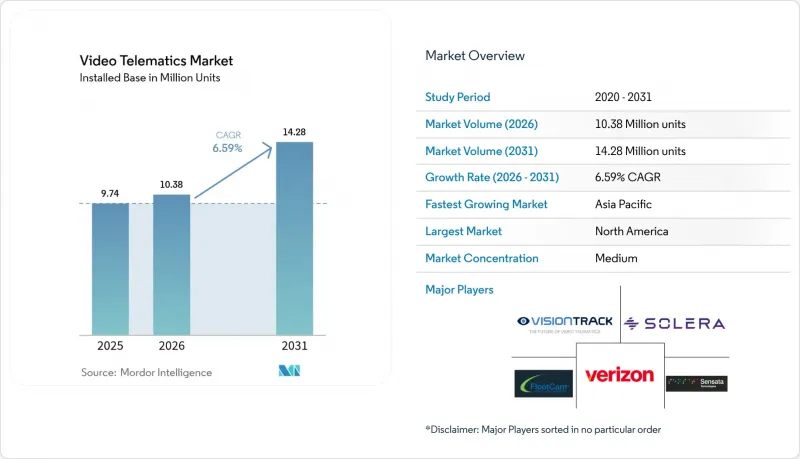
根據 Mordor Intelligence 預測,視訊遠端資訊處理市場(按部署單元數量計算)預計將從 2025 年的 974 萬台和 2026 年的 1038 萬台成長到 2031 年的 1428 萬台,2026 年至 2031 年的年複合成長率(CAGR)為 6.59%。
本報告按類型(整合系統、獨立系統)、車輛類型(重型卡車、巴士/長途客車、乘用車、其他)、部署模式(雲端、本地混合部署)、組件(硬體、軟體/分析、服務)和地區進行細分。市場預測以美元計價。
全球視訊遠端資訊處理市場趨勢及洞察
擴大與車隊遠端資訊處理系統整合的視訊解決方案的應用範圍。
企業車隊正透過將攝影機整合到現有的遠端資訊處理儀錶板中來加強與供應商的合作關係。 Samsara 於 2026 年 1 月發布的 Asset Gateway 將影像覆蓋範圍擴展到拖車和貨櫃,從而將監控範圍擴展到駕駛員座位之外。 Lytx 與 Geotab 於 2025 年 4 月達成合作,使操作員能夠在單一入口網站中同時回放緊急煞車事件和相應的同步影像片段。這種整合方法縮短了調查時間,降低了軟體成本,並增加了獨立攝影機供應商開放 API 的壓力。整合平台在 2025 年的營收佔比已達 62.37%,隨著其從一次性硬體銷售轉向多年軟體訂閱,預計其領先優勢將進一步擴大。
駕駛員監控和ADAS資料登錄的監管要求
歐盟通用安全法規將於2026年7月起強制要求所有新車安裝資料事件記錄儀,將加速歐洲各地攝影機的升級。雖然美國監管機構目前尚未強制要求影像記錄,但聯邦汽車運輸安全管理局(FMCSA)仍在持續審查駕駛時間法規,令美國國內運輸業者保持高度警覺。中國交通運輸部將於2025年生效的法規以及印度公路運輸部部的指導方針,在亞洲地區也引發了類似的迫切感。嚴格的期限迫使運輸公司提前淘汰2020年以前生產的卡車,並購買能夠在碰撞發生前記錄五秒鐘影像、轉向輸入和速度資料的系統。
隱私和資料保護合規性挑戰
《一般資料保護規範》(GDPR) 第 88 條規定,歐洲雇主必須限制對員工的監控,這導致一些貨運公司在休息期間關閉駕駛員攝影機。加州議會第 1651 號法案要求獲得書面同意,並在 24 小時內提供影像,這增加了招募流程中的文書工作。因此,供應商必須開發諸如同意開關、資料儲存位置指定和影像遮罩等功能,所有這些都會延長軟體開發時間並增加工程成本。跨境營運的貨運公司面臨重疊的隱私法規,導致合規預算增加和銷售週期延長。
細分市場分析
預計到2025年,整合平台將佔據62.37%的營收佔有率,凸顯了車隊對整合影片、GPS、維修警報和駕駛員評分卡等功能的單一控制面板的需求。企業負責人傾向於簽訂涵蓋硬體、雲端儲存和分析更新的單一契約,從而將分散的獨立解決方案整合為統一的合規引擎。訂閱式定價模式進一步推動了這一趨勢,它以可預測的月度營運成本取代了攝影機的初始購買成本,Samsara等供應商正是這種模式的倡導者。同時,發展藍圖正著眼於即時指導而非事後檢驗,進一步加強遠端資訊處理數據與可在幾秒鐘內查看的影片片段的整合。
獨立式行車記錄器系統預計到2031年將以6.91%的複合年成長率成長,略高於整體市場成長率。這是因為它們可以輕鬆整合到已配備第三方電子記錄器的混合車隊中。 Garmin 的 LTE 版 Dash Cam Live 就是這種即插即用模式的典型例子,它可以將日常影像保存在本地,僅上傳已標記的事件。這種設計在行動電話資料通訊費用較高的地區可以節省頻寬。對於小規模運輸業者而言,柔軟性先部署一個前置鏡頭,之後再添加側視鏡頭或駕駛員側鏡頭至關重要,因為它無需移除現有硬體。隨著邊緣人工智慧處理器實現設備端分析,其與整合套件的效能差距正在縮小,這給價格和功能差異化帶來了新的壓力。
2025年,重型卡車銷量佔總銷售量的33.68%。這主要是由於長途運輸中發生嚴重事故的風險較高,以及保險公司嚴格審核並強制要求影像。車道偏離預警、盲點監測和駕駛員疲勞檢測等功能現在已成為標配,並與其他選配功能捆綁銷售,因為運輸公司清楚地認知到車輛影像與訴訟成本之間存在密切關聯。儘管聯邦機動車輛安全管理局 (FMCSA) 沒有正式的聯邦強制安裝攝影機規定,但其監管力道仍維持了較高的普及率。此外,隨著貨主越來越需要證據來反駁盜竊和貨物劣化的索賠,覆蓋拖車車門和貨艙的多攝影機陣列也正成為標配。
預計2026年至2031年間,輕型商用車的複合年成長率將達7.33%,在所有車型中成長最高。這主要歸功於亞馬遜等電商企業在其送貨車上安裝了人工智慧驅動的車載鏡頭,用於評估車輛拖曳、跟車距離不足和急煞車等情況。小包裹配送路線頻繁的啟停比高速公路行駛產生更多的每英里事件數據,這些數據正被用於機器學習模型,以預測未來的碰撞事故。保險公司也積極響應,為共用駕駛員行為影像的送貨車隊提供保費折扣,從而有效地為「最後一公里」配送環節的硬體應用提供了經濟支持。雖然目前巴士、長途客車和乘用車的市場佔有率較小,但預計未來十年後半期,歐洲即將實施的安全法規將推動這些車輛安裝攝影機的比例上升。
區域分析
到2025年,北美將佔據全球視訊遠端資訊處理市場38.91%的佔有率。該地區成熟的保險生態系統可根據影片檢驗的安全評分,為車隊提供20-30%的保費折扣,從而將投資回收期縮短至約18個月。聯邦政府針對駕駛員疲勞和工時追蹤的審計,正促使長途運輸業者繼續採用雙向攝影機和即時警報功能。將硬體、通訊和分析功能整合到單一月費套餐中的訂閱模式,對缺乏大筆現金採購資金的小規模企業極具吸引力。往返於美國和加拿大之間的跨境車隊面臨著如何應對不同隱私法規的挑戰,同時也要滿足對可配置的同意工作流程和區域特定資料儲存的需求。
預計到2031年,亞太地區的複合年成長率將達到7.57%,是該地區成長最快的市場,這將推動該地區的視訊遠端資訊處理市場規模遠超過2025年的基準值。在中國,2025年即將生效的商用車遠端資訊處理設備強制安裝法規已促使國內大型物流公司訂單激增。同時,印度的ADAS(高級駕駛輔助系統)指南也鼓勵大型貨運公司採用多攝影機配置。當地供應商透過提供多語言儀錶板和迎合成本敏感型個體企業主的定價策略,獲得了競爭優勢。在日本、韓國和澳大利亞,強調事故重建和即時駕駛員引導的自願性智慧交通計畫正在推動該領域的進一步發展。
歐洲市場處於中間位置,其需求受到2026年7月生效的《一般資料保護規範》(GDPR)的推動,該規範將強制所有新車安裝行車記錄器。 GDPR第88條規定的嚴格隱私要求阻礙了行車記錄器的發展,迫使供應商透過精細的隱私模式和自動資料脫敏工具來凸顯自身優勢。南美、中東和非洲市場規模仍然較小,有限的行動電話覆蓋範圍也減緩了即時視訊串流的普及,但無需預付費用的訂閱模式正開始受到注重成本的擁有者的青睞。混合架構將日常影像儲存在本機裝置上,僅上傳已標記的事件,這有助於解決頻寬限制和主權法規問題。
其他好處
- Excel格式的市場預測(ME)表
- 3個月的分析師支持
目錄
第1章:引言
- 研究假設和市場定義
- 調查範圍
第2章:調查方法
第3章執行摘要
第4章 市場狀況
- 市場概覽
- 市場促進因素
- 擴大與車隊遠端資訊處理系統整合的影像解決方案的部署。
- 關於駕駛員監控和ADAS資料記錄的監管義務
- 降低攝影機和邊緣人工智慧的成本
- 人們對商用車輛安全標準遵守情況的認知不斷提高
- 過渡到使用量關聯保險的影像檢驗索賠。
- 智慧城市中道路圖像數據和夥伴關係關係的商業化
- 市場限制因素
- 隱私和資料保護合規性挑戰
- 中小企業車隊硬體和部署成本高昂
- 高清和 4K 串流媒體的頻寬和儲存負擔
- 影像分析領域缺乏互通性的開放標準
- 產業價值鏈分析
- 監理情勢
- 技術展望
- 宏觀經濟因素對市場的影響
- 波特五力分析
- 投資分析
第5章 市場規模與成長預測
- 按類型
- 整合系統
- 獨立系統
- 按車輛類型
- 大型卡車
- 巴士和長途汽車
- 輕型商用車
- 搭乘用車
- 按部署模式
- 基於雲端的
- 本地混合
- 按組件
- 硬體
- 軟體和分析
- 服務
- 按地區
- 北美洲
- 美國
- 加拿大
- 墨西哥
- 南美洲
- 巴西
- 阿根廷
- 南美洲其他地區
- 歐洲
- 英國
- 德國
- 法國
- 義大利
- 其他歐洲國家
- 亞太地區
- 中國
- 日本
- 印度
- 韓國
- 亞太其他地區
- 中東和非洲
- 中東
- 阿拉伯聯合大公國
- 沙烏地阿拉伯
- 其他中東國家
- 非洲
- 南非
- 埃及
- 其他非洲地區
- 中東
- 北美洲
第6章 競爭情勢
- 市場集中度
- 策略趨勢
- 市佔率分析
- 公司簡介
- Sensata Technologies
- Verizon Communications Inc.
- Solera Holdings Inc.
- FleetCam Pty Ltd
- VisionTrack Ltd
- Lytx Inc.
- Nauto Inc.
- SureCam(Europe)Limited
- LightMetrics Inc.
- NetraDyne Inc.
- Geotab Inc.
- AT&T Inc.
- Fleet Complete Inc.
- Samsara Inc.
- Octo Group SpA
- Motive Technologies Inc.
- One Step GPS LLC
- MiX Telematics Ltd
- Trimble Inc.
- Streamax Technology Co. Ltd
- Howen Technologies Co. Ltd
- Micronet Ltd
- PFK Electronics Pty Ltd
- Blackvue(Pittasoft Co. Ltd)
- Garmin Ltd
- Zonar Systems Inc.
- Azuga Holdings Inc.
第7章 市場機會與未來展望
According to Mordor Intelligence, the video telematics market size in terms of installed base is projected to expand from 9.74 Million units in 2025 and 10.38 Million units in 2026 to 14.28 Million units by 2031, registering a CAGR of 6.59% between 2026 to 2031.
This report is Segmented by Type (Integrated Systems, and Stand-Alone Systems), Vehicle Type (Heavy Trucks, Buses and Coaches, Passenger Cars, and More), Deployment Model (Cloud-Based, and On-Premises/Hybrid), Component (Hardware, Software and Analytics, Services), and Geography. The Market Forecasts are Provided in Terms of Value (USD).
Global Video Telematics Market Trends and Insights
Increasing Adoption of Fleet Telematics-Integrated Video Solutions
Enterprise fleets are consolidating vendor relationships by embedding cameras inside existing telematics dashboards. Samsara's January 2026 Asset Gateway added video coverage to trailers and containers, expanding surveillance beyond the cab. Lytx's April 2025 link-up with Geotab lets operators replay harsh-braking events alongside synchronized clips inside a single portal. The integrated approach reduces investigation time, cuts software costs, and pressures stand-alone camera vendors to open their APIs. Integrated platforms already captured 62.37% of 2025 revenue and will widen that lead as multiyear software subscriptions replace one-off hardware sales.
Regulatory Mandates for Driver-Monitoring and ADAS Data Logging
The European Union's General Safety Regulation requires Data Event Recorders on all new vehicles from July 2026, accelerating camera upgrades across the continent. United States regulators have not mandated video yet, but ongoing Hours-of-Service audits by FMCSA keep domestic carriers on high alert. China's Ministry of Transport rules from 2025, and India's Road Transport Ministry guidelines are generating similar urgency in Asia. Hard deadlines are compelling fleets to retire pre-2020 trucks earlier than planned and to purchase systems capable of capturing 5 seconds of pre-crash footage, steering inputs, and speed data.
Privacy and Data-Protection Compliance Hurdles
GDPR Article 88 requires European employers to limit worker monitoring, prompting some carriers to switch off driver-facing cameras during breaks. California's Assembly Bill 1651 requires written consent and access to footage within 24 hours, adding extra paperwork to onboarding. Vendors must therefore build consent toggles, data-residency paths, and footage redaction, all of which inflate software timelines and raise engineering costs. Fleets that operate across borders face overlapping privacy codes, driving up compliance budgets and extending sales cycles.
Other drivers and restraints analyzed in the detailed report include:
- Falling Camera and Edge-AI Costs
- Growing Safety-Compliance Focus among Commercial Fleets
- High Hardware and Installation Costs for SMB Fleets
For complete list of drivers and restraints, kindly check the Table Of Contents.
Segment Analysis
Integrated platforms accounted for a commanding 62.37% of 2025 revenue, underscoring fleet demand for single dashboards that align video with GPS, maintenance alerts, and driver scorecards. Enterprise buyers prefer a single contract that covers hardware, cloud storage, and analytics updates, turning a patchwork of point solutions into a unified compliance engine. Subscription pricing reinforces that pull by exchanging up-front camera purchases for predictable monthly operating costs, an approach championed by vendors such as Samsara. At the same time, the focus on real-time coaching rather than delayed incident reviews is steering development road maps toward tighter links between telematics data and video clips that can be surfaced within seconds.
Stand-alone systems are expanding at a 6.91% CAGR through 2031, slightly outpacing overall market growth, as they easily integrate into mixed fleets that already run third-party electronic logging devices. Garmin's LTE-enabled Dash Cam Live exemplifies this bolt-on model by storing routine footage locally and uploading only flagged events, a design that saves bandwidth in regions with expensive cellular data. Smaller carriers value the flexibility to deploy a single forward-facing unit today and add side or driver cameras later without ripping out legacy hardware. As edge-AI processors bring analytics to the device, performance gaps with integrated suites are narrowing, putting fresh pressure on pricing and feature differentiation.
Heavy trucks accounted for 33.68% of 2025 revenue, driven by long-haul exposure to high-severity crashes and stringent insurance audits that require video documentation. Continuous lane-departure warnings, blind-spot monitoring, and driver-fatigue detection now ship as bundled options because motor carriers see clear correlations between onboard footage and courtroom defense costs. Regulatory attention from the Federal Motor Carrier Safety Administration keeps the momentum for adoption strong, even without a formal federal camera mandate. Multiple-camera arrays covering trailer doors and cargo bays are also becoming standard as freight owners insist on proof against theft and spoilage claims.
Light commercial vehicles are on track for a 7.33% CAGR between 2026-2031, the fastest of any vehicle class, as e-commerce operators such as Amazon wire delivery vans with AI-powered cabin cameras that score distraction, tailgating, and harsh braking. The dense stop-and-go profile of parcel routes produces richer event data per mile than highway driving, feeding machine-learning models that predict future collisions. Insurers respond by tailoring premium discounts to van fleets that share driver-behavior clips, effectively financing hardware rollouts in the last-mile sector. Buses, coaches, and passenger cars remain smaller slices today, but incoming safety mandates in Europe are set to raise their camera penetration later in the decade.
Complete Report Scope:
- By Type
- Integrated Systems
- Stand-Alone Systems
- By Vehicle Type
- Heavy Trucks
- Buses and Coaches
- Light Commercial Vehicles
- Passenger Cars
- By Deployment Model
- Cloud-Based
- On-Premises / Hybrid
- By Component
- Hardware
- Software and Analytics
- Services
- By Geography
- North America
- United States
- Canada
- Mexico
- South America
- Brazil
- Argentina
- Rest of South America
- Europe
- United Kingdom
- Germany
- France
- Italy
- Rest of Europe
- Asia Pacific
- China
- Japan
- India
- South Korea
- Rest of Asia Pacific
- Middle East and Africa
- Middle East
- United Arab Emirates
- Saudi Arabia
- Rest of Middle East
- Africa
- South Africa
- Egypt
- Rest of Africa
- Middle East
- North America
Geography Analysis
North America accounted for 38.91% of the global video telematics market share in 2025. The region's mature insurance ecosystem rewards fleets with 20-30% premium discounts for video-verified safety scores, which shortens payback periods to roughly 18 months. Federal audits that spotlight driver fatigue and hours-of-service records keep long-haul carriers on a steady upgrade path for dual-facing cameras and real-time alerting. Subscription bundles that bundle hardware, connectivity, and analytics into a single monthly fee appeal to small operators who lack the capital for large cash purchases. Cross-border fleets moving between the United States and Canada juggle diverging privacy rules, which sustains demand for configurable consent workflows and localized data storage.
Asia-Pacific is projected to post the fastest CAGR of 7.57% through 2031, lifting the regional video telematics market well above its 2025 baseline. China's 2025 mandate for telematics devices in commercial vehicles has already sparked bulk orders from domestic logistics giants, while India's ADAS guidelines are nudging heavy-goods carriers toward multi-camera configurations. Local suppliers gain an edge by offering dashboards in multiple languages and pricing that aligns with cost-sensitive owner-operators. Japan, South Korea, and Australia add further momentum with voluntary smart-transportation programs that emphasize accident reconstruction and real-time driver coaching.
Europe occupies a middle ground, with demand anchored by the July 2026 General Safety Regulation, which makes Data Event Recorders compulsory on all new vehicles. Onerous privacy requirements under GDPR Article 88 temper growth for driver-facing cameras, so vendors differentiate through granular privacy modes and automated data-redaction tools. South America, the Middle East, and Africa remain smaller outlets where limited cellular coverage slows live-streaming adoption, yet zero-upfront subscription models are beginning to unlock volume among cost-conscious fleets. Hybrid architectures that store routine footage on local devices and upload only flagged events help address both bandwidth constraints and sovereignty rules.
- Sensata Technologies
- Verizon Communications Inc.
- Solera Holdings Inc.
- FleetCam Pty Ltd
- VisionTrack Ltd
- Lytx Inc.
- Nauto Inc.
- SureCam (Europe) Limited
- LightMetrics Inc.
- NetraDyne Inc.
- Geotab Inc.
- AT&T Inc.
- Fleet Complete Inc.
- Samsara Inc.
- Octo Group SpA
- Motive Technologies Inc.
- One Step GPS LLC
- MiX Telematics Ltd
- Trimble Inc.
- Streamax Technology Co. Ltd
- Howen Technologies Co. Ltd
- Micronet Ltd
- PFK Electronics Pty Ltd
- Blackvue (Pittasoft Co. Ltd)
- Garmin Ltd
- Zonar Systems Inc.
- Azuga Holdings Inc.
Additional Benefits:
- The market estimate (ME) sheet in Excel format
- 3 months of analyst support
TABLE OF CONTENTS
1 INTRODUCTION
- 1.1 Study Assumptions and Market Definition
- 1.2 Scope of the Study
2 RESEARCH METHODOLOGY
3 EXECUTIVE SUMMARY
4 MARKET LANDSCAPE
- 4.1 Market Overview
- 4.2 Market Drivers
- 4.2.1 Increasing Adoption of Fleet Telematics-Integrated Video Solutions
- 4.2.2 Regulatory Mandates for Driver-Monitoring and ADAS Data Logging
- 4.2.3 Falling Camera and Edge-AI Costs
- 4.2.4 Growing Safety-Compliance Focus among Commercial Fleets
- 4.2.5 Usage-Based-Insurance Shift to Video-Verified Claims
- 4.2.6 Road-Image Data Monetisation and Smart-City Partnerships
- 4.3 Market Restraints
- 4.3.1 Privacy and Data-Protection Compliance Hurdles
- 4.3.2 High Hardware and Installation Costs for SMB Fleets
- 4.3.3 Bandwidth or Storage Burdens for HD and 4K Streaming
- 4.3.4 Lack of Open Standards for Video-Analytics Interoperability
- 4.4 Industry Value Chain Analysis
- 4.5 Regulatory Landscape
- 4.6 Technological Outlook
- 4.7 Impact of Macroeconomic Factors on the Market
- 4.8 Porter's Five Forces Analysis
- 4.8.1 Bargaining Power of Suppliers
- 4.8.2 Bargaining Power of Buyers
- 4.8.3 Threat of New Entrants
- 4.8.4 Threat of Substitutes
- 4.8.5 Degree of Competition
- 4.9 Investment Analysis
5 MARKET SIZE AND GROWTH FORECASTS (VALUE)
- 5.1 By Type
- 5.1.1 Integrated Systems
- 5.1.2 Stand-Alone Systems
- 5.2 By Vehicle Type
- 5.2.1 Heavy Trucks
- 5.2.2 Buses and Coaches
- 5.2.3 Light Commercial Vehicles
- 5.2.4 Passenger Cars
- 5.3 By Deployment Model
- 5.3.1 Cloud-Based
- 5.3.2 On-Premises / Hybrid
- 5.4 By Component
- 5.4.1 Hardware
- 5.4.2 Software and Analytics
- 5.4.3 Services
- 5.5 By Geography
- 5.5.1 North America
- 5.5.1.1 United States
- 5.5.1.2 Canada
- 5.5.1.3 Mexico
- 5.5.2 South America
- 5.5.2.1 Brazil
- 5.5.2.2 Argentina
- 5.5.2.3 Rest of South America
- 5.5.3 Europe
- 5.5.3.1 United Kingdom
- 5.5.3.2 Germany
- 5.5.3.3 France
- 5.5.3.4 Italy
- 5.5.3.5 Rest of Europe
- 5.5.4 Asia Pacific
- 5.5.4.1 China
- 5.5.4.2 Japan
- 5.5.4.3 India
- 5.5.4.4 South Korea
- 5.5.4.5 Rest of Asia Pacific
- 5.5.5 Middle East and Africa
- 5.5.5.1 Middle East
- 5.5.5.1.1 United Arab Emirates
- 5.5.5.1.2 Saudi Arabia
- 5.5.5.1.3 Rest of Middle East
- 5.5.5.2 Africa
- 5.5.5.2.1 South Africa
- 5.5.5.2.2 Egypt
- 5.5.5.2.3 Rest of Africa
- 5.5.5.1 Middle East
- 5.5.1 North America
6 COMPETITIVE LANDSCAPE
- 6.1 Market Concentration
- 6.2 Strategic Moves
- 6.3 Market Share Analysis
- 6.4 Company Profiles (includes Global Level Overview, Market Level Overview, Core Segments, Financials as available, Strategic Information, Market Rank/Share, Products and Services, Recent Developments)
- 6.4.1 Sensata Technologies
- 6.4.2 Verizon Communications Inc.
- 6.4.3 Solera Holdings Inc.
- 6.4.4 FleetCam Pty Ltd
- 6.4.5 VisionTrack Ltd
- 6.4.6 Lytx Inc.
- 6.4.7 Nauto Inc.
- 6.4.8 SureCam (Europe) Limited
- 6.4.9 LightMetrics Inc.
- 6.4.10 NetraDyne Inc.
- 6.4.11 Geotab Inc.
- 6.4.12 AT&T Inc.
- 6.4.13 Fleet Complete Inc.
- 6.4.14 Samsara Inc.
- 6.4.15 Octo Group SpA
- 6.4.16 Motive Technologies Inc.
- 6.4.17 One Step GPS LLC
- 6.4.18 MiX Telematics Ltd
- 6.4.19 Trimble Inc.
- 6.4.20 Streamax Technology Co. Ltd
- 6.4.21 Howen Technologies Co. Ltd
- 6.4.22 Micronet Ltd
- 6.4.23 PFK Electronics Pty Ltd
- 6.4.24 Blackvue (Pittasoft Co. Ltd)
- 6.4.25 Garmin Ltd
- 6.4.26 Zonar Systems Inc.
- 6.4.27 Azuga Holdings Inc.
7 MARKET OPPORTUNITIES AND FUTURE OUTLOOK
- 7.1 White-Space and Unmet-Need Assessment


