


 |
市場調查報告書
商品編碼
2124747
北美收縮拉伸膜市場:市場佔有率分析、產業趨勢與統計及成長預測(2026-2031)North America Shrink And Stretch Film - Market Share Analysis, Industry Trends & Statistics, Growth Forecasts (2026 - 2031) |
||||||

※ 本網頁內容可能與最新版本有所差異。詳細情況請與我們聯繫。
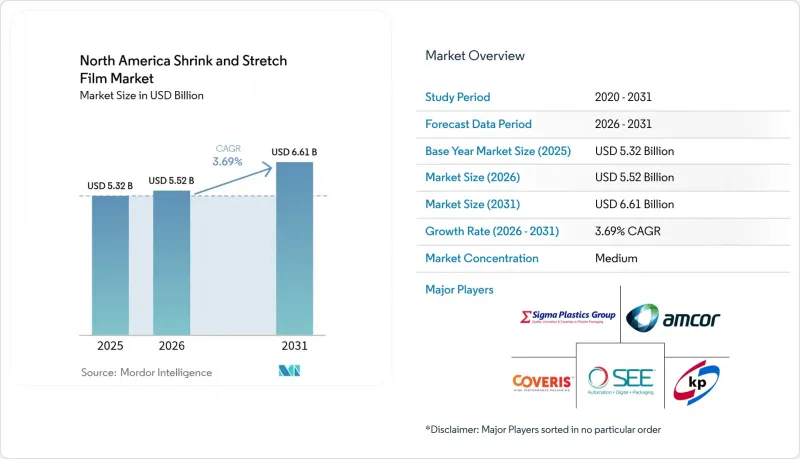
根據 Mordor Intelligence 預測,北美收縮膜和拉伸膜市場規模預計將從 2025 年的 53.2 億美元成長到 2026 年的 55.2 億美元,到 2031 年將達到 66.1 億美元,2026 年至 2031 年的複合年成長率為 3.69%。
本報告按產品類型(食品、包裝膜、套筒標籤、包裝袋和軟包裝袋)、材料(LDPE、LLDPE、PVC、PET 等)、終端用戶行業(食品飲料、消費品、醫藥保健等)、包裝應用(托盤包裝、商品搭售和多件包裝等)以及國家/地區進行細分。市場預測以美元計價。
北美收縮膜和拉伸膜市場趨勢及洞察
電子商務履約的蓬勃發展正在推動托盤纏繞膜的使用量增加。
線上零售的強勁成長持續改變北美收縮膜和拉伸膜市場,履約中心對能夠穩定以每小時60托盤以上速度運行的機器即用型拉伸膜的需求日益成長。亞馬遜計畫在美國和加拿大新建15個物流中心,沃爾瑪也斥資42億美元升級物流系統,這些都凸顯了在混合SKU托盤貨物的包裝中,自動化拉伸罩膜的性能優於螺旋纏繞膜。能夠現場微調七層薄膜配方的加工商,透過幫助營運商減少薄膜浪費和停機時間,贏得了更多訂單。此外,貨物穩定性的要求也促使人們選擇既能防穿刺又能保持條碼掃描所需透明度的薄膜。位於中西部和西南部倉庫走廊附近的薄膜工廠,透過縮短前置作業時間和降低運費附加費,正在獲得競爭優勢。
加工食品和冷凍食品的成長正在推動零售收縮膜的需求。
便利食品需求的加速成長推動了美國冷凍食品銷售在2024年成長8.2%,進而帶動了對能夠承受冷鏈溫度波動的零售收縮膜的訂單。飲料裝瓶商也開始採用防篡改封條以符合美國食品藥物管理局(FDA)的指導方針,而加工商則在開發帶有易撕線的多層收縮膜。隨著新產品上市速度的加快,標籤必須使用可洗掉的油墨。例如,Klockner Pentaplast公司的「SmartCycle」收縮膜採用特殊設計,即使在PET回收過程中標籤也能保持附著。這些趨勢使得北美收縮膜和拉伸膜市場保持穩定,即便永續性已成為關注的焦點。這是因為可回收的阻隔結構如今既能滿足零售商的要求,又不會影響產品的保存期限。
聚乙烯和聚氯乙烯樹脂價格波動劇烈
2024年,受原料供不應求和運輸瓶頸的影響,北美聚乙烯現貨價格波動幅度高達40%,這給依賴低利潤、高產量經營模式的加工商的利潤率帶來了壓力。此外,PVC樹脂價格較去年同期飆升35%,削弱了高透明度收縮套管的競爭力。大規模垂直整合企業利用期貨合約對沖庫存風險,而小型加工商則無法迅速將額外成本轉嫁給消費者,導致營運資金緊張。原料價格的這些不可預測的波動正在減緩對新擠出生產線的投資,從而抑制了北美收縮和拉伸薄膜市場的短期擴張。
細分市場分析
預計到2025年,拉伸纏繞膜將佔據北美收縮和拉伸薄膜市場51.35%的佔有率,凸顯其在傳統倉庫中固定托盤貨物方面的重要作用。受對更薄薄膜和自動化需求的推動,北美收縮和拉伸薄膜市場(包括拉伸纏繞膜)預計將以約3.08%的複合年成長率溫和成長至2031年。同時,由於機器人堆垛機需要均勻的張力和良好的薄膜透氣性,拉伸罩的複合年成長率更高,達到3.74%。 Sigma Plastics Group於2024年收購Starlwart的拉伸薄膜資產,將加強供應鏈,並表明其戰略重點是高產量SKU。儘管套筒標籤和包裝袋領域在永續性方面面臨挑戰,但防篡改功能和可回收PET相容性等創新技術正在為其帶來一些緩解。
採用率曲線表明,一旦年托盤搬運量超過30萬,大型搬運商就有必要投資購買罩蓋。罩蓋具有卓越的抗穿刺性能,並能最大限度地減少重新包裝的工作量,但其高昂的薄膜成本限制了中小型托運商的採用。套筒標籤採購者擴大指定使用符合「瓶到瓶」PET指南的可清潔塗層,這迫使加工商轉向使用無溶劑凹版油墨。隨著各州附加稅的加大,特種肉類加工商對可堆肥纖維素收縮袋的需求日益成長,這為北美收縮膜和拉伸膜市場開闢了新的差異化發展道路。
由於其高延伸率和撕裂強度,線性低密度聚乙烯(LLDPE)適用於1噸托盤的機械捲繞,預計到2025年,LLDPE仍將保持62.35%的市場佔有率。然而,再生樹脂和生物基樹脂的複合年成長率(CAGR)高達3.99%,是所有材料選項中成長最快的,這主要得益於Nova Chemicals公司35% PCR LLDPE共混物獲得FDA食品接觸許可。雖然PCR等級的產品在北美收縮拉伸膜市場仍佔小規模佔有率,但其溢價足以彌補擠出加工能力的不足。
儘管PVC的光學透明度對於曲面飲料容器上的高收縮率套筒標籤仍然至關重要,但其氯含量正受到監管部門的嚴格審查,並阻礙了掩埋廢棄物的減少。 PET收縮膜是高階製藥行業的常用材料,該行業需要其耐刮擦性和氧氣阻隔性,這使其成本結構合理。隨著PFAS的逐步淘汰即將到來,無氟減磨劑的研究正在取得進展。同時,在旨在2027年實現25%再生材料含量的綜合加工企業中,工業廢棄物回收循環正日益受到關注。
其他好處:
- Excel格式的市場預測(ME)表
- 3個月的分析師支持
目錄
第1章:引言
- 研究假設和市場定義
- 調查範圍
第2章:調查方法
第3章執行摘要
第4章 市場狀況
- 市場概覽
- 市場促進因素
- 電子商務履約需求的激增正在推動托盤纏繞膜使用量的增加。
- 加工食品和冷凍食品的成長正在推動零售收縮膜的需求。
- 在倉庫自動化中,為了確保貨物的穩定性,通常選擇使用拉伸罩。
- 醫藥和飲料業防篡改法規
- 墨西哥近岸外包業務的激增正在促進跨境托盤運輸。
- 利用薄壁拉伸膜進行大麻冷鏈物流
- 市場限制因素
- 聚乙烯和聚氯乙烯樹脂的價格波動
- 美國各州和加拿大對一次性塑膠製品都有嚴格的規定。
- 由於供不應求,電影製作受到限制。
- 專利訴訟延緩了7層薄膜的商業化。
- 價值供應鏈分析
- 監理情勢
- 技術展望
- 波特五力分析
- 收縮膜和拉伸膜的價格分析
第5章 市場規模與成長預測
- 依產品類型
- 食物
- 捲筒紙(機械式和手動式)
- 套筒標籤
- 袋子和小袋
- 材料
- LDPE
- LLDPE
- PVC
- PET
- 再生樹脂和生物基樹脂
- 按最終用途行業分類
- 食品/飲料
- 消費品
- 藥品和醫療保健
- 工業與物流
- 電子商務履約中心
- 透過包裝使用
- 托盤單元化
- 商品搭售和多包裝
- 防篡改套筒標籤
- 二級零售包裝
- 國家
- 美國
- 加拿大
- 墨西哥
第6章 競爭情勢
- 市場集中度
- 策略趨勢
- 市佔率分析
- 公司簡介
- Sigma Plastics Group LLC
- Amcor Group GmbH
- Sealed Air Corporation
- Intertape Polymer Group Inc.
- Dow Inc.
- Taghleef Industries LLC
- Klockner Pentaplast Group
- Transcontinental Inc.
- Paragon Films Inc.
- AEP Industries Inc.
- Coveris Holdings SA
- Clysar LLC
- Winpak Ltd.
- Jindal Films Americas LLC
- Poly-America LP
- Revolution Company
- Charter Next Generation Inc.
- FlexSol Packaging Corp.
- Bollore Inc.(Bolphane USA)
- Hood Packaging Corporation
- Uflex Limited
- Bemis Company LLC
- Sigma Stretch Film Corp.
第7章 市場機會與未來展望
According to Mordor Intelligence, the North America shrink and stretch film market size is expected to grow from USD 5.32 billion in 2025 to USD 5.52 billion in 2026 and is forecast to reach USD 6.61 billion by 2031 at 3.69% CAGR over 2026-2031.
This report is Segmented by Product Type (Hoods, Wraps, Sleeve Labels, Bags and Pouches), Material (LDPE, LLDPE, PVC, PET, and More), End-Use Industry (Food and Beverage, Consumer Goods, Pharmaceutical and Healthcare, and More), Packaging Application (Pallet Unitization, Bundling and Multipack, and More), and Country. The Market Forecasts are Provided in Terms of Value (USD).
North America Shrink And Stretch Film Market Trends and Insights
E-Commerce Fulfillment Boom Raises Pallet-Wrap Usage
Robust online retail expansion continues to transform the North America shrink and stretch film market, with fulfillment campuses demanding machine-grade stretch films that deliver repeatable performance at 60-plus pallets per hour. Amazon's plan for 15 new U.S. and Canadian centers and Walmart's USD 4.2 billion logistics upgrade highlight how automated stretch hoods now outperform spiral wraps for mixed-SKU pallet loads. Converters able to fine-tune seven-layer formulations onsite win contracts by helping operators cut film waste and downtime. Load-stability requirements also favor puncture-resistant films that maintain clarity for barcode scanning. Regional film plants near Midwestern and Southwestern warehouse corridors shorten lead times and mitigate freight surcharges, strengthening competitive positions.
Growth of Processed and Frozen Foods Drives Retail Shrink Film
Accelerating demand for convenience meals sustained an 8.2% rise in U.S. frozen food sales during 2024, lifting orders for retail shrink sleeves that tolerate cold-chain temperature swings. Beverage bottlers likewise adopt tamper-evident bands to satisfy FDA guidance, pushing converters toward multilayer sleeves with perforated tear strips. Product-launch velocity compels labels to integrate wash-off inks, as seen in Klockner Pentaplast's SmartCycle sleeves that remain attached during PET reclamation. These developments reinforce the North America shrink and stretch film market's stability even amid sustainability scrutiny, because recyclable barrier structures now address retailer mandates without sacrificing shelf life.
Volatile Polyethylene and PVC Resin Prices
North American spot polyethylene values swung 40% during 2024 amid feedstock outages and shipping bottlenecks, squeezing converter margins that hinge on thin unit economics. PVC resin spiked 35% year-over-year, eroding the competitiveness of high-clarity shrink sleeves. Large vertically integrated players hedge inventory with forward contracts, but smaller converters struggle to pass through surcharges promptly, eroding working-capital positions. These unpredictable inputs slow capital spending on new extrusion lines, tempering near-term expansion of the North America shrink and stretch film market.
Other drivers and restraints analyzed in the detailed report include:
- Warehouse Automation Prefers Stretch Hoods for Load Stability
- Tamper-Evident Regulations in Pharma and Beverages
- Stringent Single-Use-Plastic Legislation in U.S. States and Canada
For complete list of drivers and restraints, kindly check the Table Of Contents.
Segment Analysis
Stretch wraps secured 51.35% of the North America shrink and stretch film market share in 2025, underscoring their entrenched use for pallet load containment in conventional warehouses. The North America shrink and stretch film market size tied to stretch wraps is forecast to edge forward at roughly 3.08% CAGR through 2031 as downgauging and automation sustain baseline demand. Parallelly, stretch hoods record a stronger 3.74% CAGR as robotic palletizers require uniform tension and film breathability. Sigma Plastics Group's 2024 purchase of Stalwart's stretch-film assets bolsters supply depth and signals strategic concentration around high-run SKUs. Sleeve labels and bags segments confront greater sustainability headwinds yet find respite in tamper-evident and recyclable PET-compatible innovations.
Adoption curves demonstrate that high-volume distributors justify hood capital expenditures once yearly pallet throughput exceeds 300,000. Hoods deliver superior puncture resistance that minimizes rewrap labor, although higher unit film cost restricts penetration among small to mid-sized shippers. Sleeve label buyers increasingly specify wash-off coatings that meet bottle-to-bottle PET guidelines, pushing converters toward solvent-free gravure inks. As state fees escalate, interest grows in compostable cellulosic shrink bags for specialty meat processors, adding differentiated avenues to the North America shrink and stretch film market.
LLDPE retained a 62.35% share during 2025 as its high elongation and tear strength suit machine wraps for 1-ton pallets. Recycled and bio-based resins, however, are advancing at a 3.99% CAGR, the fastest among material options, aided by Nova Chemicals securing FDA food-contact clearance for 35% PCR LLDPE blends. The North America shrink and stretch film market size attributable to PCR grades remains modest yet enjoys premium pricing that offsets throughput de-rates during extrusion.
PVC's optical clarity maintains relevance for high-shrink sleeve labels on contoured beverage containers, though its chlorine content draws regulatory scrutiny and hinders landfill diversion. PET shrink films anchor premium pharmaceuticals that demand scuff resistance and oxygen barrier, justifying their cost profile. The imminent PFAS phase-outs push research toward fluorine-free friction reducers, while post-industrial scrap recycling loops gain traction among integrated converters striving to meet 25% recycled-content pledges by 2027.
Complete Report Scope:
- By Product Type
- Hoods
- Wraps (Machine and Hand)
- Sleeve Labels
- Bags and Pouches
- By Material
- LDPE
- LLDPE
- PVC
- PET
- Recycled and Bio-based Resins
- By End-use Industry
- Food and Beverage
- Consumer Goods
- Pharmaceutical and Healthcare
- Industrial and Logistics
- E-commerce Fulfilment Centers
- By Packaging Application
- Pallet Unitization
- Bundling and Multipack
- Tamper-evident Sleeve Labeling
- Secondary Retail Packaging
- By Country
- United States
- Canada
- Mexico
List of Companies Covered in this Report:
- Sigma Plastics Group LLC
- Amcor Group GmbH
- Sealed Air Corporation
- Intertape Polymer Group Inc.
- Dow Inc.
- Taghleef Industries LLC
- Klockner Pentaplast Group
- Transcontinental Inc.
- Paragon Films Inc.
- AEP Industries Inc.
- Coveris Holdings S.A.
- Clysar LLC
- Winpak Ltd.
- Jindal Films Americas LLC
- Poly-America L.P.
- Revolution Company
- Charter Next Generation Inc.
- FlexSol Packaging Corp.
- Bollore Inc. (Bolphane USA)
- Hood Packaging Corporation
- Uflex Limited
- Bemis Company LLC
- Sigma Stretch Film Corp.
Additional Benefits:
- The market estimate (ME) sheet in Excel format
- 3 months of analyst support
TABLE OF CONTENTS
1 INTRODUCTION
- 1.1 Study Assumptions and Market Definition
- 1.2 Scope of the Study
2 RESEARCH METHODOLOGY
3 EXECUTIVE SUMMARY
4 MARKET LANDSCAPE
- 4.1 Market Overview
- 4.2 Market Drivers
- 4.2.1 E-commerce fulfilment boom raises pallet-wrap usage
- 4.2.2 Growth of processed and frozen foods drives retail shrink film
- 4.2.3 Warehouse automation prefers stretch hoods for load stability
- 4.2.4 Tamper-evident regulations in pharma and beverages
- 4.2.5 Surge in Mexico near-shoring boosting cross-border pallet traffic
- 4.2.6 Cold-chain cannabis logistics adopting downgauged stretch film
- 4.3 Market Restraints
- 4.3.1 Volatile polyethylene and PVC resin prices
- 4.3.2 Stringent single-use-plastic legislation in U.S. states and Canada
- 4.3.3 Post-consumer recycled (PCR) supply shortage limits film output
- 4.3.4 Patent litigation slowing seven-layer film commercialisation
- 4.4 Value / Supply-Chain Analysis
- 4.5 Regulatory Landscape
- 4.6 Technological Outlook
- 4.7 Porter's Five Forces Analysis
- 4.7.1 Threat of New Entrants
- 4.7.2 Bargaining Power of Suppliers
- 4.7.3 Bargaining Power of Buyers
- 4.7.4 Threat of Substitutes
- 4.7.5 Competitive Rivalry
- 4.8 Shrink and Stretch Film Pricing Analysis
5 MARKET SIZE AND GROWTH FORECASTS (VALUE)
- 5.1 By Product Type
- 5.1.1 Hoods
- 5.1.2 Wraps (Machine and Hand)
- 5.1.3 Sleeve Labels
- 5.1.4 Bags and Pouches
- 5.2 By Material
- 5.2.1 LDPE
- 5.2.2 LLDPE
- 5.2.3 PVC
- 5.2.4 PET
- 5.2.5 Recycled and Bio-based Resins
- 5.3 By End-use Industry
- 5.3.1 Food and Beverage
- 5.3.2 Consumer Goods
- 5.3.3 Pharmaceutical and Healthcare
- 5.3.4 Industrial and Logistics
- 5.3.5 E-commerce Fulfilment Centers
- 5.4 By Packaging Application
- 5.4.1 Pallet Unitization
- 5.4.2 Bundling and Multipack
- 5.4.3 Tamper-evident Sleeve Labeling
- 5.4.4 Secondary Retail Packaging
- 5.5 By Country
- 5.5.1 United States
- 5.5.2 Canada
- 5.5.3 Mexico
6 COMPETITIVE LANDSCAPE
- 6.1 Market Concentration
- 6.2 Strategic Moves
- 6.3 Market Share Analysis
- 6.4 Company Profiles (includes Global level Overview, Market level overview, Core Segments, Financials as available, Strategic Information, Market Rank/Share for key companies, Products and Services, and Recent Developments)
- 6.4.1 Sigma Plastics Group LLC
- 6.4.2 Amcor Group GmbH
- 6.4.3 Sealed Air Corporation
- 6.4.4 Intertape Polymer Group Inc.
- 6.4.5 Dow Inc.
- 6.4.6 Taghleef Industries LLC
- 6.4.7 Klockner Pentaplast Group
- 6.4.8 Transcontinental Inc.
- 6.4.9 Paragon Films Inc.
- 6.4.10 AEP Industries Inc.
- 6.4.11 Coveris Holdings S.A.
- 6.4.12 Clysar LLC
- 6.4.13 Winpak Ltd.
- 6.4.14 Jindal Films Americas LLC
- 6.4.15 Poly-America L.P.
- 6.4.16 Revolution Company
- 6.4.17 Charter Next Generation Inc.
- 6.4.18 FlexSol Packaging Corp.
- 6.4.19 Bollore Inc. (Bolphane USA)
- 6.4.20 Hood Packaging Corporation
- 6.4.21 Uflex Limited
- 6.4.22 Bemis Company LLC
- 6.4.23 Sigma Stretch Film Corp.
7 MARKET OPPORTUNITIES AND FUTURE OUTLOOK
- 7.1 White-space and Unmet-need Assessment

 拉伸膜和收縮膜市場:2026-2032年全球市場預測(按產品類型、產品形式、材料、加工技術、包裝等級和應用分類)
 拉伸包裝市場預測至2034年—按產品類型、材料、技術、包裝應用、最終用戶和地區分類的全球分析
 拉伸膜和收縮膜市場規模、佔有率和成長分析:按類型、材料、應用、最終用途和地區分類 - 產業預測(2026-2033 年)
 拉伸和收縮薄膜:市場佔有率分析、行業趨勢和統計數據、成長預測(2026-2031)拉伸收縮膜包裝市場預測至2034年-全球分析(按薄膜類型、材料類型、產品類型、厚度、包裝形式、應用和地區分類)
 全球拉伸膜和收縮膜市場:市場規模、佔有率和趨勢分析(按材料、產品、應用和地區分類),細分市場預測(2026-2033 年)
 拉伸膜包裝市場-2026-2031年預測
 拉伸膜及收縮膜市場機會、成長要素、產業趨勢分析及預測(2026年至2035年)流延拉伸膜市場-2026-2031年預測拉伸膜包裝市場:全球預測(2026-2032 年),按薄膜類型、材料、厚度、應用和最終用途產業分類