


 |
市場調查報告書
商品編碼
2062064
拉伸和收縮薄膜:市場佔有率分析、行業趨勢和統計數據、成長預測(2026-2031)Stretch And Shrink Film - Market Share Analysis, Industry Trends & Statistics, Growth Forecasts (2026 - 2031) |
||||||

※ 本網頁內容可能與最新版本有所差異。詳細情況請與我們聯繫。
根據 Mordor Intelligence 預測,拉伸和收縮薄膜市場規模將從 2025 年的 179.3 億美元成長到 2026 年的 189.2 億美元,到 2031 年將達到 247.4 億美元,2026 年至 2031 年的複合年成長率為 5.51%。
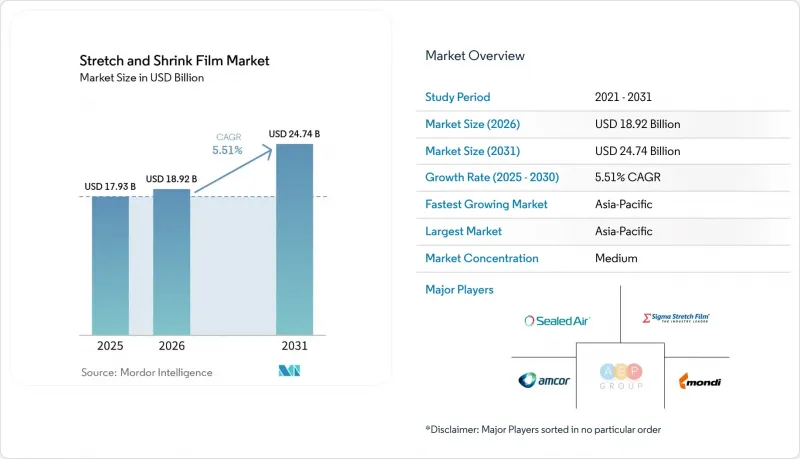
本報告按薄膜類型(拉伸、收縮膜)、材料(LLDPE、LDPE、MLLDPE、PVC等)、厚度(15mm及以下、15-25mm、25mm及以上)、應用(托盤包裝、套筒/標籤、防篡改包裝、其他)、最終用戶(食品飲料、製藥、電子、製造業、其他地區和歐洲地區(北美地區、其他地區)和歐洲地區細分。市場預測以美元計價。
全球拉伸和收縮薄膜市場趨勢及洞察
對托盤化包裝單元和防篡改貨物處理的需求不斷成長。
隨著輕工業生產基地向墨西哥和美國東南部轉移,托盤貨物的數量因需要安全的多式聯運以防止邊緣撕裂和貨物移位而增加。 2026年,北美處理的小包裹數量將超過250億件。預計從散裝紙箱到托盤運輸的轉變率每提高1個百分點,就能減少約10%的損壞索賠。尤其是在藥品和電子產品托運人中,FDA 21 CFR Part 11電子記錄法規的合規要求推動了對帶有易碎條的防篡改包裝膜的需求。在印度,每小時處理能力達200個托盤的自動化拉伸罩系統的引入,正在解決出口路線上因溫度和濕度波動而需要加強貨物固定的挑戰。從人工生產線向自動化生產線的轉變,其動力在於每托盤可降低高達 60% 的人事費用和高達 35% 的薄膜用量,即使在工資水平較低的地區,也能在兩年內收回投資。
致力於生產更薄、可回收薄膜的永續性舉措
到2030年,歐盟的《包裝和包裝廢棄物法規》要求軟包裝必須含有35%的再生材料,並且完全可回收。不遵守該法規的公司可能面臨高達年銷售額3%的罰款。為了應對這項挑戰,加工商正在採用12微米厚的茂金屬基拉拉伸膜,這種薄膜具有抗穿刺性,同時可減少約50%的樹脂用量。此外,七層共擠出技術使得拉伸套膜的厚度從100微米減少到80微米成為可能,同時保持了角落強度。同時,在美國,加州的SB 54法案規定,到2032年,一次性塑膠包裝的使用量必須減少25%。該州還徵收每年可能高達5億美元的費用,以加強回收基礎建設。這進一步促使品牌商選擇可回收且輕盈的薄膜。
機械回收聚乙烯流中的污染
零售用拉伸膜捆包中通常含有標籤和黏合劑,這使得潔淨薄膜的回收率僅為 60-75%。即使少量 PVC 或聚丙烯也會在新薄膜中形成凝膠,導致熔體流動速率超出可接受範圍。雖然像印第安納州的 SYNDIGO 工廠這樣的閉合迴路回收設施透過嚴格的分類程序實現了 85% 以上的回收率,但許多機械回收網路仍然面臨品質不穩定的問題。這種不穩定性限制了適用於食品接觸和高透明度應用的再生材料比例。
細分市場分析
到2025年,拉伸膜將佔據市場主導地位,佔總銷售額的63.11%。這主要歸功於其在自動化包裝機中的廣泛應用,這些包裝機每小時可處理多達200個托盤。電商倉庫和近岸工廠對高透明度、防篡改單元化包裝的需求不斷成長,推動了這一成長。諸如預取向奈米層薄膜等創新技術正在推動這一擴張,這些薄膜可在最大限度地減少樹脂用量的同時,實現高達300%的預拉伸率。此外,終端使用者越來越傾向於使用穿孔拉伸膜,這種薄膜有助於水分散發,尤其是在農產品運輸領域。
預計到2025年,收縮膜的市佔率將達到36.89%,並有望在2031年之前以每年5.89%的速度成長,超過拉伸膜。這一成長主要得益於飲料多包裝和套筒標籤中聚烯( PVC)的取代。聚烯的活化溫度範圍為200-275°F(約93-135°C),這不僅縮短了隧道停留時間,也解決了人們對PVC相關戴奧辛的擔憂,尤其是在預計2025年生效的各州級禁令的背景下。此外,高透明度配方符合店內回收和再利用法規,因此被眾多品牌迅速採用。東南亞和中東地區低溫運輸基礎設施的發展也推動了對收縮膜的需求,即使在溫度波動的情況下也能確保密封強度。
2025年,拉伸和收縮薄膜領域的市佔率預計將略有下降。茂金屬共混物的優點在於其較薄的壁厚,可使運輸重量降低高達30%。 2025年,全球茂金屬樹脂的年產能將超過2,600萬噸,印度加工業者將以每年6.15%的速度採用該樹脂,以滿足出口市場對高承載能力產品的需求。
聚烯收縮膜市場歷來屬於小眾市場,但隨著歐美地區回收法規日益嚴格,市場正快速擴張。低密度聚乙烯(LLDPE)因其高黏合性和光澤度,在需要高黏合性和高光澤度的手用薄膜應用中仍然佔據重要地位,但聚氯乙烯(PVC)的市場佔有率持續下降,只有某些對光學性能和剛性要求極高的工業套管除外。隨著品牌商承諾在2030年在其產品中添加25-30%的再生塑膠,再生聚乙烯正日益受到關注。 SYNDIGO的再生LLDPE在抗穿刺測試中展現出與原生LLDPE相當的性能,目前已在非食品包裝領域取代原生LLDPE。
區域分析
預計到2025年,亞太地區將佔全球銷售額的41.25%,並將在2031年之前以6.19%的年均成長率成長。古吉拉突邦和卡納塔克邦新增224億盧比(約2.51億美元)的產能將促進對海灣國家和東南亞的出口。中國擁有最大的供應量,但國內消費放緩正促使加工商轉向海外市場,而印度、越南和泰國正擴大採用自動化拉伸食品加工設備,以滿足跨國公司客戶的特定需求。日本、韓國和澳洲等已開發國家則專注於可回收單層薄膜和生產線的自動化升級。
預計到2025年,北美將成為全球第二大市場,這主要得益於Amcor和Berry的合併,合併後將打造該地區最大的收縮膜平台。 Sigma Plastics Group在喬治亞投資3,900萬美元進行擴建,預計到2026年12月將新增15萬平方英尺的拉伸膜產能,從而彌合其肯塔基州和加州工廠之間的供應缺口。美國正受益於電子商務小包裹量的成長以及東南部地區的近岸外包,而墨西哥和加拿大在汽車和電子行業對拉伸膜的需求也在不斷成長,這得益於自2024年以來宣布的400億美元的製造業投資。
歐洲的趨勢主要受《包裝及包裝廢棄物法規》的驅動,該法規要求在2030年使用35%的再生材料。德國、英國、法國、義大利和西班牙憑藉其成熟的回收基礎設施和雄心勃勃的品牌承諾,在消費方面處於領先地位。東歐國家則利用低廉的人事費用和接近性製造群的優勢,吸引新的薄膜工廠落腳。 Coveris於2025年在德國哈勒投資1,050萬美元,用於擴大其可回收單層薄膜和醫用級薄膜生產線的產能。
其他好處:
- Excel格式的市場預測(ME)表
- 3個月的分析師支持
目錄
第1章:引言
- 研究假設和市場定義
- 調查範圍
第2章:調查方法
第3章執行摘要
第4章 市場狀況
- 市場概覽
- 市場促進因素
- 對托盤化單元化和防篡改包裝的需求日益成長。
- 薄壁可回收薄膜的永續發展舉措
- 食品飲料低溫運輸的擴展需要高透明度的收縮膜。
- 新興市場拉伸食品生產線的自動化
- 醫藥冷鏈物流管道的成長
- 市場限制因素
- 聚烯和PVC原物料價格波動
- 機械回收聚乙烯流中的污染物
- 多層薄壁擠出成型設備的升級改造需要大量資金投入。
- 價值鏈分析
- 波特五力模型
第5章 市場規模與成長預測
- 按膠片類型
- 拉伸膜
- 收縮膜
- 材料類型
- 線型低密度聚乙烯(LLDPE)
- 低密度聚乙烯(LDPE)
- mLLDPE和茂金屬混合物
- 聚氯乙烯(PVC)
- 聚烯(POF)
- 其他材料(EVOH、PLA、再生PE)
- 按厚度
- 15微米或更小
- 15~25µm
- 大於25微米
- 透過使用
- 托盤包裝和捆紮
- 套筒和標籤包裝
- 防篡改重疊
- 食品和飲料包裝
- 工業產品保護
- 其他用途
- 按最終用戶行業分類
- 食品/飲料
- 藥品和醫療保健
- 家用電子電器和家用電器
- 工業製造
- 電子商務與第三方物流
- 其他終端用戶產業
- 按地區
- 亞太地區
- 中國
- 印度
- 日本
- 韓國
- 澳洲
- 其他亞太國家
- 北美洲
- 美國
- 加拿大
- 墨西哥
- 歐洲
- 德國
- 英國
- 法國
- 義大利
- 西班牙
- 其他歐洲國家
- 南美洲
- 巴西
- 阿根廷
- 其他南美國家
- 中東和非洲
- 沙烏地阿拉伯
- 南非
- 奈及利亞
- 其他中東和非洲國家
- 亞太地區
第6章 競爭情勢
- 市場集中度
- 策略趨勢
- 市佔率和排名分析
- 公司簡介
- AEP Industries Inc.
- Amcor plc
- Bonset America Corporation
- Charter Next Generation(CNG)
- Coveris
- Egeria
- Inteplast Group
- IPG
- Mondi
- Paragon Films
- Polifilm Group
- RKW Group
- SABIC
- Sealed Air
- Sigma Plastics Group
- Signode Industrial Group LLC
- Taghleef Industries
- UFlex Limited
- Winpak LTD.
第7章 市場機會與未來展望
According to Mordor Intelligence, the stretch and shrink film market size is expected to grow from USD 17.93 billion in 2025 to USD 18.92 billion in 2026 and is forecast to reach USD 24.74 billion by 2031 at 5.51% CAGR over 2026-2031.
This report is Segmented by Film Type (Stretch, Shrink), Material (LLDPE, LDPE, MLLDPE, PVC, and More), Thickness (≤15 Mm, 15-25 Mm and More), Application (Pallet Wrapping, Sleeve/Label, Tamper-Evident, and More), End-User (F&B, Pharma, Electronics, Manufacturing, and More), and Geography (Asia-Pacific, North America, Europe, South America, Middle-East and Africa). Market Forecasts are in Value (USD).
Global Stretch And Shrink Film Market Trends and Insights
Rising Demand for Pallet Unitization and Tamper-Proof Loads
As light manufacturing was reshored to Mexico and the U.S. Southeast, the volume of palletized freight increased, driven by the need for secure multi-modal transport to prevent edge tears and load shifting. In 2026, parcel traffic in North America exceeded 25 billion units. A shift of just one percentage point from loose cartons to palletized shipping is projected to reduce damage claims by approximately 10%. The demand for tamper-evident wraps with tear strips is growing, particularly among pharmaceutical and electronics shippers, due to compliance requirements with the FDA's 21 CFR Part 11 electronic-records regulations. In India, the installation of automated stretch-hooding systems, with a capacity of 200 pallets per hour, is addressing export lane challenges where temperature and humidity fluctuations require improved load retention. The transition from manual to automated lines is driven by the potential to lower labor costs by up to 60% per pallet and reduce film usage by as much as 35%, offering a return on investment within two years, even in regions with lower wage scales.
Sustainability Push for Downgauged and Recyclable Films
By 2030, the European Union's Packaging and Packaging Waste Regulation requires flexible packaging to contain 35% recycled content and be fully recyclable. Non-compliance could lead to penalties of up to 3% of a company's annual turnover. In response, converters are turning to a 12-micron metallocene-based stretch film, which offers puncture resistance while using nearly 50% less resin. Additionally, the seven-layer coextrusion technology has allowed for a reduction in stretch-hood film gauges from 100 µm to 80 µm, maintaining corner-hold strength. Meanwhile, in the U.S., California's SB 54 mandates a 25% cut in single-use plastic packaging by 2032. The state also imposes fees, potentially reaching USD 500 million annually, to bolster recycling infrastructure. This intensifies the push on brands to choose recyclable and lighter films.
Contamination in Mechanical-Recycled PE Streams
Retail stretch-film bales often include labels and adhesives, which reduce the yield of clean flake to 60-75%. Even small amounts of PVC or polypropylene can form gels in new film, causing melt-flow indices to fall outside acceptable limits. While closed-loop initiatives such as the SYNDIGO facility in Indiana have achieved yields above 85% through strict sorting protocols, much of the mechanical-recycling network continues to face variability. These inconsistencies limit the proportion of recycled content suitable for food-contact or high-clarity applications.
Other drivers and restraints analyzed in the detailed report include:
- Expansion of F&B Cold-Chain Requiring High-Clarity Shrink Film
- Automation of Stretch-Hooding Lines in Emerging Markets
- High Capex for Multilayer Thin-Gauge Extrusion Upgrades
For complete list of drivers and restraints, kindly check the Table Of Contents.
Segment Analysis
In 2025, stretch film dominated the market, accounting for 63.11% of total revenue, largely due to its widespread use in automated wrappers capable of processing up to 200 pallets per hour. This growth is driven by the rising demand from e-commerce warehouses and nearshored factories for high-clarity, tamper-evident unitization. Innovations like pre-oriented nano-layer films, which offer a remarkable 300% pre-stretch ratio while minimizing resin usage, are fueling this expansion. Additionally, end users are increasingly favoring perforated stretch films, especially for produce distribution, as they facilitate moisture dissipation.
While shrink film accounted for the 36.89% market share in 2025, it's projected to surpass stretch film, growing at an annual rate of 5.89% until 2031. This surge is attributed to the shift from PVC to polyolefin in beverage multipacks and sleeve labels. Polyolefin's activation window of 200-275 °F not only reduces tunnel residence times but also addresses dioxin concerns associated with PVC, especially in light of state-level bans set to take effect in 2025. Furthermore, high-clarity formulations are now compliant with store drop-off recycling protocols, prompting a swift conversion among brands. The demand for shrink films is also bolstered by the cold-chain infrastructure developments in Southeast Asia and the Middle East, ensuring seal integrity amidst temperature fluctuations.
LLDPE held 48.36% of 2025 sales due to its 15-25% cost edge and broad compatibility with legacy extruders. The stretch and shrink film market share for LLDPE is expected to fall modestly as metallocene blends climb at a 5.76% CAGR through 2031, benefiting from downgauging that shaves freight weight by up to 30%. Global metallocene capacity topped 26 million tpa in 2025, and converters in India are adopting the resin at 6.15% yearly growth to serve export lanes that require superior load retention.
Polyolefin shrink films, traditionally a niche, are scaling quickly as recycling mandates bite in Europe and North America. Low-density polyethylene remains important in hand-film applications that rely on its high cling and gloss, while PVC's share continues to decline except in certain industrial sleeves where optics and stiffness are critical. Recycled polyethylene is gaining momentum as brand owners commit to 25-30% post-consumer content by 2030; SYNDIGO recycled LLDPE is already displacing virgin grades in non-food wraps after proving parity in puncture testing.
Geography Analysis
Asia-Pacific generated 41.25% of 2025 revenue and is projected to grow at 6.19% to 2031. Capacity additions worth Rs 2,240 crore (USD 251 million) in Gujarat and Karnataka will feed exports to Gulf and Southeast Asian corridors. China supplies the largest volume but slower domestic consumption is pushing converters toward overseas markets, while India, Vietnam, and Thailand are adding automated stretch-hooding to meet multinational client specifications. Developed economies such as Japan, South Korea, and Australia focus on recycling-ready mono-films and line automation upgrades.
North America ranked second in 2025, supported by the Amcor-Berry merger that created the region's largest shrink-film platform. Sigma Plastics Group's USD 39 million Georgia expansion will add 150,000 square feet of stretch-film capacity by December 2026, closing a supply gap between Kentucky and California operations. The United States demands benefits from e-commerce parcel volumes and Southeast nearshoring, while Mexico and Canada ride USD 40 billion of announced manufacturing investments since 2024 that favor stretch-hood adoption for automotive and electronics.
Europe's trajectory is anchored by its Packaging and Packaging Waste Regulation, which sets a 35% recycled-content requirement by 2030. Germany, the United Kingdom, France, Italy, and Spain dominate consumption thanks to mature recycling infrastructure and ambitious brand pledges. Eastern European countries attract greenfield film plants leveraging lower labor costs and proximity to manufacturing clusters. Coveris invested USD 10.5 million in Halle, Germany in 2025 to expand recyclable mono-film capacity and medical-grade production lines.
- AEP Industries Inc.
- Amcor plc
- Bonset America Corporation
- Charter Next Generation (CNG)
- Coveris
- Egeria
- Inteplast Group
- IPG
- Mondi
- Paragon Films
- Polifilm Group
- RKW Group
- SABIC
- Sealed Air
- Sigma Plastics Group
- Signode Industrial Group LLC
- Taghleef Industries
- UFlex Limited
- Winpak LTD.
Additional Benefits:
- The market estimate (ME) sheet in Excel format
- 3 months of analyst support
TABLE OF CONTENTS
1 Introduction
- 1.1 Study Assumptions and Market Definition
- 1.2 Scope of the Study
2 Research Methodology
3 Executive Summary
4 Market Landscape
- 4.1 Market Overview
- 4.2 Market Drivers
- 4.2.1 Rising demand for pallet unitization and tamper-proof loads
- 4.2.2 Sustainability push for downgauged and recyclable films
- 4.2.3 Expansion of F&B cold-chain requiring high-clarity shrink film
- 4.2.4 Automation of stretch-hooding lines in emerging markets
- 4.2.5 Growth of pharma low-temperature distribution channels
- 4.3 Market Restraints
- 4.3.1 Volatility in polyolefin and PVC feedstock prices
- 4.3.2 Contamination in mechanical-recycled PE stream
- 4.3.3 High capex for multilayer thin-gauge extrusion upgrades
- 4.4 Value Chain Analysis
- 4.5 Porter's Five Forces
- 4.5.1 Bargaining Power of Buyers
- 4.5.2 Bargaining Power of Suppliers
- 4.5.3 Threat of Substitutes
- 4.5.4 Threat of New Entrants
- 4.5.5 Degree of Competition
5 Market Size and Growth Forecasts (Value)
- 5.1 By Film Type
- 5.1.1 Stretch Film
- 5.1.2 Shrink Film
- 5.2 By Material Type
- 5.2.1 Linear Low-Density Polyethylene (LLDPE)
- 5.2.2 Low Density Polyethylene (LDPE)
- 5.2.3 mLLDPE and Metallocene Blends
- 5.2.4 Polyvinyl chloride (PVC)
- 5.2.5 Polyolefin (POF)
- 5.2.6 Other Materials (EVOH, PLA, Recycled PE)
- 5.3 By Thickness
- 5.3.1 Less than or Equal to 15 µm
- 5.3.2 15-25 µm
- 5.3.3 Greater than 25 µm
- 5.4 By Application
- 5.4.1 Pallet Wrapping and Bundling
- 5.4.2 Sleeve and Label Packaging
- 5.4.3 Tamper-evident Overwraps
- 5.4.4 Food and Beverage Packs
- 5.4.5 Industrial Goods Protection
- 5.4.6 Other Applications
- 5.5 By End-user Industry
- 5.5.1 Food and Beverage
- 5.5.2 Pharmaceutical and Healthcare
- 5.5.3 Consumer Electronics and Appliances
- 5.5.4 Industrial Manufacturing
- 5.5.5 E-commerce and Third-Party Logistics
- 5.5.6 Other End-User Industries
- 5.6 By Geography
- 5.6.1 Asia-Pacific
- 5.6.1.1 China
- 5.6.1.2 India
- 5.6.1.3 Japan
- 5.6.1.4 South Korea
- 5.6.1.5 Australia
- 5.6.1.6 Rest of Asia-Pacific
- 5.6.2 North America
- 5.6.2.1 United States
- 5.6.2.2 Canada
- 5.6.2.3 Mexico
- 5.6.3 Europe
- 5.6.3.1 Germany
- 5.6.3.2 United Kingdom
- 5.6.3.3 France
- 5.6.3.4 Italy
- 5.6.3.5 Spain
- 5.6.3.6 Rest of Europe
- 5.6.4 South America
- 5.6.4.1 Brazil
- 5.6.4.2 Argentina
- 5.6.4.3 Rest of South America
- 5.6.5 Middle-East and Africa
- 5.6.5.1 Saudi Arabia
- 5.6.5.2 South Africa
- 5.6.5.3 Nigeria
- 5.6.5.4 Rest of Middle-East and Africa
- 5.6.1 Asia-Pacific
6 Competitive Landscape
- 6.1 Market Concentration
- 6.2 Strategic Moves
- 6.3 Market Share(%)/Ranking Analysis
- 6.4 Company Profiles (includes Global Overview, Market Overview, Core Segments, Financials, Strategic Information, Products and Services, Recent Developments)
- 6.4.1 AEP Industries Inc.
- 6.4.2 Amcor plc
- 6.4.3 Bonset America Corporation
- 6.4.4 Charter Next Generation (CNG)
- 6.4.5 Coveris
- 6.4.6 Egeria
- 6.4.7 Inteplast Group
- 6.4.8 IPG
- 6.4.9 Mondi
- 6.4.10 Paragon Films
- 6.4.11 Polifilm Group
- 6.4.12 RKW Group
- 6.4.13 SABIC
- 6.4.14 Sealed Air
- 6.4.15 Sigma Plastics Group
- 6.4.16 Signode Industrial Group LLC
- 6.4.17 Taghleef Industries
- 6.4.18 UFlex Limited
- 6.4.19 Winpak LTD.
7 Market Opportunities and Future Outlook
- 7.1 White-space and Unmet-Need Assessment

 北美收縮拉伸膜市場:市場佔有率分析、產業趨勢與統計及成長預測(2026-2031)
 拉伸膜和收縮膜市場:2026-2032年全球市場預測(按產品類型、產品形式、材料、加工技術、包裝等級和應用分類)
 拉伸包裝市場預測至2034年—按產品類型、材料、技術、包裝應用、最終用戶和地區分類的全球分析
 拉伸膜和收縮膜市場規模、佔有率和成長分析:按類型、材料、應用、最終用途和地區分類 - 產業預測(2026-2033 年)拉伸收縮膜包裝市場預測至2034年-全球分析(按薄膜類型、材料類型、產品類型、厚度、包裝形式、應用和地區分類)
 全球拉伸膜和收縮膜市場:市場規模、佔有率和趨勢分析(按材料、產品、應用和地區分類),細分市場預測(2026-2033 年)
 拉伸膜包裝市場-2026-2031年預測
 拉伸膜及收縮膜市場機會、成長要素、產業趨勢分析及預測(2026年至2035年)流延拉伸膜市場-2026-2031年預測拉伸膜包裝市場:全球預測(2026-2032 年),按薄膜類型、材料、厚度、應用和最終用途產業分類