


 |
市場調查報告書
商品編碼
2124738
北美食品服務包裝:市場佔有率分析、產業趨勢與統計及成長預測(2026-2031 年)North America Foodservice Packaging - Market Share Analysis, Industry Trends & Statistics, Growth Forecasts (2026 - 2031) |
||||||

※ 本網頁內容可能與最新版本有所差異。詳細情況請與我們聯繫。
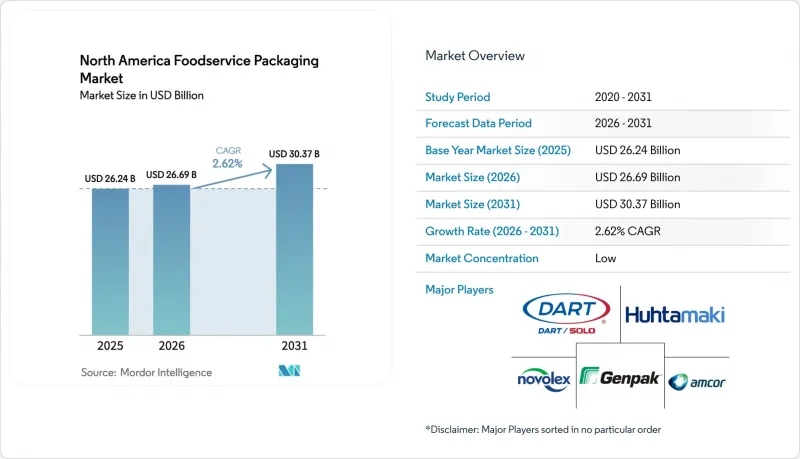
根據 Mordor Intelligence 預測,北美食品服務包裝市場規模將從 2025 年的 262.4 億美元和 2026 年的 266.9 億美元成長到 2031 年的 303.7 億美元,2026 年至 2031 年的複合年成長率為 2.62%。
本報告按材料(紙/紙板、塑膠、其他)、包裝類型(翻蓋式、杯/拉環式、托盤/容器、小袋/包裝袋、其他)、終端用戶行業(快餐店、餐飲店、機構餐飲、酒店/咖啡館、其他)、永續性概況(傳統、永續)和國家/地區進行細分。市場預測以美元計價。
北美食品服務包裝市場趨勢與洞察
外帶和即食餐的便利性和需求
到2025年,外送、外帶和外帶支出將占美國食品總支出的55%,凸顯了食品消費結構向攜帶式餐食形式的轉變。單份翻蓋式餐盒和可用於烤箱和微波爐的紙板托盤如今已成為盛裝早餐三明治和主菜的主流選擇,因為通勤者無需將食物轉移到盤子中即可加熱。快餐連鎖店報告稱,菜單簡化已將訂單處理的人事費用降低了12%至15%,並提高了平均訂單處理速度。這進一步增加了對標準化包裝尺寸的需求。同時,加工商正在擴大符合修訂後過渡法規的水性阻隔材料的生產,從而減少對含氟化學品的依賴。這種便利性也與「幽靈廚房」策略密切相關,該策略透過最佳化SKU和採用輕量化包裝來降低配送成本,使企業即使在食品價格上漲導致自由裁量權下降的情況下也能維持銷售。
食品配送和幽靈廚房模式的快速擴張
到2025年,DoorDash北美訂單中超過三分之二的配送距離將超過四英里,這促使包裝加工商重新設計蓋子和密封件,以防止在30分鐘的配送過程中發生洩漏。虛擬廚房目前已占美國商業食品服務訂單的15%,其中成長最快的地區是二線都會區,由於租金較低,這些地區的配送中心較容易位置。採用單體聚丙烯和模塑纖維製成的配送最佳化托盤,由於在資源回收設施中污染較少,如今價格更高。 Graphic Packaging的數據顯示,與虛擬品牌簽約的托盤出貨量年增了22%,這顯示耐用性和可堆疊性比店內用餐的美觀更為重要。單一材料的托盤壁可以無縫整合到現有的回收流程中,市政回收法規也推動了這一趨勢,並支持品牌所有者實現循環經濟目標。
嚴格監管和禁止使用一次性塑膠製品
在加州、科羅拉多、緬因州、佛蒙特州和華盛頓州,聚苯乙烯的使用已經受到限制,或被強制要求從源頭減少其使用。同時,加拿大的一項聯邦禁令於2023年生效。由於這些法規的實施日期重疊,加工商被迫管理多個SKU,造成庫存估價損失的風險。 Dart Container公司在2024年因舊聚苯乙烯模具的減損損失累計了4,200萬美元的稅金。合規成本存在不平衡。垂直整合的供應商比依賴第三方混配商的本地公司更容易應對測試和配方變更。零售商正在法律規定的最後期限之前加速淘汰傳統泡沫杯,以避免消費者的強烈反對。因此,模塑纖維、單層PET和塗層紙板等替代品正在迅速獲得認證,傳統發泡杯的市場規模正在萎縮。
細分市場分析
纖維、生物分解樹脂和特殊基材供應商正將監管方面的不利因素轉化為市場佔有率擴張的機會。隨著企業尋求符合SB 54標準的替代方案,預計到2031年,生物分解材料的複合年成長率將達到4.32%。雖然塑膠在2025年仍將佔銷售額的48.42%,但由於加州和加拿大的禁令,聚苯乙烯的銷售量已經下降。 Graphic Packaging公司的模塑纖維翻蓋式容器在快餐沙拉銷售管道中取得了成功,這表明其改進的耐油性和剛性正在縮小與以往材料的性能差距。同時,鋁和玻璃在高階飲料領域仍然佔據小眾市場,因為重量、成本以及家庭垃圾分類的挑戰超過了其無限可回收性的提案。
NatureWorks公司在內布拉斯加州投資6億美元擴建PLA生產線,預計到2027年產能將加倍,耐熱性也將提升至110 度C,從而為進軍熱填充食品服務市場開闢機遇。 Danimer Scientific公司的Nodax PHA油脂阻隔塗層已獲得FDA批准,為避免使用含氟化合物PFAS的纖維托盤開闢了新途徑。然而,在北美食品服務包裝市場,經認證的可堆肥產品的市場規模取決於其使用後的處理方式。在美國,僅有185家工業堆肥設施接收食品服務容器。西海岸以外的企業往往被迫依賴掩埋,這削弱了其環保理念的說服力。在家庭有機垃圾收集規模擴大之前,加工商正將可堆肥產品定位在沿海大都會圈,同時在其他地區推廣rPET和rPP等再生材料的升級。
到2025年,杯裝和桶裝產品將佔據39.89%的市場佔有率,這主要得益於咖啡和冷凍甜點連鎖店的推動。然而,由於外帶需求的激增,托盤和容器行業預計將逐步成長,並且預計到2031年,這些行業的成長率將超過北美餐飲包裝市場3.46%的整體成長率。 Inline Plastics公司的防篡改翻蓋式容器符合FDA的可追溯性要求,目前已成為食材自煮包產品的核心。小包裝袋因其輕巧的包裝特性而越來越受歡迎,可用於盛裝調味品和醬料,從而減少運輸過程中的浪費和單位成本。
Pactiv Evergreen 的 EarthChoice 雙層烤箱適用紙托盤可承受 425°F (218°C) 的高溫 20 分鐘,方便消費者無需使用其他餐具即可重新加熱食物。 Chipotle 也因此將每份訂單的包裝重量減少了 18%。 Sabert 的 Pulp-it 系列產品採用甘蔗渣製成,符合 ASTM D6868 標準,其隔熱性能可與聚苯乙烯媲美,因此深受監管嚴格州連鎖商店的青睞。加州 SB 1335 法案強制要求公共機構在 2028 年前使用可堆肥或可回收的容器,進一步加速了向單纖維和單聚丙烯托盤設計的轉變。
其他好處:
- Excel格式的市場預測(ME)表
- 3個月的分析師支持
目錄
第1章:引言
- 研究假設和市場定義
- 調查範圍
第2章:調查方法
第3章執行摘要
第4章 市場狀況
- 市場概覽
- 市場促進因素
- 對便利性和外帶/便攜餐點的需求。
- 食品配送和幽靈廚房模式的快速擴張
- 企業淨零排放要求正在促進永續包裝材料的採購。
- 重點關注可回收和二手材料
- 將智慧互聯包裝整合到廢棄物追蹤系統中
- 政府獎勵措施促進國內可生物分解包裝材料的生產能力
- 隨著人們對食品安全的日益關注,對具有防篡改功能的包裝的需求也隨之增加。
- 市場限制因素
- 嚴格監管和禁止使用一次性塑膠製品
- 聚合物和紙漿原料價格的波動
- 缺乏工業堆肥基礎設施
- 供應商整合會增加合約重新談判的風險。
- 州級 PFAS 法規實施面臨的挑戰
- 產業價值鏈分析
- 監理情勢
- 技術展望
- 宏觀經濟因素對市場的影響
- 波特五力分析
第5章 市場規模與成長預測
- 材料
- 紙張和紙板
- 塑膠
- 聚對苯二甲酸乙二醇酯(PET)
- 聚丙烯(PP)
- 聚苯乙烯(PS)和發泡聚苯乙烯(EPS)
- 其他
- 鋁
- 玻璃
- 可生物分解材料及特殊材料
- 按包裝類型
- 蛤殼
- 杯狀浴缸
- 托盤和容器
- 小袋子/小包
- 其他
- 按最終用戶行業分類
- 速食店(QSR)
- 全方位服務餐廳 (FSR)
- 為機構提供餐飲服務
- 熱情好客咖啡館
- 其他
- 依永續發展概況
- 傳統的
- 永續的
- 國家
- 美國
- 加拿大
- 墨西哥
第6章 競爭情勢
- 市場集中度
- 策略趨勢
- 市佔率分析
- 公司簡介
- Novolex Holdings LLC
- Huhtamaki Oyj
- Dart Container Corporation
- Genpak LLC
- Amcor plc
- Silgan Holdings Inc.
- Graphic Packaging Holding Company
- Sonoco Products Company
- Smurfit Westrock
- International Paper Company
- Anchor Packaging Inc.
- Eco-Products LLC
- Fabri-Kal Corporation
- UFP Technologies Inc.
- Inline Plastics Corp.
- Sabert Corporation
- Winpak Ltd.
- ProAmpac LLC
- Pactiv Evergreen Inc.
第7章 市場機會與未來展望
According to Mordor Intelligence, the North America foodservice packaging market size is projected to expand from USD 26.24 billion in 2025 and USD 26.69 billion in 2026 to USD 30.37 billion by 2031, registering a CAGR of 2.62% between 2026 to 2031.
This report is Segmented by Material (Paper and Paperboard, Plastics, and More), Packaging Type (Clamshells, Cups and Tubs, Trays and Containers, Sachets and Pouches, and More), End-User Industry (QSR, FSR, Institutional Catering, Hospitality and Cafes, and More), Sustainability Profile (Conventional, and Sustainable), and Country. The Market Forecasts are Provided in Terms of Value (USD).
North America Foodservice Packaging Market Trends and Insights
Demand for Convenience and On-the-Go Meals
Food-away-from-home spending climbed to 55% of total United States food expenditures in 2025, underlining a structural move toward portable meal formats. Single-serve clamshells and dual-ovenable paperboard trays now dominate breakfast sandwich and entree offerings because they let commuters reheat food without re-plating. Quick-service chains report that menu simplification lowered fulfillment labor by 12% to 15% and raised average order speed, reinforcing the pull for standardized footprints. Converters, in turn, are scaling up water-based barriers that comply with updated migration rules, reducing dependence on fluorochemicals. The convenience theme also dovetails with ghost-kitchen playbooks where SKU discipline and lightweight packaging lower delivery fees, sustaining volume even when food inflation pressures discretionary spending.
Rapid Expansion of Food-Delivery and Ghost-Kitchen Models
More than two-thirds of DoorDash North America orders in 2025 traveled more than 4 miles, so converters redesigned lids and seals to withstand 30-minute trips without leakage. Ghost kitchens already represent 15% of United States commercial foodservice orders, with penetration rising fastest in secondary metros where rents favor commissary hubs. Delivery-optimized trays made from mono-PP or molded fiber now earn price premiums because they reduce contamination at material recovery facilities. Graphic Packaging recorded a 22% year-over-year jump in tray shipments linked to virtual-brand contracts, confirming that durability and stackability trump dine-in aesthetics. Municipal recycling rules amplify the trend, since single-material walls flow more easily into existing streams, supporting circular-economy scorecards for brand owners.
Stringent Single-Use Plastic Regulations and Bans
California, Colorado, Maine, Vermont, and Washington already restrict polystyrene or require source reduction, while Canada's federal ban took effect in 2023. The overlapping timelines force converters to manage multiple SKUs and create inventory write-down risks; Dart Container booked a USD 42 million impairment on legacy polystyrene tooling in 2024. Compliance costs are asymmetric; vertically integrated suppliers absorb testing and reformulation more easily than regional firms that rely on third-party compounders. Retailers are accelerating phase-outs ahead of statutory deadlines to avoid consumer backlash. As a result, molded-fiber, mono-PET, and coated paperboard alternatives are gaining accelerated certifications, shrinking the addressable volume for traditional foam cups.
Other drivers and restraints analyzed in the detailed report include:
- Corporate Net-Zero Mandates Driving Sustainable Packaging Procurement
- Emphasis on Recyclable and Post-Consumer Materials
- Volatility in Polymer and Pulp Input Prices
For complete list of drivers and restraints, kindly check the Table Of Contents.
Segment Analysis
Fiber, biodegradable resin and specialty substrate suppliers are converting regulatory headwinds into share gains. Biodegradable materials are set to register a 4.32% CAGR through 2031 as operators search for SB 54-compliant alternatives. Plastics still account for 48.42% of 2025 revenue, but California and Canada bans have already trimmed polystyrene volumes. Graphic Packaging's molded-fiber clamshell wins in quick-service salad channels demonstrate how improved grease resistance and stiffness close historical performance gaps. Meanwhile, aluminum and glass stay niche in premium beverage formats because weight, cost and curbside sortation challenges offset their infinitely recyclable value proposition.
NatureWorks' USD 600 million Nebraska PLA expansion will double capacity by 2027 and raise heat performance to 110 °C, unlocking hot-fill foodservice opportunities. Danimer Scientific secured FDA approval for Nodax PHA grease-barrier coatings, opening new avenues for fiber trays that bypass PFAS fluorochemicals. Still, the North America foodservice packaging market size for certified compostables hinges on end-of-life access; only 185 industrial composters accept foodservice ware in the United States. Operators outside the West Coast often default to landfill, diluting environmental claims. Until curbside organics pickup expands, converters are positioning compostables for coastal metros while pushing rPET and rPP upgrades elsewhere.
Cups and tubs captured 39.89% of the market share in 2025, buoyed by coffee and frozen-dessert chains. Yet the delivery boom is steering incremental growth toward trays and containers, which are expected to outpace the overall North America foodservice packaging market at a 3.46% CAGR through 2031. Inline Plastics' tamper-evident clamshells meet FDA traceability mandates and now anchor meal-kit SKUs. Sachets and pouches gain in condiment and sauce applications because lighter packages lower freight emissions and unit cost.
Pactiv Evergreen's EarthChoice dual-ovenable paperboard tray withstands 425 °F for 20 minutes, letting consumers reheat meals without secondary dishes and cutting per-order packaging weight 18% at Chipotle. Sabert's sugarcane-bagasse Pulp-it line meets ASTM D6868 and rivals polystyrene on insulating performance, winning chain accounts in legislation-heavy states. California's SB 1335 requirement that public institutions use compostable or recyclable formats by 2028 further tilts the mix to mono-fiber and mono-PP tray designs.
Complete Report Scope:
- By Material
- Paper and Paperboard
- Plastics
- Polyethylene Terephthalate (PET)
- Polypropylene (PP)
- Polystyrene (PS) and Expanded Polystyrene (EPS)
- Other Plastics
- Aluminum
- Glass
- Biodegradable and Specialty Materials
- By Packaging Type
- Clamshells
- Cups and Tubs
- Trays and Containers
- Sachets and Pouches
- Other Packaging Types
- By End-User Industry
- Quick-Service Restaurants (QSR)
- Full-Service Restaurants (FSR)
- Institutional Catering
- Hospitality and Cafes
- Other End-User Industries
- By Sustainability Profile
- Conventional Type
- Sustainable Packaging
- By Country
- United States
- Canada
- Mexico
List of Companies Covered in this Report:
- Novolex Holdings LLC
- Huhtamaki Oyj
- Dart Container Corporation
- Genpak LLC
- Amcor plc
- Silgan Holdings Inc.
- Graphic Packaging Holding Company
- Sonoco Products Company
- Smurfit Westrock
- International Paper Company
- Anchor Packaging Inc.
- Eco-Products LLC
- Fabri-Kal Corporation
- UFP Technologies Inc.
- Inline Plastics Corp.
- Sabert Corporation
- Winpak Ltd.
- ProAmpac LLC
- Pactiv Evergreen Inc.
Additional Benefits:
- The market estimate (ME) sheet in Excel format
- 3 months of analyst support
TABLE OF CONTENTS
1 INTRODUCTION
- 1.1 Study Assumptions and Market Definition
- 1.2 Scope of the Study
2 RESEARCH METHODOLOGY
3 EXECUTIVE SUMMARY
4 MARKET LANDSCAPE
- 4.1 Market Overview
- 4.2 Market Drivers
- 4.2.1 Demand for Convenience and On-the-Go Meals
- 4.2.2 Rapid Expansion of Food-Delivery and Ghost-Kitchen Models
- 4.2.3 Corporate Net-Zero Mandates Driving Sustainable Packaging Procurement
- 4.2.4 Emphasis on Recyclable and Post-Consumer Materials
- 4.2.5 Integration of Smart, Connected Packaging for Waste-Tracking
- 4.2.6 Government Incentives for Domestic Compostable Packaging Capacity
- 4.2.7 Heightened Food-Safety Focus Requiring Tamper-Evident Formats
- 4.3 Market Restraints
- 4.3.1 Stringent Single-Use Plastic Regulations and Bans
- 4.3.2 Volatility in Polymer and Pulp Input Prices
- 4.3.3 Limited Industrial Composting Infrastructure
- 4.3.4 Supplier Consolidation Triggering Contract Renegotiation Risk
- 4.3.5 Operational Challenges from State-Level PFAS Restrictions
- 4.4 Industry Value Chain Analysis
- 4.5 Regulatory Landscape
- 4.6 Technological Outlook
- 4.7 Impact of Macroeconomic Factors on the Market
- 4.8 Porter's Five Forces Analysis
- 4.8.1 Threat of New Entrants
- 4.8.2 Bargaining Power of Buyers
- 4.8.3 Bargaining Power of Suppliers
- 4.8.4 Threat of Substitutes
- 4.8.5 Intensity of Competitive Rivalry
5 MARKET SIZE AND GROWTH FORECASTS (VALUE)
- 5.1 By Material
- 5.1.1 Paper and Paperboard
- 5.1.2 Plastics
- 5.1.2.1 Polyethylene Terephthalate (PET)
- 5.1.2.2 Polypropylene (PP)
- 5.1.2.3 Polystyrene (PS) and Expanded Polystyrene (EPS)
- 5.1.2.4 Other Plastics
- 5.1.3 Aluminum
- 5.1.4 Glass
- 5.1.5 Biodegradable and Specialty Materials
- 5.2 By Packaging Type
- 5.2.1 Clamshells
- 5.2.2 Cups and Tubs
- 5.2.3 Trays and Containers
- 5.2.4 Sachets and Pouches
- 5.2.5 Other Packaging Types
- 5.3 By End-User Industry
- 5.3.1 Quick-Service Restaurants (QSR)
- 5.3.2 Full-Service Restaurants (FSR)
- 5.3.3 Institutional Catering
- 5.3.4 Hospitality and Cafes
- 5.3.5 Other End-User Industries
- 5.4 By Sustainability Profile
- 5.4.1 Conventional Type
- 5.4.2 Sustainable Packaging
- 5.5 By Country
- 5.5.1 United States
- 5.5.2 Canada
- 5.5.3 Mexico
6 COMPETITIVE LANDSCAPE
- 6.1 Market Concentration
- 6.2 Strategic Moves
- 6.3 Market Share Analysis
- 6.4 Company Profiles (Includes Global Level Overview, Market Level Overview, Core Segments, Financials as Available, Strategic Information, Market Rank/Share, Products and Services, and Recent Developments)
- 6.4.1 Novolex Holdings LLC
- 6.4.2 Huhtamaki Oyj
- 6.4.3 Dart Container Corporation
- 6.4.4 Genpak LLC
- 6.4.5 Amcor plc
- 6.4.6 Silgan Holdings Inc.
- 6.4.7 Graphic Packaging Holding Company
- 6.4.8 Sonoco Products Company
- 6.4.9 Smurfit Westrock
- 6.4.10 International Paper Company
- 6.4.11 Anchor Packaging Inc.
- 6.4.12 Eco-Products LLC
- 6.4.13 Fabri-Kal Corporation
- 6.4.14 UFP Technologies Inc.
- 6.4.15 Inline Plastics Corp.
- 6.4.16 Sabert Corporation
- 6.4.17 Winpak Ltd.
- 6.4.18 ProAmpac LLC
- 6.4.19 Pactiv Evergreen Inc.
7 MARKET OPPORTUNITIES AND FUTURE OUTLOOK
- 7.1 White-Space and Unmet-Need Assessment

 餐飲食品服務一次性包裝:市場佔有率分析、產業趨勢與統計及成長預測(2026-2031)
 食品服務包裝市場報告:趨勢、預測與競爭分析(至2035年)食品服務包裝:市場佔有率分析、產業趨勢與統計、成長預測(2026-2031)
 溫控食品配送包裝市場預測至2034年-按包裝類型、材料類型、包裝形式、溫度類型、最終用戶和地區分類的全球分析食品服務包裝市場預測至2034年-全球分析(按包裝類型、產品類型、材料類型、功能、應用、最終用戶和地區分類)
 線上食品配送包裝市場報告:按產品類型、材料和地區分類(2026-2034 年)
 可生物分解食品服務一次性用品市場:依產品類型、材料類型、堆肥類型、應用和銷售管道分類-2026-2032年全球市場預測食品服務包裝市場:依包裝類型、材料、永續、應用、最終用戶、分銷管道分類,全球預測(2026-2032年)
 食品服務包裝市場-全球產業規模、佔有率、趨勢、機會及預測(依材料、包裝類型、應用、地區及競爭格局分類,2021-2031年)
 食品服務包裝市場-2026-2031年預測