


 |
市場調查報告書
商品編碼
2116960
餐飲食品服務一次性包裝:市場佔有率分析、產業趨勢與統計及成長預測(2026-2031)Foodservice Disposable Packaging - Market Share Analysis, Industry Trends & Statistics, Growth Forecasts (2026 - 2031) |
||||||

※ 本網頁內容可能與最新版本有所差異。詳細情況請與我們聯繫。
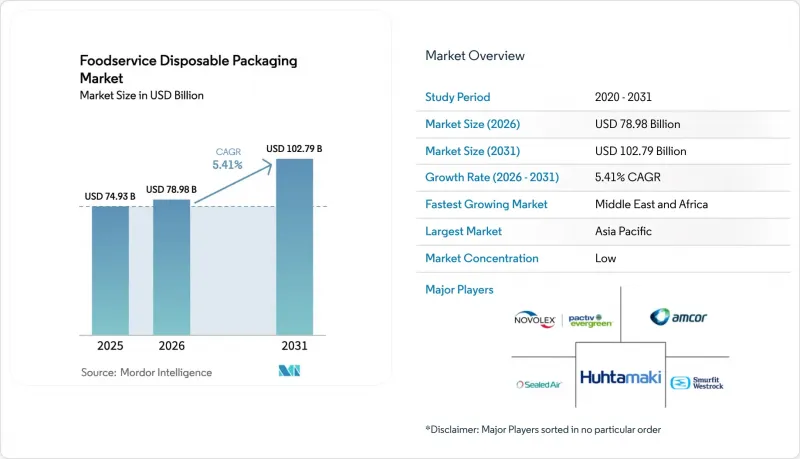
據 Mordor Intelligence 稱,2025 年食品服務服務業的包裝市場價值為 749.3 億美元,預計到 2031 年將達到 1027.9 億美元,而 2026 年為 789.8 億美元,預測期(2026-2031 年)的複合成長率為 5.41%。
本報告按材料(塑膠、紙、鋁、可生物分解材料)、產品類型(杯子/蓋子、容器、托盤/盤子、刀叉餐具、其他)、最終用戶(快餐店/咖啡館、全方位服務餐廳、雲端廚房、機構用戶、其他)、分銷管道(直接、間接)和地區(北美、歐洲、亞太、中東和非洲、南美)進行細分。市場預測以美元計價。
全球食品服務一次性包裝市場趨勢及洞察。
幽靈廚房和線上配送的激增正在推動對防篡改包裝的需求。
如今,美國餐飲業40%的銷售額來自線上訂購,迫使沒有店內飲食空間的商家將包裝視為重要的品牌接點。諸如DayMark Safety Systems的TamperSeal標籤和Dart Container的ClearPac SafeSeal鉸鏈技術等防篡改解決方案,透過顯示明顯的篡改痕跡來增強顧客的信心。由於第三方平台將安全評分納入餐廳評級,採用此類包裝已成為競爭優勢。此外,商家也傾向於選擇內建於包裝中的防篡改功能,而非額外的收縮膜包裝,以簡化工作流程並減少材料消耗。
歐盟和亞洲的永續發展法規正在推動對紡織品包裝的需求轉變。
歐盟的《包裝及包裝廢棄物法規》將於2025年2月生效,該法規要求所有包裝材料在2030年前必須可回收利用,並禁止在食品接觸材料中使用全氟烷基和多氟烷基物質(PFAS)。同時,亞洲各國也正在透過相關政策收緊合規標準,例如中國的食品接觸黏合劑標準GB 4806.15-2024和日本的合成樹脂正面表列。為了因應這些監管趨勢,像Futamaqi這樣的製造商正在北愛爾蘭擴大其紡織蓋的生產能力。這些法規共同作用,將紡織材料從“自願的永續發展選項”轉變為“強制性合規要求”,迫使全球品牌重新設計其傳統產品系列。
生產成本高昂:這是採用紙質包裝的一大障礙。
2025年1月,第二輪價格上漲生效,箱板紙價格飆升至每噸70美元,給先前已承受通膨壓力的企業雪上加霜。與傳統塑膠相比,額外的能源和運輸成本進一步推高了纖維材料的價格,阻礙了對成本敏感的新興市場採用替代材料。面臨融資的中小型餐飲企業議價能力有限,即使法規鼓勵,他們也往往會延後改用可堆肥紙張。
細分市場分析
預計到2025年,塑膠將佔食品服務一次性包裝市場佔有率的48.85%,但可生物分解和可堆肥材料正以8.88%的複合年成長率快速成長。 Braschem公司推出的WENEW,一種由廢棄食用油製成的生物循環聚丙烯,展現了可直接替代主流樹脂等級的潛力,這些替代材料能夠在不影響性能的前提下實現脫碳。 Amcor公司獲得了AmFiber高性能紙的歐洲專利,這是一種高阻隔阻隔性、可回收的紙張,可直接與金屬沉澱薄膜競爭。 Graphic Packaging公司的PaperSeal烹飪托盤是一款可用於烤箱的產品,它將纖維材料的應用範圍擴展到了高溫環境,從而拓寬了其目標終端應用範圍。
該領域的成長動能也得益於供應端產能的提升。 2022年,全球PLA產量超過70萬噸,其中亞太地區佔總產量的70%和總消費量的60%。 2024年7月,BioPak推出了符合家庭堆肥標準的PHA塗層咖啡杯,在其植物纖維產品線中消除了PFAS。 Sabert的「Pulp Ultra」容器則證明,憑藉其防潮塗層,纖維可以取代塑膠,用於盛裝油性、高溫食品。這些進展共同表明,我們正處於一個轉折點,技術壁壘的突破速度超過了成本溢價的成長速度。
到2025年,在飲料業持續創新的推動下,杯子和杯蓋將佔食品服務一次性包裝市場的26.21%。 SIG公司推出的冷萃咖啡「盒中袋」解決方案比玻璃容器更輕,並能延長保存期限。同時,隨著熱食配送的日益普及,托盤和餐盤市場預計將以6.92%的複合年成長率成長。 Huta Mäki公司為北歐超級市場提供的紡織調理食品餐盤表明,耐高溫的紡織材料不僅能夠滿足零售通路的需求,也能滿足餐飲服務業的需求。
托盤市場的成長與商用餐飲市場息息相關,在商業餐飲市場中,一次性解決方案出於衛生考量仍然不可或缺。 SEE 的可堆肥肉類托盤(54% 生物基,45% 回收材料)就是一個混合材料策略的典範,有助於企業轉型。 ProAmpac 的防漏 RotiBag 包裝袋具有隔熱、整合提把和輕量化等優點,充分展現了針對性設計如何在解決配送難題的同時減少材料消耗。
區域分析
到2025年,亞太地區將佔據42.10%的市場佔有率,引領食品服務一次性包裝市場。這主要得益於印度、印尼和越南快餐業的強勁擴張,以及2025年2月生效的北京食品接觸黏合劑修訂法規,該法規將確保監管朝著更安全材料的方向發展。此外,亞太地區在全球聚乳酸(PLA)產能中佔據重要佔有率,為可生物分解產品提供了成本優勢。日本將於2025年6月生效的正面表列制度將加強樹脂合規性,並刺激國內紡織品投資;而香港分階段禁止使用塑膠餐具的舉措,正引導餐飲業採購商轉向可堆肥替代品。
歐洲憑藉其《包裝和包裝廢棄物法規》在政策方面仍處於主導,該法規要求在2030年實現包裝的完全可回收性。歐洲各地的生產商正在加速擴大紡織品產能,而生產者延伸責任制(EPR)正逐步掩埋,不再是廢棄物的最終處置方式。在北美,各州已分階段實施了PFAS禁令,但隨著FDA於2024年2月完成PFAS的逐步淘汰,聯邦層級的統一法規得以實現。這些相互重疊的法規增加了合規的複雜性,但同時,它們也創造了對阻隔塗佈紙碗和rPET蓋的市場需求。
在中東和非洲地區,基礎設施的擴張正在推動商用餐飲一次性用品的需求,預計到2031年,其複合年成長率將達到6.95%。像Hotpack這樣的領先本土企業正在海外投資,以確保樹脂供應和技術訣竅,然後將成品和半成品再進口,以履行與海灣合作理事會(GCC)國家的合約。諸如SIG在埃及開展的飲料紙盒回收試點項目,旨在即使在仍在發展中的廢棄物管理系統中,也能建構循環解決方案。
在拉丁美洲,隨著一次性餐具被納入零售食材自煮包和便利商店食品計劃,市場需求穩步成長。該地區的製造商通常使用當地採購的甘蔗渣,同時融合歐洲紡織設計,並兼顧成本和永續性。
其他好處:
- Excel格式的市場預測(ME)表
- 3個月的分析師支持
目錄
第1章:引言
- 研究假設和市場定義
- 調查範圍
第2章:調查方法
第3章執行摘要
第4章 市場狀況
- 市場概覽
- 市場促進因素
- 幽靈廚房和線上配送服務的激增推動了對防篡改包裝的需求。
- 歐盟和亞洲的永續發展法規正在推動對紡織品包裝的需求轉變。
- 速食連鎖店在各國擴張
- 由於新冠肺炎疫情後人們衛生意識的提高,中東醫療機構中一次性托盤的使用量正在增加。
- 採用耐熱模塑纖維碗外帶熱食。
- 飲料菜單的多樣化(冷萃咖啡、珍珠奶茶)正在推動杯蓋的創新。
- 市場限制因素
- 生產成本高:這是食品服務業採用紙包裝的主要障礙。
- 地方政府對使用 PFAS 的禁令降低了現有庫存的市場價值。
- PLA樹脂供應緊張推高了生質塑膠的成本。
- 聚合商的整合給供應商的單價帶來了壓力。
- 供應鏈分析
- 監理展望
- 分析與消費者行為和偏好相關的關鍵趨勢
- 波特五力分析
第5章 市場規模與成長預測
- 材料
- 塑膠
- 聚丙烯(PP)
- 聚對苯二甲酸乙二醇酯(PET)
- 其他類型的塑膠
- 紙
- 塗層紙
- 牛皮紙
- 模塑纖維
- 鋁
- 可生物分解和可堆肥
- 塑膠
- 依產品類型
- 杯子和蓋子
- 浴缸和容器
- 托盤和盤子
- 刀叉餐具、攪拌棒、吸管
- 其他產品類型(袋子、包裝紙、盒子、紙箱、吸塑包裝等)
- 最終用戶
- 快餐店和咖啡館
- 全方位服務的餐廳
- 雲端廚房/幽靈廚房
- 為機構(醫院、學校)提供餐飲服務
- 其他最終用戶
- 透過分銷管道
- 直銷
- 間接銷售
- 按地區
- 北美洲
- 美國
- 加拿大
- 墨西哥
- 歐洲
- 德國
- 英國
- 法國
- 義大利
- 西班牙
- 俄羅斯
- 其他歐洲國家
- 亞太地區
- 中國
- 印度
- 日本
- 韓國
- 澳洲和紐西蘭
- 其他亞太國家
- 中東和非洲
- 中東
- 阿拉伯聯合大公國
- 沙烏地阿拉伯
- 土耳其
- 其他中東國家
- 非洲
- 南非
- 奈及利亞
- 埃及
- 其他非洲國家
- 中東
- 南美洲
- 巴西
- 阿根廷
- 其他南美國家
- 北美洲
第6章 競爭情勢
- 市場集中度
- 策略趨勢
- 市佔率分析
- 公司簡介
- Huhtamaki Oyj
- Amcor plc
- Graphic Packaging International, LLC
- Dart Container Corporation
- Smurfit Westrock
- Sabert Corporation
- Anchor Packaging LLC
- Genpak LLC
- Sealed Air Corporation
- Novolex Holdings, LLC
- Detpak(Eco Products)
- Vegware Ltd
- BioPak
- Hotpack Global
- Falcon Pack
- Pacific National Enterprises Pty Ltd
- Freshpack
第7章 市場機會與未來展望
According to Mordor Intelligence, the foodservice disposable packaging market size was valued at USD 74.93 billion in 2025 and estimated to grow from USD 78.98 billion in 2026 to reach USD 102.79 billion by 2031, at a CAGR of 5.41% during the forecast period (2026-2031).
This report is Segmented by Material Type (Plastics, Paper, Aluminum, Biodegradable), Product Type (Cups/Lids, Containers, Trays/Plates, Cutlery, Others), End User (QSR/Cafes, Full-Service, Ghost Kitchens, Institutional, Others), Distribution Channel (Direct, Indirect), and Geography (North America, Europe, Asia-Pacific, MEA, South America). Market Forecasts in Value (USD).
Global Foodservice Disposable Packaging Market Trends and Insights
Surge in Ghost Kitchens and Online Delivery Boosting Tamper-Evident Packaging Demand
Digital ordering now represents 40% of total U.S. restaurant sales, compelling operators without dining rooms to treat packaging as their primary brand touchpoint. Tamper-evident solutions such as DayMark Safety Systems' TamperSeal labels and Dart Container's ClearPac SafeSeal hinge technology reassure customers by showing visible breach indicators. Because third-party platforms rank restaurants partly on security scores, adoption of such packaging is now a competitive necessity. Operators also favour integrated tamper features over add-on shrink bands to reduce labour steps and material usage.
EU and Asian Sustainability Mandates Shifting Demand to Fiber-Based Packaging
The European Union's Packaging and Packaging Waste Regulation, effective February 2025, requires all packaging to achieve recyclability by 2030 and bans PFAS in food contact materials. Parallel policies-China's GB 4806.15-2024 for food-contact adhesives and Japan's Positive List for synthetic resins-tighten compliance thresholds across Asia. Producers such as Huhtamaki have scaled fiber-lid capacity in Northern Ireland to match this regulatory pull. Together, these rules reposition fiber as a compliance imperative rather than a voluntary sustainability choice, pushing global brands to redesign legacy SKUs.
High Production Costs: A Major Barrier to Paper Packaging Adoption
A second wave of containerboard price hikes of USD 70 per metric ton took effect in January 2025, burdening operators who had already absorbed earlier inflation. Energy and freight surcharges compound the premium for fibre formats over conventional plastics, slowing substitution in cost-sensitive emerging markets. Smaller foodservice businesses with tight cash flow have little bargaining power and often postpone switching to compostable paper, even where regulations encourage it.
Other drivers and restraints analyzed in the detailed report include:
- Expansion of QSR Chains in Various Countries
- Post-Hygiene Focus Raising Single-Use Trays in Middle-East Institutions
- Municipal PFAS Bans Reducing Viability of Existing Inventory
For complete list of drivers and restraints, kindly check the Table Of Contents.
Segment Analysis
Plastics held 48.85% of foodservice disposable packaging market share in 2025, yet biodegradable and compostable formats are accelerating at a 8.88% CAGR. Braskem's launch of WENEW bio-circular polypropylene sourced from used cooking oil shows how drop-in replacements can decarbonise mainstream resin grades without performance loss. Amcor has secured European patents for AmFiber Performance Paper, a high-barrier recyclable paper that competes directly with metallised films. Graphic Packaging's oven-ready PaperSeal Cook Tray extends fibre utility to hot applications, broadening addressable end-use cases.
Momentum in this segment also rides on supply-side capacity: global PLA production topped 700 kilotons in 2022, with Asia-Pacific controlling 70% of output and 60% of consumption. BioPak eliminated PFAS from its plant-fibre line in July 2024 and introduced PHA-lined coffee cups that meet home-compost standards. Sabert's Pulp Ultra containers underscore how moisture-resistant coatings can allow fibre to displace plastic in greasy hot-food contexts. Collectively, these developments signal a tipping point where technical hurdles are receding faster than cost premiums.
Cups & lids commanded 26.21% of the foodservice disposable packaging market size in 2025, supported by continued beverage innovation. SIG's bag-in-box solution for cold-brew coffee trims weight versus glass and improves shelf-life. Conversely, trays & plates are projected to grow at a 6.92% CAGR as hot meal delivery proliferates. Huhtamaki's fibre ready-meal trays for Nordic supermarkets prove that ovenable fibre can satisfy retail as well as foodservice channels.
Growth in trays is also linked to institutional catering where single-use solutions remain hygiene-critical. SEE's compostable meat trays-54% bio-based and 45% recycled-illustrate hybrid material strategies that ease operator transition. ProAmpac's leak-resistant RotiBag provides heat retention, integrated handles, and reduced packaging weight, demonstrating how targeted design solves delivery pain points while using fewer materials.
Complete Report Scope:
- By Material Type
- Plastics
- Polypropylene (PP)
- Polyethylene Terephthalate (PET)
- Other Plastic Types
- Paper
- Coated paper
- Kraft paper
- Molded fiber
- Aluminum
- Biodegradable and Compostable
- Plastics
- By Product Type
- Cups and Lids
- Tubs and Containers
- Trays and Plates
- Cutlery, Stirrers and Straw
- Other Product Types (Bags, Wraps, Boxes, Cartons, Clamshell, etc.)
- By End User
- Quick Service Restaurants and Cafes
- Full-service Restaurants
- Cloud / Ghost Kitchens
- Institutional Catering (Hospitals, Schools)
- Other End User
- By Distribution Channel
- Direct Sales
- Indirect Sales
- By Geography
- North America
- United States
- Canada
- Mexico
- Europe
- Germany
- United Kingdom
- France
- Italy
- Spain
- Russia
- Rest of Europe
- Asia-Pacific
- China
- India
- Japan
- South Korea
- Australia and New Zealand
- Rest of Asia-Pacific
- Middle East and Africa
- Middle East
- United Arab Emirates
- Saudi Arabia
- Turkey
- Rest of Middle East
- Africa
- South Africa
- Nigeria
- Egypt
- Rest of Africa
- Middle East
- South America
- Brazil
- Argentina
- Rest of South America
- North America
Geography Analysis
Asia-Pacific dominated the foodservice disposable packaging market with 42.10% share in 2025. Robust quick-service expansion in India, Indonesia, and Vietnam, coupled with Beijing's updated food-contact adhesive rule effective February 2025, ensures strong regulatory alignment toward safer materials. The region also hosts the bulk of global PLA capacity, establishing a cost advantage for biodegradable formats. Japan's Positive List system entering force in June 2025 tightens resin compliance and spurs domestic fibre investment, while Hong Kong's phased plastic tableware ban guides hospitality buyers toward compostable alternatives.
Europe remains an agenda-setter thanks to the Packaging and Packaging Waste Regulation that mandates full recyclability by 2030. Producers across the continent are accelerating fibre capacity, and extended producer responsibility schemes distance landfill from acceptable end-of-life routes. North America faces a patchwork of state-level PFAS bans; federal alignment arrived when the FDA completed the PFAS phase-out in February 2024. These overlapping rules complicate compliance but also create a market pull for barrier-coated paper bowls and rPET lids.
The Middle East & Africa region is expected to post 6.95% CAGR through 2031 as infrastructure growth feeds demand for institutional catering disposables. Local champions like Hotpack are investing abroad to secure resin supply and technical know-how, then re-importing finished or semi-finished goods to service GCC contracts. Pilot recycling projects, such as SIG's beverage-carton retrieval in Egypt, aim to build circular solutions even in nascent waste-management systems.
Latin America shows steady demand growth as disposable tableware accompanies retail meal kits and convenience-store food programs. Regional producers often adapt European fibre designs but utilise locally sourced sugar-cane bagasse, reflecting both cost and sustainability priorities.
- Huhtamaki Oyj
- Amcor plc
- Graphic Packaging International, LLC
- Dart Container Corporation
- Smurfit Westrock
- Sabert Corporation
- Anchor Packaging LLC
- Genpak LLC
- Sealed Air Corporation
- Novolex Holdings, LLC
- Detpak (Eco Products)
- Vegware Ltd
- BioPak
- Hotpack Global
- Falcon Pack
- Pacific National Enterprises Pty Ltd
- Freshpack
Additional Benefits:
- The market estimate (ME) sheet in Excel format
- 3 months of analyst support
TABLE OF CONTENTS
1 INTRODUCTION
- 1.1 Study Assumptions and Market Definition
- 1.2 Scope of the Study
2 RESEARCH METHODOLOGY
3 EXECUTIVE SUMMARY
4 MARKET LANDSCAPE
- 4.1 Market Overview
- 4.2 Market Drivers
- 4.2.1 Surge in ghost kitchens and online delivery boosting tamper-evident packaging demand
- 4.2.2 EU and Asian sustainability mandates shifting demand to fiber-based packaging
- 4.2.3 Expansion of QSR chains in various countries
- 4.2.4 Post-COVID hygiene focus raising single-use trays in Middle-East institutions
- 4.2.5 Adoption of heat-resistant molded-fiber bowls for hot off-premise meals
- 4.2.6 Diversified beverage menus (cold-brew, bubble tea) driving cup-lid innovation
- 4.3 Market Restraints
- 4.3.1 High Production Costs: A Major Barrier to Paper Packaging Adoption in the Foodservice Sector
- 4.3.2 Municipal PFAS bans reducing viability of existing inventory
- 4.3.3 PLA resin supply bottlenecks elevating bioplastic costs
- 4.3.4 Aggregator consolidation squeezing unit pricing for suppliers
- 4.4 Supply-Chain Analysis
- 4.5 Regulatory Outlook
- 4.6 Analysis of the Key Trends Related to Consumer Behavior and Preferences
- 4.7 Porter's Five Forces Analysis
- 4.7.1 Bargaining Power of Suppliers
- 4.7.2 Bargaining Power of Buyers
- 4.7.3 Threat of New Entrants
- 4.7.4 Threat of Substitutes
- 4.7.5 Competitive Rivalry
5 MARKET SIZE AND GROWTH FORECASTS (VALUE)
- 5.1 By Material Type
- 5.1.1 Plastics
- 5.1.1.1 Polypropylene (PP)
- 5.1.1.2 Polyethylene Terephthalate (PET)
- 5.1.1.3 Other Plastic Types
- 5.1.2 Paper
- 5.1.2.1 Coated paper
- 5.1.2.2 Kraft paper
- 5.1.2.3 Molded fiber
- 5.1.3 Aluminum
- 5.1.4 Biodegradable and Compostable
- 5.1.1 Plastics
- 5.2 By Product Type
- 5.2.1 Cups and Lids
- 5.2.2 Tubs and Containers
- 5.2.3 Trays and Plates
- 5.2.4 Cutlery, Stirrers and Straw
- 5.2.5 Other Product Types (Bags, Wraps, Boxes, Cartons, Clamshell, etc.)
- 5.3 By End User
- 5.3.1 Quick Service Restaurants and Cafes
- 5.3.2 Full-service Restaurants
- 5.3.3 Cloud / Ghost Kitchens
- 5.3.4 Institutional Catering (Hospitals, Schools)
- 5.3.5 Other End User
- 5.4 By Distribution Channel
- 5.4.1 Direct Sales
- 5.4.2 Indirect Sales
- 5.5 By Geography
- 5.5.1 North America
- 5.5.1.1 United States
- 5.5.1.2 Canada
- 5.5.1.3 Mexico
- 5.5.2 Europe
- 5.5.2.1 Germany
- 5.5.2.2 United Kingdom
- 5.5.2.3 France
- 5.5.2.4 Italy
- 5.5.2.5 Spain
- 5.5.2.6 Russia
- 5.5.2.7 Rest of Europe
- 5.5.3 Asia-Pacific
- 5.5.3.1 China
- 5.5.3.2 India
- 5.5.3.3 Japan
- 5.5.3.4 South Korea
- 5.5.3.5 Australia and New Zealand
- 5.5.3.6 Rest of Asia-Pacific
- 5.5.4 Middle East and Africa
- 5.5.4.1 Middle East
- 5.5.4.1.1 United Arab Emirates
- 5.5.4.1.2 Saudi Arabia
- 5.5.4.1.3 Turkey
- 5.5.4.1.4 Rest of Middle East
- 5.5.4.2 Africa
- 5.5.4.2.1 South Africa
- 5.5.4.2.2 Nigeria
- 5.5.4.2.3 Egypt
- 5.5.4.2.4 Rest of Africa
- 5.5.4.1 Middle East
- 5.5.5 South America
- 5.5.5.1 Brazil
- 5.5.5.2 Argentina
- 5.5.5.3 Rest of South America
- 5.5.1 North America
6 COMPETITIVE LANDSCAPE
- 6.1 Market Concentration
- 6.2 Strategic Moves
- 6.3 Market Share Analysis
- 6.4 Company Profiles (includes Global level Overview, Market level overview, Core Segments, Financials as available, Strategic Information, Market Rank/Share for key companies, Products and Services, and Recent Developments)
- 6.4.1 Huhtamaki Oyj
- 6.4.2 Amcor plc
- 6.4.3 Graphic Packaging International, LLC
- 6.4.4 Dart Container Corporation
- 6.4.5 Smurfit Westrock
- 6.4.6 Sabert Corporation
- 6.4.7 Anchor Packaging LLC
- 6.4.8 Genpak LLC
- 6.4.9 Sealed Air Corporation
- 6.4.10 Novolex Holdings, LLC
- 6.4.11 Detpak (Eco Products)
- 6.4.12 Vegware Ltd
- 6.4.13 BioPak
- 6.4.14 Hotpack Global
- 6.4.15 Falcon Pack
- 6.4.16 Pacific National Enterprises Pty Ltd
- 6.4.17 Freshpack
7 MARKET OPPORTUNITIES AND FUTURE OUTLOOK
- 7.1 White-space and Unmet-need Assessment

 北美食品服務包裝:市場佔有率分析、產業趨勢與統計及成長預測(2026-2031 年)
 食品服務包裝市場報告:趨勢、預測與競爭分析(至2035年)食品服務包裝:市場佔有率分析、產業趨勢與統計、成長預測(2026-2031)
 溫控食品配送包裝市場預測至2034年-按包裝類型、材料類型、包裝形式、溫度類型、最終用戶和地區分類的全球分析食品服務包裝市場預測至2034年-全球分析(按包裝類型、產品類型、材料類型、功能、應用、最終用戶和地區分類)
 線上食品配送包裝市場報告:按產品類型、材料和地區分類(2026-2034 年)
 可生物分解食品服務一次性用品市場:依產品類型、材料類型、堆肥類型、應用和銷售管道分類-2026-2032年全球市場預測食品服務包裝市場:依包裝類型、材料、永續、應用、最終用戶、分銷管道分類,全球預測(2026-2032年)
 食品服務包裝市場-全球產業規模、佔有率、趨勢、機會及預測(依材料、包裝類型、應用、地區及競爭格局分類,2021-2031年)
 食品服務包裝市場-2026-2031年預測