


 |
市場調查報告書
商品編碼
2122038
食品服務包裝:市場佔有率分析、產業趨勢與統計、成長預測(2026-2031)Food Service Packaging - Market Share Analysis, Industry Trends & Statistics, Growth Forecasts (2026 - 2031) |
||||||

※ 本網頁內容可能與最新版本有所差異。詳細情況請與我們聯繫。
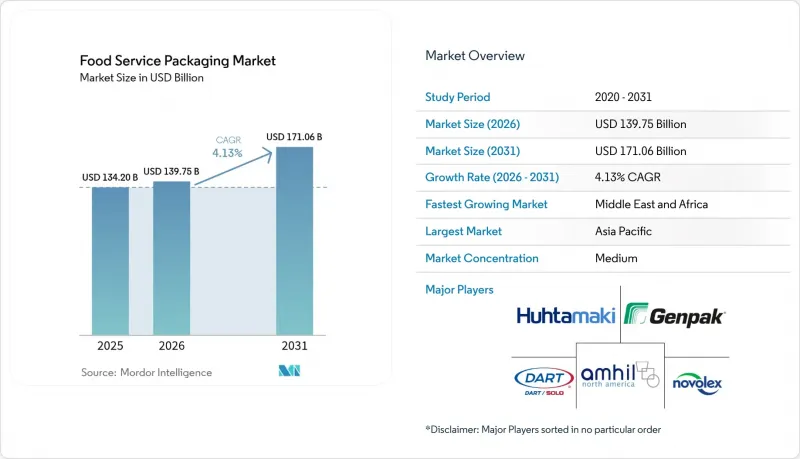
根據 Mordor Intelligence 預測,餐飲包裝市場規模將從 2025 年的 1,342 億美元成長到 2026 年的 1,397.5 億美元,然後在 2031 年達到 1,710.6 億美元,2026 年至 2031 年的複合年成長率為 4.13%。
本報告按材料(紙/紙板、塑膠、其他)、包裝類型(翻蓋式、杯/容器、其他)、終端用戶行業(快餐、餐飲、機構餐飲、其他)、永續性概況(傳統、永續)和地區(北美、南美、歐洲、亞太、中東和非洲)進行細分。市場預測以美元計價。
全球食品服務包裝市場趨勢與洞察
城市地區對「外帶」和「已調整的」餐點的需求日益成長。
隨著年輕的都市區消費者越來越傾向選擇方便快速、可在短途通勤途中食用的單份餐食,單份包裝正迅速崛起,超越散裝包裝。品牌商現在指定使用可堆疊的托盤,這些托盤相容於自動販賣機和微型倉配餐櫃,並整合卡路里圖示和可掃描的2D碼營養標籤。麥當勞在德國開展的紙質漢堡包裝試點項目,展示了跨國快餐連鎖店如何將便利性和永續性結合,以滿足都市區消費者的需求。機構買家也在推動這一趨勢。英國國家醫療服務體系 (NHS) 的餐飲服務耗材框架強制要求標準化份量和過敏原敏感標籤。因此,精通模組化模切和可變數據標籤的加工商在滿足都市區複雜服務需求的同時,也獲得了成本優勢。
電子商務食材自煮包的蓬勃發展正在加速對二級和三級包裝的需求。
食材自煮包製造商需要多層解決方案,以保護生肉、防止異味轉移並承受兩天的宅配週期。這種需求推動了對客製化阻隔袋、瓦楞紙冷藏箱和模塑纖維內襯的投資增加,這些內襯旨在減少冷媒的使用和運輸重量。供應商擴大將NFC保鮮標籤整合到外包裝盒中,以檢測篡改和溫度偏差,這一趨勢與利樂公司2024年推出的配備感測器的乳製品直接配送先導計畫相呼應。為了降低供應風險,美國和德國正在建造新的模塑纖維生產線,而亞太地區的製造商正在升級設備,以提供適用於烤箱和微波爐的水性油墨系統,用於食材自煮包。
超過 60 個國家正在透過法規逐步淘汰一次性 EPS 和 PVC 產品。
加速實施的禁令將過渡期縮短至12-18個月,加劇了替代材料供應商的供給能力。法國的AGEC法案強制要求麥當勞在2024年前引進可重複使用的聚丙烯托盤,改善店內工作流程,並試行使用矽膠容器盛裝店內飲食訂單。小規模企業缺乏資金投資於廚房洗碗和押金物流的現代化改造,這促使它們轉向第三方共享服務,並進一步加速向財務更穩定的連鎖企業整合。
細分市場分析
2025年,塑膠在餐飲包裝市場仍佔最大佔有率,達41.98%。這主要歸功於塑膠的成本效益、高透明度(便於產品展示)以及其對飲料蓋和高溫湯品容器至關重要的氣密性。然而,可生物分解和特殊基材預計將以5.42%的複合年成長率成長,這反映了消費者對環保標籤的需求不斷成長以及北歐都市區堆肥基礎設施的擴展。目前,澱粉混合材料的普及推動了可生物分解薄膜餐飲包裝市場的發展,預計到2031年,該市場規模將達到263.6億美元。這種混合材料即使在100°C的微波爐中重新加熱也不會變形。在傳統塑膠領域,PFAS 去除和化學回收方法佔據了研發預算的很大一部分,麥當勞實現了到 2024 年逐步淘汰 99.5% 含氟化合物的里程碑,就證明了這一點。
紙張和紙板持續向高階市場轉型,水性分散塗料如今可提供長達8小時的耐熱耐油性能,使得纖維材料能夠應用於翻蓋式容器和麵條碗等包裝。鋁罐和托盤在飛機餐飲和高酸性食品配料等領域仍保持著一定的市場需求,但難以與輕量複合紙盒競爭。玻璃的市場滲透率極低,因為配送平台不青睞其重量和破損風險。在塑膠價格持續波動的情況下,加工商正透過採用聚丙烯(PP)和紙漿混合解決方案來規避風險,這些方案可在維持保溫性能的同時減少50%的聚合物用量,進一步鞏固了可生物分解材料在餐飲包裝市場創新領域的重要地位。
預計到2025年,杯子和容器的銷售額將保持37.89%的領先優勢,這主要得益於它們在一般飲料和湯品中的廣泛應用,以及快餐店(QSR)的大批量訂單降低了單位成本。然而,托盤和容器的銷售額正以5.11%的複合年成長率快速成長,這主要受以宅配為中心的菜單設計的推動。到2031年,食品服務包裝托盤市場規模預計將達到473億美元,因為「幽靈廚房」(ghost kitchen,指外帶廚房)更傾向於採用防漏、可微波加熱、帶有卡扣式蓋子和防霧窗口的設計。防篡改封條和可撕式保鮮封條正從醫藥行業轉向食品行業,這為熱成型製造商創造了新的模具需求。
曾經以發泡聚苯乙烯(EPS)為代表的翻蓋式容器,如今正逐漸轉向模塑纖維和再生PET材料,以符合相關法規。同時,小袋和包裝袋正在填補分裝調味品市場的空白。 Sabert公司將於2024年推出的「Tray2Go」紙漿產品系列,兼具可堆肥性和貨架強度,為航空公司和醫院餐飲供應商提供了比PP托盤更具成本效益的選擇。總而言之,包裝形式的多樣化表明,能夠提供多種規格產品系列的供應商,預計將在餐飲包裝市場獲得更高價位的訂單。
區域分析
亞太地區以40.32%的市佔率領先食品服務包裝市場,主要得益於中國、印度和東南亞國家不斷成長的都市區消費。隨著整合實體店和線上商店的食品聚合平台規模不斷擴大,包裝加工商正將擠出和印刷工廠遷至靠近大都會圈,以縮短前置作業時間並根據當地偏好客製化產品。越南的生產者延伸責任制(EPR)草案表明,強制性再生材料含量即將成為主流,這促使RPET薄片出口商在國內建造清洗生產線。然而,地方政府回收體系的不完善阻礙了瓶子再利用為食品容器的試點項目,而高溫烹飪麵條等應用領域對原生樹脂的需求仍然強勁。
在北美,儘管市場已趨於成熟,但創新主導的趨勢正在出現。各州對全氟烷基和多氟烷基物質(PFAS)的禁令正在加速向纖維蓋的轉變,並促進大型塑膠製造商和包裝加工商之間開展化學回收合資計畫。紐約州總務部現已發布符合標準的纖維容器和包裝材料的年度採購規範,為公共部門採購人員提供經過審核的永續產品清單。美國品牌正在體育場館的特許經營攤位率先開展重複使用試點項目,收集有關洗滌次數和消費者接受度的數據,以幫助制定其2030年零廢棄目標。
在歐洲,各國正透過「一次性塑膠指令」推進監管協調。德國和北歐國家的押金返還制度提高了PET的回收率,降低了RPET顆粒的成本。在與廚餘垃圾垃圾處理系統相連的堆肥基礎設施的支持下,纖維塗層披薩盤和模製飲料杯託的使用越來越普遍。然而,纖維素紙漿的供應受到限制,促使人們投資於永續林業和利用農業廢棄物製漿。
目前,中東和非洲的銷售額僅佔總銷售額的6%,但預計將以5.98%的複合年成長率成長。肯德基和漢堡王等快餐專利經營正在採用標準化包裝套件,以支持其在沿岸地區和北非商店的快速擴張。 UFlex投資2億美元在埃及建造的工廠旨在滿足不斷成長的非洲市場需求以及歐洲本地採購的需求,從而縮短前置作業時間並規避紅海航線的運輸風險。由於廢棄物管理基礎設施仍不完善,隨著收集系統的擴展,人們對便於下游機械回收的單一材料聚丙烯(PP)容器的興趣日益濃厚。
其他好處:
- Excel格式的市場預測(ME)表
- 3個月的分析師支持
目錄
第1章:引言
- 研究假設和市場定義
- 調查範圍
第2章:調查方法
第3章執行摘要
第4章 市場狀況
- 市場概覽
- 市場促進因素
- 在都市區,人們對方便攜帶、分量可控的餐點的需求日益成長。
- 電子商務推動的食材自煮包熱潮,也帶動了二級和三級包裝的處理量成長。
- 受 PFAS 法規的推動,快餐店開始轉向使用紡織餐具。
- 再生PET產能的擴張正在縮小其與原生樹脂之間的價格差距。
- 配備感測器的「智慧蓋」提高了外帶食品的安全性和品牌差異化。
- 幽靈廚房的特許經營模式正在迅速發展,由此產生了對輕便、防篡改包裝的需求。
- 市場限制因素
- 超過 60 個國家正在透過法規逐步淘汰一次性 EPS 和 PVC 產品。
- 原生聚合物價格的波動給加工商的利潤率帶來了壓力。
- 亞洲新興國家回收舊產品的基礎設施不足。
- 體育場館和校園內的可重複使用食品服務系統需要大量的初始資本投資。
- 產業價值鏈分析
- 監理情勢
- 技術展望
- 波特五力分析
- 宏觀經濟因素對市場的影響
第5章 市場規模與成長預測
- 材料
- 紙張和紙板
- 塑膠
- 聚對苯二甲酸乙二醇酯(PET)
- 聚丙烯(PP)
- 聚苯乙烯(PS)和發泡聚苯乙烯(EPS)
- 其他塑膠
- 鋁
- 玻璃
- 可生物分解材料及特殊材料
- 按包裝類型
- 蛤殼
- 杯子和容器
- 托盤和容器
- 小袋子和小包
- 其他包裝類型
- 按最終用戶行業分類
- 速食店(QSR)
- 全方位服務餐廳 (FSR)
- 商用餐飲
- 飯店和咖啡館
- 其他終端用戶產業
- 依永續發展概況
- 傳統的
- 永續包裝
- 按地區
- 北美洲
- 美國
- 加拿大
- 墨西哥
- 南美洲
- 巴西
- 阿根廷
- 智利
- 其他南美國家
- 歐洲
- 英國
- 德國
- 法國
- 西班牙
- 義大利
- 其他歐洲國家
- 亞太地區
- 中國
- 印度
- 日本
- 澳洲
- 韓國
- 越南
- 其他亞太國家
- 中東和非洲
- 中東
- 沙烏地阿拉伯
- 阿拉伯聯合大公國
- 土耳其
- 其他中東國家
- 非洲
- 南非
- 奈及利亞
- 埃及
- 其他非洲國家
- 中東
- 北美洲
第6章 競爭情勢
- 市場集中度
- 策略趨勢
- 市佔率分析
- 公司簡介
- Pactiv Evergreen Inc.
- Dart Container Corporation
- Amhil North America
- Genpak LLC
- Huhtamaki Oyj
- Novolex Holdings LLC
- Sabert Corporation
- Silgan Holdings Inc.
- B & R Plastics Inc.
- Graphic Packaging Holding Company
- Amcor plc
- Sonoco Products Company
- Anchor Packaging LLC
- Smurfit WestRock
- Georgia-Pacific LLC
- Coveris Holdings SA
- Reynolds Group Holdings Ltd.
- International Paper Company
- Vegware Ltd.
- BioPak Pty Ltd.
- Fabri-Kal Corporation
- Eco-Products LLC
- Sealed Air Corporation
第7章 市場機會與未來展望
According to Mordor Intelligence, the food service packaging market size is expected to grow from USD 134.20 billion in 2025 to USD 139.75 billion in 2026 and is forecast to reach USD 171.06 billion by 2031 at 4.13% CAGR over 2026-2031.
This report is Segmented by Material (Paper and Paperboard, Plastics, and More), Packaging Type (Clamshells, Cups and Tubs, and More), End-User Industry (QSR, FSR, Institutional Catering, and More), Sustainability Profile (Conventional, Sustainable), and Geography (North America, South America, Europe, Asia-Pacific, Middle East and Africa). The Market Forecasts are Provided in Terms of Value (USD).
Global Food Service Packaging Market Trends and Insights
Growing Demand for On-the-Go, Portion-Controlled Meals in Urban Centers
Portion-specific packs have outpaced bulk formats as younger, city-dwelling consumers favor convenient single-serve meals they can finish during short commutes. Brand owners now specify stackable trays with integrated calorie icons and scannable QR nutrition tags that fit automated vending and micro-fulfillment lockers. McDonald's pilot of grass-paper burger wraps in Germany illustrates how multinational QSR chains marry convenience with sustainability to satisfy urban diners. Institutional buyers reinforce the trend; the United Kingdom's National Health Service framework for catering consumables standardizes portion sizes while mandating allergen-compliant labels. As a result, converters that master modular die-cutting and variable-data labeling gain a cost edge while meeting complex urban service requirements.
E-commerce Meal-Kit Boom Accelerating Secondary and Tertiary Packaging Volumes
Meal-kit operators require multi-layered solutions that shield raw proteins, prevent odor transfer, and withstand two-day courier cycles. Demand has spurred investment in customized barrier pouches, corrugated coolers, and molded-fiber inserts designed to curb refrigerant use and shipping weight. Providers increasingly embed NFC freshness tags in outer cartons to signal tamper events and temperature excursions, mirroring Tetra Pak's sensor-equipped pilot for direct-to-consumer dairy in 2024. Domestic fiber molding lines have been added in the United States and Germany to curb supply risk, and Asia-Pacific manufacturers are retooling to supply water-based ink systems compatible with meal-kit ovens and microwaves.
Regulatory Phase-Outs of Single-Use EPS and PVC in More Than 60 Countries
Fast-tracked bans compress transition windows to 12-18 months, straining the capacity of alternative substrate suppliers. France's AGEC law obliged McDonald's to roll out reusable polypropylene trays in 2024, rewiring front-of-house workflows and piloting silicone-rubber containers for eat-in orders. Small operators lack the capex to overhaul back-of-house dishwashing or deposit logistics, nudging them to third-party pooling services and reinforcing consolidation toward well-capitalized chains.
Other drivers and restraints analyzed in the detailed report include:
- Quick-Service Restaurants' Shift to Fiber-Based Serviceware Amid PFAS Bans
- Recycled PET Capacity Expansions Lowering Price Premium vs. Virgin Resin
- Volatility in Virgin Polymer Prices Squeezing Converter Margins
For complete list of drivers and restraints, kindly check the Table Of Contents.
Segment Analysis
Plastics kept the largest 41.98% food service packaging market share in 2025, leveraged by cost efficiency, high-clarity display, and seal integrity that remain critical for beverage lids and hot-fill soup tubs. Still, biodegradable and specialty substrates are slated for a 5.42% CAGR, reflecting stronger eco-labeling pull and expanding compost infrastructure in urban Northern Europe. The food service packaging market size for biodegradable films is forecast to reach USD 26.36 billion by 2031, buoyed by starch blends that now tolerate microwave reheating at 100 °C without warpage. In conventional plastics, PFAS removal and chemical-recycle pathways dominate R&D budgets, evidenced by McDonald's 99.5% fluorinated-compound phase-out milestone in 2024.
Paper and paperboard continue to migrate up-market; aqueous dispersion coatings now achieve 8-hour hot-grease resistance, opening burger clam shells and noodle bowls to fiber conversion. Aluminum cans and trays preserve niche demand for airline catering and high-acid meal components but struggle against lightweight composite cartons. Glass sees negligible penetration because delivery platforms penalize weight and breakage risk. As resin volatility persists, converters hedge with hybrid PP-pulp solutions that trim polymer usage by 50% while safeguarding heat retention, reinforcing biodegradable materials as the prime innovation arena within the food service packaging market.
Cups and tubs retained a 37.89% revenue lead in 2025, anchored by universal beverage and soup applications and mega-volume QSR procurement that lowers unit costs. Nonetheless, trays and containers surge ahead at a 5.11% CAGR, supported by courier-centric menu designs. The food service packaging market size for trays could hit USD 47.30 billion by 2031 as ghost kitchens favor leak-proof, microwavable designs with snap-fit lids and anti-fog windows. Tamper bands and peel-away freshness seals migrate from pharma to food, creating incremental tooling demand for thermoformers.
Clamshells, once synonymous with EPS, reposition toward molded-fiber and post-consumer recycled PET formats to meet bans, while sachets and pouches fill portion-controlled condiment niches. Sabert's Tray2Go pulp line, introduced in 2024, pairs compostability with shelf stacking strength, giving airlines and hospital caterers a cost-neutral swap from PP trays. Overall, packaging-type diversification indicates that suppliers offering multi-format portfolios will command premium bids in the food service packaging market.
Complete Report Scope:
- By Material
- Paper and Paperboard
- Plastics
- Polyethylene Terephthalate (PET)
- Polypropylene (PP)
- Polystyrene (PS) and Expanded Polystyrene (EPS)
- Other Plastics
- Aluminum
- Glass
- Biodegradable and specialty materials
- By Packaging Type
- Clamshells
- Cups and Tubs
- Trays and Containers
- Sachets and Pouches
- Other Packaging Types
- By End-user Industry
- Quick-Service Restaurants (QSR)
- Full-Service Restaurants (FSR)
- Institutional Catering
- Hospitality and Cafes
- Other End-user Industries
- By Sustainability Profile
- Conventional Type
- Sustainable Packaging
- By Geography
- North America
- United States
- Canada
- Mexico
- South America
- Brazil
- Argentina
- Chile
- Rest of South America
- Europe
- United Kingdom
- Germany
- France
- Spain
- Italy
- Rest of Europe
- Asia-Pacific
- China
- India
- Japan
- Australia
- South Korea
- Vietnam
- Rest of Asia-Pacific
- Middle East and Africa
- Middle East
- Saudi Arabia
- United Arab Emirates
- Turkey
- Rest of Middle East
- Africa
- South Africa
- Nigeria
- Egypt
- Rest of Africa
- Middle East
- North America
Geography Analysis
Asia-Pacific commands the food service packaging market with 40.32% share, fueled by expanding urban consumption in China, India, and Southeast Asian economies. As bricks-and-clicks food aggregators scale, packaging converters relocate extrusion and printing assets closer to megacities to shrink lead times and tailor SKUs to local taste profiles. Vietnam's draft EPR law signals an impending shift toward mandatory recycled-content quotas, prompting RPET flake exporters to build domestic washing lines. Yet inconsistent municipal collection slows bottle-to-food trials, keeping virgin resin demand resilient across high-temperature noodle applications.
North America displays mature yet innovation-led dynamics. State-level PFAS prohibitions catalyze rapid fiber-lid conversions and push chemical-recycling joint ventures between resin majors and packaging converters. The New York Office of General Services now publishes an annual purchasing specification for compliant fiber containers and wraps, giving public-sector buyers a vetted list of sustainable SKUs. U.S. brands pioneer pilot reuse schemes in stadium concessions, collecting data on wash-cycle durability and consumer acceptance to inform 2030 zero-waste targets.
Europe follows a harmonized regulatory path via the Single-Use Plastics Directive. Deposit-return systems in Germany and the Nordics deliver high PET collection rates, lowering RPET pellet costs. Fiber-coated pizza discs and molded drink carriers gain traction, supported by compost infrastructure integrated with municipal bio-waste streams. Supply, however, is constrained by cellulose pulp availability, spurring investments in sustainable forestry and agricultural-waste fiber pulping.
The Middle East and Africa, though only 6 % of current revenue, present a 5.98% CAGR upside. Fast-food franchisors such as KFC and Burger King deploy standardized packaging kits to support rapid outlet roll-outs in the Gulf and North Africa. UFlex's USD 200 million Egypt plant positions the firm to serve both African growth markets and European proximity sourcing, shortening lead times and hedging Red Sea shipping risks. Waste infrastructure remains nascent, prompting interest in mono-material PP tubs that facilitate downstream mechanical recycling once collection systems scale.
- Pactiv Evergreen Inc.
- Dart Container Corporation
- Amhil North America
- Genpak LLC
- Huhtamaki Oyj
- Novolex Holdings LLC
- Sabert Corporation
- Silgan Holdings Inc.
- B & R Plastics Inc.
- Graphic Packaging Holding Company
- Amcor plc
- Sonoco Products Company
- Anchor Packaging LLC
- Smurfit WestRock
- Georgia-Pacific LLC
- Coveris Holdings S.A.
- Reynolds Group Holdings Ltd.
- International Paper Company
- Vegware Ltd.
- BioPak Pty Ltd.
- Fabri-Kal Corporation
- Eco-Products LLC
- Sealed Air Corporation
Additional Benefits:
- The market estimate (ME) sheet in Excel format
- 3 months of analyst support
TABLE OF CONTENTS
1 INTRODUCTION
- 1.1 Study Assumptions and Market Definition
- 1.2 Scope of the Study
2 RESEARCH METHODOLOGY
3 EXECUTIVE SUMMARY
4 MARKET LANDSCAPE
- 4.1 Market Overview
- 4.2 Market Drivers
- 4.2.1 Growing demand for on-the-go, portion-controlled meals in urban centres
- 4.2.2 E-commerce meal-kit boom accelerating secondary and tertiary packaging volumes
- 4.2.3 Quick-service restaurants' shift to fiber-based serviceware amid PFAS bans
- 4.2.4 Recycled PET capacity expansions lowering price premium vs. virgin resin
- 4.2.5 Sensor-enabled "smart lids" improving delivery food safety and brand differentiation
- 4.2.6 Surge in ghost-kitchen franchising requiring lightweight, tamper-evident packs
- 4.3 Market Restraints
- 4.3.1 Regulatory phase-outs of single-use EPS and PVC in >60 countries
- 4.3.2 Volatility in virgin polymer prices squeezing converter margins
- 4.3.3 Insufficient post-consumer collection infrastructure in emerging Asia
- 4.3.4 High upfront capex for reusable food-service systems in stadiums and campuses
- 4.4 Industry Value Chain Analysis
- 4.5 Regulatory Landscape
- 4.6 Technological Outlook
- 4.7 Porter's Five Forces Analysis
- 4.7.1 Bargaining Power of Suppliers
- 4.7.2 Bargaining Power of Buyers
- 4.7.3 Threat of New Entrants
- 4.7.4 Threat of Substitutes
- 4.7.5 Intensity of Competitive Rivalry
- 4.8 Impact of Macroeconomic Factors on the Market
5 MARKET SIZE AND GROWTH FORECASTS(VALUE)
- 5.1 By Material
- 5.1.1 Paper and Paperboard
- 5.1.2 Plastics
- 5.1.2.1 Polyethylene Terephthalate (PET)
- 5.1.2.2 Polypropylene (PP)
- 5.1.2.3 Polystyrene (PS) and Expanded Polystyrene (EPS)
- 5.1.2.4 Other Plastics
- 5.1.3 Aluminum
- 5.1.4 Glass
- 5.1.5 Biodegradable and specialty materials
- 5.2 By Packaging Type
- 5.2.1 Clamshells
- 5.2.2 Cups and Tubs
- 5.2.3 Trays and Containers
- 5.2.4 Sachets and Pouches
- 5.2.5 Other Packaging Types
- 5.3 By End-user Industry
- 5.3.1 Quick-Service Restaurants (QSR)
- 5.3.2 Full-Service Restaurants (FSR)
- 5.3.3 Institutional Catering
- 5.3.4 Hospitality and Cafes
- 5.3.5 Other End-user Industries
- 5.4 By Sustainability Profile
- 5.4.1 Conventional Type
- 5.4.2 Sustainable Packaging
- 5.5 By Geography
- 5.5.1 North America
- 5.5.1.1 United States
- 5.5.1.2 Canada
- 5.5.1.3 Mexico
- 5.5.2 South America
- 5.5.2.1 Brazil
- 5.5.2.2 Argentina
- 5.5.2.3 Chile
- 5.5.2.4 Rest of South America
- 5.5.3 Europe
- 5.5.3.1 United Kingdom
- 5.5.3.2 Germany
- 5.5.3.3 France
- 5.5.3.4 Spain
- 5.5.3.5 Italy
- 5.5.3.6 Rest of Europe
- 5.5.4 Asia-Pacific
- 5.5.4.1 China
- 5.5.4.2 India
- 5.5.4.3 Japan
- 5.5.4.4 Australia
- 5.5.4.5 South Korea
- 5.5.4.6 Vietnam
- 5.5.4.7 Rest of Asia-Pacific
- 5.5.5 Middle East and Africa
- 5.5.5.1 Middle East
- 5.5.5.1.1 Saudi Arabia
- 5.5.5.1.2 United Arab Emirates
- 5.5.5.1.3 Turkey
- 5.5.5.1.4 Rest of Middle East
- 5.5.5.2 Africa
- 5.5.5.2.1 South Africa
- 5.5.5.2.2 Nigeria
- 5.5.5.2.3 Egypt
- 5.5.5.2.4 Rest of Africa
- 5.5.5.1 Middle East
- 5.5.1 North America
6 COMPETITIVE LANDSCAPE
- 6.1 Market Concentration
- 6.2 Strategic Moves
- 6.3 Market Share Analysis
- 6.4 Company Profiles (includes Global level Overview, Market level overview, Core Segments, Financials as available, Strategic Information, Market Rank/Share for key companies, Products and Services, and Recent Developments)
- 6.4.1 Pactiv Evergreen Inc.
- 6.4.2 Dart Container Corporation
- 6.4.3 Amhil North America
- 6.4.4 Genpak LLC
- 6.4.5 Huhtamaki Oyj
- 6.4.6 Novolex Holdings LLC
- 6.4.7 Sabert Corporation
- 6.4.8 Silgan Holdings Inc.
- 6.4.9 B & R Plastics Inc.
- 6.4.10 Graphic Packaging Holding Company
- 6.4.11 Amcor plc
- 6.4.12 Sonoco Products Company
- 6.4.13 Anchor Packaging LLC
- 6.4.14 Smurfit WestRock
- 6.4.15 Georgia-Pacific LLC
- 6.4.16 Coveris Holdings S.A.
- 6.4.17 Reynolds Group Holdings Ltd.
- 6.4.18 International Paper Company
- 6.4.19 Vegware Ltd.
- 6.4.20 BioPak Pty Ltd.
- 6.4.21 Fabri-Kal Corporation
- 6.4.22 Eco-Products LLC
- 6.4.23 Sealed Air Corporation
7 MARKET OPPORTUNITIES AND FUTURE OUTLOOK
- 7.1 White-space and Unmet-need Assessment

 餐飲食品服務一次性包裝:市場佔有率分析、產業趨勢與統計及成長預測(2026-2031)北美食品服務包裝:市場佔有率分析、產業趨勢與統計及成長預測(2026-2031 年)
 食品服務包裝市場報告:趨勢、預測與競爭分析(至2035年)
 溫控食品配送包裝市場預測至2034年-按包裝類型、材料類型、包裝形式、溫度類型、最終用戶和地區分類的全球分析食品服務包裝市場預測至2034年-全球分析(按包裝類型、產品類型、材料類型、功能、應用、最終用戶和地區分類)
 線上食品配送包裝市場報告:按產品類型、材料和地區分類(2026-2034 年)
 可生物分解食品服務一次性用品市場:依產品類型、材料類型、堆肥類型、應用和銷售管道分類-2026-2032年全球市場預測食品服務包裝市場:依包裝類型、材料、永續、應用、最終用戶、分銷管道分類,全球預測(2026-2032年)
 食品服務包裝市場-全球產業規模、佔有率、趨勢、機會及預測(依材料、包裝類型、應用、地區及競爭格局分類,2021-2031年)
 食品服務包裝市場-2026-2031年預測